Home Blog Page 1218

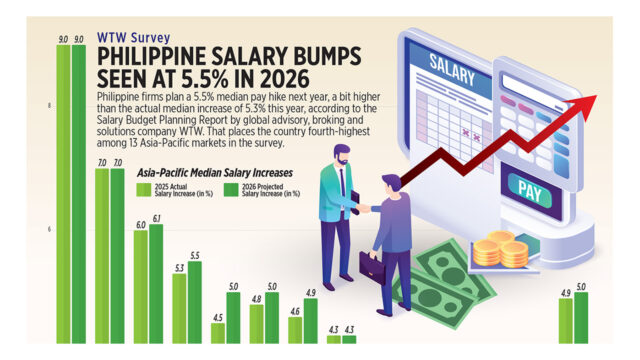
WTW Survey: Philippine salary bumps seen at 5.5% in 2026

PHILIPPINE EMPLOYERS expect to see a decline in their salary budgets in 2026, which could affect potential pay hikes for private sector workers, global advisory firm WTW said. Read the full story.

WTW Survey: Philippine salary bumps seen at 5.5% in 2026

SEC cautions investors against Fortune Wave

SEC.GOV.PH

THE Securities and Exchange Commission (SEC) has issued an advisory on Fortune Wave over investment solicitations allegedly made without proper registration.

Fortune Wave Solution Hub OPC, Fortune Wave Trading, and Fortune Wave Trading PH are not authorized to solicit investments from the public, in violation of Republic Act No. 8799 or the Securities Regulation Code (SRC), the SEC said in an advisory dated July 28 on its website.

The three entities were found to be offering investment schemes that promise returns of 3% up to 330%, depending on the initial investment, the SEC said.

The SEC said that Fortune Wave Solution Hub OPC is registered as a one-person corporation with the commission but has not registered any securities offerings.

On the other hand, Fortune Wave Trading and Fortune Wave Trading PH are not SEC-registered corporations, it said.

The SEC noted that the investment schemes of the entities show signs of a Ponzi scheme, where returns to early investors are sourced from the capital contributed by subsequent investors rather than from legitimate business activities.

“The commission hereby strongly advises the public to desist from investing, whether directly or indirectly, in any investment scheme being offered by the above-named entities or by any other persons or entities operating under the same or similar arrangements,” the advisory said.

“The public is likewise enjoined to exercise heightened vigilance and due diligence when dealing with solicitations for investment, especially those involving unrealistically high returns with minimal risk,” it added.

Under the SRC, securities must not be sold or offered without a registration statement filed with and approved by the SEC. — Revin Mikhael D. Ochave

IC sets transition period for MBAs’ adoption of updated frameworks

THE INSURANCE Commission (IC) has set a transition period for mutual benefit associations’ (MBA) adoption of the new financial reporting and risk-based capital frameworks and reserve valuation standards.

“To assess the quantitative impact of the new regulatory frameworks, the MBAs shall be subject to a transition period for the conduct of parallel runs on the adoption of the new Financial Reporting Framework, valuation of policy reserves, and the Risk-Based Capital (RBC) Framework,” the IC said in a circular dated July 28.

Based on the schedule, MBAs will have to submit by Oct. 30 the regulatory requirements covering periods with cut-off dates as of Dec. 31, 2024 and as of June 30, 2025.

Meanwhile, all requirements for the period ending Dec. 31, 2025 will need to be turned in by June 30, 2026.

IC Circular Letter (CL) No. 2022-24 dated May 19, 2022 prescribed the new Financial Reporting Framework for MBAs, which aligned the economic valuation of assets and liabilities with international accounting and actuarial standards, as well as core insurance principles.

Under these guidelines, MBAs were required to use the new framework in their standard chart of accounts, which shall be in accordance with the current Philippine Financial Reporting Standards (PFRS), starting this year.

Meanwhile, CL No. 2025-12 dated May 15, 2025 provided the updated valuation standards for MBAs, requiring that policy reserves for both basic and optional life insurance coverages be determined at the end of each valuation period.

Policy reserves are dues that MBAs are required to collect from its members, which are used for the payment of claims or obligations. Under the circular, MBAs are required to compute their required reserves using gross premium valuation.

Lastly, CL No. 2025-15 dated July 28 introduced the amended Risk-Based Capital Framework for MBAs, incorporating new accounts and their corresponding RBC factors, ensuring alignment and consistency with the updated reporting standards.

The latest circular amends guidelines issued in 2006.

The MBA sector’s total contributions or premiums rose by 2.89% year on year to P3.99 billion as of end-March, latest IC data showed.

The industry’s net income grew by 7.09% year on year to P15.3 billion in the first quarter. — AMCS

Palo Alto Networks in talks to buy CyberArk in deal worth over $20 billion, WSJ reports

PALO ALTO Networks is in talks to acquire CyberArk Software in a deal that could value the Israeli cybersecurity firm at more than $20 billion, the Wall Street Journal (WSJ) reported on Tuesday, citing people familiar with the matter.

Shares in CyberArk rose about 13%, while Palo Alto Networks’ stock fell roughly 2%.

The Santa Clara, California-based company could finalize a deal for CyberArk as soon as later this week, the report said.

CyberArk declined to comment on the report when contacted by Reuters. Palo Alto did not immediately respond.

Cybersecurity deal activity has been robust in recent years as large corporations have increased spending on security tools.

Google-parent Alphabet said in March it would buy Israeli cybersecurity startup Wiz for about $32 billion.

Rising competition among all-in-one cybersecurity platforms has reshaped the industry, making several companies attractive takeover targets for larger rivals and private equity firms.

As of Monday’s close, CyberArk had a market capitalization of $19.3 billion, according to data compiled by LSEG. Reuters

Inertia

STOCK PHOTO | Image by Snowing from Freepik

REFORM is often associated with change and usually overturning the status quo. The underlying assumption is that an organization needs fixing, shaking it up by rearranging the boxes and dispensing with certain incumbents. Change is presumed to result in a different power structure.

Implementing change must often deal with resistance. The more radical the change, the stronger the pushback. Maintaining the status quo has a powerful appeal, especially to the ruling class and vested interests. In every organization, a powerful block that considers change a disruptive force is bent on undermining the moves for a new order. (If we move towards digital transformation, what do we do with all the office furniture?)

In physics, the law of inertia dictates that an object naturally resists change in its state of motion. So, when it is at rest, it tends to stay that way, unless shoved or pushed. This tendency to stay put applies to organizations too.

The response to a change initiative may be first to shrug it off — we already tried that before. This routine dismissal of any attempts at reform rests on the presumption of naiveté on the part of the proponent, a kind of “eager beaver” enthusiasm that is going nowhere.

The claim of having already tried the change being proposed is a favorite tactic for resisting change, especially if it failed miserably before. Change agents, especially those just taking over a company, quickly recognize the looming challenge of indifference.

Change agents first offer a new vision for incumbents to buy into. Workshops for new vision/mission statements are conducted. (Are there any senior executives in attendance?) They show charts and a picture of paradise after the changes are implemented. When all this winning over of incumbents fails, are more drastic measures in the works? Getting rid of resisters through job redundancy and offers of early retirement are studied.

Among management gurus and consultants, it is the change agent who is projected as a super-hero battling traditionalists. Purveyors of change are acclaimed as visionaries, turnaround artists, shifters of paradigms, and innovative spirits.

If those advocating change are cast as heroes, guess who the villains are.

Resisting change is seen as reactionary and even old-fashioned. (We must go with the times.) Those who resist are characterized as dinosaurs that are doomed to extinction.

The warnings of the opponents of change are dismissed as attempts to hang on to power. Of course, entrenched interests won’t buy into a move to eliminate their costly jobs, expressed in headcount reduction to achieve higher revenues with lower overhead. Still, the challenge to fight through this corporate inertia can be overwhelming. It ends up as a crusade against everything that is traditional — so, we don’t serve coffee with milk anymore?

Then the inertia of a body in motion goes the other way. The innovation, once it gets going, can no longer be easily slowed down. It has its own momentum. The organization just keeps moving in the same direction of blowing down all the processes and structures that are in its way. (There goes the pantry.)

Under a new management, especially one that is hired to shake things up, there is an implicit sub-text to leave no traditional thinkers. Anything less than enthusiasm from the natives is considered a protest movement. The missionary zeal takes over.

Is it possible for the change agent to move slowly and take a gradual approach? Little changes, even just symbolic ones, like joining the horde in the canteen for lunch or coming to work early and walking around the office to fetch a cup of coffee, may go a longer way in introducing a new culture. This gradualism can elicit broader support from potential resisters. Or it may achieve nothing.

Every change agent will understand that there are some things that need to be left alone. There are values like customer care that should remain unchanged except for further enhancement. Resistance to change may just reflect a passion for how things ought to be.

When change management is successful, a new power structure emerges. These new leaders then become the defenders of what they have achieved. This new status quo will stay in place…until a new change agent is put in charge.


Tony Samson is chairman and CEO of TOUCH xda

ar.samson@yahoo.com

Women-only US dating advice app Tea suspends messaging following breaches

PLAY.GOOGLE.COM

WASHINGTON — The women-only US dating advice app Tea has suspended direct messaging following a series of security breaches that exposed its users’ personal details and sensitive communications, the company said on Tuesday.

In a series of posts to TikTok, Tea Dating Advice said it had taken messaging offline “out of an abundance of caution” after discovering the breach. The announcement followed a report last week in tech publication 404media that the company had inadvertently exposed the names, selfies, and identity documents of thousands of women, and a second report earlier on Tuesday that direct messages — including sensitive conversations around abortions and infidelity — had similarly been exposed.

The app — which boasts 4.6 million users — is pitched as a “dating safety platform” that women can use to steer clear of men who are adulterous, dishonest, or worse. As a TikTok video put out by the company last year put it, the app “makes the FBI work for us girlies so much easier.”

Women on Tea are encouraged to share details about prospective dates, create alerts against men’s names, and put red flags against men who are alleged to be unscrupulous and green flags against those who are not. “Everything is anonymous,” the app promises users on sign-up. Reuters could not establish why the selfies and ID card data had lingered online.

Tea did not respond to requests seeking further comment. In its TikTok message, the app said the FBI was investigating the circumstances around the breach. The FBI declined to comment.

Eva Galperin, the director of cybersecurity at San Francisco-based Electronic Frontier Foundation, said the premise behind the app — creating a kind of massive whisper network powered by anonymous users — was already “a little bit sketchy.” She said the app’s makers had made it worse by being “honestly negligent” about their security and that the disaster was compounded because “women are encouraged to share extremely sensitive information about themselves and others.” — Reuters

How PSEi member stocks performed — July 30, 2025

Here’s a quick glance at how PSEi stocks fared on Wednesday, July 30, 2025.


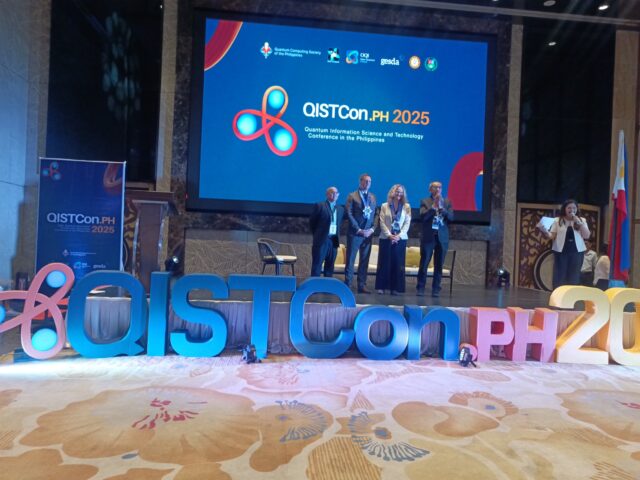
PH’s quantum tech has ‘big’ potential with involvement of youth

Photo by Edg Adrian A. Eva

As the Philippines ramps up efforts in quantum technology, experts urge Filipino youth to explore the field, saying they are the key to positioning the country as a future global leader.

Among the latest initiatives is the development of a scaled-down quantum computer, intended to ignite the curiosity of young Filipinos, according to Dr. Enrico C. Paringit, executive director of the Philippine Council for Industry, Energy and Emerging Technology Research and Development (PCIEERD).

“We do not have a quantum computer — a full-scale quantum computer as they would like to see it… (But) we’re going to unveil a modest version of it, just to probably stir up interest, especially among our younger generation,” Mr. Paringit told reporters at the first day of Quantum Information, Science, and Technology Conference held in Mactan City , Cebu.

“We do have great potential because of our large population. We have potential if we train and educate our youth properly and stir up their interest to pursue a career in… quantum science and innovation,” he added.

As quantum technology remains in its early stages, Mr. Paringit also called for the field’s integration into the academic curriculum to help raise awareness of its developments and potentially encourage students to pursue it as a career.

Mr. Paringit also guaranteed that researchers and contributors in the field will receive support from PCIEERD, potentially enabling the emergence of niche quantum industries in the country.

Bobby O. Corpus, President of the Quantum Computing Society of the Philippines (QCSP), said that sectors such as agriculture, healthcare, banking, and finance stand to benefit the most from quantum technology—essentially spanning nearly all industries.

“It’s a paradigm shift,” Mr. Corpus said. “Anything that requires optimization will benefit.”
Among the other significant developments in quantum technology in the country is the establishment of a P59-million quantum innovation laboratory, which enables researchers to collaborate.

In March, the country’s first research laboratory dedicated to using quantum computing to ensure a reliable and efficient energy supply—named Quantum Computing-based Forecasting and Optimization Applied to Electric Power Grid (QRIEnTE)—was also launched, with a funding of P18 million.

Meanwhile, Department of Science and Technology (DOST) Secretary Dr. Renato U. Solidum, Jr. reaffirmed during his speech that quantum technology is among the key focus areas under the agency’s eight flagship research and development (R&D) programs.

He added that by 2030, the country aims to leverage quantum technology for innovation and economic growth, as outlined in the 2022–2028 Quantum R&D Roadmap.

“This roadmap commits us to establishing a robust national quantum network,” Mr. Solidum said, “positioning our archipelago as a central player in Southeast Asia for quantum-enabled industries and research.” — Edg Adrian A. Eva

DepEd launches ten-year plan to improve learning quality

PHILIPPINE STAR/WALTER BOLLOZOS

By Almira Louise S. Martinez, Reporter

The Department of Education (DepEd) launched the Quality Basic Education Development Plan (QBEDP) 2025-2035 on Tuesday, aiming to improve the quality of learning among Filipino students.

“Ito na yung operationalization nung ating [This is the operationalization of our] five-point reform agenda ,” DepEd Assistant Secretary for Strategic Management Roger B. Masapol told reporters.

Mr. Masapol added that the ten-year roadmap aligns with the Basic Education Development Plan (BEDP) released in 2022 and the five-point reform agenda in 2024.

“BEDP is also a long-term plan that articulates what to reform,” he said in Filipino. “Meanwhile, the Quality Basic Education Development Plan articulates how to reform.”

The QBEDP aims to have “basecamps” in 2028, 2031, and 2034 to guide and align the education sector in meeting global benchmarks.

“We all know that we have an ongoing crisis, and our main problem is quality,” Mr. Masapol said. “We want all of our programs and activities aligned towards addressing the quality of basic education.”

The ten-year program aims to improve the learning outcomes and performance of students, especially in international assessments, such as the Program for International Student Assessment (PISA), through three key strategies: decentralization, digitalization, and public-private partnerships.

“We are hoping that we see a substantial improvement in our performance in PISA,” Mr. Masapol said. “At least be at par with Indonesia and Vietnam by 2030.”

President Ferdinand R. Marcos, Jr., in his fourth State of the Nation Address (SONA), underscored the learning crisis evident in the results of the 2022 PISA, with the Philippines ranking 76th out of 81 countries.

“The realities of our youth is very clear to us,” Mr. Marcos said in Filipino. “They lack literacy in mathematics, science, reading, and comprehension.”

According to Education Secretary Juan Edgardo “Sonny” M. Angara, the lack of digital literacy contributed to the low performance of students in the 2022 PISA.

“Students who used a computer for the first time during the PISA exam won’t face that situation again,” Mr. Angara told reporters in an interview. “Because we’ve now trained all students to take exams using a computer.”

The results of the 2025 PISA held from March to April in 208 schools nationwide will be released in September 2026.

Stocks extend slide before Fed, tariff deadline

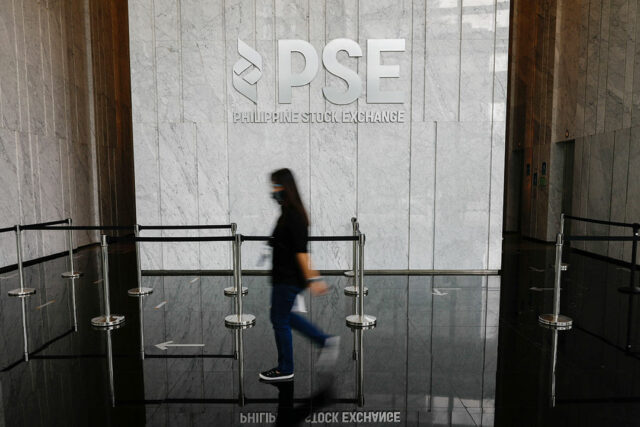
The lobby of the Philippine Stock Exchange in Taguig City, Sept. 30, 2020. — REUTERS

PHILIPPINE SHARES on Wednesday extended their losing streak to a fifth straight session as investors stayed on the sidelines before the US Federal Reserve’s policy decision overnight and the Trump administration’s Aug. 1 tariff deadline.

The benchmark Philippine Stock Exchange index (PSEi) dropped by 0.11% or 7.19 points to close at 6,381.23, while the broader all shares index fell by 0.09% or 3.49 points to 3,776.59.

“The local market declined for a fifth straight day as investors take a cautious stance while dealing with global trade uncertainties as the US’ Aug. 1 tariff negotiations deadline draws near,” Philstocks Financial Inc. Research Manager Japhet Louis O. Tantiangco said in a Viber message. “Investors are also waiting for clues on the Fed’s policy outlook.”

“The PSEi slid down as investors are still watching if there would be still further developments on the upcoming tariff deadline on Aug. 1,” Regina Capital Development Corp. Head of Sales Luis A. Limlingan said in a Viber message. “Moreover, companies are still releasing earnings reports, and this will probably remain as one of the sentiment drivers of the market for the next few weeks.”

The Fed was set to conclude its two-day meeting overnight, where it was widely expected to keep rates unchanged but provide clues on its policy path moving forward.

Meanwhile, ahead of US President Donald J. Trump’s deadline to reach a deal to avert “Liberation Day” tariffs, some countries’ talks with the US looked set to go down to the wire, Reuters reported.

US and Chinese officials agreed to seek an extension of their 90-day tariff truce on Tuesday, though no major breakthroughs were announced.

US officials said it was up to Mr. Trump to decide whether to extend a trade truce that expires on Aug. 12 or potentially let tariffs shoot back up to triple-digits.

Meanwhile, three South Korean cabinet-level officials met with US Commerce Secretary Howard Lutnick in a last-ditch push for a deal.

Most sectoral indices closed lower on Wednesday. Financials sank by 0.58% or 13.18 points to 2,223.13; holding firms declined by 0.33% or 17.97 points to 5,385.81; mining and oil retreated by 0.13% or 11.87 points to 9,082; and services went down by 0.11% or 2.45 points to 2,221.94.

Meanwhile, property increased by 0.6% or 14.17 points to 2,373.59 and industrials climbed by 0.28% or 26.06 points to 9,123.03.

“Ayala Land, Inc. was the day’s index leader, climbing 2.38% to P25.80. Converge ICT Solutions, Inc. was at the tail end, falling 3.14% to P17.90,” Mr. Tantiangco said.

Value turnover dropped to P4.66 billion on Wednesday with 800.01 million shares traded from the P6.86 billion with 1.04 billion shares exchanged on Tuesday.

Decliners beat advancers, 95 versus 87, while 62 names were unchanged.

Net foreign selling went down to P57.49 million on Wednesday from P429.15 million on Tuesday. — Revin Mikhael D. Ochave with Reuters

EDSA rehab start pushed back to 2026 or 2027

Motorists are stuck in traffic along ESDA in Cubao, Quezon City, Nov. 7, 2023. — PHILIPPINE STAR/MIGUEL DE GUZMAN

By Ashley Erika O. Jose, Reporter

REHABILITATION WORK on Epifanio de los Santos Avenue (EDSA), Metro Manila’s main circumferential road, is now expected to start as late as 2027, the Department of Public Works and Highways (DPWH) said.

“It is not feasible anymore to begin the project this year (due to the rains). We can do this maybe next year or even 2027,” Public Works Secretary Manuel M. Bonoan told reporters on the sidelines of the post-State of the Nation Address briefings on Wednesday.

The rehabilitation of EDSA was initially set to begin on June 13 with completed expected by 2027. However, President Ferdinand R. Marcos, Jr. ordered the suspension of the project, citing the need for further study and to reduce its expected impact on commuters, motorists, and broader economic activity. Mr. Marcos also instructed his officials to look into the possibility of shortening the project’s duration.

Mr. Bonoan said another consideration arguing against a 2025 start date is the expected hosting of the Association of Southeast Asian Nations Summit in 2026.

Nigel Paul C. Villarete, senior adviser on public-private partnerships at the technical advisory group Libra Konsult, Inc., said it is not advisable to further delay projects as massive as the EDSA rebuild.

“Economic costs increase over time, much more if it involves a delay of economic benefits which are crucial in transport infrastructure,” Mr. Villarete said.

Rene S. Santiago, former president of the Transportation Science Society of the Philippines said traffic would be worse in 2027.

“It merely postpones the pain,” he added.

A 2018 Japan International Cooperation Agency study estimated the economic cost of road congestion in Metro Manila at around P3.5 billion per day.

“It will always be more difficult to do infrastructure when you postpone, especially in transport since demand and volume always increases over time,” Mr. Villarete said.

The DPWH has a best-case estimate of 6 months for rehabilitating EDSA and noted the possibility of coming in under the initially estimated cost of P15 billion.

The Department of Transportation has said that it is working with other agencies to assess options for expediting the rehabilitation, including innovative construction methods that promise shorter completion times over conventional methods.

Government ready to take over power generation in Siquijor

PHILSTAR FILE PHOTO

THE GOVERNMENT signaled its readiness to take over Siquijor Island Power Corp. (Sipcor), the province’s sole power generator, if Sipcor proves unable to deliver continuous power, energy officials said.

“If we can prove that Sipcor can no longer manage, then by all means, I would strongly suggest, and I’m sure my Secretary will agree with me, we should exercise police power to take over operations,” Antonio Mariano C. Almeda, administrator of the National Electrification Administration (NEA), said during the post-State of the Nation Address (SONA) briefings on Wednesday.

Siquijor was placed under a state of calamity in June due to the deteriorating power situation.

According to the Department of Energy (DoE) Electric Power Industry Management Bureau, Sipcor’s capacity is 11.58 megawatts (MW), but only 8.816 MW is being contracted to the Provincial Electric Cooperative of Siquijor.

In his fourth SONA, President Ferdinand R. Marcos, Jr. ordered NEA, the DoE, and the Energy Regulatory Commission to resolve electricity crisis in Siquijor before the end of the year.

Mr. Marcos said that initial investigations showed that Sipcor has “expired permits, broken generators that were clearly neglected, slow response times, and the lack of a system for purchasing fuel and spare parts.”

Energy Secretary Sharon S. Garin reported violations on Sipcor’s part in terms of its ability to maintain an adequate number of generator sets.

“I think we’ve been quite lenient because we’ve been giving chances over and over again. Even in finding those gensets, we’ve been helping look for solutions — but now, we’re back to where we started,” she said.

Mr. Almeda also said that NEA is tapping third-party surveyors composed of engineers from the University of the Philippines to “evaluate the viability of whether or not (Sipcor) can still continue to perform its obligations.”

“If we are not convinced that they can still continue according to the provisions of the contract, and I believe contractual obligations should always give way to the interest of public welfare, and that’s the time that the government will step in,” he said. — Sheldeen Joy Talavera

ADVERTISEMENT
ADVERTISEMENT