Home Blog Page 1185

Tsunami waves reach Hawaii after big quake rattles Russia’s Far East
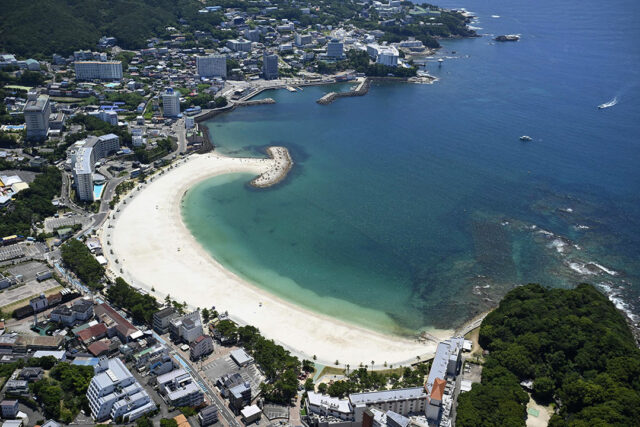
PHOTO TAKEN from a Kyodo News helicopter shows a deserted bathing beach in Shirahama in the western Japanese prefecture of Wakayama on July 30, after the Japan Meteorological Agency issued a tsunami warning for the country’s Pacific coast following a powerful earthquake off Russia’s Kamchatka Peninsula. — KYODO/VIA REUTERS

A POWERFUL magnitude 8.8 earthquake off Russia’s Far Eastern Kamchatka Peninsula triggered tsunami waves of up to 5 meters (16 feet) nearby and sparked evacuation orders as far away as Hawaii and across the Pacific on Wednesday.

The shallow earthquake damaged buildings and injured several people in the remote Russian region, while much of Japan’s eastern seaboard — devastated by a 9.0 magnitude earthquake and tsunami in 2011 — was ordered to evacuate.

A resident in the city of Petropavlovsk-Kamchatsky said the shaking went on for several minutes.

“I decided to leave the building,” said Yaroslav, 25. “It felt like the walls could collapse any moment. The shaking lasted continuously for at least 3 minutes.”

Video footage released by the region’s health ministry showed a team of medics in Petropavlovsk-Kamchatsky performing surgery as the tremors shook their equipment and the floor beneath them.

Tsunami waves struck parts of Kamchatka, partially flooding the port and a fish processing plant in the town of Severo-Kurilsk and sweeping vessels from their moorings, regional officials and Russia’s emergency ministry said.

Verified drone footage showed the town’s entire shoreline was submerged, with taller buildings and some storage facilities surrounded by water, which was seen pouring back into the sea.

“Today’s earthquake was serious and the strongest in decades of tremors,” Kamchatka Governor Vladimir Solodov said in a video posted on the Telegram messaging app. Russian scientists said it was the most powerful to hit the region since 1952.

In Hawaii, waves of up to 1.7 meters (5.5 feet) impacted the islands before the Pacific Tsunami Warning Center reduced its warning level for the state around 0850 GMT, saying no major tsunami was expected.

Coastal residents were earlier told to get to high ground or the fourth floor or above of buildings, and the US Coast Guard ordered ships out of harbors.

Flights out of Honolulu airport resumed later, the transportation department said, while the main airport in Maui remained closed with passengers sheltering in the terminal.

Tsunami waves of nearly half a meter were observed as far as California, with smaller ones reaching Canada’s province of British Columbia.

WARNINGS ACROSS THE PACIFIC
The US Geological Survey said the earthquake was shallow at a depth of 19.3 kilometers (12 miles), and centered 119 kilometers (74 miles) east-southeast of Petropavlovsk-Kamchatsky, a city of 165,000.

Tsunami alarms sounded in coastal towns across Japan’s Pacific coast and evacuation orders were issued for tens of thousands of people.

Workers evacuated the stricken Fukushima nuclear plant, where a meltdown following the 2011 tsunami caused a radioactive disaster, operator TEPCO said.

Footage on public broadcaster NHK showed scores of people on the northern island of Hokkaido on the roof of a building, sheltering under tents from the sun, as fishing boats left harbors to avoid any damage from incoming waves.

Broadcaster Asahi TV reported a 58-year-old woman died when her car fell off a cliff while she was evacuating in central Japan’s Mie prefecture.

Automaker Nissan Motor suspended operations at some factories in Japan to ensure employee safety, Kyodo news agency reported.

Three tsunami waves had been recorded in Japan, the largest of 1.3 meters (4.3 feet), officials said.

Chief Cabinet Secretary Yoshimasa Hayashi said no injuries or damage had been reported, and there were no irregularities at any nuclear plants.

Tsunami waves of 1 to 3 meters (3-9 feet) can be fatal for people who are swept away, said NHK.

The US Tsunami Warning System said waves of more than 3 meters were possible along some coasts of Russia, the northern Hawaiian islands and Ecuador, while waves of 1-3 meters were possible in countries including Japan, Hawaii, Chile and the Solomon Islands.

‘RING OF FIRE’
Russia’s Ministry for Emergency Services said on Telegram that a kindergarten was damaged but most buildings withstood the quake. No serious injuries or fatalities have been reported.

Several people in Kamchatka sought medical assistance following the quake, Oleg Melnikov, regional health minister, told Russia’s TASS state news agency.

In Severo-Kurilsk in the northern Kuril islands, south of Kamchatka, tsunami waves exceeded 3 meters, with the largest up to 5 meters, Russia’s RIA news agency reported.

Alexander Ovsyannikov, the town’s mayor, urged residents to assess damage to their homes and not to use gas stove heating until inspections had been carried out.

Kamchatka and Russia’s Far East sit on the Pacific Ring of Fire, a geologically active region that is prone to earthquakes and volcanic eruptions.

“However, due to certain characteristics of the epicenter, the shaking intensity was not as high… as one might expect from such a magnitude,” said Danila Chebrov, director of the Kamchatka Branch of the Geophysical Service, on Telegram.

“Aftershocks are currently ongoing… Their intensity will remain fairly high. However, stronger tremors are not expected in the near future. The situation is under control.” — Reuters
Trump’s ‘napkin’ trade deals are a worry for SE Asia, analyst says

BW FILE PHOTO

NATIONS and businesses need to remain prepared for challenging impacts from US tariffs after next month’s deadline for trade deals, as agreements struck so far are short on firm details or commitments, according to a key policy watcher.

“I’ve been calling them napkin deals, because I think they are about as durable as a paper napkin and they’re about as well specified as you could write on a paper napkin,” Deborah Elms, head of trade policy of the Hinrich Foundation told the Bloomberg Sustainable Business Summit in Singapore on Wednesday.

Duties set at 15% would remain “significantly higher than we had in March,” and will present difficulties “for a lot of companies and particularly for small businesses that are trying to navigate with fairly thin margins,” Ms. Elms said. For Southeast Asia specifically, uneven tariff rates are likely to “create challenges for supply chains,” she said.

President Donald J. Trump’s blizzard of recent trade deal announcements have faced criticism for lacking specifics, with key aspects of some agreements still under negotiation. The precise details of promised major investments by counterparties also remain uncertain, including large pledges by the European Union and Japan.

India may be hit with a tariff rate of 20% to 25%, though a final levy had still not been settled on as the countries negotiate ahead of an Aug. 1 deadline, Mr. Trump said Tuesday. The US and China will continue talks over maintaining a tariff truce before it expires in two weeks, and Mr. Trump will make the final call on any extension, Treasury Secretary Scott Bessent said after meetings in Stockholm with Chinese officials.

Concerns over trade are also adding to uncertainty over investments and hampering efforts on climate action, Ms. Elms said. Global investments into climate technology firms by venture capitalists and private equity firms declined 10% in the first quarter from a year ago, according to data from market intelligence firm PitchBook.

‘PANIC MODE’
“Many companies are in a bit of a panic mode,” Ms. Elms said. “We will continue in the general direction, but it is not gonna be as smooth a process as we might have imagined in December.”

Even so, for many businesses, long-term commitments to lower emissions are an area of certainty in an otherwise uncertain global environment, Mary Ng, the former Canadian minister for international trade, told the summit.

“While there isn’t that intense activity around accelerating ESG, I wouldn’t even say that it’s a pause,” said Ms. Ng, who stepped down in March ahead of Canada’s election. “All the companies that I’ve been talking to have not stopped the work of looking through their supply chain with ESG in mind because that is just where the puck is going.” — Bloomberg

Britain warns Israel it could recognize Palestinian state as Gaza starvation spreads

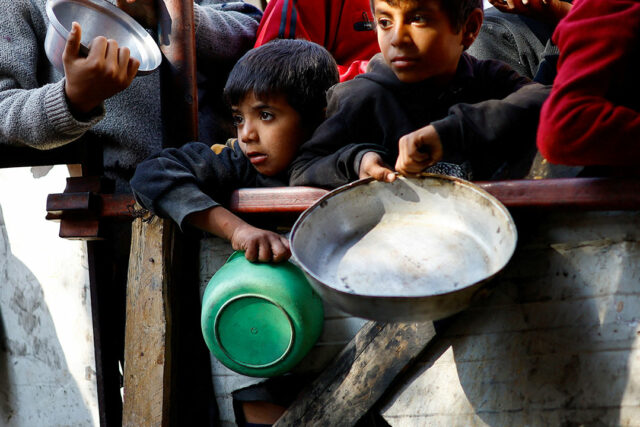
PALESTINIANS wait to receive food cooked by a charity kitchen amid shortages of food supplies in Rafah in the southern Gaza Strip, Jan. 16, 2024. — REUTERS

UNITED NATIONS/LONDON — Britain said on Tuesday it would recognize a Palestinian state in September unless Israel takes steps to relieve suffering in Gaza, where starvation is spreading, and reaches a ceasefire in the nearly two-year war with Hamas.

The warning, which drew a harsh Israeli rebuke, came after a hunger monitor said a worst-case scenario of famine is unfolding and immediate action is needed to avoid widespread death. Palestinian authorities said more than 60,000 Palestinians were now confirmed killed by Israel’s assault on the Gaza Strip.

The hunger alert and the new death toll are grim milestones in the current conflict that began in October 2023 when Hamas attacked Israel, sparking an offensive that has flattened much of the enclave and ignited hostilities across the Middle East.

The alert by the Integrated Food Security Phase Classification (IPC) raised the prospect that the starvation crisis in Gaza could be formally classified as a famine, in the hope that this might raise the pressure on Israel to let in far more food.

British Prime Minister Keir Starmer’s warning heightens pressure on Israel amid an international outcry over its conduct of the war. France announced last week it would recognize Palestinian statehood in September, a move that enraged the Israeli government.

Israeli Prime Minister Benjamin Netanyahu said in a post on X that Mr. Starmer’s decision “rewards Hamas’ monstrous terrorism & punishes its victims,” adding that “A jihadist state on Israel’s border TODAY will threaten Britain TOMORROW.”

US President Donald J. Trump said he did not discuss Britain’s plans on Palestinian statehood during talks with Mr. Starmer in Scotland on Monday, when he told reporters he did “not mind” if Britain made such a move.

But on Tuesday he said aboard Air Force One that he did not think Hamas “should be rewarded” with recognition of Palestinian independence.

Palestinian President Mahmoud Abbas described Starmer’s decision as “bold,” according to Palestinian state news agency WAFA.

Mr. Starmer told his cabinet that Britain would recognize Palestinian statehood at the United Nations (UN) General Assembly in September “unless the Israeli government takes substantive steps to end the appalling situation in Gaza, reaches a ceasefire, makes clear there will be no annexation in the West Bank, and commits to a long-term peace process that delivers a two-state solution,” his government said.

The move, if carried through, would be mostly symbolic, with Israel occupying the territories where the Palestinians have long aimed to establish that state in the West Bank and the Gaza Strip with East Jerusalem as its capital.

It makes Israel more isolated on the international stage as a growing number of countries call for it to allow unfettered aid into Gaza, where it controls all entry and exit points to the besieged coastal territory.

However, Mr. Trump’s administration — Israel’s closest and most influential ally — has made clear it has no intention of joining others in recognizing Palestinian statehood anytime soon. Since returning to office in January, Mr. Trump has been vague about whether or not he would support an eventual Palestinian state.

Mr. Starmer held separate phone calls with Mr. Netanyahu and Mr. Abbas on Tuesday before making his announcement.

EVIDENCE OF STARVATION
With the international furor over Gaza’s ordeal growing, Israel announced steps over the weekend to ease aid access. But the UN World Food Programme said on Tuesday it was not getting the permissions it needed to deliver enough aid since Israel began humanitarian pauses in warfare on Sunday.

“Mounting evidence shows that widespread starvation, malnutrition and disease are driving a rise in hunger-related deaths,” the IPC said, adding that “famine thresholds” have been reached for food consumption in most of Gaza.

It said it would quickly carry out the formal analysis that could allow it to classify Gaza as “in famine.”

Gaza health authorities have been reporting more and more people dying from hunger-related causes. The total stands at 147, among them 88 children, most of whom died in the last few weeks.

Images of emaciated Palestinian children have shocked the world, with Israel’s strongest ally Mr. Trump declaring that many people were starving. He promised to set up new “food centers.”

Israel has denied pursuing a policy of starvation. Foreign Minister Gideon Saar said on Tuesday that the situation in Gaza was “tough” but there were lies about starvation there.

DEADLIEST CONFLICT
The Gazan casualty figures, which are often cited by the UN and have previously been described as reliable by the World Health Organization, underline the war as the deadliest involving Israel since its establishment in 1948.

Israel launched its offensive in response to Hamas’ cross-border attack on Oct. 7, 2023, when militants killed some 1,200 people and took another 251 hostage — Israel’s deadliest ever day. Since Israel launched ground operations in Gaza in October 2023, 454 soldiers have been killed.

The new Palestinian toll does not distinguish between fighters and civilians. Thousands more bodies are believed to be buried under rubble, meaning the true toll is likely to be significantly higher, Palestinian officials and rescue workers say.

Israeli airstrikes overnight killed at least 30 Palestinians in Nuseirat camp in central Gaza, Gaza health authorities said. Doctors at Al-Awda Hospital said at least 14 women and 12 children were among the dead.

The hospital also said that 13 people had been killed and dozens wounded by Israeli gunfire along the Salahudeen Road as they waited for aid trucks to roll into Gaza.

Mr. Saar said 5,000 aid trucks had entered Gaza in the last two months, and that Israel would assist those wanting to conduct airdrops — a delivery method that aid groups say is ineffective and a token.

Israel and the US accuse Hamas of stealing aid — which the militants deny — and the UN of failing to prevent it. The UN says it has not seen evidence of Hamas diverting much aid. Hamas accuses Israel of causing starvation and using aid as a weapon. — Reuters

Trump approval rating sinks to 40%, the lowest of his term, Reuters/Ipsos poll finds

REUTERS

WASHINGTON — US President Donald J. Trump’s approval rating dropped one percentage point to 40%, the lowest level of his second term in office, as Americans remained concerned about his handling of the economy and immigration, a Reuters/Ipsos poll found.

The three-day poll, which closed on Monday, surveyed 1,023 US adults nationwide and had a margin of error of 3 percentage points. It showed a nation deeply polarized over Mr. Trump, with 83% of Republicans and just 3% of Democrats approving of his performance. About one-third of independents approved.

Mr. Trump had a 41% approval rating in Reuters/Ipsos’ most recent prior poll, conducted on July 15 and 16.

The Republican campaigned on promises to supercharge the US economy and crack down on immigration, and the poll found that Americans gave him mixed marks on both those areas, where his administration is using aggressive tactics.

Some 38% of respondents approved of Mr. Trump’s handling of the economy, up from 35% approval in the mid-July poll. His numbers were also up slightly on immigration, with 43% of respondents approving, compared with 41% in the earlier poll.

All the shifts were within the poll’s margin of error. — Reuters

m360 earns ISO 27001 Certification, joins list of  Mandaluyong’s Top 10 corporate taxpayers

m360, Inc., one of the country’s leading enterprise communications providers, continues to drive innovation, strengthen security, and uphold operational excellence while contributing to the country’s economic growth.

The Globe subsidiary recently achieved ISO/IEC 27001:2022 certification and was named one of Mandaluyong City’s Top 10 Corporate Taxpayers for 2024.

Conducted by QAS International, the ISO certification specifically validates m360’s comprehensive information security management system, robust risk management framework, systematic approach to handling sensitive company and customer data, and commitment to continuous improvement in security practices.

“This ISO certification proves our unwavering commitment to protecting our clients’ data and communications while delivering innovative solutions that drive business growth. As businesses face mounting challenges in managing multiple communication platforms, m360 continues to invest in security frameworks that provide peace of mind,” said President & CEO Ramon Hirang.

This achievement comes as organizations seek reliable partners to simplify and secure their communication systems. At the same time, digital interactions are becoming vital to business in the Philippines, with 71% of Filipinos using messaging apps to connect with companies.

Since its launch in January 2022, m360 has emerged as a comprehensive Communications Platform as a Service (CPaaS) provider, delivering advanced, integrated solutions backed by strong security standards.

m360’s certified security framework underpins its full suite of services, including advanced A2P messaging with fraud management, multi-channel communication via SMS, Viber, Meta platforms, Email, and Hyper-targeted SMS, as well as My360’s customizable messaging plans.

Powered by a unified One API, these services simplify integration and management, allowing businesses to streamline communications efficiently. m360 also offers the Hummingbird omnichannel platform to support conversational commerce.

In parallel with its operational achievements, m360 was recognized by Mandaluyong City as one of its Top 10 Corporate Taxpayers for 2024. The award was conferred during a recent ceremony led by Mayor Ben Abalos and city officials.

m360 was the only technology firm honored, operating with fewer than 100 employees. It received a city seal plaque in recognition of its substantial contribution to the city’s growth and development.

“Being recognized among Mandaluyong’s top taxpayers, alongside companies that have been pillars of Philippine industry for decades, shows that technology companies can make substantial economic contributions while maintaining lean operations. This achievement reflects our commitment to both innovation and corporate responsibility,” said Hirang.

As it builds on these twin milestones, m360 is expanding its secure, integrated communication platforms to support enterprise growth and contribute to local development.

For more information, visit www.m360.com.ph or follow on www.linkedin.com/company/m360-ph and www.facebook.com/m360ph.


Spotlight is BusinessWorld’s sponsored section that allows advertisers to amplify their brand and connect with BusinessWorld’s audience by publishing their stories on the BusinessWorld Web site. For more information, send an email to online@bworldonline.com.

Join us on Viber at https://bit.ly/3hv6bLA to get more updates and subscribe to BusinessWorld’s titles and get exclusive content through www.bworld-x.com.

Remulla blames Metro Manila’s waste woes on decades of poor planning

PHILIPPINE STAR/ MICHAEL VARCAS
Metro Manila’s perpetual waste problem, made evident once again by the recent flooding, can be blamed on decades of poor planning in solid waste management, Interior Secretary Juanito Victor “Jonvic” C. Remulla said on Tuesday.
During the post-State of the Nation Address discussion, Mr. Remulla made this remark, citing the capital’s lack of a cohesive and unified plan for how local government units (LGUs) should dispose of their solid waste.
“Mayroon tayong nagtatambak sa Rizal; mayroon tayong nagtatambak sa Quezon City; mayroong nagtatambak hanggang Capas, Tarlac [We have some cities dumping in Rizal; some in Quezon City; and even some as far as Capas, Tarlac],” Mr. Remulla said.
“Dahil sa inefficient ang planning natin in the last 30 years sa solid waste management, ang mga local government units ngayon ay nahihirapan sa collection system [Because our planning for solid waste management over the past 30 years has been inefficient, local government units are now struggling with the collection system],” he added.
The Interior Secretary also said that due to poorly coordinated waste disposal, garbage trucks face difficulties accessing dump sites, as each area they traverse enforces its own restrictions.
“Dapat diyan kasi mayroon tayong systematic approach na east, west, north and … sa buong [We need a systematic approach that east, west, north, and the whole] Metro Manila and south,” Mr. Remulla said.
He also emphasized the need to revisit the Local Government Code of 1991 to establish a more integrated approach to waste management, rather than a fragmented system where each LGU is solely responsible for its own waste.
“The wording of the Local Government Code is one of the biggest hindrances for the government in planning waste management, and it’s something we have to revisit,” Mr. Remulla said.
A World Bank report showed that the waste collection rate in Metro Manila is around 60%, lower than in Southeast Asian cities like Jakarta and Bangkok, which are at 70%.
The uncollected portion of the waste, primarily plastics, usually ends up in rivers and waterways, indicating a lack of efficient collection systems in the country’s capital, the report also said.
Mr. Remulla called for improved regulations on waste collection to better mobilize barangays and municipalities.
On Friday, he added that Metro Manila mayors are scheduled to meet to discuss the institutionalization of disciplinary measures for individuals caught littering. – Edg Adrian A. Eva

IMF nudges up 2025 growth forecast but says tariff risks still dog outlook

THE International Monetary Fund (IMF) logo is seen outside the headquarters building in Washington, U.S. — REUTERS

USThe International Monetary Fund on Tuesday raised its global growth forecasts for 2025 and 2026 slightly, citing stronger-than-expected purchases ahead of an August 1 jump in US tariffs and a drop in the effective US tariff rate to 17.3% from 24.4%.

It warned, however, that the global economy faced major risks including a potential rebound in tariff rates, geopolitical tensions and larger fiscal deficits that could drive up interest rates and tighten global financial conditions.

“The world economy is still hurting, and it’s going to continue hurting with tariffs at that level, even though it’s not as bad as it could have been,” said Pierre-Olivier Gourinchas, IMF chief economist.

In an update to its World Economic Outlook from April, the IMF raised its global growth forecast by 0.2 percentage point to 3.0% for 2025 and by 0.1 percentage point to 3.1% for 2026. However, that is still below the 3.3% growth it had projected for both years in January and the pre-pandemic historical average of 3.7%.

It said global headline inflation was expected to fall to 4.2% in 2025 and 3.6% in 2026, but noted that inflation would likely remain above target in the US as tariffs passed through to US consumers in the second half of the year.

The US effective tariff rate – measured by import duty revenue as a proportion of goods imports – has dropped since April, but remains far higher than its estimated level of 2.5% in early January. The corresponding tariff rate for the rest of the world is 3.5%, compared with 4.1% in April, the IMF said.

US President Donald Trump has upended global trade by imposing a universal tariff of 10% on nearly all countries from April and threatening even higher duties to kick in on Friday. Far higher tit-for-tat tariffs imposed by the US and China were put on hold until August 12, with talks in Stockholm this week potentially leading to a further extension.

The US has also announced steep duties ranging from 25%-50% on automobiles, steel and other metals, with higher duties soon to be announced on pharmaceuticals, lumber, and semiconductor chips.

Such future tariff increases are not reflected in the IMF numbers, and could raise effective tariff rates further, creating bottlenecks and amplifying the effect of higher tariffs, the IMF said.

SHIFTING TARIFFS
Gourinchas said the IMF was evaluating new 15% tariff deals reached by the US with the European Union and Japan over the past week, which came too late to factor into the July forecast, but said the tariff rates were similar to the 17.3% rate underlying the IMF’s forecast.

“Right now, we are not seeing a major change compared to the effective tariff rate that the US is imposing on other countries,” he said, adding it was not yet clear if these agreements would last.

“We’ll have to see whether these deals are sticking, whether they’re unravelled, whether they’re followed by other changes in trade policy,” he said.

Staff simulations showed that global growth in 2025 would be roughly 0.2 percentage point lower if the maximum tariff rates announced in April and July were implemented, the IMF said.

The IMF said the global economy was proving resilient for now, but uncertainty remained high and current economic activity suggested “distortions from trade, rather than underlying robustness.”

Gourinchas said the 2025 outlook had been helped by what he called “a tremendous amount” of front-loading as businesses tried to get ahead of the tariffs, but he warned that the stock-piling boost would not last.

“That is going to fade away,” he said, adding: “That’s going to be a drag on economic activity in the second half of the year and into 2026. There is going to be pay-back for that front loading, and that’s one of the risks we face.”

Tariffs were expected to remain high, he said, pointing to signs that US consumer prices were starting to edge higher.

“The underlying tariff is much higher than it was back in January, February. If that stays … that will weigh on growth going forward, contributing to a really lackluster global performance.”

One unusual factor has been a depreciation of the dollar, not seen during previous trade tensions, Gourinchas said, noting that the lower dollar was adding to the tariff shock for other countries, while also helping ease financial conditions.

US growth was expected to reach 1.9% in 2025, up 0.1 percentage point from April’s outlook, edging up to 2% in 2026. A new US tax cut and spending law was expected to increase the US fiscal deficit by 1.5 percentage points, with tariff revenues offsetting that by about half, the IMF said.

It lifted its forecast for the euro area by 0.2 percentage point to 1.0% in 2025, and left the 2026 forecast unchanged at 1.2%. The IMF said the upward revision reflected a historically large surge in Irish pharmaceutical exports to the US; without it, the revision would have been half as big.

China’s outlook got a bigger upgrade of 0.8 percentage point, reflecting stronger-than-expected activity in the first half of the year, and the significant reduction in US-China tariffs after Washington and Beijing declared a temporary truce.

The IMF increased its forecast for Chinese growth in 2026 by 0.2 percentage point to 4.2%.
Overall, growth is expected to reach 4.1% in emerging markets and developing economies in 2025, edging lower to 4.0% in 2026, it said.

The IMF revised its forecast for world trade up by 0.9 percentage point to 2.6%, but cut its forecast for 2026 by 0.6 percentage point to 1.9%. — Reuters

US to complete review into AUKUS defense pact in autumn

ADOBESTOCK | 3D Rendering of two flags from Commonwealth of Australia and State of United States of America together with fabric texture, bilateral relations, peace and conflict between countries, great for background

 – The United States will complete a review into a defense pact with the United Kingdom and Australia in the northern hemisphere autumn, the office of a top Pentagon official said on Wednesday.

U.S. President Donald Trump’s administration said in June it had launched a formal review into the AUKUS defense deal – worth hundreds of billions of dollars – that will allow Australia to acquire U.S. nuclear-powered submarines, causing alarm in Canberra.

The review into the 2021 deal struck during the Biden administration is being led by Under Secretary of Defense for Policy Elbridge Colby, a public critic of the pact.

Mr. Colby’s office said in a post on X on Wednesday (Tuesday EST) the review will be an “empirical and clear-eyed assessment” of the deal.

“The Department anticipates completing the review in the fall,” the post said.

“Its purpose will be to provide the President and his senior leadership team with a fact-based, rigorous assessment of the initiative.”

AUKUS is Australia’s biggest-ever defense project, with Canberra committing to spend A$368 billion ($240 billion) over three decades to the program, which includes billions of dollars of investment in the U.S. submarine production base.

Mr. Colby, the Pentagon’s top policy adviser, said last year that submarines were a scarce, critical commodity, and U.S. industry could not produce enough to meet American demand.

Australia, which this month paid A$800 million to the U.S. in the second instalment under AUKUS, has maintained it is confident the pact will proceed.

Australia and Britain on Saturday signed a bilateral 50-year submarine pact, that they said builds on the AUKUS alliance with the U.S. – Reuters

Philippines issues tsunami warning after Russia earthquake

Philippine Institute of Volcanology and Seismology (PHIVOLCS), Public domain, via Wikimedia Commons

 – The Philippines’ seismology agency advised people to stay away from beaches in coastal areas facing the Pacific Ocean on Wednesday, as these regions are expected to experience tsunami waves of less than one meter in height.

PHIVOLCS issued the advisory following a magnitude 8.7 earthquake that struck off Russia’s Far Eastern Kamchatka Peninsula on Wednesday. – Reuters

Australia widens teen social media ban to YouTube, scraps exemption

REUTERS

 – Australia said on Wednesday it will add YouTube to sites covered by its world-first ban on social media for teenagers, reversing an earlier decision to exempt the Alphabet-owned video-sharing site and potentially setting up a legal challenge.

The decision came after the internet regulator urged the government last week to overturn the YouTube carve-out, citing a survey that found 37% of minors reported harmful content on the site.

“Social media have a social responsibility and there is no doubt that Australian kids are being negatively impacted by online platforms, so I’m calling time on it,” Prime Minister Anthony Albanese said in a statement.

“I want Australian parents to know that we have their backs.”

The decision broadens the ban set to take effect in December. YouTube says it is used by nearly three-quarters of Australians aged 13 to 15, and should not be classified as social media because its main activity is hosting videos.

“Our position remains clear: YouTube is a video sharing platform with a library of free, high-quality content, increasingly viewed on TV screens. It’s not social media,” a YouTube spokesperson said by email.

Since the government said last year it would exempt YouTube due to its popularity with teachers, platforms covered by the ban, such as Meta’s Facebook and Instagram, Snapchat and TikTok, have complained.

They say YouTube has key similarities to their products, including letting users interact and recommending content through an algorithm based on activity.

Artificial intelligence has supercharged the spread of misinformation on social media platforms such as YouTube, said Adam Marre, chief information security officer at cyber security firm Arctic Wolf.

“The Australian government’s move to regulate YouTube is an important step in pushing back against the unchecked power of big tech and protecting kids,” he added in an email.

The reversal sets up a fresh dispute with Alphabet, which threatened to withdraw some Google services from Australia in 2021 to avoid a law forcing it to pay news outlets for content appearing in searches.

Last week, YouTube told Reuters it had urged the government “to uphold the integrity of the legislative process”. Australian media said YouTube threatened a court challenge, but YouTube did not confirm that.

The law passed in November only requires “reasonable steps” by social media platforms to keep out Australians younger than 16, or face a fine of up to A$49.5 million.

The government, which is due to receive a report this month on tests of age-checking products, has said those results will influence enforcement of the ban. – Reuters

Powerful quake in Russia’s Far East causes tsunami, Japan and Hawaii order evacuations

STOCK PHOTO | Image by Elias from Pixabay

A magnitude 8.7 earthquake struck off Russia’s Far Eastern Kamchatka Peninsula on Wednesday, generating a tsunami of up to 4 meters (13 feet), damaging buildings and prompting evacuation warnings in the area and across most of Japan’s east coast, officials said.

“Today’s earthquake was serious and the strongest in decades of tremors,” Kamchatka Governor Vladimir Solodov said in a video posted on the Telegram messaging app, adding that a kindergarten was damaged.

A tsunami with a height of 3-4 meters (10-13 feet) was recorded in parts of Kamchatka, Sergei Lebedev, regional minister for emergency situations said, urging people to move away from the shoreline of the peninsula.

The U.S. Geological Survey said the earthquake was shallow at a depth of 19.3 km (12 miles), and was centered 126 km (80 miles) east-southeast of Petropavlovsk-Kamchatsky, a city of 165,000 along the coast of Avacha Bay. It revised the magnitude up from 8.0 earlier.

The Japan Weather Agency upgraded its warning, saying it expected tsunami waves of up to 3 meters (10 feet) to reach large coastal areas starting around 0100 GMT. Broadcast NHK said evacuation orders had been issued by the government for some areas.

Factory workers and residents in Japan’s northern Hokkaido evacuated to a hill overlooking the ocean, footage from broadcaster TBS showed.

“Please evacuate quickly. If you can move quickly to higher ground and away from the coast,” a newscaster on Japanese public broadcaster NHK said.

The U.S. Tsunami Warning System also issued a warning of “hazardous tsunami waves” within the next three hours along some coasts of Russia, Japan, Alaska and Hawaii. A tsunami watch was also in effect for the U.S. island territory of Guam and other islands of Micronesia.

Hawaii ordered evacuations from some coastal areas. “Take Action! Destructive tsunami waves expected,” the Honolulu Department of Emergency Management said on X.

An evacuation order for the small town of Severo-Kurilsk, south of the Kamchatka peninsula, was declared due to the tsunami threat, Sakhalin Governor Valery Limarenko said on Telegram.

Several people sought medical assistance following the quake, Oleg Melnikov, regional health minister told Russia’s TASS state news agency.

“Unfortunately, there are some people injured during the seismic event. Some were hurt while running outside, and one patient jumped out of a window. A woman was also injured inside the new airport terminal,” Melnikov said.

“All patients are currently in satisfactory condition, and no serious injuries have been reported so far.”

The Kamchatka branch of the Geophysical Service of the Russian Academy of Sciences said it was a very powerful earthquake.

“However, due to certain characteristics of the epicenter, the shaking intensity was not as high … as one might expect from such a magnitude,” it said in a video on Telegram.

“Aftershocks are currently ongoing … Their intensity will remain fairly high. However, stronger tremors are not expected in the near future. The situation is under control.”

Kamchatka and Russia’s Far East sit on the Pacific Ring of Fire, a geologically active region that is prone to major earthquakes and volcanic eruptions. – Reuters

Trump administration slashed federal funding for gun violence prevention

STOCK PHOTO | Image by gmsjs90 from Pixabay

 – The Trump administration has terminated more than half of all federal funding for gun violence prevention programs in the U.S., cutting $158 million in grants that had been directed to groups in cities like New York, Los Angeles, Chicago, Washington, DC, and Baltimore.

Of the 145 community violence intervention (CVI) grants totaling more than $300 million awarded through the U.S. Department of Justice, 69 grants were abruptly terminated in April, according to government data analyzed by Reuters.

The elimination of CVI programs is part of a broader rollback at the department’s grant-issuing Office of Justice Programs, which terminated 365 grants valued at $811 million in April, impacting a range of public safety and victim services programs.

A DOJ official told Reuters the gun violence grants were eliminated because they “no longer effectuate the program’s goals or agency’s priorities.” Thousands of Office of Justice Programs grants are under review, the official said, and are being evaluated, among other things, on how well they support law enforcement and combat violent crime.

The majority of CVI grants were originally funded through the 2022 Bipartisan Safer Communities Act and part of a push by former President Joe Biden to stem the rise of gun violence in America, including establishing the first White House Office for Gun Violence Prevention.

That office was “dismantled on day one” of Mr. Trump taking office, said former deputy director of the office, Greg Jackson Jr..

Prior to the Biden-era funding, most gun violence prevention programs were funded on the state level.

“These programs five years ago, if they did exist, had very small budgets and didn’t have large, multimillion-dollar federal investments,” said Michael-Sean Spence, managing director of community safety initiatives at Everytown for Gun Safety, which has worked with 136 community-based violence intervention organizations since 2019.

Twenty-five of the groups were impacted by funding cuts.

The grants supported a wide range of CVI programming to prevent shootings such as training outreach teams to de-escalate and mediate conflict, social workers to connect people to services and employment, and hospital-based programs for gun violence victims.

“[It’s] preventing them from doing the work in service of those that need it the most at the most urgent, and deadliest time of the year,” Spence said, referring to summer months when there’s typically an uptick in shootings.

Gun violence deaths in the U.S. grew more than 50% from 2015 to the pandemic-era peak of 21,383 in 2021, according to the Gun Violence Archive. Since then, deadly shootings have been in decline, falling to 16,725 in 2024, which is more in line with the pre-pandemic trend. As of May 2025, deaths are down 866 from the same period last year.


DEFUNDED PROGRAMS

While cities like New York City, Chicago and Los Angeles received the bulk of gun violence prevention funding, southern cities like Memphis, Selma, Alabama and Baton Rouge, Louisiana also received millions and were more reliant on the grants due to limited state support for the programs, experts told Reuters.

“Very few state legislatures are passing funding right now, that’s why the federal cuts were such a tragic hit,” said Amber Goodwin, co-founder of Community Violence Legal Network, who’s part of a coalition of lawyers working to get grants reinstated.

Nearly a dozen interviews with legal experts, gun violence interventionists, and former DOJ officials said funding cuts threaten the long-term sustainability of community violence intervention initiatives that have taken years to establish and are embedded in predominantly Black and Latino communities.

Pha’Tal Perkins founded Think Outside Da Block in 2016, a nonprofit based in Chicago’s violence-plagued Englewood neighborhood. Federal funding allowed him to hire full-time staff, but when grants were stripped, he was forced to lay off five team members.

“Being able to have outreach teams at specific places at the right time to have conversations before things get out of hand is what people don’t see,” Perkins said.

The programs initiated in 2022 marked the first time grassroots organizations could apply for federal community violence prevention funding directly, without going through law enforcement or state intermediaries, according to three former DOJ officials.

Aqeela Sherrills, co-founder of Community Based Public Safety Collective in Los Angeles, provided training on implementing violence intervention strategies to nearly 94 grantees, including states, law enforcement agencies, and community-based organizations.

Prior to the cuts, “we were onboarding 30 new grantees through the federal government. Many of these cities and law enforcement agencies have no idea how to implement CVI,” Sherrills said.


POLICE SUPPORT

Some critics of CVI argue that the programs aren’t effective and that federal dollars would be better spent on law enforcement to stymie gun violence. Others view the initiatives as inherently “anti-gun” and are “nothing more than a funnel to send federal tax dollars to anti-gun non-profits who advocate against our rights,” said Aidan Johnston, federal affairs director of the Gun Owners of America.

That view is not universally shared by law enforcement, however. In June, a letter signed by 18 law enforcement groups and police chiefs in Louisville, Minneapolis, Tucson and Omaha called on Attorney General Pam Bondi to reinstate funding that has resulted in “measurable and significant reductions in violence and homicides.”

“These aren’t feel-good programs; they’re lifesaving, law-enforcement-enhancing strategies that work,” they wrote.

Columbia, South Carolina Deputy Police Chief Melron Kelly, who was unaware of the letter, told Reuters that CVI programs were relatively new in the city, but as a result, the police began collaborating more with community organizations.

Mr. Kelly said Columbia’s CVI programs focused on preventing retaliatory shootings that can escalate a neighborhood conflict.

“Public safety really starts in the neighborhood before police get involved. CVI work is very important; we’ve seen a drastic reduction in violent crime post-COVID and shootings are almost at a 10-year low,” Kelly said.

Now, organizations are trying to figure out how to keep the doors open now that federal money has run dry.

Durell Cowan, executive director of HEAL 901, a community violence prevention nonprofit in Memphis, received a $1.7 million CVI grant in October 2024.

Mr. Cowan’s organization received $150,000 in federal funds since the beginning of the year before his grant was canceled. He’s had to dip into his personal savings to keep his 14-person staff on payroll, he said.

Recently, he secured funding from an out-of-state nonprofit as well as a $125,000 emergency grant from the city. Still, he may be forced to conduct layoffs if federal government dollars don’t start flowing again.

“We shouldn’t be pulling from our own personal finances and life insurance policies to cover the cost of public safety,” he said. – Reuters