Home Blog Page 1170

The doctor is in

STOCK PHOTO | Image by Benzoix from Freepik

IT CAN be just a recurring headache that you complain about occasionally. Somebody tired of this griping may suggest — why don’t you see a doctor?

Which doctor to see is determined by referrals from friends including relatives in the medical profession. The specialization is supposed to match the discomfort being experienced — I have this sense of vertigo every time I wake up and check my bank deposit balance online.

Seeing a doctor for consultation is seldom time-bound the way a business meeting or even a social gathering usually is. A confirmed appointment to see the doctor needs to be given some leeway in terms of precision. A one-hour delay from the expected medical consultation’s end is routine. So, it’s best not to schedule anything else two hours after the expected end of the visit.

The doctor does not have full control of his schedule, except perhaps when planning for his vacation out of the country. Who can predict when some patient will need his services immediately or how long that will take? (Can you just come back on Thursday?)

Only doctors involved in optional procedures like a dental implant or stem cell treatment can have a more predictable schedule. Also, doctors in demand usually hold clinic hours in different hospitals and at different days and times. They may be in one of the designated venues, diagnosing a difficult case which can overlap with the start time of the next clinic stop.

The first-time consultation with a doctor seldom connotes urgency. So, queueing protocols follow the same one for taxis and airport check-ins, using the first-come-first-served model, including those who arrive before the actual clinic hours and log in, before taking their breakfast downstairs.

When the secretary takes your weight, height, and blood pressure, you are sure to be next in line. Is the blood pressure above normal? It must be the result of the “white coat syndrome.” This psychological anxiety comes from the mere sight of a doctor and what possible diagnosis he will render. The worst-case scenarios are always at the top of the mind.

The time speeds up as soon as the receptionist calls out your name — the doctor will see you now. Here at last is the person one waited to see.

There is no time for small talk on the traffic or distant relatives. The doctor checks the blood pressure taken by the secretary. Then it’s straight to the questions about the complaint and how long this has been going on. There follows the obligatory stethoscope procedure. (Breathe deeply. Hold it. Exhale.)

A seemingly healthy individual, walking on his own and not being wheeled in with a trailing dextrose bottle, but still needing to see a medical specialist, must be asked what his problem is. The interview, which is what the initial consultation is all about, delves on complaints, observed disorders, and particular pains that recur.

Maybe the doctor asks the patient to stand up for a cursory physical examination or even lie down on a bed — please pull your pants up. More questions and answers follow. A possible scenario is discussed on ailments and procedures that will need to be considered. And then, like a power point presentation, the last slide calls for “next steps.” These are written down for the patient or his companion to handle.

There are instructions given on medicines and tests that need to be taken to have a proper diagnosis of the ailment. A list is provided without the corresponding costs. These tests may include blood sampling, MRI, maybe a treadmill session.

Are you sleeping well? Do you snore? (The wife is asked for her inputs.) There may be a sleep test that may indicate an undiscovered case of sleep apnea. The need for equipment and medication may follow.

The patient then goes out to pay the consultation fee to the receptionist, net of the senior discount. She then calls for the next one in line — the doctor will see you now.

On the second visit, this time with the test results in hand, comes the dreaded comment from the doctor — I have some good news and bad news. (Which one do you want to hear first?)


Tony Samson is chairman and CEO of TOUCH xda

ar.samson@yahoo.com

Peso up on BSP intervention signals

BW FILE PHOTO

THE PESO appreciated against the dollar on Wednesday after the Bangko Sentral ng Pilipinas (BSP) chief said they would actively intervene in the foreign exchange market to manage sharp swings in the currency.

The local unit closed at P57.475 per dollar, strengthening by 15.5 centavos from its P57.63 finish on Tuesday, Bankers Association of the Philippines data showed.

The peso opened Wednesday’s session a tad stronger at P57.60 against the dollar. Its worst showing was at P57.78, while its intraday best was at P57.41 against the greenback.

Dollars exchanged climbed to $2.49 billion on Wednesday from $2.11 billion on Tuesday.

The local unit rebounded against the dollar after BSP Governor Eli M. Remolona, Jr. said the central bank would intervene more forcefully in the market during extended periods of peso weakness due to its effect on inflation, Rizal Commercial Banking Corp. Chief Economist Michael L. Ricafort said in a Viber message.

“The dollar-peso closed lower as the market responded to the BSP governor’s comment saying the central bank will intervene more forcefully on peso weakness,” a trader likewise said in a phone interview.

For Thursday, the trader sees the peso moving between P57.20 and P57.60 per dollar, while Mr. Ricafort expects it to range from P57.35 to P57.65.

Mr. Remolona told Bloomberg on Tuesday that the BSP is intervening more forcefully during periods of extended peso weakness as part of a new strategy, gradually moving away from day-to-day intervention.

The BSP adopted a new formula that determines the magnitude of peso losses that require stronger intervention to curb price pressures, Mr. Remolona said in an interview Tuesday. He declined to elaborate on the formula.

The BSP used to intervene to smoothen day-to-day volatility, the BSP chief said. “We now understand there are thresholds: a depreciation of the peso doesn’t cause inflation to go up until it’s enough of a depreciation,” he said.

The governor also said “there’s a risk” of the local currency dropping again to the record low of P59 per dollar given the peso’s volatility though he said authorities aren’t worried about specific levels. — A.M.C. Sy with Bloomberg

Lady Gaga, Bruno Mars lead nominees for MTV Video Music Awards

Bruno Mars and Lady Gaga in the music video for the song “Die With A Smile.” — YOUTUBE.COM/LADYGAGA

LOS ANGELES — Pop singer Lady Gaga and her “Die With A Smile” collaborator Bruno Mars landed at the top of the list of nominees announced on Tuesday for this year’s MTV Video Music Awards (VMA).

Gaga scored 12 nominations, including artist of the year and best album for Mayhem. Mars received 11 nods for “Die With A Smile,” his Grammy-winning song with Gaga, and for “APT.,” a duet with K-pop sensation Rose.

Both Mars collaborations will compete for video of the year against “Birds of a Feather” by Billie Eilish, the Kendrick Lamar diss track “Not Like Us,” Sabrina Carpenter’s “Manchild” and others.

Superstars Beyoncé and Taylor Swift both received nominations for artist of the year. The two women have the most career VMA awards with 30 each. Other nominees in the category are Lamar, Puerto Rican singer Bad Bunny, country singer Morgan Wallen, and Canadian pop star The Weeknd.

The VMAs began airing on MTV in 1984 and became known for memorable moments such as an onstage kiss between Madonna and Britney Spears and Lady Gaga’s appearance in a raw meat dress.

Fans can vote online in 19 of this year’s categories. Winners will be announced on Sept. 7 at a ceremony broadcast live from New York on the CBS network.

New categories were added this year for best country video and best pop artist.

The nominees for country video include “Think I’m in Love with You” by Chris Stapleton, “Liar” by Jelly Roll, and Wallen’s “Smile.”

Carpenter, Ariana Grande, Justin Bieber, and Tate McRae are among those in the running for pop artist. — Reuters

Senators ask US to probe data security issues with DeepSeek

THE DeepSeek logo is seen in this illustration taken on Jan. 29, 2025. — REUTERS

A GROUP of seven Republican US senators on Tuesday asked the Commerce department to evaluate potential data security vulnerabilities posed by Chinese open-source artificial intelligence (AI) models like DeepSeek.

The senators led by Ted Budd and include Jon Husted, Todd Young, John Cornyn, John Curtis, Bill Cassidy and Marsha Blackburn want the Commerce department to detail any threats from data collected by applications being fed back to Chinese servers or whether the AI models are feeding American personal or enterprise data to China’s military or to companies with Chinese military ties.

The letter also asks for details on “any findings related to how Chinese open-source models may have improperly accessed export-controlled semiconductors or violated use terms of US models to advance their capabilities.”

Senators have introduced bipartisan pieces of legislation to prohibit DeepSeek from operating on any federal government devices or networks and to prohibit federal contractors from using DeepSeek in government contracts.

Commerce Secretary Howard Lutnick said in January it appeared DeepSeek had misappropriated US AI technology and vowed to impose restrictions.

The Commerce department did not immediately comment.

In June, Reuters reported DeepSeek is aiding China’s military and intelligence operations, citing a senior US official, adding that the Chinese tech startup sought to use Southeast Asian shell companies to access high-end semiconductors that cannot be shipped to China under US rules.

The US conclusions reflect a growing conviction in Washington that the capabilities behind the rapid rise of one of China’s flagship AI enterprises may have been exaggerated and relied heavily on US technology.

Hangzhou-based DeepSeek sent shockwaves through the technology world in January, saying its AI reasoning models were on par with or better than US industry-leading models at a fraction of the cost. Reuters

DMCI Q2 income drops 27% to P4.02B on weaker core units

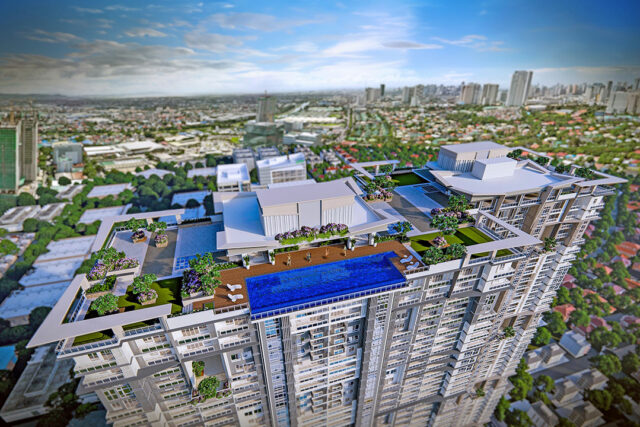
The Valeron Tower will soon rise along the C-5 Ortigas Corridor in Metro Manila. — COURTESY OF DMCI HOMES

CONSUNJI-LED conglomerate DMCI Holdings, Inc. saw a 27% drop in its net income for the second quarter (Q2) to P4.02 billion from P5.53 billion a year ago due to lower contributions from its core units.

DMCI attributed the lower second-quarter profit to weaker performances in its coal, real estate, and construction businesses, as well as the ongoing integration of its cement operations, the company said in a regulatory filing on Wednesday.

However, the conglomerate said the decline in income was mitigated by higher earnings from its water distribution, nickel mining, and off-grid power units.

Total revenues for April to June increased by 6% to P29.74 billion from P28.09 billion a year earlier, led by contributions from the cement business, stronger nickel and off-grid power sales, and higher construction accomplishments.

“Business transition and integration take time, but our diverse business mix and engineering ecosystem continue to support the group,” DMCI Chairman and Chief Executive Officer Isidro A. Consunji said.

“We believe that the improvements we are making today will lead to meaningful value for our stakeholders in the long run,” he added.

Coal subsidiary Semirara Mining and Power Corp. accounted for P2.3 billion in earnings, down by 32% from P3.4 billion, due to lower selling prices amid soft energy market conditions.

The real estate business led by DMCI Project Developers, Inc. contributed P678 million in profit, down by 8% from P737 million, due to higher operating and finance costs amid improved revenue recognition from newly qualified accounts.

The earnings contribution from associate Maynilad Water Services, Inc. grew by 33% to P973 million from P732 million, driven by an increased average effective tariff and prudent cost management.

DMCI Power Corp. accounted for P374 million in profit, higher by 5% from P355 million, on the back of higher energy sales and the addition of new bunker-fired and wind power capacities in Palawan and Antique, respectively.

Mining subsidiary DMCI Mining Corp. generated P344 million in net income, a turnaround from a P43-million net loss, driven by better selling prices and improved operational performance with the full activation of Zambales Chromite Mining Co.

The construction business led by D.M. Consunji, Inc. contributed P18 million, down from P250 million, due to higher project costs, delays, and conservative revenue recognition.

Cement subsidiary Concreat Holdings Philippines Inc. posted a P682-million net loss due to higher interest expense and softer revenues. The company’s recovery efforts are ongoing, with improvements aimed at increasing sales and lowering costs.

For the first half, DMCI posted an 18% decline in consolidated net income to P9.1 billion from P11.1 billion a year ago.

Total revenues climbed by 11% to P61.6 billion from P55.52 billion a year earlier on construction accomplishments from new projects, higher real estate accounts qualifying for revenue recognition, improved nickel shipments and prices, and one full quarter of cement revenue contribution.

DMCI shares rose by 0.20%, or two centavos, to P10.22 apiece on Wednesday. — Revin Mikhael D. Ochave

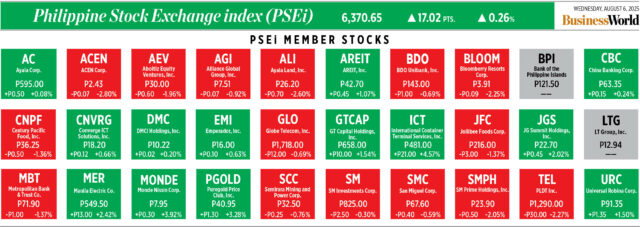
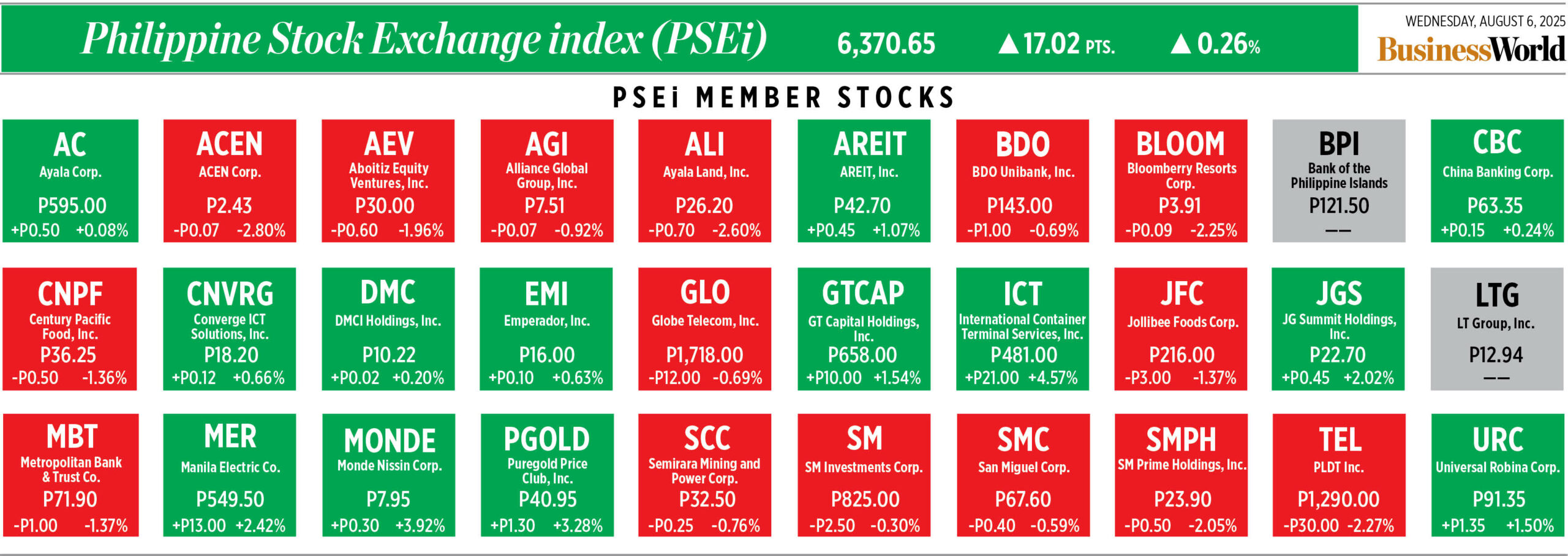
How PSEi member stocks performed — August 6, 2025

Here’s a quick glance at how PSEi stocks fared on Wednesday, August 6, 2025.


DBM to pre-select vetted infra projects for legislators

BW FILE PHOTO

THE Department of Budget and Management (DBM) is working on creating a “menu” of ready-to-implement infrastructure projects for legislators to include in the budget, Secretary Amenah F. Pangandaman said.

“We are going to have a menu for our legislators. If they want to add to the budget or if they see something from our list of projects, for example, flood control, farm-to-market roads, school building programs, they can choose from that menu,” she said on a radio program on Wednesday.

She said the menu system ensures that a project is pre-vetted or validated.

Ms. Pangandaman has indicated a move to a more coordinated, efficient and data-driven approach in selecting priority projects.

The Development Budget Coordination Committee has proposed a P6.793-trillion spending plan for 2026. This is 7.4% higher than this year’s budget and is equivalent to 22% of gross domestic product.

President Ferdinand R. Marcos, Jr. in his State of the Nation Address last month said he would not approve any 2026 national budget that significantly deviates from his government’s national expenditure program.

This could lead to a reenacted budget, under which the government is forced to operate under the preceding year’s budget. The last major reenacted budget crisis was in 2019 under President Rodrigo R. Duterte, during which the new year’s budget was left unsigned for four months.

The House of Representatives is expecting to receive the proposed national budget for 2026 by next week. Budget hearings are set to begin in September. — Luisa Maria Jacinta C. Jocson

Potential Indian investors keen on PHL pharmaceuticals, infrastructure

REUTERS

POTENTIAL Indian investors have indicated their interest in pursuing pharmaceutical and infrastructure ventures in the Philippines, the Palace press office in Manila said.

It added that Indian officials also noted the potential upside in bilateral trade activity, coming from a low base.

Citing the outcome of a business roundtable in Delhi organized during President Ferdinand R. Marcos, Jr.’s state visit to India, it said other areas of interest were digital technology, autos, agri-food processing, clean energy, and innovation-driven enterprises.

Indian investment in the Philippines is valued at about $5 billion in industries like information technology services, pharmaceuticals, healthcare, textiles, and agriculture.

At the roundtable in the Indian capital, Commerce and Industry Minister Piyush Goyal described the current level of bilateral trade as “abysmally low” but saw it as an opportunity for growth.

“This is one partnership where we should only aim for exponential growth,” Mr. Goyal said.

Mr. Marcos’ state visit to India is meant to signal a Philippine pivot to non-traditional trade partners.

The two countries are currently working towards a Preferential Trade Agreement (PTA) and have recently elevated their relationship to a strategic partnership.

Mr. Marcos was quoted by the Palace as saying that the Philippines is continuing to pursue reforms to attract foreign investment, highlighting the CREATE Act; Executive Order No. 18, establishing ‘green lanes’ for expedited processing of strategic investments; the newly passed Public-Private Partnership Code; and liberalization of foreign ownership in renewable energy projects.

“Our investment environment is the most open and liberal that it has ever been,” Mr. Marcos said, citing the Philippines’ 5.7% gross domestic product growth in 2024, healthy banking and financial systems, and strong credit ratings.

Trade Secretary Maria Cristina Aldeguer-Roque called on Indian firms to see the country not just as a market but as a long-term partner in nation-building.

She highlighted industries primed for investment, including infrastructure, clean energy, healthcare, digital services, and electric vehicles.

Federation of Indian Chambers of Commerce and Industry (FICCI) President Harshvardhan Agarwal was quoted as saying that the group is ready to facilitate closer cooperation, and floated the possibility of establishing an FICCI office in the Philippines to support long-term engagement.

Mr. Marcos urged Indian companies to explore joint ventures in high-growth sectors such as ICT, digital technology, semiconductors, infrastructure, healthcare, and pharmaceuticals — areas aligned with Philippine development priorities.

To accelerate progress on trade talks, Mr. Marcos directed the Department of Trade and Industry to work closely with Indian counterparts to convene the Joint Working Group on Trade and Investment.

He also pushed for formal negotiations on the proposed PTA, calling it a “strategic platform” for mutual growth.

He encouraged Indian CEOs to visit the country and “see what a globally competitive Philippines can offer.” — Chloe Mari A. Hufana

Aklan plans terminal to attract more cruise visits to Boracay

PHILIPPINE STAR/ EC TOLEDO IV

BORACAY — Aklan province said it hopes to start construction of a cruise ship terminal this year to address growing demand from cruise lines seeking to stop at Boracay.

“The most important thing for us right now is to provide facilities for cruise ships,” Aklan Governor Jose Enrique M. Miraflores told reporters on the sidelines of the inauguration on Tuesday of the LezzGo Boracay integrated ferry ticketing system for visitors to the resort island.

“Cruise ship tourism is one of the up-and-coming activities here. Last year, we received 19 cruise ships, but our problem here is that there is no port,” he added.

He said some cruise passengers were deterred from visiting Boracay because of the absence of docking facilities. Those who wished to explore the island had to be ferried to shore by tender.

“Many of them are seniors and persons with disabilities. They find it a hassle because they have to be transferred by boat,” he said.

“Our dream is to have a port here where the ships can dock and the tourists can safely go to Boracay,” he added.

He said the province has received P800 million in funding from the Philippine Ports Authority (PPA) this year for the cruise terminal.

“That funding is not enough, so we are also securing more funding that will allow us to complete it,” he said.

“I think more or less we will need P2 billion. We need it to at least have a depth of 12 meters and a 300-meter berth so the cruise ships can,” he added, noting that the province has also sent a letter to the National Government for additional funding.

He said that the project is set to begin construction in the fourth quarter, overseen by the PPA.

“This is supported by the Department of Tourism and other national agencies because they can see the need for a cruise ship facility,” he added.

Once built, he said the port will have the capacity to service two cruise ships at a time.

He said the cruise terminal will allow Boracay to accommodate more port calls by cruise lines.

“I think there were three cruise ships last year that did not go through, so it is such a waste,” he said.

“Next year, we are going to have a lot of cruise ships coming here. There’s going to be a Japanese liner that is going to make a call here,” he added.

Last year, he said the majority of the cruise ships that visited Boracay departed from Hong Kong. — Justine Irish D. Tabile

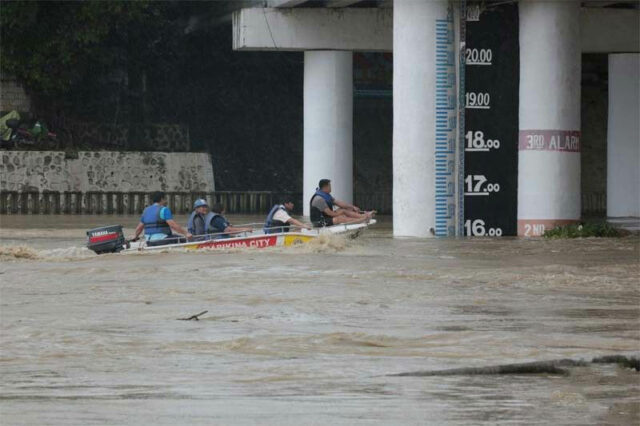
JICA expediting Pasig-Marikina, Cagayan River flood control plans

PHILIPPINE STAR/MICHAEL VARCAS

THE Department of Public Works and Highways (DPWH) said the Japan International Cooperation Agency (JICA) has been tapped to help expedite the updating of flood control master plans for the Pasig-Marikina and Cagayan River basins.

“Once finalized, the updated master plan reports will be submitted to DEPDev (the Department of Economy, Planning, and Development) for review and approval, with pre-feasibility studies expected to begin in early 2026,” Public Works and Highways Senior Undersecretary Emil K. Sadain said in a statement on Wednesday. 

The DPWH said these plans aim to mitigate the recurring problem of flooding while also enhancing disaster resilience.

These two major waterways are considered crucial in supporting the economic growth and development of Metro Manila and the Cagayan Valley.

“These studies and proposed measures in a holistic approach are anticipated to support integrated water resources management, improve interagency coordination, and enhance the overall risk and reduction efforts in Luzon,” Mr. Sadain said.

Launched in 2024, the Japan-funded technical cooperation program will also assess the necessity of flood control dams as a countermeasure to reduce flooding damage within Metro Manila.

A separate master plan for the San Juan River is also being drafted to address low-river flow capacity, and possible solutions and embankment improvements in Manila, San Juan, and Quezon City. — Ashley Erika O. Jose

July WESM rates rise on thin supply margin

BW FILE PHOTO

ELECTRICITY PRICES on the Wholesale Electricity Spot Market (WESM) rose 3.1% in July as supply margins thinned, the Independent Electricity Market Operator of the Philippines (IEMOP) said on Wednesday.

IEMOP reported that the WESM system-wide average price of power was P3.99 per kilowatt-hour (kWh) in July, against P3.86 per kWh a month earlier.

Between June 26 and July 25, the available supply decreased 3.2% month on month to 20,754 megawatts (MW). Demand fell 5% to 13,812 MW.

The WESM rate in Luzon increased 0.4% to P3.92 per kWh, with supply declining 3.6% to 14,540 MW and demand falling 6.6% to 9,710 MW.

“Despite higher supply margin there was a slight increase in price due to the limited flow of the HVDC (high voltage direct current) from the Visayas to Luzon,” IEMOP said.

The market operator said the spot price in the Visayas rose 11.7% to P4.39 per kWh in July from P3.93 per kWh in the previous month.

Supply fell 4% to 2,530 MW while demand dropped 1.8% to 1,998 MW.

Power rates in Mindanao increased 7.2% to P3.80 per kWh from P3.54 per kWh a month earlier.

The grid’s available supply decreased 1% to 3,685 MW. Demand grew 0.4% to 2,104 MW.

IEMOP said that the price increase was due to the limited HVDC flows and coal plant outages, leading to high-cost generators clearing the market.

“Having a limited power flow from Mindanao to the Visayas and from the Visayas to Luzon, and with cheaper plants on outage… resulted to higher energy prices across the regions,” IEMOP said.

For the August supply month, the market operator is expecting an increase in the WESM price with several power plants going on forced outage, affecting supply.

“We expect increase in price, but hopefully it won’t be as high as it was last year,” Isidro Cacho, Jr., IEMOP’s head of corporate strategy and communications, said in a virtual briefing.

Since Aug. 4, the Visayas grid has been on yellow alert due to high system demand and with power plants either derated in capacity or going on forced outage.

“So our fearless projection is that (the price) will range between P4.50 and P5 per kWh on average. Earlier, we did some calculations and saw a 40-centavo increase for the Visayas, in particular,” Mr. Cacho said.

Meanwhile, power prices in Luzon will be more or less unchanged, while rates in Mindanao may increase between 27 to 28 centavos.

IEMOP operates the WESM, where energy companies can purchase power when their long-term contracted power supply is insufficient for customer needs. — Sheldeen Joy Talavera

Visayas grid yellow alert continues for third day

NGCP.PH

THE Visayas grid has been placed under yellow alert for a third consecutive day after power plants went on forced outage, limiting the system’s contingency reserves, according to the National Grid Corp. of the Philippines (NGCP).

In an advisory early Wednesday, the NGCP said the yellow alert was raised over the Visayas grid between 3 p.m. and 4 p.m. and between 5 p.m. and 7 p.m.

Peak demand was 2,538 megawatts (MW) while available capacity was 2,369 MW.

The grid operator attributed the declaration of the yellow alert to high system demand and several plants either derated in capacity or going on forced outage, with 725.2 MW lost to the grid.

A yellow alert is issued when the operating margin is insufficient to meet the transmission grid’s contingency requirement. — Sheldeen Joy Talavera