Home Blog Page 1151

Providing broader, easier access to employees’ healthcare

STOCK PHOTO | Image by Rawpixel.com from Freepik

By Mhicole A. Moral, Special Features and Content Writer

Poor health continues to affect a wide segment of the Filipino population, creating a cycle that takes a toll on both personal well-being and workplace productivity.

Latest data from the Philippine Statistics Authority show that government schemes and mandatory healthcare contributions covered 44.7% of the country’s current health expenditure. Household out-of-pocket payments followed at 42%, with voluntary healthcare payments accounting for 12.6%.

Total health expenditure reached P1.56 trillion in 2024, a 17.1% increase from P1.33 trillion the previous year. On average, each Filipino spent P12,751 on health.

Consequently, projections from global advisory firm WTW indicate that healthcare expenses in the country will rise another 18.3% in 2025. This is the second-highest expected increase in the Asia-Pacific region, only behind Indonesia.

With medical costs rising, more companies are shifting from purely covering treatment expenses to promoting prevention. Employers are offering programs that include regular health checkups, fitness benefits and mental health services.

Health maintenance organizations, or HMOs, remain the most common choice for employer-sponsored healthcare in the Philippines. They typically provide employees with access to a network of doctors and hospitals at prearranged rates that help lower out-of-pocket costs.

Christopher V. Tan, first vice-president and head of the sales and marketing department of Cocolife’s Healthcare Division, said demand for health coverage remains strong as more employees see it as an essential part of their employment package.

Christopher V. Tan, Sales and Marketing Department first vice-president and head, Cocolife Healthcare Division

“Filipinos today are more health-conscious than ever,” Mr. Tan said. “Healthcare is increasingly viewed not just as a benefit but as a necessity and a security blanket.”

In the past, most employees used their health coverage mainly for hospitalization or treatment after becoming ill. Cocolife has seen a change in behavior, with more employees now using it for preventive care such as executive checkups, vaccinations and wellness screenings.

The coronavirus (COVID-19) pandemic five years ago has intensified the focus on employees’ physical and mental health. Younger professionals, in particular, appear more willing to invest time and effort in maintaining overall wellness rather than waiting for health problems to develop.

While treatment for acute illnesses and outpatient consultations still account for much of the claims, services like wellness and lifestyle programs, occupational health screenings, and expanded annual physical examinations are becoming a higher priority.

Maintaining quality healthcare packages

Medical inflation remains a major problem worldwide, affecting hospital room rates and the cost of medicines. In some areas in the Philippines, the lack of nearby hospitals or clinics makes access to care more difficult.

“Our mission is to cover as many Filipinos as possible. On the other hand, expanding quality healthcare services in a cost-sensitive market like the Philippines poses several challenges,” Mr. Tan said.

Cocolife has redesigned its healthcare packages to reach more Filipinos with affordable plans that still provide quality care. Mr. Tan said Cocolife now offers a tiered product design that fits different budgets while maintaining essential benefits.

For example, a basic plan may cover primary care and hospitalization, while higher-tier packages may include specialized treatments or wider provider networks.

The provider has also strengthened its utilization management, such as monitoring how healthcare services are used and working with partner hospitals and clinics to keep services cost-effective.

“We [are] working closely with our partners to ensure optimal use and cost effectiveness without compromising quality of care,” he said.

Modernizing health coverage

HMOs are now expanding beyond traditional coverage that once focused mainly on hospital stays and medicine reimbursements. Coverage today includes services that address a wider range of needs.

Healthcare providers are also beginning to make mental health services part of their offering.

“Services such as psychiatric consultations, counseling sessions and stress management programs are becoming more common,” Mr. Tan said. “Depending on the employer’s plan, these services may be included as standard benefits or offered as optional riders.”

Digitalization, on the other hand, is also making access to care faster, easier and more reliable for members.

“Digitalization has fast become a necessity rather than a value-added service in the healthcare industry,” he added.

Cocolife now offers 24/7 teleconsultations through its partners Doctor Anywhere, E-Konsulta and HiDoc. These services allow members to consult licensed physicians without visiting a clinic or hospital.

The company has also upgraded its medical helpline with a more advanced telecommunication system, making it easier for members to reach support at any time.

Aside from consultations, Cocolife has introduced mobile app services and real-time issuance of letters of authorization, which are required for scheduling medical procedures. These features are available through the Cocolife Healthcare Virtual Card App, which also lets members store their information and track their benefits.

Maximizing HMO benefits

While HMOs help cover employees’ medical costs, some rarely use their packages because they do not fully understand the coverage. Others find that their preferred doctors or hospitals are not included in the network. Even benefit that appears strong on paper can still fall short when it does not match the needs of those it is meant to serve.

Such gap between what is offered and what is useful points to a larger responsibility for employers. Companies are suggested to review how employees use these plans and identify ways to make the benefit more practical.

“The most effective healthcare plans are those that go beyond compliance. Healthcare plan designs engage employees, address real needs, and evolve over time,” Mr. Tan said.

He added that companies should actively gather feedback from employees about what they need in a healthcare package. Some may want broader hospital coverage, while others may prefer more preventive services or mental health support. Knowing these differences helps companies select plans that work for a wider range of employees.

In addition, Mr. Tan pointed out that integrating annual checkups, health screenings, or lifestyle programs into the HMO package can lower costs in the long run and improve overall workforce well-being.

Companies also need to balance costs with quality of care. A low-cost plan may seem appealing on paper, but if it leaves employees paying high out-of-pocket expenses or struggling to find accredited doctors, it fails its purpose. Mr. Tan said healthcare benefits should be broad enough to meet common needs without becoming a financial strain for either employers or employees.

To make the efforts sustainable, employers are encouraged to promote health literacy. Orientation sessions, printed guides or brief reminders during company meetings can help address this issue.

“At Cocolife, we value long-term partnerships rooted in deep collaboration. Together, we create solutions that not only manage costs but profoundly uplift and empower the lives of every employee,” Mr. Tan said.


Beauty and health concepts

STOCK PHOTO | Image by Pikisuperstar from Freepik

The obsession with beauty and health has become extreme.

“Health is what sells,” Professor Elizabeth Haiken wrote in her book, Venus Envy: A History of Cosmetic Surgery.

The commercial thrust is evident in how products are marketed. Innovation is the key.

Through years of subliminal programing and media conditioning, people confuse the concept of health with a beautiful face, a slim body, and youth. The multibillion-dollar beauty industry projects the ultimate image of a perfect figure and flawless face. A sexy icon, the perennial image on billboards and ads, makes people aspire to look perfect.

“Wellness” is the term used to market the booming spa and cosmetic surgery sub-categories of the beauty industry. Vitamin supplements and quick magic fixes are recommended.

Health and beauty have been intricately linked and promoted by traditional media and social media. Seductive TV and magazine advertisements heighten the desire for eternal youth. The ads entice potential customers to “feed your skin.” The healthy glow comes from nourishing cosmetics, sea extracts, oxygen treatments, and detox flush weekends. Yoga and vegetarian dishes are offered as well.

The consumer (male or female) with disposable income wants infinite ways to look and feel healthy and fit. The industry discovers and formulates innovative products and treatments to meet those needs.

It is the law of supply and demand.

People like to identify with good-looking celebrities who endorse miracle products: the young athlete who wins the race, the gymnast who has medals, the shapely model who cavorts in the surf or rides a horse on the beach to promote a vitamin, a drink. (Sometimes, there is no truth in advertising.)

Caveat emptor.

One tends to envision health as a perpetually youthful package — too good to be real. Good health is always associated with sparkling eyes, lustrous hair, shiny teeth, a glowing complexion, and a supple physique. Ill health, in contrast, is seen in a plain-looking person with stringy hair, sallow skin, and a bony frame.

Surveys reveal there is no relationship between the prettiest face and the healthiest person in an individual basis.

To illustrate, Michael Kalick, a psychologist at the University of Massachusetts, took research data that began in 1930 and lasted 40 years. The same volunteers (already in their ’60s) were rated according to how healthy they were in their youth and later in life. The study was meant to determine where the healthiest people were rated the most attractive. The results were surprising.

They did not find a relationship. “Those with the fewest medical problems when they grew older were not better looking than those plagued with ill health. People really think that attractiveness indicate health… They are mistaken about it,” Professor Kalick concluded.

Health foods and health clubs, the big money makers, have more to do with beauty than disease prevention.

“Disease prevention seems so distant, and beauty is immediate. If I take care of myself, I might slightly diminish my risk for heart disease in the future. But I might look better next week,” New York Times writer Gina Kolata commented.

In the 19th Century, Charles Darwin develop the theory of evolution. His colleague, Alfred Russell Wallace, observed that male birds have brightly colored plumage that were attractive to both female birds and predators. The fiery Prof. Wallace concluded that female birds chose the fiery feathered males because they appeared healthier.

In this millennium, people are more self-obsessed and age defiant. Thus, there are more serums, surgery, laser, Botox, liposuction, or the safe non-invasive treatments to minimize the marks of the passage of time on the face and body. Self-improvement with a high-tech make-over.

There is nothing wrong with having some procedures and creams if they are not overdone. (We see the scary results of too much stretching and plumping.)

It is the promise (and myth) of eternal youth in a pill or an expensive stitch. The quick fix to control the hormonal shifts.

Cosmetics — regardless of vitamins, herbs, and minerals — can give the glow of youth. A bottle of hair dye can cover the gray hair. Cosmetic dentistry can produce straight, white, porcelain teeth. Nips and tucks and shots can improve the appearance and boost the morale.

What people buy is not health but the illusion of it — in a shiny package. The incredible new caviar cream with complex vitamins might help delay the clock.

In the search for the fabled fountain of youth, people are trying to reverse the ravage of time. So, they take the exotic elixir or cure-all potion, attach the IVs with antioxidants that whiten their skin, and risk painful surgery to dissolve bulges and eradicate wrinkles.

As Groucho Marx once quipped, “She got her good looks from her father — he’s a plastic surgeon.”

The desire to look younger is normal. A good lifestyle, balanced diet, and moderate exercise promote health and prevent disease to a certain degree.

It is important to remember that physical perfection always be out of reach. No matter how hard we try.

Beauty is skin deep.

It seems so easy to acquire beauty in a jar.

What we should try to attain is the elusive state of inner harmony and peace of mind. It evokes the aura of real beauty and a spiritual sense of balance that can never be bought


Maria Victoria Rufino is an artist, writer and businesswoman. She is president and executive producer of Maverick Productions.

mavrufino@gmail.com

Paramount’s new owners to increase film production, hang on to cable networks

LOS ANGELES — Paramount Global unveiled plans on Wednesday to retain and develop its stalwart entertainment brands Nickelodeon, MTV, and BET, while sharply increasing feature film production following its $8.4-billion merger with Skydance Media.

“We’re thinking about… the cable networks, not as declining linear assets that we need to spin off or deal with somehow,” said President Jeff Shell. “We’re thinking of those brands that we have to redefine.”

Shell joined Chairman and Chief Executive Officer David Ellison and the rest of the executive team at a media gathering on Wednesday on the Paramount Pictures lot, where they discussed strategy for their film, television, and streaming businesses — as well as emerging technologies such as artificial intelligence.

The press event was held a week after Paramount completed its merger with Skydance Media, installing new leadership at the media company.

Television Media Chair George Cheeks acknowledged the decline of cable television — “there’s no question it’s a super challenging business” — but added that the company’s cable networks have created iconic franchises that may well thrive in the world of streaming video.

Shell singled out BET, a network focused on Black culture that Paramount previously explored selling, as an important building block of the company’s streaming strategy.

Paramount’s plans to develop its legacy cable networks come at a time when other media companies are shedding fading cable networks. Warner Bros. Discovery and Comcast have announced plans to separate their cable businesses from their studios and streaming operations.

Josh Greenstein, co-chair of Paramount Pictures, said the studio plans to raise annual output, from eight this year to 15 movies “very quickly,” with the ultimate goal of releasing 20 films a year.

The coming slate will include new installments of familiar franchises, such as Star Trek or Transformers, as well as original movies, like the newly acquired James Mangold film project, High Side, starring Timothée Chalamet.

The studio also will seek out family fare, in the vein of A Night at the Museum or The Goonies.

“We love these movies. We all grew up on these movies, and we don’t feel like many people are making them,” said Dana Goldberg, co-chair of Paramount Pictures.

Mr. Ellison said his goal is to transform Paramount into a haven for the most talented filmmakers and sees emerging technologies like artificial intelligence providing a tool to enhance storytelling.

“I also think we have to acknowledge that this is a technology that is evolving, I think, faster than everyone in Hollywood really thinks it is,” said Mr. Ellison, who is the son of Oracle co-founder Larry Ellison. “When you start putting that in a filmmaker’s hands, I think you’re seeing another moment that’ll be as transformative as when John Lasseter and Steve Jobs built Pixar.” — Reuters

China factories cut shifts and worker pay as US tariffs bite

REUTERS

GUANGZHOU, China — Mike Chai aims to cut wage costs at his kitchen cabinet factory by about 30% to remain competitive against other Chinese firms, which have stopped selling to the US due to steep tariffs and are now coming after his long-time customers in Australia.

Mr. Chai had already halved his workforce to 100 people since the pandemic and says he has no more room to trim. Instead, he is shortening shifts and asking workers to take unpaid leave — an increasingly common practice that has become a hidden deflationary force in the world’s second-largest economy.

“We’re in survival mode,” said the 53-year-old, adding that his company, Cartia Global Manufacturing, in the southern city of Foshan, “barely breaks even.”

“I told them, you don’t want our factory to go broke. You’ve worked here for 10-15 years, let’s do it together.”

China’s headline unemployment rate has held around 5% as US President Donald Trump raised tariffs on imports from China by 30 percentage points this year. Washington and Beijing extended on Monday a tariff truce for another 90 days, during which tariffs will not return to April’s triple-digit levels.

But economists say underemployment — which, in common with other economies, is not tracked in data — is worsening due to higher levies and industrial overcapacity, squeezing workers’ income, undermining their confidence about the future and prompting them to spend less.

Consumer confidence lingers near record lows, retail sales have weakened, and inflation in July was zero.

Alicia Garcia-Herrero, chief Asia-Pacific economist at Natixis, says it is China’s manufacturing workers who suffer while exports — and the economy — keep growing despite the US tariffs.

“It’s the people who are hammered by this model of huge competition, lower prices, thus you need to lower costs, thus you need to lower wages. It’s a spiral,” she said.

“The model is crazy. I’m sorry, but if you need to export at a loss, do not export.”

Statistics will not reveal Chinese workers as “the main losers” in the trade war because “they will not become unemployed, but they will get unpaid leave of absence or work fewer hours,” she added.

Mr. Chai has already lost two key customers in his main market of Australia after other Chinese firms cut their prices and his factory is operating at half-capacity.

“All those who have (left) America have come to Australia,” he said. “A lot of new supply is knocking on my customers’ doors.”

While Chinese exports to the US dropped 21.7% year on year in July, they rose by 9.2% to the European Union, 16.6% to the Association of Southeast Asian Nations and 14.8% to Australia.

Mr. Chai plans to cut prices by about 10%. To afford that, he is also cutting overtime — which previously made up more than a third of workers’ income — from 28 days per month in total to about 10. On average, his workers earn 5,000 yuan ($697) a month before overtime.

Factory bosses are also turning to temporary workers, hiring them for new orders and dismissing them when demand dries up.

Dave Fong, who co-owns three factories in southern China making everything from school bags to climbing gear and industrial machinery, says he laid off 30 full-time workers at one of the plants, then rehired some of them on a temporary basis to fulfil unexpected orders.

“We prefer temporary contracts so we don’t need to pay pension or insurance,” said Mr. Fong. “It’s by day or by hour.”

“If we don’t do that, the company hits a dead end. The market is weak because consumption power has decreased. Another factor is trade, especially with the US.”

Temporary work is common in China, especially among its nearly 300 million rural migrants.

Chen Chuyan, a recruiting agent in the central city of Wuhan, says the going rate has dropped to 14 yuan per hour from 16 yuan last year.

“There’s a long line of people waiting for job interviews every day, but the factories don’t have that much demand,” Mr. Chen said.

Alan Zhang has taken such jobs in Datang village, a cluster of small garment factories in the southern city of Guangzhou, since 2021. Back then, he earned 400 yuan a day, but now he struggles to find work paying even half that amount.

“If it’s just a couple hundred yuan, I won’t take it,” said the 30-year-old, after scanning handwritten ads for temporary work held by recruiters lounging on scooters.

“I don’t know what happened. Suddenly it got really hard to find anything. Prices dropped fast,” said Mr. Zhang, who pays 700 yuan per month to rent a studio flat in Datang with his wife, who also works in clothing factories.

He worked just 14 days in July, which worries him because he must raise 10,000 yuan every year for his son’s kindergarten fees. The boy lives with grandparents in Mr. Zhang’s hometown in neighboring Fujian province.

“If manufacturing wages are being squeezed, then the wider economy would feel deflationary pressure,” said Richard Yarrow, a fellow at Harvard Kennedy School’s Mossavar-Rahmani Center for Business and Government.

“This is definitely a growing issue for some of the lower-skill types of manufacturing in China, such as textiles, furniture, and simple electronics.”

At the Longhua employment market in the tech hub of Shenzhen, dozens of people browsed bulletin boards for electronics factory jobs paying 17-28 yuan per hour.

Mr. Mo, 26, who has a degree in digital marketing but could not find a job in the field, had already had two interviews by early afternoon. He declined the offers because the terms were not as advertised.

“They’ll say 23 yuan, but actually give you 20,” said Mr. Mo, only giving his surname for privacy reasons. “Then they’ll take management fees, housing, cleaning, and whatever else they can deduct.”

Mr. Huang, 46, was checking the market for a fifth straight day, having arrived by bus from the southwestern province of Yunnan.

He managed real estate projects before the property market crash. Now he is divorced and lives on 10 yuan meals, paying 25 yuan per night for a bed in a dormitory. He cannot afford anything else until he finds work.

“I had one interview this morning but they asked for an upfront placement fee of 80 yuan,” said Mr. Huang, dragging a small suitcase.

“So I didn’t go. I bought some food instead.” — Reuters

Meralco to receive $2.7-M USTDA grant for small modular reactor study

MERALCO.COM.PH

By Sheldeen Joy Talavera, Reporter

MANILA ELECTRIC CO. (Meralco) said it will secure a $2.7-million (P152.87 million) grant from the United States Trade and Development Agency (USTDA) to fund a feasibility study on adopting small modular reactors (SMRs) in the Philippines.

“This will be formalized via a signing ceremony very soon,” Ronnie L. Aperocho, Meralco’s executive vice-president and chief operating officer, said on the sidelines of a forum organized by the American Chamber of Commerce of the Philippines, Inc. on Thursday.

SMRs, each capable of generating up to 300 megawatts (MW), can be constructed more quickly than traditional nuclear power plants.

USTDA provides grants for feasibility studies, technical assistance, and comprehensive analyses that infrastructure projects need to proceed with implementation.

In 2022, Meralco applied for a grant from the USTDA to conduct a feasibility study on SMRs in line with the government’s goal of including nuclear energy in the country’s energy mix for energy security.

The nuclear initiative is part of the power distributor’s commitment to adopting next-generation clean technologies. It also aligns with the Department of Energy’s (DoE) target of incorporating at least 1,200 MW of nuclear energy in the energy mix by 2032.

Mr. Aperocho said that Meralco’s aggressiveness toward nuclear energy may have contributed to the award of the grant.

“They probably saw that we, as the local player, are very aggressive and supportive of the nuclear agenda,” he said.

While Meralco’s current focus is on small nuclear reactors, Mr. Aperocho said the company remains open to developing conventional power plants, such as rehabilitating the mothballed Bataan Nuclear Power Plant.

He added that the company is still awaiting the enactment of the PhilATOM bill, which has already passed in Congress.

PhilATOM refers to the proposed Philippine Atomic Energy Regulatory Authority, which will have regulatory control over all sources of ionizing radiation, including nuclear and radioactive materials and radiation devices.

REVIEW NUCLEAR LAWS
Under the DoE’s Philippine Nuclear Energy Program, the necessary laws for the nuclear legal and regulatory framework must be in place by 2025.

The Nuclear Energy Program–Inter-Agency Committee, led by the DoE, launched a review of current nuclear laws, regulations, and policies.

From Aug. 12-15, the committee examined existing laws and identified the amendments necessary to establish a national legal framework, in coordination with concerned government agencies and stakeholders.

DoE Legal Services Director Myra Fiera F. Roa said the review of laws, issuances, and policies will identify the “support, constraints and gaps” that need to be addressed for the development of a nuclear power program.

“We want to make sure that all legal hurdles are cleared before we take major steps forward in fulfilling our nuclear power objectives. From the review of the laws and issuances, we will propose enactment or amendment of laws as appropriate,” Ms. Roa said.

In December last year, the International Atomic Energy Agency (IAEA) conducted a follow-up Integrated Nuclear Infrastructure Review (INIR) mission to check on the country’s progress in developing the necessary infrastructure for embarking on a nuclear power program.

While several of the IAEA’s recommendations from its 2018 INIR mission have been fully addressed, the nuclear watchdog advised the Philippines to complete an analysis of laws that may affect its nuclear power program.

One of the key advancements undertaken by the Philippines in response to IAEA recommendations was the ratification of a comprehensive nuclear law via the PhilATOM measure.

“We want to seize every opportunity to get things done right on the potential use of nuclear energy for the benefit of our people,” Ms. Roa said.

BankCom Q2 net profit up 53%

BANK of Commerce (BankCom) saw its net income rise by 53% in the second quarter on the back of double-digit increases in both its net interest and non-interest earnings.

BankCom’s net profit went up to P993.91 million in the three months through June from P649.30 million in the same period in 2024, it said in a disclosure to the stock exchange on Thursday.

For the first semester, its net earnings jumped by 31% year on year to P1.86 billion from P1.42 billion driven by strong revenue growth as its core businesses remained robust.

This translated to a return on equity and return on assets of 11% and 1.39%, respectively, up from 9.12% and 1.23% a year ago.

“The robust performance was underpinned by sustained growth across core revenue streams, driven by net interest income, gains from trading securities, and foreign exchange transactions,” BankCom said.

“BankCom’s strong financial results underscore its strategic focus on growth, operational efficiency, and prudent risk management.”

The bank’s net interest income rose 16% to P2.66 billion in the second quarter from P2.28 billion the prior year as its interest earnings rose while its interest expense declined.

Its net interest margin was at 4.27%, down from 4.53% a year prior.

Non-interest income surged 36% to P409.43 million from P300.03 million, driven by higher service charges, fees and commissions and improved foreign exchange gains.

Meanwhile, operating expenses edged up to P1.76 billion from P1.72 billion.

“The bank’s strategy of improving its revenue streams and prudent spending resulted in a lower cost-to-income ratio of 59%,” it said. At end-June 2024, its cost-to-income ratio was at 62%.

BankCom’s total loans and receivables grew by 5% to P143.58 billion at end-June from P136.51 billion at end-2024.

Its gross nonperforming loan (NPL) ratio was at 1.34%, while its net NPL ratio stood at 0.53%. Its NPL cover was at 86.96%.

Meanwhile, total deposits were “moderately lower,” dropping by 4% to P203.82 billion as of June from P212.01 billion at end-2024 “due to seasonality in the use of larger business accounts,” BankCom said.

“The deposit mix includes 185.39 billion in current account and savings account deposits, P13.40 billion in time deposits, and P5.03 billion in long-term negotiable certificates of deposit.”

This resulted in a loans-to-deposit ratio of 71%.

BankCom’s assets stood at P271.53 billion as of June, while capital funds were at P34.46 billion.

Its capital adequacy ratio was at 17.30% at end-June, down from 17.58% at end-2024 but still well above the regulatory minimum of 10%.

BankCom’s shares closed unchanged at P7.22 each on Thursday. – BVR

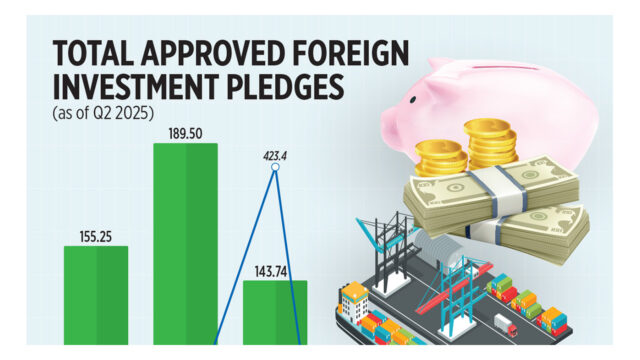
Total Approved Foreign Investment Pledges

FOREIGN INVESTMENT pledges plunged by 64.4% in the second quarter as investor sentiment turned cautious amid heightened global uncertainty driven by flip-flopping US tariff policies. Read the full story.

Total Approved Foreign Investment Pledges

Saudi Arabia is losing its appetite for oil

STOCK PHOTO | Image by Eddie Zhang from Unsplash

By David Fickling

YOU KNOW that horror movie trope where the babysitter gradually realizes the crazed killer is phoning, not from some distant location, but from inside the house? Something similar is happening in the oil market.

That’s because Saudi Arabia, the world’s biggest net exporter of crude, is using renewables to drastically reduce its petroleum consumption. The threat to the kingdom’s producers isn’t coming from the heartlands of electric vehicle adoption in Shenzhen, Oslo, or San Francisco — it’s right inside the house.

This is an extraordinary reversal. Since the start of the 21st century, Saudi Arabia’s oil consumption has increased more than any other country barring China and India. It’s doubled to 2.3 million barrels per day, greater than the incremental demand from Africa, Latin America, or the former Soviet Union.

Between a quarter and a third of the country’s consumption goes into crude- and fuel oil-fired generators that provide electricity to ride out summer heatwaves. The government wants to replace all of that with renewables, with a target of 130 gigawatts (GW) by 2030 — roughly equivalent to all the solar power in India. Such a switch could represent the single largest decline in oil demand over the next five years, according to the International Energy Agency.

It’s not news that the country has such ambitions. One of the cornerstones of Vision 2030, the program announced in 2016 to wean the kingdom’s economy off hydrocarbons, was to switch the grid to an exclusive gas-renewables mix.

However, such bold pronouncements are typically heavily discounted where Saudi Arabia is concerned. This is a country that’s been working on an unfinished one-kilometer skyscraper since 2013, and recently called in consultants to review the feasibility of The Line — an implausible science fiction city being built to house nine million people inside a 170 kilometer-long tower.

Kpler, a data company that tracks commodities flows, reckons only 11.6 GW of the planned 130 GW will be online by 2030. Such a serious shortfall would be enough to sustain crude in power generation well into the future.

It might be time to start reevaluating whether that skepticism is warranted, however. There’s certainly a huge gap between promise and execution where the kingdom’s megaprojects are involved. Still, when it comes to building humdrum energy infrastructure (as opposed to, say, a cube-shaped hollow tower as tall as the Empire State Building), one of the world’s biggest petroleum producers has a decent track record.

That’s now finally showing up not just in wells and export facilities, but in renewables, too. After years in which the only major solar project connected was a relatively modest 0.3-GW plant in the deserts between Jordan and Iraq, generators are now being plugged in at a rapid pace.

Since the start of 2024 alone, ACWA Power Co., the country’s biggest electricity and water developer, started commercial operations at four solar facilities totaling about 4.9 GW. Roughly the same amount is due to start up by the end of next year, the company told investors recently, shortly after completing a 7.125 billion riyal ($1.9 billion) capital raising. Last month, it signed deals with Saudi Arabia’s main utility to build another 15 GW, to be delivered by the middle of 2028.

The broader plan is for ACWA to hit 78 GW by 2030, sufficient on its own to provide all the electricity that Saudi Arabia generated from oil last year. Much more is in the pipeline from other developers.

With ACWA giving investors detailed timelines of further near-term completion dates, the onus is increasingly on the skeptics to explain why the recent run of successful project execution is going to be broken. Thanks to abundant sunlight, Saudi solar plants deliver electricity at less than half of the cost of the grid. Arrays of panels also tend to be much more simple, in engineering terms, than the petroleum extraction, transport, and refining complexes in which the kingdom has long excelled.

Getting those renewables built is also crucial for the country’s overriding obsession: its position in the oil market. One justification given by Saudi Arabian Oil Co. President Amin Nasser for cutting back maximum output capacity last year was that removing crude from the domestic grid would boost exports as effectively as drilling extra wells. The plans to eliminate oil from the grid by 2030 are still “on track,” he told Aramco investors last week.

Saudi Aramco’s competitors might want to reflect on that. For Nasser, the country’s transition is reason enough to trim investments intended to meet hypothetical future demand. The kingdom’s grid uses more oil than all the cars and scooters in India. If such an enormous consumer of the world’s crude is going away by the end of the decade, an already oversupplied market risks heading still deeper into glut.

BLOOMBERG OPINION

How managers avoid costly worker errors

Our factory has clear, well-communicated operating standards. Our workers know them very well. Sometime ago, a worker committed a serious mistake resulting in losses worth millions. Our code of conduct prescribes a maximum one-month suspension without pay, as the owner, with a paternalistic management style, does not want to dismiss anyone. So, the company must absorb the damage and keep the employee on board. How do we prevent this same error from happening again? — Red Falcon.

Except for your paternalistic boss, this scenario sounds uncomfortably familiar. Many organizations fall into the trap of believing that written rules and clarity will prevent worker mistakes. It’s an appealing belief — after all, if the instructions are crystal clear and everyone has signed the acknowledgment form, what could go wrong?

However, policies and clarity are small parts of the productivity net equation. There are a lot more. Human nature, systems design, and company culture all play an equally critical role.

People get tired, distracted, or become overconfident. Systems have gaps that reveal themselves under pressure. And the paternalistic culture — the invisible hand guiding daily behavior  — can either encourage vigilance or breed complacency.

SOLUTIONS
With that in mind, here’s how to make sure those expensive mistakes become an important lesson and prevent the same situation from happening again through the following solutions:

One, do a root cause analysis. When a serious mistake happens, the first impulse is to focus on the what: the broken machine, the ruined batch, or the production delay, among others. But the real learning comes from the why.

Was the person rushing to meet a quota? Was he distracted by a personal issue? Was the tool faulty, the design flawed, or the procedure broken? Or was it willful negligence — knowing the rule but ignoring it?

Two, let the worker come up with a solution. Sure, you’ll want to guide them so they don’t just say, “I’ll be more careful next time.” They must go beyond that. After all, their job is still there waiting.

Therefore, they must be empowered to come up with specific and measurable preventive actions that make them co-owners of the new system.

Three, put the right system in place. Even seasoned operators can become absent-minded. They forget important steps, skip checks, and even make false assumptions — all because of their misplaced confidence.

To avoid that, apply some proven safeguards like having a new checklist, mistake-proofing (Poka-Yoke) the process, and doing peer verification with two people signing off.

Four, match the consequence to the impact. A one-month suspension for losing millions sends mixed signals. It says, “We’re disappointed, but it’s OK. See you next month.” A fair approach is graduated discipline, if not employment termination.

The first offense with minor impact might mean retraining, but a grave mistake with costly damage may require a demotion from a safety and quality-oriented role, or dismissal if willful neglect is proven. But you must convince your management about it.

Five, make the lesson public without shaming people. Every major error is tuition paid to the “school of experience.” The worst thing is to pay the tuition and not attend the class.

Hold a post-incident learning session where the concerned worker explains what happened without bring humiliated. This puts the lesson in everyone’s mind and turns a mistake into a shared responsibility.

Six, retraining is for everyone. Many factories assume that once training is done, knowledge remains perfect. In reality, familiarity breeds shortcuts. Annual or semi-annual, if not quarterly, refresher training on critical processes keeps the standards high in everyone’s mind.

Simulation is powerful. If a mistake happened in the packaging line, recreate the scenario in a controlled setting and walk everyone through the correct handling.

Seven, reward prevention, don’t just punish mistakes. A culture of vigilance doesn’t grow from punishment alone. Fear-based cultures often hide problems until they explode. Balance discipline with recognition for hazard prevention.

Make it easy for people to report an issue. Praise them for preventing a problem before it becomes an accident. Create a “Doing It Right” program where data is captured, recorded, analyzed, and the worker is recognized.

Eight, lead from the shop floor. If standards are important, leaders must be visible in enforcing them. That means walking through the process regularly. Without “snoopervising,” ask the workers to demonstrate a step. Then, point out positive compliance.

Address small deviations immediately, before they grow into big risks. A visible leader communicates that procedures aren’t just words on paper — they’re a living expectation.

REAL CHALLENGE
When rules are clear but violations still happen, the issue isn’t ignorance — it’s the presence of an unreasonable management policy that favors workers who make mistakes. In other words, the fence may be sturdy, but the gate is swinging wide open. The fix?

Close it with a lock made of firm consequences, regular follow-through, and visible leadership. This is the best time for your company, locked in a paternalistic mindset, to change its culture.

There could be legal challenges. But it’s worth challenging a deeply ingrained culture that protects employees at all costs, to the detriment of both performance and profitability.


Ask questions and receive Rey Elbo’s insights for free. E-mail elbonomics@gmail.com or DM him on Facebook, LinkedIn, X, or via https://reyelbo.com. Anonymity is guaranteed.

J-pop idol Kenshin Kamimura found guilty of indecent assault in Hong Kong

JUNSEI MOTOJIMA (L) and Kenshin Kamimura in the TV show Our Youth.

HONG KONG — J-pop star Kenshin Kamimura was found guilty by a Hong Kong court on Wednesday of the indecent assault in March of a woman who served as his interpreter during a fan event.

Mr. Kamimura, 26, was previously a member of the six-member boy group One N’ Only. He pleaded not guilty in April and chose not to testify during the trial in July.

Magistrate Peter Yu said that Mr. Kamimura’s behavior showed obvious disrespect towards women, noting that his touches suggested a sexual undertone.

“Such behavior should be condemned,” Mr. Yu said, fining him HK$15,000 ($1,923) after his lawyer in mitigation urged a financial penalty rather than jail.

On hearing the sentence, Mr. Kamimura hugged his court translator, while a handful of fans wept in the public gallery. Dozens more waited outside after the hearing ended as Mr. Kamimura left court without saying anything.

The victim, identified only as X, testified in July that Mr. Kamimura and actor Junsei Motojima hired her as an interpreter to translate during a fan meeting in Hong Kong on March 1. The group then attended a celebratory dinner at a restaurant in the city’s Mong Kok district.

She told the court Mr. Kamimura moved to sit beside her during a toasting session and started repeatedly brushing and patting her thigh before suggesting they visit the bathroom together. He asked both in Chinese and Japanese if she knew what he meant, she added.

X said she declined, telling him, “If you want to go, you can go by yourself.”

She said she then moved away to get some tea, but Mr. Kamimura blocked her path and again asked her to go outside. She told the court she refused.

After X returned to her seat, Mr. Kamimura also came back and sat beside her. He apologized and said, “Forget what just happened,” she recalled in her testimony. The singer also asked her about her relationship status and whether she planned to marry her boyfriend, she said.

Mr. Kamimura then brushed her inner thigh again with the back of his right hand, X told the court. She shrank away, but he repeated the action about two to three times.

Mr. Kamimura’s lawyer said in mitigation that his client did not intend to coerce or threaten and that alcohol might have affected his judgment.

The magistrate said that Mr. Kamimura had paid a huge price for the incident, saying he was immediately fired by his company and forced to leave the band. — Reuters

ATI Q2 profit soars 48.5% to P1.5B on higher cargo volumes

ASIANTERMINALS.COM.PH

ASIAN TERMINALS, INC. (ATI) saw its second-quarter attributable net income climb 48.5% to P1.5 billion on higher revenues for the period, driven by a surge in cargo volumes.

For the April-to-June period, ATI logged gross revenues of P4.87 billion, 22.05% higher than the P3.99 billion in the same period a year ago.

Total expenses for the three months ending June rose 21.52% to P2.88 billion from P2.37 billion in the second quarter of 2024.

For the six-month period, the listed port operator’s attributable net income surged 65.34% to P2.96 billion from P1.76 billion previously, driven by higher revenues for the period.

ATI’s total revenue for the January-to-June period increased to P9.61 billion, up 28.82% from P7.46 billion in the same period last year.

Broken down, revenues from South Harbor (SH) international containerized cargo and Batangas Container Terminal (BCT) rose 31.8% and 19.2%, respectively, on higher container volumes.

ATI, the operator of the Batangas port, said its operations in Batangas saw higher topline during the first semester, mainly driven by increases in international roll-on/roll-off cargo and higher passenger traffic for the period.

On Wednesday, the Philippine Ports Authority (PPA) said that it had temporarily suspended its review of ATI’s petition for an adjusted terminal fee at the Batangas port while Oriental Mindoro remains under a state of calamity.

ATI had earlier proposed to collect a higher terminal fee of P100 from P30 at the Batangas port, citing that the increase in fees is a recovery measure after improvements at the port and will help the company maintain the terminal.

In 2024, ATI launched the opening of a new and modernized passenger terminal building at the Batangas Port — one of the country’s busiest terminals.

The government’s share in the company’s total revenue for the six months ending June also rose 17.4% to P3.91 billion from P3.33 billion last year.

Total expenses for the first semester expanded 23.5% to P5.73 billion from P4.64 billion last year, citing increases in depreciation and amortization, as well as higher labor and fuel costs, according to its financial statement.

In March, ATI expanded its capacity at Manila South Harbor with the commissioning of two additional ship-to-shore (STS) cranes, aimed at improving handling capacity and operational efficiency.

These complement the terminal’s existing fleet of 11 STS cranes, rubber-tired gantries, and other cargo-handling equipment, aligned with its ongoing modernization efforts.

For full-year 2024, ATI handled nearly 1.6 million twenty-foot equivalent units (TEUs), reflecting a 4% increase from the previous year.

With recent infrastructure upgrades and new equipment deployment, ATI said it is now capable of handling close to 2 million TEUs annually.

At the local bourse on Thursday, shares in ATI closed 30 centavos, or 1.11% higher, at P27.30 apiece. — Ashley Erika O. Jose

Elizabeth Banks: grit, pies, and safety nets

How time flies. It feels just like yesterday when Jaime, a curious toddler with bright eyes, was running around at family gatherings. He recently graduated from the Wharton School of the University of Pennsylvania with a double major in Finance and Management, along with a graduate certificate in Film and Media Studies. The only son of GMA7 director Joel Jimenez and award-winning children’s book author Gidget, Jaime’s journey from Manila to the Ivy League is not just a personal triumph — it is a powerful story of grit, faith, and family love.

Elizabeth Banks, a renowned Hollywood actress, director, producer, and UPenn alumna was the commencement speaker at Jaime’s graduation. Witty, candid, and down-to-earth — a good match for Jaime’s dual interests in business and the creative arts. Ms. Banks shared stories of growing up in a working-class family, navigating Ivy League life on scholarships, and never taking opportunities for granted. She spoke about three powerful ideas: grit, pies, and safety nets.

Her words on grit reminded me of the graduation of Jaime’s sister Bianca from UPenn years ago. The speaker then was psychologist Angela Duckworth, author of the book “Grit: The Power of Passion and Perseverance,” who said: “Grit is working on something you care about so much, you’re willing to stay loyal to it. Grit is not just doing what you love but actively staying in love.”

Ms. Banks echoed this spirit, sharing how rejection shaped her and how she kept going even when the doors didn’t open. “Failure is a great motivator,” she said — and how true that is. Jaime’s own journey reflects this kind of quiet perseverance. From helping build Uber in the Philippines — only for it to be shut down — to later being given the opportunity to lead a product team for Uber in the US, he showed resilience and patience. As leadership expert John Maxwell writes in “Failing Forward,” failure is not final — it’s a stepping stone to growth.

Then came Ms. Banks’ metaphor: the pie. Many people grow up thinking success is a limited pie — if someone else gets more, there’s less for you. But she challenged this mindset: “If there is no more pie, make your own.” What a powerful call to action! She urged the graduates, “Stop waiting for someone to give you your slice. Go and bake your own. And when you do, you make space for others too.”

That idea of expanding the pie struck a chord. I remember back in 2010 when my sister Ate Kay’s grandchildren asked me for gardening tips. I wanted to give them a children’s gardening book but couldn’t find one in local stores. So, Jaime’s mom Gidget and I created one: “The Secret is in the Soil,” which is for ages nine and up. We didn’t realize it then, but we were “baking our own pie,” too.

Ms. Banks also emphasized the importance of safety nets — the people who guide, encourage, pray for, and believe in you. Behind Jaime stands a strong, loving net: his parents Joel and Gidget, who raised their children with discipline, grace, and purpose; his grandparents Carolina “Kay” (known as the Bamboo Queen) and Menardo Jimenez, Sr., (former GMA7 President) firm in their Christian values and open-hearted generosity; and his sisters Bianca and Sofie, both Ivy League graduates themselves, each with accomplishments of their own. Actually, all their other granchildren from children Menard, Jr. ”Butch”, Laurie (Westfall) and Carmen (Ong) are all God-fearing and achievers.

This is no coincidence. The Jimenez children shine because of a foundation built on faith and love. Joel, beyond his professional work, serves as the pro-bono president of The Potter and Clay Christian School in Sanciangco, Malabon, Rizal — a reflection of his family’s heart for service. And in his quiet testimony, Joel always points to the source of it all: God.

As Jaime returns to the Philippines, he brings with him not just a world-class education, but the spirit of Ms. Banks’ challenge: be a builder — of careers, of opportunities, of more pies and better futures.

Jaime’s story is a reminder of what truly matters: grit despite difficulties, creativity that expands the pie, and the steady hands of faith and family holding the safety net below. Congratulations, Jaime. May you lead with courage, share your blessings generously, and continue to walk boldly under the grace of the God who has been faithful every step of the way.

The views expressed herein are the author’s own and do not necessarily reflect the opinion of her office as well as FINEX.


Flor G. Tarriela is a banker and an environmentalist/gardener. She founded Flor’s Garden in Antipolo, an accredited ATI National Extension Service Provider.

ADVERTISEMENT
ADVERTISEMENT