Home Blog Page 1142

Singapore’s exports fall 4.6% y/y in July, weaker than forecast

A VIEW of the city skyline in Singapore, Dec. 31, 2020 — REUTERS

SINGAPORE – Singapore’s non-oil domestic exports fell 4.6% in July from the same month a year earlier, government data showed on Monday, weaker than analysts’ estimates as pharmaceuticals led a drop in non-electronics shipments.

The fall compared with a Reuters poll forecast for annual contraction of 1.8%, and followed a revised 12.9% rise in June.

Non-oil domestic exports to the U.S., China and Indonesia declined in July, but rose to the EU, Taiwan, South Korea and Hong Kong.

After the economy performed better-than-expected in the first half of 2025, the government last week raised its full-year growth forecast for 2025 to 1.5% to 2.5% from 0.0% to 2.0%, having cut the forecast earlier this year after the announcement of U.S. tariffs.

Despite having a free-trade agreement and running a trade deficit with the U.S., the wealthy financial hub has still been slapped with a 10% tariff rate by Washington.

Authorities have warned that growth is likely to slow in the second half of 2025 as export and production frontloading to beat the U.S. tariffs tapers off.

Last week, Enterprise Singapore kept its forecast for non-oil exports at growth of 1% to 3% this year, saying it expected some weakness in the second half after a stronger-than-expected start to 2025.

On Sunday, Prime Minister Lawrence Wong said in his national day rally speech that he took little comfort from the baseline 10% tariff the U.S. had imposed on Singapore goods.

“Because no one knows if – or when – the U.S. might raise the baseline. Or set higher tariffs on specific industries like pharmaceuticals and semiconductors,” he said.

“What we do know is that there will be more trade barriers in the world. That means small and open economies like us will feel the squeeze.” — Reuters

Europeans to back Zelenskiy in Washington as Trump presses Ukraine deal

PRESIDENT.GOV.UA

LONDON/KYIV – European leaders will join Volodymyr Zelenskiy to meet Donald Trump in Washington, they said on Sunday, seeking to shore up Zelenskiy’s position as the U.S. president presses Ukraine to accept a quick peace deal to end Europe’s deadliest war in 80 years.

Mr. Trump is leaning on Mr. Zelenskiy to strike an agreement after he met Kremlin chief Vladimir Putin in Alaska and emerged more aligned with Moscow on seeking a peace deal instead of a ceasefire first. Mr. Trump and Mr. Zelenskiy will meet on Monday.

“If peace is not going to be possible here and this is just going to continue on as a war, people will continue to die by the thousands … we may unfortunately wind up there, but we don’t want to wind up there,” Secretary of State Marco Rubio said in an interview with CBS’ “Face the Nation.”

Mr. Trump on Sunday promised “BIG PROGRESS ON RUSSIA” in a social media post without specifying what this might be.

Sources briefed on Moscow’s thinking told Reuters the U.S. and Russian leaders have discussed proposals for Russia to relinquish tiny pockets of occupied Ukraine in exchange for Kyiv ceding a swathe of fortified land in the east and freezing the front lines elsewhere.

Mikhail Ulyanov, Russia’s envoy to international organizations in Vienna, said Russia agreed that any peace agreement on Ukraine must provide security guarantees to Kyiv.

“Many leaders of #EU states emphasize that a future peace agreement should provide reliable security assurances or guarantees for Ukraine,” Mr. Ulyanov said on social media platform X. “Russia agrees with that. But it has equal right to expect that Moscow will also get efficient security guarantees.”

Top Trump officials hinted that the fate of Ukraine’s eastern Donbas region – which is already mostly under Russian control – was on the line, while some sort of defensive pact was also on the table.

“We were able to win the following concession, that the United States could offer Article 5-like protection,” Trump envoy Steve Witkoff told CNN’s “State of the Union” on Sunday, suggesting this would be in lieu of Ukraine seeking NATO membership. He said it was “the first time we had ever heard the Russians agree to that.”

Article 5 of NATO’s founding treaty enshrines the principle of collective defense, in which an attack on any member is considered an attack on all.

That pledge may not be enough to sway Kyiv to sign over Donbas. Ukraine’s borders were already meant to be guaranteed when Ukraine surrendered a nuclear arsenal in 1994, which proved to be little deterrent when Russia absorbed Crimea in 2014 and launched its full-scale invasion in 2022. The war has killed or wounded more than 1 million people.

German Chancellor Friedrich Merz, French President Emmanuel Macron, and British Prime Minister Keir Starmer hosted a meeting of allies on Sunday to bolster Mr. Zelenskiy’s hand, hoping in particular to lock down robust security guarantees for Ukraine that would include a U.S. role.

The Europeans are eager to help Mr. Zelenskiy avoid a repeat of his last Oval Office meeting in February when Mr. Trump and Vice President JD Vance gave the Ukrainian leader a public dressing-down, accusing him of being ungrateful and disrespectful.

European Commission President Ursula von der Leyen will also travel to Washington, as will Finnish President Alexander Stubb, who has played rounds of golf with Trump this year, and Italian Prime Minister Giorgia Meloni, an admirer of many Trump policies.

EUROPEAN SHOW OF UNITY
European leaders at the Sunday meeting projected unity, welcoming U.S. talk of a security guarantee but stressing no discussions over territory could take place without Kyiv’s involvement and clear arrangements to safeguard the rest of Ukraine’s land.

Some called for an immediate ceasefire, which Trump originally said he was trying to secure during his summit with Putin. Trump later changed course and agreed with the Russians that peace negotiations could come without a ceasefire, an idea dismissed by some of Ukraine’s European allies.

“You cannot negotiate peace under falling bombs,” Poland’s foreign ministry said in a statement.

A joint communique released by Britain, France and Germany after the meeting said their leaders were ready “to deploy a reassurance force once hostilities have ceased, and to help secure Ukraine’s skies and seas and regenerate Ukraine’s armed forces.”

Some European countries, led by Britain and France, have been working since last year on such a plan, but others in the region remain reluctant to become involved militarily.

Mr. Zelenskiy said on X there had been “clear support for Ukraine’s independence and sovereignty” at the meeting. “Everyone agrees that borders must not be changed by force.”

He said any prospective security guarantees “must really be very practical, delivering protection on land, in the air, and at sea, and must be developed with Europe’s participation.”

Mr. Rubio said both Russia and Ukraine would need to make concessions to reach a peace deal and security guarantees for Ukraine would be discussed on Monday. He also said there must be additional consequences for Russia if no deal was reached.

“I’m not saying we’re on the verge of a peace deal, but I am saying that we saw movement, enough movement to justify a follow-up meeting with Zelenskiy and the Europeans, enough movement for us to dedicate even more time to this,” Mr. Rubio told broadcaster CBS.

Mr. Putin briefed his close ally, Belarusian President Alexander Lukashenko, about the Alaska talks, and also spoke with Kazakhstan’s president, Kassym-Jomart Tokayev.

Trump said on Friday Ukraine should make a deal to end the war because “Russia is a very big power, and they’re not.”

After the Alaska summit, Mr. Trump phoned Mr. Zelenskiy and told him the Kremlin chief had offered to freeze most front lines if Ukraine ceded all of Donetsk, a source familiar with the matter said. Mr. Zelenskiy rejected the demand. — Reuters

NATO-like protection in focus for Trump meeting with Ukraine, Europe

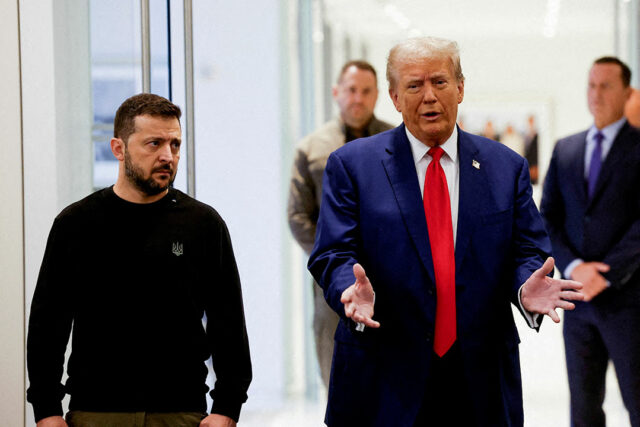
Donald Trump and Ukraine’s President Volodymyr Zelenskiy meet at Trump Tower in New York City, U.S., Sept. 27, 2024. — REUTERS

U.S. President Donald Trump could offer NATO-like protection of Ukraine, and Russia is open to the idea, one of his top foreign policy officials said on Sunday ahead of a meeting with Ukraine and European leaders to hammer out details of possible security guarantees for Kyiv.

“We were able to win the following concession, that the United States could offer Article 5-like protection,” Steve Witkoff, Mr. Trump’s special envoy to Russia, told CNN’s “State of the Union” program. “The United States could offer Article 5 protection, which was the first time we had ever heard the Russians agree to that.”

Mr. Witkoff was referring to Article 5 of the North Atlantic Treaty, which regards any attack against one of its 32 members as an attack on all. He suggested that a security guarantee of that scale could be offered to Ukraine in lieu of NATO membership, which Mr. Putin has ruled out.

Russia launched a full-scale invasion of Ukraine in February 2022 and has been gradually advancing for months in the deadliest war in Europe for 80 years,

Witkoff and Secretary of State Marco Rubio, who were both in the room when Trump met Russian leader Vladimir Putin in Alaska on Friday, gave a series of TV interviews ahead of a Monday meeting in Washington with Ukrainian President Volodymyr Zelenskiy and leaders of some European allies.

“We made some progress, we believe, and now we have to follow up on that progress,” Mr. Rubio told CNN’s “State of the Union” about the meeting with Putin. “Ultimately, where this should lead is to a meeting between the three leaders, between Mr. Zelenskiy, Mr. Putin and President Trump, where we can finalize, but we got to get this thing closer before we get to that point.”

Russian officials are opposed to Western troops in Ukraine, but have not ruled out a security guarantee for Kyiv. Speaking during a joint media appearance with Mr. Trump after their nearly three-hour long meeting, Mr. Putin said on Friday: “I agree with President Trump. He said today that Ukraine’s security must be ensured by all means. Of course, we are ready to work on this.”

Witkoff told “Fox News Sunday” that Russia had also agreed to passing a law against taking any more of Ukraine by force.

“The Russians agreed on enshrining legislatively language that would prevent them from – or that they would attest to not attempting to take any more land from Ukraine after a peace deal, where they would attest to not violating any European borders,” he said.

PEACE DEAL VS SURRENDER
Any security guarantees offered to Mr. Zelenskiy could also include a commitment from the United States, Mr. Rubio told Fox News’ “Sunday Morning Futures”, an option that many of Trump’s MAGA supporters have rejected up to now.

“It would be a very big move by the president, if he were to offer a U.S. commitment to a security guarantee,” Mr. Rubio said. “It tells you how badly he wants peace, how much he values peace, that he would be willing to make a concession like that …That’s what we’ll talk about tomorrow.”

In a social media post, Mt. Trump wrote, “BIG PROGRESS ON RUSSIA. STAY TUNED!” But he gave no details.

Mr. Rubio said U.S. officials discussed security details for Ukraine with the national security advisers of multiple European countries on Saturday, adding that the aim would be to build in details that could ultimately be presented to Russia as part of a peace agreement.

He told Fox News that the talks between Mr. Trump and Mr. Putin on Friday had narrowed the number of key issues, which include drawing borders and military alliances for Ukraine as well as security guarantees. “There’s a lot of work that remains,” Mr. Rubio added.

According to sources, Mr. Trump and Mr. Putin discussed proposals for Russia to relinquish tiny pockets of occupied Ukraine in exchange for Ukraine ceding a swathe of fortified land in the east and freezing the front lines elsewhere.

Mr. Rubio said Russia and Ukraine would not be able to get everything they want.

“If one side gets everything they want, that’s not a peace deal. It’s called surrender, and I don’t think this is a war that’s going to end anytime soon on the basis of surrender,” Mr. Rubio told CNN.

In a separate interview on ABC, Rubio said if a deal could not be reached to end the war, existing U.S. sanctions on Russia would continue, and more could be added.

When Mr. Zelenskiy visited the White House in February, the meeting ended in a shouting match. Mr. Rubio, speaking to CBS, dismissed the idea that the European leaders were coming to Washington to protect Mr. Zelenskiy.

“They’re not coming here tomorrow to keep Zelenskiy from being bullied. They’re coming here tomorrow because we’ve been working with the Europeans,” he said. “We invited them to come.” — Reuters

New corporate governance circular eyed

BW FILE PHOTO

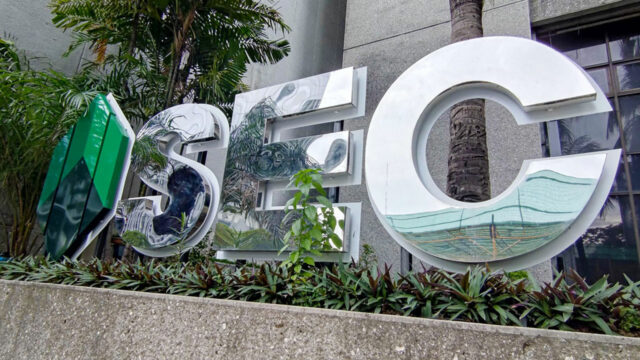
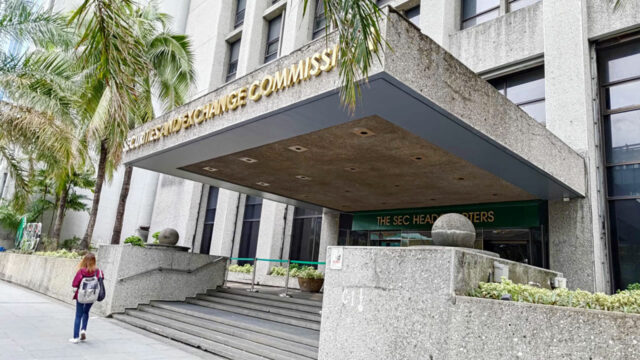
THE SECURITIES and Exchange Commission (SEC) wants to ensure that independent directors of publicly listed companies have security of tenure.

SEC Chairperson Francisco Ed. Lim told reporters on Friday that they are currently looking at issuing a new memorandum circular on corporate governance, including a provision on security of tenure for independent directors.

Mr. Lim said independent directors should have security of tenure during their nine-year term so they can speak up on company policies without fear of being removed from their post.

“We’re still discussing the issue because what I would want is a new memorandum circular purely on corporate governance-related matters, which will include like the term of independent directors, even their security of tenure… What we’re thinking is security of tenure within that nine-year limit,” he said. 

“If you’re an independent director and you fight for something which you believe is right, but it’s not consistent with what the controlling shareholders say, you’re putting your tenure at risk,” he added.   

An independent director is a member of a company’s board but does not have any material relationship with the company, its parent, subsidiaries or affiliates, and is independent of management.

Under the Code of Corporate Governance for Publicly-Listed Companies issued in 2016, the SEC recommended the board should have at least three independent directors or make up at least one-third of the board.

Mr. Lim said he also wants to strictly enforce the nine-year term limit for independent directors under current rules, instead of allowing companies to file for exemption.

“What is happening in some cases is they (companies) go to the SEC to seek exemption from that nine-year term limit. That’s why you see some independent directors exceeding the nine-year limit. I want to cap (the term limit),” he said.

“There’s no monopoly of talent. There is available talent in the market.”

Under the Code of Corporate Governance, independent directors can serve for a maximum cumulative term of nine years. However, the board has to provide meritorious justification and seek shareholders’ approval if an independent director’s term is extended beyond nine years.

“If the sitting independent directors really want to help, they can become independent directors of other companies, especially the smaller companies who stand to benefit from their wisdom and experience. The SEC may want to enable that by giving a term limit to independent directors,” Mr. Lim said.

Rizal Commercial Banking Corp. Chief Economist Michael L. Ricafort said the SEC’s proposal will further improve corporate governance standards in the country.

“This will help in ensuring checks and balances with high level decisions, while avoiding groupthink,” he said in a Viber message.   

“This will also help to align with the changing regulatory landscape towards higher environmental, social, and governance standards,” he added.

TALKS WITH GOCC
Meanwhile, Mr. Lim said the SEC has been in talks with the Philippine Stock Exchange (PSE) on potential Philippine government-owned and -controlled corporations (GOCC) that could be listed on the stock market.   

He added that the GOCCs should be “worth listing” to avoid creating unnecessary risk for investors.   

“That’s a work in progress. We have been discussing. What we did was to discuss it with the PSE, because it’s not a matter of listing all GOCCs,” he said.   

“We will identify. I want to have an official list,” he added.   

At present, there are no listed GOCCs in the Philippines.

In a report last April, the Organisation for Economic Co-operation and Development said state-run banks such as the Land Bank of the Philippines and the Development Bank of the Philippines are potential candidates for listing at the PSE.

At the same time, Mr. Lim said the SEC is veering towards a tiered minimum public float requirement for initial public offerings (IPOs) but noted that there’s no final decision yet.   

“We will still discuss it. If we can implement it earlier, the better,” he said.   

The PSE is eyeing to have six IPOs this year. However, the local bourse has only seen one public listing so far, with Cebu-based fuel retailer and distributor Top Line Business Development Corp. in April. — R.M.D.Ochave

Investors keen on PHL but seek stable rules, lower costs — Kearney

Buildings are seen in Quezon City in this file photo taken on May 27, 2024. — PHILIPPINE STAR/MIGUEL DE GUZMAN

By Beatriz Marie D. Cruz, Reporter

FOREIGN INVESTORS are eager to tap into the growth potential of the Philippines but concerns over unpredictable regulations and high cost of energy and logistics persist, according to executives of global management consulting firm Kearney.

In an interview with BusinessWorld, Shigeru Sekinada, Kearney senior partner and region chair, Asia-Pacific, and managing director, Japan, said foreign investors are looking at the Philippines as they diversify their manufacturing operations.

“In this context, each country needs to have predictable rules, governance, laws, and so on. This kind of element is among the most important, for the long-term perspective is necessary for the manufacturing sector,” Mr. Sekinada said.

“If they decide to invest in a factory, and this factory needs to run maybe 10 years, 20 years, 30 years. So, this kind of long-term predictability is very important.”

Lowering the cost of doing business would also encourage more foreign investors to expand operations here, Mr. Sekinada said. He noted investors look at the cost of logistics and energy before investing in a country.

“If the country has low-cost energy, low-cost logistics infrastructure, surely outside companies will be able to consider the Philippines as the best location for the manufacturing sector,” he said.

Mr. Sekinada said the Philippines has the potential to attract Japanese investment in sectors such as manufacturing, energy, consumer goods and retail, and healthcare.

“As you know, Japan’s market is shrinking. On the other hand, your market is growing. That’s why Japanese companies tend to think about expanding their business in the consumer goods and retail sector,” he said.

The Philippines must also have a stronger intellectual property (IP) environment to ensure that foreign companies are protected and remain profitable, Mr. Sekinada added.

“For example, if a Japanese company enters a specific country, the local manufacturers would create an almost similar product. As a result, Japanese manufacturers’ profitability becomes the worst. That’s why some Japanese companies decide to close their business in that country,” he said.

In Kearney’s 2025 Foreign Direct Investments (FDI) Confidence Index emerging market rankings, the Philippines fell three spots to 16th out of 25 countries. The ranking is based on an economy’s likelihood of attracting FDIs in the next three years.

China, including Hong Kong, topped the emerging market rankings. The Philippines trailed behind Southeast Asian neighbors like Thailand (10th), Malaysia (11th), Indonesia (12th), but was ahead of Vietnam (19th).

The index showed that efficiency of legal and regulatory processes, as well as domestic economic performance, are the top two most important factors that foreign investors take into consideration before making investment decisions.

Kearney Senior Partner and Philippines Country Head Marco de la Rosa said investors also look at an economy’s level of technology and innovation, ease of bringing in and taking out capital, tax rates, and infrastructure quality.

“It’s not just what the country can offer, it’s how the country does business with investors,” Mr. De la Rosa told BusinessWorld.

“If we can somehow make it easier to do business here in the country, that’s the number one most attractive factor for investors… If we are a lot more transparent and a lot more predictable, then we have a pretty good fighting chance,” he said.

While the Philippines has existing policies to support investors like Republic Act No. 11032 or the Ease of Doing Business Act, Mr. De la Rosa said there is a need for better enforcement and implementation of existing laws.

“As a Filipino, what I would observe is we have the right laws, but it’s a very complex structure — there’s different levels of government, corporate organizations, and there’s public organizations,” he said. “How do you make sure that everybody complies with the law and also executes it very quickly?”

Mr. De la Rosa said removing restrictions on full foreign ownership of land is not necessarily needed to attract more FDIs as long as the country maintains a consistent and predictable business environment.

“Obviously, a totally free market where an investor can come in and own assets outright is easier because they feel that sense of control. But if you look at Indonesia, Vietnam, and other markets, they also don’t have 100% foreign investment laws,” he said.

“If you can’t give 100% or outright foreign ownership, as long as it’s predictable, enforceable, and consistent, then you’re probably okay,” he added.

GLOBAL UNCERTAINTY
The Kearney executive noted that global uncertainties present both a risk and an opportunity for countries to diversify their supply chains.

“In this era of uncertainty, there is a window of opportunity where the Philippines can invest and be a player in the game, but it’s a finite window, and we need to catch up,” Mr. De la Rosa said.

Last month, US President Donald J. Trump slapped a 19% tariff on exports from the Philippines, Cambodia, Malaysia, Thailand and Indonesia.

With this, the Philippines has “no choice but to diversify” its supply chains, Mr. De la Rosa said.

“It’s not like we have a zero track record on manufacturing. We have local manufacturers, food and others, here in the country, so there is a reason to believe that we can do it with the right focused investment,” he added.

Gov’t expects poverty incidence to fall to as low as 8% by 2028

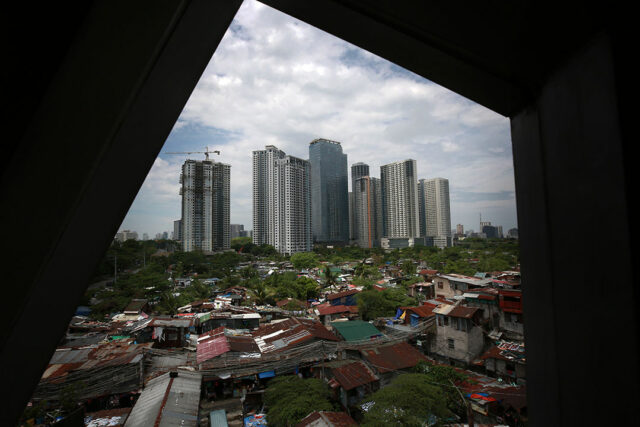
Homes of informal settlers are seen in Baseco, Tondo, Manila. — PHILIPPINE STAR/JOHN RYAN BALDEMOR

THE PHILIPPINE government is confident it can bring down the poverty rate to single-digit levels by 2028.

“While we lowered our growth targets, we remain optimistic about reducing poverty rates to single-digit levels by 2028,” the Department of Economy, Planning, and Development (DEPDev) said in the midterm update of the Philippine Development Plan (PDP) 2023-2028.

Under the updated PDP, the government now aims to reduce the poverty incidence rate to 10-11% by 2027 and 8-9% by 2028. President Ferdinand R. Marcos, Jr.’s term will end in June 2028.

The poverty incidence target stood at 12-13% for 2025.

“Poverty incidence continues to fall, and we are intensifying efforts to ensure that the benefits of economic growth reach all regions and communities,” Economy Secretary Arsenio M. Balisacan said.

Data from the Philippine Statistics Authority (PSA) showed poverty incidence among the population fell to 15.5% in 2023 from the 18.1% estimate in 2021. This translated to 17.54 million poor Filipinos, 12.26% down from 19.99 million in 2021. This exceeded the 2023 poverty rate target of 16-16.4%.

“This indicates that nearly 2.4 million Filipinos were lifted out of poverty. Encouragingly, income growth among the poorer half of the population outpaced that of the wealthier half — signaling meaningful progress toward making economic growth more inclusive,” DEPDev said in the report.

The government has recalibrated the development plan at the midpoint of Mr. Marcos’ term, reflecting emerging domestic and global challenges. 

Under the updated PDP, the government is aiming for 5.5-6.5% economic growth this year. It also narrowed the gross domestic product (GDP) target band to 6-7% from 2026 to 2028.

The PDP previously set a 6.5-8% GDP growth target until 2028.

“While slower economic growth typically poses a challenge to reducing poverty, the recent achievement provides a strong rationale for retaining current poverty targets,” DEPDev said.

With sustained focus on key priorities, such as health and food security, DEPDev expects the impact of growth to be more inclusive and pro-poor, supporting the attainment of poverty targets.

“Furthermore, we will enhance the efficiency of social assistance programs by developing a dynamic social registry and refining our targeting protocols. To further empower beneficiaries of ayuda programs, we will link them to initiatives on financial literacy and employment facilitation, enabling them to build resilience and better withstand future shocks,” it said.

UMIC STATUS
Meanwhile, DEPDev said the Philippines is poised to achieve its upper middle-income country (UMIC) status in the “near term.”

“Achieving upper middle-income status is no longer a distant aspiration — it is now within reach,” Mr. Balisacan said.

Under the updated PDP, the government is targeting gross national income (GNI) per capita to reach $4,814-$4,920 this year and $5,124-$5,210 in 2026.

The government aims to have a GNI per capita of $5,452-$5,589 in 2027, and $5,882-$6,081 in 2028.

The World Bank’s latest country income classification released in July showed the Philippines remained a lower middle-income country even as it posted a record-high GNI per capita of $4,470.

The World Bank classifies a country as lower middle income if the GNI per capita level is between $1,136 and $4,495. A country has to have a GNI per capita of $4,496-$13,935 to be classified as upper middle income. — ARAI

BIR to collect P360 billion in excise taxes in 2026

AN ILLUSTRATION picture shows cigarettes in their pack, Oct. 8, 2014. — REUTERS/CHRISTIAN HARTMANN/ ILLUSTRATION/FILE PHOTO

THE Bureau of Internal Revenue (BIR) is looking to increase excise tax collections by 9% in 2026, mainly driven by tobacco products.

In the 2026 Budget of Expenditures and Sources of Financing (BESF), the government is set to collect P359.65 billion in excise taxes in selected goods, 9.35% higher than P328.9 billion for this year.

The bulk or P166.57 billion in excise taxes will be collected from tobacco products, even as the government sees significant losses due to illicit trade.

The BIR expects to collect P132.07 billion in excise taxes from alcohol products, and P42.09 billion from sugar-sweetened beverages.

It is also targeting to collect excise taxes from mining (P11.85 billion) and automobiles (P6.54 billion).

Notably, the government took out the projected revenue from the proposed tax on single-use plastics, as the measure has yet to be approved by Congress.

The Philippines is bleeding $2 billion (P114 billion) in lost revenues due to the proliferation of illicit tobacco trade in the country, a consultancy firm said at a forum last week.

BIR Commissioner Romeo D. Lumagui, Jr. earlier said the government loses billions of revenues due to illicit tobacco trade coupled with Health department’s campaign to discourage tobacco use.

Mr. Lumagui also said illicit tobacco manufacturers are using economic zones to avoid paying excise taxes even though the products are sold in the Philippines.

“If it’s meant for export and not for local consumption, there’s no excise tax. It’s being manufactured here in the ecozones. That’s what they’re trying to show — that the license they’re getting is for exporting all these products,” he told reporters during a tobacco forum on Aug. 5.

In the first half, excise taxes on tobacco went up 34.16% to P58.97 billion in the January-to-June period, after several months of continued contraction. — ARAI

SEC says no ban on crypto trading

BW FILE PHOTO

THE Securities and Exchange Commission (SEC) said its new rules on crypto asset service providers (CASPs) do not ban cryptocurrency trading in the Philippines but require platforms to register to safeguard investors and uphold market integrity.

“The CASP rules do not prohibit cryptocurrency trading or investment. Rather, they require platforms to obtain the appropriate registration and licenses before offering their services in the Philippines,” the corporate regulator said in an advisory on its website issued on Aug. 14.

“This ensures that investors are protected, market integrity is upheld, and all market participants operate on a level playing field,” it added.

The SEC said the CASP rules, which took effect on July 5, apply to all entities, local or foreign, that offer crypto asset services in the Philippines. With this, the commission urged local and foreign platforms to register and comply.

“We recognize the importance of a free, competitive market, but one that is responsibly regulated to protect investors and support the sustainable growth of the crypto industry in the Philippines,” the SEC said.

The commission said the enforcement of the CASP rules is within its legal mandate to investigate and act against unregistered entities, which may include measures to limit access to noncompliant platforms.

“These actions are designed to safeguard the public from risks such as fraud, loss of funds, and money laundering risks that often increase during periods of heightened market activity,” it said.

On May 30, the SEC issued Memorandum Circular Nos. 4 and 5, providing for the CASP rules and the guidelines on CASP operations, respectively.

Under the guidelines, CASPs must be registered as corporations with a minimum paid-up capital of P100 million in cash or property, excluding crypto assets. They must also have a physical office that is appropriately staffed during regular business hours.

Applications for registration will come with an initial filing fee of P50,000. CASPs will also pay a supervision fee to the SEC based on their gross revenue during the preceding year, for the privilege of doing business.

The SEC warned that violators may be punished with imprisonment of one to five years, or with a fine of P50,000 to P10 million.

Earlier this month, the SEC issued an advisory warning the public against ten crypto platforms providing crypto asset services without the necessary licenses. These platforms include OKX, Bybit, Mexc, Kucoin, Bitget, Phemex, Coinex, Bitmart, Poloniex, and Kraken.

“These platforms have no license, registration, or authorization from the SEC to operate in the Philippines or to solicit investments from the public. Their actions are unauthorized and expose Filipino investors to significant risk, including total loss of funds, no legal recourse, and exposure to fraud, market manipulation, and identity theft,” the SEC said.

A crypto asset refers to “a cryptographically secured digital representation of value or of a right that relies on a cryptographically secured distributed ledger or a similar technology to validate and secure transactions that can be transferred, stored, or traded electronically.” On the other hand, crypto asset securities are crypto assets being offered as securities.

A CASP is a business entity that offers or provides one or more crypto asset services, including the operation of a digital platform that provides such services. — Revin Mikhael D. Ochave

Analysts see BSP order on gambling links weighing on e-wallets

BW FILE PHOTO

By Ashley Erika O. Jose, Reporter

THE Bangko Sentral ng Pilipinas’ (BSP) order directing electronic wallet (e-wallet) platforms to remove in-app links to online gambling sites is expected to weigh on their earnings and could delay the planned initial public offering (IPO) of GCash, analysts said.

“The BSP suspension order is expected to have a significant impact on the major e-wallet platforms because of the substantial volume of online gaming transactions through those apps,” China Bank Capital Corp. Managing Director Juan Paolo E. Colet told BusinessWorld.

Last week, the BSP ordered all e-wallets, banks, and other supervised institutions to remove in-app gambling assets, including links directing users to gaming or gambling websites. The BSP said the suspension will remain in place until its guidelines for online gambling payment services are finalized.

Maya, the digital finance platform partly owned by listed telecommunications firm PLDT Inc., said it had fully complied with the BSP directive by disabling links to gambling sites.

GCash also announced that it had suspended gaming access following the BSP’s directive. Listed Globe Telecom, Inc. has an ownership stake in Globe Fintech Innovations, Inc. (Mynt), the parent company of GCash.

“The order to remove in-app gaming access in GCash and Maya may dent these platforms’ gaming-related transactions,” Unicapital Securities, Inc. Equity Research Analyst Peter Louise D.C. Garnace said in a Viber message.

First Grade Finance, Inc. Managing Director Astro C. del Castillo said the BSP order is a welcome move and the immediate compliance of both GCash and Maya is commendable.

“We don’t expect that it will derail their earnings trajectory since both are more focused on infra expansion and enterprise services among others,” Mr. Del Castillo said.

However, for Unicapital Securities’ Mr. Garnace and China Bank Capital’s Mr. Colet, the recent government order may still pose a threat to major e-wallet platforms.

“The impact should be limited as growth in these e-wallets remains broad-based. The BSP’s directive restricts only in-app gambling access and does not impair overall payment capability, as users can still transact directly through online gaming providers’ websites,” Mr. Garnace said.

While the BSP order is temporary, Mr. Colet said it could still affect the earnings of these platforms.

“The order is temporary, but the longer it stays in place, the bigger the potential drag on their earnings. This will likely further delay the planned initial public offering of GCash,” he said.

Globe said earlier that the much-anticipated GCash IPO would likely proceed later this year or next year amid market uncertainties.

For the first half, Globe’s attributable net income fell 14.5% to P12.44 billion from P14.55 billion a year earlier, dragged by weaker revenue for the six months ending June.

Globe’s gross revenue for the January-to-June period dropped 2.68% to P87.23 billion from P89.63 billion a year ago.

The company’s net income decline was partly tempered by its affiliates, particularly Mynt, the holding company of GCash.

Mynt posted strong performance in the first half, Globe said, noting that GCash helped offset a steeper decline in its net income.

Mynt’s equity earnings for the six-month period ended June 2025 surged 78% to P3.8 billion from P2.1 billion last year. This accounted for 26% of Globe’s pre-tax net income, more than double its 12% contribution a year earlier.

Meanwhile, PLDT said it expects profitability from Maya this year, adding that the platform may generate about P2 billion in earnings by yearend.

For the first half, PLDT’s share of profits from its digital bank Maya amounted to P406 million, a turnaround from a P1.1-billion loss a year ago.

“In our view, the measure reduces convenience (no more one-click access to the e-wallet), but does not eliminate the ability to fund gambling activities. Whether this added friction will significantly curb gaming-related transactions remains to be seen,” Mr. Garnace said.

At the stock exchange on Friday, shares in Globe closed P3, or 0.18% higher at P1,698 apiece, while PLDT shares fell P26, or 1.99%, to P1,280 each.

Hastings Holdings Inc., a unit of PLDT Beneficial Trust Fund subsidiary MediaQuest Holdings Inc., holds a majority stake in BusinessWorld through the Philippine Star Group.

PLDT resumes talks to sell stake in data center unit

EPLDT.COM

TELECOMMUNICATIONS company PLDT Inc. has resumed talks to sell a stake in its data center business, after previously shelving a $1-billion deal.

“We have been approached lately by interested parties… they are a big multinational and are also listed,” PLDT Chairman and Chief Executive Officer Manuel V. Pangilinan told reporters on the sidelines of the company’s financial briefing last week.

Mr. Pangilinan declined to identify the company but said that nothing is final yet.

“I think this time we are serious about selling a stake in data centers,” he said.

PLDT had previously announced plans to finalize the sale of its data center unit, ePLDT Inc., to a foreign entity for over $1 billion after talks with Japan’s Nippon Telegraph and Telephone Corp. (NTT) failed to progress.

However, Mr. Pangilinan later said that the company had shelved the plan as it intended to continue expanding its data center assets.

In April, PLDT inaugurated VITRO Sta. Rosa, its 11th data center.

The facility, located on a five-hectare site in Sta. Rosa, Laguna, is said to be the country’s largest data center campus, with a capacity of up to 50 megawatts (MW). Across all sites, VITRO data centers have a combined capacity of nearly 100 MW.

The company also said it is moving closer to building its 12th and largest data center. The facility will rise in General Trias, Cavite, and will have a capacity of up to 100 MW — double that of VITRO Sta. Rosa.

Hastings Holdings, Inc., a unit of the PLDT Beneficial Trust Fund subsidiary MediaQuest Holdings, Inc., holds a majority stake in BusinessWorld through the Philippine Star Group, which it controls. — Ashley Erika O. Jose

T-bill, bond rates may go down on easing hopes

BW FILE PHOTO

RATES of the Treasury bills (T-bills) and Treasury bonds (T-bonds) on offer this week could go down on monetary easing bets and as demand returns to normal following the end of the government’s public offering of five-year retail Treasury bonds (RTB).

The Bureau of the Treasury (BTr) will auction off P25 billion in T-bills on Monday, or P8 billion in 91-day and 182-day securities, and P9 billion in 364-day papers.

On Tuesday, the government will offer P25 billion in reissued 10-year T-bonds with a remaining life of nine years and eight months.

T-bill and T-bond yields could decline this week, mirroring the week-on-week decline seen at the secondary market, following dovish signals from the central bank chief, Rizal Commercial Banking Corp. Chief Economist Michael L. Ricafort said in a Viber message.

“The markets have been anticipating a possible 25-basis-point (bp) Bangko Sentral ng Pilipinas (BSP) rate cut as early as the next rate-setting meeting on Aug. 28, as supported by benign inflation recently,” Mr. Ricafort said.

Investors are also pricing in a possible 25-bp reduction from the US Federal Reserve in September, he added.

A trader said in an e-mail that the reissued 10-year bonds to be offered this week could see good reception and fetch rates ranging from 6% to 6.075%, broadly in line with secondary market levels.

At the secondary market on Friday, yields on the 91-, 182-, and 364-day T-bills went down by 7.83 bps, 5.09 bps, and 0.65 bp week on week to close at 5.2921%, 5.5066%, and 5.6592%, respectively, according to PHP Bloomberg Valuation Service Reference Rates data published on the Philippine Dealing System’s website.

The 10-year bond’s rate also declined by 5.91 bps week on week to end at 6.0657%.

Last week, BSP Governor Eli M. Remolona, Jr. said a rate cut is “quite likely” at the Monetary Board’s next meeting on Aug. 28 as inflation is likely to settle within its annual target.

The central bank has so far lowered borrowing costs by a total of 125 bps since it began its easing cycle in August last year to bring the benchmark rate to 5.25%.

Mr. Remolona said they are expecting to deliver two more rate cuts this year. However, he noted that the possibility of three rate cuts is “unlikely.”

After the Aug. 28 meeting, the BSP will have two more policy meetings before the end of 2025.

Philippine headline inflation slowed to a near six-year low of 0.9% in July, marking the fifth straight month that inflation settled below the central bank’s 2-4% target range.    

For the first seven months of the year, inflation averaged 1.7%.

Mr. Ricafort added that the closure of the government’s RTB offer on Friday, which temporarily affected market liquidity, as well as a recent bond maturity could lead to better demand and lower yields this week.

The government raised an initial P210 billion from its offer of five-year RTBs at the rate-setting auction held on Aug. 5, with tenders reaching P354.175 billion.

The notes are priced at 6% per annum, payable quarterly.

The public offer period ran from Aug. 5 to 15, while settlement is on Aug. 20.

The government has not announced the final issue size for its latest tranche of retail bonds. National Treasurer Sharon P. Almanza earlier said the government is aiming to raise P300 billion in fresh funds from the RTBs, excluding the volume generated through the bond exchange offer program.

Last week, the government raised P25 billion as planned from the T-bills it auctioned off as the offer was almost four times oversubscribed, with total bids reaching P94.926 billion.

Broken down, the Treasury borrowed P8 billion as planned via the 91-day T-bills as total tenders for the tenor reached P30.47 billion. The three-month paper was quoted at an average rate of 5.287%, down by 3.1 bps from the previous auction. Yields accepted ranged from 5.21% to 5.318%.

The government also raised P8 billion as programmed from the 182-day securities as tenders amounted to P33.45 billion. The average rate of the six-month T-bill was at 5.506%, declining by 2.9 bps, with accepted yields ranging from 5.448% to 5.533%.

Lastly, the Treasury sold the planned P9 billion in 364-day debt as demand for the tenor totaled P31.006 billion. The average rate of the one-year T-bill dropped by 2.5 bps to 5.612%. Tenders accepted carried rates ranging from 5.6% to 5.638%.

Meanwhile, the reissued 10-year bonds on offer on Tuesday were last auctioned off on July 15, where the BTr raised P25 billion as planned at an average rate of 6.285%, below the 6.375% coupon.

The Treasury is looking to raise P185 billion from the domestic market this month, or P125 billion through T-bills and P60 billion via T-bonds.

The government borrows from local and foreign sources to help fund its budget deficit, which is capped at P1.56 trillion or 5.5% of gross domestic product this year. — Aaron Michael C. Sy

AI, language training to address skills gaps in Philippine labor market — MMDC

MMDC CHIEF LEARNING OFFICER and Ayala Education Co-founder Derrick Latreille

By Beatriz Marie D. Cruz, Reporter

MAPÚA MALAYAN Digital College (MMDC) said it is expanding its micro-credential programs with courses in English proficiency and artificial intelligence (AI) to help Filipino workers address skills gaps in the technology-driven labor market.

The upcoming courses will focus on training and exam preparation for the International English Language Testing System (IELTS), certification for English as a Second Language (ESL) instructors, and an introduction to AI, MMDC Chief Learning Officer and Ayala Education Co-founder Derrick Latreille said in an interview with BusinessWorld.

“As technology disrupts the labor market faster and faster, people need quicker, more nimble ways to skill themselves up and move into better-paying jobs and better careers,” Mr. Latreille said.

“We’ve gotten overwhelming demand for ESL, so we’re going to offer a micro-credential certification to qualify someone as an ESL instructor,” he added.

MMDC will also offer micro-credential courses for those taking the IELTS, particularly individuals aiming to work, study, or migrate to English-speaking countries, he said.

Meanwhile, its AI certification course is intended to help learners transition from basic to advanced use of AI technologies.

“We’ve put together an AI micro-credential [course] from multiple providers that addresses the awareness gaps people have around which AI [tools] they need to know, and the skill gaps,” Mr. Latreille said.

By September, MMDC will also implement a more affordable pricing scheme in response to public demand, he said.

“We saw that people wanted lower, more broken-down prices. So, starting in September, all our courses will cost no more than P5,000 to get started,” Mr. Latreille said. “The modules that follow will usually be about P1,000 to P3,000.”

MMDC offers flexible, industry-recognized certification programs as workers navigate technological disruptions in the post-pandemic workplace. It operates under Mapúa Malayan Colleges Laguna, a sister school of Mapúa University.

Mapúa is the flagship university of listed company iPeople, Inc., a joint venture between the Yuchengco-led House of Investments and Ayala Corp.

The MMDC Certification Programs currently offer five courses: Virtual Assistance, Meta Social Media Marketing, Google Digital Marketing and E-Commerce, Adobe Content Creation, and IBM Data Analytics.

“We just launched in April, so what we’re working on and ironing out is what the experience has been [for our enrollees, and] what support they need,” Mr. Latreille said.

“By October, November, and December, we’re going to be taking off at high speed. I would expect there will be about a thousand people enrolling in that timeframe.”

MMDC’s certification programs are fully online, catering to the needs of both full-time and working students. They are accessed through Coursera, a global online learning platform, providing self-paced learning modules, AI learning tools, and student monitoring.

Upon completing a course, MMDC can provide additional support such as building graduates’ curriculum vitae, preparing them for interviews, and connecting them with prospective employers.

To enroll in a certification program, an applicant must be at least a high school graduate, whether pre-K-12 or K-12. Enrollment is open from the 1st to the 20th of each month, while classes begin on the 1st of the succeeding month.

Most of MMDC’s students already have work experience and are aiming for promotions, while others enroll to increase their chances of being hired, Mr. Latreille said.

“One of the things that surprised us is we thought most of the people signing up would be looking for new jobs, but that’s actually the minority. A lot of them are looking to upgrade their skills for a future promotion,” he added.

About 68% of Filipinos need training to meet evolving skill demands, with two-thirds of Philippine employers identifying skills gaps as a barrier in the labor market over the next five years, the World Economic Forum (WEF) said in its 2025 Future of Jobs Report.

By 2030, the most in-demand skills among employers globally will include AI and big data, networks and cybersecurity, technological literacy, creative thinking, resilience, flexibility and agility, and curiosity and lifelong learning, WEF said.

“Some of my friends in the BPO (business process outsourcing) space recently told me that they’re finally seeing AI handle low-level phone calls. So, people in the BPO space need to start looking at other options, like, ‘How can I skill up to move into other spaces?’” Mr. Latreille said.

The gig economy also serves as a key market for MMDC, he noted, as many types of gig work opportunities focus on an individual’s micro-credentials and value-added skills.

“First, it was the OFWs (overseas Filipino workers), then it was the BPOs, and now, I think gig work is the third wave of labor in the Philippines,” he said. “Preparing people for lots of gig work will be a big opportunity for micro-credentials to enable them to participate in it.”

As the Philippine job market evolves, MMDC expects greater demand for micro-credential programs as workers and employers alike seek to address the country’s digital skills gap.

“There will be a lot of people looking for better jobs, and they don’t have the time and money to make college work,” Mr. Latreille said. “At the same time, you might have a college degree but you see the labor market shrinking for that degree because of things like AI.”

For Mr. Latreille, what sets MMDC’s certification courses apart is the involvement of tech leaders such as Google and Meta.

“We’re letting the labor market lead us in what we offer, because we see ourselves as facilitators here rather than the teachers.”


ADVERTISEMENT
ADVERTISEMENT