Home Blog Page 1134

Lawyers and academics ask tribunal to halt service fee increase at NAIA

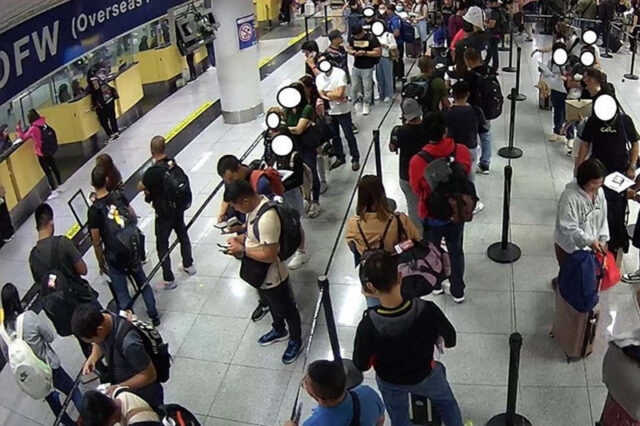
NINOY AQUINO INTERNATIONAL AIRPORT (NAIA) Terminal 3 — PHILIPPINE STAR/MIGUEL DE GUZMAN

A GROUP of lawyers and academics on Monday asked the Supreme Court (SC) to stop a plan to increase service fees at the Ninoy Aquino International Airport (NAIA), set to take effect on Sept. 14.

The group, led by lawyer Joel R. Butuyan and Antonio Gabriel M. La Viña, former dean of the Ateneo de Manila University’s School of Government, asked the tribunal to block the Manila International Airport Authority’s (MIAA) revised Administrative Order No. 1, issued last year.

Named respondents were Executive Secretary Lucas P. Bersamin, the MIAA, Pre-Qualification, Bids and Awards Committee for the NAIA public-private partnership (PPP) project, PPP Governing Board and New NAIA Infra Corp. (NNIC).

The same plaintiffs earlier asked the High Court in April to void MIAA’s revised administrative order and the award of the concession agreement to NNIC, arguing that both were illegal and against public policy.

In their latest filing, they opposed the upcoming fee hikes. Under the plan, international departure fees will rise 72.7% to P990, while domestic passenger service charges will increase 95% to P390.

The March 18, 2024, concession agreement among the Transportation department, MIAA and NNIC covers the rehabilitation, operation and expansion of Manila’s international airport, with a 15-year term that is extendable by 10 years.

“The petitioners cannot and should not be burdened by exactions arising from an administrative order and from an awarded concession contract that violate their constitutional rights to due process and the equal protection of the laws,” the plaintiffs said in their lawsuit.

Officials from the NNIC, MIAA, San Miguel Corp., the Presidential Palace and Transportation department did not immediately reply to separate Viber messages seeking comments.

The group noted that since the NNIC assumed operations in September 2024, fees and rentals at NAIA have surged. They said landing and takeoff charges have more than tripled, while aircraft parking rates have risen more than 15 times.

They also cited a 60% increase in tracking fees, a 90% rise in lease rates for airlines, a 50% hike for ground handlers and a 50% increase in rates for lounges and commercial spaces.

They added that the concessionaire has yet to build any major structure or introduced significant equipment upgrades.

“These increases will affect 130,000 airline passengers daily, or more than 50 million passengers per year [who] have been reportedly recorded to have used NAIA in the past year,” the petitioners said in a separate statement. “It will also affect 750 flights per week, or 293,433 flights per year, per 2024 statistics.”

The plaintiffs cited jurisprudence involving NAIA that held excessive airport fees ultimately burden ordinary Filipinos, threaten business viability, cause job losses and worsen inflation and unemployment.

A separate petition was filed last week by a coalition of citizens, taxpayers, overseas Filipino workers and airport employees questioning both the MIAA order and the March 2024 concession agreement granting NNIC control over NAIA’s modernization.

San Miguel Corp.-led NNIC in March signed a P170.6-billion contract to operate, maintain and upgrade the country’s main gateway for 25 years. It took over the airport in September last year.

The NNIC plans to build a passenger terminal building with a capacity of 35 million passengers annually as part of efforts to ease airport congestion.

Passenger volume at NAIA rose 4.73% in the first half to 26.74 million from a year earlier, thanks to the sustained growth of domestic travel. The number of domestic passengers climbed 6.25% to 14.27 million, while international passenger traffic rose 6.76% to 12.47 million, MIAA reported earlier this month.

For the six-month period, MIAA logged 147,813 flights. MIAA expects passenger volume to grow by as much as 30% this year. — Chloe Mari A. Hufana


PHL starts P100-M solar irrigation project in Ormoc

PRESIDENT Ferdinand R. Marcos, Jr. inspects Ormoc City’s P100-M solar-powered irrigation project. — PRESIDENTIAL COMMUNICATIONS OFFICE

THE PHILIPPINES has invested P100 million in a solar-powered irrigation project in Ormoc City, Eastern Visayas, as part of efforts to boost renewable infrastructure spending to cut farm energy costs and improve food production.

The RM Tan Solar Pump Irrigation Project (SPIP), developed under the National Irrigation Administration (NIA), will provide year-round irrigation to 100 hectares of farmland, benefiting 92 farmers, Malacañang said in a statement on Monday after a site visit by President Ferdinand R. Marcos, Jr. and NIA Administrator Eduardo Eddie G. Guillen.

The system, which replaces diesel-powered pumps with solar-powered units, is expected to lower operating expenses, reduce carbon emissions and shield farm production from oil price volatility.

The Presidential Palace said the Ormoc project is the largest of its kind in Eastern Visayas and forms part of NIA’s nationwide push to deploy climate-smart irrigation systems, in line with the government’s renewable energy targets and Mr. Marcos’ climate-resilient agriculture agenda.

The facility includes seven solar-powered pumps with a combined 70-horsepower capacity spread across two sites.

“The Ormoc SPIP is part of a nationwide initiative to build similar solar-powered irrigation systems,” it said. “This effort aims to deliver long-term benefits to farmers and aligns with the country’s renewable energy and sustainable development goals.”

Officials said the project is expected to provide farmers with a cheaper and cleaner water source, improve harvests, raise rural incomes and cushion them from fluctuations in fuel prices.

Mr. Marcos was joined at the inauguration by Mr. Guillen, NIA Integrated Management Office for Biliran-Leyte del Norte-Leyte del Sur Manager Conrado M. Samson and personnel from NIA’s central and regional offices.

Leaders of the RM Tan Irrigators Association and farmer-beneficiaries also took part in the event.

Meanwhile, Senator Emmanuel Joel J. Villanueva has filed a bill that seeks to give farmers and fisherfolk pension and social security benefits.

Senate Bill No. 244 or the Pensiyonadong Magsasaka at Mangingisda bill will create a Farmers and Fisherfolk Social Security and Pension program. About 10 million farmers and fishermen nationwide will get sickness, maternity, disability, retirement, death and funeral benefits.

“Let’s make our farmers and fishermen feel that they have someone to lean on in their old age,” Mr. Villanueva said in a statement.

In the bill’s explanatory note, the senator cited the urgency of safeguarding the welfare of agricultural workers. “There is an urgent need to safeguard their welfare through policies that mitigate their socioeconomic risks and vulnerabilities,” he said.

A comprehensive pension and social security program would help ensure a “higher quality of life” for those who sustain the country’s food supply, he added.

Under the bill, the program will be integrated into the Social Security System (SSS), as well as initiatives of the Department of Agriculture (DA) and Philippine Crop Insurance Corp. (PCIC).

Initial funding for the program will come from government savings. Later, 10% of annual duties from farm imports will fund the program, while the Agriculture department will cover any supplemental funding requirements in its yearly budget. — Chloe Mari A. Hufana and Adrian H. Halili

Metro Manila air quality improved in 2024 due to Euro 4 fuel standards, says DENR

PHILIPPINE STAR/ MIGUEL DE GUZMAN

AIR QUALITY in Metro Manila improved significantly in 2024, largely due to emission-reduction programs including the enforcement of Euro 4 fuel standards since 2016, the Department of Environment and Natural Resources (DENR) said.

Based on data from the agency’s Environmental Management Bureau (EMB), average particulate matter 10 (PM10) concentration in the capital region fell 17.4% to 38 micrograms per normal cubic meter (µg/ncm) from 46 µg/ncm in 2016.

PM10 refers to particles 10 micrometers or smaller, while PM2.5 includes finer particles of 2.5 micrometers or less. Such pollutants, often produced by vehicle exhaust, burning of fossil fuels and industrial processes, can penetrate the lungs and enter the bloodstream, the DENR said.

The EMB also recorded a 37.6% improvement in PM2.5 levels in Metro Manila, from 27 µg/ncm in 2016 to 16.86 µg/ncm in 2024.

Nationwide, the DENR reported a 28.2% reduction in PM10, from 39 µg/ncm in 2016 to 28 µg/ncm in 2024 — well below the national guideline value of 60 µg/ncm. PM2.5 levels also dropped to 16 µg/ncm in 2024 from 20 µg/ncm in 2016, reflecting the effectiveness of emission-reduction initiatives.

The agency said 65% of highly urbanized and major urban centers — or 22 out of 34 cities — complied with both PM10 and PM2.5 air quality guidelines last year, surpassing the national compliance target of 62%.

From 2022 to 2024, the EMB issued 1,807 certificates for Euro 4-compliant vehicles, certifying that new units meet emission standards before entering the market. Euro 4 regulations set strict limits on pollutants such as nitrogen oxides, particulate matter, carbon monoxide and hydrocarbons from both light- and heavy-duty vehicles.

The DENR said it is “actively leading” the shift toward Euro 5 fuels and engines, which could cut particulate emissions by as much as 95.5%. It is also pushing changes to the Philippine Clean Air Act to strengthen standards regulating industrial emissions, particularly particulate matter, carbon monoxide, nitrogen oxides and sulfur oxides.

The EMB has been implementing industrial emission monitoring programs covering coal-fired power plants, cement plants and other major facilities. As of June, 20 companies with 59 stack sampling teams were accredited to conduct emission testing, up from 57 teams last year.

The bureau said many facilities are now equipped with continuous emission monitoring systems linked to the EMB Data Center, allowing real-time emission tracking and ensuring compliance.

To support air quality management, the EMB operates 113 air quality monitoring stations nationwide, providing real-time data on harmful pollutants to guide policymaking. — Kyle Aristophere T. Atienza

Inter-agency body created for PHL education, workforce development

Students walk to school, March 3, 2025. — PHILIPPINE STAR/RYAN BALDEMOR

PRESIDENT Ferdinand R. Marcos, Jr., created a new inter-agency body to coordinate reforms in the country’s education and workforce development systems, citing persistent gaps in teacher support, policy consistency, and program implementation.

Administrative Order No. 36, signed on Aug. 13, provided that the Education and Workforce Development Group (EWDG) will serve as the government’s primary coordinating body for education and workforce matters.

“It is necessary to establish an effective coordinating mechanism among agencies involved in education and workforce development to address long-standing concerns in the education sector, and foster a complete, adequate, and integrated education system in the country,” the order read.

The order was prompted by findings from the Second Congressional Commission on Education (EDCOM II), which flagged fragmented implementation of education programs, misaligned teacher training initiatives, and inconsistent planning across agencies.

The EWDG is tasked to craft a 10-year National Education and Workforce Development Plan, reviewing existing inter-agency bodies and policies, and assessing the legal framework governing the education sector. It will be required to submit monthly performance reports to the President and the Executive Secretary.

The Order also grants the Group authority to form technical working groups to support its initiatives.

Mr. Marcos will chair the Group, with the Education Secretary as co-chair and the Labor Secretary as vice-chair.

Other members include the heads of the Commission on Higher Education, the Technical Education and Skills Development Authority, the Department of Migrant Workers, and the Department of Economy, Planning, and Development.

The Philippines continues to face a deep learning crisis marked by low student achievement, weak teacher support, and fragmented governance across its education system.

Despite significant spending on reforms, recent international assessments have ranked Filipino learners among the lowest globally in reading, math, and science.

These challenges have resulted in poor learning outcomes, widening inequality in access to quality education, and a workforce unprepared to meet the demands of a rapidly changing economy. — Chloe Mari A. Hufana

Target set for ambulance rollout

President Ferdinand R. Marcos, Jr., led the distribution of modern ambulances in eastern Visayas on Monday. — PRESIDENTIAL COMMUNICATIONS OFFICE

THE PHILIPPINE government aims to complete the rollout of patient transfer vehicles (PTVs) to all 1,642 cities and municipalities by December, as President Ferdinand R. Marcos, Jr. promised to eliminate out-of-pocket hospital expenses for Filipinos and overhaul the country’s underfunded health system.

So far, 1,173 PTVs have been distributed, including several towns in Leyte and Samar receiving ambulances for the first time, with the President leading the distribution of 124 PTVs for Eastern Visayas on Monday.

Mr. Marcos, in his speech in Ormoc City, said that a second wave of allocations will commence once nationwide coverage is achieved, targeting larger cities where a single unit is insufficient.

The program aligns with the government’s “zero billing” policy in Department of Health (DoH) hospitals, announced in the President’s fourth State of the Nation Address last July 28.

Patients are expected to walk out of public hospitals with a receipt showing no charges, while prescriptions can be filled free of cost at accredited pharmacies.

According to the Presidential Communications Office, PTVs are modern ambulances. Mr. Marcos said the government deliberately chose smaller, easier-to-repair models to ensure reliability in rural areas where bulky ambulances cannot easily navigate.

Meanwhile, on a separate visit to the Eastern Visayas Medical Center in Tacloban City, Mr. Marcos said the “zero billing” policy was working as intended after reports of long queues.

“Now, we just have to make sure that all hospitals across the Philippines know the procedure since this is new,” Mr. Marcos said in Filipino. “But I think they can manage because it’s very clear what PhilHealth covers, what the Department of Health covers, and who is qualified. Almost everyone is qualified.”

The President acknowledged problems, including long queues and a lack of clarity in procedures, and instructed Health Secretary Teodoro J. Herbosa to ensure all DoH hospitals adopt uniform processes.

The reforms come after the coronavirus pandemic exposed gaps in the Philippine healthcare infrastructure. Mr. Marcos has pledged to establish virology and specialty centers, deploy a doctor in every municipality, and invest in dialysis and cancer treatment facilities.

In a related development, the President urged Filipino doctors and nurses to stay in the country as more healthcare professionals work abroad due to lower wages and uncompetitive compensation packages.

“Our nurses and doctors are thinking of leaving and working abroad. But we are encouraging them to stay. They are Filipinos; of course, they want to help their own people,” he said. “For the first time in the Philippines, every single municipality and every single city has a doctor now.” — Chloe Mari A. Hufana

IACAT: 120 OFWs repatriated

BUREAU OF IMMIGRATION PHOTO

THE INTER-AGENCY Council Against Trafficking (IACAT) said on Monday that 120 overseas Filipino workers (OFWs) who were victims of human trafficking have been repatriated from Laos, Myanmar, and Cambodia.

Of the total, 77 individuals were flown home from Laos, 38 came from Myanmar, and 5 from Cambodia. The repatriated group consists of 61 women and 53 men, according to a live-streamed video on IACAT’s Facebook page.

Among the Myanmar cases were reports of grave abuse, including a woman allegedly forced to undergo an abortion to keep her job and another raped by her Chinese supervisor.

Most victims had been lured by fraudulent online job offers, particularly in the cyber-scam industry, before being subjected to exploitative working conditions.

IACAT said upcoming repatriations include two Filipinos from Baghdad on Aug. 17, and another 41 from Nigeria and Kurdistan, Iraq, on Aug. 18. — Chloe Mari A. Hufana

Expanded rail discount sought

PHILIPPINE STAR/MIGUEL DE GUZMAN

THE TRADE Union Congress of the Philippines (TUCP) on Monday urged the government to include minimum wage earners in the 50% discount in Metro Manila’s railways.

“There are over a million minimum wage earners in Metro Manila alone and this is the least we can do to help alleviate their struggle in making ends meet,” TUCP Party-list Rep. and Deputy Speaker Raymond Democrito C. Mendoza said in a statement.

Mr. Mendoza had called on the Transportation department, noting that minimum wage earners can save up to P840 a month or an extra P35 take-home pay every day, with the 50% discount.

He had also questioned why minimum wage earners were left out of the discounted train fares.

“The last thing we want is for our workers to fall in long lines all the time just to avail of the discount. They have sacrificed too much for their jobs — let’s not add to the misery of the queue,” he added.

Mr. Mendoza proposed that workers only show their certificate of employment that states their salaries to be given the discounts.

The Department of Transportation earlier launched a 50% fare discount for senior citizens and persons with disabilities for LRT-1, LRT-2 and MRT-3 — extending a similar benefit earlier granted to students in June. — Adrian H. Halili

JAZA tells UA&P graduates: Choose the difficult

Ayala Corp. Chairman Jaime Augusto Zobel de Ayala (JAZA) spoke to new graduates of the University of Asia and the Pacific during its 30th Commencement Exercises at the Solaire Grand Ballroom in Parañaque City, Aug. 16. — UA&P

AYALA Corp. Chairman Jaime Augusto Zobel de Ayala (JAZA) challenged new graduates to opt for the difficult choices, as these will prepare them for the challenges of the modern world.

“Choose the difficult. Because character is formed through friction, through struggle, through fire,” Mr. Zobel said during the 30th Commencement Exercises of the University of Asia and the Pacific (UA&P) on Aug. 16. at the Solaire Grand Ballroom in Parañaque City.

“Serve something greater than yourselves. Let your values guide you, even when they set you apart. Take courage — act even when faced with fear. Endure. Persevere. This is what makes a worthy story,” he added.

Mr. Zobel told the UA&P graduates to face the complexities of the modern world with courage, clarity, and deep personal conviction.

As the world grows faster and more fragmented, Mr. Zobel said that purpose-driven choices guided by enduring values, not ease or efficiency, will set future leaders apart.

“This ‘real world’ we are now in is fast, but it lacks wisdom. It is loud but no one is listening. It is hyperconnected, but deeply fragmented. To confront a world like this, we must begin by making sense of it… and humans have always turned to one of the oldest tools we have: story,” he said.

Mr. Zobel emphasized that while structure helps us understand the past and present, purpose is what points us toward the future.

“You don’t need to have all the answers now. But you must begin asking the right questions: What do I stand for? Who or what do I hold dear? Who do I want to become? What am I building, not just for myself, but for others?” he said.

UA&P’s 30th Commencement Exercises included 414 graduates from undergraduate and graduate degrees across various disciplines including business, economics, humanities, early childhood education, information technology, marketing, and law.

The ceremony opened with a salutation from Vikka Angeline L. Arevalo (Magna cum laude, BSBA Management with specialization in Business Analytics) and featured a valedictory address by Francisco S. Pantaleon, magna cum laude, Master of Arts in Humanities. — Revin Mikhael D. Ochave

Marcos urged to require DPWH officials to undergo lifestyle check

PHILIPPINE STAR/EDD GUMBAN

PRESIDENT Ferdinand R. Marcos, Jr. should require all regional directors and engineers of the Public Works department to undergo a mandatory lifestyle check and reveal their assets and net worth statements to expose officials that may have benefitted from anomalous infrastructure deals, a congressman said on Monday.

“If the Marcos administration is truly serious about holding people accountable for the failed flood control projects, then it should order this,” Party-list Rep. Elijah R. San Fernando said in a statement in Filipino. “No one wants to admit wrongdoing in flood control and infrastructure projects, so let’s make them admit it.”

Mr. Marcos, in his fourth State of the Nation Address, ordered the Department of Public Works and Highways (DPWH) to investigate flood control projects that failed.

Last week, he revealed that 6,021 flood control projects beginning in 2022 lacked basic details specifying the type of infrastructure to be built, flagging about 50 separate projects that shared an identical contract price of P150 million.

“As storms grow stronger and flooding worsens due to the climate crisis, every peso stolen from flood control projects puts lives at risk,” said Mr. Fernando. — Kenneth Christiane L. Basilio

MSME development plan pushed

A vendor sits in a stall selling products in sachet packaging at a public market in Manila, Philippines, Aug. 1, 2019. — REUTERS

PRESIDENT Ferdinand R. Marcos, Jr., on Monday, said his administration is pushing ahead with the implementation of the MSME Development Plan 2023–2028 to strengthen the role of micro, small, and medium enterprises (MSMEs) in the Philippine economy.

In a message delivered by Executive Secretary Lucas P. Bersamin at the Presidential Awards for Outstanding MSMEs and the Presidential Recognition for Outstanding Development Partners in Malacañang, Mr. Marcos said the plan aims to create a business environment that encourages innovation, expands market reach, and enhances competitiveness.

He said the government is investing in digital infrastructure, skills development, and tools to help smaller enterprises adapt to new technologies such as e-commerce, artificial intelligence-powered systems, digital finance, and smart logistics.

He also stressed the need to bring financing, capacity building, and market linkages closer to rural entrepreneurs, women- and youth-led businesses, and community-based enterprises, describing them as vital sources of local products and creativity.

At the ceremony, the Palace honored MSMEs and development partners that demonstrated excellence in market growth, innovation, sustainability, and community impact.

The President said their contributions highlight why MSMEs, which account for more than 99% of Philippine businesses, are the “backbone of the economy” and “sparks of innovation” in local industries. — Chloe Mari A. Hufana

Padilla staff resigns amid drug allegations

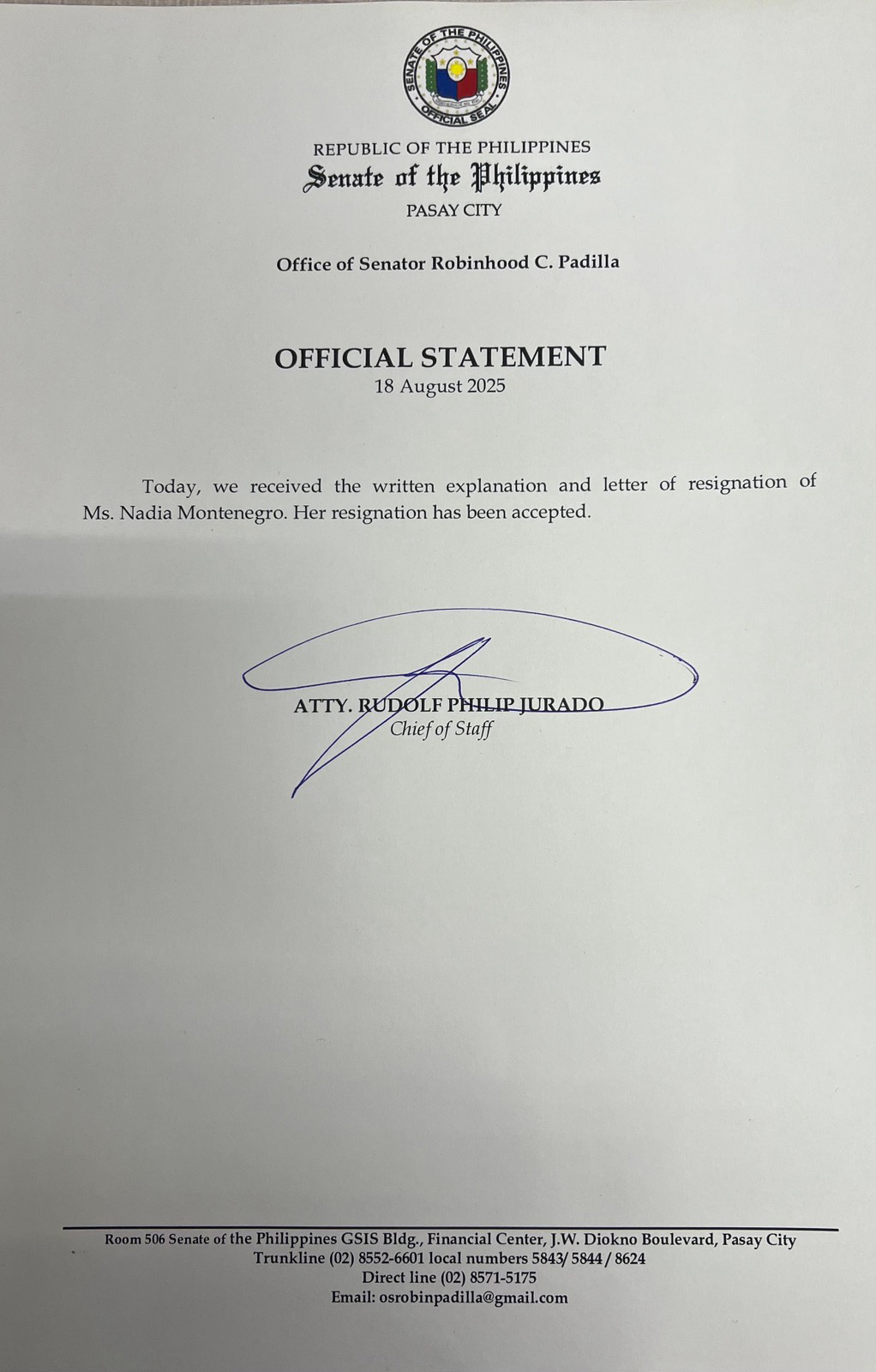
A letter from the Office of Senator Robinhood C. Padilla accepting the resignation of political staff Nadia Montenegro, who was accused of using illegal drugs in the Senate building, Aug. 18. — SENATORIAL CHIEF OF STAFF RUDOLF PHILIP JURADO

THE OFFICE of Senator Robinhood “Robin” C. Padilla on Monday confirmed that its staff accused of using illegal drugs in the Senate building has resigned.

“Today, we received the written explanation and letter of resignation of Ms. Nadia Montenegro. Her resignation has been accepted,” Mr. Padilla’s Chief of Staff Rudolf Philip Jurado said in a statement.

Ms. Montenegro was named in an incidence report by the Office of the Seargent at Arms (OSAA) last week, noting an odor resembling marijuana was reported in the fifth-floor restroom of the Senator’s extension offices.

In her explanation and resignation letter, she denied that she used marijuana in the Senate premises and that she was the staff named in the report.

“I vehemently deny that I am the staff of the senator mentioned in those articles. There was no incident wherein personnel of the OSAA went to our office and found me in the restroom and asked me about the alleged smell of marijuana in the restroom of our office,” Ms. Montenegro said.

In the same letter, she cited her “mental health and the welfare of my children” as reasons for resigning.

“My decision to resign should not be misconstrued as an admission of guilt-it is not… To prevent this baseless issue from growing any further, I would rather remove myself from the spotlight and allow the Senate to focus on its important work,” she added.

Senator Juan Miguel F. Zubiri called on his fellow senators and their staff members to conduct voluntary drugs tests.

“I encourage senators and their offices to take a drug test so that there would be no more doubts that there are drug users in the Senate,” Mr. Zubiri told reporters, after undergoing drug testing.

“Let’s lead by example. Many people are saying that someone in the Senate is using drugs. So I said my staff and I should go first and volunteer ourselves for a test against illegal drugs, hoping that doing so would also encourage our colleagues,” he added. — Adrian H. Halili

DBM says P13-B budget balance can plug zero funding for AKAP 

PHILIPPINE STAR/EDD GUMBAN

THE Department of Social Welfare and Development (DSWD) still has P13 billion to fund its cash assistance program Ayuda sa Kapos ang Kita Program (AKAP), Budget Secretary Amenah F. Pangandaman said, after the program received zero budget for 2026.

“Upon review, there’s still (a) P13-billion balance from the P26 billion appropriated for this year. The DSWD can still use that until the end of the year [and next year],” she said during a House Committee on Appropriations briefing on Monday.

This came as the Department of Budget and Management (DBM) submitted the P6.793-trillion proposed National Expenditure Program and allotted zero funds for the controversial social assistance program next year.

Ms. Pangandaman reiterated that the agency received P10.1-trillion funding request from government agencies.

“We have to prioritize the projects and programs that were proposed by each and every department,” she said.

AKAP is a social welfare scheme that provides one-time cash assistance worth P3,000 to P5,000 to workers whose income falls below the poverty threshold.

The House-backed assistance program continues to face criticism as concerns of being “politicized.” — Aubrey Rose A. Inosante

ADVERTISEMENT
ADVERTISEMENT