Home Blog Page 111

Meta, Google lose US case over social media harm to kids

ARPAD CZAPP-UNSPLASH

LOS ANGELES — A Los Angeles jury on Wednesday found Meta and Alphabet’s Google negligent for designing social media platforms that are harmful to young people, in a $6 million verdict that will serve as a bellwether for numerous similar cases.

The jury found Meta liable for $4.2 million in damages and Google for $1.8 million, small amounts for two of the world’s most valuable companies with annual capital spending over $100 billion each.

The Los Angeles trial is meant to serve as a bellwether, or test case, for the thousands of similar lawsuits consolidated in California state courts.

‘ACCOUNTABILITY HAS ARRIVED’

The case involves a 20-year-old woman, a minor when the case began who is known in court by her first name Kaley. She said she became addicted to Google’s YouTube and Meta’s Instagram at a young age because of their attention-grabbing design, such as the “infinite scroll” that encourages users to keep looking at new posts.

The jury found Google and Meta were negligent in the design of both apps and failed to warn about their dangers.

“Today’s verdict is a referendum — from a jury, to an entire industry — that accountability has arrived,” the plaintiff’s lead counsel said in a statement.

Meta and Google disagree with the verdict and plan to appeal, spokespeople for each company said.

Shares of Meta closed up 0.3%, and Google parent Alphabet finished 0.2% higher.

US law strongly protects social media companies from liability for what is on their platforms, but the plaintiff in the Los Angeles proceeding focused on platform design rather than content.

The verdict is a “setback” for Meta and Google, said Gil Luria, a technology sector analyst at investment firm D.A. Davidson.

“This process will likely get dragged out through future cases and appeals, but eventually may cause these companies to put in consumer safeguards that may dampen growth,” he said.

Snap and TikTok were also defendants in the trial. Both settled with the plaintiff before it began. Terms of the agreements were not disclosed.

MOUNTING CRITICISM

Large technology companies in the US have faced mounting criticism in the last decade over child and teen safety. The debate has now shifted to courts and state governments. The US Congress has declined to pass comprehensive legislation regulating social media.

At least 20 states enacted laws last year on social media usage and children, according to the nonpartisan National Conference of State Legislatures, an organization that tracks state laws.

The legislation includes bills that regulate the use of cellphones in schools and require users to verify their ages to open a social media account. NetChoice, a trade association backed by tech companies such as Meta and Google, is seeking to invalidate age verification requirements in court.

US senators Marsha Blackburn, a Republican, and Richard Blumenthal, a Democrat, in statements after the verdict, called on Congress to pass legislation directing social media companies to design their platforms with kids’ safety in mind.

A separate social media addiction case brought by several states and school districts against technology companies is expected to go to trial this summer in federal court in Oakland, California.

Another state trial is slated to begin in Los Angeles in July, said Matthew Bergman, one of the attorneys leading the cases for the plaintiffs. It will involve Instagram, YouTube, TikTok, and Snapchat.

Separately, a New Mexico jury on Tuesday found Meta violated state law in a lawsuit brought by the state’s attorney general, who accused the company of misleading users about the safety of Facebook, Instagram, and WhatsApp and of enabling child sexual exploitation on those platforms.

TRIAL ARGUMENTS

At trial, the plaintiff’s lawyers sought to show Meta and Google intentionally targeted kids and made decisions that put profit over safety. Meta’s attorneys emphasized the plaintiff’s difficult home life as a child as the cause of her mental health struggles, while YouTube argued her usage of the streaming platform was minimal.

Jurors saw internal documents revealing how Meta and Google sought to attract younger users, and heard executives, including Meta CEO Mark Zuckerberg, take the stand last month to defend company decisions.

When asked about Meta’s decision to lift a temporary ban on beauty filters that some inside Meta warned could be harmful to teen girls, Mr. Zuckerberg said he decided to let users express themselves.

“I felt like the evidence wasn’t clear enough to support limiting people’s expression,” he said.

How free speech and content moderation factored into the companies’ decisions is likely to play a part in any appeal. — Reuters
Trump plans May visit to China for talks with Xi after Iran war delay

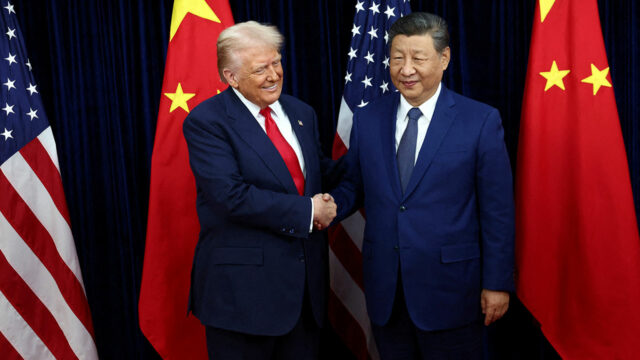
US PRESIDENT Donald J. Trump shakes hands with Chinese President Xi Jinping as they hold a bilateral meeting at Gimhae International Airport on the sidelines of the Asia-Pacific Economic Cooperation (APEC) summit in Busan, South Korea, Oct. 30, 2025. — REUTERS/EVELYN HOCKSTEIN

WASHINGTON — US President Donald Trump will meet Chinese President Xi Jinping in May during his first visit to China in eight years, a closely watched trip postponed due to the ongoing Iran war.

Mr. Trump’s effort to reschedule the trip reflected the Republican president’s eagerness to project confidence in a challenging Middle East war and simultaneously to manage a tense relationship between the world’s biggest economies.

Initially slated to travel next week, Mr. Trump will now visit Beijing on May 14 and 15, he said in a Truth Social post on Wednesday. Mr. Trump added that he would host Mr. Xi for a reciprocal visit in Washington later this year.

“Our Representatives are finalizing preparations for these Historic Visits,” Mr. Trump said. “I look very much forward to spending time with President Xi in what will be, I am sure, a Monumental Event.”

China’s embassy said it had no information to provide on the announcement of the visit. Beijing normally does not detail Mr. Xi’s schedule more than a ​few days in ⁠advance.

The long-scheduled trip – and Washington’s broader effort to reset relations in the Asia Pacific region – have been repeatedly overtaken by events.

In February, the Supreme Court curtailed the US president’s power to impose tariffs, a source of leverage for Mr. Trump in negotiations with the US’ third-biggest trading partner. Later that month, Mr. Trump’s joint military operation with Israel against Iran introduced a new point of tension with Beijing, Tehran’s main oil buyer.

Mr. Trump’s last trip to China, in 2017, was the most recent by a US president. Mr. Trump’s visit in May will be the leaders’ first in-person talks since an October meeting in South Korea, where they agreed on a trade truce.

WHITE HOUSE SAYS XI UNDERSTANDS TRUMP’S REASONS FOR DELAY

The two-day trip is set to combine the lavish pomp and circumstance that has become a feature of Mr. Trump’s trips abroad with hard-nosed diplomacy.

While the two sides could strike goodwill agreements in Beijing on trade in agriculture and airplane parts, they are also expected to discuss areas of deep tension like Taiwan, where little progress is expected.

Mr. Trump has dramatically ramped up US arms sales to Taiwan during his second term in office. The moves have angered Beijing, which claims the democratically governed island as its own territory.

It is also not clear whether the war with Iran, which has shaken the global economy, will be settled by the time of the Xi-Trump meeting.

Mr. Trump has sought support from the world’s major oil consumers, including China, to help counter Iran’s efforts to close the Strait of Hormuz.

Mr. Trump’s request for assistance so far has largely been rebuffed. China, which imported around 12 million barrels of oil daily during the first two months of ​2026, the most in the world, has ​not directly responded to ⁠his request.

Asked whether the war could wind down in time for the China trip, White House spokeswoman Karoline Leavitt told reporters on Wednesday that “we’ve always estimated approximately four to six weeks. So you could do the math on that.”

Ms. Leavitt also said Mr. Trump and Mr. Xi spoke about rescheduling the trip and that Mr. Xi had understood the reasons for doing so.

“President Xi understood that it’s very important for the president to be here throughout these combat operations right now,” she said. — Reuters

Marcos says Philippine oil supply secure beyond 45 days

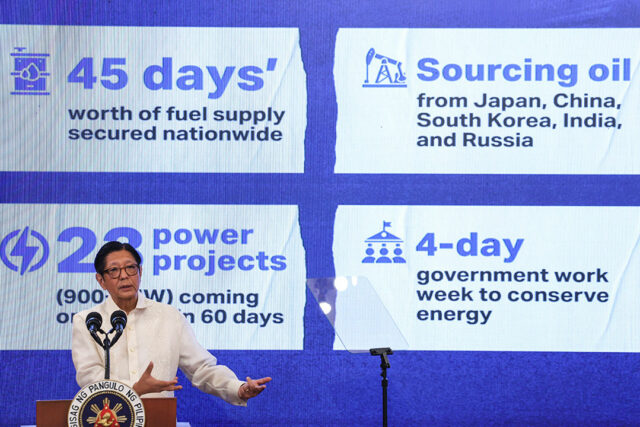
President Ferdinand R. Marcos, Jr. assured the public the country has sufficient fuel supply during a briefing at Malacañan Palace, March 25, 2026. — PHILIPPINE STAR/NOEL PABALATE

By Erika Mae P. Sinaking, Reporter

PRESIDENT Ferdinand R. Marcos, Jr. said the Philippines has secured enough fuel supply to last beyond 45 days despite disruptions caused by war in the Middle East, as the government scrambles to line up alternative sources and ensure existing contracts are fulfilled.

Speaking on Wednesday, Mr. Marcos said authorities moved quickly to make sure deliveries under previously signed contracts continued to reach the country, even as uncertainty initially froze communications with oil suppliers.

“In the beginning, our suppliers could not even tell us what was happening, and they couldn’t give us prices,” he told a livestreamed briefing in Filipino from the presidential palace. “But through constant engagement and by putting new systems in place, supply has continued to come in.”

Global oil markets have been jolted by escalating tensions in the Middle East, a key supply region, raising concerns over shortages and higher prices for fuel-importing countries such as the Philippines. The country relies almost entirely on imported petroleum products.

Mr. Marcos said the government is not relying solely on traditional suppliers in the region. Officials have been reaching out to alternative sources unaffected by the conflict, though he cautioned that it is still too early to say whether new contracts have been finalized.

“It would be premature to say that everything has been perfected. But things are beginning to open up,” he said. “I’m very confident in saying that we have sufficient supply.”

The Department of Energy (DoE) on Tuesday said the Philippines has an average fuel inventory equivalent to about 45 days of supply, though levels vary by product.

Mr. Marcos expressed confidence that additional shipments would arrive before stocks run low, ensuring a steady flow rather than isolated deliveries.

“We can be fairly confident that after the 45 days, we will already have oil arriving here in the Philippines,” he said. “Not just one delivery, not just two deliveries, but a flow of petroleum and petroleum-related products.”

Mr. Marcos credited the country’s diplomatic ties for helping secure continued access to fuel, noting that good relations with partner countries have played a key role in keeping supply lines open.

Authorities, he said, would continue to explore new sourcing arrangements while monitoring global developments, as energy prices remain vulnerable to further geopolitical shocks.

He and Energy Secretary Sharon S. Garin earlier said the country is talking to China, Russia, the US, South American countries, Brunei, South Korea, Japan and India, among others, for oil supply, noting the discussions yield positive results.

As a net oil importer, the Philippines is particularly vulnerable to disruptions in global oil supply and volatility in prices. It imports nearly all of its crude oil from the Middle East, with Saudi Arabia as its top supplier.

At the same time, the Department of Budget and Management (DBM) has approved the release of P20 billion to the DoE to secure fuel supply for the country.

The funds were released on March 24 through a Special Allotment Release Order (SARO) and Notice of Cash Allocation (NCA), which was sourced from the Malampaya Gas Fund under the Special Account in the General Fund (SAGF), the DBM said in a statement.

The P20 billion will fund the “strategic procurement of fuel products — including diesel, gasoline, and liquefied petroleum gas (LPG) — to boost national fuel inventory, stabilize pump prices, and ensure uninterrupted operations across transport, logistics, agriculture, emergency response, and other critical sectors.”

It will be implemented by the Philippine National Oil Company-Exploration Corporation, which has already started procurement.

‘DO NOT PANIC’
On Tuesday evening, Mr. Marcos placed the country under a national state of energy emergency under Executive Order (EO) No. 110, noting the ongoing war’s imminent threat to the country’s energy supply. The order will be in effect for a year.

The President on Wednesday clarified that the declaration was only a “precautionary tool” and that only the energy sector was covered by the state of emergency.

“I want to assure everyone that this does not mean that we should panic. It means that we are doing everything that we can to assess and to alleviate the situation,” Mr. Marcos said.

Under the EO, the President created the Unified Package for Livelihoods, Industry, Food, and Transport (UPLIFT) committee for a coordinated response in stabilizing fuel supply, sustaining economic activity and protecting sectors most exposed to rising energy costs.

The EO also allows authorities to focus interventions on ensuring adequate energy supply and mitigating price spikes while mobilizing government resources more efficiently.

“The source of the problem is the supply and the price of energy, and that is what we need to address directly… The reason that I declared an energy emergency is to provide government with more options should the need arise,” Mr. Marcos said.

Transport workers are planning a two-day strike starting Thursday to protest surging oil prices and demand a fare hike, a move Mr. Marcos rejected last week.

They also want him to cut or halt excise taxes on petroleum products to lessen oil prices.

Mr. Marcos on Wednesday signed into law Republic Act No. 12316, a measure granting him the power to temporarily suspend or reduce excise taxes on petroleum products to mitigate the impact of rising global oil prices.

Asked if the government will take control of the oil industry, the President said he hopes the situation won’t call for the move.

“We don’t want to get into that discussion,” Mr. Marcos told reporters and refused to take follow-up questions.

Jay M. Layug, a former energy undersecretary and executive board member of the Philippine Energy Research and Policy Institute, echoed the President’s remarks.

“No need to take control of oil companies,” he said in a Viber message.

“What government needs to do is implement multiple measures to manage demand for petroleum and conserve energy use. Example, coding system expansion, carpooling, expanded WFH (work-from-home) program, expanded EV (electric vehicle) program, etc.”

The government had already mandated a four-day workweek for government offices to lessen energy use.

Fuel prices climbed again this week, extending one of the longest runs of increases in recent years.

Noel M. Baga, co-convenor of the Center for Energy Research and Policy think tank, said the declaration is overdue, noting that the legal tools were already in place and that recent price hikes and suspended public utility operations highlighted the urgency of stronger action.

“Every power generation project in the pipeline must be fast-tracked,” Mr. Baga said. “The emergency declaration signals that the government is finally treating this as the crisis it is. The next measure of seriousness is whether price ceilings follow.”

INFRA SPENDING
Meanwhile, the DBM said it has also released P16.5 billion to the Department of Public Works and Highways (DPWH) in a bid to accelerate infrastructure spending and support economic growth.

The funds will be released via the issuance of an NCA to the DPWH Central Office and will be used to cover the settlement of the department’s due and demandable accounts payable.

“Upon the order of the President, we are accelerating infrastructure spending to keep projects moving and the economy growing. This P16.5 billion release ensures that obligations are paid on time,” Budget Secretary Rolando U. Toledo said in a statement.

Philippines most at risk of fertilizer supply shock in Southeast Asia

A farmer sprays fertilizer mixed with water at a rice field in Dinalupihan, Bataan in the Philippines in this file photo taken on Nov. 16, 2016. — REUTERS

THE PHILIPPINES faces the highest exposure to fertilizer price and supply risks in Southeast Asia due to its heavy reliance on imports and vulnerability to supply disruptions, according to Fitch Solutions unit BMI.

In a report, BMI said the risk of reduced fertilizer application across the region is rising as global prices surge amid the ongoing war in the Middle East, with the Philippines particularly at risk due to limited domestic production capacity.

“The Philippines is more fundamentally exposed to an extended disruption to nitrogenous fertilizer supplies given its high reliance on imports,” the think tank said.

BMI said delays in fertilizer shipments could coincide with key planting windows in the Philippines, posing downside risks to crop yields.

“With approximately 75% of corn plantings occurring between April and May and around 60% of rice plantings taking place from March to May, delay in fertilizer arrivals past key application windows could pose significant downside risks to the upcoming crop,” it said.

BMI said global urea prices have already surged following the escalation of tensions in late February. The US Gulf New Orleans granular urea spot index had risen by 40.4% to $660 per metric ton as of March 20, reflecting expectations of tighter global supply.

Locally, data from the Department of Agriculture (DA) showed that fertilizer prices have also climbed sharply.

The average price of prilled urea rose by 17.15% to P1,948.01 per bag last week from P1,662.84 at the end of December, while granular urea increased by 18.88% to P1,969.03 from P1,656.28.

Ammonium sulfate prices likewise went up by 14.48% to P937.33 per bag from P818.80 over the same period.

BMI warned that sustained high prices for nitrogen-based fertilizers could lead farmers to cut back on usage, weighing on yields for the 2026-2027 crop cycle.

The DA earlier flagged potential declines in agricultural output under a prolonged high oil price scenario, which feeds into fertilizer costs.

RICE OUTPUT MAY DROP
At a Senate hearing on Tuesday, the DA said that if crude oil prices reach a 180-day average of $200 per barrel, second-semester rice output could fall by 3.81% to 10.7 million metric tons (MT) from the initial 11.12 million MT projection.

Corn production could also fall by 4.58% to 3.26 million MT from 3.42 million MT previously projected, while lowland vegetable output may drop by 9.92% to 737,625 MT from 818,856 MT.

Highland vegetable supply could see a sharper 20% decline to 311,230 MT from a prewar projection of 389,037 MT.

Under the same scenario, onion supply is also projected to slide by 14.02% to 359,419 MT from a prewar estimate of 418,025.68 MT.

In an earlier statement, the DA said the government is negotiating with China, Russia, and India to ensure steady delivery of petroleum-based inputs should the supply outlook from the Gulf becomes even more uncertain.

Meanwhile, BMI said other Southeast Asian countries such as Indonesia, Malaysia, and Vietnam are relatively insulated from supply shocks due to strong domestic production of nitrogen-based fertilizers and access to natural gas feedstock.

However, BMI said policy decisions, such as whether to prioritize domestic demand or exports, could still affect availability in these markets.

Thailand, while also reliant on imports, has sufficient urea stockpiles to meet demand through August 2026, providing a buffer against near-term disruptions, BMI said. — Vonn Andrei E. Villamiel

S&P hikes Philippine growth forecast but oil crisis poses risks

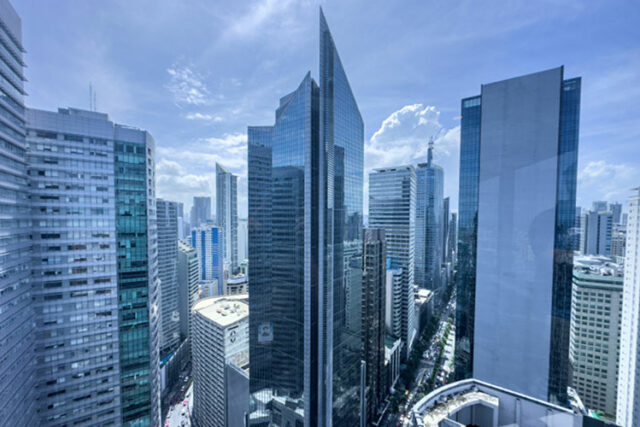
A view of the Makati central business district. — PHILIPPINE STAR/RYAN BALDEMOR

By Katherine K. Chan, Reporter

A GRADUAL RECOVERY in investments and robust technology exports could drive Philippine economic growth to 5.8% this year, although the ongoing oil crisis poses a crucial risk, S&P Global Ratings said.

In a report on Wednesday, the debt watcher said it sees the Philippine gross domestic product (GDP) expanding by 5.8% in 2026, slightly higher than its earlier projection of 5.7%.

“We have marginally raised our 2026 growth forecast for the Philippines to 5.8% from 5.7%, reflecting a gradual normalization of investment and continued strength in technology-related exports,” Vishrut Rana, a senior economist for Asia-Pacific at S&P Global Ratings, said in an e-mailed reply to questions.

If realized, the economy will grow much faster than last year when GDP grew by 4.4%. Economic growth hit a post-pandemic low in 2025 as the flood control corruption mess weakened investments and domestic consumption.

In 2025, gross capital formation, the investment component of GDP, slid by 2.1% after it posted its steepest drop in over four years of 10.9% in the fourth quarter.

S&P’s growth estimate for the Philippines is also higher than its 4.5% revised growth forecast for the Asia-Pacific region excluding China.

At 5.8%, growth would likewise come near the upper end of the government’s 5%-6% target. President Ferdinand R. Marcos, Jr., however, said they might revise their targets considering the impact of the Middle East war.

Mr. Rana noted that the Philippines faces risks to its growth prospects as the Middle East turmoil continues to jolt oil markets.

“Energy disruption is a key risk to the economy this year,” he said, noting the country’s heavy reliance on energy imports, which accounted for 3.3% of GDP last year.

“If energy supplies face sustained disruption, we see downside risk to our economic projections,” Mr. Rana added.

Mr. Marcos placed the Philippines under a state of national energy emergency for one year, after acknowledging that the oil trade disruption and price shocks threaten the country’s energy security. 

Meanwhile, economists from the University of Asia and the Pacific (UA&P) see first-quarter GDP growth remaining weak amid high unemployment and an anticipated inflation uptick triggered by the Middle East war.

“Total unemployed persons reaching 2.97 million in January, the highest since June 2022, and higher inflation starting March (to over 4% initially) would bring Q1-2026 GDP growth back to a pace (of around 3%) similar to Q4-2025,” UA&P said in its latest The Market Call released on Wednesday.

This as soaring oil prices could accelerate inflation to a near two-year high of 4.2% in March, it added.

“Inflation will likely rise sharply to 4.2% year on year in March, compared with 2.4% previously, and may continue climbing until crude oil prices stabilize or decrease as more producers respond to higher prices and as Iran and the US allow additional tankers to transit the Strait of Hormuz,” UA&P said.

If realized, the headline print will hit the fastest in 20 months or since 4.4% in July 2024, likewise marking the first time since then that inflation will breach the central bank’s target.

RATE HIKE LATER THIS YEAR
Emerging economic headwinds from the Middle East war may also prompt the Bangko Sentral ng Pilipinas (BSP) to raise its policy rate by 25 basis points (bps) later this year, S&P’s Mr. Rana said.   

“We expect a modest 25-bp rate hike for the Philippines to 4.5% during 2026, based on the energy price outlook,” he said. “Given inflation is contained, the BSP has policy space and is unlikely to tighten immediately.” 

This came after S&P raised its inflation projection to 3.4% for this year from 2.7% previously, and to 3.2% for 2027 from 3%.

“While we project average inflation to remain within the target range this year, the acceleration in price gains could be significant due to the potential impact of the energy shock,” Mr. Rana said. “The central bank may also be watching the effects of a weaker currency.”

At the same time, UA&P said the peso may continue to trade above P59 against the dollar due to rising inflationary pressure. 

“Export performance should remain strong, achieving double-digit growth. However, the peso-dollar exchange rate may stay above P59/$ due to rising local inflation and increased demand for foreign currency assets as a hedge,” it noted.

Last week, the peso breached the P60 level for the first time as the greenback strengthened amid the US-Israeli war on Iran. It finished at a new all-time low of P60.30 versus the dollar on Monday, but later returned to the P59 level after closing at P59.95 on Tuesday. 

BSP Governor Eli M. Remolona, Jr. earlier gave hawkish signals, hinting at a potential rate hike if sustained $100 per barrel oil price pushes inflation beyond 4%.

The BSP wants inflation to stay within the 2%-4% range, with 3% as its “sweet spot.”

If it decides to tighten, the central bank will be reversing its near two-year easing cycle, where it has slashed the key interest rate by 225 bps to an over three-year low of 4.25%. It last lifted the policy rate in October 2023. 

Meanwhile, S&P trimmed growth projections for 2027 and 2028 to 6.2% from 6.5% previously.

“We have lowered our growth forecasts for 2027 and 2028 on slower domestic demand momentum and moderating growth in established sectors such as BPO (business process outsourcing,” Mr. Rana said. “We expect growth in the BPO and tech-related spaces to continue to be brisk, albeit slower than in recent years.”

Surging fuel prices seen driving demand for EVs

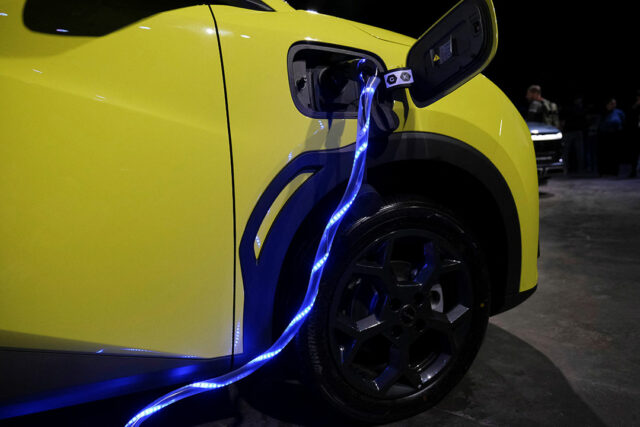
A BYD Dolphin Mini electric vehicle is displayed during the launch event of Chinese electric vehicle (EV) maker BYD in Buenos Aires, Argentina, Oct. 8, 2025. — REUTERS/ALESSIA MACCIONI

By Sheldeen Joy Talavera, Reporter

SOARING FUEL COSTS are expected to further accelerate demand for electric vehicles (EV) in the Philippines this year, with sales projected to post double-digit growth, analysts said.

Patrick T. Aquino, director of the Department of Energy’s (DoE) Energy Utilization Management Bureau, said EV sales are expected to grow by double digits to over 40,000 this year.

“Given the developments, we’re looking at it [and it will] definitely [be] higher than 40,000,” Mr. Aquino told BusinessWorld.

Citing DoE data, he said sales of EVs and light EVs reached around 40,000 last year.

According to a joint report by the Chamber of Automotive Manufacturers of the Philippines, Inc.  and Truck Manufacturers Association, EV sales reached 32,489 units in 2025, which accounted for 7.01% of total auto sales.

Mr. Aquino said EV dealers are already seeing “a lot of foot traffic.”

Edmund A. Araga, president of the Asian Federation of Electric Vehicle Association and former president of the Electric Vehicle Association of the Philippines, said that EV sales are projected to exceed last year’s sales.

“We are projecting that we will surpass last year’s registered EVs of about 45,000 as reported by LTO (Land Transportation Office) by more than 10-15% as interested consumers are now being felt by our members through inquiries and reservations,” Mr. Araga told BusinessWorld.

The government is expecting the surge in EV sales this year will help achieve the national target of having 100,000 EV registrations by 2028.

Since the enactment of the Electric Vehicle Industry Development Act in 2022, the Philippines has sought to promote the development and adoption of EVs by mandating a higher share of EVs in corporate and government fleets.

Under the Comprehensive Roadmap for the Electric Vehicle Industry, the business-as-usual scenario target is a 10% EV fleet share by 2040, while it sets a clean energy scenario target of at least 50%.

Before the Iran war, the DoE had calculated that fuel costs for a conventional car averaged about P5 per kilometer (km), compared with roughly P1.75 per km for an electric vehicle.

Energy Secretary Sharon S. Garin earlier said that EVs are cheaper to operate compared with fuel-powered cars because electricity costs rise less sharply than fuel prices.

“We only use 3% of diesel on our electricity. The other fuels like coal and gas are affected because of the transportation and logistics costs, but not in proportion to the increase [in fuel prices] so it won’t increase as much,” she said.

“Actually, there should be a major campaign already in the Philippines for electric vehicles and hybrid with what we’re experiencing,” she added.

BETTER PUBLIC TRANSPORTATION
Nigel Paul C. Villarete, a senior adviser on public-private partnerships at the technical advisory group Libra Konsult, said the heightened interest in EVs is already expected since fuel is the largest component of the operational costs of running private cars.

“Electric vehicles are ‘relatively new’ so rising fuel costs would indeed stoke the interest of those who are buying new cars,” Mr. Villarete told BusinessWorld.

Since not everyone can afford to buy an electric car, analysts said the current situation highlights the need for better public transportation.

“[Public transportation] will always be the more efficient and more effective mode of mobility compared with private car use which, among mobility planners and managers, is the most wasteful, both in terms of space needed and money used,” Mr. Villarete said.

He said that private car use comes at a high economic cost compared with the far more efficient public transport system.

“But we live in a capitalistic society where the private (sector) wants to dictate over public good, so what the government has to ensure is the availability of the more efficient and cost-effective alternative in the hope of contributing more to national economic benefits,” he said.

Rene S. Santiago, an international consultant on transport development and former president of the Transportation Science Society of the Philippines, said rising fuel prices will widen the advantage of EVs and hybrids over traditional or internal combustion engine vehicles.

“Public transport is another universe altogether, weakened by bad regulation and poor execution of the PUVMP (Public Utility Vehicle Modernization Program) such that shifting to EVs is not on the table,” Mr. Santiago told BusinessWorld.

JG Summit posts P88-B net loss on petrochemical asset write-down

NINOY AQUINO INTERNATIONAL AIRPORT (NAIA) Terminal 3 — PHILIPPINE STAR/MIGUEL DE GUZMAN

JG Summit Holdings, Inc. posted a net loss of P87.9 billion for 2025 after recording a P114.3-billion impairment tied to the write-down of its discontinued petrochemical operations.

Core net income declined 11% to P36.4 billion, while net income from continuing operations fell 7% to P36.1 billion. The declines mainly reflected the absence of a P7.9-billion gain recorded in 2024 from a bank merger. This was partly offset by a P4.2-billion gain in 2025 from the airline’s receipt of free engines.

“Our 2025 performance reflects the resilience of our portfolio, supported by sustained consumer demand and continued strength in our leisure-related businesses. During the year, we also recognized an impairment loss on our discontinued petrochemical operations. We have also started discussions with potential buyers of the mothballed asset and are determining the best use of the Batangas complex,” JG Summit President and Chief Executive Officer Lance Y. Gokongwei said in a statement on Wednesday.

Excluding one-off items, core profit reached P31.9 billion. Results were supported by strong performance in leisure-related businesses and favorable mark-to-market gains, which helped offset higher coffee costs in branded foods and higher parent-level interest expenses.

The group reported a 3% increase in recurring net income for 2025 to P31.9 billion, supported by strong travel and leisure demand and sustained consumer spending.

It posted consolidated revenues of P368.6 billion, up 9%, driven by double-digit growth in its airline and real estate businesses, along with steady volume gains in food and beverage.

Despite the impairment, the company said it maintained a healthy financial position as of December 2025, with stable cash and debt levels. Its debt-to-equity ratio stood at 0.73, while net debt-to-equity was 0.59. Parent-level dividends reached a record P21.6 billion, up 25%, driven by contributions from subsidiaries and investments, including airline preferred shares.

Its business units reported mixed results. Universal Robina Corp. (URC) reported a 5% decline in net income to P11 billion despite a 4% increase in revenues to P168 billion. Growth was supported by volume gains in Branded Consumer Foods Philippines, Sugar and Renewables, and URC Malaysia, but was offset by weaker sales in Animal Nutrition and Health and a midyear slowdown in Indochina.

Robinsons Land Corp. (RLC) posted an 8% increase in net income to P13.5 billion, while revenues rose 13% to P48.4 billion. Growth was driven mainly by its malls and hotels segments amid higher consumer spending and a recovery in tourism.

Residential sales also improved, particularly from lease-to-own and ready-for-occupancy units, further supporting revenue growth.

Cebu Air, Inc. more than doubled its net income to P12.3 billion, supported by compensation gains from five engines received from Pratt & Whitney for ongoing aircraft-on-ground issues. Revenues rose 14% to P119.9 billion, driven by a record 26.9 million passengers, up 10%, along with stable seat load factors and higher cargo volumes.

JG Summit’s equity earnings from Manila Electric Co. (Meralco) increased 12% to P13.3 billion, supported by stronger power generation results, higher distribution pass-through charges, and increased retail electricity sales.

Its equity share in Singapore Land Group rose 7%, driven by improved yields from investment properties and stronger contributions from its Singapore-based assets.

“As we look ahead to 2026 amid heightened global uncertainty, we are taking a prudent and disciplined approach — prioritizing cash flow protection, balance sheet strength, and operational efficiency,” Mr. Gokongwei said.

“At the same time, we remain focused on long-term value creation as we continue to advance our Parent transformation, with our business units refining their value creation plans under clear governance and investment guardrails informed by our portfolio review,” he added.

On Wednesday, JG Summit closed at P26.45 per share, down P0.55 or 2.04%. — Alexandria Grace C. Magno

First Gen earnings rise 8% on higher hydropower output

FIRSTGEN.COM.PH

LOPEZ-LED power producer First Gen Corp. reported an 8% increase in its bottom line in 2025, supported by higher electricity sales driven by stronger hydropower output.

In a statement on Wednesday, the company said it posted attributable recurring net income of $264 million in 2025, up from $245 million a year earlier.

First Gen said revenues rose 6% to $906 million, driven by higher energy sales volumes, although its full-year report has yet to be released.

During the period, the group’s geothermal, wind, and solar portfolio under subsidiary Energy Development Corp. (EDC) accounted for 87% of total revenues, while hydroelectric plants contributed 11%. The remaining 2% came from affiliates and the parent company.

First Gen’s hydro platform posted a 73% increase in earnings to $19 million, supported by a fivefold rise in contributions from the 132-megawatt (MW) Pantabangan-Masiway power plant.

The company said higher starting water elevation at the facility allowed it to generate and sell more electricity during the year.

Stronger hydro performance helped offset a 31% decline in EDC’s earnings to $75 million.

While the Bacman and Palinpinon geothermal plants produced more kilowatt-hours, lower gross sales volumes in Leyte and Mindanao partly offset the gains due to well workovers and maintenance activities.

“Aside from a reduction in spot market prices, EDC also had higher interest expenses from more debt following the execution of its drilling operation program and project expansions,” the company said.

Despite the decline in earnings, EDC completed 77 MW of geothermal capacity and 40 megawatt-hours (MWh) of battery and energy storage projects, with an additional 6 MW of geothermal capacity set for commissioning this year.

Meanwhile, First Gen reported $11 million in income from its remaining 40% stake in its gas assets starting November 2025.

The company earlier sold a 60% equity stake in its natural gas business to Prime Infrastructure Capital, Inc. for P50 billion in late 2025.

For the January-to-October period prior to the sale, the gas business recorded $200 million as discontinued operations.

“The previous year brought about a fundamental change in First Gen as we decided to sell down our controlling stake in the gas assets,” First Gen President and Chief Operating Officer Francis Giles B. Puno said. “We decided to strategically pivot into our renewable energy investments.”

Mr. Puno said the company is preparing for new developments this year, with EDC’s drilling program expected to deliver results and planned investments in 2,000-MW hydropower projects marking its entry into greenfield development.

Shares in First Gen fell by 0.24% on Wednesday to close at P16.96 each. — Sheldeen Joy Talavera

D&L sees supply risks, says inventory good for 74 days

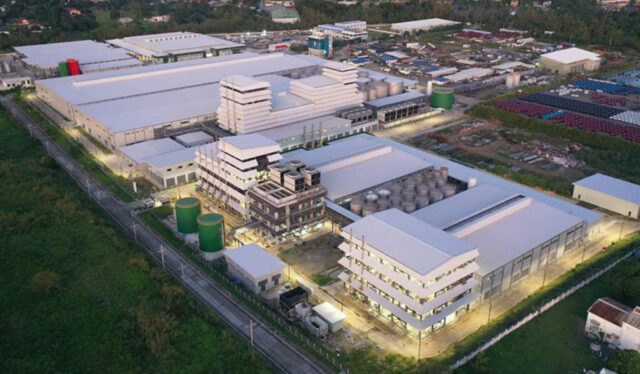
DNL.COM.PH

LISTED specialty food ingredients and oleochemicals manufacturer D&L Industries, Inc. said it is monitoring potential disruptions to raw material supply and costs due to the ongoing conflict in the Middle East, while expressing confidence in managing the risks.

“Looking ahead, 2026 presents a new set of uncertainties, particularly with the ongoing war in the Middle East and its potential impact on crude oil prices, raw material costs, and global supply chains,” D&L President and Chief Executive Officer Alvin D. Lao said during a media briefing on Wednesday.

The company said geopolitical tensions could disrupt oil prices, raw material supply, and global logistics, while also affecting growth and market confidence.

The company added that it sees opportunities to strengthen its position as a reliable supplier of essential goods amid volatility, supported by steady demand.

Mr. Lao said the company has not encountered a full shortage of materials but noted that access costs have increased. He warned that some items could become scarce within a month.

“The price of everything is going up. Actually, that’s not the only problem. Never mind if prices are going up, but it seems access to supply for a lot of products is also affected. And that’s a big worry,” he said.

D&L said it is negotiating with its global supplier network to maintain raw material flows.

It noted that several suppliers have declared force majeure, limiting deliveries to available supply and canceling contracted future shipments.

Despite the risks, Mr. Lao expressed confidence in the company’s ability to manage disruptions, citing its experience during past oil shocks.

“We were able to survive. We’ve learned the lessons. We have put in a lot of measures to (deal with the problems) because we still remember what we did before,” he said.

The company said it has about 74 days’ worth of inventory to support operations, but flagged replenishment as a key concern.

In 2025, D&L reported a 10.6% increase in recurring net income to P2.6 billion, supported by strong performance from its biodiesel, plastics, and consumer businesses.

Fourth-quarter recurring income rose 20% to P640 million.

Full-year earnings growth was driven by 8% volume expansion, despite elevated coconut oil prices, which have nearly tripled over the past two years.

“Coconut oil prices hit all-time highs, but we still grew earnings 10.6%. This came from R&D investments, customized solutions, and long-term partnerships,” Mr. Lao said.

Volumes increased 8% across both high-margin specialty products and commodities. The company said stabilizing margins could support further earnings growth.

Segment performance was mixed. Chemrez Technologies posted a 24% increase in volumes and a 96% rise in net income, supported by global demand for coconut oil-based products and a higher mandated biodiesel blend.

The Specialty Plastics segment recorded 9% earnings growth in 2025, following 32% growth in 2024. Margins reached record levels, supported by new products developed through ongoing research and development.

“The segment remains well-positioned for continued growth, supported by ongoing investments in research and development and the company’s focus on delivering innovative and sustainable plastic solutions aligned with evolving customer needs,” the company said.

The Consumer Products original design manufacturing (ODM) segment posted an 80% increase in earnings, driven by the ramp-up of operations in Batangas. Exports accounted for 16% of total sales, up from negligible levels six years ago.

In contrast, the food ingredients segment saw earnings decline by 61% due to higher commodity costs. While the company typically passes on cost increases to customers, the rapid rise in coconut oil prices led to short-term margin pressure due to a 30- to 45-day lag in price adjustments.

“As coconut oil prices begin to normalize, coupled with pricing adjustments and ongoing portfolio optimization — rationalizing commodity exposure while increasing focus on high-margin specialty products — the company expects a recovery in profitability and margins,” D&L said.

Shares in D&L rose 5.71% on Wednesday to close at P3.70 each. — Alexandria Grace C. Magno

Meralco sees higher generation costs as peso weakens

PHILSTAR FILE PHOTO

POWER DISTRIBUTOR Manila Electric Co. (Meralco) said a weaker peso is putting upward pressure on power generation costs, following the currency’s recent slide to a record low amid geopolitical tensions.

“A depreciation of the peso will put upward pressure on power rates, in particular, the generation charge,” Lawrence S. Fernandez, vice-president and head of utility economics at Meralco, told BusinessWorld.

On March 23, the peso fell to a record low of P60.30 against the US dollar, marking the first time it breached the P60-per-dollar level, according to data from the Bankers Association of the Philippines.

Mr. Fernandez said nearly 60% of Meralco’s cost of purchased power is dollar-denominated, as it largely consists of imported fuels such as coal and gas.

These costs are reflected in the generation charge, which typically accounts for more than half of consumers’ electricity bills.

Earlier this month, Meralco Chairman Manuel V. Pangilinan ordered a review of the company’s power supply mix to manage price volatility linked to movements in the global petroleum market.

“We are optimizing our energy mix and fully leveraging cost-efficient sources, regardless of technology. In addition, we are carefully managing our exposure to the WESM (Wholesale Electricity Spot Market), where price volatility is high,” he said in a social media post.

Gas currently accounts for about 60% of Meralco’s power supply, followed by coal at 20-25% and renewable energy at around 10%. The remainder is sourced from the Wholesale Electricity Spot Market.

Last month, Meralco raised electricity rates by P0.6427 per kilowatt-hour (kWh) to P13.8161 per kWh for March, driven by higher transmission and generation charges.

Meralco is the country’s largest private electric distribution utility, serving more than 8.2 million customers in Metro Manila and nearby provinces, including Bulacan, Cavite, Rizal, and parts of Laguna, Batangas, Pampanga, and Quezon.

Aside from electricity distribution, the company also has power generation interests through its subsidiaries.

Meralco PowerGen Corp. (MGEN), the company’s generation arm, said a weaker peso could affect not only generation costs but also the broader energy value chain.

“The impact of a weaker peso goes well beyond new power investments — it affects the entire energy value chain and is broadly inflationary, making imported goods, including fuel and equipment, more expensive,” MGEN President and Chief Executive Officer Emmanuel V. Rubio told BusinessWorld.

He added that currency weakness may also put upward pressure on interest rates, increasing financing costs for new projects and affecting returns over time.

“At MGEN, we have taken a proactive approach to managing these risks,” Mr. Rubio said.

He said the company has hedged its exposure to currency risks by largely locking in costs for the MTerra Solar project, an integrated solar facility spanning Nueva Ecija and Bulacan.

However, Mr. Rubio said a weaker peso would still feed through to electricity prices, as most of the country’s coal and gas supply is imported and dollar denominated.

“Ultimately, while the direct impact on generators is manageable, the broader concern is affordability — particularly as sustained cost pressures may influence customer demand and the overall energy mix toward more cost-competitive sources,” he said. 

Meralco’s controlling stakeholder, Beacon Electric Asset Holdings, Inc., is partly owned by PLDT Inc. Hastings Holdings, Inc., a unit of PLDT Beneficial Trust Fund subsidiary MediaQuest Holdings, Inc., has an interest in BusinessWorld through the Philippine Star Group, which it controls. — Sheldeen Joy Talavera

ACEN secures P4.78-B loan for India wind project

BW FILE PHOTO

RENEWABLE energy developer ACEN Corp. has secured fresh funding worth 7.517 billion Indian rupees (P4.78 billion) from Japanese banks for its 120-megawatt (MW) wind power project in Karnataka, India.

Diyos Renewables India Project Private Ltd., ACEN’s project developer, obtained a green term loan facility from Mitsubishi UFJ Financial Group and Sumitomo Mitsui Banking Corp., the company said in a statement on Wednesday.

“Securing this project finance facility underscores the strong confidence of global financial institutions in ACEN’s renewable energy platform and our disciplined approach to developing high-quality projects,” ACEN International Chief Executive Officer Patrice Clausse said, adding that the project strengthens the company’s presence in a key renewable energy market.

The funding will support the initial 100-MW phase of the Bijapur Wind project.

The project is scheduled for commissioning in 2027 and is expected to generate about 330 million kilowatt-hours of electricity annually, while avoiding around 300,000 metric tons of carbon dioxide emissions.

ACEN said the project supports India’s target of expanding renewable energy capacity to 500 gigawatts (GW) by 2030.

Once completed, the facility will supply electricity under a power purchase agreement with Indian state-owned firm SJVN Ltd.

“The Bijapur Wind project reflects our focus on delivering scalable, high-quality projects that contribute to India’s clean energy transition while creating sustained value on the ground,” said Alok Nigam, chief executive officer of ACEN’s India platform.

Last month, ACEN said it would take full control of its renewable energy business in India after acquiring the remaining stake held by Singapore-based UPC Renewables in their joint venture.

Following the acquisition, ACEN will own Unlimited Renewables Holdings B.V., which is developing three renewable energy projects in Rajasthan and Karnataka with a combined capacity of 1,059 MW, covering both construction and advanced development stages.

As of March 2026, India accounts for 40% of ACEN’s net attributable capacity across its international portfolio. The company currently operates three solar power projects in the country with a combined capacity of 630 MW.

ACEN, the listed energy platform of the Ayala group, manages an attributable renewable energy portfolio of 7 GW across the Philippines, Australia, Vietnam, India, Indonesia, Laos, and the United States.

Shares in ACEN rose 3.75% on Wednesday to close at P2.77 each. — Sheldeen Joy Talavera

RRHI exits No Brand business as it adapts to consumer trends

NO BRAND PHILIPPINES FACEBOOK PAGE

ROBINSONS Retail Holdings, Inc. (RRHI) said it will close its 11 No Brand standalone stores nationwide by end-June 2026, citing shifting consumer preferences and a move to align its formats with customer demand.

“The decision reflects evolving consumer preferences and how customers are choosing to shop across our retail formats,” RRHI President and Chief Executive Officer Stanley C. Co said in a disclosure on Wednesday.

“Our focus remains on meeting customer needs by providing relevant assortments in the most appropriate formats. We thank Emart for the partnership over the past several years,” he added.

RRHI said the closures are not expected to materially affect its financial performance, as No Brand accounts for about 0.2% of annual net sales and a minimal share of total assets.

“No Brand’s 11 stores are immaterial relative to RRHI’s network of more than 2,700 company-owned stores — including 157 Robinsons Supermarket, 159 Robinsons Easymart, 38 The Marketplace, 16 Shopwise, and 415 Uncle John’s under its food segment — and over 2,100 franchised TGP branches, as of Dec. 31, 2025,” the company said.

No Brand entered the Philippine market in 2019 through a master franchise agreement between RRHI and South Korea’s Emart, allowing the company to operate dedicated stores nationwide.

Analysts said the move reflects a strategic shift toward focusing on more established and profitable formats.

“The No Brand shut down is a move to double down on higher margin formats that should yield RRHI the best returns over time, while also trimming formats that may not be part of their long-term format priorities,” AP Securities, Inc. Equity Research Analyst Shawn Ray R. Atienza said in a Viber message.

In a separate Viber message, F. Yap Securities investment analyst Marky Carunungan said the closure forms part of a broader portfolio rationalization strategy.

“The pivot toward larger, more established formats such as supermarkets is better aligned with local consumption behavior and provides a more resilient earnings base. It also signals a shift toward prioritizing scale, efficiency, and returns over experimentation,” he added.

“The group has been candid about the concept’s limited traction in the Philippine market, and that its performance fell short of expectations. From an impact standpoint, No Brand represents only a small portion of the overall portfolio, and as such, we do not expect this development to materially affect RRHI,” Unicapital Securities Equity Research Analyst Jeri R. Alfonso said in a separate Viber message.

She added that the US-Iran conflict may have also contributed to the decision, as it affects global supply chains and raises logistics and input costs, while contributing to inflation.

“This explains RRHI’s shift toward supermarket formats, which cater to basic needs. While No Brand offers food items, its focus on snacks and confectionery makes it more discretionary, and thus more vulnerable to volume declines as households prioritize meals over indulgences.”

RRHI shares closed unchanged at P39.25 apiece on Wednesday. — Alexandria Grace C. Magno

ADVERTISEMENT
ADVERTISEMENT