Home Blog Page 1106

WTO committee backs Indonesia in EU biodiesel dispute

REUTERS

GENEVA — A World Trade Organization (WTO) panel backed Indonesia on several key claims in its complaint over countervailing duties imposed by the European Union (EU) on biodiesel imports originating in the country.

Indonesia brought the dispute to the WTO in 2023, alleging the EU’s imposition of duties on imports of biodiesel from the Southeast Asian nation broke the body’s rules.

“We recommend that the European Union bring its measures into conformity with its obligations under the SCM Agreement,” the panel said in its conclusion, referring to a WTO agreement on subsidies and countervailing measures.

The EU is Indonesia’s third-largest destination for palm oil products and is an important market for its biodiesel, a product made from palm oil. Indonesia is the world’s biggest palm oil producer.

Indonesia appreciates the ruling and is preparing for its implementation, chief economic minister Airlangga Hartarto told Reuters on Saturday, without providing further details.

The finding can be appealed, but no final ruling is possible since the WTO’s top appeals court is no longer operational.

The WTO Appellate Body ceased functioning in 2019 due to repeated blockages of judge appointments by the first administration of US President Donald Trump. — Reuters

Hospital design: Blueprints for healing

STOCK PHOTO | Image by Upklyak from Freepik

When people think of hospitals, what usually comes to mind are doctors, nurses, and other healthcare professionals applying their expertise through medicines, diagnostic tests, and medical procedures to treat patients. Less visible, but equally vital, is how hospital design and planning shape health outcomes and influence the experience of patients, families, and staff.

On the week of Aug. 6-12, the country observed National Hospital Week, a reminder of the essential role hospitals play in promoting health. According to architect Alexander Balce, who has designed more than two dozen private hospitals, patient-centered design is not merely about aesthetics. Rather, it is grounded in evidence-based design principles that enhance safety, comfort, and healing. When applied well, these elements foster dignity, efficiency, and emotional well-being for all who enter a hospital’s doors.

The COVID-19 crisis underscored how hospital infrastructure must adapt to meet the challenges of airborne disease outbreaks. Mr. Balce noted that hospitals are now being designed with infection control, flexibility, resilience, and staff well-being as core considerations. Key features include enhanced air filtration and ventilation systems to minimize viral transmission; room adaptability that allows spaces to be converted for different levels of care; and separated traffic flows between clean and contaminated hallways to reduce cross-infection.

Also integral are decentralized hand hygiene and PPE zones to improve infection control compliance; modular expansion and surge capacity to manage sudden spikes in patient load; and telemedicine integration to maintain continuity of care while reducing crowding.

Other innovations now widely incorporated include touchless technologies such as automatic doors and faucets, antimicrobial surfaces like copper or coated materials, and staff wellness-centered features including respite rooms, lounges, natural light, calming colors, ergonomic furniture, and access to nature. These are no longer luxuries but essentials in future-ready healthcare facilities.

Beyond infection control, hospital architects are increasingly integrating digital health and green technologies into their blueprints. In many countries — including those in Southeast Asia, the Middle East, and across Europe and North America — private hospitals are using architecture not just to house technology but to enable and amplify its use. Collaboration between architects and IT specialists ensures seamless digital infrastructure across the facility, including robust network connectivity, data security, and centralized systems for electronic health records (EHRs) and telemedicine.

These investments make healthcare delivery more efficient and responsive. At the same time, the rise of green hospital design is helping reduce environmental footprints while improving the indoor environment for patients and staff.

This includes energy-efficient construction, renewable energy adoption, waste reduction systems, and sustainable procurement practices. Greener hospitals are healthier hospitals.

Drawing from Department of Health (DoH) guidelines and global best practices, Mr. Balce integrates several patient-focused elements into his projects. Among these are single-occupancy rooms that improve privacy, reduce infection risk, and promote recovery; nature views and art in patient rooms, which reduce stress and anxiety while improving mood; and accessible hand hygiene stations to support patient safety and infection prevention.

Other elements being integrated are clear signages that guide patients and visitors to departments, rooms, and emergency exits, easing stress and confusion; and LED lighting with adjustable intensity, which can be tailored for healing, reduce eye strain for medical staff, and lower energy use.

Also being considered are family-friendly spaces such as play areas, lounges, and comfortable waiting rooms, which provide a sense of normalcy, support recovery, and reduce stress for both patients and caregivers. These features transform hospitals from being merely places of treatment into environments of healing and reassurance.

The Philippines’ aging population and the growing burden of non-communicable diseases (NCDs) will significantly influence future hospital planning. Facilities will need to adapt for longer patient stays, geriatric care, and chronic disease management. This means designing for accessibility, long-term care, disability support, and staff sustainability.

Mr. Balce emphasized that hospital infrastructure must evolve to meet these demographic realities or risk falling behind healthcare demands.

The DoH issues guidelines that cover hospital planning and design, from site selection and building layout to essential services such as water supply and fire protection. These standards are critical to ensuring patient safety and functional efficiency. To stay abreast of trends, the United Architects of the Philippines (UAP) and the Professional Regulation Commission (PRC) organize Continuing Professional Development (CPD) programs for architects specializing in healthcare facilities. This ensures that Filipino professionals are equipped with the specialized skills required for hospital architecture, a field that demands not only design expertise but also knowledge of healthcare planning, patient safety, and regulatory compliance.

Given these, hospitals are not just buildings but they are blueprints for healing. Their design influences recovery rates, staff performance, infection control, and even family experience. As healthcare evolves, so must the spaces where care is delivered. By marrying functionality with humanity, and technology with sustainability, hospitals can become true sanctuaries of healing.


Teodoro B. Padilla is the executive director of Pharmaceutical and Healthcare Association of the Philippines which represents the biopharmaceutical medicines and vaccines industry in the country. Its members are at the forefront of developing, investing and delivering innovative medicines, vaccines and diagnostics for Filipinos to live healthier and more productive lives.


Meralco shares slip on profit taking after PSEi rebalancing

BW FILE PHOTO

MANILA ELECTRIC CO. (Meralco) shares fell last week as investors took profits following gains from the recent Philippine Stock Exchange index (PSEi) rebalancing, with analysts citing technical factors as the main driver.

Data from the Philippine Stock Exchange showed Meralco was the eighth most traded stock of the week, with 1.33 million shares worth P717.51 million changing hands by Friday.

The stock closed at P547 last Friday, down 2.3% from a week earlier, defying the 0.7% rise in the industrial sector week on week. However, it mirrored the 0.5% decline in the benchmark PSEi.

Franco Fernandez, equity research analyst at Dragonfi Securities, said Meralco’s decline was primarily driven by technical factors following a sharp price increase the previous Friday due to the PSEi rebalancing.

Effective Aug. 18, the PSE announced changes to its indices, which included the removal of Bloomberry Resorts Corp. from the PSEi and the addition of DigiPlus Interactive Corp.

In the industrial index, Concepcion Industrial Corp., Citicore Renewable Energy Corp., and Vitarich Corp. were added, while Basic Energy Corp., EEI Corp., and Max’s Group, Inc. were removed.

Additional changes were made to the Mining and Oil, MidCap, and Dividend Yield indices to reflect the latest market capitalization and liquidity review.

“This led to profit taking as the stock approached a resistance level,” Mr. Fernandez added.

Year to date, Meralco’s share price has risen 12.1%, compared with the PSEi’s 3.8% decline.

In an Aug. 15 disclosure, Meralco reported an attributable net income of P13.19 billion for the second quarter, up 2.7% from P12.84 billion a year earlier. This brought the first-half bottom line to P23.64 billion, 5.3% higher than the P22.44 billion in the same period last year.

Meanwhile, consolidated revenues reached P130.71 billion in the second quarter, down 1.7% from P132.93 billion a year earlier. For the first half of 2025, revenues stood at P245.22 billion.

“The slight revenue contraction and softer sales growth across customer segments prompted some caution (in the market),” said Jervin De Celis, equity trader at The First Resources Management and Securities Corp.

Luis A. Limlingan, head of sales at Regina Capital Development Corp., said that Meralco’s earnings stood out as notably strong compared with its previous performance, despite lower spot market prices compressing margins.

In a statement on Aug. 19, Meralco said it had signed an agreement with South Korea’s DL Engineering & Construction (DL E&C) to conduct studies on the possible deployment of small modular reactors (SMRs) in the Philippines.

The company has expressed strong interest in SMRs as a solution to energize off-grid areas.

“This was seen as a forward-looking move that could largely contribute to the company’s energy diversification and electrification in off-grid areas,” Mr. De Celis said via e-mail.

However, he added that the market appeared to view the development as only a mildly positive signal, since the studies remain in the preliminary stage and are unlikely to have any immediate effect on earnings.

Similarly, Mr. Fernandez noted “limited immediate impact until feasibility results are clearer and capital intensity is better defined.”

For the third quarter, Mr. De Celis forecast Meralco’s attributable net income at P11-12 billion.

Mr. Fernandez estimated core net income for the year at P50-51 billion. He also pegged immediate support and resistance at P520-530 and P550-560, respectively.

Likewise, Mr. Limlingan placed support at P531 and resistance at P560.

Mr. De Celis sees support at P531 and resistance at P548, with stronger resistance at P560-580. 

Meralco’s controlling stakeholder, Beacon Electric Asset Holdings, Inc., is partly owned by PLDT Inc. Hastings Holdings, Inc., a unit of PLDT Beneficial Trust Fund subsidiary MediaQuest Holdings, Inc., has an interest in BusinessWorld through the Philippine Star Group, which it controls. — Heather Caitlin P. Mañago

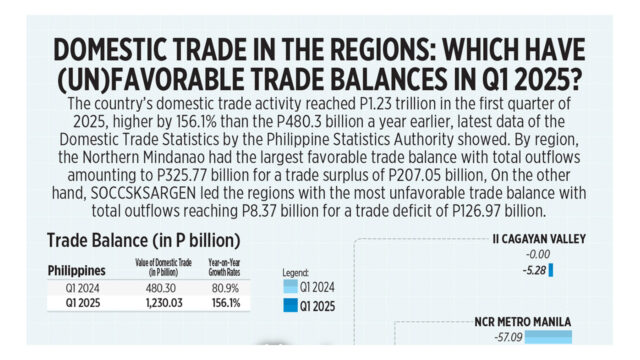
Domestic trade in the regions: Which have (un)favorable trade balances in Q1 2025?

The country’s domestic trade activity reached P1.23 trillion in the first quarter of 2025, higher by 156.1% than the P480.3 billion a year earlier, latest data of the Domestic Trade Statistics by the Philippine Statistics Authority showed. By region, the Northern Mindanao had the largest favorable trade balance with total outflows amounting to P325.77 billion for a trade surplus of P207.05 billion, On the other hand, SOCCSKSARGEN led the regions with the most unfavorable trade balance with total outflows reaching P8.37 billion for a trade deficit of P126.97 billion.

Domestic trade in the regions: Which have (Un)favorable trade balances in Q1 2025?

VinFast VF 7 targets ‘young, eco-conscious drivers’

PHOTO FROM VINFAST

ELECTRIC VEHICLES are said to be reshaping car culture as automakers embrace the “fashionization” of design. In a release, VinFast Philippines asserted that for younger, eco-conscious drivers, cars like the VF 7 are becoming expressions of personal style.

And without internal combustion engines, designers are said to be free to explore new forms and aesthetics. “EVs remove constraints, opening the door to cleaner, more innovative design. The newest electric models lean into sleek, aerodynamic profiles that echo the clean lines of modern architecture and fashion. Designers are favoring smooth surfaces, sculpted silhouettes, and flush panels that reduce drag while elevating visual appeal,” continued the release.

Designed by Italy’s Torino Design, the VinFast VF 7 “illustrates a new design philosophy that maintains the futuristic spirit of concept cars while preserving that essence in a commercial vehicle.” The all-electric C-SUV, priced from P1.76 million, draws inspiration from aerospace engineering, especially supersonic aircraft. Its sharp lines and bold forms suggest speed and precision. Hidden door handles, widened proportions, and a tapered roofline contribute to both visual drama and improved aerodynamics. All of these are the results of over 80,000 hours of work by Torino.

Inside is an expression of what Torino Design calls “Asymmetric Aerospace,” a driver-focused cockpit that prioritizes the person behind the wheel. Functionality, clean lines, and minimal physical controls reflect contemporary tastes.

The VF 7 Plus model delivers 500 Nm of torque, accelerating from a standstill to 100kph in 5.8 seconds. The base model, with a single motor, offers a 430 kilometers of range on a full charge. Both versions include features like hill-start assist, traction control, and adaptive cruise control. A 10-year battery warranty underscores VinFast’s focus on durability and peace of mind.

Style (08/25/25)


Lazada launching Labubu V3, Crybaby on Aug. 27

LAZADA is partnering with Pop Mart to launch its inaugural Super Brand Day (SBD), which will take place in-app on Aug. 27. During the regional SBD across Southeast Asia, there will be the timed release of Pop Mart products such as The Monsters and Crybaby. There will be storewide discounts of up to P320 off during the SBD, and buyers will receive an exclusive limited-edition gift-with-purchase, while stocks last. These products will be exclusively available on the Pop Mart brand store within Lazada’s LazMall during the SBD event. Pop Mart will increase its stock levels and scale up visibility on its LazMall storefront to meet demand. As part of the collaboration, a whole set of Hirono Reshape Series Figures will also be given away via Lazada’s Facebook and Instagram pages on Aug. 27.


Vintage Filipiniana exhibit up

THE University of the Philippines’ College of Home Economics (CHE) Costume Museum will be holding its anniversary exhibit, featuring garments from the Jurado Study Collection and the terno designs of Bachelor of Science in Clothing Technology students, entitled Aberrations. It is ongoing until Oct. 30, Tuesdays to Fridays, 11 a.m. to 3 p.m. at the Exhibit Hall of the CHE Museum. Of particular note is the collection of Dr. Leonarda Jurado who started a collection of traditional Filipino clothing in 1959. The collection, composed of 2,500 pieces of historical and cultural clothing, textiles and accessories, is now the Jurado Study Collection of the CHE Costume Museum. It is now on special exhibit, straight from the baul.


Anko launches Home Living Collection in PHL

ANKO is launching its new Home Living Collection in stores at TriNoma, Glorietta 2, and Alabang Town Center, starting on Monday, Aug. 25, for a limited time only. Designed by Anko’s in-house buying and design team in Melbourne, the collection brings sculptural forms, rich textures, saturated hues, and pops of accent colors, with curvy furniture and oversized accents to color-blocked cushions, ripple-edged mirrors, and textured ceramics. Among the offerings are a sage-toned ceramic kitchenware set (P900-P1,400); a Lava Rock Diffuser (P550); the minimalist white Mali Lounge Chair (P9,990), a collapsible Square Storage Ottoman (P800); striped cushions (P480) in pink-and-red and green-and-white colorways; a Muslin Cotton Quilt Cover Set (P1,790-P2,490), in sizes ranging from double to super king, available in seagrass and white; Trellis Laundry Basket and Hampers (P490-P1,290); and a Curved Boucle Floor Mirror (P3,290). Anko is also hosting an Interior Design Masterclass for Anko Club members on Sept. 8 at its TriNoma store. Guests can get expert styling tips from Sarah Dummett. To become a member, download the Anko Club app or sign up at www.anko.com/anko-club.


Miss Esthe now in Westgate Alabang, Newport City

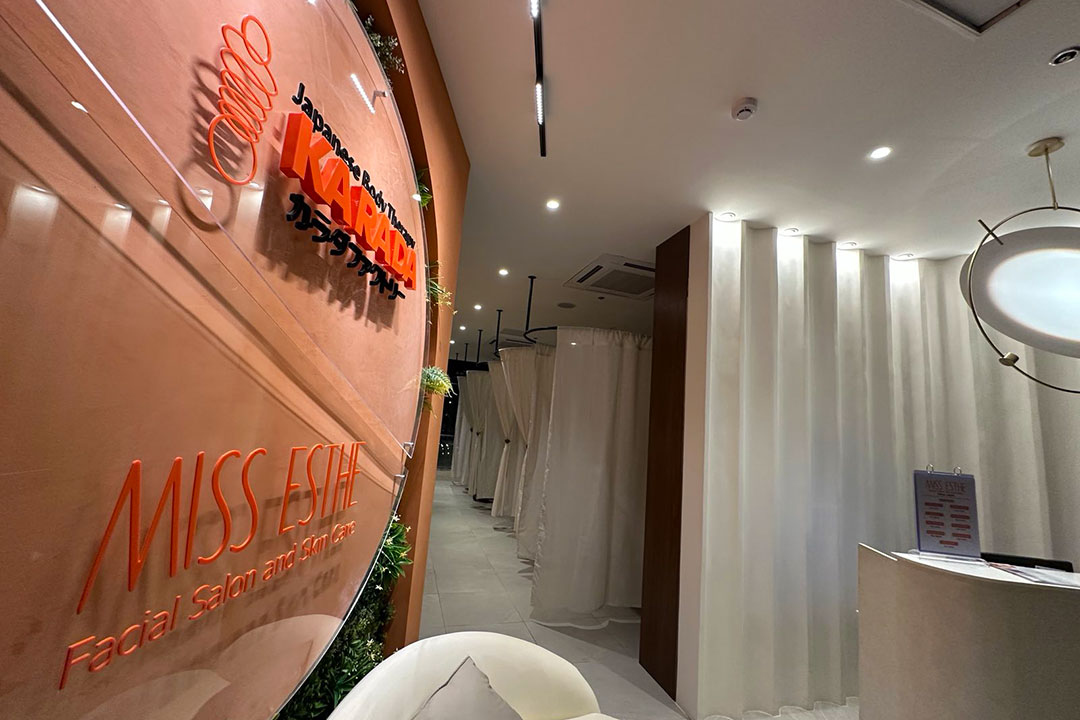
MISS ESTHE, a facial and skin care salon from Tokyo, Japan, has opened new branches at the Newport Circle, Newport City and Westgate Alabang, with soon-to-open branches at The Rise Assembly Grounds in Makati and at Shangri-La Plaza Mall. Each branch of Miss Esthe Facial Salon and Skin Care is equipped with state-of-the-art technology that is non-invasive, with estheticians who are trained by experts. Miss Esthe is known for its anti-aging facial as well as whitening, acne, sensitive skin, instant lifting, deep whitening and deep acne and open pores treatments. Each treatment includes a calming face and decollete massage which is unique to the Miss Esthe. Miss Esthe opened its first Philippine branch in 2018 at Uptown Mall in Bonifacio Global City (BGC). This was followed by another location at the Wellness Place, Glorietta 3 in Makati City. To make a reservation, call 0935-336-4720 for Uptown BGC, Taguig; 0906-285-7811 for Wellness Place, Glorietta, Makati; 0915-932-9182 for Newport Circle, Pasay; 0915-932-9184 for Westgate Hub, Alabang; or 0977-669-7513 for The Rise Assembly Grounds, Makati.


Hoka collaborates with Supervsn on sneaker

HOKA’S latest collaboration is with Supervsn, a Los Angeles-based creative house and lifestyle brand. This launch marks Supervsn’s official debut in footwear, reimagining the Hoka Clifton One9 through the lens of Inner Space Exploration — a concept coined by Supervsn founder Gavin Mathieu to reflect an astro-futurism aesthetic rooted in personal introspection. The collection features three colorways of the Clifton One9 silhouette: the Mantis Green and Ice Grey colorways will be available globally, while a third, Neon Gold, will be released in an extremely limited run of just 99 pairs, making it the rarest HOKA style ever produced. The launch includes a $25,000 donation from Hoka to The STUDIO Foundation, a mentorship program meant to educate, empower, and usher in the next generation of creative visionaries and entrepreneurs. The Supervsn x HOKA collection is available at HOKA exclusive stores in One Ayala Mall, GH Mall, SM Aura, and Ayala Malls Manila Bay.


Travel Sentry offers eco-chic accessories

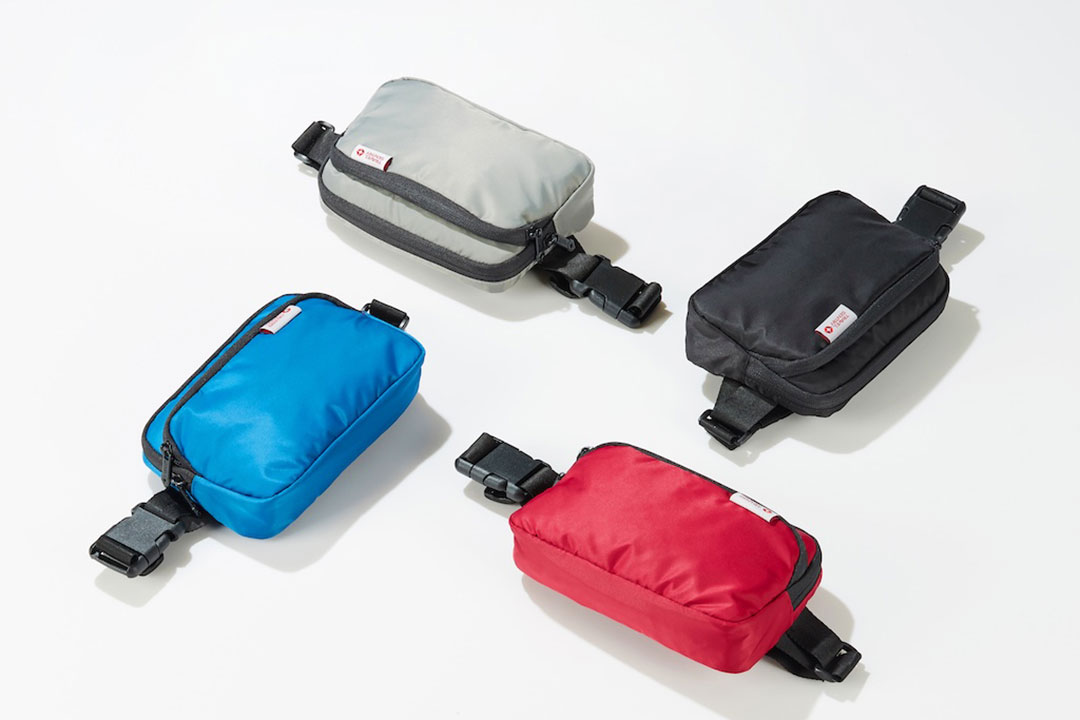
TRAVEL SENTRY Accessories are meant for eco-conscious jetsetters who want to explore the world without compromising on fashion or function. Made from 70% to 100% recycled RPET Nylon and Polyester, these accessories are not just functional, they are eco-friendly. Each piece is crafted in GRS-certified factories, ensuring that high environmental and social standards are met from start to finish. Travel Sentry pieces are lightweight, stain-resistant, and feature quality stitching, breathable mesh panels, and RFID pockets. All items come in FSC-certified, minimal-glue boxes, making recycling easy. Travel Sentry accessories are available at select True Value, SM Department stores, Landmark Department stores, Robinsons Department stores, Urbanize, and Duty Free stores.


Fendi unveils kids fall/winter collection

FENDI unveils its Kids Fall/Winter 2025-26 collection which also delves into the brand’s centenary year celebration. Timeless codes such as the iconic FF logo are accompanied by the Fendi Roma 1925 lettering on stripes or the Fendi Crest, a heraldic crest shield divided into four parts, featuring the Pequin stripe and the FF logo, the Giano Bifronte and the Fendi squirrel. Also present throughout the collection is the squirrel itself, part of the original 1925 Fendi logo. For girls, the collection blossoms with floral motifs that become delicate macro-FFs on white cotton poplin and muslin dresses, skirts, and blouses with puffed sleeves, and embroidered flowers on organza. An off-shoulder white dress features eyelet lace and subtle Fendi Roma 1925 lettering, also embroidered on a light blue organza piece and on knitwear sets in a punch-hole pattern with a 3D effect. Mini Me chambray pieces in a blue denim shade are adorned with signature ruffles and ton sur ton floral prints from the Women’s collection, or feature a FF logo interior as seen on a maxi skirt or Fendi Go To Jacket. For boys, a playful all-over pattern explores holiday elements. Surfboards, sunglasses, cameras, bananas, and many more shape an FF logo on poplin sets, nylon jackets, and an explorer backpack. The same little objects become prints or embroideries on T-shirts or polo shirts that also feature the distinctive Fendi Kids teddy bear. There are also charms including ping pong rackets, apples or badminton shuttlecocks. The collection has bon ton gabardine pieces with a mix-and-match of sporty details, such as technical piqué fabrics and polo necks as well as the incorporation of Fendi Roma 1925 stripes or the number “25.” There are tartan patterns in red-blue for girls and blue-green for boys, combined with FF logo piping, or embroidered Fendi Crest patches.


Cotton On offers denim collection

COTTON ON focuses on denim this month, with the Care Bears x Sesame Street collection. This includes a nightie and a limited-edition cardigan. There are also the Music License Tees, with a strong focus on iconic music legends, tapping into nostalgic appeal and generational fandom. These legendary artists not only bring bold graphic energy to the T-shirts but also connect with parents and kids alike through recognizable and timeless cultural moments.

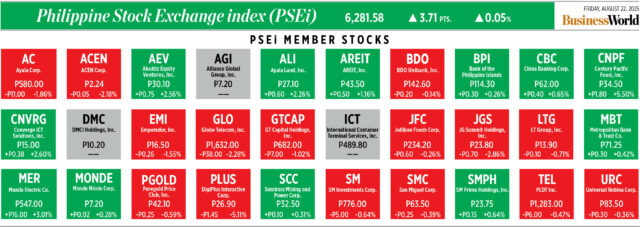
How PSEi member stocks performed — August 22, 2025

Here’s a quick glance at how PSEi stocks fared on Friday, August 22, 2025.


Stocks inch up on bargain hunting, rating action

PHILIPPINE STAR/KRIZ JOHN ROSALES

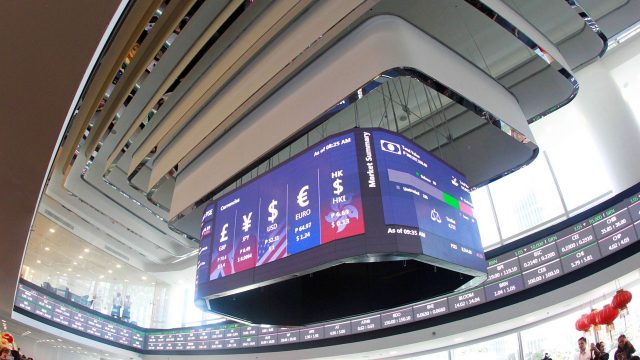
PHILIPPINE STOCKS inched higher on Friday after the country’s investment-grade rating was affirmed and on bargain hunting.

The benchmark Philippine Stock Exchange index (PSEi) went up by 0.05% or 3.71 points to close at 6,281.58, while the broader all shares index increased by 0.06% or 2.44 points to 3,737.58.

“The local market posted gains on the back of bargain hunting. Investors also appreciated Rating and Investment Information, Inc.’s (R&I) affirmation of the Philippines’ “A-” credit rating with a stable outlook,” Philstocks Financial Inc. Research Manager Japhet Louis O. Tantiangco said in a Viber message. “Finally, hopes of a Bangko Sentral ng Pilipinas (BSP) rate cut [this] week helped in lifting the bourse.” 

R&I on Wednesday affirmed the Philippines’ investment-grade “A-” rating with a stable outlook as it said it expects sustained economic growth and improving incomes amid “robust public and private investments, development of domestic business such as information technology and business process management industry, and population growth.”

For the first half, Philippine economic growth averaged 5.4%, slightly below the government’s 5.5% to 6.5% target for this year.

Meanwhile, BSP Governor Eli M. Remolona, Jr. earlier said that a rate cut is “quite likely” at the Monetary Board’s Aug. 28 meeting amid easing inflation.

If realized, this would be the BSP’s third straight reduction since April. The Monetary Board has lowered benchmark interest rates by a cumulative 125 basis points since it began its easing cycle in August 2024, with the policy rate now at 5.25%.

Meanwhile, week on week, the PSEi dropped by 0.54% or 34.35 points from its 6,315.93 close on Aug. 15, marking its second straight week of decline.

“Without any positive catalyst, the local market succumbed to bearish pressures, leading to an extended decline in last week’s trading. This is the first week since June 9 to 13 that the market continued in a certain direction,” Mr. Tantiangco said. “The local market remains undervalued fundamentals-wise. As of last week’s closing, the PSEi’s price-to-earnings ratio is at 10.8 times. This is below its five-year historical average of 17.3 times and the regional average of 17.6 times.”

The majority of sectoral indices closed higher on Friday. Property went up by 1.02% or 24.69 points to 2,444.46; industrials rose by 0.89% or 80.98 points to 9,112.92; mining and oil climbed by 0.46% or 44.09 points to 9,489.24; and financials increased by 0.09% or 1.91 points to 2,116.45.

Meanwhile, holding firms declined by 0.8% or 42 points to 5,205.46 and services retreated by 0.35% or 8 points to 2,276.18.

Value turnover rose to P6.44 billion on Friday with 803.64 million shares traded from the P5.76 billion with 1.07 billion shares exchanged on Wednesday. 

Decliners beat advancers, 97 versus 93, while 50 names were unchanged. Net foreign selling was at P721.91 million on Friday versus the P161.83 million in net buying recorded on Wednesday. — Revin Mikhael D. Ochave

Exporters see lower PDP goal out of reach with US chip tariff

STOCK PHOTO | Image by Freepik

THE Philippine Exporters Confederation, Inc. (Philexport), said the export targets set by the Philippine Development Plan (PDP) will be difficult to achieve if the US imposes tariffs on semiconductors. 

“The Philippine Export Development Plan (PEDP) was not achievable… so we adapted the PDP (target), which is lower,” Philexport President Sergio Ortiz-Luis, Jr. told reporters last week.

“That is the target we are now following; officially we haven’t changed the target, but that is what we are looking at, and even that is difficult to achieve … I am not even sure if we will meet it, because exports of electronics to the US will drop,” he added.

Under the PEDP, Philippine merchandise and services exports are projected at $163.6 billion in 2025. The corresponding PDP target was initially $113.42 billion, rising to $115.49 billion in the midterm PDP update.

This month, US President Donald J. Trump said he will be imposing a levy on semiconductors entering the US market in a bid to revive US chip production.

“We are very worried. We hope that there will be some breaks, but it is quite dim at the moment. We were hoping that electronics would save us, but I think our major competitors have lower tariffs, and that is the problem,” Mr. Ortiz-Luis said.

He said the hope is for Philippine chip exports to be exempt but noted that the Philippines has little leverage with nothing to offer the US.

“We might have to change our geopolitics because we are being left behind by our neighbors,” he added.

He said exporters have been trying to diversify their markets for the last 20 years but are failing due to lack of support.

“Our neighbors have complete support for research and development, policy, and promotions. If there are export exhibitions, our exporters won’t join because… our booths will look pathetic,” he said.

“Unless the government seriously says we will support exports and really puts money into it… I don’t see anything happening,” he added.

However, he said that the free trade agreements (FTAs) are helping cushion the impact of the US tariff.

“At least here in ASEAN, Korea, and Japan, the FTAs are helping somewhat, but we only have about four, and the others have more,” he said.

Aside from the US, he said that the other potential big markets for Philippine exports are Greater China and Japan. — Justine Irish D. Tabile

MIC, Saudi energy firm in off-grid RE collaboration

THE Maharlika Investment Corp. (MIC) said it signed an agreement with Saudi Arabian energy company ACWA Power to develop renewable energy (RE) projects for off-grid locations in the Philippines.

“No specific island was targeted yet. We’re doing our assessment on which to aim at first,” MIC President and Chief Executive Officer Rafael D. Consing, Jr. told BusinessWorld via Viber.

The memorandum of understanding (MoU) signed on June 30 allows both parties to explore the development of renewable energy and energy storage projects for off-grid Philippine islands.

In a separate statement, ACWA Power said the collaboration involves joint technical, commercial, and financial studies to assess the feasibility of developing power generation and energy storage infrastructure in the islands.

“These studies will identify potential project sites, system sizing, transmission requirements, and offtake arrangements,” ACWA Power said.

ACWA Power operates as a developer, investor, and operator of renewable energy and green hydrogen projects. It is also the world’s largest private water desalination company.

“We are excited to partner with Maharlika Investment Corp. in exploring renewable energy solutions for communities in the Philippines. This MoU reflects our shared commitment to inclusive energy access and sustainable development,” ACWA Power Chief Investment and Development Officer Thomas Brostrøm said.

Ahead of the MoU signing, Meralco Powergen Corp. (MGen), the power generation subsidiary of Manila Electric Co. (Meralco) entered into a partnership with ACWA to jointly explore solar power development opportunities in the Philippines and across Southeast Asia.

The partnership was formalized on the sidelines of the ASEAN Summit in Kuala Lumpur.

MIC said it has deployed a portion of its P75 billion in funding and the balance will be invested within the year.

In January, the MIC signed a deal to acquire a 20% stake in Synergy Grid & Development Phils., Inc. for P19.7 billion or about P15 per preferred share, giving it a “foothold” in the National Grid Corp. of the Philippines. — Aubrey Rose A. Inosante

PSA approval process eyed for streamlining

THE Energy Regulatory Commission (ERC) is proposing to amend the rules governing the power supply agreements (PSA) of distribution utilities and power suppliers to streamline the approval process to shore up investor confidence.

In a draft resolution, the ERC said the proposed changes are meant to expedite resolution of PSA applications and facilitate the entry of new generating capacities to support growing demand.

A PSA is a contract entered into by a distribution utility (DU) and a power supplier to procure a certain capacity for a price as a result of a competitive selection process (CSP). The CSP policy requires DUs to procure power through a transparent bidding exercise to secure least-cost supply.

One of the ERC’s proposed amendments is the immediate approval of the lowest bid under the executed PSA resulting from the CSP, as long as it complies with the guidelines and shows no indication of anti-competitive behavior.

Meanwhile, for PSAs resulting from direct negotiation, the ERC will review for reasonableness in terms of costs, risk allocation and other contractual terms “to ensure compliance with the least-cost obligation of the DU.”

Republic Act No. 9136 or the Electric Power Industry Reform Act of 2001 tasks the ERC with promoting competition, encouraging market development, and expanding consumer choice in the electric power industry.

The law also requires the Department of Energy (DoE) to facilitate and encourage reforms in the structure and operations of DUs for greater efficiency and lower costs.

In 2015, the DoE issued a circular requiring DUs to undergo CSP in securing their PSAs to ensure “transparent and reasonable prices of electricity in a regime of free and fair competition and full public accountability.”

In a recent open commission meeting, ERC Chairman and Chief Executive Officer Francis Saturnino Juan questioned the agency’s current evaluation methodology for PSAs.

He said the ERC still reviews rates based on cost-based methodology, even if contracts came via tendering or selection processes.

“Is our failure to honor the result of the CSP conducted in accordance with the DoE circular a violation of the DoE circular itself?” he said.

Mr. Juan said backlogs may affect investor confidence as they could end up not pursuing the power supply contracts because the bids are not honored.

“Maybe it is high time that we engage the stakeholders on a possible amendment to our existing guidelines,” he said. — Sheldeen Joy Talavera

More local government units express interest in ecozone development

ANFLOINDUSTRIALESTATE.COM

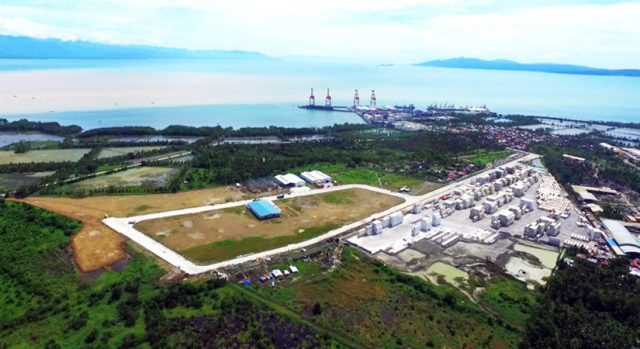
LOCAL government units (LGUs) have signified their interest in building new economic zones (ecozones), according to the Philippine Economic Zone Authority (PEZA).

In a Facebook post, PEZA Director General Tereso O. Panga said that these include Naga City, Los Baños City, and San Pablo City.

“We certainly welcome these new host LGUs to join the PEZA network of 427 operating ecozones (and counting) all over the country,” he added.

This week, he said PEZA visited three proposed ecozones in San Andres, Quezon (135 hectares), Pamplona, Camarines Sur (60 hectares), and Libon, Albay (40 hectares) to conduct due diligence and hold consultation meetings.

“These three ecozones are strategically located along the Bicol and Bondoc Peninsulas, fronting the Ragay Gulf — the third-largest gulf in the Philippines,” he said.

“By providing for port connectivity among San Andres, Pasacao, and Pantao ports, this will stimulate regional economic growth, as the goods produced and raw materials needed in the ecozones can be facilitated through barge deliveries,” he added.

He said the ports can serve as gateways for domestic and international commerce, tourism, and inter-island transportation.

He expects more LGUs to embrace ecozones to spur growth with the Philippines continuing to be one of the best-performing economies in the region. 

“The Philippine economy could be boosted if business activities flourish in the ecozones as well as their linkages to the domestic market. This is where PEZA and host LGUs can collaborate in promoting and facilitating ecozone investments to accelerate our countrywide development,” he said.

As ecozones in rural and new growth areas are created, he said LGUs must draft investment codes, transform digitally, and develop human resources, infrastructure, and local supply chains to enhance their capacities and attract locators.

“All these key reforms will factor in as competing LGUs vie to host ecozones and locator industries to generate additional income, jobs, livelihood, and other economic opportunities for their constituents,” he said.

“It is already a proven fact that when ecozones exist in LGUs, it becomes a boon to their community as it generates new ancillary and complementary micro, small, and medium enterprises, service companies, and transport service opportunities that each ecozone spurs with its creation,” he added.

Citing a survey by the Philippine Statistics Authority, PEZA said that almost all the top 10 performing LGUs host ecozones.

“The bigger the number of ecozones and locator companies in a certain city or municipality, the higher is its level of socio-economic progress as compared to those LGUs that do not host any ecozones,” Mr. Panga said.

To date, 34 ecozones have been proclaimed under President Ferdinand R. Marcos, Jr., accounting for P14.7 billion in capital investment. — Justine Irish D. Tabile