Home Blog Page 1048

Venice Film Festival: No reason to boycott actors over Gaza, director Schnabel says

In the Hand of Dante (2025)

VENICE — US director Julian Schnabel on Wednesday criticized calls for two of the stars of his latest film, Gal Gadot and Gerard Butler, not to show up at the Venice Film Festival over their support for Israel.

Last month a collective of hundreds of film industry figures, Venice4Palestine, urged the festival to take a robust stand over the war in Gaza.

The group subsequently called for Israeli actor Ms. Gadot and Britain’s Mr. Butler, who once took part in a fundraiser for the Israeli Defence Forces, to be barred from the 11-day event.

Both actors appear in Mr. Schnabel’s star-studded movie In the Hand of Dante, which is being premiered at Venice on Wednesday. Neither actor is set to appear on the red carpet — although Ms. Gadot, for one, had never been expected to attend according to pre-festival planning notes.

Asked about the push to bar actors for their political beliefs, Mr. Schnabel said: “I think there’s no reason to boycott artists. I selected those actors for their merits as actors, and they did an extraordinary job in the film, and that’s about it.”

Festival director Alberto Barbera told Reuters last week that Venice welcomed open debate, but dismissed calls for anyone to be excluded from the festival.

In the Hand of Dante follows author Nick Tosches as he is drawn into a violent quest to verify the origins of a manuscript believed to be Dante’s The Divine Comedy. Jumping between the 21st and 14th centuries, the film interweaves the parallel lives of Tosches and Dante, both played by US actor Oscar Isaac.

The film also stars Al Pacino, John Malkovich, Martin Scorsese, Jason Momoa, and Louis Cancelmi. It is being shown out of competition in Venice, meaning it is not in the running for the Golden Lion award.

The project was a labor of love for Mr. Schnabel, an American painter-turned-filmmaker, who previously directed art house movies The Diving Bell and the Butterfly, Before Night Falls, and At Eternity’s Gate. — Reuters

Peso returns to P56:$1 level as US data bolster Fed easing view

BW FILE PHOTO

THE PESO jumped back to the P56 level versus the dollar on Thursday as weaker-than-expected US jobs data fueled expectations of a rate cut by the US Federal Reserve this month.

The local unit closed at P56.98 per dollar, strengthening by 32 centavos from its P57.30 finish on Wednesday, Bankers Association of the Philippines data showed.

The peso opened Thursday’s trading session flat at P57.30 against the dollar. Its intraday best was at its closing level of P56.98, while its worst showing was at P57.32 versus the greenback.

Dollars traded increased to $1.46 billion on Thursday from $1.37 billion on Wednesday.

The peso rose on “reinforced dovish Fed bets after the dismal jobs release overnight,” the first trader said in a phone interview.

“The peso appreciated after the weak US job openings data continue to fuel views of a September Fed rate cut,” the second trader said in an e-mail.

The US dollar steadied on Thursday in a volatile week as investors contend with a fragile bond market and data showing a weakening labor market, which has reinforced expectations the Federal Reserve will cut rates this month, Reuters reported.

With the Fed focused on employment, Friday’s crucial jobs report will help set expectations for the central bank’s next few policy meetings. Data on Wednesday showed job openings fell to a 10-month low in July, although layoffs remained relatively low. Separate surveys on private sector employment and monthly layoffs were due later on Thursday.

Traders are pricing in a near-100% chance of the Fed cutting interest rates later this month, up from 89% a week ago, CME FedWatch showed. They are also pricing in 139 basis points of easing by the end of next year.

The dollar edged up in relatively steady trade, reflecting investor wariness of making any big moves ahead of Friday’s payrolls report.

The dollar index, which tracks the US currency against six others, was up slightly at 98.23.

Several Federal Reserve officials said labor market worries continue to underpin their view that rate cuts still lie ahead for the central bank, boosting expectations of an imminent rate cut.

For Friday, the second trader said the peso could depreciate anew against the dollar due an expected uptick in Philippine inflation in August.

A BusinessWorld poll of 16 analysts yielded a median estimate of 1.3% for the August consumer price index, faster than the 0.9% rise in July but slower than the 3.3% clip in August 2024.

The first trader sees the peso moving between P56.80 and P57.20 per dollar on Friday, while the second trader expects it to range from P56.85 to P57.10. — A.M.C. Sy with Reuters

Petron launches $550-M exchange, tender offer for securities

PETRON.COM

PETRON CORP. is offering investors the option to exchange $550 million worth of its existing securities for new ones, or to sell them back for cash.

In a regulatory filing on Thursday, the oil company said investors who agree to the exchange will receive $1,000 worth of new securities in return, along with an accrued distribution amount.

“The company is undertaking the exchange and tender offer as part of a proactive approach to the strategic management of its capital structure and to extend the maturity profile in respect of its outstanding obligations,” Petron said.

At the same time, Petron plans to issue a separate round of new US dollar-denominated senior perpetual capital securities. The company expects to announce the minimum initial distribution rate on or around Sept. 15, with final pricing details and the results of the exchange to be released on or before Sept. 16.

Petron held the largest share of the local oil market at 24.9% as of June 2024, Department of Energy data showed. It has a refining capacity of nearly 270,000 barrels per day, operates around 50 terminals in the region, and runs about 2,700 service stations nationwide.

On Thursday, Petron closed at P2.45, down 0.03 or 1.21%. — Sheldeen Joy Talavera

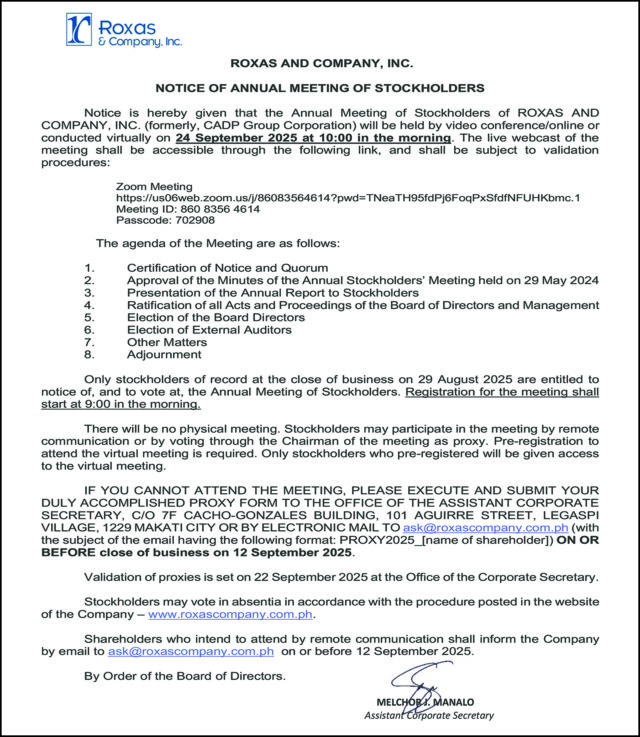
Roxas and Company, Inc. to conduct 2025 Annual Meeting of Stockholders virtually on Sept. 24


Spotlight is BusinessWorld’s sponsored section that allows advertisers to amplify their brand and connect with BusinessWorld’s audience by publishing their stories on the BusinessWorld Web site. For more information, send an email to online@bworldonline.com.

Join us on Viber at https://bit.ly/3hv6bLA to get more updates and subscribe to BusinessWorld’s titles and get exclusive content through www.bworld-x.com.

Another People Power in the making?

STOCK PHOTO | Image by Creativeart from Freepik

By now, most Filipinos have seen, if not memorized, excerpts from Senator Ping Lacson’s much-circulated “corruptionary.” Unlike the entries in Merriam-Webster, Lacson’s version doesn’t define words, it defines a system. It is tailor-made for the digital age: short, graphic, and horrifyingly effective in exposing how billions in public funds have been misused, particularly in the Department of Public Works and Highways’ (DPWH) flood control projects. These are not mere accounting errors, they are systematic acts of plunder.

What once seemed unthinkable has now become painfully clear. Taxpayer money has been siphoned off into ghost projects, unfinished infrastructure, and substandard materials. The general public is only now awakening to the grotesque scale of these abuses. We now understand how luxury umbrellas could trigger the sale of Rolls-Royce vehicles, how a single Patek Philippe watch can command over P11 million, and how one extravagant dinner in Bonifacio Global City can cost three-quarters of a million pesos — for just four people. In a country where more than half of all families identify as poor, these revelations are not just obscene — they are potentially explosive.

Such revelations shorten not only the political lifespans of those involved but also their economic and social credibility. The Bible puts it succinctly: “By their fruits, ye shall know them” (Matthew 7:16).

As discussed in last week’s column, these flood control anomalies raise foundational questions, and not merely about legality, but about basic decency. At this point, the issue is not whether guilt can be proven beyond reasonable doubt. The volume of red flags, confessions, and physical evidence is already overwhelming.

We’ve seen a high-ranking DPWH official casually admit in congressional hearings that he gambled two to three times a month while in office. One might ask: on what salary was he funding this vice? One contractor testified to donating P30 million to a senator’s campaign. That senator, in turn, acknowledged receiving campaign funds from a “friend” who held active government contracts despite clear prohibitions under election law. Meanwhile, the children of these contractors, undeterred by public scrutiny, flaunt their wealth on social media — luxury cars, designer goods, and million-peso watches treated like everyday accessories.

Has decorum been entirely abandoned?

Even a basic inspection conducted by the President, followed by Senator Lacson’s own staff, found numerous non-existent projects in vulnerable, flood-prone areas like Bulacan and Oriental Mindoro. Where structures did exist, the use of substandard cement and steel was evident. The deviation between approved designs and actual builds reveals a dangerous pattern: weakened infrastructure at inflated costs. A cursory review of the national infrastructure budget even shows inexplicable uniformity: identical allocations for vastly different projects across disparate terrains.

This goes beyond poor planning; it reflects a fundamental betrayal of public trust. When legislators, contractors, district engineers, auditors, and bidding committee members all appear to operate in concert — with their families openly enjoying the spoils — the public is justified in assuming widespread collusion. Their lifestyles betray their true income sources. Their own testimonies, sometimes unwittingly, reveal their guilt. “Out of the abundance of the heart, the mouth speaketh” (Matthew 12:34).

How do we begin to dismantle such entrenched corruption? How do we reclaim a sense of integrity in public service?

We must first acknowledge that the current investigations in Congress are compromised. The very lawmakers tasked with oversight are, in many cases, implicated in the anomalies under scrutiny. The annual national budgets they passed are rife with “insertions” — pork-barrel allocations that siphon funds away from public health, education, and truly critical infrastructure. This context casts a long shadow over the objectivity of current Senate and House hearings. No amount of political grandstanding can undo this perception. The ties between lawmakers, DPWH officials, and favored contractors appear too strong to ignore.

One immediate step would be for lawmakers and public officials who may be investigated to voluntarily recuse themselves from proceedings related to transparency and accountability. This is not only prudent but necessary if we are to rebuild public trust.

Another promising development is the recent executive order creating an independent anti-corruption commission with a specific focus on the DPWH. As the civic coalition 1Sambayan correctly points out, this could be a critical move towards ensuring proper use of public funds. But for this initiative to succeed, the President must appoint individuals of “unquestionable integrity, competence, and independence.”

Yet, good intentions are not enough. The commission’s mandate must go beyond investigating and recommending cases to the Office of the Ombudsman or the Department of Justice. It must have real authority, legal and administrative, to enforce its findings and hold both public officials and private contractors accountable.

Otherwise, it risks becoming another toothless body, its reports fated to collect dust, as many Senate Blue Ribbon Committee investigations have in the past. One only needs to revisit the Pharmally scandal to see how detailed Senate findings — such as overpriced PPE and substandard medical gear — never translated into concrete legal action. No officials from the Department of Health or Department of Budget and Management were prosecuted, despite clear evidence of wrongdoing.

The call of 1Sambayan to “identify individuals and entities involved in corrupt practices and recommend appropriate legal action” is not merely sound — it is urgent.

And yet, some of those under scrutiny continue to assert their innocence, even as their lavish lifestyles and public spending habits say otherwise. The disconnect is staggering.

Former Supreme Court Justice Adolf Azcuna recently proposed a powerful idea: under Republic Act 1379, the government has the authority to seize properties that are clearly disproportionate to declared incomes, even in the absence of direct proof of theft. This law allows for the forfeiture of ill-gotten wealth and must be used more aggressively starting with our lawmakers and DPWH officials.

Private contractors should also face the full force of the law. Their actions may constitute not just graft and corruption but also fraudulent practices, malversation of public funds, and falsification of documents. By collecting payments for ghost or substandard projects, they violate their legal and contractual obligations and rob the country of infrastructure that could have spurred economic growth and improved lives.

What’s most tragic is the opportunity cost. For every peso stolen, a child goes uneducated, a barangay remains flooded, a road stays broken. Corruption kills development.

We must not wait until Filipinos are driven to the streets in protest, as Indonesians were just last week. According to The Guardian, at least seven people died, and hundreds were injured as protests erupted over lawmakers receiving housing allowances 10 times higher than Jakarta’s minimum wage — all while essential services like education, healthcare, and infrastructure were slashed under austerity. The people also railed against what they saw as a “corrupt elite,” hoarding the nation’s wealth for conglomerates and the military.

We must not allow a similar tragedy to unfold here. The case of the 21-year-old delivery driver in Jakarta — killed as a paramilitary vehicle rammed through protestors — is a chilling reminder of how quickly injustice can escalate into unrest.

Some observers have begun to speak of this moment as a tipping point. Perhaps they are right. It is time civil society becomes bolder in confronting indecent governance. For far too long, our outrage has been muted. Now, with evidence in plain sight, silence is no longer an option.

Let us be reminded once again by Scripture:

“If you do nothing in a difficult time, your strength is limited. Rescue those being taken off to death, and save those stumbling toward slaughter.” Proverbs 24:10–11

Let us begin with truth, and follow it with action.


Diwa C. Guinigundo is the former deputy governor for the Monetary and Economics Sector, the Bangko Sentral ng Pilipinas (BSP). He served the BSP for 41 years. In 2001-2003, he was alternate executive director at the International Monetary Fund in Washington, DC. He is the senior pastor of the Fullness of Christ International Ministries in Mandaluyong.


Venice Film Festival: Gaza girl’s desperate pleas in The Voice of Hind Rajab shake Venice

A scene from The Voice of Hind Rajab.

VENICE — The anguished final pleas of a five-year-old Palestinian girl trapped in a car under Israeli fire are retold in The Voice of Hind Rajab, a searing new film that received a rapturous premiere at the Venice Film Festival on Wednesday.

“Hind’s story carries the weight of an entire people,” one of the actors, Saja Kilani, told reporters in a statement she read out on behalf of the whole cast and crew ahead of the screening.

The true-life drama focuses on telephone operators from the Palestinian Red Crescent Society who tried for hours to reassure the trapped Hind Rajab as she begged to be rescued from the car, where her aunt, uncle, and three cousins already lay dead.

“I’m so scared, please come,” the little girl says, with the original recordings of her increasingly desperate calls to the dispatchers used to powerful effect throughout the film.

“The real question is, how have we let a child beg for life? No one can live in peace while even one child is forced to plead for survival. …Let Hind Rajab’s voice echo around the world,” Ms. Kilani said.

After a three-hour wait, the Red Crescent finally got the green light from Israel to dispatch an ambulance to save Hind. But contact with the girl and the rescuers themselves was cut just after the ambulance arrived at the scene.

Days later, the girl’s body was found along with those of her relatives in the car. The remains of the two dead ambulance workers were also recovered from their bombed-out vehicle.

The Israel Defence Forces initially said its troops had not been within firing range of the car. However, independent investigations challenged this assertion and a subsequent UN report said the IDF had destroyed Rajab’s car and killed the two medics who were trying to save her.

Asked about the killings this week, the IDF said the incident, which happened on January 29, 2024, was still under review and declined further comment.

STANDING OVATION
The film received a thunderous, 24-minute standing ovation at its premiere, by far the longest of this festival to date, making it the clear crowd favorite to win the prestigious Golden Lion award, which will be awarded on September 6.

“Free, free Palestine,” people in the audience chanted.

The movie has also attracted some top Hollywood names as executive producers, giving it added industry heft, including actors Joaquin Phoenix and Rooney Mara, who were both in Venice on Wednesday to support the production, as well as Brad Pitt.

Tunisian director Kaouther Ben Hania, who also wrote the screenplay, said Hind’s voice transcended a single tragedy.

“When I heard the first time the voice of Hind, there was something more than her voice. It was the very voice of Gaza asking for help. …It was anger and helplessness that gave birth to this movie,” she told reporters.

The IDF invaded the Gaza Strip after Hamas militants attacked Israel on Oct. 7, 2023, killing 1,200 people and taking 251 hostages. More than 63,000 people living in Gaza have died in the fighting, Gaza health authorities say.

“The narrative around the world is that those dying in Gaza are collateral damage. I think this is so dehumanizing, and that’s why cinema and art are important, to give those people a voice and a face. We are saying enough, enough of this genocide,” Ben Hania said.

The world’s biggest academic association of genocide scholars announced this week that it had passed a resolution saying the legal criteria had been met to establish that Israel is committing genocide in Gaza, something Israel denies.

The actors playing the Red Crescent dispatchers said they only heard Rajab’s recordings when they were on the set, making the filming an extremely emotional process.

“There were two times where I couldn’t keep filming. I had a panic attack,” Palestinian actor Motaz Malhees said. — Reuters

Interest never sleeps

The 2026 National Expenditure Program prepared by the Department of Budget and Management (DBM) and submitted to Congress is set at a record P6.793 trillion. While high expenditures are expected for a growing country like the Philippines, the increasing debt level is concerning, as the government is projected to spend P950 billion on interest payments, with another P1 trillion allocated for principal amortization. Movements in interest rates are significant as interest payments are a function of rates and the principal borrowed.

Between 1986 and 2010, approximately 30% of the national budget was allocated to interest payments, which restricted productive spending on sectors such as social services and infrastructure. These are still areas where the Philippines is falling behind, showing the cumulative effect of underspending in those sectors. This share reached 36.9% in 2004 when the growing budget deficit, rising public debt, and macroeconomic factors led President Gloria Macapagal-Arroyo to declare that the Philippines was in the midst of a fiscal crisis, warning of a potential debt default. The situation has improved, and the Philippines is now in a significantly better fiscal position, but it is our responsibility to sustain this improvement.

Borrowing to finance projects that will bring long-term value to the country is not necessarily a bad thing; however, in the words of J. Reuben Clark, “Interest never sleeps nor sickens nor dies; it works on Sundays and holidays.” The investments the country makes must generate enough return to pay off the debt we incur to finance them. We borrow today with the understanding that future generations will repay it, and each extra peso we pay in interest is one less peso available for priority projects. Whether the projects succeed or not, we still have to pay the principal and interest.

This situation is further aggravated by corruption, which siphons off vital national resources. The World Bank estimates that this amount was roughly 20% of the National Expenditure Program in 2024. These stolen funds translate into debts that future generations will shoulder, not only through monetary payments, but also through the long-term impacts of reduced investments in social services, such as education and healthcare, as well as infrastructure development. Today, we see this playing out in the Philippines’ educational crisis. At the same time, we continue to deal with recurrent flooding and inadequate road networks, all of which hinder progress and deepen inequality.

Imagine the impact if, instead of funding lavish lifestyles for corrupt officials and their associates, those funds were redirected toward genuine national development. Public funds must be used effectively and efficiently, with transparent processes and strict accountability to ensure the projects benefit the broader population. When investments focus on critical sectors like education, healthcare, infrastructure, and social welfare, the country can experience sustainable growth, improved living standards, and greater opportunities for all Filipinos.

As our national debt continues to grow, it becomes even more critical for the government to exercise exceptional care and transparency in how it allocates, disburses, and utilizes public funds. Our national debt has grown tremendously from approximately P6 trillion in June 2016 to more than P17 trillion as of June 2025. Responsible borrowing and prudent fiscal management are essential to prevent debt from perpetuating a cycle of dependency and corruption.

Private citizens can play a crucial role in ensuring accountability by actively participating in the democratic process and engaging in civic discussions to influence policies and shape the actions of leaders. Citizens can also hold public officials and institutions responsible through advocacy, watchdog activities, and demanding transparency in government dealings. Additionally, private individuals lead by example by following laws and regulations, supporting community growth, and promoting ethical conduct. Ultimately, engaged and responsible citizens are the backbone of a strong nation because, after all, it is our tax money funding it. Let us fund a better tomorrow for all.

The views expressed herein are his own and do not necessarily reflect the opinion of his office as well as FINEX.


EJ Qua Hiansen is the chief financial officer of PHINMA Corp. and the president of the Financial Executives Institute of the Philippines.

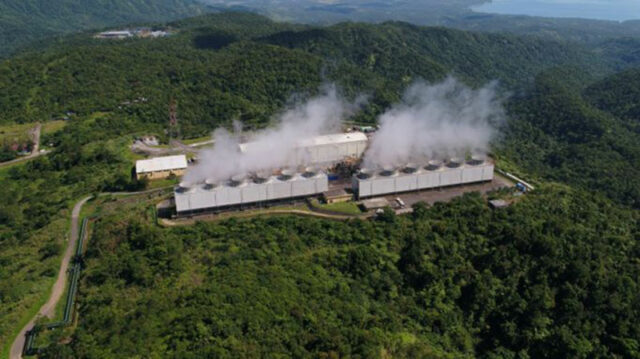
First Gen says Batangas plant to run on Bac-Man geothermal via GEOP

BW FILE PHOTO

TAIWAN FRUCTOSE (Philippines), the local subsidiary of global sweetener supplier Taiwan Fructose Co. Ltd., has tapped Lopez-led First Gen Corp. to procure renewable energy to power its production and logistics facility in Batangas.

In a statement on Thursday, First Gen said it will supply the Taiwan Fructose facility inside the First Philippine Industrial Park (FPIP) in Batangas with electricity sourced from the Bacon-Manito (Bac-Man) geothermal complex in the Bicol region via the government’s Green Energy Option Program (GEOP).

GEOP is a program that allows eligible electricity end-users to choose renewable energy as their power source.

Taiwan Fructose’s facility at the FPIP manufactures various sweetening products for the export market — such as glucose and fructose syrups — and other sweet additives for a wide range of food and beverage products, as well as health supplements.

“Geothermal energy is a renewable energy source that can run at baseload capacity which is ideal for industries that require stable 24/7 power supply with a lower carbon footprint. We are pleased to support Taiwan Fructose in its journey towards sustainability and decarbonization,” said First Gen Chief Customer Engagement Officer Carlo Vega.

The Bac-Man geothermal complex is owned and operated by First Gen subsidiary Energy Development Corporation, the country’s leading geothermal developer.

To date, First Gen has a total of 3,617 megawatts (MW) of combined capacity from its portfolio of plants that run on geothermal, wind, hydro, solar energy, and natural gas.

On Thursday, First Gen closed at P16.50, up 0.06 or 0.36%. — Sheldeen Joy Talavera

Outrage, memes, and amnesia

PHILIPPINE STAR/RYAN BALDEMOR

By Jam Magdaleno

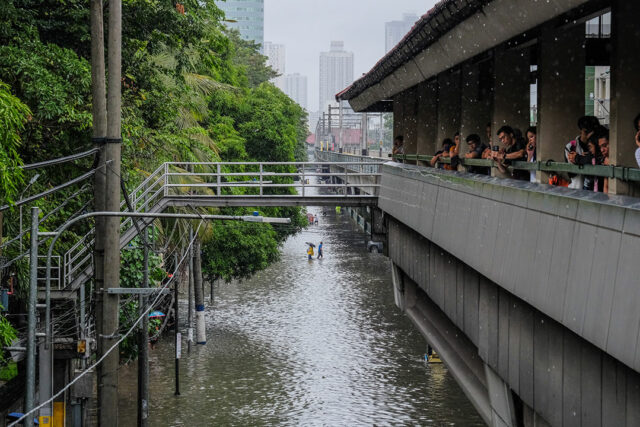
THE RECENT flood control fiasco offers a textbook case of our political cycle of outrage and forgetting. Ironically, the same cycle happens every few months. Last year, everyone seemed to be preoccupied with POGO and Alice Guo. A few weeks back, the same public gaze was turned towards online gambling. While it is understandable that people are enraged, what is concerning is that these events reveal a cyclical pattern in our public discourse.

For one, the endpoint of these issues almost always leads to more government intervention. Once the flood subsides — no pun intended — it is predictable that the result of these hearings will be yet another layer of government oversight. While oversight and fact-finding bodies are important to extract justice in some form, they are merely ex post facto. If we are to have any hope of addressing these decades-old problems, shouldn’t we be more creative? Some proposals, like Ramon Ang’s plan to fix Metro Manila’s flooding, have already been forgotten.

Former Solicitor General Florin Hilbay rightly suggests that perhaps it is time to seek private-sector intervention, given that the cost of government-led flood control projects is often inflated by leakages.

Waiting for the government to carry out a self-inflicted overhaul is like waiting for Godot. No matter how many good-governance officials are in place, the very nature of politics ensures that self-interest trumps the public interest.

To understand why this is the case, we turn to the concept of public choice. Public choice theory, pioneered by Nobel laureate James Buchanan and Gordon Tullock, views politicians, bureaucrats, and voters not as benevolent guardians of the public good but as rational actors driven by incentives, much like participants in a marketplace. Officials seek re-election, agencies seek bigger budgets, and voters often pursue short-term benefits without regard for long-term costs. In this view, politicians and bureaucrats are not moral guardians. If we adopt this perspective, it becomes clear that the next steps must focus on changing the environment rather than moralizing the issue.

What, then, is the problem with moralizing the issue? It pollutes public discourse, reducing it to individual-level fault-finding and “memeing” rather than fostering informed discussion and genuine problem-solving. One way this manifests is through the shaming culture so rampant today. TikTok and Facebook are flooded with memes targeting contractors, politicians, and even their relatives. But does this solve anything? No. Instead, it creates a false sense of action, widening the awareness-action gap. This gap arises because awareness is often easier and more emotionally gratifying than action. Social media makes it especially visible: we get the feeling of having done something by liking, sharing, or memeing, but in reality, nothing changes on the ground. It trivializes complex problems and makes them easy fodder for virality. By this point, the PR directors of these politicians are already busy figuring out how to spin the outrage into their favor for 2028. Once the dust has settled, we will be left only with memes to carry into 2028, being none the wiser.

If outrage and forgetting are the default cycle, the challenge is to design ways of breaking it. Scandals will always come and go, but institutions can be built to outlast the news cycle. One promising model is already here in the Philippines: the Citizen Participatory Audit (CPA) program of the Commission on Audit. Since 2012, CPA has embedded citizens into audit teams alongside state auditors, producing joint reports on flood control projects, health centers, sanitation, and road construction. These audits have exposed irregularities ranging from poor construction to procurement defects, leading in some cases to resignations and legal action. Unlike traditional post-mortems, CPAs keep pressure alive by institutionalizing citizen oversight and transforming outrage into evidence-based accountability.

The temptation is to believe that politics will correct itself if only “good people” are elected. Public choice theory warns us otherwise. Since self-interest is always at play, the real task is to design rules that channel self-interest toward the public good. This means procurement systems where contracts are open and competitive, infrastructure deals with automatic performance benchmarks, and even sunset clauses for programs that require renewal to continue. These may sound boring compared to fiery hearings or viral memes, but boring is exactly what enduring reforms look like.

International models prove that such institutional design works. The Netherlands, for example, entrusts flood control to independent water boards (waterschappen), which have existed since the Middle Ages. These boards raise their own revenues through dedicated local levies and wastewater fees, fund 95% of their own budgets, and are legally required to upgrade defenses every five years to meet strict safety norms — such as preparing for one-in-10,000-year flood events in critical zones. Their financial autonomy and regulatory power mean that flood protection is insulated from electoral cycles and partisan interference. The result: the Dutch have not experienced a catastrophic flood like 1953’s North Sea disaster in over 70 years, despite rising seas and climate risk. These lessons matter for Metro Manila and the Philippines.

Mr. Hilbay is right: massive public works are too prone to leakages when left entirely to the government. A Philippine version of the Dutch model, whether through independent authorities funded by user fees, or through public-private partnerships with contracts tied to measurable results, could help ensure that self-interest works in service of the public good.

But none of this will matter if public discourse itself remains trapped in the cycle of outrage, memes, and amnesia. Social media platforms reward trivialization. This is not a reason to abandon them but to rethink how they can be manipulated for a more mature and sustained social movement. If virality is inevitable, can it be redirected to sustain reform pressure rather than dissipate it? Civic groups have already experimented with digital scorecards, fact-checking campaigns, and “explainers” that keep issues alive well after the headlines fade. The task is to scale these efforts so that memes do not merely mock politicians but pin them down with evidence-based demands.

Ultimately, the larger point is that waiting for politics to correct itself is futile. Scandals will fade, personalities will come and go, and 2028 will arrive whether or not we have learned anything. The only way forward is to redesign the environment, through stronger institutions, smarter contracts, and civic innovations that make accountability harder to dodge. Ostensible outrage without follow-through only guarantees that we will face the same problems again. The real test is whether we can channel outrage into structures that endure after the floodwaters— and the memes — have receded.


Jam Magdaleno is a political and economic researcher, writer, and communication strategist. He is the head of Information and Communications of the Foundation for Economic Freedom (FEF), a Philippine-based think tank.

Venice Film Festival: Camus classic The Stranger revitalized

A scene from The Stranger.

VENICE — Adapting a book for the screen is always “a betrayal,” French director François Ozon says, but in bringing Albert Camus’ The Stranger to the Venice Film Festival he hopes to generate fresh debate around a French classic.

Shot in black and white, the film follows Meursault, a detached young Frenchman living in colonial Algeria in the 1930s who kills an Arab on a beach and is put on trial, with a possible death sentence hanging over him.

Mr. Ozon, 57, is one of France’s most prolific filmmakers, known for works such as Swimming Pool, 8 Women, and By the Grace of God. He said his latest project was born after he revisited Camus’ novel, which he had first read in his teens.

“I realized how much the book still resonates with the present day,” he told Reuters. “I launched into this adaptation with a bit of fear, because I’m tackling a masterpiece of French literature.”

Published in 1942, the book was brought to the screen in 1967 by Italian director Luchino Visconti, in a film starring his compatriot Marcello Mastroianni.

Mr. Ozon has said he was very keen to produce a French-language version of Camus’ existentialist classic, although he was aware that not everyone will appreciate his effort.

“Adapting a book always involves a degree of betrayal, but it’s a reinterpretation in another language. It’s not the language of literature; it’s the language of cinema.”

He said the novel’s themes of absurdity, alienation, and colonial injustice remain pressing.

“When you see what’s happening, the wars, the rise of the far right, the misdeeds of colonialism, the destruction of nature, all these philosophical questions are in Camus’ book.”

Actor Benjamin Voisin, who plays Meursault, said it was extremely tough to portray such an emotionally detached and indifferent character.

“It was hard for me to be asked to never ‘act.’ But I had to find a compromise between the role, Camus’ philosophy, and Ozon’s film,” he said.

The Stranger is one of 21 films competing for the prestigious Golden Lion, which will be awarded on Sept. 6. — Reuters

BSP may deliver one last cut in December

BW FILE PHOTO

THE BANGKO SENTRAL ng Pilipinas (BSP) could pause its easing cycle at its next meeting and deliver its final rate cut in December.

“We had expected BSP to cut in August. We also penciled in a pause for October, largely because we feel the BSP will be watching the Fed and what the Fed decides to do. That’s why we actually expect the last cut for this year to come around at their December meeting,” Nicholas Antonio T. Mapa, chief economist at Metropolitan Bank & Trust Co., said on Money Talks with Cathy Yang on One News.

“So, pause in October, wait things out — just see how data plays out, see where the Fed takes policy rates — and then maybe decide by December. With inflation still quite manageable, with growth still needing a bit of a boost, this could give Governor Remolona enough leeway to cut policy rates before the end of the year.”

Last week, the Monetary Board slashed the target reverse repurchase rate by 25 basis points (bps) for a third straight meeting to 5%. It has now slashed borrowing costs by 150 bps since it began its easing cycle in August 2024.

BSP Governor Eli M. Remolona, Jr. said the latest cut puts the policy rate at a “sweet spot” in terms of both inflation and output, signaling that the central bank is nearing the end of its rate-cut cycle.

However, he said one last reduction could be possible this year if economic conditions warrant more support.

The Monetary Board’s last two meetings this year are scheduled for Oct. 9 and Dec. 11.

Mr. Mapa said headline inflation may have picked up slightly last month due to higher prices of electricity, fish and vegetables.

“On the downside, we’re looking at rice disinflation or deflation to continue to weigh or to offset some of the uptick in headline inflation,” he said.

The Philippine Statistics Authority will release August inflation data on Friday, Sept. 15. A BusinessWorld poll of 16 analysts conducted last week yielded a median estimate of 1.3% for the August consumer price index.

Headline inflation sharply eased to a near six-year low of 0.9% in July from 1.4% in June, bringing the seven-month average to 1.7%, below the BSP’s 2-4% annual target.

He added that the impact of the government’s move to halt rice imports for two months on prices is likely to be limited as it coincides with the harvest season.

“September is generally a low import volume month… We also do have quite a bit of domestic rice supply. So, I don’t think the ban would impact prices significantly in the sense because there’s so much rice in our stocks. We’ll likely just see headline inflation tick slightly higher,” Mr. Mapa said.

The 60-day suspension of rice imports began on Sept. 1 and will end on Oct. 30. It covers imports of regular milled and well-milled rice but excludes varieties that are not commonly produced locally. — Katherine K. Chan

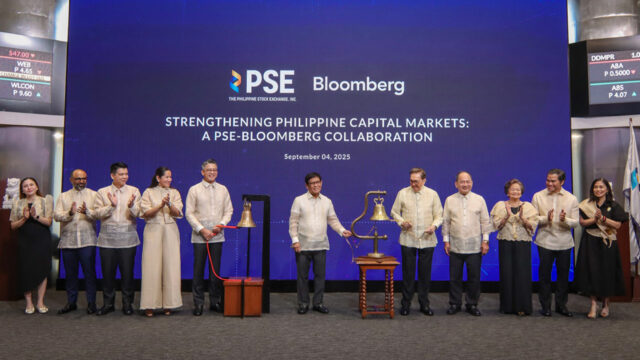
PSE launches new partnership to boost global investor outreach

Bloomberg Philippines Head of Sales Charina Evangelista, Bloomberg ASEAN Head of Market & Product Specialists Vignesh R S, Bloomberg ASEAN Head of Sales Kelvin Cen, Bloomberg APAC Head of Market & Product Specialists Manju Sakhrani, Bloomberg APAC Head of Sales Bing Li, Securities and Exchange Commission Chairman Francis Ed. Lim, PSE Chairman Jose T. Pardo, PSE President and CEO Ramon S. Monzon, PSE Independent Director Chief Justice Teresita Leonardo De Castro (ret.), PSE COO Roel A. Refran, and PSE Corporate Secretary Aissa V. Encarnacion. — PHILIPPINE STOCK EXCHANGE

THE PHILIPPINE STOCK EXCHANGE (PSE) and Bloomberg, a global financial data and media company, have announced a partnership aimed at boosting global investor awareness of the Philippine capital markets, through a series of joint outreach initiatives both locally and internationally.

The partnership was launched on Thursday with a bell-ringing ceremony and a panel discussion featuring PSE President and Chief Executive Officer Ramon S. Monzon, Bloomberg’s Asia-Pacific Head Bing Li, and Securities and Exchange Commission (SEC) Chairman Francisco Ed. Lim.

Under the agreement, the PSE and Bloomberg will organize various investor-focused activities such as virtual roadshows and C-suite roundtables. They also plan to explore enhanced training opportunities for Philippine-based investor relations professionals.

During the 40-minute panel discussion, Mr. Monzon noted that the Philippines is home to some of Asia’s most dynamic companies, which are actively pursuing growth, expansion, and sustainability. Mr. Lim, for his part, said that integrity and credibility are vital to the development of the capital markets.

“Our objective really is to be able to leverage the global reach and expertise of Bloomberg so that our companies can reach out to global investors. And hopefully global investors will get to know about our listed companies and invest,” Mr. Monzon said.

Asked about the potential benefits for listed firms, Mr. Monzon said the collaboration provides a platform for companies to share key information — such as earnings, strategic initiatives, and growth plans — with an international audience.

“And because they’re on a global stage, I think it helps them become more transparent. It’s one of the transparency [requirements] of the global market,” he added.

Mr. Monzon expressed hope that continued dialogue with market participants would generate stronger global interest in Philippine-listed companies.

Meanwhile, Mr. Li said the outreach efforts highlight the Philippine market’s openness and growing appeal to global investors, particularly those eyeing Southeast Asia.

“This initiative can start an important dialogue with local market participants about how they can better tell their story to global investors through transparency and data,” Mr. Li said. — Alexandria Grace C. Magno

ADVERTISEMENT
ADVERTISEMENT