Home Blog Page 1029

PUV accident insurance rules updated

PHILIPPINE STAR/EDD GUMBAN

THE INSURANCE COMMISSION (IC) has revised the framework for passenger personal accident insurance covering public utility vehicles (PUV), introducing stricter rules on claims, fund adequacy and public disclosure.

In a circular dated Sept. 8, the regulator said the guidelines update and consolidate rules issued in 2020 under Circular Letter No. 2020-96A.

Under the framework, nonlife insurers are now required to adopt a standard passenger personal accident insurance policy form with an “all risk, no fault” provision to ensure uniform coverage and adequate protection for passengers.

Insurance pools — groups of insurance companies participating in the program — must also adhere to the premium rates set in Circular Letter No. 2018-59.

The IC also adjusted requirements for claim funds, which serve as reserves for payouts. While the minimum remains at P50 million, the regulator may now require higher amounts depending on a pool’s risk profile and coverage data.

The management company or the lead insurer in a pool will be responsible for monitoring fund levels.

If the fund falls below the prescribed threshold, all member insurers will be jointly and solidarily liable to replenish it within a period set by the commission.

The updated rules also set a stricter timeline for claims. Payments must be made within five working days from submission of requirements. Claims settled later without valid justification will be subject to a 12% annual interest rate, computed starting on the sixth working day until actual payment.

To improve accountability, management companies must submit quarterly reports detailing the number of claims received, the average processing time, delayed cases and reasons for delay and total disbursements.

The IC also ordered insurers and pools to boost public awareness. They must disseminate information about the benefits of accident insurance, claim procedures, contact details for assistance and details of the “all risk, no fault” provision to ensure passengers understand their entitlements.

The program was introduced to provide financial protection to passengers of PUVs in the event of accidents, with coverage financed through premiums included in fares. — Aaron Michael C. Sy

Theater actor, director, and playwright George de Jesus III, 54

GEORGE DE JESUS III, a stalwart in the Philippine theater scene where he worked as an actor, director, and playwright, died on Tuesday, Sept. 9. He was 54.

Mr. De Jesus’ passing was announced by his sister, Che de Jesus, on Tuesday morning in a Facebook post.

“It is with a heavy heart that we announce the passing of our beloved brother, George ‘Jon’ de Jesus III,” she said. “We appreciate your thoughts and prayers during this difficult time. We love you and we will miss you, kuya Jon.”

The Philippine Educational Theater Association (PETA), with whom Mr. De Jesus had worked extensively, extended its condolences.

“George generously shared his talent on the PETA stage, delivering memorable performances in productions like Haring Lear, Walang Himala, and Noli Fili Dekada Dos Mil. George was also part of the PETA Broadcast and Film, Inc’s Teleplay Writing Workshop,” it said in a Facebook post.

“His legacy in the Filipino theater community will live on through his work. Our thoughts are with his family and loved ones during this difficult time,” PETA added.

Tanghalang Pilipino, of which he was a member from 1994 to 2001, also paid tribute to Mr. De Jesus on their social media pages, acknowledging his impact on the theater community.

Lubos na nakikiramay ang Tanghalang Pilipino sa pagpanaw ng isang alagad ng sining (Tanghalang Pilipino expresses its deepest condolences on the passing of an artist),” it said in a Facebook post.

Mr. De Jesus performed in many of the company’s productions: Henrik Ibsen’s Hedda Gabler, Calderon de la Barca’s Las Tres Justicias En Una, Moliere’s The Miser and Les Fourberies de Scapin, Mikhail Bulgakov’s Flight, Luis Valdez’s The Shrunken Head of Pancho Villa, Michel de Ghelderode’s Pantaglieze, and Aristophanes’ Lysistrata, to name a few.

A writer, he won multiple Carlos Palanca Memorial Awards for Literature over the years. Some of his award-winning works include Linggo ng Palasapas, Unang Ulan ng Mayo, and Kapit (all one-act plays); Cell Phone (future fiction); Sala sa Pito and Maniacal (full-length plays); and Kung Paano Maghiwalay (screenplay).

His work Paglayang Minamahal was also awarded by the Centennial Literary Competition while his screenplay, Para Walang Unyon, won in the NCCA Teatro Bulawan Playwriting Competition.

Mr. De Jesus co-founded the Egg Theater Company in 2015 ahead of that year’s Fringe Manila festival. They went on to stage many contemporary theater pieces — original plays, translations, and adaptations. These include Martin McDonagh’s The Pillowman and Moliere’s The Learned Ladies and The Misanthrope.

He wrote, directed, and acted in countless productions for Stages Production Specialists, Inc., Virgin Labfest, and Dulaang UP.

His most recent appearance was in the one-act play Minating ni Mariah ang Manto ng Mommy ni Mama Mary, part of this year’s Virgin Labfest.

Mr. De Jesus’ wake takes place from Sept. 10 to 12 at the Solenne and Amore rooms of the Solennelle Funeral Chapels, Valenzuela City. The final service and interment will be on Sept. 13, 10 a.m., at Tierra Santa Memorial Park, also in Valenzuela City. — Brontë H. Lacsamana

The SME’s guide to AI for business

JERRY ILAO (left), president of the Philippine AI Business Association with RJ Ledesma. — THE POD NETWORK ENTERTAINMENT

Entrepreneurs have heard the warnings loud and clear. Adopt AI or be left behind. Embrace digital transformation or become a dinosaur. Adapt or die. And yet, for SMEs, AI for business seems hopelessly cooked in favor of large enterprises. But this isn’t the case at all, according to Jerry Ilao, president of the Philippine AI Business Association (PAIBA). For SMEs to reap the benefits of AI, all they need to do is start.

Mr. Ilao has deep and wide experience in entrepreneurship and the tech industry. I’ve known him since our days in Procter & Gamble when I was in brand and he was in finance. From there, he ventured into entrepreneurship, putting up the ubiquitous Ink All-You-Can business. Clearly bitten by the entrepreneurship bug, he also established Olern, Tellix, Tartino Mobile Optima, and Leappreneur. PAIBA, an organization he co-founded, is dedicated to a single mission: helping SMEs implement AI for business.

“What’s stopping [SMEs] from implementing AI generally is one thing,” he says, “which is knowledge on how to implement AI.”

To provide this knowledge and educate SMEs, PAIBA holds AI Connect sessions every few weeks — all for free. For members of the organization, they also hold AI hackathons to explore the many uses AI can have for Philippine SMEs.

I recently reconnected with him on the RJ Ledesma Podcast. In our conversation, he shared a step-by-step guide on what SMEs need to do to get started with AI for business. Here are some of the highlights:

Get Your Feet Wet. To begin, Mr. Ilao advises entrepreneurs to stop following the latest or hottest tech trends (a.k.a. shiny object syndrome). “Focus on one problem that you want to solve,” he said.

The best way to do this? Just jump in and get your feet wet. There’s nothing wrong with starting with general-use large language models like ChatGPT or Gemini. And the good thing about these general-use AIs is that they can help you in a broad range of tasks, from marketing to customer service, you name it.

By doing this, entrepreneurs can get more comfortable with AI and learn what AI can do for their business. And from there, they can move on to more technical solutions to address that problem they wanted to solve — like integrating AI into business processes or automation.

AI as Your “Thought Partner.” In our conversation, Mr. Ilao gave many use-cases for AI that could be helpful for SMEs. The first was using AI as, what he calls, a “thought partner.”

“When you’re an entrepreneur,” he explained, “you cannot afford a consultant. It’s hard.” But with AI using deep research, it can be equivalent to getting PhD level research.

He recounted, “I did a sample before on market analysis… Sobrang amazed ’yung nag-attend ng session namin because nakalatag na kung ano ’yung SWOT strategy, ano ’yung market opportunities. (Those who attended our session were amazed because we already presented the SWOT strategy, what the market opportunities were.) And that’s done by AI in 10 minutes.”

Another use-case for SMEs is in building company processes. Unlike large corporations, many SMEs cannot spend time and resources on defining and properly designing their processes and systems.

“ChatGPT can do that for you,” he said. “So, travel expense policy, work from home policy, and any SOP from, let’s say, receiving the inventory up to recording it in the system, you can easily do that using ChatGPT.”

The use-cases for SMEs are varied and deep. AI can help design processes for security or spot financial control loopholes — which can be valuable to SMEs who are often prone to theft or fraud.

For marketing, the uses of AI are almost too many to mention. Beyond content creation, SMEs can use AI for market research or e-mail campaigns. Or you can create an AI chatbot to engage customers and provide customer service.

Finally, many Filipino entrepreneurs struggle with finance — a topic close to Mr. Ilao’s heart.

Maraming mga entrepreneurs na medyo waterloo nila ’yung finance (Finance is the waterloo of many entrepreneurs),” he said. “You can ask ChatGPT to help you with that, analyze financial statements.”

Use AI to Help You With AI. Connected to using AI as your thought partner, he advises using AI to help you learn more about AI — a sort of AI inception, if you will.

Want to create a website? Want to edit videos faster? Ask AI if there is an AI that can do that for you.

Want to check if the process you created with AI is safe and secure? Ask AI to look for loopholes or flaws in your process.

Prompt Engineering Basics. Many of the results you get from AI depend on what you input into your prompt. For this reason, “prompt engineering” has become a big thing. It has become a skill that employers seek, and there are even classes on the topic being offered online. Mr. Ilao offered a simple approach to prompt engineering, which he summarized as RTC — Role, Task and Context.

“Role” is all about telling the AI what it is acting as. “AI is very good at many things,” Mr. Ilao said. “Tell the AI kung ano ’yung role na iti-take niya (tell the AI what role it has to take on).” AI can be a marketer, a researcher, a programmer, a content creator and so much more.

“Task” is about defining what you want it to do clearly.

For “Context,” the idea is to give the AI as much information as you can for more targeted results. “Provide as much context as you can to make the AI output very, very specific to your needs,” Mr. Ilao advised.

CAVEATS

With all these game-changing abilities at the fingertips of entrepreneurs, it’s important to remember that there are limits as well as dangers to using AI.

1. Keep a human in the loop. Mr. Ilao says: “I always say that the AI output is a very good first draft. Never the final one.”

In any process — even one that is automated with AI — there should always be a human in the loop. Don’t just accept whatever the AI gives you. The decision process or the output of AI should always be reviewed.

2. Be aware of concerns. Security, confidentiality, intellectual property ownership. These are all valid concerns when it comes to AI for business. Currently, there are no laws that cover AI in the Philippines, but there are common sense practices that you can employ to ensure that your business remains safe.

3. Do not be dependent on AI. Finally, Mr. Ilao warned about how easy it is to become dependent on AI once you start using it.

“Don’t let AI decide for you,” he said. “Just let AI spell out all the information that you need to make an informed decision. Then you’ll decide.

“And in fact, you can take this further. When you decide, let AI challenge you. This is my decision: what am I missing?”


RJ Ledesma (www.rjledesma.com) is a Hall of Fame Awardee for Best Male Host at the Aliw Awards, a multi-awarded serial entrepreneur, motivational speaker, and business mentor, podcaster, an Honorary Consul, and editor-in-chief of The Business Manual. Mr. Ledesma can be found on LinkedIn, Facebook and Instagram.

The RJ Ledesma Podcast is available on Facebook, Spotify, Google and Apple Podcasts. Are there entrepreneurs you want Mr. Ledesma to interview? Let him know at ledesma.rj@gmail.com.

A Brown consolidates energy assets under ABCEI

PHILSTAR FILE PHOTO

LISTED holding company A Brown Co., Inc. (ABCI) is consolidating its energy assets under its wholly owned subsidiary ABC Energy, Inc. (ABCEI), the group’s energy holding firm.

In a regulatory filing on Wednesday, ABCI said its board of directors had approved the transfer of its wholly owned subsidiary Northmin Renewables Corp. (NRC) and its 20% equity interest in Peakpower Energy, Inc. (PEI) to ABCEI.

“The restructuring consolidates these energy-related assets under ABCEI, streamlining management oversight, sharpening operational focus, and strengthening the group’s platform for future growth in the energy sector,” the company said.

ABCI said the transaction will have no financial impact on the group since it is between the parent company and a wholly owned subsidiary.

NRC focuses on renewable energy projects in Northern Mindanao, with pre-development activities for a wind power project currently underway. PEI, meanwhile, develops diesel- and bunker-fired power plants designed to provide peaking capacity for various electric cooperatives in Mindanao.

In July, ABCEI’s board approved the sale of its 20% equity stake in Palm Concepcion Power Corp. (PCPC) to give the A Brown Group additional capital to support its strategic objectives.

PCPC operates a coal-fired power plant on Panay Island.

Based in Mindanao, ABCI has interests in property development, power generation, public utilities, and agribusiness.

Shares in ABCI closed unchanged at P0.72 apiece on Wednesday. — Sheldeen Joy Talavera

Cloud modernization can accelerate financial firms’ shift from old systems

FREEPIK/THIS IMAGE WAS GENERATED WITH AI

CLOUD modernization solutions can help Philippine financial institutions as they move to transition out of their outdated legacy systems, according to US-based software firm Rocket Software, Inc.

“Most financial institutions are very paranoid about cloud security and that’s one of the reasons the adoption rates are in a phased approach,” Praveen Kumar, vice-president for Asia-Pacific at Rocket Software said in a virtual interview.

In the Asia-Pacific, the Philippines, Malaysia, Indonesia, and India are among those that are lagging in terms of cloud adoption, he noted.

“I think the lagging is not because of lack of interest or technology. It’s just that the banking environment has matured to such a level that they’re able to provide very strong services from on-premises (on-prem) software,” Mr. Kumar said.

“So, they’re deciding which of the services go to the cloud and which don’t.”

A 2024 study by the Asian Development Bank (ADB) Institute showed that total cloud spending in Australia, Japan, New Zealand, and Singapore is higher than 0.4% of gross domestic product (GDP).

Conversely, total cloud spending is less than 0.3% of GDP in the Republic of Korea (0.29%) Thailand (0.22%), Philippines (0.19%), India (0.16%), Vietnam (0.13%), and Indonesia (0.10%), the ADB Institute said.

Mr. Kumar said cloud security has evolved from an information technology (IT)-related issue to a company problem, citing the need for financial institutions to educate their staff on secure cloud adoption.

“If you don’t take care of your personal computer, laptop or home device, and that device connects to the cloud enterprise or the enterprise data center, you’re actually posing a risk for the company itself,” he said.

Rocket Software, which entered in the Philippine market in 2008, provides multiple technologies that assist companies in modernizing their legacy systems and moving to the cloud.

“If you move content, data, as well as applications which are residing on-prem but built over the years, we move them to the cloud and put it in a secure environment,” Mr. Kumar said.

“At Rocket, we have solutions, both from a content and a data perspective, where we allow most of your paper content to be available in digital form, and the ability to process some of the workflows digitally without the need for manual interventions,” he said.

Globally, cloud infrastructure spending is expected to reach $461.9 billion by 2029, according to the International Data Corp. — Beatriz Marie D. Cruz

Unemployment rate rises to 3-year high in July

THE PHILIPPINES’ unemployment rate rose to a three-year high of 5.3% in July as a series of typhoons and monsoon rains dented hiring activity, the statistics agency said on Wednesday. Read the full story.

Unemployment rate rises to 3-year high in July

Bangko Sentral term deposit yields fall after Treasury bond maturity

Bangko Sentral ng Pilipinas main office in Manila. — BW FILE PHOTO

By Katherine K. Chan

YIELDS on the Bangko Sentral ng Pilipinas’ (BSP) term deposit facility (TDF) slipped on Wednesday as strong demand followed the maturity of almost P289 billion in government bonds.

Total tenders reached P128.4 billion, well above the P100 billion on offer and higher than the P98.18 billion in bids for the same auction volume a week earlier. The BSP fully awarded both tenors.

For the seven-day deposits, bids hit P55.593 billion, exceeding the P40-billion offer and the P39.548 billion in tenders for the P50-billion issue last week. The central bank accepted the entire P40 billion.

Accepted yields ranged from 5% to 5.185%, narrower than the 4.96% to 5.2498% margin recorded previously. This brought the average rate down by 1.26 basis points (bps) to 5.0975%.

Meanwhile, the 14-day deposits attracted P72.796 billion in tenders, higher than the P60-billion offer and last week’s P58.632 billion for a P50-billion auction. The BSP awarded the full P60 billion.

Rates for the two-week debt ranged from 4.98% to 5.165%, wider than last week. The average yield fell by 1.45 bps to 5.1149%.

“The auction saw good demand as total tenders rose week on week from P98.2 billion to P128.4 billion,” the BSP said, noting bid-to-cover ratios of 1.39x for the seven-day securities and 1.21x for the 14-day tenor.

Michael L. Ricafort, chief economist at Rizal Commercial Banking Corp., said reinvestment demand after the P288.7-billion Treasury bond maturity on Sept. 9 supported the TDF auction.

“The BSP TDF average auction yields were again slightly lower, after the large Treasury bond maturity that could have increased the demand for government securities and reinvestment at still much higher yields,” he said in a Viber message.

He added that the softer yields also reflected the BSP’s recent 25-bp rate cut that reduced the benchmark rate to 5%. The Monetary Board has lowered policy rates by 150 bps since August 2024.

BSP Governor Eli M. Remolona, Jr. and Finance Secretary Ralph G. Recto have signaled a possible additional 25-bp cut this year, though the central bank chief said the easing cycle is nearing its end.

The Monetary Board has two more meetings scheduled for October and December.

Dining In/Out (09/11/25)


Smashing Lemons marks first year with promo

SMASHING LEMONS, a lemon tea franchise from Hong Kong, marks its first anniversary in the Philippines this month. Smashing Lemons officially entered the Philippine market in 2024 through a franchise partnership with Smash Foods Inc. It has over 800 stores globally, spanning China, Hong Kong, Macau, Taiwan, Malaysia, Singapore, and Canada. The brand is rolling out a one-day only Buy One, Take One anniversary promo on Sept. 15. Offering over 30 unique lemon-based beverage varieties, the anniversary promo will be available at the following branches: SM City Manila, SM City East Ortigas, SM City Caloocan, SM City San Lazaro, SM City Fairview and S&R BGC, Taguig City.


Negronis this month at Solaire Resort North

SOLAIRE RESORT NORTH celebrates the Negroni from Sept. 22 to 25, with Negroni cocktails inspired by cities like Bologna, Sicily, Naples, Venice, and more. The cocktails are made with key ingredients from each highlighted Italian city, with pistachio-infused Negronis, floral-based Negronis, or even Carbonara- and Tiramisu-inspired beverages. The cocktails will be available at most of the restaurants, starting at P500++ net per glass. The Pistachio Negroni by Café Mangrove (a classic gin-vermouth-campari-based mix garnished with pistachio sauce and crumbs) represents Sicilian cuisine. Trattoria e Dolci serves Parmesan-infused Viva Bologna Negroni (Bulldog Gin, Campari and a homemade Parmesan vermouth) in tribute to Bologna. Solaire Resort’s Japanese restaurant, Yakumi, serves the Fiore Negroni, in tribute to Sanremo, the city of flowers. Dragon Bar serves the Neapolitan-inspired Caffe Negroni. The Pool Café offers the Limone Negroni paying homage to Sorrento’s zesty lemons with a drink made with Malfy Con Limone, Bianco Vermouth, and Campari, topped with lemon foam, and the zest of lemons and oranges. Tastes of Rome, Perugia, and Venice are served at Finestra and Skybar through Finestra’s Roma Italia Negroni (warmed Parmesan foam and pancetta for savory notes). At Skybar, try the Cioccolato Negroni (with Perugian chocolate) or the Tiramisu Negroni in honor of the Venetian dessert. For reservations and inquiries, visit sn.solaireresort.com, call 8888-8888, or e-mail snrestaurantevents@solaireresort.com.


The Bistro Group opens to sub-franchising

THE BISTRO GROUP announced that they are open to sub-franchising some of their most successful restaurant concepts with the Japanese casual dining brand, Watami NAIA Terminal 3, as the first sub-franchise store. It will be launched this October. The 80-seat restaurant will serve a wide range of authentic Japanese dishes. The NAIA Terminal store is Watami’s 23rd branch. To date, the Bistro Group operates 200+ stores nationwide and 28 different concepts. The Bistro Group is moving to offer sub-franchising, with it providing prospective investors with business assistance, marketing and logistical support, a built-in customer base, brand equity and reputation and customer loyalty. Among the concepts that are open to sub-franchising are TGIFriday’s, Italianni’s, El Pollo Loco, Bulgogi Brothers, Modern Shang, and Red Lotus, plus homegrown concepts Krazy Garlik and Siklab+. More branches mean that The Bistro Group will be accessible to more people in Metro Manila and key provinces. For further details and inquiries about sub-franchising, contact The Bistro Group via e-mail at tbg.franchising@bistro.com.ph.


Goodday Friz brings paraprobiotics soda

THE country’s first-ever paraprobiotic soda is Goodday Friz. Goodday, a brand of cultured milk beverages, uses Japanese technology to make Friz, a bubbly fusion of cultured milk and soda. It’s filled with 2 billion Lac-Shield paraprobiotics per can. Available in two variants — Original and Orange, Friz is now rolling out across supermarkets, groceries, and convenience stores nationwide. For details, check out Goodday on Facebook, Instagram, and on TikTok @gooddayfrizph.

Fund pension by fighting corruption

STOCK PHOTO | Image by Lifestylememory from Freepik

I recently went through the exercise of computing my probable SSS pension if I retire at 60 or 65, and whether it makes sense to keep making voluntary contributions, and until when. As a columnist, I am considered a freelancer and thus contribute to SSS as self-employed.

The result, of course, is obvious. At 65, whatever I will likely receive from SSS will not be enough to cover even my basic needs. I will need a supplemental pension, probably a private one, and set aside “enough” savings to keep me afloat until the end of my days.

In this context, I support the Senate proposal to grant an additional pension to retirees and to extend the benefit to all seniors, not just indigents. My main argument is straightforward: much of the government’s money is lost to corruption anyway. We might as well redirect it to our seniors, rich or poor.

Senate Bill No. 215, the “Lingap Para Kay Lolo at Lola Act,” proposes a monthly social pension of P1,500 for all senior citizens aged 60 and above, regardless of economic standing. The pension will not come from SSS or GSIS but directly from the National Government.

At first glance, the numbers seem daunting. Depending on coverage, the annual cost could range from P73.5 billion (if limited to indigent seniors) to over P200 billion (if granted to all seniors). Fiscal conservatives instinctively question such spending, pointing to deficits, debt servicing, and competing priorities.

On the other hand, by mitigating corruption in public works projects, the government could restore a substantial amount of money that can be directed toward this initiative. Funding options deserve careful study, but the proposal merits both government and public support.

I believe the nation can find a way to afford dignity for our seniors without breaking the bank. That is, if the present administration and present Congress can effectively combat corruption and ensure accountability, particularly in public works.

Those who argue against this “handout” cannot ignore the reality that far more money is stolen by crooks in government. Rather than letting them pocket the nation’s wealth, and fund their personal pensions, the government should channel it to our seniors.

One estimate places government losses from 2023 to 2025 at between P42.3 billion and P118.5 billion due to fraud, ghost projects, and substandard flood-control works. These figures assume kickbacks and “SOPs” ranging from 25% to 70% of project costs.

At Senate hearings, a former Department of Public Works and Highways (DPWH) engineer alleged that in 2023 some individuals pocketed 30% kickbacks on project budgets ranging from P355 million to P600 million in Bulacan alone. A contractor also alleged that numerous lawmakers demanded a 25% share of project costs to secure flood-control contracts.

Meanwhile, the government’s Social Pension Program for Indigent Senior Citizens (SPISC) under the Department of Social Welfare and Development (DSWD) currently provides P1,000 monthly to over four million indigent seniors, or those who are poor, frail, sickly, without income, and without family support. These are people who truly need government help.

In 2025, the program has an annual budget of P49.8 billion under the General Appropriations Act. It is implemented with LGUs, which verify eligibility, distribute payouts, and handle grievances.

Problems remain. Not all intended beneficiaries meet the government’s definition of “indigent,” and the delivery system can be uneven. Many seniors with meager pensions or irregular family support fall through the cracks. Others wait months for payouts. And with today’s prices, P1,000 barely covers maintenance medicine. Still, it helps. Thus, raising it to P1,500 would be a meaningful boost.

Senate Bill No. 215 proposes precisely that. The pension remains modest but more useful, and coverage expands to all seniors aged 60 and above, removing the indigent-only qualifier. It moves beyond being a mere poverty safety net and becomes a sort of basic income for all seniors.

The Philippine Statistics Authority estimates that in 2025, around 11 to 12 million Filipinos will be 60 or older. Most of them have no SSS or GSIS pension. Many worked in the informal economy and could not afford contributions to these pension systems.

The minimum SSS retirement pension is just over P2,000, while GSIS pays more. But even these amounts fall short given today’s costs of food, medicine, and utilities. An additional P1,500 monthly would be a lifeline, especially for seniors managing chronic illnesses like diabetes, hypertension, or heart disease.

The goal is to give seniors a modest, reliable stipend: enough to buy medicine, pay utilities, or add to the household food budget. For rural seniors with limited access to healthcare, this could mean the difference between survival and neglect.

If the program remains indigent-only, raising the pension to P1,500 raises the annual cost to the government to P73.5 billion. Heavy, but manageable. The national budget can shoulder this through better prioritization. If efficiencies can be gained, the pensions can be funded.

But if made universal, as proposed, the fund cost climbs to around P220 billion annually, or roughly equal to the DPWH allocation for major infrastructure projects in 2025. Such magnitude requires a sound funding plan.

I believe if there is will, there is a way. But this requires political will to fund the senior pension program and to fight government malfeasance. My call is to source pension money from “savings” generated by plugging corruption leaks in public works, especially flood control.

Flood control is notorious as a “black hole” of government spending. Every administration pours billions into dikes, dredging, and drainage, yet Metro Manila and much of Luzon still flood. The problem is not budget size, but corruption. As we now know, contracts are padded, overpriced, or entirely ghost projects.

With DPWH’s 2025 budget at over P800 billion, saving even 20% through tighter controls would yield over P160 billion, enough to cover most of the proposed pension program. Add a restitution mechanism, legislated so officials and contractors convicted of corruption must forfeit ill-gotten wealth to the pension fund. This not only creates accountability but ties restitution to a socially just outcome.

Raise the pension and make it universal, but pair it with anti-corruption reforms that institutionalize savings. Legislate restitution of ill-gotten wealth. Even partial recovery could sustain the pension program at P1,500 monthly per senior.

Phase the initiative: expand coverage first to seniors 75 and above in 2026, then to seniors 65 and above in 2027, and finally to all 60 and above by 2028. This gives fiscal space time to widen and systems time to adapt. By then, index the pension to inflation.

Call it a populist handout if you will. But better to give money to those who need it than to those who steal it. Senate Bill No. 215 is not only about pensions. It will be a test of how we value our elderly and how serious we are about cleaning up public finance. The challenge is not whether we can fund pensions, but whether we have the political courage to plug the leaks that make us think we cannot.

Rather than letting corruption fund the personal “pensions” of unscrupulous officials and their families — the most brazen criminals of all — we can turn the situation around. Redirect that money to support our seniors as we improve accountability in government.


Marvin Tort is a former managing editor of BusinessWorld, and a former chairman of the Philippine Press Council

matort@yahoo.com

Coca-Cola to build new manufacturing plant in Tarlac

COCA-COLA EUROPACIFIC ABOITIZ PHILIPPINES

COCA-COLA Europacific Aboitiz Philippines (CCEAP) is set to build a 42-hectare manufacturing plant in TARI Estate, a development expected to generate jobs in Tarlac and nearby provinces.

“This will be one of the largest Coca-Cola facilities in the Philippines and among the most significant global infrastructure investments of Coca-Cola Europacific Partners,” the company said in a statement on Wednesday.

The announcement follows the signing of a definitive agreement between CCEAP, the official bottling partner and distributor of Coca-Cola products in the country, and Aboitiz InfraCapital Economic Estates.

CCEAP said the investment also represents the largest single-locator commitment for the estate and is expected to attract complementary industries and strengthen local supply chains.

“Coca-Cola’s decision to establish one of its largest manufacturing plants here underscores both the strategic importance of Tarlac and the strength of our vision,” said Rafael Fernandez de Mesa, head of Aboitiz InfraCapital Economic Estates and president and chief executive officer of Aboitiz Land.

“As a foundational anchor, Coca-Cola will help attract complementary industries, deepen supply chains, and create thousands of jobs — fueling economic activity well beyond the estate and reinforcing the Philippines’ position as a leading investment destination,” he added. — Justine Irish D. Tabile

Identity security: The core of cyber resilience

TRUSTPAIR.COM

By Eric Kong

AS DIGITAL TRANSFORMAtion accelerates across the Asia-Pacific (APAC) region, the cybersecurity landscape evolves at an unprecedented pace. Organizations in APAC and beyond face a complex web of internal and external threats, challenging traditional security models. A recent SailPoint survey of over 100 chief information security officers (CISOs) and vice-presidents of information security reveals a definitive shift in focus: identity security is emerging as the cornerstone of a cybersecurity strategy, particularly in combating the rising tide of sophisticated attacks driven by artificial intelligence (AI).

In Asia-Pacific, where digital ecosystems are rapidly expanding, the hyper-connected nature of today’s business environment demands a fundamental rethinking of security architecture. Some 78% of enterprises rank identity security as extremely or very central to their cybersecurity priorities. This shift reflects a profound understanding that identity — encompassing both human and digital entities — is the new security control plane.

THE IMPORTANCE OF IDENTITY SECURITY
Identity security is critical today due to the growing sophistication and prevalence of identity-based attacks, including credential theft, phishing, and increasingly AI-driven exploits. External threats consistently rank highest on the risk radar of surveyed CISOs, surpassing concerns like insider threats and compliance issues. The rise of AI-powered cyberattacks introduces unprecedented challenges, as attackers leverage AI to craft real-time, targeted phishing campaigns that evade traditional detection methods.

Some 60% of organizations are very concerned about the evolving nature of AI-driven cyberthreats, highlighting the urgency for adaptive defense mechanisms. The stakes are particularly high in the Philippines and the wider Asia-Pacific region, where financial services and technology sectors represent lucrative targets for threat actors.

AI: BOTH A CHALLENGE AND A SOLUTION
As threat actors harness AI to enhance the precision and scale of their attacks, security teams must leverage AI to stay ahead. The survey identifies role mining and anomaly detection powered by AI as game-changing capabilities that enhance identity governance. Role mining, set to be implemented by 62% of organizations surveyed, uses AI to continuously analyze access permissions and optimize role structures, uncovering hidden risks and reducing unnecessary permissions that could be exploited in a breach.

Moreover, AI-driven outlier detection is transforming threat mitigation by surfacing unusual access patterns that would otherwise go unnoticed. Organizations that deploy these advanced AI tools report significantly higher confidence in their ability to contain risks from compromised accounts. By integrating AI into identity security, enterprises move from reactive defense toward a proactive, intelligent posture capable of anticipating and neutralizing threats before they escalate.

OPERATIONALIZING ZERO TRUST THROUGH IDENTITY
The survey highlights that standard identity-centric controls — role-based access control (RBAC), self-service access requests, and automated provisioning — are now ubiquitous, with 90% of respondents reporting active deployment. These foundational controls operationalize zero trust principles by enforcing least privilege access and automating lifecycle management to minimize human error and reduce the attack surface.

Yet, the evolving threat landscape demands continuous refinement. Static access models must give way to dynamic, AI-powered frameworks that align with business realities and adapt in near real-time. This evolution moves identity security from a static gatekeeper to an intelligent, adaptive security layer that continuously verifies and assesses risk.

CHALLENGES AND THE ROAD AHEAD
While significant progress has been made, the path forward is not without challenges. AI-powered attacks are becoming increasingly sophisticated, raising the risk of account takeovers that can bypass traditional defenses. Additionally, managing identities such as employees, third party vendors and machines across hybrid environments and cloud services adds complexity to security operations.

Future investments will have to prioritize AI and machine learning capabilities within identity governance, focusing on risk-based access recommendations, automated policy adjustments, and proactive enforcement mechanisms. Security leaders must recognize these advancements as essential to maintaining resilience in a rapidly evolving threat landscape, and partner closely with IT, risk management, compliance, and business units to cultivate a culture where identity security becomes embedded as a core component of enterprise risk management.

For the Philippines and the broader APAC region, identity security has shifted from a secondary concern to the forefront of cybersecurity defense. As AI-powered threats grow in sophistication within an increasingly borderless digital landscape, AI-driven identity security architectures are essential for resilience. These dynamic solutions are vital for containing breach impacts, protecting critical assets, and confidently navigating the evolving cyber frontier. By adopting adaptive, continuous validation approaches, identity security remains central to safeguarding digital environments against emerging threats.


Eric Kong is the Managing Director for ASEAN, SailPoint

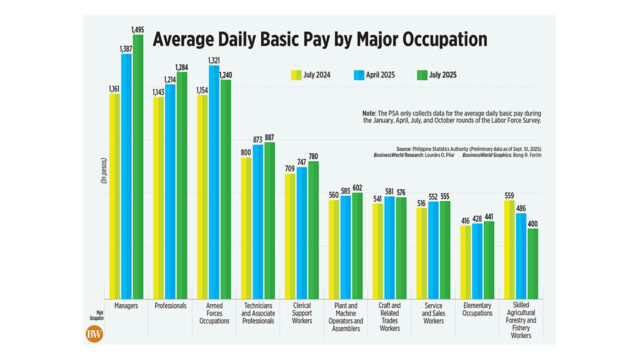
Average Daily Basic Pay by Major Occupation

THE PHILIPPINES’ unemployment rate rose to a three-year high of 5.3% in July as a series of typhoons and monsoon rains dented hiring activity, the statistics agency said on Wednesday. Read the full story.

Average Daily Basic Pay by Major Occupation