Home Blog Page 10002

Crunch time approaching to pass CITIRA — EIU

CORPORATE tax legislation, still pending at the Congress, needs to pass by the first half to keep the tax reform program on track, according to the Economist Intelligence Unit (EIU).

In a note Wednesday, EIU said the proposed Corporate Income Tax and Incentives Reform Act (CITIRA) continues to face delays as business groups lobby over the planned overhaul to fiscal incentives.

It said the measure, which was approved by the House of Representatives on Sept. 13 and remains pending at the Senate, should be passed in the first half if the Philippines is to remain “on track” to bring corporate income tax rates to 20% by 2030.

“The president, Rodrigo (R.) Duterte, is facing delays in reforming the Philippines’ outdated tax code,” the report noted.

On the measure imposing higher excise tax on electronic cigarettes, vapor products and alcoholic products, Finance Assistant Secretary Antonio Joselito G. Lambino II has said that the measure is “under final review (by) the Office of the President.”

The measure, which forms Package 2+ of the Comprehensive Tax Reform Program, was ratified by the 18th Congress on Dec. 18. It lapses into law on Jan. 24 if the President takes no action.

Congress resumes session on Jan. 20, after a one-month recess.

BusinessWorld sought comment from the office of Senator Pia S. Cayetano, who chairs the Senate Ways and Means committee, to ask for a timeline on the bill’s approval but it had not replied at deadline time.

EIU said the reforms are needed if the government is to hit its tax collection target for this year of over P3 trillion.

“The resolution of Mr. Duterte’s corporation tax reforms will play out this year. The president needs to increase tax revenue to fund his commitments to raise social spending and disbursements for infrastructure,” it said.

“While the government will find it hard to achieve its ambitious revenue target, the shortfall in actual tax collection will not be wide, considering that the pace of reduction in the corporate income tax rate is much slower than that at which incentives are supposed to be rolled back,” it added.

However, it said the impact of the lower tax rates, which could arrest the decline in foreign direct investment (FDI), will largely depend on the bicameral review by the two Chambers.

FDI net inflows rose 33.7% year-on-year to $672 million in October but year-to-date figure is still down by 32.8% at $5.79 billion, due to “subdued investor sentiment.”

EIU said the bicameral session to harmonize both chambers’ bills will “likely… center on fiscal incentives and the status of tax on gross income earned (GIE).”

Business groups, including foreign chambers of commerce have constantly warned of job losses if fiscal incentives currently enjoyed by companies operating in special economic zones are overhauled.

Finance Undersecretary Karl Kendrick T. Chua has asked for more evidence on the job loss claims.

The report said various foreign chambers of commerce have that estimated at least 15 out of the 250 regional operating headquarters in the Philippines have closed after their 15% preferential tax rate for employees was removed under the Tax Reform for Acceleration and Inclusion (TRAIN) Act.

On the transition period for companies adopting new incentives, EIU said “a compromise is likely to be reached in the bicameral stage.”

The Philippine Economic Zone Authority (PEZA) has said it wants a 15-year transition period while the Department of Trade and Industry (DTI) is seeking a 7-year transition period, as opposed to the two to five year period in the bill approved by the House.

The remaining priority measures that have yet to be passed by Congress are CITIRA, the mining tax bill, the real property tax bill and a measure that will simplify the tax structure for financial investments.

So far, the government has passed Republic Act (RA) No. 10963, which slashed personal income tax rates and increased or added levies on several goods and services and RA 11213 or the Tax Amnesty Act of 2019 which granted an estate tax amnesty and an amnesty on delinquent accounts that remain unpaid even after final assessment. — Beatrice M. Laforga

Can PAN be the new FAN?

There’s a certain feeling of trepidation that most taxpayers get during tax audits. After all, a tax audit is no laughing matter. It involves flipping back the books and records of prior years to respond to the Bureau of Internal Revenue (BIR), and often, making sense of past transactions for hours on end. But this is all par for the course, and what a complicated course it is.

As people handling tax audits are well aware, a tax investigation has several stages: it begins with the issuance of a Letter of Authority (LoA) by the BIR. If the BIR finds any deficiency taxes during the examination of the taxpayer’s records, a Notice for Informal Conference (NIC) shall be issued inviting the taxpayer for a conference within 30 days from the receipt of the NIC. The conference allows the taxpayer to present its side to the BIR.

If the taxpayer and the BIR fail to resolve the issues at the informal conference stage, a Preliminary Assessment Notice (PAN) shall be issued, to which the taxpayer may reply in writing within 15 days of receipt. Within another 15 days from the taxpayer’s reply to the PAN, the BIR shall issue a Final Assessment Notice and a Formal Letter of Demand (FAN/FLD). The taxpayer must file a protest letter within 30 days from its receipt in the form of either a request for reconsideration or reinvestigation. In case of a reinvestigation, additional supporting documents may be submitted within 60 days from the date of filing the protest.

The Supreme Court (SC) and Court of Tax Appeals (CTA) have held in numerous cases that the failure to observe the above procedural rules constitutes a violation of the taxpayers’ right to due process, which renders the assessment void. The CTA has nullified assessments specifically for the non-observance of the prescribed timeline for the issuance of the assessment notices. Last year, the CTA canceled assessments where the taxpayer received a FAN/FLD before the lapse of the 15-day period from the receipt of the PAN, or worse, where the FAN/FLD was received on the same day as the PAN.

In one of its resolutions earlier last year, the SC again held an assessment void for violating the due process requirement. In this resolution, however, the SC clarified that Section 228 of the Tax Code — the provision which sets out the procedures on tax assessments — gives the taxpayer 60 days from the date of filing its protest to the PAN to submit relevant supporting documents. The SC held that the 60-day period to protest refers to the one made against the PAN and not the FAN.

While this is interesting on several points, it threads through this core question: Can the PAN be the new FAN/FLD?

Section 228 of the Tax Code specifically requires the Commissioner of Internal Revenue (CIR) or an authorized representative to first notify the taxpayer in writing through a pre-assessment notice if the CIR finds that proper taxes should be assessed. Then, the taxpayer is required to respond to the notice within the period prescribed by the regulations. If no response is made, the CIR shall issue an assessment based on his findings. The assessment may be protested by filing a request for reconsideration or reinvestigation within 30 days. Within 60 days from the filing of the protest, all relevant supporting documents should have been submitted; otherwise, the assessment shall become final.

Previously, we’ve associated the PAN as the first notice mentioned in Section 228, and the FAN/FLD to be the assessment subject to the 30-day period to protest and 60-day submission of documents. But if the SC considers the 60 days to apply to the PAN instead of the FAN/FLD, this could imply many things. First, a taxpayer is allowed 30 days to reply to the PAN (instead of 15). Second, the BIR is precluded from issuing the FAN/FLD until the lapse of the 30-day period, or if the taxpayer files a request for reinvestigation, 90 days (i.e., 30 days to protest and 60 days to submit documents). Third, a taxpayer’s failure to reply to the PAN would render the assessment final and executory. By this analogy, the PAN essentially becomes the FAN.

But if the PAN is the assessment subject to protest under Section 228, what then should be considered as the notice prior to the PAN? Could it be the NIC?

From a procedural perspective, this may make sense. The NIC does serve as an initial notification of the BIR’s findings and gives the taxpayer an avenue to respond and come to an agreement with the BIR. Although the previous CIR revoked the requirement for a NIC, this was reinstated in 2018 through Revenue Regulations No. 7-2018. In the period that the NIC formed part of the tax audit rules, the SC repeatedly recognized the NIC as an indispensable part of a tax assessment and held that its non-issuance is a violation of due process.

If the NIC is the pre-assessment notice and the PAN is the new FAN, what does this make the FAN/FLD and Final Decision on Disputed Assessment (FDDA)?

While the above points are all worthy considerations to ponder, it should be noted that the SC resolution earlier this year is merely a minute resolution signed by a Division Clerk of Court. As such, it cannot be considered yet as a binding precedent. The SC has previously ruled that only decisions, which have been duly signed by the members of the Court and certified by the Chief Justice, constitute a binding precedent that forms part of the law.

Nonetheless, as this is still a resolution from our High Court, we cannot discount the possibility that this will be adopted in a decision in the future, or that the BIR would consider this under advisement in future tax audits. For now, though, taxpayers and tax practitioners alike can only take notes and keep this resolution in mind.

The views or opinions expressed in this article are solely those of the author and do not necessarily represent those of Isla Lipana & Co. The content is for general information purposes only, and should not be used as a substitute for specific advice.


Olivia Erika Susa is a senior associate at the Tax Services Department of Isla Lipana & Co., the Philippine member firm of the PwC network.

+63 (2) 8845-2728

olivia.erika.susa@pwc.com

Developing resilience in 2020

The year 2020 started with a bang. From the wildfires that have been ravaging Australia, to the floods in the Indonesia capital, and to the political strife between the United States of America and Iran, the world has been in a constant state of flux. Here at home, we were treated to a spectacular volcanic plume that is causing dread and despair in Batangas, Laguna, and Cavite. This eruption reminds us of how nature’s wrath and fury should teach us to become more resilient.

In her Harvard Business Review article on how resilience works, Diane Coutu states that “more than education, more than experience, more than training, a person’s lever of resilience will determine who succeeds and who fails. That’s true in the cancer ward, it’s true in the Olympics, and it’s true in the boardroom.” We need resilience in our volatile, uncertain, complex, and ambiguous world. According to Coutu, resilient people possess the following: “a staunch acceptance of reality; a deep belief, often buttressed by strongly held values, that life is meaningful; and an uncanny ability to improvise.” Thus, we must develop resilience so that we can face the challenges within and outside our offices and homes in this new decade.

How do we develop resilience? There have been numerous studies on the development of individual-level resilience and organizational resilience specifically in the field of positive psychology and organizational behavior. Shawn Anchor and Michelle Gielan, in their Harvard Business Review article entitled “Resilience Is about How You Recharge, Not How You Endure,” assert that a resilient person is well-rested. This means that a person who is overworked and exhausted will not be resilient. Rather, “The key to resilience is trying really hard, then stopping, recovering, and then trying again.” Thus, working on a task for a prolonged period can be beneficial only if high-endurance performance is coupled with recovery.

But what is recovery? Zijlstra, Cropley, and Rydstedt, in their article “From Recovery to Regulation: An Attempt to Reconceptualize Recovery from Work,” differentiate between internal and external recovery. Internal recovery refers to “shorter periods of relaxation that take place within the frames of the workday or the work setting in the form of short scheduled or unscheduled breaks, by shifting attention or changing to other work tasks when the mental or physical resources required for the initial task are temporarily depleted or exhausted.” External recovery pertains to “actions that take place outside of work-in the free time between the workdays, and during weekends, holidays or vacations.”

The importance of maintaining appropriate levels of energy has been theorized by Stevan Hobfall in his conservation of resources theory, which “describes the motivation that drives humans to both maintain their current resources and to pursue new resources.” To become more resilient, we must be aware of our energies and find ways to conserve, maintain, and build our resources.

Another way to become more resilient is by developing an entrepreneurial mindset. Such a mindset does not mean that people must start their own businesses. Rather, it means thinking like an entrepreneur and applying this mindset to one’s personal and professional lives.

I gave a talk last November on “Developing an Entrepreneurial Mindset for Climate and Disaster Resilience,” hosted by the Resilience Institute of the University of the Philippines. I focused on how individuals and organizations must have an entrepreneurial mindset similar to the growth mindset espoused by Carol Dweck in her groundbreaking bestseller entitled, Mindset: The New Psychology of Success, in order for people to become more resilient. To become more resilient, one must have the following tools for life advocated by the National Foundation for Teaching Entrepreneurship: “flexibility and adaptability; communication and collaboration; creativity and innovation; future orientation; opportunity recognition; and comfort with risk.” Entrepreneurs or not, we can apply all of these traits to become more resilient.

The year and decade have just begun, and we are already faced with external upheavals. Given these issues and concerns that we will continuously face, having a resilient mindset will make us future-ready.


Brian C. Gozun is professor of the Decision Sciences and Innovation Department of the Ramon V. Del Rosario College of Business, De La Salle University Manila. He is doing research on resilience both on individual and organizational levels.

brian.gozun@dlsu.edu.ph

Boom and bust, repeat

The Tagaytay City of today is not the same sleepy town I knew 25 years ago when my family started frequenting the place on weekends and holidays. Back then, there were still lots of open spaces, clearings, green grass, trees, and pineapple plants. And, one could easily view Taal Lake and the volcano from anywhere on the ridge, along the main highway to Nasugbu.

As of last Sunday, Tagaytay was a boomtown. Residential and commercial buildings were on the rise. Lots of construction and tourism development going on. Even on weekdays the city was bustling, unlike in the past when the place came to life only on weekends and holidays. And there are now more roads going to and from the city. Big shopping malls have likewise sprouted.

Tagaytay also has a growing community of residents, many of them retirees and balikbayans. A lot of migrants have been moving to the city in the last 25 years, primarily for the weather and the scenery. And while it has also become congested, Tagaytay was still a good option as it was not as densely populated as Metro Manila, or big towns like Imus and Dasmariñas. The weather was conducive for gardening, too.

But since Taal Volcano started erupting Sunday afternoon, the place has become a ghost town. What was green has become dusty if not muddy gray. People have evacuated, and many businesses have temporarily shut down. Many have left not by choice. Practically the whole of Tagaytay City is within the 14-kilometer danger or evacuation zone, as measured by its radius to the volcano’s crater.

Tagaytay first became a chartered city in 1938, about 27 years after the destructive eruption of Taal Volcano in 1911. At that point, it was unlikely that government planners considered the possibility of another destructive eruption within their lifetime. The last eruption from the main crater in 1911 was said to have obliterated the crater floor, creating the present lake.

Despite the volcano’s long history of activity and eruptions, Tagaytay had always adapted and overcome. In similar fashion, I believe that despite a possibly destructive eruption this year, I am certain Tagaytay will again adapt and overcome. It will survive. It must, for the sake of its people who cannot afford to be displaced.

There are roughly one million people living within the volcano’s 17-kilometer danger zone, of which about 460,000 are within the riskier 14-kilometer danger zone. Many of these people may have come from Metro Manila and nearby provinces, and had dispersed to Cavite’s cooler city over time. If displaced by a volcanic eruption, where can we expect them to go?

There is no way of telling how things will be. But if we go by our Pinatubo experience, then one can have some idea of the magnitude of the potential displacement, damage, and economic havoc that may be expected from a Taal eruption. The sad part is that people knew this could happen again, as it did in 1911 and before that. But the reward from developing Tagaytay appeared to have outweighed that risk. Only time can tell if the gamble was worth it.

Recall what the 1991 Mount Pinatubo eruption did to Central Luzon, and how it changed the landscape and the economy of the provinces of Pampanga, Tarlac, Zambales, and Bataan. That was 24 years ago, when the region was not as developed and progressive as it is now. This, in a way, helped limit the damage. Just imagine if Pinatubo were to erupt now. The devastation will be severe, with heavy casualties.

Pinatubo is over 200 kilometers away from Metro Manila. This helps protect the center from its havoc in case of a destructive eruption. But Taal Volcano is just about 60 kilometers away. A Taal eruption now of the magnitude of Pinatubo in 1991 can have dire consequences for the capital and its neighboring provinces. One can only imagine the terrible destruction that can hit the whole of the Southern Luzon region.

“The Southern and Central Luzon as well as National Capital Region (NCR) are some of the heftier pistons of our country’s economic engine, and we will do what is necessary to get areas affected by this natural disaster up and running as fast as possible,” Finance Secretary Carlos Dominguez was quoted as saying in a report in this paper.

He was also quoted as noting that NCR and the Calabarzon Region — made up of Cavite, Laguna, Batangas, Rizal, and Quezon provinces — contributed 53% of the country’s total gross domestic product (GDP) in 2018, at 36% and 17%, respectively. Central Luzon had a 9% share. He also noted the country loses 1-2% of its yearly GDP due to natural disasters, especially typhoons.

The economy could lose as much as P35 billion because of the Taal eruption, the same report quoted the chief economist of a universal bank. In comparison, damage from the eruption of Mt. Pinatubo in 1991 reached P25 billion, excluding the cost of caring for evacuees worth P6.7 billion, he added, citing a study by the National Economic and Development Authority.

It is precisely because of this issue with volcanic eruption that I have been questioning the government initiative to relocate the National Government and its agencies outside of Metro Manila to New Clark City in Tarlac by 2030. New Clark City is just about 25 kilometers from the crater of Pinatubo, the eruption of which in 1991 was deemed the second-largest terrestrial eruption of the 20th century.

Who is to say that Pinatubo will not erupt again 10, 20, or 30 years from now? Let’s assume the country’s government center, the seat of power, is moved to New Clark City. What will be the implication of a major Pinatubo eruption, then? Are we not putting too much at risk by knowingly moving our government center nearer (about 25 kilometers) — rather than away — from an active volcano known for violent and destructive eruptions? Do the rewards outweigh the risks of relocating there?

Taal’s last major eruption was in 1911, more than 100 years ago. At that time, the crater caved in and became the lake. At least four Batangas towns were lost and had to be relocated. The landscape changed significantly. Prior to this, in a major eruption in the 1700s, Taal Lake lost its access to Balayan Bay after the Pansipit River was covered with earth. What are we to expect now in 2020? Must Tagaytay and other towns brace for the possibility of having to start all over?


Marvin Tort is a former managing editor of BusinessWorld, and a former chairman of the Philippines Press Council.

matort@yahoo.com

Smoking, vaping and the nanny state

“To act on the belief that we possess the knowledge and the power which enable us to shape the processes of society entirely to our liking, knowledge which in fact we do not possess, is likely to make us do much harm.”

Friedrich Hayek,
“The Pretence of Knowledge”
— Nobel Prize lecture
Dec. 11, 1974

Among the stories we hear and read in the debates on higher tobacco/alcohol tax, smoking/vaping ban, are that 1.) smoking prevalence remains high and rising, 2.) vaping is not a smoking-cessation tool but smoking-enhancement, and, 3.) more government taxation and prohibitions are good to protect public health.

These are all myths and not consistent with facts. Here are the numbers and reasons why.

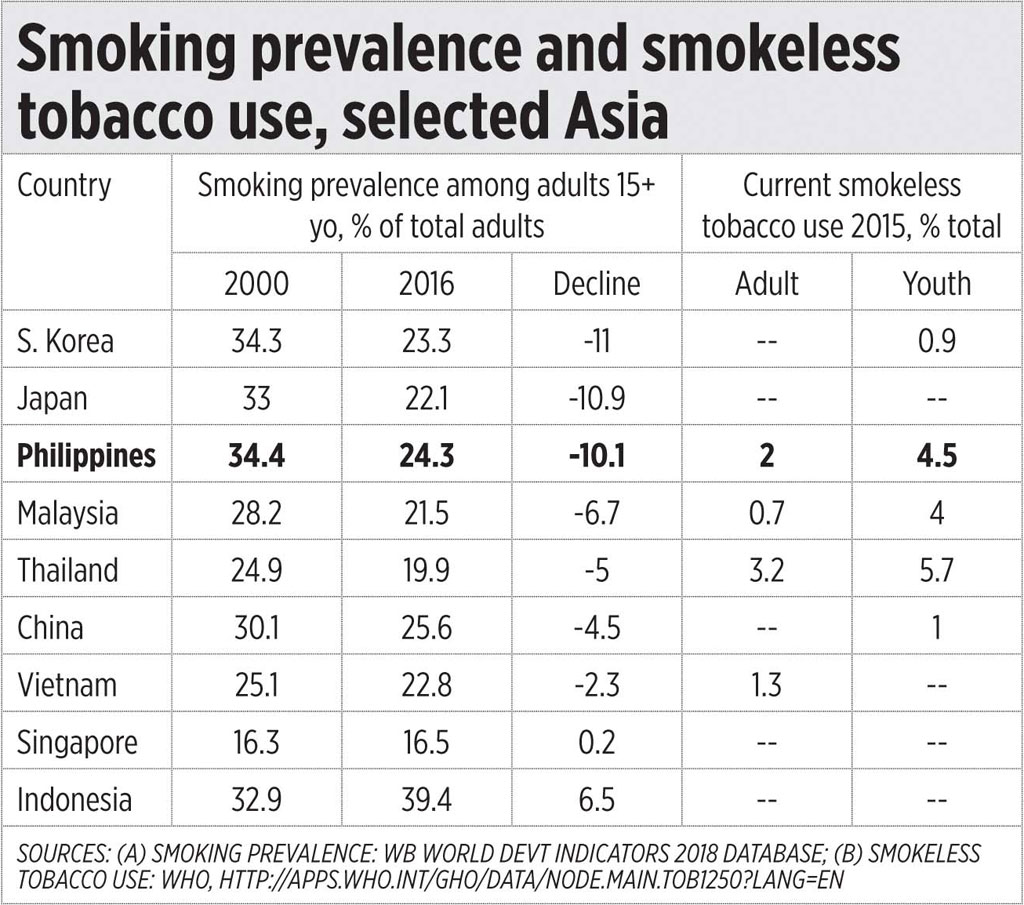
On No. 1, in most countries, smoking prevalence is declining. There has been a big decline of 10-11 percentage points for South Korea, Japan, and the Philippines in a span of 16 years. And as of 2015, only 2% of Philippine adults and 4.5% of youths were users of smokeless tobacco or e-cigarettes, vaping products (see Table).

On No. 2, vaping products have actually become smoking substitutes or smoking-cessation tools, leading to a decline in smoking prevalence of five to 10 percentage points in the Philippines, Malaysia, and Thailand as a portion of their smokers shift to smokeless, non-burning nicotine substitutes.

A “gateway theory” that vaping leads to smoking in young people is just a disproven hypothesis. In early 2019, a UK anti-smoking charity, Action on Smoking and Health (ASH), released a report showing that vaping remains uncommon among young people and is almost exclusively confined to current or past smokers, and that most teen vaping is experimental and short-lived.

Recently, the President, supported by the Department of Health, ordered a ban on vaping in public places. Government over-regulation follows the famous Newton’s third law of motion: “for every action there is an equal and opposite reaction.” Restated it becomes “for every government intervention and taxation, there is an equal and opposite distortion.”

Seven examples and cases below show why No. 3 above is wrong:

One, more prohibition means more corruption. Prostitution, drugs, certain gambling, gun running, etc. are prohibited, not just restricted and taxed in the Philippines. And these prohibited activities and products are all around. That implies that the police and government officials themselves, local and national, allow their proliferation in exchange for big bribes, other financial and political favour.

Two, more smuggling. The National Committee on Intellectual Property Rights (NCIPR) reported that full year 2018 seizures of pirated and counterfeit goods jumped to P23.6 billion. Of this, fake or smuggled cigarettes were P20.3 billion or 86% of total. Higher tobacco taxes under the TRAIN law of 2017 resulted in many smokers buying cheaper, smuggled tobacco.

Three, recent cases of coconut wine or lambanog poisoning in the Philippines. At least 23 people died due to suspected methanol poisoning, with over 500 hospitalized. As branded alcohol becomes more expensive due to more taxes, more drinkers shift to cheaper, untaxed, unbranded alcohol like lambanog, where products can include chemicals and prohibited substances.

Four, the Singapore vape ban has been in place for two to three years now. But instead of killing vaping, it sent it underground. There were seizures of $30,000 worth of illegal e-cigarettes in September, another $66,000 worth in November 2019.

Five, with misregulations around e-cigarettes in the US, illicit pods containing tetrahydrocannabinol (THC) oil together with Vitamin E acetate as a thickening agent have become widely available. Around 55 people have died after using these black market products rather than standard vape juice.

Six, when I was in southern Sweden in 2003 for two months, I noticed and read that Swedes who wanted cheaper booze would travel to Denmark to buy lots of beer and alcohol because Sweden’s alcohol taxes are very high. The same in Scotland after “minimum unit pricing” on alcohol was introduced in 2018 — Scot drinkers would go to England across the border to get cheaper alcohol.

Seven, in the UK, smoking data released after the implementation of plain packaging for tobacco products shows that for the first time in seven years, the smoking rate has risen. Illicit and smuggled tobacco became much easier because of the ease of copying the packs and cheaper prices. The same thing happened in Australia after its plain packaging policy was instated in 2012 — illegal tobacco use came in higher starting 2013, shown in KPMG study.

Friedrich Hayek has reiterated that “all-knowing” pretense and central planning of a nanny state can backfire. Thus, the state should step back from over-regulations and prohibitions. People own their bodies, not the state or NGOs. More state prohibitions only send people to seek illicit, even dangerous products and activities.


Bienvenido S. Oplas, Jr. is the president of Minimal Government Thinkers.

minimalgovernment@gmail.com

The need for villains

By Tony Samson

STORYTELLING, especially for epics featuring super-heroes, need to have villains. How else can the sometimes underdog hero triumph and seem larger than life if not by trouncing an evil foe?

When the villain is exaggerated with his power and devious designs, the hero gains in stature and unites the people behind him. This need for villains is understood by rulers. Framing problems in terms of us-versus-them can deflect criticism on leadership failures.

News and the subjects they cover tend to slant stories into a contest to make the narrative more compelling, a telenovela of life in a place full of unpleasant surprises. Presenting issues with simple statistics is possible with shipping schedules and canceled flights due to a storm. But news on how a sports event is organized or how greedy investors need to be put in their place require some conflict, not necessarily resolved.

Here are some ways news organizations, and especially social media, tilt their reporting with villainous intent.

They solicit the views of supposed experts who will demolish a media subject citing vested interests and conspiracy theories. Hosts of talk shows or blogs show their impartiality with a statement: the views expressed by our guest do not reflect those of the station. But we do love to feature her in all our programs.

They select unflattering video moments. This simple editorial prerogative allows media to feature a subject in mid-yawn or smirking at the speaker on the podium, perhaps with the glee of someone watching a cockroach making its way to the speaker’s collar. The camera shutter clicks as a dignified personality sneaks a thumb into the nostril awaiting his turn. Such visuals require no dialogue.

Choosing emotionally charged modifiers and characterizations provide just the right spin. Crowds can be described as an unruly mob or with a tight close-up of a dozen placard-bearers, a group of concerned citizens. They can be referred to as a cross-section of different sectors of society or a motley assembly of jobless riff-raff.

Man-on-the-street interviews are a convenient way of slanting opinion. Out of 10, maybe only three are featured in the news. Anonymous interviewees can be guided by the way the question is asked. They are seldom identified by name and occupation and seem to be hurrying off to the washroom when caught by the interviewer.

Editing video clips determines if a subject seems coherent or inconsistent. The “sound bite” lasts five to 10 seconds and the news editor decides which parts of a long answer to feature. “He has shown a mastery of the political process… but it seems he is still uncomfortable with dealing with the investment climate.” Playing the full statement or only one part of it makes the comment balanced or biased.

News programs now feature tweets or netizen comments (always unidentified) to show which side of an issue the viewers favor. Questions can be twisted to invite the desired results. “Are you in favor of sex education to introduce widespread promiscuity in schools giving way to teenage pregnancies with students doing their thing inside the toilet for the disabled?” The unsurprising result supporting a “No” is projected as a rejection of sex education in school.

Balanced reporting in media seems more honored in the breach. Bias determines what stories to feature and in which segment. While facts may be objective, they can still be selected in search of the required villain. Ratings or circulation numbers love controversy.

News subjects have learned the need for villains.

Instead of admitting a failure of policy, some convenient villain (cooperative with his silence) is conjured to whip up the masses and sidestep a crisis, even one that is still to come. With the dominance of social media, a lynch mob hysteria can be mobilized to order, the way old-fashioned rallies used to be organized with the provision of food, transport, and money to mobs for rent.

Media hysteria can be tiresome. Like fake news, it can be churned out to order. Gone are the broadcasters known to be on the take for demolition jobs. In their place are anonymous influencers who can choreograph chaos and create villains, and they’re not necessarily cheaper, even if some of them are barely out of high school.

The search for villains, and their vilification, is an occupation that is ideal for working from home… with no need to commute.


Tony Samson is Chairman and CEO, TOUCH xda.

ar.samson@yahoo.com

The unlikely rise of the Trumps and Kushners

By David Kocieniewski

AMERICANS have always been conflicted about political dynasties.

The US was born as a rebellion against monarchy and developed a vibrant mythology of rugged individualism and self-made success. Yet voters have often handed power to leaders famous for their lineage and family wealth — from the Adamses and Kennedys to the Rockefellers, Daleys, and Bushes.

The rise of President Donald Trump has vaulted two unlikely surnames into that rarefied realm, his own and that of Jared Kushner, his son-in-law and senior White House adviser. In American Oligarchs (W.W. Norton), public radio reporter Andrea Bernstein traces the histories of both the Trumps and the Kushners, seeking to explain how the offspring of two immigrant families joined together to reach the pinnacle of power despite their troubled pasts.

So much has been written about (and tweeted by) Trump since he’s taken office that his administration’s flippant approach to ethical norms is by now widely known. By building American Oligarchs around the Kushner and Trump family narratives, Bernstein offers readers a fresh perspective on how that attitude evolved — and its implications for American democracy. The Trumps and the Kushners may have taken advantage of the system, Bernstein argues, but it was American society and its political leaders who failed to defend it.

To those of us who have spent years following and covering the intrigues of the Kushners and Trumps, it offers a reminder that a relatively recent assortment of federal policy changes allowed the families to flourish: repeated tax cuts for the wealthy, especially in the real estate business; a retreat from campaign finance reform; and the de facto decriminalization of many white-collar crimes. Readers who follow the news more casually will also find the epic family tales a compelling way to understand the myriad deals and ambitions that define the Kushners and Trumps.

Despite the two families’ contrasting backgrounds — Trump’s grandfather came from Germany in the 1880s because he felt constrained by its inheritance laws, while Kushner’s grandparents led a daring escape from the Nazis in Belarus during the Holocaust — both made their way to the real estate business in metropolitan New York. They prospered in part from federal housing subsidies. They also learned the unwritten rules of the American political game, at a time when loosening campaign finance laws made it easier to buy influence with big money.

Charles Kushner, Jared’s father, gave so much to Democrats in 2000–2001 that New Jersey’s then-Governor Jim McGreevey nominated him for chairman of the Port Authority of New York and New Jersey, an infrastructure and development agency with a budget larger than some states.

(Before he could take the position, Charles Kushner was prosecuted, and ultimately sent to prison, for hiring a prostitute to seduce his brother-in-law and having a videotape of the encounter sent to his sister.)

The Trumps have also had brushes with the law. American Oligarchs expands on a story Bernstein broke in 2017, in a joint report by ProPublica and the New Yorker, about the Manhattan District Attorney Cy Vance’s decision not to prosecute Ivanka Trump and Donald Trump, Jr. on felony fraud charges. The Trump children had been accused of misleading investors about the financial details of the Trump SoHo building. But after a 2012 meeting with Trump’s lawyer Marc Kasowitz, who later became one of Vance’s biggest campaign donors, Vance declined to pursue the case. (Vance has said the donations played no role in his decision and he was convinced by the investors that it was not worth pursuing.)

The book paints a colorful portrait of the wedding that merged the Kushner and Trump families, their initial uneasiness, and their search for common ground.

After the Kushners made their first ill-advised foray into Manhattan, overpaying for 666 Fifth Avenue just before the market crashed in 2008, Trump helped them avoid bankruptcy in 2011 by steering investors their way. A few years later, when Trump University was being investigated for fraud by New York Attorney General Eric Schneiderman, Jared Kushner’s newspaper, the New York Observer, ran a biting 7,000-word piece on Schneiderman.

Once Trump entered the presidential race in 2015, Jared emerged as one of his most trusted advisers. Kushner managed the campaign’s digital operations, and attended the infamous Trump Tower meeting where Russians offered to provide damaging information about Hillary Clinton. During the transition, he met with Russian Ambassador Sergey Kislyak as well as Sergei Gorkov, head of Russia’s state-controlled VEB Bank.

Trump rewarded Kushner’s loyalty by giving him expansive power in the White House: from Middle East peace to digital innovation to the border wall. As Jared’s political portfolio has expanded, the Kushner family’s businesses have attracted foreign capital from investors who once shunned them, including the sovereign wealth funds of Saudi Arabia, Qatar, and the United Arab Emirates. Trump’s family properties, meanwhile, have raked in tens of millions from influence seekers since he took office.

That blurring of the boundaries between public policy and private business has made Trump’s administration uniquely polarizing and Kushner among its most disparaged figures.

Yet here, too, public sentiment is deeply divided.

Trump has been impeached by the House of Representatives, and his low public approval ratings have buoyed the hopes of Democrats hoping to thwart his reelection bid. Still, Bernstein cautions that the Kushner and Trump families “will do everything possible to lock us in for the foreseeable future.” Trump’s appeal to his fervent base is strong enough that he’s widely expected to prevail at his upcoming impeachment trial in the Republican-held Senate. Many consider him a good bet to win a second term.

And just this month, a poll of Republican voters was released, indicating the party’s preferences in the 2024 presidential race. Two of the top four picks were Donald Trump, Jr. and Ivanka.


BLOOMBERG

Google enhances privacy and perhaps itself at the same time

By Alex Webb

IF YOU LIVED west of the Mississippi at the dawn of the 20th century, there must have been a moment when it became clear that the Wild West of old was no more. Perhaps it was the arrival of the railroad, or the last stagecoach robbery, or the introduction of a federal income tax.

For the web, that moment might just be Google’s decision on Tuesday to end third-party tracking of people’s browsing habits. It’s a move that will better protect user data, but it also provides an opportunity for the Alphabet Inc. unit to extend its dominance of online advertising.

The advertising technology industry has long been a Wild West of its own, largely thanks to the proliferation of seemingly innocuous little files known as cookies, which nourished hordes of startups feeding on the data they generated. When internet users visit a website, files are deposited on their computers that record the visit. Many sites, if not most of them, include cookies from other firms, which means they can track users’ progress across the web.

As that data accumulates, and users peruse new shoes on one website, film reviews on another, train tickets on a third and so on, adtech firms are gradually able to build a profile of their interests, spending power, and demographic attributes. The problem is that users often have no idea who exactly is gathering that personal data. In many ways, adtech is the lubricant for the modern internet — its proceeds pay for much of the web’s operating costs.

In 2017, Apple Inc. started blocking third-party cookies on its Safari web browser to stymie the practice. Last year, Mozilla Corp.’s Firefox did the same. Google is finally now following suit with Chrome, which has significantly more users than its competitors.

The decision is a no-brainer for the search giant, which regularly asserts that search terms are its most useful tool for targeting relevant ads. And ever since the European Union’s General Data Protection Regulation (GDPR), cookies have been dying. The rules included measures that made it easier for users to opt out of cookie-based ad-tracking. Within three months of the legislation coming into force in 2018, the number of third-party cookies found on news websites in the region fell by 22%, according to the Reuters Institute. Similar digital privacy legislation is being rolled out around the world.

But GDPR also made life harder for a cohort of second-tier adtech players trying to compete with the likes of Google and Facebook Inc. The regulation’s provision to prevent data being shared wantonly with third parties seemed to give the tech giants an opportunity to tighten their control over user data. Rivals such as Sizmek Inc. have since gone bankrupt.

Putting an end to third-party cookies could have a similar effect-cement Google’s control at the expense of rivals. After Tuesday’s announcement, shares in French adtech firm Criteo SA fell as much as 14%. After all, if you’re using Chrome, Google is still likely to know your browsing habits. Data that advertisers might formerly have obtained from those third parties might become most readily available from Google itself.

It’s a move that could appear anticompetitive and might explain why Google isn’t enforcing the change immediately but instead phasing it in gradually over two years — with feedback from the adtech “ecosystem,” as director of Chrome engineering Justin Schuh wrote in an accompanying blog post. That approach might take the wind out of accusations of brazen anticompetitiveness.

For publishers, it will most likely accelerate the shift toward requiring users to register for their websites because that will be the best way to determine who exactly is browsing their content and thus how to serve appropriate ads. That could become a problem for sites that depend on sporadic visits more than they do a loyal audience.

There are still other channels where adtech’s worst practices remain rife, through the use of digital fingerprinting, mobile apps, and other means. But the industry’s gunslinging days are nearing an end, and Google is the sheriff.


BLOOMBERG OPINION

Barangay Ginebra inches closer to Governors’ Cup title

By Michael Angelo S. Murillo
Senior Reporter

THE Barangay Ginebra San Miguel Kings are on the cusp of winning another Philippine Basketball Association Governors’ Cup title after dominating the Meralco Bolts, 94-72, in Game Four of their best-of-seven finals on Wednesday at the Smart Araneta Coliseum.

Showed no let-up once they got their collective groove going in the second quarter, the Kings broke away from the Bolts and stayed the course to secure the win and the 3-1 lead in the series.

The contest got off to a competitive start with the teams not budging a bit.

They fought to a tied count of 14-all after the first 12 minutes.

In the second quarter, the Kings picked up their offense, led by import Justin Brownlee.

They outscored the Bolts, 15-6, in the first six minutes to build a 29-20 advantage.

It was a wave they would ride for the rest of the frame on their way to a 42-31 lead at the break.

Barangay Ginebra kept pouring it on Meralco at the start of the third quarter, opening the proceedings with an 8-2 run to stretch its lead to 17 points, 50-33, with just two minutes lapsing.

A hurting Raymond Almazan and import Allen Durham tried to keep the Bolts in the game but the Kings continued to hold sway, 61-44, midway into the quarter.

Barangay Ginebra would eventually settle for a 70-55 lead heading into the final frame.

Sensing that they had their opponents on the ropes, the Kings attempted for an early finish.

But Meralco stayed within striking distance, 77-63, at the 7:17 mark of the final canto.

Scottie Thompson and Aljun Mariano then propelled the Kings to a 9-0 blast in the next two minutes to push their lead to 23 points, 86-63.

From there it was all Barangay Ginebra as Meralco just had minimal answer as time wound up.

Mr. Brownlee paced the balanced Kings attack, finishing with 27 points, eight rebounds, eight assists, five steals and four blocks.

Stanley Pringle had 21 points while Scottie Thompson finished with 16 for Barangay Ginebra, which is gunning for a third Governors’ Cup title in the last four years.

For Meralco it was Mr. Durham who showed the way with 21 points, 27 rebounds and seven assists.

Mr. Almazan, who was expected to miss Wednesday’s game after injuring his knee in Game Three, had 12 points and nine boards.

Chris Newsome also had 12 markers.

INDIVIDUAL AWARDS
Meanwhile, prior to Game Four, top individual awards for the Governors’ Cup were handed out.

Winning best import was Mr. Durham who got 1,170 points, ahead of Mr. Brownlee (937), TNT’s KJ McDaniels (635) and Northport’s Michael Qualls (528).

Best player of the conference, meanwhile, went to Northport’s Christian Standhardinger, who got 1,011 points.

Coming in second was San Miguel’s June Mar Fajardo (657), TNT’s Jayson Castro (615), Columbian’s CJ Perez (506) and NLEX’s Kiefer Ravena (481).

Accounted for the votes for both best import and best player of the conference awards are statistical points, media, player and PBA office votes.

Busmen seek to shape up more for AFC CL next round

By Michael Angelo S. Murillo
Senior Reporter

WHILE happy to have been able to overcome its first hurdle in the preliminaries of the AFC Champions League 2020, top local club football team Ceres-Negros FC nonetheless looks to shape up some more heading into the next round.

Defeated Shan United FC of Myanmar, 3-2, in their Preliminary Round 1 match on Tuesday at the Rizal Memorial Stadium, the “Busmen” advanced to round 2 and are facing Port FC of Thailand on Jan. 21 in Bangkok.

Recognizing that competition could only get stiffer, they said they have to pick up their game if they want to see their goal of making it to the group play Asia’s prestigious club tournament.

“As we know we had limited preparation heading into the game but I’m very happy for the players. They played hard and they deserved to win,” said Ceres coach Risto Vidakovic postgame.

“I don’t know how much percent we are in right now but I think we are still far from the form we want to be in. Three training sessions are not enough. It usually takes six weeks to prepare a team well. Hopefully we get to put in more in training and be better,” added the coach, who also shared that he would allow his players to rest first before plunging back to training.

Against Shan United, Ceres started strong, controlling the opening half and securing a 2-nil lead by the break with goals from Robert Lopez Mendy (5’) and Bievenido Maranon (41’).

It had chances to add on to its lead in the early goings of the second half but failed to connect on them.

Shan United managed to narrow the gap, 2-1, in the 73rd minute when Zin Min Tun scored.

But OJ Porteria helped Ceres extend its lead anew, 3-1, when found the bottom of the net in the 79th minute.

Shan United though would not go down sans a fight, pushing to within 3-2 in the 87th minute of the contest care of Djawa M.

It continued its charge back all the way to the four-minute added time but Ceres would dig deep and stand its ground to hang on and preserve the win.

Despite seeing his team fail to keep the spirited level of play it had early on, Mr. Porteria, named man of the match after, said he liked what he saw and encouraged moving forward.

“We only had three or four days of preparation but I’m happy we got to keep the game in control. I’m happy for the boys. We have players who have experience, players who are fresh. We showed a lot of heart and we did not give up,” said Mr. Porteria.

“This is a good step. The game was not easy but we adjusted. We are still working our way to form but we will get there eventually,” he added.

Giannis, Bucks finish sweep of Knicks

LOS ANGELES — Giannis Antetokounmpo scored 37 points in just 21 minutes Tuesday night for the host Milwaukee Bucks, who concluded their season-long dominance of the New York Knicks by cruising to a 128-102 victory.

The Bucks swept the three-game season series from the Knicks and never trailed in outscoring New York by total of 91 points (383-292).

The Bucks have won four in a row overall and nine of 10 to improve to an NBA-best 36-6. The Knicks, whose 11-30 record at the season’s midway point is the third-worst mark in the league, have lost six of seven.

Antetokounmpo, who also had nine rebounds and four assists, is just the second player this season to score at least 30 points while playing fewer than 22 minutes. Paul George had 37 points in 20 minutes for the Los Angeles Clippers against the Atlanta Hawks on Nov. 16.

Khris Middleton scored 17 points while Ersan Ilyasova had 14 points off the bench for the Bucks. Eric Bledsoe added 11 points.

Julius Randle (25 points, 15 rebounds) had a double-double for the Knicks. RJ Barrett scored 22 points, and Bobby Portis (20 points) and Kevin Knox II (10 points) each reached double digits off the bench.

Antetokounmpo and Middleton scored four points apiece in an 8-0 game-opening run for the Bucks. The Knicks missed their first five shots. Randle (eight points) and Mitchell Robinson (four points) combined to spark a 12-4 run for New York that closed Milwaukee’s lead to 23-21.

But the Bucks mounted another big quarter-opening run in the second, when Antetokounmpo had five points in a 10-0 spurt that extended the lead to 39-23.

The Knicks closed within 10 points a handful of times before Milwaukee opened its first 20-point lead by going on a 16-5 run that was capped by five straight points from Donte DiVincenzo. Antetokounmpo scored the final four points of the half as the hosts entered the locker room with a 65-40 lead.

Antetokounmpo scored five points in the first 1:47 of the second half as the Bucks opened up a 72-42 lead. They led by as many as 35 in the third and were on top 108-76 entering the fourth. The Knicks never got closer than 23 in the final period.

MORANT LEADS GRIZZLIES PAST ROCKETS TO 6TH STRAIGHT WIN
Ja Morant paired 26 points with eight assists and took over down the stretch as the host Memphis Grizzlies extended their winning streak to six games with a 121-110 victory over the Houston Rockets on Tuesday.

After James Harden pulled the Rockets to within 98-96 on a technical free throw with 6:42 remaining, Morant drilled two 3-pointers, and completed a three-point play as Memphis reclaimed a 114-105 lead with just over two minutes to play. It was yet another dynamic performance for the rookie point guard, who finished 10 for 11 from the floor.

Dillon Brooks added 24 points on 6-for-10 shooting from 3-point range, while Jonas Valanciunas and Jaren Jackson Jr. scored 19 and 15 points, respectively.

The Grizzlies surged to the lead in the second quarter and mustered hasty responses when the Rockets took brief leads in the third and fourth.

Harden scored a game-high 41 points but shot just 13 of 37 overall and missed 14 of 19 3-pointers. Houston played without guard Russell Westbrook (rest), with his replacement Ben McLemore producing 14 points on 5 of 12 shooting.

Eric Gordon added 23 points off the bench for the Rockets, who shot just 31.1 percent (14 of 45) from behind the arc. Clint Capela finished with 16 points and 16 rebounds for the Rockets.

Harden poured in 17 points in the opening period on 6-of-8 shooting, yet the Rockets couldn’t shake Memphis. The Grizzlies erased what was an 11-point deficit in roughly three minutes, pulling even at 22-22 when Valanciunas nailed an 11-foot jumper at the 4:29 mark of the first.

The Rockets reclaimed a 39-32 lead early in the second before the Grizzlies exploded and seized control. — Reuters

WNBA bares progressive changemakers partnership with AT&T, Deloitte and Nike

NEW YORK — The Women’s National Basketball Association (WNBA) announced today the formation of a first-of-its-kind collective — WNBA Changemakers — which brings together values-driven businesses who lead the way in the advancement of women and sports. WNBA Changemakers will partner with the WNBA to significantly elevate the player experience and enable the league’s business transformation. WNBA Commissioner Cathy Engelbert highlighted the Changemakers platform during the league’s announcement with the Women’s National Basketball Players Association (WNBPA) of a new, historic WNBA Collective Bargaining Agreement (CBA).

The Changemakers platform is designed to provide direct support to the WNBA in its ongoing business transformation across marketing, branding, and player and fan experience. With a fresh approach to sports sponsorship, Changemakers are deeply invested in driving positive change for the WNBA, women’s sports, and women in society. Not only are partners providing financial investment, but they are further lifting the league and players through marketing amplification and close strategic collaboration. This group of leaders is redefining what it means to live organizational values through business partnerships.

The WNBA is thrilled to announce that the inaugural WNBA Changemakers will include AT&T, the Official Marquee Partner of the WNBA, Deloitte, the newest league partner and the Official Professional Services Provider of the WNBA and Nike, the Official Outfitter of the WNBA.

“We are launching the WNBA Changemakers platform to team up with organizations who have demonstrated unwavering commitment to women’s advancement and are pioneers in inclusive leadership,” said Commissioner Engelbert. “The support from these WNBA Changemakers companies will allow us to provide an enhanced player experience for the amazing professional athletes in the WNBA. We tip off our 24th WNBA season in May, and because of the Changemakers support, we will begin to narrow the gap that exists for women sports, as only 1% of all global corporate sponsorship dollars are directed toward women’s sports. We look forward to other companies joining our vision to drive change toward a more equitable and inclusive ecosystem.”