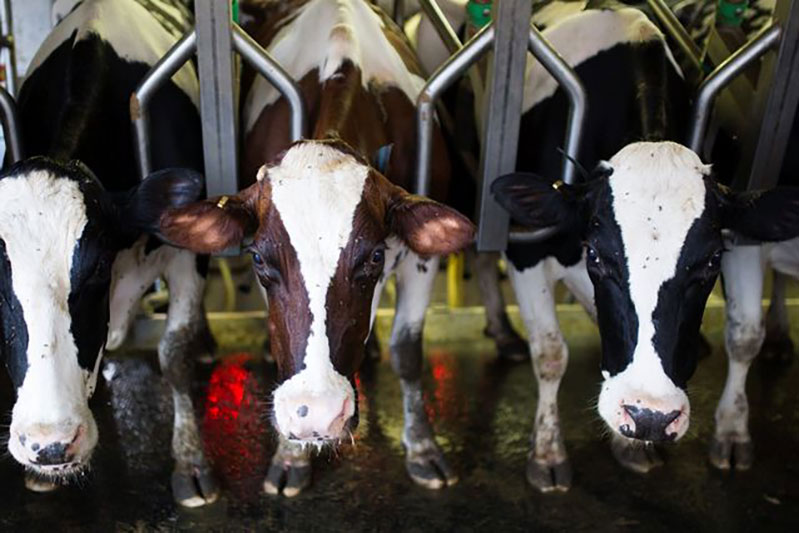
THE dairy industry expects to meet its 5% liquid milk self-sufficiency target by 2028, backed by expanded funding and foreign partnerships, the National Dairy Authority (NDA) said on Monday.
Milk production rose to 43 million liters in 2025 — equivalent to a 2.2% self-sufficiency rate, NDA Administrator Marcus Antonius T. Andaya said at a European Chamber of Commerce of the Philippines meeting at the Makati Shangri-La.
Mr. Andaya noted that Republic Act 12308 (the Animal Industry Development and Competitiveness Act) will support growth in the industry. The NDA will receive P1.5 billion annually over the next decade from the Animal Competitiveness and Enhancement Fund (ACEF).
For three decades, the Philippines produced only 1% of its total dairy requirements, with 99% imported, making the country one of the most import-dependent dairy markets in the region, Mr. Andaya said.
The administrator said the agency is targeting 53 million liters of production in 2026, equivalent to a 3.3% self-sufficiency rate.
“These numbers tell us two things: First, our domestic dairy industry remains underdeveloped. Second, the room for growth is enormous. The challenge is significant, but so is the opportunity,” Mr. Andaya said.
The NDA’s 2026 budget increased to P2.37 billion from P500 million in 2025, with P1.8 billion earmarked for the Department of Education milk-feeding program.
For 2027, the NDA is proposing a General Appropriations Act allocation of up to P1 billion, not including the P1.5 billion from the ACEF. “The NDA will have so much money that we have to spend,” Mr. Andaya told reporters at the sidelines of the event.
He cited plans to import about 800 Holstein-Jersey cattle from Australia in August, with another 800 animals expected around October.
Mr. Andaya added that the NDA is “very optimistic” about hitting the 53 million-liter target once the cattle arrive.
It currently operates four stock farms, with a fifth in Bukidnon set to become operational this year. Three additional 50-hectare facilities are planned for Sorsogon, Baguio, and Negros, each requiring approximately P50 million.
Despite the heavy reliance on imports, the Iran conflict has unexpectedly boosted demand for domestically produced fresh milk. Suppliers for the milk-feeding program now prefer local milk over imported powdered milk, after prices for the latter rose due to the war, Mr. Andaya said.
“Before, they wanted more powdered milk. But prices went up,” Mr. Andaya said. “Now they prefer less powdered milk, and more local.”
Cattle import costs have also risen to approximately P220,000 per head, though Mr. Andaya said aggressive institutional support and feed provisions should keep production targets on track even with increased costs.
The NDA is also working with international partners, with the French development agency conducting a feasibility study expected to conclude in March for technology transfer at the Ubay, Bohol stock farm, while the Czech Republic has offered grant funding for farmer training. — Pierce Oel A. Montalvo