Debt yields end higher on April inflation surge
By Isa Jane D. Acabal, Researcher
YIELDS on government securities (GS) traded at the secondary market climbed last week as faster April inflation triggered a sell-off.
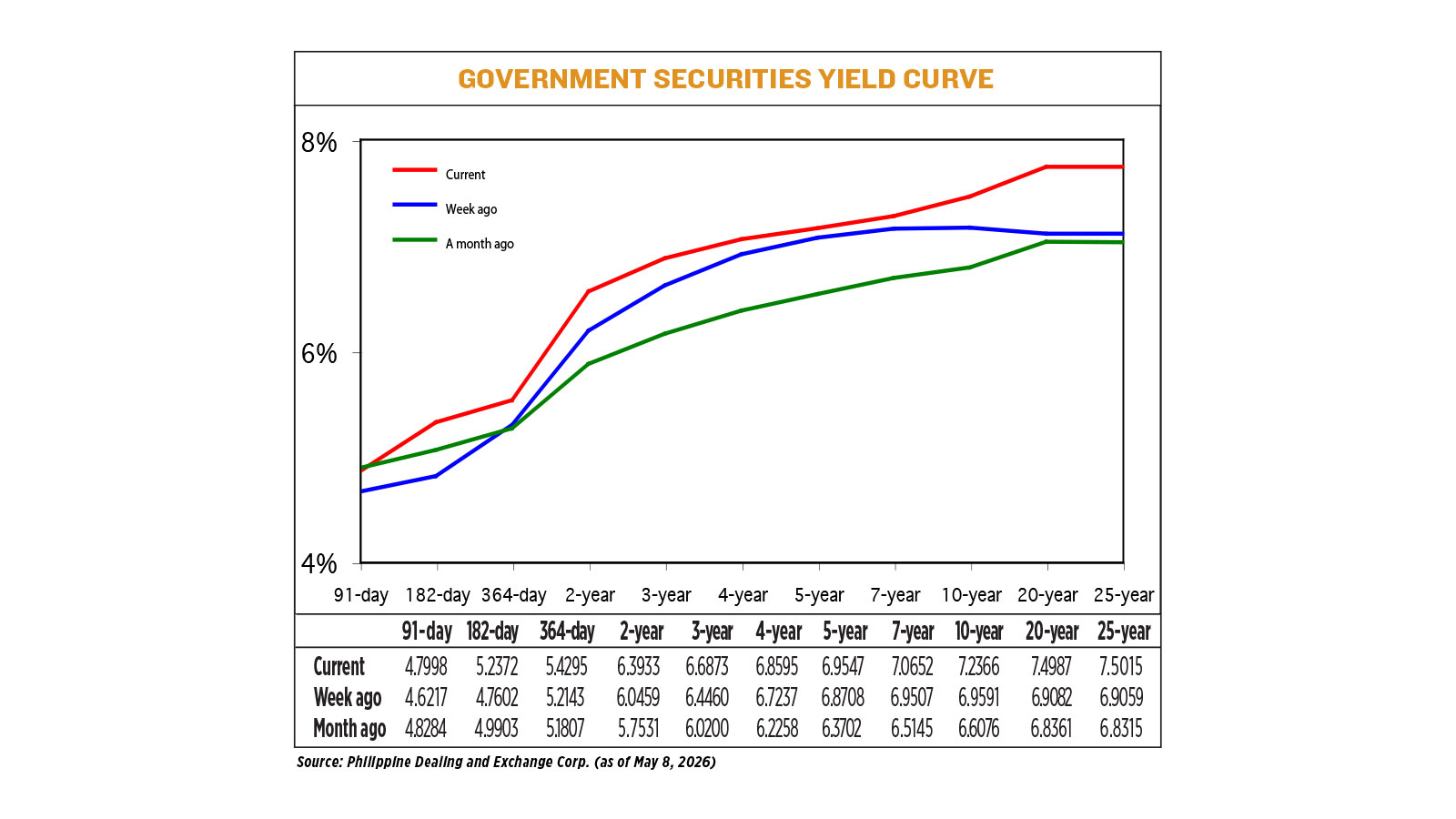
GS yields, which move opposite to prices, rose by an average of 29.61 basis points (bps) week on week at the secondary market, according to PHP Bloomberg Valuation Service Reference Rates as of May 8 published on the Philippine Dealing System’s website.
Rates climbed across all tenors. At the short end of the curve, yields on the 91-, 182-, and 364-day Treasury bills (T-bills) went up by 17.81 bps to 4.7998%, 47.7 bps to 5.2372%, and 21.52 bps to 5.4295%, respectively.
At the belly, yields on the two-, three-, four-, five-, and seven-year Treasury bonds (T-bonds) increased by 34.74 bps (to 6.3933%), 24.13 bps (6.6873%), 13.58 bps (6.8595%), 8.39 bps (6.9547%), and 11.45 bps (7.0652%), respectively.
At the long end, the rates of the 10-, 20-, and 25-year debt papers went up by 27.75 bps (to 7.2366%), 59.05 bps (7.4987%), and 59.56 bps (7.5015%), respectively.
GS volume traded dropped to P17.56 billion last week from P28.65 billion previously.
“Bond market participants staged a sell-off after the April inflation surge, with yields up by 30 bps on average from last week. While the low GDP (gross domestic product) print spurred rate cut speculation for a day, the yield curve ultimately steepened as a hawkish BSP (Bangko Sentral ng Pilipinas) tone and an elevated inflation outlook pushed up yields, particularly for the face and the tail of the curve,” Marco Antonio C. Agonia, an economist at the University of Asia and the Pacific, said in an e-mail.
“Movements in the belly were comparatively more benign, as participants took positions in oversold mid-dated tenors from the previous week’s oil price scare,” he said. “A short-lived recovery ensued late in the week as oil prices deflated on US-Iran peace deal hopes. However, this was comparatively small to the overall movement on a week-on-week basis.”
Headline inflation surged to a three-year high of 7.2% in April from 4.1% in March and 1.4% a year ago, the Philippine Statistics Authority reported on Tuesday.
This was above the central bank’s 5.6%-6.4% forecast for the month and was the fastest print since the 7.6% recorded in March 2023. This was also well above the BSP’s 2%-4% tolerance range.
In a statement following the data release, the central bank said it will “take all necessary monetary actions to ensure that inflation returns to the 3% target.”
Meanwhile, Philippine economic growth slowed further in the first quarter to hit a new post-pandemic low as a corruption scandal involving flood control projects and price shocks from the Middle East war hit consumer sentiment.
Gross domestic product expanded by 2.8% in the period, down sharply from 5.4% a year ago and also slower than the 3% pace in the fourth quarter. This was below the 3.4% estimate in a BusinessWorld poll of 21 analysts.
“Local bond yields moved sharply higher during the first half of the week following the stronger-than-expected April inflation print and weak demand at the dual-tranche auction amid rising inflation concerns, leading to the 20-year bond clearing at 7.705%, while the three-year was awarded at 6.933%,” Lodevico M. Ulpo, Jr., vice-president and head of fixed income strategies at ATRAM Trust Corp., said in a Viber message.
“The combination of elevated inflation and soft auction demand prompted selling across the curve that pushed the 20-year and 10-year benchmark yields to as high as 7.875% and 7.6% respectively.”
He added that yields eased slightly later in the week as the slower GDP print curbed expectations of further policy rate hikes from the central bank.
Security Bank Corp. Trust Asset Management Group Chief Investment Officer Noel S. Reyes said the faster-than-expected April inflation print drove yields on bonds with tenors of five years and above past 7%.
“Bid-ask spreads became wider in secondary market trading as buying levels backed up higher, hence limiting activity on the street. Some buying by Thursday saw a recovery amid the need by the BSP to balance weak GDP release of 2.8% in the first quarter to prevent a stagflation scenario,” Mr. Reyes said.
For this week, he said trading activity will be largely headline-driven, with markets monitoring developments in the Middle East war.
Mr. Ulpo expects yields to be largely rangebound, “with bias to slightly drift lower as investors continue to selectively add duration at elevated yield levels.”
“Due to a lack of major domestic catalysts, market direction for this week will likely depend on the auction of the upcoming five-year bond reissuance, which will gauge investor risk appetite and demand conditions,” he said.
Mr. Agonia said traders could track the reaction of the US market to April employment data as these could influence the Federal Reserve’s next moves.
“We see the market this week moving broadly risk-off with some volatility in play. With the higher inflation outlook and unclear signs on a peace deal, market participants may shy away from outsized bets, thus pushing yields further upwards. Traders may slip in and out of positions speculating on any de-escalation steps in the Middle East,” he said.