Yields end higher as war turns market bearish
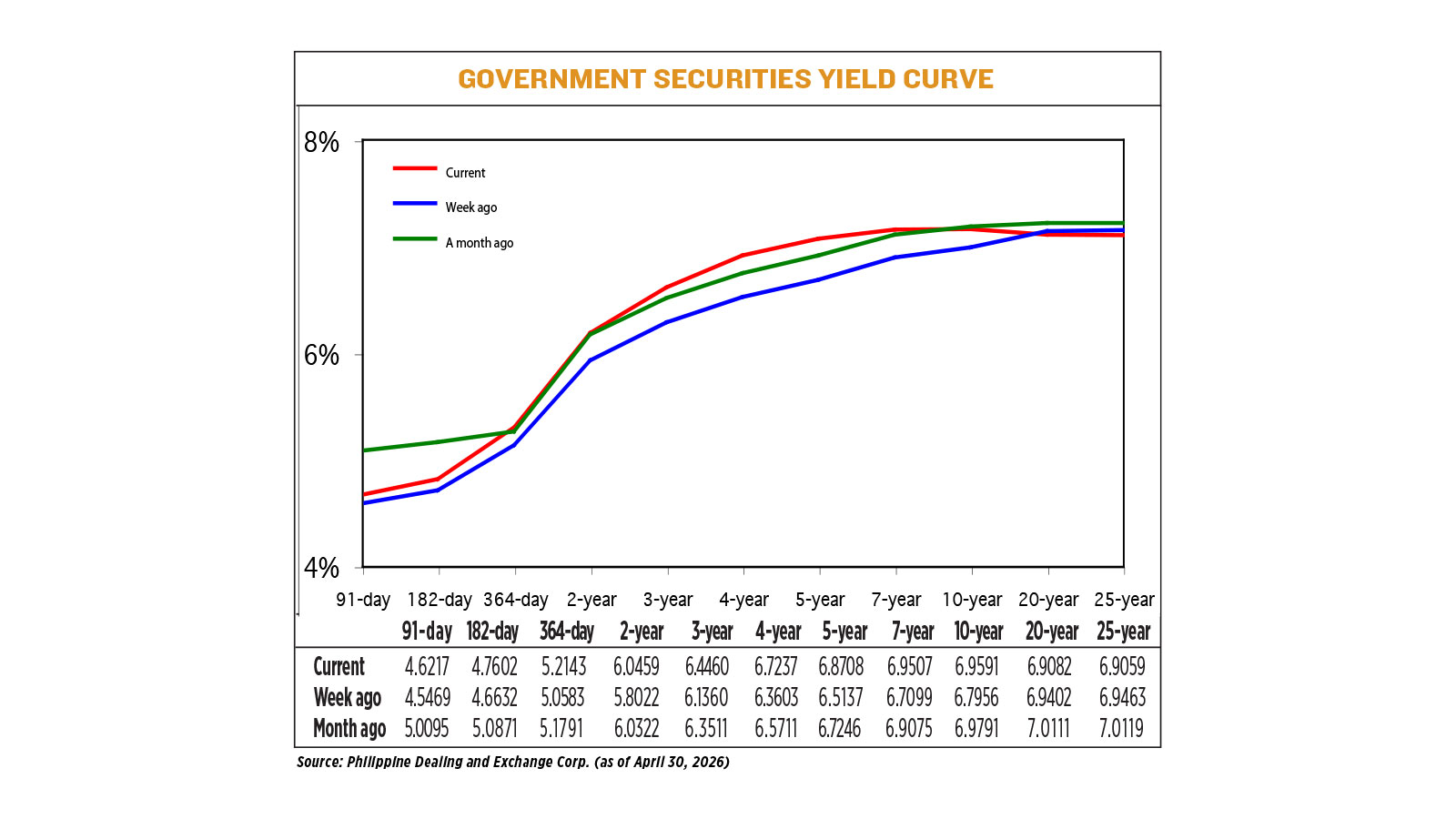
YIELDS on government securities (GS) traded in the secondary market rose last week due to inflationary pressures, shifting monetary policy expectations and continued geopolitical instability.
GS yields, which move opposite to prices, jumped by 17.58 basis points (bps) on average week on week, based on PHP Bloomberg Valuation Service Reference Rates data as of April 30 published on the Philippine Dealing System’s website.
At the short end of the curve, yields on the 91-, 182-, and 364-day Treasury bills (T-bills) increased by 7.48 bps, 9.70 bps and 15.60 bps week on week to 4.6217%, 4.7602% and 5.2143%, respectively.
At the belly, yields also went up across all tenors. The two-, three-, four-, five-, and seven-year Treasury bonds (T-bond) saw their rates climb by 24.37 bps (to 6.0459%), 31.00 bps (6.4460%), 36.34 bps (6.7237%), 35.71 bps (6.8708%), and 24.08 bps (6.9507%), respectively.
On the other hand, at the long end, rates were mixed. Yields on the 20- and 25-year debt papers declined by 3.20 bps (to 6.9082%), and 4.04 bps (6.9059%), respectively. Meanwhile, the 10-year bond jumped by 16.35 bps to fetch 6.9591%.
GS volume traded reached P28.65 billion, slightly lower than the P28.51 billion recorded a week earlier.
Philippine financial markets were closed on Friday (May 1) for Labor Day.
“Yields generally moved higher over the week as inflation concerns continued to weigh heavily on market sentiment,” Alessandra P. Araullo, chief investment officer at ATRAM Trust Corp., said in a Viber message.
Market dynamics turned bearish after the Bangko Sentral ng Pilipinas’ (BSP) rate hike and the worsening conflict in the Middle East, which caused heightened uncertainty and a defensive stance among investors.
“With both the US and Iran showing no signs of de-escalating tensions around the Strait of Hormuz, oil prices have remained elevated, further weighing on bond market sentiment,” Ms. Araullo said. “Oil prices are not expected to normalize meaningfully even in the event of an abrupt end to the conflict, given the extent of the supply disruptions and structural damage already incurred. This continues to pose downside risks to bond market sentiment and yields.”
She added that “market illiquidity has exacerbated the bearish tone,” with players staying on the sidelines amid growing concerns.
“With inflation risks resurfacing, the central bank adopted a more hawkish stance, prompting markets to reassess the path of interest rates,” the first trader said in a Viber message.
“As a result, yields, especially at the short end, moved higher, reflecting expectations of tighter financial conditions and the possibility that policy rates may remain elevated longer than previously anticipated,” the trader said. “Investors demanded higher yields to compensate for the increased inflation risk, which further exerted upward pressure across the curve, suggesting that there is ample liquidity in the system but sentiment has shifted toward a more cautious stance.”
On April 23, the Monetary Board raised benchmark interest rates by 25 bps, marking its first hike since October 2023.
BSP Governor Eli M. Remolona, Jr. signaled further tightening ahead via “a succession of modest rate hikes” as they try to quell spiraling prices due to the Middle East conflict amid worsening inflation expectations brought by the global oil shock.
The central bank raised its inflation forecasts to 6.3% for 2026 and 4.3% for 2027 from 5.1% and 3.8% previously. Both are above its 2%-4% tolerance band.
Meanwhile, US President Donald J. Trump said on Friday he was not satisfied with the latest Iranian proposal for talks on the Iran war, while Iran’s foreign minister said Tehran was ready for diplomacy if the United States changes its approach, Reuters reported.
Mr. Trump’s comments indicated the deadlock over the two-month-old war is likely to persist, even as he looks to end a conflict that remains deeply unpopular among Americans.
Though the United States and Iran have suspended hostilities since an April 8 ceasefire, the two countries remain at odds over a range of issues, including Iran’s nuclear ambitions and control over the Strait of Hormuz, and the two sides have yet to agree to a second meeting following a brief summit of senior officials in Islamabad last month.
Global oil prices eased on Friday following news of the Iranian proposal, coming off Thursday’s four-year high. Benchmark Brent crude was down 1% to around $109.
The second trader said hawkish US Federal Reserve expectations due to the Middle East conflict also pushed up bond yields.
“The hawkish dissenters wanting to remove references toward policy easing fueled further upward pressure on yields.”
Traders are now pricing in roughly a 40.5% probability of a rate hike by April 2027, up from about 8% before the Fed announced its decision, according to CME Fedwatch tool.
For this week, Philippine April inflation data to be released on Tuesday (May 5) will be a key trading driver, the analysts said.
“At this point, it appears almost a given that inflation will exceed levels most had not anticipated earlier in the year — when, prior to the conflict, expectations were centered near the BSP’s upper threshold of 4%. How high inflation ultimately rises, and how long elevated levels persist, will be the key questions shaping investor sentiment,” Ms. Araullo said.
“The market is closely watching for any positive news, particularly outcomes that signal a more durable or lasting resolution. Closely linked to this — and more direct in its market impact — is the recovery in oil prices, which remains a key variable influencing sentiment and pricing.”
The first trader said yields will remain elevated as the conflict continues.
“Geopolitical developments can quickly alter market sentiment and lead to abrupt movements in yields. Crucially, changes in oil prices remain a critical variable that could significantly influence inflation expectations and bond valuations,” the trader said.
“Another important consideration is the evolving stance of the central bank. As monetary policy becomes increasingly data-dependent, any new economic data releases or policy signals could trigger sharp market reactions, as was the case this past week. Liquidity conditions in the local bond market also warrant attention, as relatively thin trading volumes can amplify price movements during periods of uncertainty.” — Abigail Marie P. Yraola with Reuters