With budget cuts, FDCP prioritizes key projects
as it re-establishes itself in Intramuros
AT THE END of February, the Film Development Council of the Philippines (FDCP) officially moved to a new building with the goal of re-establishing itself as a “hub and sanctuary for the country’s filmic culture.” This as recent budget cuts have forced it to look at its priorities, which include film restoration and developing an audience by focusing on Gen Z.
Along with the Philippine Film Archive’s vaults and the Cinematheque Centre theater, the agency left its original location in Manila’s Kalaw St. for a new one in Intramuros named the Philippine Film Heritage Building.
FDCP Chairman Jose Javier Reyes told BusinessWorld in an exclusive interview in April that the building will be “host to many activities, as part of Intramuros which is a cultural hub of the city.”
“We will be doing a lot of things as part of this hub. We are right beside Baluarte de San Diego, where we can eventually have open-air screenings. We can also have screenings in Centro de Turismo and Fort Santiago,” Mr. Reyes said.
Since its groundbreaking in 2023, the building’s construction was hampered by limited funding and delays. Now that it has finally been completed, the FDCP has been running its programs through the transition as smoothly as possible.
FILM ARCHIVING
As seen in the name, the Philippine Film Heritage Building primarily serves as a film vault, with temperature-controlled storage space and scanning machines for digitization found on the upper floors.
Mr. Reyes said that FDCP is in talks with studios like ABS-CBN and Viva, which are seeking to restore their old films. The previous head of ABS-CBN’s Sagip Pelikula film restoration initiative, Leo Katigbak, now works as a consultant for the Philippine Film Archive.
“We’re capable of all this because we were able to get another digitizing machine that was donated by the government,” he said. “The construction of this building plus the addition of the equipment is more or less congruent with developments we’re working on.”
Citing “major budget cuts,” Mr. Reyes also explained that they have had to prioritize key projects.
“With what’s happening in the world right now, we have to be more conscientious about budget. What we spend is taxpayers’ money, so it better be worth it,” he said, adding that they will try to restore “as many films as possible” before his term as FDCP chair ends in 2028.
Among the films that are being restored are Maryo J. de los Reyes’ coming-of-age drama Magnifico (2003) and Lino Brocka’s social drama Tinimbang Ka Ngunit Kulang (1974).
Aside from films themselves, the FDCP is also working on a digitized script library which will house film scripts for the use of film students, scholars, and enthusiasts.
CINEMATHEQUE
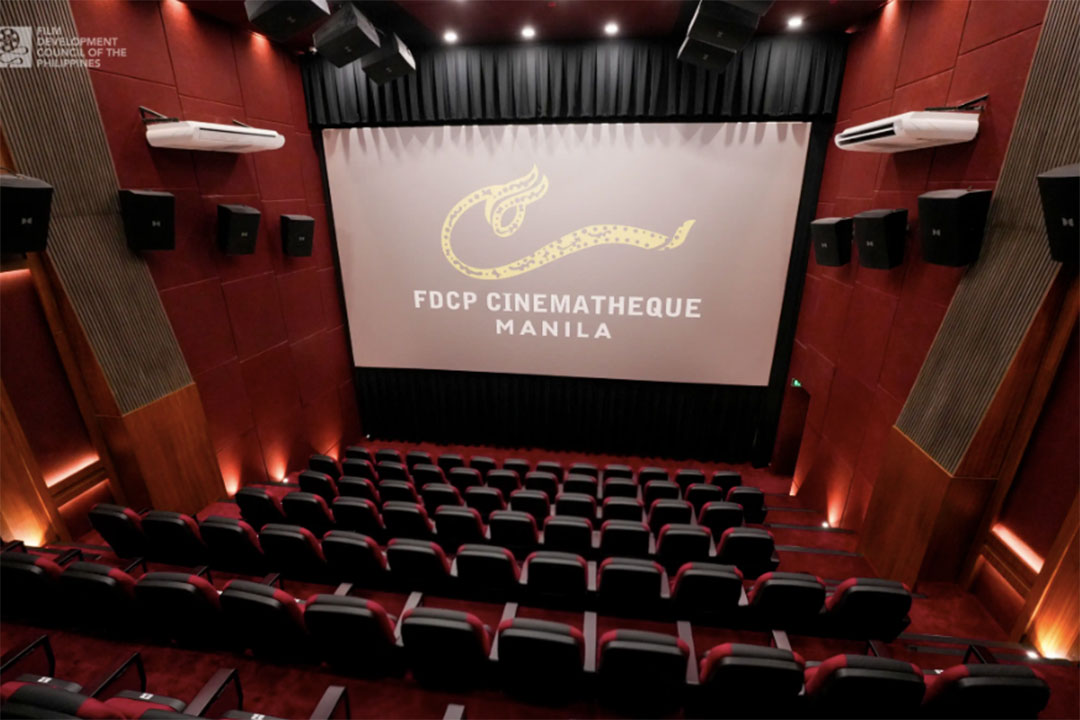
The Philippine Film Heritage Building also houses the Cinematheque Centre Manila — an 80-seat theater equipped with a 2K DCP-capable laser projector and a Dolby Atmos-fitted sound system.
Mr. Reyes told BusinessWorld that this will not only be used for film showings, but also for activities like forums and workshops.
“This hopefully will become the center of film activities in the country,” he said. A recent back-to-back screening of Antoinette Jadaone’s films was fully booked, the audience composed mainly of students.
The FDCP is also looking to open more Cinematheques outside of Metro Manila — namely in Baguio and Cebu.
“There’s a clamor in those places,” Mr. Reyes said. “These are venues where we can show restored films for free, to really effectively bring them to the public. Especially with the oil crisis and world incidents affecting people, we need to find ways of showing free films. People will not go to the cinema, so the cinema will have to go to the people.”
FILM VIEWERSHIP
As per studies commissioned by the FDCP for the 10-year Philippine Film Industry Roadmap, Filipinos find it more practical to watch films on streaming platforms rather than buy tickets to see them in cinemas.
This is a reality that the film industry is dealing with right now, according to Mr. Reyes, notwithstanding changes brought about by artificial intelligence (AI).
“With streaming, you could have an eternity of watching movies at your own convenience, at your own time, at your own comfort. We realize that, but it doesn’t mean that we just give up on cinema,” he explained. “There’s still the cinematic experience, with certain movies that are best watched with others in the right setting.”
The FDCP’s programming includes licensing foreign films that aren’t usually picked up by commercial distributors, like Cannes titles Sentimental Value from Norway and It Was Just An Accident from Iran.
“These are films that you have to bring here, for the niche audience and for the education of the people. We have to give them the opportunity to see foreign films,” said Mr. Reyes.
He added that supporting documentary, animation, and short film through grants and film festivals is another thrust of their programs.
AUDIENCE DEVELOPMENT
The FDCP has its own streaming platform, Juanflix, which offers a selection of restored classics and foreign films for just P49 a month. The agency fully launched it last year, with an emphasis to “ensure that films can be consumed and appreciated by the Filipino audience.”
This is one way that a love for film can be cultivated in the next generation.
Mr. Reyes said that after he talked about the streaming service on directors Antoinette Jadaone and JP Habac’s Ang Walang Kwentang Podcast, Juanflix subscriptions rose from 3,000 to 4,000, which was beyond the capacity of their servers.
“We had to increase our server capacity because of that. It’s a very good problem. It shows that Juanflix is something really worthy of the investment that we put in — because it’s expensive to maintain — but you know it’s reaching out to an audience,” he said.
The most viewed film on the platform is Jopy Arnaldo’s indie romance Gitling, which premiered in the Cinemalaya film festival in 2023. For Mr. Reyes, it’s proof that there’s “a new, particular audience watching,” since it’s not the kind of film that makes money in a mainstream commercial run.
He also pointed to a recent high-grossing film, The Loved One by Irene Villamor, starring Anne Curtis and Jericho Rosales, which made P300 million in the box office — a big number for a non-Metro Manila Film Festival movie.
“It’s a very Gen Z film, and it proves that the great bulk of the audience we have now with purchasing power are the young professionals,” he said. “It’s not that we should make movies just for Gen Z, but we should be focusing audience development for them.”
THE FUTURE OF CINEMA
On galvanizing audiences to watch films physically in theaters, Mr. Reyes referred to the situation as “chicken-and-egg.”
“They will not go out if there is nothing to watch, but there’s also the challenge of convincing producers to up their ante and create the excitement in the audiences,” he explained. “The only way to do that is to understand the audience, not underestimate them.”
With alternative forms of entertainment like vertical content, YouTube videos, and AI-generated content, the challenge now is to “touch the nerve of the audience, by first understanding them.”
“Our role is also to help the younger generation understand the history of film, to see what direction they’re going to go. Without Lino Brocka, Ishmael Bernal, and Marilou Diaz-Abaya, the likes of Joel Lamangan, Chito Roño, and I would not have existed,” Mr. Reyes said.
The FDCP’s programs include acting masterclasses with directors like Laurice Guillen and collaborations with junior and senior high schools to improve their film appreciation courses. The Philippine Film Heritage Building aims to be the center of these programs.
“There’s a continuum, a line, where the next generation must know the contributions of those that came before, not to duplicate, but to find a new direction,” he added.
“We really want this to be a hub for students, for them to learn and be comfortable here.”
The Philippine Film Heritage Building is located on Lot 2, Block 51, Sta. Lucia St., Intramuros, Manila. Aside from the FDCP and Cinematheque Centre Manila’s social media pages, the schedule for upcoming film screenings can be found on this website: https://sites.google.com/fdcp.gov.ph/cinemathequemanila/. — Brontë H. Lacsamana