Yields on government debt end lower
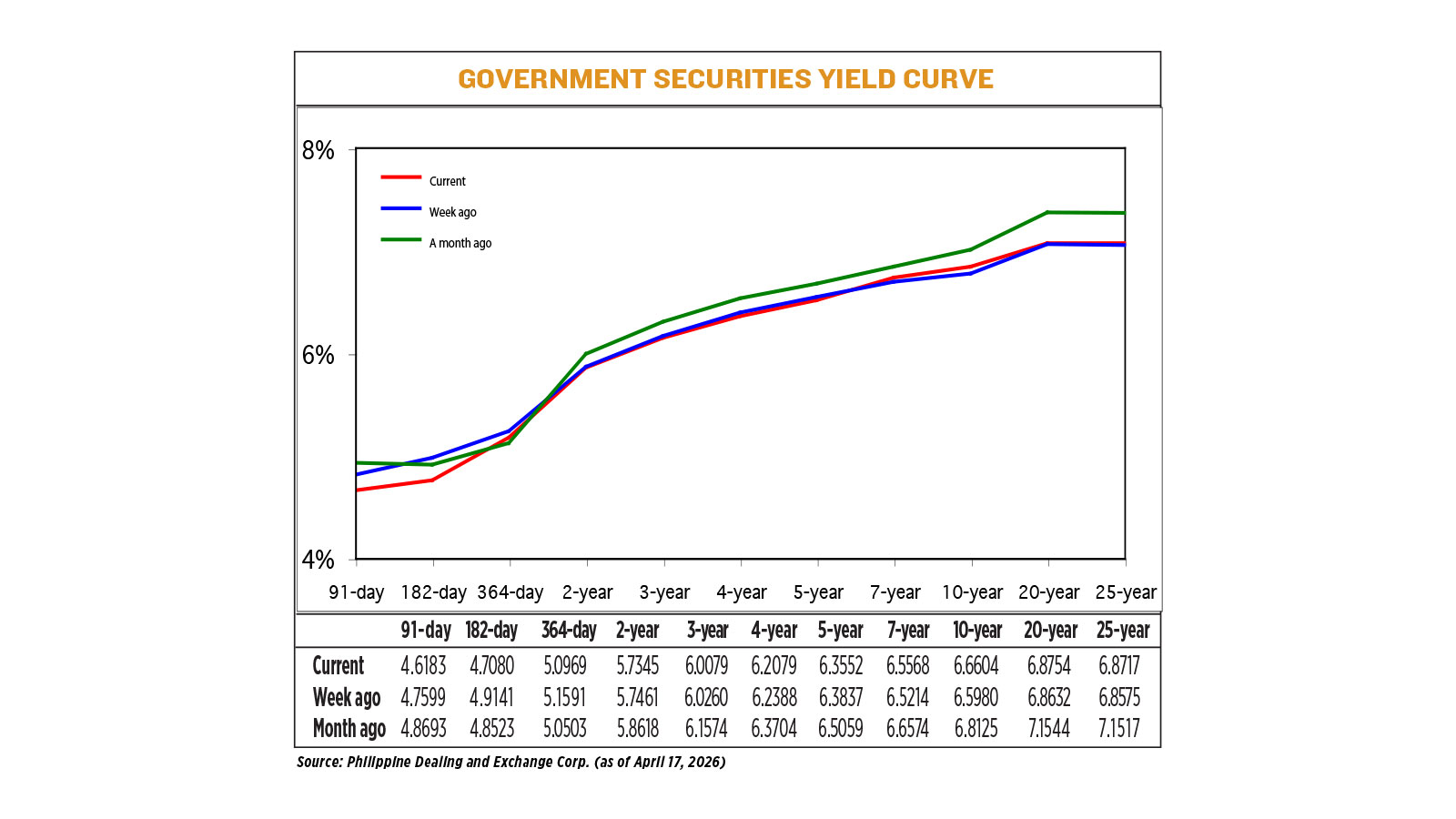
YIELDS on government securities (GS) closed mostly lower last week as traders stayed cautious over developments in the Middle East conflict while pricing in a potential rate hike from the Bangko Sentral ng Pilipinas (BSP) as early as Thursday.
GS yields, which move opposite to prices, went down by an average of 3.41 basis points (bps) week on week, according to PHP Bloomberg Valuation Reference Rates data as of April 17 published on the Philippine Dealing System’s website.
At the short end, yields fell across all tenors. Rates of the 91-, 182, and 364-day Treasury bills dropped by 14.16 bps (to 4.6183%), 20.61 bps (4.708%), and 6.22 bps (5.0969%), respectively.
Rates at the belly ended mostly lower, with the two-, three-, four-, and five-year Treasury bonds (T-bonds) dropping by 1.16 bps (to 5.7345%), 1.81 bps (6.0079%), 3.09 bps (6.2079%), and 2.85 bps (6.3552%), respectively. Meanwhile, the seven-year debt rose by 3.54 bps to yield 6.5568%.
On the other hand, the long end moved higher. Yields on the 10-, 20-, and 25-year bonds climbed by 6.24 bps (to 6.6604%), 1.79 bps (6.8754%), and 0.85 bp (6.8717%), respectively.
GS volume traded reached P42.76 billion, lower than the P68.27 billion recorded the previous week.
Traders said developments in the Middle East conflict took center stage for bond markets last week.
“Bond yields broadly declined over the week as participants welcomed the resumption of diplomatic talks between US and Iran, despite the apparent failure of the first stage of discussions from last weekend,” the first bond trader said.
“As tensions appeared to ease, risk appetite gradually returned, with the week ending with a slight upward pressure on yields,” the second bond trader added. “That said, the adjustment was likely measured rather than aggressive given that geopolitical risks remain fluid.”
Meanwhile, rate hike hints from BSP Governor Eli M. Remolona, Jr. led to “bearish” sentiment towards the end of the week, the second trader said.
“Investors responded by prioritizing short-term to belly tenors (two to five years)… in order to avoid the duration risk that came with the longer end of the yield curve. Additionally, demand for higher yields was observed on the belly to long end as [this] week’s meeting is anticipated to include a policy rate hike,” the trader said.
The first trader said that the above-target inflation print in March could push the BSP to hike benchmark interest rates this week.
“This move could help in arresting any upward spillover in inflation expectations from second-round effects, which is very critical in fulfilling the BSP’s price stability mandate.”
The Monetary Board will meet to review policy on Thursday (April 23). In a BusinessWorld poll, 11 of 19 analysts said they expect the BSP to begin tightening to stave off second-order inflation impact from the global oil price shock.
Mr. Remolona told BusinessWorld on the sidelines of the International Monetary Fund and World Bank’s 2026 Spring Meetings in Washington, D.C. last week that the central bank has room to raise rates to temper rising inflation amid the Middle East conflict as they expect government spending to support growth.
The Monetary Board last raised rates in October 2023. Its policy rate now stands at 4.25% following 225 basis points worth of cuts since it began its easing cycle in August 2024.
In an off-cycle meeting last month, it left benchmark interest rates unchanged, but said that they remain vigilant about potential price risks amid the war.
For this week, the traders said that besides the Middle East war, the BSP’s policy meeting will be one of the main trading drivers for the market.
“Yields might remain sideways as the market participants will likely remain on watch ahead of the BSP meeting. Nevertheless, traders are expected to look for policy cues about the assessed inflationary path by the BSP that could hint at its future monetary actions,” the first bond trader said. “Any positive progress on the diplomatic talks between US and Iran could likewise pull yields lower.”
“Local yields are likely to exhibit upward-biased movement due to policy rate hike expectations in [this] week’s Monetary Board meeting,” the second trader added. “Investors would likely remain cautious, waiting for concrete progress in peace negotiations and broader macroeconomic stability before materially reducing bond exposure, especially since both negotiating parties have been going back and forth for so long.” — M.M.L. Castillo