Philippines’ March trade gap widest in 6 months
By Heather Caitlin P. Mañago, Researcher
THE PHILIPPINES’ trade deficit in goods widened slightly in March as a record-high import bill driven by rising global energy prices offset the fastest export growth since late last year, the Philippine Statistics Authority (PSA) reported on Thursday.
Preliminary data from the PSA showed the country’s trade-in-goods balance — the difference between exports and imports — stood at a deficit of $4.512 billion in March, widening by 0.1% from the $4.509-billion deficit in March last year.
Month on month, the trade gap ballooned from the revised $4.015 billion in February.
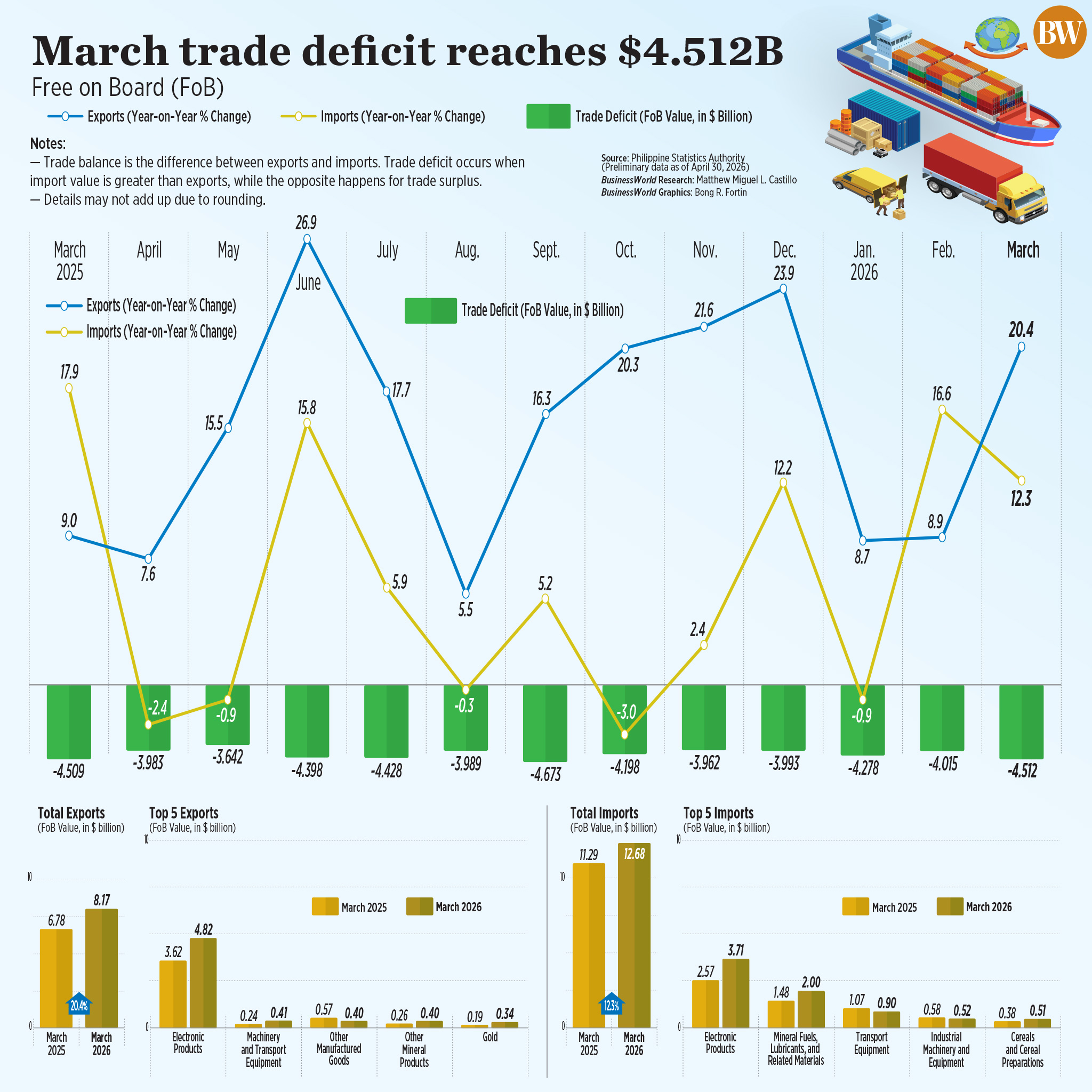
March saw the widest trade deficit in six months or since the $4.673-billion gap in September 2025.
Merchandise imports climbed by 12.3% year on year in March, slowing from the 17.9% expansion a year ago and the 16.6% growth in February. The import bill reached its highest since 1991 to $12.68 billion in March.
On the other hand, total outbound sales of Philippine-made goods increased by 20.4% year on year in March to $8.17 billion, faster than the 9% expansion in March 2025 and 8.9% gain in February.
PSA said the value of export sales in March was the highest recorded since the series began in 1991.
March also saw the fastest export growth in three months or since the 23.9% growth in December 2025.
“The slight widening of the trade-in-goods deficit in March was largely import-driven rather than a sign of export weakness,” Ruben Carlo O. Asuncion, chief economist at Union Bank of the Philippines, said in a Viber message.
Mr. Asuncion said the growth in imports was driven by stronger demand for global electronics, elevated fuel and shipping costs, and normalized inventories as global financial conditions and supply chains improved.
For the first quarter, the trade-in-goods deficit widened to $12.81 billion from the $12.46-billion gap in the January-March period last year.
Exports expanded by 12.7% to $22.7 billion in the first three months of 2026, while imports rose by 8.9% to $35.5 billion.
George T. Barcelon, chairman of the Philippine Chamber of Commerce and Industry, said the trade deficit likely reflected firms replenishing inventories after typically running stocks low in the previous quarter.
“Because normally they’re low in inventory for December and for the last quarter, they’ll bring it up in the first quarter,” Mr. Barcelon said in a phone interview.
The Development Budget Coordination Committee projects both imports and exports to grow by 2% this year.
RENEWED DEMAND FOR IMPORTS
PSA data showed imports of raw materials and intermediate goods in March grew by 11.7% to $4.6 billion. These accounted for 36.3% of the total March import bill.
During the month, imports of capital goods rose by 16.6% to $3.83 billion.
“(The) broad uptrend (in imports of capital goods) remains intact, likely reflecting the re-awakening of public-sector capex from the late-2025 lull caused by the anti-corruption drive,” Miguel Chanco, chief emerging Asia economist at Pantheon Macroeconomics, said in a research note.
“The total import print for March was salvaged unsurprisingly by helpful commodity price effects,” he added.
Imports of mineral fuels, lubricants and related materials jumped by 35.1% year on year to $2 billion.
Chinabank Research said in a note that purchases of mineral fuels surged, “largely due to price effects amid soaring global oil prices despite a drop in import volume.”
The imports of consumer goods fell by 7.6% to $2.19 billion in March, which Chinabank said is a sign of weakening consumer sentiment as high oil prices hit households’ budgets.
China was the top source of imported goods with a 27.6% share worth $3.5 billion. South Korea followed with an 11.3% share ($1.43 billion), Japan with 8.4% ($1.07 billion), Indonesia with 7.1% ($900.73 million), and the United States with 6.3% ($804.23 million).
AI-RELATED DEMAND FOR CHIPS
Electronic products, which cornered more than 70% of manufactured goods and more than half of March’s total exports, expanded by 33% year on year to $4.82 billion.
Semiconductors, which accounted for the bulk of electronic products and more than 40% of total exports, climbed by 38.2% to $3.7 billion in March.
“March’s export performance demonstrates that the government’s drive towards higher value products in high-performing industries like electronics while expanding market opportunities with targeted and strategic trade and investment promotion initiatives are helping exporters adapt to evolving global conditions and translating to export gains,” Trade and Industry Secretary Ma. Cristina A. Roque said in a statement.
For his part, Mr. Asuncion said the export performance was bolstered by the “gradual upturn in global demand for semiconductors and electronic components, particularly from advanced economies and key Asian markets.”
Chinabank Research noted that strong artificial intelligence (AI)-related demand could further support the local chip industry, but higher delivery costs have already pushed some local exporters to cancel some orders.
Chinabank Research also noted that exports of mineral products surged by 40.2%, led by gold and nickel. “In contrast, agricultural exports declined due to weaker coconut shipments. Looking ahead, limited fertilizer supply and the possible emergence of El Niño could weigh on agricultural output and export performance,” it said.
The United States was the main destination of locally made goods in March as exports to the country reached $1.4 billion, accounting for 17.1% of all outbound goods.
It was followed by Hong Kong with $1.3 billion (15.9% share), Japan with $962.41 million (11.8% share), China with $956.77 million (11.7% share), and Taiwan with $393.14 million (4.8% share).
DEFICIT TO WIDEN FURTHER
Meanwhile, Mr. Asuncion said the March trade figures will be broadly supportive of first-quarter economic growth.
“While net exports will likely remain a drag on headline GDP (gross domestic product) due to the trade deficit, the strong growth in exports points to a solid contribution from manufacturing and external demand,” he said.
He added that higher imports of capital goods and inputs suggest “healthy investment and production activity.”
The PSA will release the first-quarter 2026 GDP data on Thursday, May 7.
However, the outlook remains clouded by geopolitical risks.
“We’re not in a recession, but we could gradually be heading there if global geopolitical tensions remain unresolved,” Mr. Barcelon said.
Crude oil prices remain elevated amid concerns over a prolonged Middle East conflict.
“With no clear resolution to the Middle East conflict in sight, rising crude oil prices are likely to continue pushing up the country’s import bill in the near term, widening the trade deficit. This, however, reflects mainly price effects, as import volumes will continue to decline,” Chinabank Research said.
Chinabank Research said a ballooning trade gap could also put additional depreciation pressure on the peso.
“The trade deficit is likely to persist in the near term, reflecting the country’s import-intensive growth structure. From a macro perspective, this is manageable as long as the deficit is driven by productive investments and export-related inputs, which appears to be the case so far,” Mr. Asuncion said.