

Home Blog Page 9967

BSP, Bank Indonesia may test cross-border retail payment linkages

THE BANGKO SENTRAL ng Pilipinas (BSP) and Bank Indonesia (BI) may consider going into a joint regulatory sandbox to test cross-border retail payment linkages following the central banks’ recently signed memorandum of understanding (MoU), according to BSP Governor Benjamin E. Diokno.

“The BSP and BI have yet to consider specific projects under the MoU,” Mr. Diokno said in an e-mailed response to BusinessWorld on Tuesday.

“However, moving forward, the agreement may be expected to facilitate initiatives between the two central banks to ease information exchange on payment systems and financial innovation, promote participation in a joint regulatory sandbox testing or establish of cross-border retail payment linkages, and introduce fintech (financial technology) businesses to each other’s jurisdictions, among others.”

The two central banks inked an MoU on Feb. 1 with the intent to create a framework of closer cooperation to help attain a “more secure, efficient and reliable payment system, and to promote digital financial innovation.

The pact came after a bilateral meeting between BSP and BI which tackled advances done in the digital economy, central banking, infrastructure financing using market instruments, and sustainable financing frameworks done by both sides.

Meanwhile, BSP Deputy Governor Chuchi G. Fonacier said the BI highlighted the Indonesia Payment System (IPS) Blueprint 2025, which is a framework they have adopted in response to the digital transformation occurring in their national payment system.

“The blueprint includes open banking standards, retail payment system, market infrastructure, data management, and regulatory, licensing and supervisory framework,” Ms. Fonacier said in an e-mailed response.

In August 2019, Bank Indonesia launched its QR Code Indonesian Standard as part of the blueprint.

“Ultimately, the IPS Blueprint 2025 should challenge the BSP and Philippine banks to continue improving synergies, embracing transformation, and supporting innovation, as these were key lessons that formed the BI’s policy action,” Ms. Fonacier said.

For its part, the BSP launched the National Retail Payments System in 2015 where electronic fund transfer schemes like the PESONet and InstaPay are part of.

So far, the volume of e-payments in the country have risen to comprise 10% of total transactions in 2018 from a mere 1% in 2013, according to a study by United Nations-based Better than Cash Alliance. — Luz Wendy T. Noble

Taking a break from the usual

CONTEMPORARY artist Gig de Pio, Sr. departs from his usual portraits and revisits abstracts in Rustan’s For the Arts’ first exhibition this year.

Born in Cebu in 1951, Mr. De Pio is best known for his portraits. He holds a degree in Fine Arts from the University of the Philippines College of Fine Arts in Diliman where he was a Jose Joya scholar and later served as a professor. In 2011, Mr. De Pio received the Araw ng Manila award from former Manila City mayor Alfredo Lim.

“[This collection] is a break (from portraiture),” Mr. De Pio told BusinessWorld at the exhibition launch on Jan. 30.

“In high school, I saw an exhibit by [National Artist for Visual Arts] Jose Joya in our province in Cebu. Abstraction blew my mind. Ever since, I really wanted to do that,” he added.

In this collection, 20 paintings reflect the artist’s view of the world through the Theory of Entropy.

“One accident is just an accident. Another accident overlaps it, and there is an event. The third one is that there is a personality that is created,” Mr. De Pio explained. “You can see that in my work.”

The canvases come in various shapes that use warm earth colors.

“Not like some abstractions where elements just crisscross, it is the inside where they meet which is my subject,” he said.

The Rustan’s For The Arts series has previously featured collections by Filipino artists such as National Artists Benedicto “BenCab” Cabrera, Fernando Amorsolo, Arturo Luz, and Anita Magsaysay-Ho.

The collection is on view at Rustan’s Makati until March 31 and will move to Rustan’s Shangri-La in April. — Michelle Anne P. Soliman

RBA keeps rate at record low

SYDNEY — Australia’s central bank held its cash rate at record lows at its first meeting of the year on Tuesday and sounded doggedly optimistic even as markets bet devastating bushfires at home and a viral epidemic in China would force aggressive easing.

The Reserve Bank of Australia (RBA), which slashed its key rate three times last year to 0.75% to help achieve its employment and inflation goals, kept forecasts for economic growth intact for this year and next at 2.75% and 3% respectively.

The outlook was supported by “the low level of interest rates, recent tax refunds, ongoing spending on infrastructure, a brighter outlook for the resources sector and, later this year, an expected recovery in residential construction,” RBA Governor Philip Lowe said in a short post-meeting statement.

The upbeat statement sent the local dollar up by 40 pips to $0.6720 from $0.6680 before the rate review.

A majority of 32 analysts polled by Reuters last week had expected the Reserve Bank of Australia to keep its benchmark rate at 0.75%.

Economists now expect a cut to 0.5% in April though financial futures are pricing in the possibility of the cash rate dropping as low as 0.25% later this year, with the economic outlook clouded by bushfires and the rapidly spreading coronavirus.

Mr. Lowe did acknowledge that the two events would “temporarily weigh on domestic growth” while reiterating that an extended period of low interest rates will be needed in Australia.

Analysts at National Australia Bank estimate travel bans introduced by the government could shave 0.15 percentage points off first-quarter gross domestic product growth, in addition to the temporary hit from the bushfires.

China is Australia’s largest trading partner while Chinese tourism and students account for about 0.9% of the nation’s A$2- trillion annual economic output. — Reuters

NGCP denies employing foreigners in key posts

PRIVATELY owned National Grid Corporation of the Philippines (NGCP) on Tuesday denied that it employs foreigners in executive and management positions.

NGCP President Anthony L. Almeda said the corporate acts of the company comply with the Constitution and other laws.

He issued the statement after lawmakers in a Senate hearing on Monday called out the country’s power grid operator for allegedly employing Chinese nationals in executive and management positions. They were referring to Wen Bo and Liu Zhiaoquiang.

“Messrs. Bo and Liu left the country in 2018 and 2015, respectively. They held technical positions in the company,” he said in a statement.

He also said any audit of NGCP should be conducted by the proper regulatory agency, citing the Energy Regulatory Commission as the independent body tasked by law and recognized by the concession agreement.

Mr. Almeda said the company has only four directors from the State Grid Corporation of China who do not perform executive or management functions.

The company said it had always been diligent in implementing its board and management directives, and that it does so “with utmost regard for the law, and other rules and regulations.”

US eyes duties due to currency undervaluation

WASHINGTON — The US Commerce department on Monday finalized a new rule to impose anti-subsidy duties on products from countries that it has determined undervalue their currencies against the dollar, including potentially China.

The move could provide a fresh irritant in US-China trade talks just weeks after the world’s two largest economies signed a Phase 1 trade agreement, and comes a day after Beijing accused Washington of spreading fear about the fast-spreading coronavirus that originated in China.

In theory, the new rule would allow the Commerce department to impose duties on China, even though the US Treasury department recently removed its designation of China as a currency manipulator as part of the Phase 1 trade deal.

Commerce said it would generally rely on the Treasury’s expertise in determining undervaluation, but the two processes could come to different conclusions since they resulted from different statutes. The draft rule was first published in May.

It said it would only impose countervailing duties on imports of specific products that both benefit from countervailable subsidies and are found by the US International Trade Commission to injure US industries.

The rule would not result in the application of such duties to all imports from a given country, because not all such imports injure US industries, it said.

Commerce said the new rule was a measured response to longstanding, bipartisan calls to use existing laws to address unfair foreign currency practices, and was part of a broad push by the Trump administration to crack down on trade imbalances.

“The Trump Administration is doing the right thing by confronting the problem head-on,” it said in a statement.

US Commerce Secretary Wilbur Ross said the new rule marked another important step intended to “level the playing field for American businesses and workers.”

Mark Sobel, a former senior US Treasury official and adviser to the London-based OMFIF economy policy think tank, said the new rule failed to address many of the concerns raised after the draft rules were published in May, and would likely be inconsistent with World Trade Organization rules.

“There is no precise way to measure currency undervaluation,” he said, adding that Commerce had no responsibility or expertise in international monetary and currency matters. “This is a unilateral policy which will alienate countries around the world.”

The Commerce department said it would not normally include monetary and related credit policy in determining whether a government had acted to reduce the exchange rate of its currency to bolster its domestic industry.

In addition to China, the new rule also could put goods from other countries at risk of higher tariffs, including Germany, Ireland, Italy, Japan, Malaysia, Singapore, South Korea, Vietnam and Switzerland.

Those countries were all on the “monitoring list” included in the Treasury department’s semi-annual currency report, which tracks currency market interventions, high global current account surpluses and high bilateral trade surpluses.

The department said its proposed rule would amend the normal countervailing duty process to include new criteria for currency undervaluation, including a finding of government action on the country’s exchange rate. — Reuters

Matilda international tour comes to Manila

THE STORY of a young girl named Matilda has told on the pages of books since 1988, on the big screen in 1996, and onstage since 2010. This year, the musical (that uses over 100 tubs of chocolate every year) comes to Manila — its 63rd city — at the Theater at Solaire beginning March 5.

Matilda the Musical has won over 85 international awards including the 2012 Olivier Award for Best Musical and a joint Best Actress award for the four young actresses who played the lead role.

Commissioned by the Royal Shakespeare Company, the musical is based on the beloved book by Roald Dahl.

Matilda the Musical (with the book by Dennis Kelly and original songs by Tim Minchin) follows the five-year-old Matilda — who is gifted with telekinesis — in overcoming struggles in her family and in school.

Thanks to audience feedback, Global Marketing Group (GMG) Productions is bringing the international production to Manila.

“It’s a title that has always scored very highly in surveys, and just the general chatter online between our theater fans in the community here. Everyone says, ‘We love Matilda. We like to see Matilda.’ So, of course, we react to that kind of response,” Robert Sewell, founder of ticketing portal TicketWorld and GMG producer, told BusinessWorld at a Matilda-themed tea party on Jan. 27 at the Diamond Hotel Philippines in Manila City.

“We always talk to everyone involved in the theater and they’ll give us their ideas, and we also do online surveys,” added Carlos Candal, owner and CEO of GMG.

“We get a very big social media following in GMG productions. People are always giving us feedback. [We also consider] the biggest shows that are going on globally — those are the ones that we want to bring in here,” he said.

The musical is directed by Tony Award winner Matthew Warchus, with sets and costumes by Tony Award winner Rob Howell, choreography by Peter Darling, orchestration, additional music and musical supervision by Christopher Nightingale, lighting design by Tony Award winner Hugh Vanstone, and sound design by Simon Baker.

Alternating as Matilda in the travelling production are Zara Yazbek Polito, Sofia Poston, and Zoe Modlinne. Haley Flaherty takes on the role of Miss Honey, while Hayden Tee will be playing Miss Trunchbull. Joining them are Stephen Jubber who takes on the role of Mr. Wormwood, Claire Taylor as Mrs. Wormwood, and Nompumelelo Mayiyane as Mrs. Phelps.

“The script is the same. You’ll find that the sets of the tour will be more elaborate, and you have a touring production that has worked together for years and years,” Mr. Sewell said of the international production.

The musical was staged in Manila by Atlantis Theatrical Entertainment Group in 2017.

“People go and watch the show for a number of reasons: they want to go and see if it’s the same as the book, [and the] same as the movie. But what we want them to take away is a fabulous theater experience. So, when we put another show on, they’re gonna think about how good it was for Matilda, and certainly will come [again] and see another,” Mr. Sewell said.

There will be special prices on selected show dates. On March 10, 8 p.m., the price across all orchestra seats will be P3,800, while the price across all balcony seats will be P1,800. On March 17, 8 p.m., and March 22, 6 p.m., all orchestra seats will be P4,000 and all balcony seats will go for P2,000. A matinee performance has been added on March 18, 2 p.m., with all tickets are sold at P2,200. For more ticket information, visit TicketWorld. — Michelle Anne P. Soliman

Consunji firm denies link to massive Pandacan fire

D.M. Consunji, Inc. said the massive fire that happened on Saturday in Pandacan, Manila did not originate from its construction yard.

“Videos taken by various netizens clearly show that the fire started outside our work area,” it said in a statement on Tuesday.

“In addition, according to the Bureau of Fire Protection, the fire broke out at around 10:38 a.m. or more than 30 minutes before the warehouse inside our construction yard caught fire at around 11:15 a.m.,” it added

But it said it would cooperate with any investigation to determine the real cause of the fire.

The company made the statement after news reports citing an initial investigation said the fire was a freak accident that could have likely started from its construction yard and spread to a nearby plastics warehouse that was moving out.

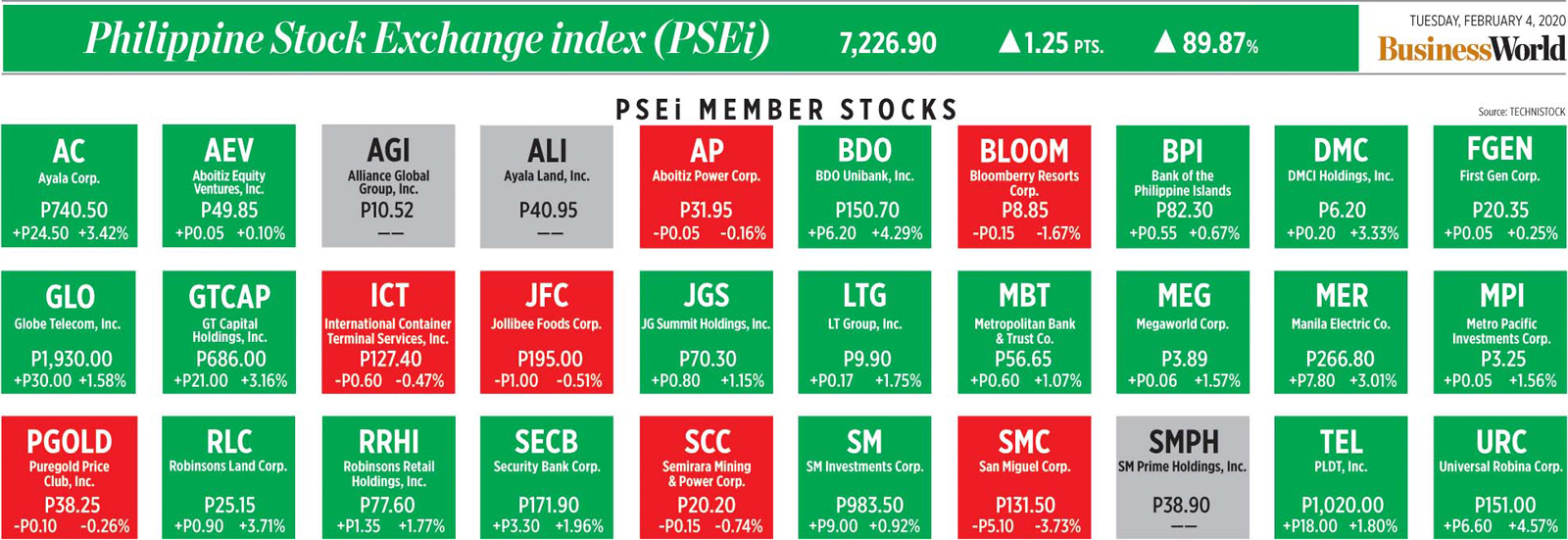
How PSEi member stocks performed — February 4, 2020

Here’s a quick glance at how PSEi stocks fared on Tuesday, February 4, 2020.


Imports of vaping products awaiting Customs order — DoF

IMPORTS of vaping products could continue once the Bureau of Customs (BoC) issues a memorandum outlining the proper procedures, the Deparment of Finance (DoF) said.

Finance Secretary Carlos G. Dominguez III said the shipments could be enabled by a Customs memorandum order (CMO) after a court issued a restraining order on regulations imposed by the Food and Drug Administration (FDA).

“The BoC issued a CMO after PRRD’s (President Rodrigo R. Duterte’s) pronouncements, which by the way, did not mention anything about imports. Then the FDA issued a regulation saying that no importation is allowed without FDA approval. This FDA issuance is now under TRO (temporary restraining order). Subsequently, PRRD signed the alcohol and e-cigarette act into law,” he said.

“Now, the BoC just has to issue a new CMO so importation can proceed and we can collect tax pursuant to the new law which took effect on the 27th,” Mr. Dominguez told reporters Monday in a Viber message.

Mr. Dominguez issued the statement in response to a query by an e-cigarette company, Juul Labs, Inc. Philippines, seeking clarification on the status of the ban on imported vapor products after the law was signed last week.

In a letter to Mr. Dominguez, Juul Labs noted that the newly signed law, Republic Act No. 11346, which took effect on Jan. 1, “legitimizes vapor products in the Philippines.”

Juul said it has experienced delays in importing vapor products after Mr. Duterte’s verbal order in November to block inbound shipments and ban their use in public areas.

Mr. Duterte signed a separate law, R.A. 11467, on Jan. 22, which amend the tax code to increase the excise taxes on alcohol products and e-cigarettes, including vapor products, while limiting their sale to those at least 21 years old.

The measure also prohibits the manufacture, import, sale, distribution and advertising of flavorings for the vapor products.

In an earlier statement, Juul said it will also stop producing and selling flavored vapor products in the Philippines in compliance with the law.

Under the law, vapor products with salt nicotine will be imposed an excise tax of P37 per milliliter this year, gradually increasing until it reaches P52 in 2023. Vapor products with conventional nicotine will be taxed at P45 per 10 milliliters in 2020, increasing by P5 annually until the tax reaches P60 in 2023.

The rates will be increased by 5% every year starting Jan. 1, 2024. — Beatrice M. Laforga

House, DBM plan measures to speed up budget approval

THE House of Representatives and the Department of Budget and Management (DBM) are working out procedures that will speed up the approval of the national budget and ensure no provisions are vetoed, Speaker Alan Peter S. Cayetano said.

“That is what we want to do and that is what Budget Secretary (Wendel E.) Avisado wants to do — even before the President submits the budget to Congress, there is consultation with the proper committees of both the House and the Senate, instead of them preparing it and the House revising it and the Senate doing its own revision,” he said in a statement Tuesday.

Mr. Cayetano said the process of preparing the appropriations bill will be smoother and faster “if we can do the budget together.”

To speed up the budget passage, the House and the DBM plan to “obviate” the possibility of the President vetoing or rejecting certain appropriations in the Congress-approved spending bill.

Meanwhile, Majority Leader and Leyte Rep. Ferdinand Martin G. Romualdez said that the planned prior consultation with Congress in the preparation of the national budget is “consistent with the constitutional mandate that the power of the purse lies with the legislature.”

“It will hasten consideration of the President’s budget proposal not only in the House Committee on Appropriations but in Plenary as well,” he said.

In April, President Rodrigo R. Duterte signed the 2019 General Appropriations Act (GAA) after vetoing P95 billion worth of alleged insertions.

Disputes between the House and the Senate over the insertions delayed the signing of the budget. The delay resulted in an economic slowdown in the first two quarters before the economy recovered in the latter part of the year.

The government targeted 6% to 6.5% economic growth in 2019, but the average settled at 5.9%.

Before the year ended, both chambers approved the 2020 national budget to avoid another delay and maintain the economy’s recovery.

The President signed the 2020 GAA on Jan. 6 without vetoing any items.

Mr. Romualdez said that the speed with which the 2020 budget was approved is “unprecedented,” adding that the House leadership only needed 20 working days to “finish the job in approving a pork-free and bereft of any illegal parking of funds and insertions.”

“Our focus right now is to work hard in legislation and pass all the measures needed to improve the living condition of our people. That is the marching order from the President,” he said. — Genshen L. Espedido

Miners face funding squeeze as green investing surges

CAPE TOWN — As global investors shift away from heavy industry in favor of cleaner sectors, mining companies are losing billions in financing, raising the cost of capital and jeopardizing projects.

Making the mining industry more sustainable by running mines on renewable energy, for example, will be a key focus at the annual Investing in African Mining Indaba conference in Cape Town this week, as companies hunt for new sources of capital including private equity, debt, offtake finance and royalty finance.

Environmental, social & governance (ESG) concerns have driven money into specialized ESG funds which often exclude mining stocks among other ‘dirty’ assets. “You talk to anyone at the moment, they say there’s no money,” said Boris Kamstra, executive director of Alphamin Resources, which manages the Bisie tin project in Democratic Republic of Congo.

The capital squeeze that started about two years ago has worsened recently, said Julian Treger, CEO of Anglo Pacific Group, a mining royalty and streaming company. The average cost of capital for early-stage mining projects rose by two percentage points over the past two years, he estimates.

“Even for companies that have good projects it’s very difficult for them to raise any money in these markets,” said Caroline Donally, managing director at private equity firm Denham Capital, in Houston.

“Previous investors who would provide equity appear to have withdrawn. A number of specialist funds have shut up shop, and generalists aren’t investing in commodities anymore,” said Donally, who will be attending Mining Indaba, the world’s biggest mining investment conference, which takes place Feb. 3-6.

Cannabis stocks and cryptocurrencies are among alternative assets that are luring retail investors away from miners. Mining-specific private equity funds raised $0.3 billion in 2019, a fifth of the amount raised in 2009, and just barely more than the $0.2 billion raised in 2014 during a global commodity crash, data from Preqin shows.

COAL PROJECTS FLOUNDER
Coal miners — especially those extracting thermal coal, burnt to produce electricity — are bearing the brunt of the sustainable investing trend.

Norway’s sovereign wealth fund divested from all fossil fuel last year, and the world’s biggest asset manager Blackrock said on Jan. 14 it would sell active holdings in companies generating more than 25% of revenues from thermal coal.

“If you’re a small coal explorer, I don’t think you stand much of a chance of raising any money at all,” said Fred White, associate director at Medea Capital Partners in London.

“There’s still a huge market and huge demand [for coal], but it’s not getting financed by Western banks,” he added. Local trading houses and lenders are stepping in instead.

Thermal coal accounts for nearly 40% of the world’s electricity generation and more than 40% of energy-related carbon dioxide emissions, according to the International Energy Agency.

In Africa, where access to electricity is still a problem, coal-to-power projects could previously rely on support from development finance institutions.

But even they are withdrawing under pressure.

In November, the African Development Bank (AfDB) decided against funding a Kenya coal project that was halted by a local environmental tribunal in June.

The continent’s biggest coal producer, South Africa, is also seeing funding dry up. South Africa’s Nedbank has stopped funding coal-related projects, while FirstRand cut greenfield thermal coal projects to less than 0.5% of its lending. — Reuters

Senate pushes for renewed oversight over intelligence funds

A RESOLUTION seeking to reactivate the oversight panel on the use and disbursement of intelligence and confidential funds has been filed in the Senate.

Senate President Vicente C. Sotto III and Senator Panfilo M. Lacson, under Senate Resolution No. 310, proposed to convene the Select Oversight Committee on Intelligence and Confidential Funds, Programs and Activities.

Mr. Sotto and Mr. Lacson, who chairs the Senate Committee on National Defense and Security, Peace, Unification and Reconciliation, intended to improve intelligence operations of government agencies tasked to protect national security.

There is a need to create the oversight committee to “enable the Senate to oversee the efficiency of concerned government institutions in the production of accurate and timely intelligence information,” the Resolution read in part.

This is expected to aid in improving government responses to threats to national security.

Previous legislatures as far back as the 10th Congress had Select Oversight Committees.

The Select Oversight Committee, as proposed, will be led by Mr. Lacson, as chair of the National Defense Panel, and include four members from the majority bloc and two from the minority bloc.

It was also provided that the Committee should lead the probe into the efficiency of government agencies in using intelligence and confidential funds. The government, under the 2020 General Appropriations Act, appropriated P9.601 billion for intelligence and confidential funds.

The Committee is also tasked to conduct hearings, investigations, receive testimonies and reports relevant to this issue and recommend legislative measures.

It is also allowed to summon key sources and documents as well as require department secretaries and other government officials to keep the Committee updated on intelligence activities. — Charmaine A. Tadalan