Home Blog Page 9961

Xiaomi launches phone with 64MP camera

XIAOMI Corp. has launched two new smartphone models, the Redmi Note 8 and the Redmi Note 8 Pro in the country, as it aims to boost its overall market share in the Philippines.

“We are growing very fast; and within one year, we became the number one online. In Lazada, we are the number one in terms of the mobile category share. With the new models, we should still be the number one, I am confident,” Xiaomi Philippines country manager Mark Li told BusinessWorld in an interview last Friday.

“We expect more market share and definitely it will happen. Also, my goal here is to bring in more innovation products to our Mi fans. In terms of market share, I think it will naturally go up especially next year,” Mr. Li added.

The Redmi Note 8 Pro is the “first-ever” ultra-high resolution 64-megapixel (MP) quad-camera smartphone in the Philippines, the company said. Photos captured through this device can be printed up to 3.26 meters tall.

“Equipped with a large 6.53” Full High Definition (FHD)+ Dot Drop display and rear fingerprint sensor, the device achieves a 91.4% screen-to-body ratio,” the company said in a statement.

“The device is powered by the MediaTek Helio G90T processor, an octa-core CPU clocked up to 2.05Ghz for extended everyday use,” it added.

The Redmi Note 8 Pro also features LiquidCool technology to prevent it from overheating, especially when used for gaming and photography. Its price starts at P11,490 for the 6GB RAM and 64GB storage version up to P12,990 for the 6GB+128GB version. The model comes in Forest Green, Mineral Gray and Pearl White.

Meanwhile, the Redmi Note 8 comes with a 48MP primary camera and a panorama selfie feature that can capture group images.

The device, which runs on Qualcomm Snapdragon 665 chipset, is equipped with a 6.3-inch Dot Drop Display with 2.5D rounded rear glass design. This model achieves a 90% screen-to-body ratio.

The Redmi Note 8, which comes in Space Black, Neptune Blue and Moonlight White, is available in 4GB+64GB for P8,990, in 4GB+128GB for P9,990 and in 3GB+32GB for P7,990.

“As we move into the new era of smartphone photography, Xiaomi pioneers the 64MP quad-camera smartphone in the Philippines with Redmi Note 8 Pro, and offers one of the best bang-for-buck quad-camera phones in the market with Redmi Note 8. These devices strengthen the company’s commitment to provide amazing products at honest prices,” Steven Shi, Xiaomi’s head of Southeast Asia, was quoted as saying in the statement.

Xiaomi, which was founded in 2010, was listed on the Main Board of the Hong Kong Stock Exchange in 2018. Its products are present in more than 80 markets around the world. — Arjay L. Balinbin

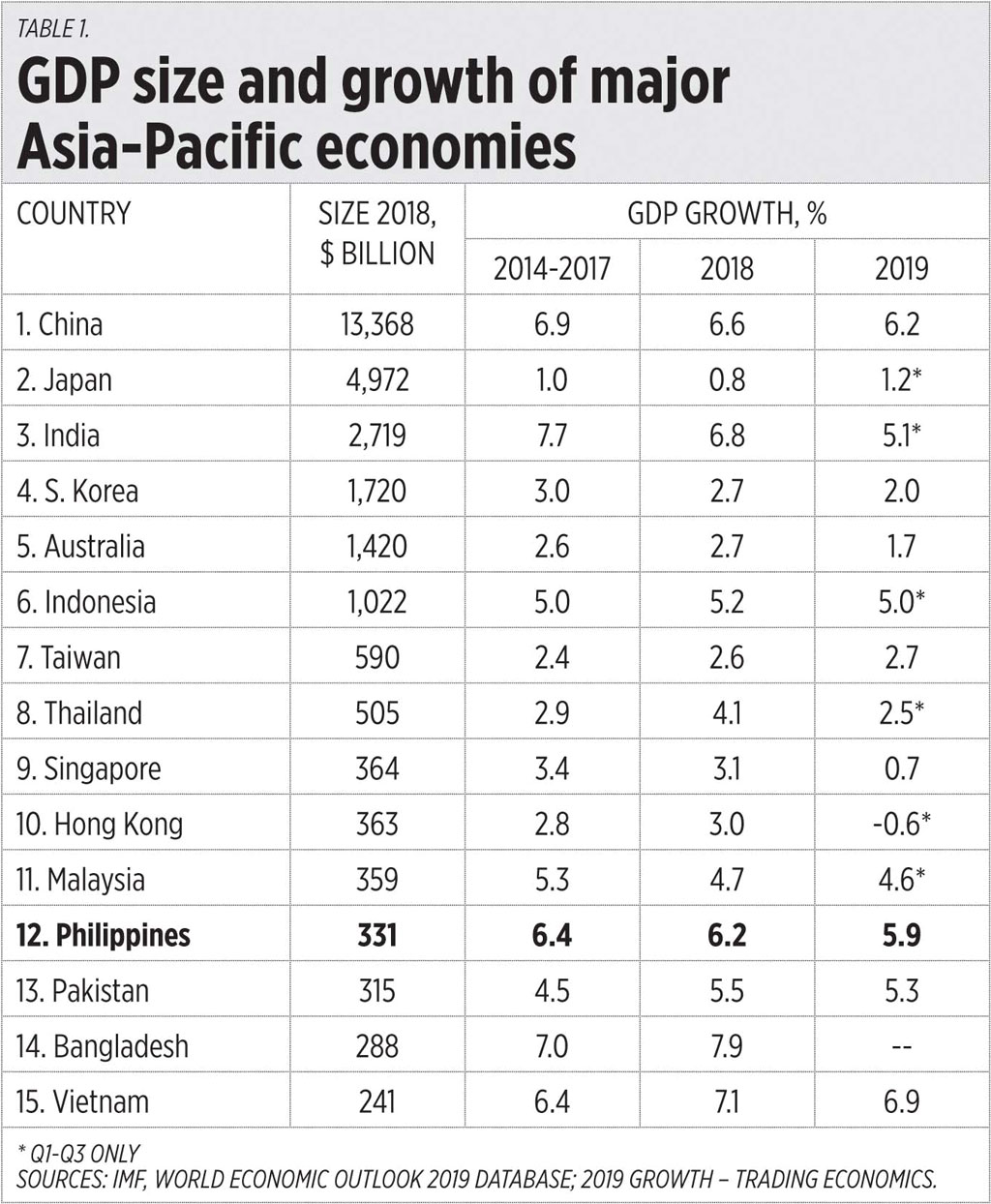
IMF slashes growth forecasts as headwinds blow

IMF slashes growth forecasts as headwinds blow

How PSEi member stocks performed — October 16, 2019

Here’s a quick glance at how PSEi stocks fared on Wednesday, October 16, 2019.


‘No excuses’ for not completing 2020 budget, Cayetano says

SPEAKER Alan Peter S. Cayetano said Wednesday that the House of Representatives hopes to move forward on the 2020 budget, revenue bills, and other legislation covering the government’s socio-economic programs when Congressional sessions resume in November.

When it meets again on Nov. 4, Mr. Cayetano said the chamber will work on fine-tuning the P4.1-trillion 2020 budget.

“One is the budget, kasi whether you talk about agriculture, health, infrastructure, education, babagsak sa budget. Wala tayong excuse, we had all the time to discuss the budget. May isang buwan na during the break na nire-review pa natin at nagpe-prepare tayo sa bicam (the budget affects everything that has to do with agriculture, health, infrastructure, education. There are no excuses for any delays because we had all this time to review. We’ve had a month to prepare for when the budget is tackled in bicameral session),” Mr. Cayetano said in chance remarks to reporters at New Clark City.

He added, “We are very close to the Senators, we are very close to the Secretaries, continued yung interaction natin. (We are in continued interaction with the Senators and the Cabinet) So, walang excuse para hindi maging 2020 budget (There is no excuse for not completing the 2020 budget).”

The House approved the budget bill on third reading on Sept. 20.

Mr. Cayetano also said the various revenue bills will be also discussed before the year ends.

Madaling magsabi ng pera para dito pero saan mo kukunin yung pera? Tatandaan natin from B rating, kung magiging A tayo, napakalaking bagay nito sa ating bansa (It’s easy to support funding for various programs but the question is where the funds will come from) he said, noting that funds must be generated in the context of the Philippines’ progress up the credit-rating ladder from B to A, which if achieved, “will be a big thing for the country.”

The House has approved on third reading House Bill No. 1026 imposing additional excise taxes on alcohol, tobacco, and vape products; HB 300 or the amendments to the Foreign Investment Act of 199; HB 304 or the Passive Income and Financial Intermediary Taxation Act (PIFITA); HB 4157 or the Corporate Income Tax and Incentive Rationalization Act (CITIRA), which was formerly known as the TRABAHO bill.

Other legislation will cover the social services like unconditional cash transfers for the “poorest of the poor” to supplement the current program of conditional cash transfers, which pay low-income families a set amount if they meet certain conditions, like undergoing health checks for women or keeping children in school.

Medyo malalim ang paguusap (the talks will be extensive) to come up with a program (for) the 20 poorest provinces, parati na lang silang ang poorest (which are always the same provinces). So we want to come up with 20 projects for the 20 poorest provinces,” Mr. Cayetano said. — Vince Angelo C. Ferreras

Filipino-Chinese chamber declares support for CITIRA

THE MAIN association of Filipino-Chinese businesses said it expects reduced corporate tax rates to attract more foreign investment and encourage firms to expand their operations, and declared its support for pending legislation that will reduce such rates while rationalizing tax incentives.

The Federation of Filipino Chinese Chambers of Commerce & Industry, Inc. (FFCCCII) said that it “supports” the passage of the proposed Comprehensive Income Tax and Incentives Rationalization Act (CITIRA) as it will “improve competitiveness” among companies and bring down Philippine tax rates to level with regional economies.

“We the FFCCCII support the passage of CITIRA. The reduction in corporate income-tax rates will improve the competitiveness of Philippine companies, and allow them to use the tax savings to expand their business or start new ventures, thus increasing creation of new jobs. This reduction of corporate income tax will also help attract more foreign direct investment,” it said in a statement.

Finance Undersecretary Karl Kendrick T. Chua has said that the Department of Finance (DoF) expects lower income taxes to encourage companies to invest their savings in business expansion, which will ultimately generate 1.5 million additional jobs.

Meanwhile, Finance Undersecretary Antonette C. Tionko said the proposal to have a longer transition period for CITIRA was among the “refinements” that can be discussed while CITIRA makes its way through Congress, but the department still backs a five-year transition period.

“That’s one of the refinements that can be discussed. Of course with consultations and everything… I told them that our position is five years,” Ms. Tionko told reporters last week when asked about the department’s position on the so-called “sunset period” for transitioning out of certain incentive programs.

The Department of Trade and Industry (DTI) has said it will support a five-to-seven year transition period for economic zone locators, as well as a seven to 10-year transition period for companies employing at least 3,000.

The House of Representatives on Sept. 13 approved its version of CITIRA, House Bill 4157, which will gradually lower corporate income tax to 20% by 2029 from the current 30%, remove tax incentives deemed redundant and make all the rest time-bound and performance-based. Its counterpart bill is now pending at the Senate.

The FFCCCII also declared its support for the “Build, Build, Build” infrastructure program as it will “interconnect” cities and provinces across the country and spur economic growth.

“To maintain and increase our global competitiveness, it’s important to keep our business-friendly policies, and have better infrastructure,” it said. — Beatrice M. Laforga

Robredo: tech adoption should address poverty

MANY Filipinos remain poor despite being eager adopters of new technology, highlighting the necessity of addressing the needs of the greater population while upgrading competitiveness, Vice-President Maria Leonor G. Robredo said at the Philippine Business Conference at The Manila Hotel Wednesday.

She said in a keynote speech that the potential of technology to put people out of work should be top of mind as the Philippines undergoes digitization in order to maintain its high-growth track.

Ms. Robredo warned that growth does not necessarily equate to a better life for all.

“Even though Filipinos are early adaptors of technology, 21% of our people are still living below the poverty line. The poor continue to be poorer,” she said.

She added it is easy to get sidetracked into offering the benefits of technology only to those who can afford it.

Ms. Robredo in her keynote urged that the government and private sector work to together and use innovation to “uplift the lives of people, especially the marginalized.”

Ms. Robredo said her office will be connecting female entrepreneurs from the Visayas and Mindanao to e-commerce platforms to allow them to sell handicrafts online.

“We need to fund innovation not for technology’s sake but for the sake of our people,” she said.

Panel discussions later in the day tackled upskilling and retraining workers for the digital age.

Employers Confederation of the Philippines President Sergio Ortiz Luis said that the Philippines must invest in connecting micro, small and medium enterprises to resources for training workers, and to focus on engineering and information technology education for workers.

Technical Education and Skills Development Authority (TESDA) Deputy Director General Rossana A. Urdaneta said the agency is preparing granular action plans to address worker education by anticipating the skills needed for jobs as industries change, and creating curriculums based on industry needs.

Transport app Angkas Head of Regulatory and Public Affairs George Royeca said in a panel that transportation regulation affects millions of lives, with his company viewing road congestion as a constraint to freedom.

He linked access to public transportation to the welfare of the broader population and added that Angkas worked with the government to develop safety standards for its motorcycle taxi service.

Philippine Fintech Association President Amor Maclang said that despite problems with digital infrastructure, regulation from the Bangko Sentral ng Pilipinas has been supportive of financial technology solutions.

“The Philippine start-up scene is exciting, and it’s burgeoning,” she said. “The government does not have all the tools yet, but it’s working as agile as it can given the circumstances.” — Jenina P. Ibañez

Hog farmers, meat processors at odds over ASF-inspired local shipment bans

THE HOG farming industry is finding itself at odds with meat processors over bans imposed by local government units (LGUs) on the movement of pork products, with animal raisers keen to keep the African Swine Fever (ASF) outbreak confined to Luzon and the processed meat industry eager to avoid lost sales during the peak period over the yearend holidays.

The latest point of contention is an order by the Department of the Interior and Local Government (DILG) directing LGUs “not to allow unwanted disruption of trade and commerce across the country and to allow the distribution and sale of processed meat products that contain pork as an ingredient in all provinces, subject to certain conditions.”

The Philippine Association of Meat Processors, Inc. (PAMPI) said it backed the DILG order, saying it will keep prices of processed meat from rising due to restrictions on supply as their goods lose freedom of movement.

“We note, that while the lifting of the restriction will help reduce our business losses, the much greater benefit will be for our people who are assured of continued supply of affordable and protein-filled nutritious products,” it said in a statement.

Meanwhile, the farming lobby, represented by the Samahang Industriya ng Agrikultura (SINAG), which includes hog raisers, said its priority was to prevent the spread of ASF, and supported the LGU bans pending the availability of a reliable method to test for ASF in processed meat.

“The hog industry supports LGUs that will invoke the general welfare clause of pertinent laws in banning processed pork,” SINAG Executive Director Jayson H. Cainglet said in a statement.

Every item shipped into the various jurisdictions should be “cleared as ASF-free. LGUs should demand: 1) No ASF test, no entry; 2) No proof of being ASF-free, no entry,” he said.

The DILG order called for unrestricted movement of goods which are not mainly pork-based, while all pork-based products should be allowed for distribution provided that canned meat products are cooked for at least 60 minutes at 116 degrees Celsius, other packed meat products such as hot dogs, ham, and bacon at 72 degrees Celsius for over an hour, and smoked or cooked pork sausage at 72 degrees Celsius for at least 40 minutes.

Imported pork must be accompanied by a Veterinary Health Certificate from the exporting country and a Sanitary and Phyto Sanitary (SPS) Import Permit issued by the Department of Agriculture, certifying that the source of the pork is ASF-free.

Domestic pork must pass inspection from the National Meat Inspection Service (NMIS), including pork products that do not undergo heat treatment.

Meat processors estimate that 56 of 81 provinces have some sort of ban in place on the shipment of processed pork products from Luzon, and estimated lost sales of P55 billion for the year, including P22 billion to P23 billion accounted during the industry’s peak sales season in the fourth quarter. PAMPI said meat processors typically generate about 40% of their output during the final quarter. — Vincent Mariel P. Galang

Domestic trade rises 12.3% by value in 2018

DOMESTIC TRADE in 2018 rose 10.2% by volume to 25.78 million tons and 12.3% by value to P859.67 billion, the Philippine Statistics Authority said in its Highlights of Domestic Trade report issued Tuesday.

It said in the report dated Tuesday that the highest-value category of goods traded domestically was machinery and transport equipment, worth P276.06 billion, or 32.1% of all traded commodities. The next-largest category was food and live animals, which were worth P208.36 billion. The bottom category was animal and vegetable oils, worth P4.58 billion.

By region, the National Capital Region shipped out goods worth P326 billion, or 38% of the total. The PSA statement listed Eastern Visayas as the second-largest source of domestically-shipped goods, with P110.02 billion, followed by Western Visayas with P105.35 billion.

Central Visayas was the top destination of domestic goods, taking in P169.72 billion, followed by the Western Visayas with P140.39 billion.

The NCR had the biggest positive trade balance with the rest of the regions at P234.62 billion. Only three other regions had favorable trade balances — Central Luzon (P40.76 billion), Eastern Visayas (P64.4 billion) and the Autonomous Region in Muslim Mindanao (P3.84 billion).

Think tank calls on gov’t to drop rice tariffication

THE government needs to manage the agriculture sector less for the benefit of big business and more for rural residents, while dropping the Rice Tariffication Act, which has harmed farmers, according to Ibon Foundation, a left-leaning research organization.

Describing agriculture as being in a state of “chronic crisis” due to long-term government neglect, it said: “Immediate steps government should take to arrest the agriculture crisis is to wipe off if not significantly reduce all forms of loans including amortization for awarded lands, and to substantially increase support and subsidies for the agriculture and agrarian reform sectors,” it said in a statement.

It said the Rice Tariffication Act should be suspended because it hinders domestic production and threatens the livelihood of Filipino farmers.

“To truly strengthen domestic agriculture, government needs to implement long-term policies that prioritize rural development over big business interests,” Ibon Foundation added.

Asked to comment, National Economic Development Authority (NEDA) director-general Ernesto M. Pernia noted that the law intends to make rice affordable, and will drive the farm sector to diversify.

The law aims “to make rice more affordable for the poor, help boost rice productivity and crop diversification and raise incomes of farmers, not at all for country to be dependent on imports,” he said in a text message.

Also approached for comment, Agriculture Secretary William D. Dar said that the government is exerting more effort to improve the condition of the sector.

“The agriculture sector will overcome all the challenges in due time. President Rodrigo R. Duterte has given priority attention and focus and increasing budget will be given [to] the sector,” he said in a text message.

Mr. Pernia said the sector “has been given and will continue to be given much attention.”

Ibon Foundation claims that the administration’s policies favoring big business have caused the role of agriculture in the economy to decline, and rural poverty to increase. — Vincent Mariel P. Galang

PHL to focus on seaweed, coconut exports in ASEAN agriculture deal

THE Philippines signed a memorandum of understanding (MoU) with other members of the Association of Southeast Asian Nations (ASEAN), agreeing to focus on growing its exports of seaweed and coconut products to markets outside the region.

Signing for the Philippines was Agriculture Secretary William D. Dar.

In a statement, the Department of Agriculture (DA) said the MoU aims to promote a scheme that will enable products of member-states to “strategically position themselves on matters affecting trade in the international market and ensure that ASEAN products are being produced through sustainable means.”

The MOU was signed on Oct. 15 in Brunei.

The agreement covers Philippine products like seaweed and seaweed-based products; coconut oil, copra meal, desiccated coconut, Oleo chemicals, Virgin Coconut Oil, coir fiber, coconut milk and cream, activated carbon, coco shell charcoal, and coconut water.

According to the Philippine Statistics Authority (PSA), coconut products exported in the first eight months of the year were worth $882.95 million, down 14.2% year-on-year. Exports of dried seaweed totaled $11.19 million, up 118%.

The program also covers Malaysian cocoa and palm oil; Vietnamese coffee; Myanmar peas and beans; Indonesian pepper, tea, and tuna; and Thai tapioca and silk. — Vincent Mariel P. Galang

Sustainable business seen generating $82B in economic benefits

THE United Nations Development Programme (UNDP) said it estimates that companies moving to sustainable business models will create 4.4 million new jobs in the Philippines, and economic benefits valued at $82 billion including environmental and social benefits.

In its “Better Business, Better World” report, the UNDP identified 60 sustainable market “hotspots” in four key investment areas around the world which if pursued will ultimately create $12 trillion in business value and create 380 million jobs by 2023, especially in developing countries.

For the Philippines, the UNDP said the main opportunities lie in UN Sustainable Development Goals (SDGs) such as cities and mobility, energy and materials, food and agriculture, and health and well-being.

“These opportunities have the potential to create 4.4 million new jobs by 2030,” it said.

It estimated that investing in cities and mobility will generate economic value of $24 billion and produce 2.1 million jobs as “business opportunities with the greatest urban economic, environmental, and social impact lie in affordable housing, green public transport systems, and disaster management systems to weather outsized climate risks.”

Food and agriculture investing have the potential to generate economic value of $23 billion and one million jobs, UNDP said.

“Upgrading technology in large-scale farms, developing sustainable aquaculture models, guaranteeing food safety and scaling energy-smart agriculture offer further attractive possibilities,” it said.

It also said that investing in energy and materials will generate economic value of $19 billion and create 700,000 jobs, while health and well-being investment will produce $16 billion in economic value and 500,000 jobs.

The country suffered $3.8 billion in damage from natural disasters between 2006 and 2013, while recovery from such setbacks is hampered by low insurance penetration rates. The UNDP said “risk pooling and extending insurance coverge for both climate and health risk is therefore a significant business opportunity.”

UNDP said SYSTEMIQ, which participated in developing the report, conducted “deep dive sessions” with top executives of four Philippine conglomerates “to drive commitment and further actions.”

These are the Ayala Corp., San Miguel Corp., First Philippine Holdings Corp. and SM Investments Corp.

The content of the discussions with the four conglomerates were not disclosed during the media forum yesterday. The UNDP will release the results of their meetings and the commitment agreements on Nov. 18.

The study also projects the Philippine economy to hit $1 trillion by 2030.

Guillermo M. Luz, Ayala Corp. associate director said that micro, small and medium scale enterprises should also be involved in adopting sustainable business models.

“I hope we don’t interpret all these opportunities to be something for large businesses only or for conglomerates. I think there’s got to be space here for micro, small and medium scale enterprises in these types of businesses,” Mr. Luz said during the media forum yesterday at Makati City when the report was launched. — Beatrice M. Laforga

Substance over new BIR Form

It’s been more than a year since the effectivity of the Tax Reform for Acceleration and Inclusion (TRAIN) Act, but the effects of its implementation are far from over. Just this year, the Bureau of Internal Revenue (BIR) released the following BIR Forms, labeled as January 2018 versions:

All the revised forms include barcodes and a reference to the Data Privacy Act of 2012. On top of that, some new information is required in the revised forms and Alphalists released since July. These data are a gold mine for the BIR, and can be used to assess and monitor a taxpayer’s compliance, among others. The salient modifications to the forms issued during the second half of this year are detailed below.

BIR FORM 1604-E AND RELATED ALPHALISTS
Under Part I of BIR Form 1604-E, a taxpayer needs to disclose whether it is a top withholding agent (TWA) in the “Background Information.” The BIR has released two lists of TWA, the first in October 2018 and the other in March 2019. The list is expected to be updated no later than June 15 and December 15 every year per Revenue Memorandum Order (RMO) No. 26-18, and considering the issuance of Revenue Regulation (RR) No. 7-2019, which took effect on June 29, defining TWAs as taxpayers whose gross sales, gross purchases, or claimed itemized deductions amounted to P12 million and more during the preceding taxable year. To avoid incurring penalties, taxpayers should check the list of TWAs to ensure compliance with the withholding and reporting obligations.

For the “Summary of Remittances” under Part II, Schedule 1, taxpayers are only required to report their total quarterly remittances per BIR Form 1601-EQ, and not the monthly payments filed using BIR Form 0619-E.

However, for the related Alphalist under Part III, Schedule 3, the nature of income payments subject to expanded withholding tax has been removed.

BIR FORM 1604-C, BIR FORM 1604-F, AND RELATED ALPHALISTS
From the consolidated BIR Form 1604-CF, we now have two separate forms: the Annual Information Return for Compensation (BIR Form 1604-C) and for Final Withholding Taxes (BIR Form 1604-F).

Similarly, taxpayers are required to disclose in the “Background Information” of both forms whether or not they are a TWA. Further, in BIR Form 1604-F, a taxpayer also needs to specify if it is availing of tax relief under a special law or international tax treaty. When claiming tax treaty benefits for dividend, interest, and royalty income paid to non-resident income earners, consider the requirements of Revenue Memorandum Order (RMO) No. 8-2017.

Likewise, taxpayers are only required to report in the “Summary of Remittances” under Part II of BIR Form 1604-F their total quarterly remittances per BIR Forms 1601-FQ and 1602Q, and not the monthly payments filed using BIR Form 0619-F. However, in BIR Form 1604-F, there is no specific column for Drawee Bank/ Bank Code/ Agency. Nonetheless, it would be prudent for taxpayers to include these data under the column TRA/eROR/eAR Number.

For the BIR Form 1604-F Alphalist, taxpayers are required to include the nature of the fringe benefit in Part III, Schedule 5. Moreover, Part III, Schedule 6, the “Alphalist for Other Payees Whose Income Payments are Exempt from Withholding Tax but Subject to Income Tax” is an added requirement.

As for BIR Form 1604-C Alphalists, the previous five schedules were reduced to two: “Alphalist of Employees” (Schedule 1) and “Alphalist of Minimum Wage Earners” (Schedule 2). Employers are now required to report in the new Alphalists the nationality of their foreign employees, employment status (whether Regular, Casual, Contractual/Project-Based, Seasonal, Probationary or Apprentices/Learners), period of employment with the present and previous employers, Tax Identification Number (TIN) of the former employer for newly-hired employees, and reason of separation for all terminated employees.

Notably, the BIR removed the requirement to reflect the TIN of the employees in the new format. Further, salaries of employees amounting to P250,000 & below should now be reported under Non-taxable/Exempt Compensation, which is mirrored in the revised BIR Form 2316. Considering that the revised BIR Form 1601-C is not yet available in the Electronic Filing and Payment System (eFPS), taxpayers may have not yet reflected as exempt compensation those falling under the P250,000 and below basic salary. If such is the case, the total compensation in the monthly BIR Form 1601-C may not match with the Alphalist entries following the revised format. To reconcile the discrepancies, amendments or adjustments in the e-filed tax returns must be made in the remaining months until Dec. 31.

BIR FORM 2316
Following the TRAIN amendments, the exemption status and details of qualified dependents under “Employee Information” (Part I) are now removed in the revised BIR Form 2316. Further, under the Conforme section, a valid ID is now an option in place of declaring the Community Tax Certificate information.

While we recognize the BIR’s effort in issuing the revised forms and Alphalists, it is worth noting though that these BIR Forms are not yet available on either the Electronic Bureau of Internal Revenue Forms (eBIRForms) and the eFPS platforms, and the Alphalist Data Entry and Validation Module is not yet updated. Any delay would not only cause inconvenience and confusion to the taxpayers but also hinder their smooth transition to the new reporting requirements. With optimism, let us all hope that these BIR Forms will be available on both platforms before the year ends. Fingers crossed.

The views or opinions expressed in this article are solely those of the author and do not necessarily represent those of Isla Lipana & Co. The content is for general information purposes only, and should not be used as a substitute for specific advice.


Floredee T. Odulio is a Director at the Client Accounting Services group of Isla Lipana & Co., the Philippine member firm of the PwC network.

+63 (2) 845-2728

floredee.t.odulio@pwc.com