Home Blog Page 984

Philippine stocks slip as investors book gains

BW FILE PHOTO

PHILIPPINE STOCKS slightly fell on Thursday in the absence of a local catalyst, with investors choosing to book their gains at the last minute.

The bellwether Philippine Stock Exchange Index (PSEi) dropped 0.2% or 12.99 points to 6,412.81, while the broader all-share index was unchanged at 3,753.1.

“The local market’s sideways movement ended in negative territory as investors decided to book gains in the final minutes of trading,” Japhet Louis O. Tantiangco, a senior research analyst at Philstocks Financial, Inc., said in a Viber message.

“Lack of positive local catalysts caused investors to exit the market. Global trade uncertainties also continued to weigh on market sentiment,” he added.

On Wednesday, the US Court of International Trade blocked most of President Donald J. Trump’s reciprocal tariffs, saying he had overstepped his authority by implementing across-the-board duties on imports from the country’s trading partners.

The court said the US Constitution grants exclusive authority to Congress to regulate commerce with other countries not overridden by the president’s emergency powers to protect the economy.

Mr. Trump had said that the tariffs would help bring back factory jobs to the US and help generate revenue to bring down federal budget deficits.

“The PSEi slipped as investor sentiment turned cautious amid fading optimism over United States-European Union trade talks and heightened geopolitical risks,” Luis A. Limlingan, head of sales at Regina Capital Development Corp., said in a Viber message.

Most sectoral indexes closed lower. Mining and oil fell 1.81% or 178.12 points to 9,612.65, while financials dropped 0.58% or 14.1 points to 2,413.77.

Holding firms retreated 0.4% or 22.11 points to 5,439.79, while property lost 0.32% or 7.36 points to 2,247.7.

On the other hand, industrials rose 0.55% or 49.22 points to 8,940.1, while services gained 0.49% or 10.66 points to 2,154.34.

Value turnover shrank to P4.84 billion covering 690.76 million shares from P6.3 billion covering 601.1 million shares on Wednesday.

Losers beat winners 92 to 89, while 61 stocks were unchanged.

Net foreign selling reached P179.92 million, a reversal of the P687.36 million worth of net foreign inflows on Wednesday. — Revin Mikhael D. Ochave


GOCC officials start quitting under orders from Palace

PHILIPPINE STAR/KRIZ JOHN ROSALES

By Aubrey Rose A. Inosante, Reporter

TOP OFFICIALS of state-run firms have started to submit courtesy resignations, Executive Secretary Lucas P. Bersamin said on Thursday, giving the government a free hand to overhaul the leadership of government-owned and -controlled corporations (GOCCs) following a similar revamp of the Cabinet earlier.

The Governance Commission for GOCCs (GCG) ordered all non ex-officio chairpersons, CEOs, and appointive board members to resign, in accordance with a May 21 Palace memorandum.

Mr. Bersamin said the GCG will process all the resignations, but the Office of the President will review the resignations of GOCC heads.

“Although that memorandum said that the GOCC resignation should come through us, we will make it clear to the GCG that only the resignations of the GOCC heads should be reviewed by us,” he said.

Those who have filed resignations include Lynette V. Ortiz, president and CEO of the Land Bank of the Philippines, Edwin M. Mercado, Philippine Health Insurance Corp. president and CEO, and Philippine Economic Zone Authority Director General Tereso O. Panga.

“I tendered my courtesy resignation Tuesday, as directed by the President to all heads of agencies to give the President a free hand,” Mr. Panga told BusinessWorld via Viber.

Philippine Reclamation Authority (PRA) Chairman Alexander T. Lopez told BusinessWorld, also via Viber:“In full respect and faithful support of the directive of our beloved President Ferdinand R. Marcos Jr., I have submitted my courtesy resignation as Chairman of the PRA.”

Mr. Lopez said the GOCC overhaul is an “essential step” to the realization of the goals of Bagong Pilipinas.

Government Service Insurance System President and General Manager Jose Arnulfo A. Veloso said he resigned to give the President full discretion in “determining the best path forward for his administration.”

Philippine Amusement and Gaming Corp. (PAGCOR) Chairman and CEO Alejandro H. Tengco and members of its board resigned last week, in advance of the GCG notice to resign dated May 26.

Joining Mr. Tengco were PAGCOR President and Operating Officer Wilma T. Eisma and directors Jose Maria C. Ortega, Francis Democrito C. Concordia and Gilbert Cesar C. Remulla.

Light Rail Transit Authority administrator Hernando T. Cabrera said he submitted his resignation to Malacañang shortly after receiving notice from the GCG.

Manila International Airport Authority General Manager Eric Jose C. Ines confirmed he has resigned.

The Development Bank of the Philippines has yet to issue a statement on the status of its affected officials.

The Department of Finance reported that GOCCs remitted P76 billion worth of dividends to the Treasury as of May and projects the full-year total to exceed the 2024 tally of P138.46 billion.

Mr. Bersamin said he does not expect any disruptions as officials are expected to remain in place until their replacements are appointed.

“The stability of policies will continue. The policy directions have been issued to these offices by the President and the governing or the supervising cabinet secretaries so there is a clear path for all of them to see, to follow and to traverse,” he said.

Maharlika Investment Fund President and Chief Executive Officer Rafael D. Consing, Jr. said the presidential order will not cause delay in operations and revenue generation.

“The directive for courtesy resignations explicitly requires officials to continue performing their duties, precisely to ensure no disruption to public service or revenue generation,” Mr. Consing, who has resigned, told BusinessWorld via Viber.

Filomeno S. Sta. Ana III, coordinator of Action for Economic Reforms, dismissed the call for courtesy resignations as “simply a propaganda ploy.”

“It’s bizarre that he made a blanket statement calling for the resignation of all, instead of protecting those who have performed well and firing the incompetents,” he said.

Supreme Court rejects challenge to LRT-1 extension concession deal

PHILIPPINE STAR/EDD GUMBAN

THE Supreme Court rejected a legal challenge to the fare-setting mechanism of the Light Rail Transit Line 1 (LRT-1) extension project, which runs from Baclaran to Bacoor, Cavite.

The ruling, written by Senior Associate Justice Marvic M.V.F. Leonen, denied a petition filed by Bagong Alyansang Makabayan, Representative Neri J. Colmenares, the Train Riders Network, and others, who had contested the Concession Agreement for the Manila LRT-1 Extension.

The petitioners had claimed the periodic fare adjustments provided for in the concession agreement violated due process due to the absence of a procedure for giving notice and conducting hearings.

The High Court upheld the authority of the Light Rail Transit Authority (LRTA), one of the respondents, to fix fares.

The other respondents were the Department of Transportation, former Transport Secretary Joseph Emilio A. Abaya, former LRTA administrator Honorito D. Chaneco, and Light Rail Manila Corp. (LRMC).

The court found that the Concession Agreement does not violate due process rules of the Public Service Act and the Administrative Code of 1987, which require notice and hearings for rate-fixing.

It said Section 20.3.b of the agreement provides a mechanism for applying for a fare increase, which still requires the grantors’ approval and obtaining all legally mandated “relevant consents,” including consent of third parties (like the public) and publication in accordance with applicable legal requirements.

Thus, any approval is subject to statutory notice and hearing requirements.

The plaintiffs also challenged the Transport department and LRTA’s assumption of real property tax liabilities for rail project assets.

The court found this arrangement valid and reasonable, citing the Build-Operate-Transfer (BOT) Law, which permits government assumption of taxes to entice private participation.

The LRT-1 Extension Project is a priority infrastructure project, and the revised implementing rules and regulations of the BOT Law explicitly permit direct government subsidies and other forms of support for solicited projects.

The LRT-1 Extension, Operations and Maintenance Project was approved by the National Economic and Development Authority Board on March 22, 2012. On Sept. 12, 2014, a Notice of Award was issued to LRMC. — Chloe Mari A. Hufana

Economic sabotage council to track food prices via daily index

FREDERICK D. GO — PHILIPPINE STAR/RYAN BALDEMOR

THE Anti-Agricultural Economic Sabotage (AAES) Council said on Thursday that it will be tracking the prices of farm goods by publishing a daily price index (DPI), which it said will aid in the crackdown against smugglers and market manipulators.

Secretary Frederick D. Go, who is President Ferdinand R. Marcos, Jr.’s permanent representative to the council, said in a statement that the AAES Council agreed to “intensify the crackdown on major smugglers, hoarders, profiteers, and cartel operators.”

“Protecting consumers entails going after the root of the problem — large-scale economic saboteurs who distort our agricultural and fisheries markets,” according to Mr. Go, who is also special assistant to the President for investment and economic affairs.

“With the law now in effect and enforcement mechanisms operational, the council is well-equipped to pursue offenders aggressively in pursuit of stable food prices and a better quality of life for all,” he added.

At a meeting on Wednesday, the council approved the compilation of a DPI as well as the operational protocols presented by the Department of Justice, which will set the framework for “coordinated action against major market saboteurs.”

“The council committed to regular audits and public dissemination of the DPI to deter price manipulation,” the council said in the statement.

The Department of Agriculture (DA) also presented guidelines for declaring a market situation to be “abnormal,” which will trigger intervention from the council to counteract economic sabotage and supply chain disruptions.

The council also authorized the enforcement group, composed of the National Bureau of Investigation, the Philippine National Police, the Philippine Coast Guard, and the Department of Finance (DoF), to run after smuggling and profiteering networks.

The council also promised expedited filing and resolution of charges for violating the AAES Act.

“In addition, the council directed relevant agencies to advance two critical components of its enforcement mechanism,” it said.

“These are the full implementation of the National Single Window system through the DoF, Department of Information and Communications Technology, and Bureau of Customs, and ensuring readiness of storage facilities for goods that will be seized to ensure proper handling and disposition,” it added.

Chaired by Mr. Go, the AAES Council was created through the AAES Act. It meets quarterly and may convene special sessions to address time-sensitive matters. — Justine Irish D. Tabile

Gov’t plans measures to cut out pork middlemen

A MEAT VENDOR at the Marikina Public Market. — PHILIPPINE STAR/ WALTER BOLLOZOS

THE GOVERNMENT announced plans to more actively intervene in the pork market to address high prices, saying it will expand a direct-sourcing program to reduce the number of layers in the value chain.

Food Terminal, Inc. (FTI) is stepping in to replace middlemen by buying more hogs from farms, delivering them to slaughterhouses, and supplying retailers in Metro Manila, Agriculture Secretary Francisco Tiu Laurel, Jr. told reporters.

He said retailers participating in the direct-sourcing scheme will be allowed to charge a margin of P30-P50 per kilo.

“We’re trying to cut the middlemen. But they will not totally disappear,” Mr. Laurel said.

In this manner, the FTI seek to influence pork prices by forcing parts of the supply chain, including non-participating retailers, to match its pricing, according to Mr. Laurel.

“If we compete with other retailers, then prices should go down. We’re creating competition,” he said.

The FTI first tested the direct-sourcing scheme with Charoen Pokphand Foods PLC (CP Foods), from which the government bought 100 live hogs daily for slaughter in Metro Manila.

Mr. Laurel said the FTI has signed partnerships with three hog farms and plans to expand the program.

FTI, a government-owned corporation, is seeking a P500-million standby budget from Malacañang for the scheme as it seeks to procure 150,000 metric tons (MT) of live hogs by year’s end, he added.

Mr. Laurel said the discontinued Maximum Suggested Retail Price (MSRP) for pork will be brought back once meat regulators finalize the internal rules for the program.

The MSRP imposed in March at P350 per kilo for pork leg/ham and shoulder, P380 for pork belly, and P300 for fresh carcasses — will remain unchanged, after the industry pleaded that the price is difficult to comply with.

Hog producers had lobbied for the lifting of the price cap, citing the continuing impact of African Swine Fever (ASF) on production.

Compliance with the MSRP was below 5% as of May 2, the Department of Agriculture (DA) said.

The DA is still “fixing” internal rules, particularly on the side of the National Meat Inspection Service (NMIS), Mr. Laurel said.

Hog production in the first quarter of 2025 declined 3.7% year on year to 403.79 thousand MT on a liveweight basis.

Mr. Laurel said ASF vaccines being conducted by the Food and Drug Administration (FDA) are moving closer to a commercial rollout.

On Thursday, the Meat Importers and Traders Association (MITA) told BusinessWorld that the government has proposed an additional minimum access volume (MAV) or MAV Plus of 150,000 MT for imported pork.

MITA had earlier proposed a 500,000-MT MAV Plus allocation after pork production fell to 900,000 MT from the pre-ASF level of one million MT.

Citing a letter to the MAV Advisory Council dated May 27, MITA President Jesus C. Cham said via Viber that his group is proposing that the annual MAV Plus volume be at least 200,000 MT for the three remaining years of the Marcos administration.

Mr. Laurel said in mid-May that the DA had allocated this year’s 54,210-MT MAV minimum for pork.

The MITA said in its letter to the MAV Council that the 200,000-MAV Plus allocation it is requesting will be available to qualified importers on a first-come-first-served basis.

“Each importer shall be capped at a maximum of 1,000 tons in order to prevent any single importer from cornering the volume,” it said.

Pork imports under the MAV arrangement are charged a tariff of 15% for shipments within the quota. Outside the quota, shipments pay a 25% tariff. — Kyle Aristophere T. Atienza

BCDA reopens bidding for Clark ICT infra

CLARK FREEPORT ZONE — BCDA.GOV.PH

THE Bases Conversion and Development Authority (BCDA) said on Thursday that it restarted the bidding for the commercialization of passive information and communications technology (ICT) infrastructure in New Clark City.

“The BCDA, with assistance from the Asian Development Bank (ADB), is currently in the process of selecting a joint venture (JV) partner for the commercialization and, as necessary, the expansion, repair, and maintenance of passive ICT infrastructure,” it said in a statement.

The initial bidding for the P2.5-billion project failed in 2023 after the bidders were declared ineligible.

The BCDA had moved to resume the bidding earlier this year but canceled the exercise to better align the project with the Public-Private Partnership Code and its implementing rules and regulations.

According to the BCDA, it hopes to conclude the selection process this year, signing a joint venture agreement by the fourth quarter.

“This project will become pivotal in the smart urban development of New Clark City,” BCDA President and Chief Executive Officer Joshua M. Bingcang said.

A pre-qualification conference will be held on June 4. Interested parties will be given until Sept. 4 to submit their bids. — Justine Irish D. Tabile

Negros sugar pest infestation spreads to 186 hectares

PHILSTAR FILE PHOTO

A RED-STRIPED soft scale insect (RSSI) infestation on Negros island is now affecting 186 hectares (ha) of sugarland, according to the Sugar Regulatory Administration (SRA).

Some 115 farmers are affected by the infestation, Administrator Pablo Luis S. Azcona told reporters.

He described the impact as “extremely mild” on 96.21 ha while it is “severe” on 12 ha.

RSSI, which has the potential to reduce sugar content in cane by nearly 50%, was first detected by the SRA in Tarlac province in 2022.

Mr. Azcona said the SRA has been trialing available pesticides to control the infestation.

The National Crop Protection Center at the University of the Philippines Los Baños has said that at least five insecticides could be effective against RSSI — buprofezin, dinotefuran, phenthoate, pymetrozine, and thiamethoxam.

Use of the insecticide, however, is only possible with the issuance of an emergency-use permit by the Fertilizer and Pesticide Authority (FPA).

The FPA has yet to receive applications for such permits from the SRA, the Department of Agriculture said earlier this week.

Mr. Azcona said the infestation is not expected to affect the sugar production target for crop year 2024-2025, which has hit 1.9 million metric tons (MMT), up from 1.82 MMT as of May 4.

The government’s last projection for the crop year was set at 1.78 MMT, lower than the actual output of 1.92 MMT in the preceding crop year.

Also on Thursday, the SRA and customs authorities inspected smuggled sugar from Thailand brought in by a multi-purpose cooperative.

Seized were four container vans with 2,000 50-kilo bags of refined sugar, with an estimated retail value of P9 million.

One shipment, which arrived on April 29 at the Port of Manila, consisted of two container vans of refined sugar imported by Roxas City-based Lapaz Multi-purpose Cooperative without a permit or import allocation from the SRA. — Kyle Aristophere T. Atienza

New doctors, nurses deemed unprepared for challenges of universal health coverage

PHILSTAR FILE PHOTO

MANY GRADUATES of healthcare programs are inadequately prepared to operate in a public-health environment, particularly in delivering community medicine in remote areas, the Ateneo de Manila University said.

“Graduates often enter the workforce without sufficient understanding of universal health coverage (UHC) principles, and there are limited onboarding programs to bridge this gap,” the university said in a statement.

“And since current health and medical education often neglects community health and UHC principles, new graduates are ill-prepared for deployment to underserved areas,” it added.

According to the Department of Health (DoH), UHC is the “provision to every Filipino of the highest possible quality of healthcare that is accessible, efficient, equitably distributed, adequately funded, fairly financed, and appropriately used by an informed and empowered public.”

Republic Act No. 11223, also known as the Universal Health Care Act, mandates that UHC be made available for all Filipinos.

Former Department of Health advisor Anthony C. Leachon said that medical education must be revised to better prepare new graduates to render public health services.

“New graduates often enter the workforce without structured training to integrate them into public health systems,” he told BusinessWorld via Viber. “Integrate public health and UHC principles into medical and nursing curricula to ensure that graduates are equipped for community-based care.”

Mr. Leachon added that current healthcare workers must also undergo training.

“Implement mandatory UHC training for all healthcare workers to align their skills with national health goals,” he said.

Staff shortages are also a factor in providing quality healthcare.

“Due to restrictive hiring policies, nurses and doctors often take on multiple roles beyond their expertise, affecting service quality,” Mr. Leachon said.

Ateneo de Manila said the physician-to-population ratio in the Philippines is 7.92 per 10,000 people, which is under the international minimum standard of 10 per 10,000.

It estimated the nurse shortage at 127,000, much of it in private hospitals.

“Urgent and sustained investment in the health workforce are needed to ensure that universal healthcare is more than just a legal aspiration,” it said. — Almira Louise S. Martinez

ASEAN ‘community vision’ declaration seen expanding MSME market access

PHILIPPINE STAR/JAM STA. ROSA

THE Department of Trade and Industry (DTI) said that the Association of Southeast Asian Nations (ASEAN) Community Vision 2025, is expected to expand market access for micro, small and medium enterprises (MSMEs).

“The ASEAN Vision 2045 presents greater opportunities for Filipino businesses, MSMEs, and workers. These include improved market access, enhanced digital trade facilitation, and greater support for sustainable and creative industries,” the DTI said in a statement on Thursday.

“Consumers are also set to benefit from stronger product standards, broader access to goods and services, and enhanced regional consumer protection, among others,” it added.

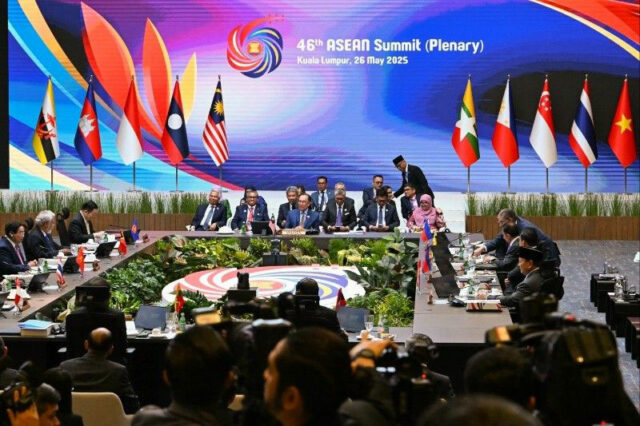
President Ferdinand R. Marcos, Jr. signed the Kuala Lumpur Declaration on ASEAN 2045: Our Shared Future on May 26.

“This pivotal declaration charts the region’s unified direction over the next two decades, reflecting a renewed commitment to fostering a more resilient, forward-looking, and people-first Southeast Asia,” the DTI said.

The declaration aims to help the region navigate digital disruption, climate change, demographic shifts, and evolving geopolitical realities.

“This comprehensive roadmap builds upon previous ASEAN blueprints, adapting to the challenges and opportunities of an increasingly complex global environment,” the DTI said.

“Central to the declaration is the ASEAN Economic Community (AEC) Strategic Plan 2026-2030. This five-year economic blueprint is designed to position ASEAN as the world’s fourth-largest economy by 2030,” it added.

“Developed through an inclusive and region-wide consultative process, the AEC Strategic Plan drew insights from all AEC sectoral bodies and was enriched by inputs from the ASEAN Community’s political-security and socio-cultural pillars,” the DTI said.

“The plan captures the perspectives of 315 stakeholders from business, academia, civil society, parliaments, and ASEAN’s external partners, who participated in a series of dialogues and technical consultations,” it added.

The Philippines will chair ASEAN next year, which “carries both a significant responsibility and a unique opportunity to influence regional priorities, champion inclusive growth, and ensure ASEAN’s progress directly benefits the lives of everyday people, especially in communities that need it most,” the DTI said. — Justine Irish D. Tabile

Fed saw inflation, jobless, stability risks at May meeting, minutes show

A sign for the Federal Reserve Board of Governors is seen at the entrance to the William McChesney Martin Jr. building in Washington, D.C. — REUTERS

WASHINGTON — US Federal Reserve officials at their last meeting acknowledged they could face “difficult tradeoffs” in coming months in the form of rising inflation alongside rising unemployment, an outlook buttressed by concerns about financial market volatility and Fed staff warnings of increasing recession risk, according to minutes of the May 6-7 session.

The foreboding outlook has likely shifted since then following President Donald Trump’s decision just a week after the meeting to postpone the severe import tariffs, including a 145% levy on goods from China, that had forced up bond yields, driven down stock prices, and led to widening predictions of a US economic downturn.

But the minutes released on Wednesday still showed Fed policymakers and staff engaged in a consequential discussion of the likely fallout from Trump administration policies that remain in flux — with even the highest tariffs on hold but not yet withdrawn altogether.

Officials at the meeting noted that volatility in bond markets in the weeks before “warranted monitoring” as a possible risk to financial stability, and noted that a change in the US dollar’s safe-haven status, along with rising Treasury bond yields, “could have long-lasting implications for the economy.”

Fed officials continue to cite the possibility of inflation and unemployment rising in tandem as a risk that would leave them forced to decide whether to prioritize fighting inflation with tighter monetary policy or cutting interest rates to support growth and employment.

“Almost all participants commented on the risk that inflation could prove to be more persistent than expected,” as the economy adapted to higher import taxes proposed by the Trump administration.

“Participants noted that the (Federal Open Market) Committee might face difficult tradeoffs if inflation proves to be more persistent while the outlooks for growth and employment weaken,” the minutes said. “Participants agreed that uncertainty about the economic outlook had increased further, making it appropriate to take a cautious approach until the net economic effects of the array of changes to government policies become clearer.”

RISKS TO BOTH SIDES
The prospect of rising unemployment and higher inflation was outlined in staff briefings that projected a “markedly” higher inflation rate this year due to the impact of tariffs and a job market “expected to weaken substantially” with the unemployment rate rising above estimates of full employment by the end of this year and remaining there for two years.

The unemployment rate was 4.2% as of April; Fed officials consider 4.6% to represent the level sustainable in the long run with inflation steady at the central bank’s 2% target.

The delay in the most aggressive tariffs to be imposed on China and other nations caused many analysts to lower their own estimated recession risks, which Fed staff as of early May had considered “almost as likely” as their baseline outlook of slowing but continued growth.

In theory those stiff tariffs are only on hold until July pending negotiations over final tax rates, with Fed officials and business executives left in the dark about key aspects of the upcoming economic landscape.

The uncertainty still felt today was also the watchword at the meeting in early May, when the Fed decided to hold the benchmark policy rate steady in the 4.25% to 4.5% range. In a press conference after the meeting, Fed Chair Jerome Powell indicated the central bank was effectively sidelined until the Trump administration finalizes its tariff plans and the impact on the economy becomes clearer, a view reiterated by Powell and other Fed policymakers in the weeks since.

The Fed next meets on June 17-18, when the central bank will release new projections from policymakers about their outlook for inflation, employment and economic growth in coming months and years, and the projected interest rate they feel would be appropriate.

At their March meeting the median projection among policymakers was for two quarter-point interest rate cuts by the end of 2025. — Reuters

Barefoot runner spoils 4-gold sweep by NCR in sprint events

LONGGA BAREFOOTED RUNNER Trixia Ann Arellano from Western Visayas wins her second gold medal in the centerpiece 100m dash to spoil a four-gold medal sweep by NCR in the sprint events.

LAOAG CITY — Western Visayas just put a dent on National Capital Region’s anticipated spotless coronation run, dealing two defeats in the two centerpiece events of the 2025 Palarong Pambansa here.

A barefoot runner in Trixia Ann Arellano from Concepcion, Iloilo denied a four-gold sweep from the Big City in the highlight 100m dashes followed by St. Roberts International Academy of Iloilo’s 76-67 stunner to dethrone champion National University-Nazareth School as early as the quarterfinals in the secondary boys’ basketball at the Ilocos Norte Centennial Arena.

The last time NCR failed to make the finals of its pet event was in 2016 Palaro Albay when CALABARZON represented by San Beda-Rizal eliminated the latter in the semifinals en route to the championship over Central Luzon.

But the spotlight shone brighter on neophyte yet already the games’ fastest runner in Arellano at the Ferdinand E. Marcos Memorial Stadium as she completed Iloilo’s last-ditch snatching of two coveted eggs from the nests of NCR on its way to 18th straight Palaro overall crown — all without running shoes.

Arellano blitzed for 12.84 seconds in the elementary girls’ century run to be hailed as this year’s Palaro sprint princess after also ruling the 200m (26.4) the other day and breaking the 26.7 mark of NCR’s Maureen Emily Schrijvers’ in the 2008 Palaro Puerto Princesa.

“I’m slow with shoes,” said the 11-year Grade 6 student, who glided through the track oval with comfortability over Northern Mindanao’s Dale Jane Tagalog (12.99s) and Bicol’s Mary Anthonette delos Santos (13.09).

She actually ran with shoes in the heats of 200m but failed to top the race although she still got in with qualifying time before running roughshod in the finals barefooted with eyes on the 4×100 relay on Thursday for her third gold.

“I win when I run barefooted,” beamed the newbie trackster, a daughter of fisherfolks in the Iloilo coastal town, without experience even in regional and Batang Pinoy.

Her conquest spoiled NCR’s sprint domination as Malabon’s Cris Ivan Domingo (12.04), winner of 200m and 400m as well, ruled the elementary boys’ 100m for the sprint prince title while sprint king and queen Pi Durden Forward Wangkay (10.82) of Muntinlupa and Jeralyn Rodriguez (12.05) of Manila won the secondary boys’ and girls’ century dashes.

Ms. Wangkay also reigned in the 200m while Ms. Rodriguez captured the 200m and 400m for total domination by the Big City in the staple sprint events of Palaro that on the other hand had the biggest upset in secondary boys’ basketball in over a decade.

Meanwhile, archer Naina Dominique Tagle from Central Visayas wasn’t to be left behind in the race for the most bemedaled athlete currently led by swimmers and gymnasts with four gold medals (50m, 30m, 60m and 1440 round), including two new records.

Ms. Tagle, an incoming Grade 12 student from Silliman University in Dumaguete, scored 343 in the 30m to beat the 342 of Ilocos Region’s Irish Angel Licudan in 2018 Palaro Vigan and 1294 in the 1440 to surpass her own mark of 1278 in 2023 Palaro Marikina.

And she’s not yet done.

“As of now, my best collection is in 2023 where  I got 6 gold medals and 2 silvers. I hope this year, I will be better,” said Ms. Tagle, still not contented in her medal haul.

Moreover, Titus Rafael Sia and Sophia Rose Garra won their fifth gold medal in elementary swimming to tie gymnasts Arman Hernandez Jr. of NCR and Sheena Jillianne Ty of Central Luzon as the most bemedaled athletes so far.

NCR, despite the historic defeats, is a cinch for yet another Palaro overall title with 73 gold, 51 silver and 27 bronze medals with a day to go in the competitions as CALABARZON (30-44-40) and Western Visayas (24-33-27) trail far behind.

NOTE: Pending verification from the PATAFA, five athletics stars could also break the national junior records after resetting the Palaro marks in Western Visayas’ Mico Villaran (secondary boys’ 100m hurldes), Bicol’s Ana Bhiana Espinilla (secondary girls’ javelin throw), Central Luzon’s Alfred Talplacido (secondary boys’ 400m), CALABARZON’s Sam Garcia (elementary girls’ shot put) and Western Visayas’ Josh Gabriel Salcedo (secondary boys’ discus throw). — John Bryan Ulanday

Philippines’ Ramirez snatches gold in 9th Asian Jiu-jitsu Championships

ASIAN Games gold medalist Annie Ramirez saved the best for last, delivering the Philippines lone gold medal in the 9th Asian Jiu-jitsu Championships in Amman, Jordan recently

The 34-year-old Ms. Ramirez, who is also a former Asian Indoor and Martial Arts Games gold winner, repeated over Kazakh Galina Duvanova in a master class of a performance to rule the women’s -57-kilogram class.

She also ran roughshod over South Korean Lee Yu Jin, Mongolian Narankhishig Baasanjargal and Uzbek Shakhzoda Azatova on her way to the golden moment.

It was a reprise of Ms. Ramirez’s domination of Ms. Duvanova in the Hangzhou Asiad finals three years ago.

It was also Ms. Ramirez’s second gold in the event after reigning supreme two years back in Bangkok, Thailand.

“It feels surreal,” said Ms. Ramirez on social media.

It was the country’s one and only mint in the event after bagging two silver from Kaila Napolis (women’s -52kg) and Dylan Chrystle Valmores (women’s +70kg) and five bronzes from Kimberly Anne Custodio (women’s -45kg), Joanne Pauline Tan (women’s -70kg), Carlo Angelo Peña (men’s -56kg), Santino Luis Luzuriaga (men’s -62kg), and Baby Jhen Buzon (women’s -52kg).

This was part of the preparation by Ms. Ramirez and the national team for the World Games set this August in Chengdu, China. — Joey Villar