In the world of financing, transactions often take center stage. But for Global Dominion, success is defined by its impact on people’s lives. Guided by the belief that real progress is built on service and growth, the company has become a trusted partner for Filipinos nationwide.
From the moment a client walks into a branch or speaks to a Customer Service Representative, Global Dominion strives to deliver a level of “malasakit” that goes beyond traditional financing. Every interaction is rooted in care, ensuring that customers feel heard, valued, and supported. This service-first culture has helped turn dreams of car ownership, business expansion, and family security into reality, proof that #PwedePala.
The company’s impact is best reflected in the numbers. From January to July 2025, Global Dominion released almost 17 thousand accounts nationwide through its expanding network of 150 branches and counting, with approved loans amounting to P6.85 billion. Behind these figures are stories of opportunities unlocked, businesses strengthened, and families empowered.
Beyond serving clients, Global Dominion invests in its people. Programs such as Sales Ninja equip employees with modern selling skills and effective strategies, helping sales professionals achieve measurable results in today’s competitive market. Leadership development is also prioritized through Leaderology 1 (Foundations of Leadership), which builds self-leadership and credibility, and Leaderology 2 (Leading Others Effectively), which develops emotional intelligence, communication, and coaching skills. Together, these initiatives ensure that leaders are prepared not only to manage tasks but to inspire and empower teams.
The company also nurtures strong partnerships with dealers, loan consultants, and communities across the Philippines. These collaborations reflect the essence of #KaPartnerMosaPagAngat, the belief that true progress is best achieved together. Whether through innovative financing solutions, recognition events, or collaborative programs, Global Dominion works hand in hand with its stakeholders to drive shared success.
Looking ahead, Global Dominion continues to pursue its vision to make financing simplified. With digital innovations and nationwide accessibility at the forefront, the company remains committed to making financing easy, transparent, and within reach for every Filipino.
At Global Dominion, service and growth go hand in hand, proving one thing: #PwedePala when you have the right #KaPartnerMosaPagAngat.
Spotlight is BusinessWorld’s sponsored section that allows advertisers to amplify their brand and connect with BusinessWorld’s audience by publishing their stories on the BusinessWorld Web site. For more information, send an email to online@bworldonline.com.
Join us on Viber at https://bit.ly/3hv6bLA to get more updates and subscribe to BusinessWorld’s titles and get exclusive content through www.bworld-x.com.
THE PENTAGON is seen from the air in Washington, US, March 3. — REUTERS
WASHINGTON — US President Donald Trump’s administration is imposing new restrictions on media coverage of the US military, requiring news organizations to agree they will not disclose information that the government has not approved for release.
In a memo on Friday, the Department of Defense said journalists who publish unauthorized sensitive material could have their press credentials revoked. Media advocates said the restrictions would stifle independent reporting.
Asked by reporters outside the White House whether the Pentagon should be in charge of what the press can report, Trump replied on Sunday, “No, I don’t think so. Nothing stops reporters.” Trump was not specifically asked about the new policy.
The memo said news organizations will be required to acknowledge that disclosing, accessing or attempting to access sensitive information without authorization could be grounds for having their Pentagon press credentials denied or revoked.
The department “remains committed to transparency to promote accountability and public trust. However, DoW information must be approved for public release by an appropriate authorizing official before it is released, even if it is unclassified,” the memo stated, using the acronym for the Department of War. Trump has ordered the department to rename itself the Department of War, a change that will require action by Congress.
The move marks the latest instance of the Trump administration applying government pressure on media organizations in the US that Trump has long viewed as biased against him. It also represents an expansion of restrictions on press access to the Pentagon under Defense Secretary Pete Hegseth, a former Fox News host.
The memo said reporters who lose their credentials will be denied access to all US military installations, which would include the Pentagon itself. Such a ban would raise serious questions about coverage of the US military, from major Pentagon announcements to its actions in conflicts and disaster relief.
The move was quickly condemned by media organizations including the New York Times, Reuters, the Washington Post, the Wall Street Journal. The head of the National Press Club in Washington, which advocates for a free press, said it was a “direct assault” on independent journalism.
“If the news about our military must first be approved by the government, then the public is no longer getting independent reporting. It is getting only what officials want them to see,” National Press Club President Mike Balsamo said in a statement.
More than two dozen news organizations operate at the Pentagon, including Reuters, reporting on the daily activities of the US military.
Republican Representative Don Bacon of Nebraska, a US Air Force veteran and a member of the Armed Services Committee in the House of Representatives, criticized the restrictions in a post on X.
“A free press makes our country better,” Bacon wrote. “This sounds like more amateur hour.”
Pentagon spokesperson Sean Parnell said in a statement that these “are basic, common-sense guidelines to protect sensitive information as well as the protection of national security and the safety of all who work at the Pentagon.
In February, the department removed four media organizations from their designated Pentagon office spaces, beginning a rotation with other outlets that included right-leaning publications. In May, Hegseth also issued orders that require journalists to have official escorts within much of the Pentagon building. — Reuters
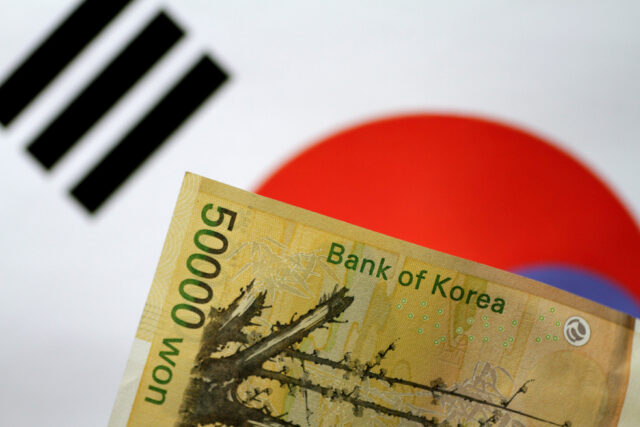
A South Korea won note is seen in this illustration photo May 31, 2017. — REUTERS/THOMASWHITE/ILLUSTRATION
SEOUL – South Korea’s economy could fall into crisis rivalling its 1997 meltdown if the government accepts current US demands in stalled trade talks without safeguards, President Lee Jae Myung told Reuters.
Seoul and Washington verbally agreed to a trade deal in July in which the USUS would lower President Donald Trump’s tariffs on South Korean goods in exchange for $350 billion in investment from South Korea, among other measures.
They have yet to put the agreement to paper because of disputes over how the investments would be handled, Lee said.
“Without a currency swap, if we were to withdraw $350 billion in the manner that the US is demanding and to invest this all in cash in the US, South Korea would face a situation as it had in the 1997 financial crisis,” he said through a translator.
In an interview in his office on Friday, Lee also spoke about a huge US immigration raid that detained hundreds of Koreans, as well as Seoul’s relations with rival North Korea, neighboring giant China and Russia.
But trade and defense talks with the US, South Korea’s military ally and a top economic partner, are overshadowing a trip Lee makes from Monday to New York, where he will address the United Nations General Assembly and be the first South Korean president to chair a meeting of the Security Council.
PRAISES TRUMP’S HANDLING OF HYUNDAI RAID
Lee, a liberal, took office in a June snap election after his conservative predecessor, Yoon Suk Yeol, was removed from office and jailed for briefly imposing martial law. Lee has sought to calm the country and its economy and said he plans to use his US visit to tell the world that “democratic Korea is back”.
Lee met Trump for their first summit in August, saying he had built a strong personal tie with the US leader, despite not agreeing on a joint statement or concrete announcement.
This month Trump’s administration rocked South Korea with the arrest of more than 300 South Korean workers at a Hyundai Motor battery plant in Georgia, with federal officials accusing them of immigration violations.
Lee said South Koreans were naturally angered by the “harsh” treatment of the workers – the Trump administration published images of them in shackles – and has warned it could make companies wary of investing in the United States.
But he said the raid would not undermine the bilateral alliance, praising Trump for offering to let the workers stay. Lee said he did not believe it was directed by Trump but was the result of overzealous law enforcement.
“I do not believe this was intentional, and the US has apologised for this incident, and we have agreed to seek reasonable measures in this regard and we are working on them,” he said.
Lee’s office says there is no plan for him to meet Trump in New York and that the trade talks are not on the visit’s agenda.
STUMBLING BLOCK IN TRADE TALKS
Commerce Secretary Howard Lutnick has said South Korea should follow Japan’s deal with the United States. He said Seoul either needs to accept the deal or pay the tariffs, using the Trump administration’s depiction of foreign governments paying the levies, which are instead paid by US importers.
Lee, asked if he would walk away from the deal, said: “I believe that between blood allies, we will be able to maintain the minimum amount of rationality.”
South Korea has proposed a foreign exchange swap line with the US to reduce the shock of the investments on the local market for the won currency. Lee did not address how likely the US was to agree or whether that would be enough for the deal to go forward.
He said South Korea is different from Japan, which struck a trade deal with the US in July. Tokyo has more than double South Korea’s $410 billion foreign exchange reserves, an international currency in the yen and a swap line with the United States, Lee said.
Seoul and Washington have said in writing that any investment projects must be commercially viable, but working out the details is proving difficult, he said.
“Reaching detailed agreements that guarantee commercial reasonableness is now the central task – yet it also remains the biggest obstacle,” Lee said. Proposals during working level talks provide no assurance of commercial viability, making it hard to bridge the gap, he said.
Trump says the investments will be “selected” by him and controlled by the US, meaning Washington would have discretion over where the money will be invested.
But Lee policy adviser Kim Yong-beom said in July that South Korea had added a safety mechanism to reduce financing risk, including supporting commercially feasible projects rather than providing unconditional financial support.
Lee said South Korea and the United States do not disagree on increasing Seoul’s contributions toward its own defence, bolstered by 28,500 US troops on the Korean peninsula, but that Washington wants to keep security and trade talks separate.
“We should end this unstable situation as soon as possible,” he said, when asked whether talks could extend into next year.
TENSIONS WITH NORTH KOREA, CHINA, RUSSIA
Lee has sought to reduce tensions with nuclear-armed North Korea. Pyongyang has rebuffed the South’s overtures, and Lee said he was not optimistic about the prospect of inter-Korean talks for the time being.
During their meeting, Lee encouraged Trump to try to meet again with North Korean leader Kim Jong Un during Trump’s trip next month for an Asia-Pacific summit Lee will host in the South.
Lee told Reuters his government does not have detailed information on the status of any talks between Washington and Pyongyang. “It is our judgement that they are not engaging in concrete conversations,” he said.
He said he shares his predecessor Yoon’s view that North Korea’s military cooperation with Russia is a significant threat to South Korea’s security. But he said it is not enough to respond in a simplistic way to the issue, which must be addressed through dialogue and coordination.
The North Korean leader and Russian President Vladimir Putin stood shoulder to shoulder this month in Beijing when Chinese President Xi Jinping hosted them at a massive military parade and summit.
Lee said there is increasing confrontation between a socialist camp of countries and a capitalist, democratic camp that includes Seoul, and South Korea’s geography threatens to place it on the frontier of any conflict with the other camp.
He said there is an escalatory spiral of rivalry and tensions where South Korea, Japan and the United States deepen cooperation and China, Russia, and North Korea work more closely together.
“This is a very dangerous situation for Korea, and we must find an exit ramp out of the escalating military tensions,” Lee said. “We must find a way for peaceful coexistence.” — Reuters
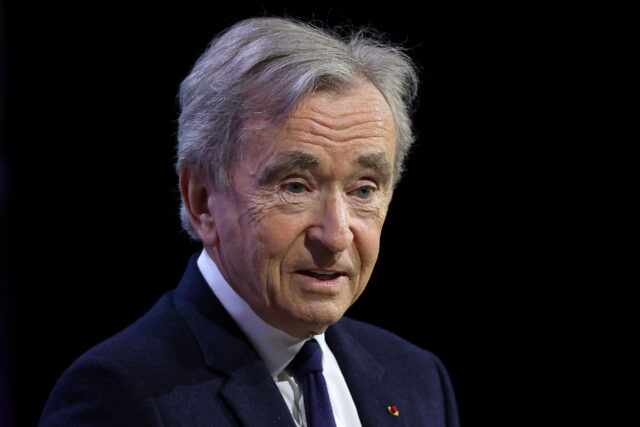
Bernard Arnault, Chairman and CEO of LVMH Moet Hennessy Louis Vuitton, speaks during the annual shareholders meeting of LVMH Moet Hennessy Louis Vuitton in Paris, France, April 17, 2025. REUTERS/Gonzalo Fuentes
PARIS – Bernard Arnault, the boss of luxury goods group LVMH and France’s richest man, has attacked a proposed 2% tax on billionaires as an assault on France’s economy and denounced the plan’s architect as a far-left ideologue.
The tax, which would target wealth above 100 million euros ($117 million), has gained political traction in France, where Prime Minister Sébastien Lecornu faces pressure from the Socialist Party to include it in the 2026 budget or face a confidence vote that could topple his government.
“This is clearly not a technical or economic debate, but rather a clearly stated desire to destroy the French economy,” Arnault told Britain’s Sunday Times.
He accused the plan’s architect, economist Gabriel Zucman of being “first and foremost a far-left activist” who uses “pseudo-academic competence” to promote an ideology aimed at dismantling the liberal economic system, which Arnault described as “the only one that works for the good of all”.
Zucman, a professor at France’s École Normale Supérieure and the University of California, Berkeley, rejected the accusations.
“I’ve never been an activist for any movement or party,” he said on X, adding his work was grounded in research, not ideology.
Zucman was among 300 economists who publicly backed the economic platform of the left-wing Nouveau Front Populaire alliance ahead of last year’s legislative elections.
He has recently argued in media appearances that the ultra-rich pay proportionally less tax than many other citizens — a gap the proposed levy aims to close.
The tax has broad public support, with an Ifop poll commissioned by the Socialist Party this month showing 86% approval. — Reuters
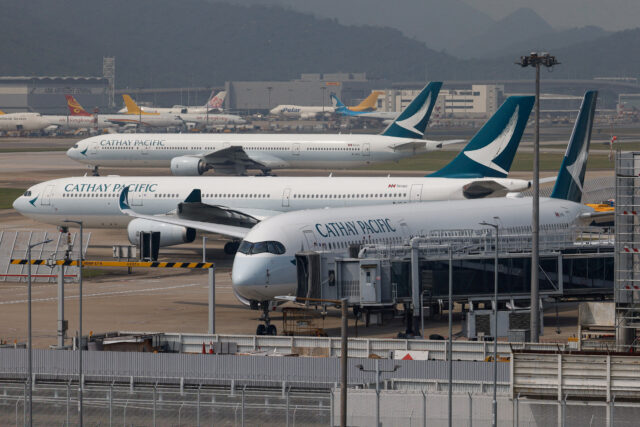
A Cathay Pacific Airbus A350 aircraft is seen in Hong Kong International Airport, in Hong Kong, China Sept. 3, 2024. REUTERS/Tyrone Siu
Hong Kong International Airport is planning to suspend all passenger flights for 36 hours as the Asian financial hub prepares for one of its strongest super typhoons in years, Bloomberg News reported on Monday, citing people familiar with the matter.
Airport and aviation officials are set to stop all flights from as early as 6 p.m. (1000 GMT) on Tuesday till 6 a.m. on Thursday as Super Typhoon Ragasa advances, the report added.
A spokesperson for Airport Authority Hong Kong said it is closely monitoring the developments regarding Ragasa and has commenced preparations to deal with the super typhoon.
An official announcement is expected to happen on Monday and the Hong Kong Observatory plans to hoist its first precautionary signal for the storm around noon, according to the report.
The Civil Aviation Department did not immediately respond to a Reuters request for comment.
The Philippines suspended work and classes across Metro Manila and large parts of the country on Monday as Ragasa moved toward northern Luzon, threatening destructive winds and heavy rain. — Reuters
Malacañang suspended classes and government work in Metro Manila and more than a dozen provinces in Luzon on Monday as Super Typhoon Ragasa, locally named Nando, threatened Northern Luzon with destructive winds and torrential rains, made worse by the Southwest Monsoon.
The presidential palace said classes at all levels and work in government offices were suspended in Metro Manila, Abra, Antique, Apayao, Bataan, Batanes, Batangas, Benguet, Bulacan, Cagayan, Cavite, and Ifugao. The order also covered Ilocos Norte, Ilocos Sur, Isabela, Kalinga, La Union, Oriental Mindoro, Pampanga, Pangasinan, Palawan, Romblon, Rizal, Tarlac and Zambales.
The suspension, made upon the recommendation of the National Disaster Risk Reduction and Management Council (NDRRMC), seeks to reduce risks from heavy rainfall and strong winds. Agencies involved in critical services such as health, disaster response and other essential operations were ordered to remain on duty.
Some local governments suspended classes as early as Sunday.
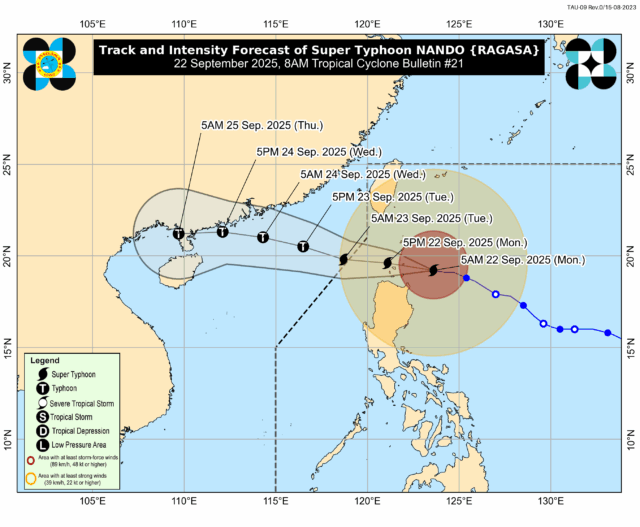
As of 8 a.m., the Philippine Atmospheric, Geophysical and Astronomical Services Administration (PAGASA) said Ragasa was spotted 180 kilometers east of Calayan, Cagayan. It was moving westward at 20 kilometers per hour (kph), packing maximum sustained winds of 215 kph and gusts of up to 265 kph.
PAGASA warned that the super typhoon might either pass close to or make landfall over the Babuyan Islands between noon and early afternoon and could leave the Philippine Area of Responsibility by Tuesday morning. The weather bureau added that Ragasa might maintain its intensity or strengthen further before its closest approach.
Tropical Cyclone Wind Signals (TCWS) were raised across Northern Luzon. Signal No. 5, the highest alert, was hoisted over the northern and central portions of the Babuyan Islands, where winds reaching 185 kph pose an extreme threat to life and property.
Signal No. 4 was raised in the southeastern portion of Batanes, the rest of the Babuyan Islands, the northeastern and northwestern parts of mainland Cagayan, and Pagudpud in Ilocos Norte. PAGASA said these areas could experience severe damage to structures, widespread blackouts and disruptions to transportation.
Meanwhile, Signal No. 3 was in effect over the rest of Batanes, much of Cagayan, northern and central Apayao, and northern and central Ilocos Norte. These areas face moderate to significant threats, including damage to infrastructure and agriculture.
Signal No. 2 was hoisted over the rest of Cagayan, Isabela, parts of Apayao, Abra, Kalinga, Mountain Province, Ifugao, northern Benguet, Diadi in Nueva Vizcaya, the remainder of Ilocos Norte, Ilocos Sur and northern La Union.
The rest of Nueva Vizcaya, Benguet, La Union, Pangasinan, Aurora, Nueva Ecija, Bulacan, Tarlac, Pampanga, Zambales, and Quezon’s General Nakar and Polillo Islands were placed under Signal No. 1. These areas may experience occasional gusts and light damage to vulnerable structures.
Authorities urged residents in high-risk areas to prepare for strong winds, storm surges, flooding and landslides. PAGASA also warned fisherfolk and operators of small vessels to avoid sailing in affected coastal waters. — Edg Adrian A. Eva
An information sign for passport and visa appointments is displayed outside the US embassy in London, Britain, May 29, 2025. — REUTERS/HANNAH MCKAY
BENGALURU – India’s $283 billion information technology sector will have to overhaul its decades-old strategy of rotating skilled talent into US projects following US President Donald Trump’s move to impose a $100,000 fee for new H-1B visas from Sunday, according to tech veterans, analysts, lawyers and economists.
The sector, which earns about 57% of its total revenue from the US market, has long gained from US work visa programs and the outsourcing of software and business services — a contentious issue for many Americans who have lost jobs to cheaper workers in India.
India was by far the largest beneficiary of H-1B visas last year, accounting for 71% of approved beneficiaries, while China was a distant second at 11.7%, according to US government data.
Trump’s move to reshape the H-1B program will force IT firms with clients such as Apple AAPL.O, JPMorgan Chase JPM.N, Walmart WMT.N, Microsoft MSFT.O, Meta META.O and Alphabet’s GOOGL.O Google to pause onshore rotations, accelerate offshore delivery, and ramp up hiring of US citizens and green card holders, experts said.
AMERICAN DREAM SLIPPING AWAY
“The ‘American Dream’ for aspiring workers will be tough,” Ganesh Natarajan, former CEO of IT outsourcer Zensar Technologies, said, adding that he expected firms to restrict cross-border travel and get more work done out of countries such as India, Mexico and the Philippines.
IT firms Tata Consultancy Services, Infosys, HCLTech, Wipro and Tech Mahindra did not respond to Reuters requests seeking comment.
Industry body Nasscom said the move would “potentially have ripple effects on America’s innovation ecosystem” and disrupt business continuity for onshore projects.
“Services exports have finally been dragged into the ongoing global trade and tech war,” Emkay Global Chief Economist Madhavi Arora said, adding that it could disrupt the IT sector’s onsite-offshore model, pressuring margins, and supply chain.
Most industry watchers expect Trump’s move to constrain client-facing roles, hurting IT deal conversion and extending the time taken to scale up tech projects.
“Clients will demand repricing or delay start dates until there is clarity on legal challenges. Some projects will be re-scoped to reduce onshore staffing. Others will shift delivery offshore or near-shore from day one,” HFS Research CEO Phil Fersht said.
FUTURE H1-B VISAS FOR CRITICAL ROLES ONLY
Immigration lawyers, who received frantic calls over the weekend due to the chaos and confusion created by Trump’s proclamation, in which he accused the IT sector of manipulating the H-1B system, said the new visa fee was steep.
“We expect that companies will become far more selective in deciding which candidates to sponsor, reserving H-1B filings for only the most business-critical roles,” Vic Goel, managing partner at US law firm Goel & Anderson said. “This would significantly reduce access to the H-1B program for many skilled foreign nationals and could reshape employer demand.”
Before the White House clarified that the order applied only to new applicants and not holders of existing visas or those seeking renewals, companies including Tata Consultancy Services, Eli Lilly, Microsoft, JPMorgan, and Amazon advised employees on H-1B visas to stay put or return to the US before Sunday, according to internal messages seen by Reuters, forcing many workers from India and China to abandon travel plans and rush back.
Many immigration lawyers expect Trump’s move to be challenged legally soon.
“We are anticipating that several lawsuits will be immediately forthcoming this week,” Alcorn Immigration Law CEO Sophie Alcorn said.
The fresh challenge for the Indian IT sector comes as it awaits clarity on a proposed 25% tax on outsourcing payments and struggles with weak revenue growth in its mainstay US market as clients defer non-essential tech spending amid inflationary pressures and tariff uncertainty.
MOVE TO PROPEL GCC GROWTH
Across the board, industry watchers expect Trump’s move to accelerate the growth of US firms’ global capability centres (GCCs), which have evolved from low-cost offshore back offices to high-value innovation hubs that support operations, finance, research and development.
“Time zone proximity will accelerate GCCs and resourcing in Canada, Mexico, and Latin America, where talent is stable and cost advantages remain,” ISG President and Chief AI officer Steven Hall said. “GCCs in India will also continue to rise with broader capabilities and skills as enterprises shift strategic roles to India.”
India, currently home to more than half of the world’s GCCs, is projected to host more than 2,200 companies by 2030, with a market size nearing $100 billion and generating up to 2.8 million jobs, according to a Nasscom-Zinnov report released last year.
Silicon Valley-based Constellation Research founder and chairman Ray Wang expects Trump’s move to lead to more GCCs in India, more local hiring in the US, more pressure to deliver automation and AI at the same time, less outsourcing, fewer H-1B visas and less job mobility.
“We are seeing a new world order on services economics,” Wang said. — Reuters
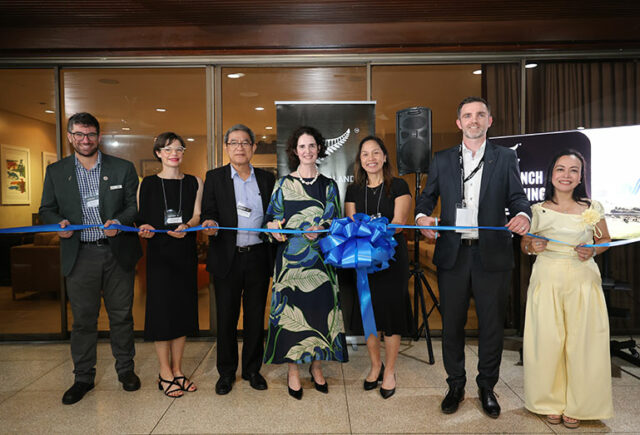
(L-R) Matt Sophy, Senior Engineer - Geothermal Development, Contact Energy; Cecilia Shand, New Zealand Trade Commissioner to Indonesia and the Philippines; Sec. Ernesto Perez, Anti-Red Tape Authority; Dr. Catherine McIntosh, New Zealand Ambassador to the Philippines; Sec. Sharon Garin, Department of Energy; Angus Howden, International Business Development Manager, Western Energy; and Maricon Popanes-Lim, New Zealand Trade and Enterprise Country Manager - Philippines
The Philippines and New Zealand are deepening geothermal collaboration ahead of their 60th diplomatic anniversary in 2026, in line with plans to elevate bilateral relations into a comprehensive partnership. Underscoring the renewed commitment between the two countries, Western Energy, New Zealand’s largest geothermal well services provider, recently opened its first office in the Philippines, expanding its regional presence and highlighting growing synergy in advancing sustainable energy solutions.
Clean, reliable, and affordable energy is central to the Philippines’ growth agenda, outlined in AmBisyon Natin 2040 and the Philippine Development Plan 2023-2028. With geothermal energy being vital to this vision, New Zealand’s expertise as a global pioneer makes it an invaluable partner.
“A clean energy future is integral to our development goals. Through the Philippine Energy Plan 2023-2050, we aim to achieve 50% renewables by 2040, which will cut emissions, boost energy independence, and meet rising demand from emerging technologies like artificial intelligence (AI),” Sharon Garin, Secretary of the Department of Energy (DoE), said.
“The Philippines, ranked third globally in geothermal capacity, has vast potential but faces high costs and exploration risks. Through reforms and initiatives like the Green Energy Auction Programme (GEAP) to boost investor confidence, and the Philippine Geothermal Risk Facility (PGRF) to offset upfront drilling costs, we aim to attract private investment and unlock geothermal’s full potential to drive growth, create jobs, and enhance energy security,” Rowena Christina Guevara, Undersecretary of the DOE, added.
“New Zealand has been a pioneer in geothermal technology since the 1950s, and our geothermal journey with the Philippines has been a constant thread in our bilateral relationship. As we mark 60 years of ties and move towards a comprehensive partnership in 2026, geothermal energy will be a crucial pillar,” Dr. Catherine McIntosh, New Zealand Ambassador to the Philippines, said.
Powering the Future, Together
The New Zealand-Philippines geothermal partnership, formalised in 2012 and renewed in 2017 and 2021, builds on cooperation dating back to the 1960s with the development of the Tiwi and Tongonan geothermal fields. Today, New Zealand continues to support three geothermal fields, including Palimpinon.
Guiding its continued collaboration with the Philippines to share expertise, foster joint research, and cultivate the next generation of industry leaders, the New Zealand Government recently launched its Draft Geothermal Strategy, developed with the New Zealand Geothermal Association (NZGA), combining the insights of communities, scientists, and the industry.
“Backed by world-class research and a stable energy market, New Zealand’s geothermal power delivers reliable baseload energy that reduces emissions. With new supercritical geothermal technology, we can utilise deeper resources to help the Philippines advance its clean energy goals,” said Cecilia Shand, New Zealand Trade Commissioner to Indonesia and the Philippines.
The opening of Western Energy’s office in Manila, supported by New Zealand’s largest geothermal power firm, Contact Energy, marks a new chapter in the partnership.
“We are excited to bring the same technology, know-how, and expertise to the local industry. Our top priority is to build relationships and be an active part of the Philippine geothermal sector,” Angus Howden, International Business Development Manager, Western Energy, said.
“Contact Energy’s extensive experience offers adaptive management to support Western Energy’s clients and spot collaboration opportunities,” added Matt Sophy, Senior Engineer, Geothermal Development, Contact Energy.
Advancing Geothermal Innovation
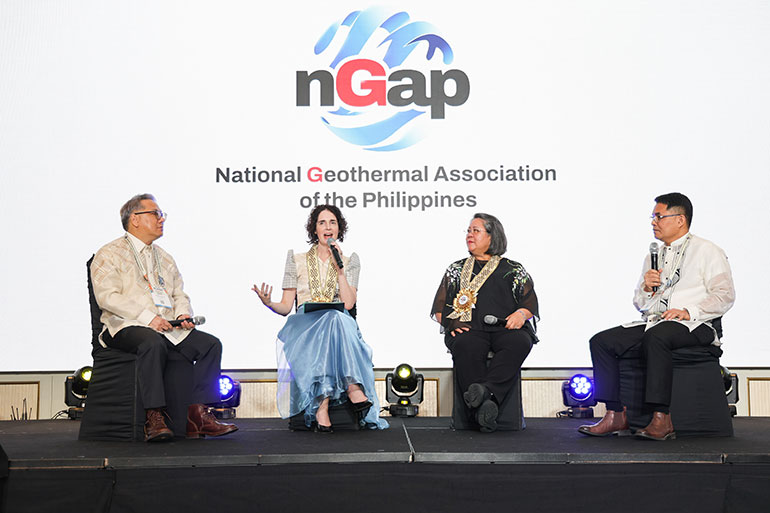
(L-R) Jaime Jemuel Austria, Jr., National Geothermal Association of the Philippines (NGAP) President; Dr. Catherine McIntosh, New Zealand Ambassador to the Philippines; Rowena Christina Guevara, Undersecretary of the Department of Energy; and Erlindo Angcoy, Jr., NGAP Trustee
This strengthened cooperation was showcased at the 6th Philippine International Geothermal Conference (PIGC6), hosted by the National Geothermal Association of the Philippines (NGAP) in partnership with the DoE and New Zealand Trade and Enterprise (NZTE). Leading New Zealand geothermal companies and institutions highlighted their expertise and contributions to the Philippine sector, emphasising innovation, knowledge-sharing, and capacity-building.
With cutting-edge technology transforming geothermal development, JRG Energy and Seequent are introducing advanced solutions to enhance the Philippines’ capacity and accelerate its clean energy transition.
JRG Energy, a pioneer in well cleaning and productivity solutions, is expanding its technical studies and well servicing capabilities in the Philippines. “Geothermal is a major solution to global decarbonisation, and the Philippines has fantastic resources to provide low-cost energy while helping decarbonise the country. Our advanced geothermal solutions maximise 24/7 baseload power, accelerating the transition to a low-carbon future,” Callum Streeter, General Manager, JRG Energy, said.
AI and machine learning are also reshaping geothermal development. Seequent, the subsurface software arm of Bentley Systems, powers over 65% of the world’s geothermal capacity and has worked with Philippine operators for nearly a decade. “Geothermal requires long-term thinking and strategic use of technology. Our AI-powered software allows operators to identify steam zones and optimise production, reducing costs and risk,” Andrew McMahon, Principal Solutions Manager, Energy Production, Bentley Systems, explained.
Nurturing Human Ingenuity
Talent development remains at the core of the partnership. The University of Auckland’s Geothermal Institute has trained hundreds of Filipino geothermal professionals since 1978, many of whom now lead innovation across the sector. “We believe that knowledge is power. As a real renaissance is happening in geothermal, we need more experts and multidisciplinary teams to deliver ambitious projects, and our graduates are making this possible,” said John O’Sullivan, Co-Director, Geothermal Institute.
MB Century, with 75 years in geothermal and hydropower, has provided end-to-end technical solutions across Philippine plants since opening its office in 2018. “Our goal is to offer a full range of services, from well design to turbine assembly, while creating opportunities for Filipino employees to grow internationally,” said Alan Stewart, CEO, MB Century.
Earth Sciences New Zealand, formerly GNS Science, has been advancing global geothermal exploration since the 1950s. “To unlock the Philippines’ geothermal potential, it is crucial to blend indigenous knowledge with technology, beginning with understanding the needs of communities, whether corporations, governments, or indigenous groups,” said said Mark Gibson, Senior Business Development Manager, Earth Sciences New Zealand.
With supportive policies, investment programmes, and strong international partnerships, the Philippines’ geothermal sector is well-positioned for growth. By leveraging New Zealand’s expertise, the country can secure its energy future, create green jobs, and accelerate its transition to clean energy.
Spotlight is BusinessWorld’s sponsored section that allows advertisers to amplify their brand and connect with BusinessWorld’s audience by publishing their stories on the BusinessWorld Web site. For more information, send an email to online@bworldonline.com.
Join us on Viber at https://bit.ly/3hv6bLA to get more updates and subscribe to BusinessWorld’s titles and get exclusive content through www.bworld-x.com.
A Palestinian flag flies during a protest in front of the Gare du Nord railway station in Paris, France, Sept. 18, 2025. REUTERS/Benoit Tessier
LONDON/TORONTO – Britain, Canada, Australia and Portugal all recognized a Palestinian state on Sunday in a move borne out of frustration over the Gaza war and intended to promote a two-state solution, prompting a furious response from Israel.
The decision by four nations from the West, which has traditionally allied with Israel, aligned them with more than 140 other countries also backing Palestinians’ aspiration to forge an independent homeland from the occupied territories.
Britain’s decision carried particular symbolism given its major role in Israel’s creation as a modern nation in the aftermath of World War Two.
“Today, to revive the hope of peace for the Palestinians and Israelis, and a two-state solution, the United Kingdom formally recognizes the State of Palestine,” said Prime Minister Keir Starmer.
“The man-made humanitarian crisis in Gaza reaches new depths. The Israeli government’s relentless and increasing bombardment of Gaza, the offensive of recent weeks, the starvation and devastation are utterly intolerable.”
Other nations, including France, are expected to follow suit this week at the United Nations General Assembly in New York.
Israeli Prime Minister Benjamin Netanyahu condemned the move.
“I have a clear message to those leaders who recognize a Palestinian state after the horrific massacre of October 7: You are giving a huge reward to terrorism,” he said, referring to Palestinian militant group Hamas’ 2023 attack on Israel that triggered the nearly two-year war in Gaza.
“And I have another message for you: It will not happen. A Palestinian state will not be established west of the Jordan River.”
The Hamas-led attack on Israel killed 1,200 people and saw 251 others taken hostage, according to Israeli tallies.
Israel’s ensuing campaign in Gaza has killed more than 65,000 Palestinians, most of them civilians, according to local health authorities, spread famine, demolished most buildings and displaced most of the population – often multiple times.
PALESTINIANS WELCOME RECOGNITION
“It is a human duty of every respectful and free human being in the world to support Palestinians during the ordeal they are going through and Britain’s role now comes within this,” said Sharaf Al Tarda, a Palestinian resident of Hebron in the Israeli-occupied West Bank.
Hamas welcomed the move but said it must be accompanied by “practical measures” to end the war in Gaza and prevent Israel from annexing the West Bank.
Palestinian President Mahmoud Abbas said recognition would help pave the way for the “State of Palestine to live side by side with the State of Israel in security, peace, and good neighbourliness”.
Starmer wrote to Abbas to confirm Britain’s decision, noting that London had backed a Jewish homeland in 1917 while also pledging to protect the rights of non-Jewish communities.
Western governments have been under pressure from many in their parties and populations angry at the ever-rising death toll in Gaza, images of starving children and their states’ inability to rein in Israel, even continuing to provide arms.
Londoners voiced mixed reactions on Sunday.
“A whole lot needs to happen and peace needs to come to that region,” said 56-year-old charity director Michael Angus. “This is the first step in actually acknowledging that those people have a right to have somewhere to call home.”
Announcing his country’s decision, Canadian Prime Minister Mark Carney said it would empower those seeking peaceful co-existence and the end of Hamas. “This in no way legitimizes terrorism, nor is it any reward for it,” he added.
Portugal’s Foreign Affairs Minister Paulo Rangel said this recognition was a “fundamental line of Portuguese foreign policy”. Speaking to reporters at the headquarters of Portugal’s permanent mission to the United Nations in New York, he said: “Portugal advocates the two-state solution as the only path to a just and lasting peace…a ceasefire is urgent.”
The United States, Israel’s closest ally, did not comment immediately on the decision by three of its allies to recognize a Palestinian state, but President Donald Trump has previously made clear he opposes such a move.
Israeli Security Minister Itamar Ben-Gvir said he would propose that the cabinet apply sovereignty in another Israeli-occupied Palestinian territory, the West Bank. That would represent de facto annexation of land seized in a 1967 war.
BRITAIN PLAYED A KEY HISTORIC ROLE
British troops captured Jerusalem from the Ottoman Empire in 1917, and in 1922 the League of Nations awarded Britain an international mandate to administer Palestine during the post-war deal-making that redrew the map of the Middle East.
Mandy Damari, the British mother of released British-Israeli hostage Emily Damari, told Reuters on Sunday that Starmer was “under a two-state delusion” given that the Gaza Strip’s government was still Hamas whose mission was to destroy Israel.
“He is rewarding Hamas for the 7th October barbaric and savage attack on Israel when the hostages are still not back, the war is not over and Hamas are still in power in Gaza.”
Husam Zomlot, head of the Palestinian Mission to the UK, watched on his phone as Starmer announced Britain’s recognition of a Palestinian state.
At the London headquarters of the mission, which may now be upgraded to an embassy, there were smiles and embraces.
“Today is a moment when the UK Prime Minister and the British government, on behalf of their people, stand and say: ‘We must correct history, we must right the wrongs’,” Zomlot said. — Reuters
A person shows US dollars at a currency exchange store in Manila, Philippines, Oct. 21, 2022. — REUTERS
THE PHILIPPINES’ balance of payments (BoP) surplus ballooned to $359 million in August, reflecting gains in the central bank’s net income from overseas investments, the Bangko Sentral ng Pilipinas (BSP) said.
Preliminary data from the BSP showed the BoP surplus stood at $359 million in August, widening from $88 million in the same month last year.
Month on month, the BoP position swung to a surplus from the $167-million deficit recorded in July.
“The BoP surplus reflected the Bangko Sentral ng Pilipinas’ net income from its investments abroad,” the central bank said in a statement.
BoP refers to the country’s economic transactions with other nations. A surplus indicates more funds entered the country, while a deficit shows that the country spent more than it received.
In the January-to-August period, the country’s BoP position swung to a $5.397-billion deficit, a reversal from the $1.592-billion surplus in 2024.
“Preliminary data indicate that the year-to-date BoP deficit was largely due to the continued trade in goods deficit,” the BSP said.
The Philippines’ trade-in-goods balance, or the difference between the values of exports and imports, narrowed to $28.46 billion in the January-to-July period, from $29.93 billion a year ago.
“This was partly offset by the sustained net inflows from personal remittances from overseas Filipinos, foreign borrowings by the National Government, foreign direct and portfolio investments, and trade in services,” the BSP said.
Michael L. Ricafort, chief economist at Rizal Commercial Banking Corp., said in an e-mail that the latest BoP position partly reflects the central bank’s investment gains from abroad.
“(This was) offset by the continued Trump risk factor or premium that led to some market volatility worldwide in view of the Aug. 7, 2025 extended deadline for US trade deals and tariffs,” he added.
US President Donald J. Trump’s higher tariffs on imports from dozens of countries, including the Philippines, took effect on Aug. 7.
The US imposed a 19% tariff on Philippines goods.
Mr. Ricafort said the August BoP position also came as the government paid off external debts and increased volatility in the local foreign exchange market.
In August, the peso performed weaker at an average P57.2525 per US dollar from the P56.7523 recorded in July.
The BSP expects the overall BoP position to end at a $6.3-billion deficit or -1.3% of gross domestic product (GDP) this year and a $2.8-billion deficit or -0.5% of GDP in 2026.
DOLLAR RESERVES Meanwhile, the BSP said the BoP position mirrored the rise in gross international reserves (GIR) to $107.1 billion as of end-August from $105.4 billion as of end-July.
“The latest GIR level ensures availability of foreign exchange to meet balance of payments financing needs, such as for payment of imports and debt service, in extreme conditions when there are no export earnings or foreign loans,” the BSP said.
The central bank said the level of dollar reserves as of end-August “remains an adequate liquidity buffer,” equivalent to 7.2 months’ worth of imports of goods and payments of services and primary income, more than double the three-month standard.
It is also enough to cover about 3.7 times the country’s short-term external debt based on residual maturity.
GIR comprises foreign-denominated securities, foreign exchange, and other assets such as gold. It enables a country to finance imports and foreign debts, maintain the stability of its currency, and safeguard itself against global economic disruptions.
The central bank expects GIR to settle at $104 billion by end-2025 and $105 billion in 2026. — Katherine K. Chan
By Aubrey Rose A. Inosante and Chloe Mari A. Hufana, Reporters
THE GOVERNMENT will restore the P60 billion in excess funds of the Philippine Health Insurance Corp. (PhilHealth) as “savings” in the proposed 2026 national budget, Finance Secretary Ralph G. Recto said.
Mr. Recto, who defended the National Government’s decision to reallocate the funds before the Supreme Court (SC), is now under orders from President Ferdinand R. Marcos, Jr. to restore the funds to PhilHealth.
“(Savings) will be included in the NEP26 (National Expenditure Program for 2026). We are also looking for legal authority to do it this year,” he told BusinessWorld in a Viber message over the weekend.
The Department of Finance (DoF) said it issued a “solicited opinion” supporting the restoration of the funds, citing PhilHealth’s improved revenue position and the availability of savings from other agencies after the termination of flood control projects.
The DoF’s response came after Mr. Marcos on Saturday ordered the return of the P60 billion to PhilHealth, which would allow the agency to expand its benefit packages and strengthen the Zero Balance Billing program.
The President acknowledged public concerns that the transfer of excess funds could affect PhilHealth’s programs and services, saying such worries are understandable given that healthcare involves life-and-death situations.
“No matter how much we explained, no matter how much we showed that PhilHealth has been expanding the services it covers, people still had fears that services might be reduced,” Mr. Marcos said.
The President’s move may render the SC’s ruling on the issue moot and academic.
The SC has yet to issue a ruling on three petitions questioning the legality of the original P60-billion transfer from PhilHealth to the Bureau of the Treasury in 2024.
Asked if the agency will wait for the SC decision, Mr. Recto said: “We’re following PBBM’s (President Marcos) directive.”
‘FACE-SAVING MEASURE’ Meanwhile, analysts said Mr. Marcos’ decision to return P60 billion to PhilHealth is a “face-saving” measure and is aimed at easing public discontent amid ongoing corruption investigation in public works projects.
“I can only assume that this is intended to further ease the growing tension and disillusionment among the people caused by the flood control mess,” said Arjan P. Aguirre, a political analyst at the Ateneo de Manila University, via Facebook Messenger.
“In the coming days, it may be used to create the impression that Marcos, Jr. cares about the people’s welfare — particularly health concerns — and that he is also fulfilling his SONA (State of the Nation Address) promise. This is all about optics and projecting a positive image of the President,” he added.
On Sunday, thousands of Filipinos took to the streets to protest massive corruption in government.
Former Health adviser Anthony C. Leachon called the move a “face-saving measure” amid growing public outrage over corruption.
“It must not preempt the Supreme Court’s decision on the matter. Without a ruling, the petition risks being declared moot — setting a dangerous precedent for future abuse,” he said in a statement on Sept. 21.
“If the Court affirms that the P60-billion transfer was unconstitutional, then how much more indefensible is the zero subsidy for PhilHealth in the 2025 budget? That is not just a fiscal error — it is a moral failure.”
Mr. Leachon also questioned the DoF’s role in the original transfer, saying the agency is now attempting to “wash its hands” of responsibility.
He also noted that PhilHealth was not the only institution forced to surrender reserves, and the Philippine Deposit Insurance Corp. remitted over P107 billion justified as “unrestricted funds” for infrastructure and social programs.
“If the DoF is truly sincere, it should return those funds too,” Mr. Leachon added.
Former Finance Undersecretary Cielo D. Magno said a SC ruling is still necessary to “prevent the illegal diversion of PhilHealth funds from happening again.”
“Let’s keep raising our voices and staying vigilant,” she said in a Facebook post on Sept. 20.
The Federation of Free Workers (FFW) and the Nagkaisa Labor Coalition welcomed Mr. Marcos’ order to return P60 billion to the state health insurer but stressed that the case before the High Court is still alive.
FFW and Nagkaisa Labor Coalition are intervenors in G.R. No. 274778, with petitioners including Ms. Magno, former Senator Aquilino L. Pimentel III, and the Philippine Medical Association, among others.
“This is no small amount, and returning it to PhilHealth is already a moral and political victory for workers and the people. On the contrary, it strengthens our case,” FFW President and Nagkaisa Chair Jose Sonny G. Matula said via Viber.
He urged the High Court to declare the transfer unconstitutional, warning that without such a ruling the same diversion of funds could recur.
He also called on the government to source the refund from budgetary savings — particularly from delayed or suspended public works projects — rather than through new taxes or borrowings that would burden workers.
SC Spokesperson Camille Sue Mae L. Ting did not immediately reply to a Viber chat seeking comment.
Globe President and Chief Executive Officer Carl Raymond R. Cruz
GLOBE Telecom, Inc. is betting on artificial intelligence (AI) to streamline operations and drive growth as it aims to sharpen its edge in a highly competitive industry, its top executive said.
Globe President and Chief Executive Officer Carl Raymond R. Cruz said the telco giant is now using AI in all facets of the organization.
“We are in a very fast-paced industry — telecommunications — and we need to stay ahead or two, ahead of everyone else. And we do feel that this technology can keep us very, very competitive moving forward,” he told BusinessWorld Editor-in-Chief Cathy Rose A. Garcia as part of BusinessWorld One-on-One’s online interview series.
Mr. Cruz is optimistic that the company’s adoption of AI will serve as a catalyst for growth.
“The vision is to be the best in terms of where the customers are. Whatever point they engage with the network, we will use whatever technology is required for us to continuously elevate the customer experience that we provide on the network,” he said.
Emerging technologies like AI are reshaping strategies and how businesses operate, Mr. Cruz said, noting that the company is looking to unlock its potential from automation, hyper-personalization of its offerings and services, network enhancement and even in the prediction of threats.
“At Globe, we have been probably one of the leaders in deployment because instead of looking at AI as a project, we have actually deployed AI and we have given access to each and every of our employees. We are not limiting access to the technology, simply because we actually want the larger organization to be comfortable in using the new technology,” he said.
Globe established an AI Development and Enablement Group (AIDE) in June 2024 to lead its AI initiatives. It appointed cybersecurity expert Anton Bonifacio as its first chief AI officer.
The company is using the technology for its business operations particularly in its service offerings by deploying AI to study customer behavior and tailor-fit services to match their needs, as well as identifying areas where it should enhance network coverage.
“We are using the technology for network planning, determining the best possible locations where we will deploy new towers or new sites and allowing us to predict where potential points of failure will be. That is to ensure that the experience of our subscribers on the network remains to be very consistent and also best in class,” Mr. Cruz said.
“We will use whatever technology is required for us to continuously elevate the customer experience… Our heritage is all about being customer centric. And we will use a combination of both, of course, technology and human-centric customer service approach to make sure that that journey continues to move forward,” he added.
Globe has also democratized AI use across its workforce, encouraging experimentation and innovation.
Mr. Cruz emphasized that governance and safeguards around the use of technology and cybersecurity are priorities for Globe.
However, he noted there should be human-centric approach when it comes to using AI.
Upskilling is also a very important piece of the puzzle in advancing and ensuring the ethical use of AI, Mr. Cruz said.
“A lot of the tasks, especially the repetitive ones will actually benefit from technology and in that way, we are freeing up valuable time for our employees to do other value-adding roles or value-adding tasks and processes,” he said.
Asked if he has advice for other Philippine companies that are embarking on their AI journey, Mr. Cruz said they should start now.
“If you stand still in today’s day and age, you’re actually moving backwards. There’s really a high chance that organizations that do not leverage this technology, the probability of getting left behind is very, very high,” he said.
PRIORITIES Meanwhile, Mr. Cruz, who took the helm of Globe in April this year, said his number one priority in his first year is to continue to elevate the customer experience.
“Number two, we will diversify. The intent is to diversify our revenue streams, again leveraging the potential of the Philippines to be the fastest-growing digital economy. We have a young population who are already digital savvy and who want to be online most of the time,” he said.
Mr. Cruz said the company will also continue to play a leading role in driving growth in the Philippines’ digital economy.
“One of the key objectives is for us… is to play a leading role in the digital journey of the Philippines — every Filipino, every Filipino home, Filipino businesses, and the country,” he said.
“We cannot stay stagnant just being a core connectivity provider. We have to make sure that we get into the digital space… Telecoms is the backbone of any digital economy. It really enables development because once you have core connectivity, education is possible, employment is possible, inclusion is definitely possible.” —Ashley Erika O. Jose
Catch BusinessWorld One-on-One online interview series “Reconfiguring Business Amid Megatrends” from Sept. 22-25. The interview with Globe President and CEO Carl Raymond R. Cruz will be streamed at 11 a.m., Sept. 22 (Monday) on BusinessWorld’s Facebook and YouTube pages.








 “We are in a very fast-paced industry