

Home Blog Page 9774

The confusion of confinement, in words

By Joseph L. Garcia
Reporter

YOU and I have been placed under house arrest by an invisible spectre: a virus.

It has just been over a week since the announcement of an “enhanced community quarantine” has kept most of us locked in our homes, and developments might change even that. Tension turns to tedium, if you’re lucky enough. While we may not be able to reach out to you right now, we’ve compiled a list of books that may be able to help you make sense of the tightening screws of quarantines and curfews. The people in these novels and biographies have been placed in confusion and confinement, a state we wish to leave soon. We can’t promise much, except that the air would never smell as fresh as when you step outside for the first time, when the virus finally releases its hold.

1.) Anne Frank: The Diary of a Young Girl — Everyone who has made it to high school has read the diary of Anne Frank, the middle-class Jewish girl who went into hiding with her family behind an office building in 1942, after the Nazis tightened their grip on the Netherlands in the heat of the Second World War. Kept first as a personal journal, Anne edited the diary to donate it as a wartime record. Sadly, only the dream would remain, as Anne and her family were betrayed, discovered, and arrested in 1944. Her family would die in concentration camps, save for her father, businessman Otto Frank, who recovered the diaries from one of their protectors when they were in hiding. Her father would edit and publish his daughter’s diaries after the war.

The daily minutiae of a life lived in a cramped space is given a voice, that of an energetic teenager forced to put her life on hold. Anne, despite her young age, deftly sketches and analyzes her companions at home, which included her family, the family of her father’s business associate, and a guest. Small events, such as the arrival of food rations, and other such small comforts achieved special significance in an existence bound by four walls concealed to the outside world by a false bookcase. While Anne Frank’s life was ultimately dimmed by the tragedies of war, her words shine brighter than ever, providing a face and a voice to the cruelties of war and conflict, not for its fighters, but its victims. Anne wrote, “It’s utterly impossible for me to build my life on a foundation of chaos, suffering, and death. I see the world being slowly transformed into a wilderness. I hear the approaching thunder that one day, will destroy us too. I feel the suffering of millions. And yet, when I look up at the sky, I somehow feel that everything will change for the better, that this cruelty too shall end, and peace and tranquility will return once more. In the meantime, I must hold on to my ideals.”

2.) The Last Days of the Romanovs: Tragedy at Ekaterinburg (Helen Rappaport, 2008) — It could be argued that the last Imperial Family of Russia, the Romanovs, had long been imprisoned by tradition, position, and their own inherited faults. Yet from 1917 to their deaths in 1918, in their physical incarceration in remote backwaters of the country they once ruled, their captivity could not be felt more acutely. The family that was once at the head of one-sixth of the Earth’s landmass was now reduced to moving about in a few rooms, while subjected to petty humiliations by their jailers. Kept in captivity as they were however, what most of the book covers were the memories of their past lives and how quiet stress changed them inside the Ipatiev House, while the world they left behind changed rapidly and violently. In the book, we see what a formerly grand family, ultimately good but fatally flawed did to pass the time in seclusion, in greatly reduced comfort, while awaiting their fate. I personally find the book remarkable for the brilliant character sketches, from the imperials themselves to Lenin — each detail of their characters are somehow a prefigure to their roles in history. There’s no light at the end of the tunnel for them (the last few chapters are postmortem accounts of their bodies). It does, however, remind us of the small solaces that provide comfort in a life of pressure — yes, even when death is literally at the door.

A note on illness and disease, considering the climate: we’re hearing a lot about the process of contagion these days, and we can see from the Romanovs’ lives how microbes travelling from one body to another have the ability to change lives, great and small. For example, the Empress Alexandra’s character of severe introversion (which made her feel unsuited for her highly public and personal role) was molded by the childhood tragedy of her mother’s death, due to an outbreak of diphtheria in her childhood home. Later in her life, her children would have the ill luck of simultaneously contracting measles at the height of the Russian Revolution, preventing their escape to another country, and thus sealing their fate.

3.) Marie Antoinette: The Journey (Lady Antonia Fraser, 2001) — She’s not the most popular figure for this period, being as she is a symbol of extravagance and inequality. The book details her life as an ignored imperial child in Vienna, a flamboyant French consort, and in a redemption arc, a good mother, a leader who tried and failed, and finally, a wronged prisoner and scapegoat who would reach her personal apotheosis in her final hours. While the acclaimed biography, of course, is a historical record, ultimately, it’s an exquisitely rendered portrait of a flawed person gaining redemption under pressure — and in these trying times, isn’t that what every person should strive for?

Another note on illness and disease, considering the times: if not for a virus, perhaps Marie Antoinette would never have been Queen of France. A smarter, more decisive sister, Maria Carolina of Austria, might have sat on the throne instead, and may have changed the course of history. But 18th century Vienna was stalked by a plague of smallpox. An older sister was killed by it, while another sister, a particularly beautiful one, was left scarred by the disease and was not deemed suitable for marriage. Maria Carolina and Marie Antoinette moved two places up their mother’s list of arranged marriages, and Maria Carolina, earmarked as a bride for France, was sent instead to Italy.

4.) A Gentleman in Moscow (Amor Towles, 2016) — — Who will you become and what will you do, when the world you once loved and lorded over no longer exists? A Gentleman in Moscow is about Count Alexander Rostov, a noble in Revolutionary Russia stripped of position and possessions and clapped into house arrest: but inside a luxury hotel, the historical Hotel Metropol in Moscow. We cheer on the charming and affable Rostov as he tries to find purpose while within confinement, (albeit trapped in the best surroundings possible), in a world that no longer wants him. As elegantly written as the classical pieces frequently referenced in the novel, it has ruminations on wine, cocktails, food, the nature of Time, and all sorts of topics you can quote at a future dinner party — the Count had, after all, a lot of time to think while incarcerated.

5.) Suite Française (Irène Némirovsky, published posthumously 2004) — The last and unfinished novel of French-Jewish novelist Irène Némirovsky was less about confinement, but confusion in a large, busy, capital city during conflict. The novel is remarkable in that it manages to make a tightly written fictional narrative of the beginning of the Second World War in France — right as it was happening. We’re introduced to a host of glamorous Parisians in the first part, “Storm in June,” who either bungle their way out of the capital, or else remain in unsure circumstances in the City of Lights. More humanized faces are seen in the middle-class characters, who bear the hardships of initial panic with more nobility than their “noble” counterparts. A second part, “Dolce”, sees a small provincial town shaken up by the arrival of conflict in the form of German troops. Corruption and collaboration bloom, but then, so does camaraderie and compassion.

The story of how the novel was found is a story in itself. Némirovsky’s family had been tracked down by the Nazis while hiding in the country. She was arrested shortly after, and died in a concentration camp. Her young daughters, only narrowly escaping persecution through flight, saved their mother’s papers and kept them in a suitcase. They took the suitcase with their mother’s papers, covered in very tiny handwriting, as they jumped from one hiding place to another. The daughters would grow up to have careers in the literary world. Deciding to donate their mother’s papers, which they prevented themselves from reading after all those years, they found out that their mother planned out a complex novel inspired by the movements in a symphony, to be executed in several parts. Unfortunately, their mother had been forced to stop writing after finishing the second part. As well, she couldn’t possibly conclude the novel while the conflict was just beginning, not knowing that the war would rage on for years. Writing notes about the then-indeterminate shape of the novel, she wrote, “The fourth and fifth (parts) are in limbo, and what limbo! It’s really in the lap of the gods since it depends on what happens.”

All of these books are available in e-format via Google Books or Amazon Kindle.
Tips on working from home

WHEN the novel coronavirus started spreading across Asia in January, forcing the world’s largest work-from-home experiment, not many knew what to expect, least of all Bloomberg’s 400-plus journalists in the region. Six weeks later (and counting), only now are some starting to return to the office.

Meanwhile, the great experiment is going worldwide as Covid-19 cases mount in the US and Europe, with Spain and France joining Italy on lockdown, and cities such as New York grinding to a halt. Chances are that you, too, will be executing a mandatory telecommute sometime soon, if you aren’t already.

To help get you through your own ad-hoc, at-home office situation, we turned to our colleagues in Beijing, Shanghai, Hong Kong, Seoul, and Tokyo for tips and advice.

MAXIMIZE PRODUCTIVITY
The biggest piece of advice: “Go” to work.

“Try to stick to some semblance of your original routine from before you started working from home,” says Eric Lam, a cross-asset reporter in Hong Kong. If you needed to be at your desk at 8 a.m., don’t wake up at 7:59. “Give yourself a little bit of time before your start to wake yourself up, have a coffee, make breakfast. Especially for those of us — like me — who are not morning types.”

And dress the part. That means comfortable work clothes — not pajamas.

“It makes me feel awake, fresh, productive, and less slovenly,” says Kristine Servando, deputy head of Asia digital in Hong Kong. “It was part of the mental trick of demarcating between work and the rest of your life.”

“For the boys: Shave,” says Edward Gelband, part of the media distribution team in Tokyo.

Creating an “office environment” is important, too. Try to set up your workspace in a well-lit room or one with as much natural light as possible. Have a good chair. Stand up. Have a lot more meetings: Communicate, communicate, communicate.

Alex Millson, news desk editor in Hong Kong, has an indispensable item to avoid distractions from partners and children: “Noise. Canceling. Headphones.” He adds: “I just bought a pair of AirPods Pro, which are great at drowning out the playgroup we host once a week and other close-quarters distractions.”

He also ordered a lumbar cushion. “It’s totally saved my back — hugely recommend it for slouchers. Of course, it’s no good if you’re working from the sofa.” And his Nespresso Mini Essenza is working overtime. “It’s great because it makes a cup of coffee in 30 seconds. It’s so small, it can sit right next to your workstation.”

And don’t forget the little things, like getting a real mouse. “It’s a game changer. Laptop trackpads just don’t cut it and could lead to mistakes,” says Lam. An external keyboard is a good idea, too, and if you can swing it, a second monitor.

SET BOUNDARIES
When you live in your office, it’s easy to overwork.

Servando in Hong Kong stresses the importance of completely logging off when you’re supposed to. Resist the urge to come back to your computer after dinner. “Otherwise, the work life bleeds into home life, physically and mentally.”

“The biggest surprise for me is how fast the day can go without you realizing it, compared with working in the office,” says Lam. “Cutting out the commute makes me feel much more productive with my day. But on the other hand, it sometimes does not feel like you’re actually done with work when your working hours are up. So it’s important to know when to get up and turn it off.”

If possible, designate an area for work, as opposed to using your kitchen table or bed. It helps get you into a better mental space than you might think. Transitioning to a laptop, slower home internet, and a laggy virtual private network can lead to major frustration. The key is to minimize it.

“I generally try not to sit on the couch until after the workday,” says Alice Truong, digital news editor in Hong Kong, who created a makeshift standing desk, using boxes to raise her keyboard and monitor. “I also got a new router and gooseneck kettle, both of which have been a boost.”

Megan Hess, also in Hong Kong, says the biggest thing for her was “creating an actual physical space to work, which can be tricky in a small apartment space.” She also recommends adhering to regular morning routines, such as listening to a favorite news podcast while getting ready. “I bought a small table and chair to sit at, and advise getting a monitor and separate mouse/keyboard so you’re not slouched over a tiny laptop.”

One major bonus of having a dedicated setup: “After the workday was over, I put all my office ‘supplies’ (notebooks, etc.) away and out of sight till the next morning.”

WHAT IF MY KIDS ARE HOME, TOO?
“Three-year olds are inherently attracted to keyboards, mice, or anything that clicks, so it’s important that you have things that are even more irresistible handy, like their favorite toys or cookies,” says Young-Sam Cho, an editor in Hong Kong. “Saying ‘No, don’t grab that’ or ‘Hey, I’m in the middle of sending an important headline/story’ just won’t cut it. If nothing works, give them the iPad.”

“And don’t ever wake them up.”

Clara Ferreira Marques, 40, a Bloomberg Opinion columnist in Hong Kong who lives with her husband and three kids, stressed the importance of scheduling blocks of child-free time. “This is challenging for most of us who end up alone at home, but not impossible.”

Also: Buy lots of craft material, coloring books, workbooks. Schools will not always provide the right amount of work, and you will need to add/fill in.

“Prepare enough books and toys, but give them to kids only in batches,” says Penny Peng, 32, a news editor in Beijing. Think of activities to give them, such as light housework or cleaning their play mats.

And talk to your kids about what is happening, adds Ferreira Marques. Buy the papers. Explain the age-appropriate details. This is new territory for them, too.

AVOID ISOLATION
Social distancing isn’t easy, especially if you’re used to a bustling office.

“It’s actually been quite a struggle for me to try to stay sane,” says Jihye Lee, 28, a breaking news reporter in Seoul. “I started making sure I talk to someone on the phone at least once a day.”

And although decompressing over lunch with co-workers might be out of the question, that doesn’t mean meals have to be solitary. “I’ve started eating while watching mukbang,” says Lee, “which is a form of YouTube where people just eat… and talk to you.” Her favorites are Boki, Hamzy, and Hatnim.

You can also try watching movies with your bestie, just remotely. “When my friend in Beijing was under lockdown (and about to go crazy), I scheduled a lot of weekend movie screenings with her over a video call,” says Servando, who used Google Hangouts. “We’d pull up the same movie on Netflix and start streaming at the same time, and then unmute the call if we had a comment.” She kept the fare light and non-gloomy: Top Gun, Taylor Swift’s Miss Americana documentary.

If happy hour was a regular fixture before working from home, try to recreate it virtually.

One Hong Kong employee said that after three weeks of working from home, a manager helped moderate a video chat for 20 people on their team. With drinks in hand, they talked about their working environment, their pets, their families (some showed their kids on camera), and shared happy and funny stories. The call lasted about 45 minutes.

Although it was strange at first, it was nice to connect to people outside their “office.” Smaller groups of two to three people kept it going over ensuing Fridays.

Most of all: “Be kind to yourself,” says Ferreira Marques. “It’s really hard, and some days all of the above goes out the window.”

STAY HEALTHY
Lethargy and weight gain can set in faster than you think. Your daily steps are about to go way down. And that 5 p.m. glass of wine is often much too close.

“Stretch out a lot before, during, or after the shift,” says Servando. “It’s so easy to succumb to the magnetic pull of a comfortable couch and pillow-laden bed — and stay there.”

If gyms go on lockdown at-home workouts are a good option. Consider rolling out a yoga mat or doing a 30-minute high intensity set via online exercise videos.

If not that, try pushups: “I’ve been squeezing in pushups throughout my day,” says Truong, “aiming for at least 100.”

For Lee in Seoul, short walks or five-minute workout breaks, such as these free yoga and stretching sessions on YouTube — spread through the day — were also useful.

Millson used the change of routine as an opportunity to eat better. “For me, it’s been all about breaking the bad habits that creep into office life — a pack of chips with morning coffee, dim sum in the office on Friday mornings, things like that.”

He stripped all the snack foods from the cupboards, and he and his wife, who was also working from home, decided to go low-carb with meat, vegetables, and small portions. “And that’s what it’s been like for three weeks. I’ve lost a couple of kilos so far — eight to go. I just wouldn’t have the willpower to do it in the office.”

Peng took 30-minute online gym classes with her three-year-old daughter. “We use Keep, a Chinese fitness app. While most people were at home, they designed online class for parents and kids. The activities are as simple as situps or very basics for boxing, gymnastics, with music, of course.”

Ferreira Marques instituted a strict schedule that ensured everyone getting out and exercising at least three times a day: “Morning, lunchtime, and evening,” she says. “Otherwise the lethargy takes over.” For her that meant dog walks, football, frisbee, cricket in the park — “and on the weekend, get out into nature as much as you can.”

And if you need to, take a nap. “Japan is one of the countries where people aren’t getting enough sleep,” says Marika Katanuma, 27, digital news editor in Tokyo. A short 15- to 30-minute nap on your lunch break can boost your productivity and keep you focused over a longer day. “It’s a bit like starting a new day.”

EMBRACE UNEXPECTED DIVIDENDS
Working from home might bring fresh stresses — but with them, fresh rewards. You can listen to your own music, cuddle a cat to relieve stress, and get additional sleep. And if you need a second monitor for your computer, it might be the perfect excuse to upgrade your living room TV.

“The irritations of WFH are a small sacrifice in the grand scheme of things,” says Rachel Chang, a healthcare and consumer news editor in Hong Kong.

Plus, “now that you’re not commuting, you’ve got extra time to do all the things that build up,” says Millson, who’s using his to run three times a week and spend more time playing games with daughters aged four and five.

“Compile a big to do list, and as soon as you log off, plow through it,” he adds.

Moreover, there’s camaraderie, even outside your company: Everyone understands the challenges right now. “There’s nothing that beats the experience of calling a source and having your toddler crawling toward you because he hears your voice and wants to play with you while the source can hear him playing, or shouting, or crying at times,” says Manuel Baigorri, a deal reporter based in Hong Kong. He finds spending more time with his wife and kid an indisputable upside of working from home.

“Being able to have breakfast, lunch, and dinner with them, play during breaks with my kid, and just seeing them around the house and being able to talk to them during the day is priceless.” — Bloomberg

Private firms launch drive for lockdown-affected Filipinos

LOPEZ-LED companies have donated P100 million to ABC-CBN Corp.’s fund-raising campaign that aims to help local government units provide food and basic necessities to families affected by the Luzon-wide lockdown, the media company said.

ABS-CBN’s fund-raising campaign “Pantawid ng Pag-ibig” accepts donations from the public.

“ABS-CBN will be purchasing food and other basic necessities that the Filipino families need. At least four companies have already pledged to allocate stocks for the relief packages. These are Century Canning Corporation, Suy Sing Commercial Corporation, Republic Biscuit Corporation, and the Lucio Tan Group,” it said in a statement over the weekend.

The Lopezes are among the big names in Philippine business who have separately responded to the plight of Filipinos as the new coronavirus prompted an enhanced community quarantine to contain its spread.

Globe Telecom, Inc. now allows its postpaid and platinum subscribers to suspend their monthly spending limit amid the surge in demand for voice and mobile data.

Ayala-led Globe said the new option it gives to thee subscribers will help those who are studying or working from home during the Luzon-wide lockdown period.

Pangilinan-led Smart Communications, Inc. announced on Friday that it now gives its prepaid and Talk ‘N Text subscribers an extra 1 gigabyte of data for Facebook, Instagram, and Tiktok “to provide them with means to stay connected and productive amid the COVID-19 situation.”

Universal Robina Corp. (URC) and the Gokongwei Brothers Foundation (GBF) have also been distributing products such as Great Taste Coffee, Magic Crackers, Nissin Noodles and C2 to checkpoints and hospitals.

The GBF has created a P100-million fund to support the government in its fight against COVID-19.

The foundation has also committed to donate surgical masks and other personal protective equipment to medical institutions.

Razon-led Solaire Resort & Casino’s Bloomberry Cultural Foundation, Inc. (BCFI) is also donating P60 million worth of personal protective equipment to the Department of Health.

“Shipment of these equipment are due to arrive late next week, and shall be distributed to medical front liners in various hospitals dealing with COVID-19 patients,” Bloomberry Resorts Corp. said in a statement over the weekend.

“BCFI has also applied with the FDA for the necessary permits for three different COVID-19 testing kits currently available in China and South Korea. As soon as the clearances and permits are issued, BCFI will procure 100,000 test kits to augment the much needed supply of the government for testing COVID-19,” it added. — Arjay L. Balinbin

Rates of T-bills, T-bonds to rise as investors prefer to hold cash

GOVERNMENT SECURITIES on offer this week will likely fetch higher rates as investors prefer to hold on to their cash amid the rising number of coronavirus disease 2019 (COVID-19) cases in the country and its potential impact on the economy.

The Bureau of the Treasury (BTr) will attempt to raise P20 billion via Treasury bills (T-bills) on Monday: P6 billion each for the 91- and 182-day T-bills and P8 billion via 364-day securities.

On Tuesday, the BTr will offer P30 billion worth of fresh seven-year Treasury bonds (T-bonds).

A bond trader said rates on the T-bills may rise 10 to 15 basis points against the previous auction’s yields, while rates for the seven-year bonds may settle around five percent.

“For [this] week, we expect the auction to fetch higher yields on weak demand due to concerns on the COVID-19 crisis, they (investors) prefer cash,” the bond trader said on Friday via telephone.

In the previous T-bill auction on March 16, the Treasury rejected all bids for the 91-day papers as the tenor was undersubscribed, attracting only P4.97 billion in bids versus the P6-billion program. Had the Treasury made a full award, the average rate for the three-month papers would have settled at 3.6%.

The government fully awarded the P6 billion it offered in 182-day T-bills and P8 billion in 364-day papers amid lower average yields of 3.398% and 3.557%, respectively

At the secondary market on Friday, the seven-year T-bond was quoted at 4.9%, while yields on the 91-, 182- and 364-day T-bills were at 3.199%, 3.422% and 3.721%, respectively, according to the PHP Bloomberg Valuation Service Reference Rates published on the Philippine Dealing System’s website.

Another bond trader said one reason for investors’ preference for cash recently is that some might be “short of cash” amid fears over COVID-19 and as the month-long lockdown for Luzon continues to disrupt business operations.

National Treasury Rosalia V. de Leon assured that amid disruptions, slowing economic activity and the 30-day lockdown, the government has enough cash on hand after raising P310.8 billion from its sale of three-year retail Treasury bonds (RTBs) early last month as well as the series of full awards that the BTr made in previous auctions.

“It’s (lockdown) only one month. We have cash stashed from RTB and full award auctions. Hoarded cash already. We are so good in what we are supposed to do,” Ms. De Leon told reporters via Viber.

President Rodrigo R. Duterte placed Luzon under enhanced community quarantine until April 13 to slow the spread of COVID-19 that has infected 380 and killed 25 people in the country as of Sunday morning.

The Treasury has set a P420-billion local borrowing program this quarter, broken down into P240 billion in T-bills and P180 billion via T-bonds.

The government plans to raise P1.4 trillion this year from local and foreign lenders to plug its budget deficit, which is expected to widen to as much as 3.2% of gross domestic product. — Beatrice M. Laforga

Cinemalaya film fest postponed

THE 16th Cinemalaya Independent Film Festival scheduled for August has been postponed as the COVID-19 pandemic poses “safety and health hazards” to filmmakers trying to make their deadlines, the Cinemalaya Foundation Inc. said in a statement.

“This crisis puts into sharp focus the readiness of our industry with regards the health and safety of its constituents and Cinemalaya will work with agencies and organizations to address this gap,” the foundation said in the statement posted on festival director Chris B. Millado’s Facebook page on Saturday.

“The organizers will also consider solutions for mitigating the economic loss that stakeholders of the festival absorbed. The festival programmers are also looking for alternative ways of delivering content to the public using online technologies,” it added.

Considered the largest independent film festival in the country, Cinemalaya announced last year the 10 finalists for the festival’s competition section, each of whom will get a P1-million seed grant released in tranches.

The festival was originally scheduled to run from Aug. 7 to 16 at the Cultural Center of the Philippines and select cinemas.

The 2020 finalists for the full-length section are: Ang Halimaw by Emmanuel Q. Palo, Angkas by Rainerio Samson II, Bakit Di Mo Sabihin (Tell Her) by Real Florido, Bula sa Langit by Sheenly Gener, Dalagita sa Likod ng Pawikan by Paul Sta. Ana, Kargo by T.M. Malones, Kathoey by Joris Fernandez and Paolo Valconcha, Parole by Briliant Juan, Rhino Girl by Jav Velasco, and Seperate/Separate by David Corpuz. — ZBC

D&L raw materials output goes on

LISTED manufacturer D&L Industries, Inc. said it continues to produce raw materials used in food and sanitation products to help provide the public’s needs amid the coronavirus disease 2019 (COVID-19) pandemic.

In a statement over the weekend, the Lao-led company said it is maintaining operations during enhanced community quarantine in Luzon “to prevent any disruption in the supply of raw materials.”

D&L manufactures customized food ingredients that are used in canned goods, noodles, biscuits and other shelf-stable snacks. It also produces chemicals used in alcohol, disinfectant spray and sanitizers, which are highly distributed products to fight COVID-19.

“We’re working in less than ideal operating conditions right now… But as of now, we’re still able to maintain selected manufacturing capabilities, and I hope will continue to do so until the outbreak has been permanently contained,” D&L President and Chief Executive Officer Alvin D. Lao said in the statement.

“[I]t is our responsibility to keep our employees safe and make sure there are no major disruptions in manufacturing raw materials used in basic food items and sanitation products that are crucial during these times,” he added.

Some D&L employees have already been allowed to work from home during the lockdown. They were also given half of their 13th month pay last week, aside from being promised their full salaries for the month-long quarantine.

D&L booked a net income of P2.62 billion in 2019, 18% lower year-on-year due to reduced sales as an effect of the delayed national budget and the rise in inflation and interest rates. — Denise A. Valdez

The fast and conscientious Porsche Taycan

“SPORTS CAR” and “environment-friendly” do not usually appear in the same sentence and are, in fact, largely dichotomous concepts. But Stuttgart-headquartered Porsche has a clear goal for itself: To become the most sustainable premium sports car manufacturer in the world. The brand is inventing and implementing measures across its entire value chain to avoid (or, at least, reduce) CO2 emissions.

Nothing more clearly embodies this aspiration than the company’s first all-electric sports car, the Porsche Taycan, and its “bespoke, CO2-neutral production facility” in Zuffenhausen.

The all-new Taycan’s fully electric powertrain, of course, produces no emission. The first batch of the model is arriving in some markets, with more arrivals to follow across the globe. Included among the markets where the Taycan will be introduced is the Philippines.

The Taycan is seen to usher in a new era of “networked and flexible” automotive production. At the Zuffenhausen plant, Porsche is using electricity from renewable sources and bio-gas to generate heat. It also employs automated guided vehicle systems instead of traditional conveyor belts to transport components and vehicles from station to station. Even the new production buildings are designed to be extremely energy-efficient too — — adopting green rail transportation solutions and increasing their reliance on electric-powered logistics trucks. All told, the production facility “sets new standards in terms of energy efficiency and environmental friendliness.”

Said Oliver Blume, chairman of the executive board of Porsche AG, “We have a level of responsibility for the environment and society. Production of the Taycan is already carbon-neutral. Heritage meets the future at our parent plant in Stuttgart-Zuffenhausen, which is the heart of the brand.”

The company is “committed to the climate protection targets agreed in Paris in December 2015” and recognizes its “clear responsibility” to cut down on harmful emissions, added Albrecht Reimold, a member of the executive board for production and logistics. He clarified that “sustainability strategy goes much further than decarbonization. Porsche is pursuing the goal of a zero-impact factory — production without any negative impact on the environment,” he said.

The production of the Taycan also sees 1,500 new jobs being created at the Zuffenhausen site, demonstrating that electric-powered mobility is generating employment at Porsche. And even while the company was still constructing the factory and preparing for operations, Porsche had already implemented an unprecedented training program that familiarized employees with the unique aspects of electric vehicles.

The advanced methods used in producing the Taycan, as well as its features, are currently setting the benchmark in sustainability and digitalization. “We promised a true Porsche for the age of electromobility — a fascinating sports car that not only excites in terms of its technology and driving dynamics, but also sparks a passion in people all over the world, just like its legendary predecessors have done. Now we are delivering on this promise,” asserted Michael Steiner, a member of the executive board of Porsche AG’s research and development.

The Taycan, which pairs typical Porsche performance and connectivity with everyday usability, is available in three versions.

The flagship Taycan Turbo S version can generate up to 761ps and has a combined power consumption of 26.9kWh/100 km. It has no CO2 emissions on overboost power (when used with Launch Control). The sports car accelerates from zero to 100kph in 2.8 seconds and has a driving range of up to 412 kilometers.

The Taycan Turbo can deliver up to 680ps and has a combined power consumption of 26kWh/100 km, with no CO2 emissions. It can sprint from zero to 100kph in 3.2 seconds and has a range of up to 450 kilometers. The top speed of the Taycan Turbo S and Taycan Turbo is 260kph.

Joining the two versions is the Taycan 4S — the entry-level variant. Available in the Taycan 4S are two battery sizes. The standard Performance battery can put out as much as 530ps and a combined power consumption of 24.6kWh/100 km, with no CO2 emissions. Driving range is estimated at 407 kilometers.

Referring to the Taycan as a “new Porsche icon,” Mr. Blume said, “It is different to our previous vehicles, yet is still a typical Porsche — innovative, sporty and emotive.”

Yields on government debt climb on coronavirus fears

GOVERNMENT SECURITIES (GS) yields went up across-the- board last week as market players grapple with uncertainties brought by the coronavirus disease 2019 (COVID-19).

On average, GS yields went up by 25.8 basis points (bps) week on week, according to the PHP Bloomberg Valuation Service (BVAL) Reference Rates as of March 20 published on the Philippine Dealing System’s website.

At the secondary market on Friday, yields on the 91-, 182- and 364-day Treasury bills went up 7.5 bps, 3.1 bps, and 6.7 bps, to fetch 3.199%, 3.422%, and 3.721%, respectively.

At the belly, yields on the two-, three-, four-, five-, and seven-year Treasury bonds (T-bonds) rose by 22.6 bps (4.348%), 27.2 bps (4.536%), 33 bps (4.681%), 38.7 bps (4.797%), and 38.8 bps (4.900%).

Rates on longer-term papers likewise climbed, with yields on 10-, 20-, and 25-year T-bonds up by 26.7 bps (4.940%), 38.5 bps (5.291%), and 40.5 bps (5.301%).

“Local yields rose across-the- board as market participants liquidate positions amid strong cash demand following the implementation of the enhanced community quarantine [last] week. There was also some upward pressure over prospects of fiscal support locally and globally which might entail higher borrowing rates for sovereign issuers,” a bond trader said in an e-mail.

UnionBank of the Philippines, Inc. Chief Economist Ruben Carlo O. Asuncion likewise attributed last week’s yield movements to increasing preference for cash: “Normally, yields should be declining during these uncertain times. But instead, it is moving higher. This may mean that there is a lack of liquidity in the market as investors seek to raise cash.,” he said.

In a separate e-mail, ING Bank N.V.-Manila Senior Economist Nicholas Antonio T. Mapa said local GS yields tracked other markets in emerging economies with a “broad risk-off tone” enveloping Asia.

“Despite central bank action, bonds sold off on extreme uncertainty as markets remain skittish over growth prospects,” Mr. Mapa said, referring to last Thursday’s widely expected policy rate cut by the Bangko Sentral ng Pilipinas (BSP) to shield the economy against the impact of COVID-19.

President Rodrigo R. Duterte placed Luzon under enhanced community quarantine until April 13 in order to contain the spread of the virus in the country.

There were 380 COVID-19 cases in the Philippines as of Sunday morning with 25 deaths.

On Thursday, the BSP’s Monetary Board (MB) slashed policy rates by 50 bps, reducing the overnight repurchase rate to 3.25%. Likewise, overnight lending and deposit rates have been trimmed to 3.75% and 2.75%, respectively.

This latest rate cut follows the 25-bp reduction in February, bringing the cumulative reduction in the BSP’s key policy rates to 150 bps since 2019, almost completely unwinding the 175 bps in hikes implemented in 2018.

The central bank also imposed additional regulatory relief measures amid business disruptions due to the Luzon-wide quarantine meant to contain the spread of the virus. Among these measures, according to BSP Governor Benjamin E. Diokno, include the authorization of “time-bound, temporary relaxation of BSP regulations on compliance reported by banks, calculation of penalties on required reserves, and the single borrower limits.”

For the week, analysts expect yields to continue moving northward.

“Yields might move sideways with some upward bias, especially in the long-term end of the curve, amid rising expectations of expanded fiscal stimulus locally and abroad. However, there might still be downward pressure on short-term yields amid likely aggressive dovish moves from the BSP and other major central banks abroad, particularly the US Federal Reserve and the European Central Bank,” the bond trader said.

ING Bank’s Mr. Mapa said yields “will likely be pushed higher again this week “ until we see a turn in the tide in the fight against COVID-19.”

For UnionBank’s Mr. Asuncion: “We will probably see more of the uptrend but there may be a downward pressure as global central banks try to drive rates lower.” — Jobo E. Hernandez

Pork, poultry supply estimated good for five months’ consumption

PORK and poultry producers said the supply of their produce is ample for Luzon, especially Metro Manila, with large inventories in cold storage supplementing available livestock estimated as good for five months’ consumption.

In a statement, the Pork Producers Federation of the Philippines, Inc. said hog producers will be able to meet demand.

ProPork President Edwin G. Chen said the association is working with government agencies to ensure pork products are delivered in steady volumes and readily available in the markets.

“We have more than enough supply. And we continue to work hard to make sure the Philippines has food resiliency and we as producers can put safe food on the tables of every Filipino,” Mr. Chen said.

The Samahang Industriya ng Agrikultura Chairman Rosendo O. So estimated the pork and poultry products supply as good for at least five months’ consumption, based on estimates by the National Meat Inspection Service.

He added that frozen pork inventory in accredited cold storage facilities, was ample at 43,398 metric tons (MT), while poultry products were at 56,521 MT, higher month-on-month and year-on-year.

As of January, the hog herd was 12.80 million head, according to the Philippine Statistics Authority.

“Our farms are filled with hogs and poultry. Even cold storage facilities across the country have many supplies,” Mr. So said.

The Department of Agriculture estimated that Metro Manila’s weekly demand for poultry and meat was 7,394 MT while the committed weekly supply was 11,074 MT, with Regions II, III, and IV-A being the top providers. — Revin Mikhael D. Ochave

GMA adjusts programming because of quarantine

GMA Network announced that it has adjusted its programming starting March 21 due to the Luzon-wide enhanced community quarantine which was imposed because of the COVID-19 pandemic.

“[T]he Network understands that during these times, reliable news and information is greatly needed by the public. As such, viewers could stay up-to-date by watching newscasts and other breaking news on GMA-7, which is now airing a new programming lineup. Beginning tomorrow, March 21, GMA News TV will air DZBB programs and simulcast GMA primetime newscast 24 Oras,” the network said in a statement on Friday.

GMA is currently operating via a skeletal workforce and adapted special work arrangements including working from home for its employees.

“This is in addition to the earlier announced temporary suspension production of all network-produced entertainment programs,” it explained.

GMA Regional TV meanwhile, affirmed that it will still continue to air newscasts for regions outside Metro Manila including Balitang Amianan for North Central Luzon, Balitang Bisdak for Eastern and Central Visayas, One Western Visayas for Western Visayas, and One Mindanao for Mindanao.

GMA Regional TV’s Weekend News will temporarily start airing on GMA-7 every Saturday at 10:30 p.m. starting March 21.

Aside from television, GMA noted that audiences can still tune in via Super Radyo DZBB 594 khz, Barangay LS 91.7 FM, and the rest of Radio GMA stations in the country. People can also get their updates online via GMA News Online alongside the network’s official social media accounts. — ZBC

Petron says fuel supply secure

THE Philippine’s largest fuel refiner said it has a steady supply of its petroleum products during the Luzon-wide enhanced community quarantine.

Petron Corp. on Saturday assured its continuous delivery of fuel supplies from March 17 to April 14 as the government ramped up its fight to prevent the spread of the new coronavirus disease 2019 (COVID-19).

“So far, our entire supply chain is working overtime to ensure that enough products are produced at our refinery. Vessels are continuously loaded so that our terminals are filled, and tank truck operations remain consistent,” Petron President and Chief Executive Officer Ramon S. Ang said in a statement.

“We are also trying our best to keep as many of our stations open and filled as possible while putting the safety and well-being of our employees first,” he added.

There are an estimated 2.7 billion liters of crude and oil products in the National Capital Region as of Feb. 29, according to the Department of Energy (DoE). This inventory can last up to 45 days, which is above the oil industry’s minimum inventory requirement.

Last week, Petron’s parent San Miguel Corp. noted in its disclosure to the Philippine Stock Exchange that there is a possibility of lower demand for fuel as public and private transportation is suspended.

“Such decrease will likely occur for all kinds [of] fuel such as gasoline, diesel, and aviation fuel,” it added.

Besides Petron, competitors Pilipinas Shell Petroleum Corp. and Phoenix Petroleum Philippines, Inc. have also implemented their respective business continuity plans upon the order from the DoE.

Petron supplies nearly 30% of the Philippines’ petroleum requirement via its 180,000 barrel-per-day Bataan refinery, 30 terminals, and over 2,400 stations nationwide. — Adam J. Ang

We don’t need a second skin in our cars

Text and photos by Aries B. Espinosa

THIS IS certainly a great week for meaningful birthdays. For one, it’s Velocity’s anniversary week. For another, I will be observing (yes, not “celebrating,” thanks a lot, social distancing tyrant Covid-19) my own birthday.

Speaking of birthdays, I’d like to think of it as commemorating being born into our one and only real skin. Yes, we clothe ourselves to augment or supplement our “birthday skin,” but nothing comes close to the comfort and protection our own hides provide us. We would not survive without our skin (and imagine how gross we’d look walking around with our insides showing).

Human skin, however, is quite vulnerable to the elements, and as such we have found it necessary to, well, “save our own skins” by using other materials. Primitive humans resorted to using the hide and fur of other animals. Then, with the rise of agriculture, garments were derived from plant fabrics.

Today, thanks to human ingenuity, we can don ourselves with an almost limitless variety of apparel and accessories made from whatever kind of material (yes, even from plastic bags).

Sadly, though, we haven’t completely discarded our stone-age ways, and have continued to use animal skins (leather, fur) for our clothes, and especially on car seats. Ironically, this vestige of primitive human life is considered “premium” or “luxury.”

It’s all in the perception, and the cycle of marketing, that perpetuates genuine animal leather as something that “adds prestige” to a car.

Would it still be considered prestigious if car marketers witnessed for themselves the cruel slaughter of 56 billion farm animals, year in and year out? Would we still caress genuine leather with fondness if we saw how, every year, more than a billion cows and bulls would face the unspeakable torture of being face-branded with hot irons, electrocuted, beaten and suffocated?

Would you still opt for leather that has been made with the cruelest of methods, even if you knew there were ways to create faux (or imitation) leather that looks and feels like the real thing?

Take, for example, the textile named Piñatex used for vehicle interiors. Piñatex is a natural leather alternative made from cellulose fibers extracted from pineapple leaves, PLA (polylactic acid), and petroleum-based resin, and used in the manufacture of bags, shoes, wallets, watch bands, and seat covers.

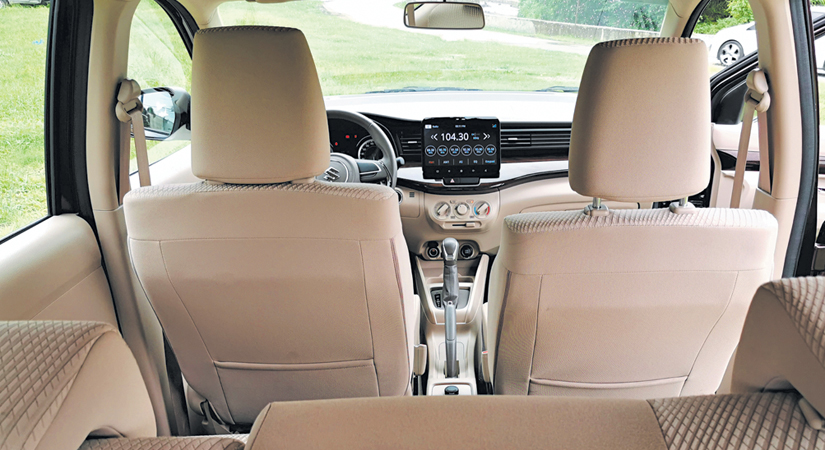
Suzuki Ertiga’s elegant seven-seater fabric seats

The Artico man-made leather or the MB-Tex seat upholstery is now used by Mercedes-Benz. Italian-made Alcantara leather, composed of about 68% polyester and 32% polyurethane, giving the appearance and tactile feel of suede, is now used in private jets and in European luxury cars such as Porsche, BMW M, and in the Lamborghini Gallardo LP570-4 Superleggera and Lexus LC500h. Volvo uses its own synthetic fabric T-Tec upholstery.

In a BBC News report in December 2016, it was reported that Paul McCartney, a staunch vegan, purchased a Lexus kitted out with Alcantara.

Plantbasednews.org reported in March 2018 that the Toyota Prius hybrid uses SofTex, a synthetic fabric that mimics leather, and is also proven to be more breathable than its animal-based alternative. Meanwhile, the Tesla Model X offers a variant with alternative ultra-white synthetic leather seating.

It is heartening to see that many car manufacturers are now coming out with non-leather variants, particularly in their entry- to mid-level cars. Synthetic fabrics are truly more suited to our usually hot and humid climates, as these absorb and radiate less heat when exposed directly to the sun and under the hottest times of the day.

Using faux or synthetic leather is not only compassionate, it is also more environmentally sustainable. It eases the demand for more cattle to be raised and take up more real estate via grazing. Every second, a forested area the size of a football field is destroyed forever due to the global expansion of animal farms.

Owning and driving a cruelty-free car, however, entails more than just eliminating the genuine leather in your ride. There are other ways animal products can creep into the car. Tallow, also known as stearic acid, a hard, fatty substance made from rendered animal fat and commonly used in making candles and soap, is also used to toughen tires and tubing. Steel is coated with lubricants made from animal products.

Right now, it’s still virtually impossible to own a car that’s 100% free of animal products. But taking out the genuine leather component already takes out much of the cruelty involved in making one.

I’m just hoping that someday, our inventive and compassionate scientists and auto engineers may finally produce the synthetic products that could practically replace the stearic acid and lubricants sourced from animals. I do hear that Michelin already manufactures tires using plant-based stearic acid, so, hurray for that. I hope other tire makers follow suit.

I do believe in the innate goodness of people. Given the choice, we would rather not inflict harm upon others. The same should apply with the choice of car we own and drive. Getting around shouldn’t cost a voiceless, defenseless being unspeakable pain and, ultimately, its life. We let the horses and cows go free when we invented the horseless carriage. Why stab them in the back and drag them back for their hides, in an enlightened age when we wouldn’t even dare mistreat our beloved animal companions one bit?