Home Blog Page 9724

Obiena, Tsukii get boost in Tokyo Olympic bids

THEIR Olympic bids may have been sidetracked with the decision to postpone the Tokyo Summer Games to next year because of the coronavirus disease 2019 (COVID-19), still national athletes EJ Obiena (pole vault) and Junna Tsukii (karate) have their quest firmly on sight, aided by aminoVital.

Ajinomoto’s newest sports nutrition brand, aminoVital is rallying behind Olympic-bound Obiena and hopeful Tsukii to see their respective Olympic quests through, providing them with both motivation and power.

“aminoVITAL has helped me maintain my energy in training,” said Mr. Obiena, who was the first Filipino athlete to earn a ticket to the Tokyo Games.

“I train for four hours, and my energy just goes down. But with aminoVITAL, I take a sip at the start and middle of training and I’m full of energy until the end. It’s really helpful, and hopefully, everyone has the chance to try it out,” he added.

aminoVITAL is a jelly-based drink that contains 3,000mg of amino acids, including BCAA (Branched Chain Amino Acid). Paired with proper diet, it can reduce fatigue and muscle loss during high-intensity training and strenuous physical activity.

It is the same effect the Ms. Tsukii is getting, sharing, “aminoVITAL has given me the strength to push myself when I train.”

The Filipino-Japanese karateka, a gold medallist in the 30th Southeast Asian Games, had yet to secure a spot in the Games when the decision to postpone it was made but expressed her determination to do everything she can to achieve qualification in the remaining qualifying tournaments.

aminoVital underscored the need to encourage and support Filipino talent to see their true potential, something it is bent on continue doing with Mr. Obiena and Ms. Tsukii, and other athletes.

aminoVITAL is available on LazMart, an online store on LazMall, and selected Chris Sports branches for just P100 per pack. Simply consume aminoVITAL 30 minutes before any activity and allow yourself to reach heights of physical accomplishments. — MASM

Cancellation

Wimbledon is gone for the year, and, while expected, the decision of the All England Lawn Tennis Club nonetheless underscores the gravity of the situation in which humanity finds itself. Notwithstanding the vagaries of holding a fortnight’s worth of topnotch competition on extremely fickle perennial ryegrass, the tournament has been around since 1877, and through all of history save for a six-year period covering the Second World War. And yet, organizers felt compelled to scuttle the proceedings, chucking tradition, however reluctantly, in favor of public safety given concerns on the spread of the coronavirus disease 2019.

Certainly, the Club considered all possible alternatives before deciding to deep-six this year’s affair. They understood the implications of their choice in the face of Wimbledon’s status as the sport’s premier event. Holding it behind closed doors was a non-starter considering the logistics involved; even without the record crowds, a significant portion of the work force, typically numbering 6,000 or so, would still have been required to be on site and hard-pressed to practice social distancing measures. Meanwhile, postponement was tricky, especially with the prospect of playing indoors ruled out. A new schedule in late August, featuring fewer daylight hours and a surface less predisposed to withstand the change in weather conditions, would have been a stretch.

At a time when sports is viewed by all and sundry as a bright light, the absence of Wimbledon is a decided bummer. Nonetheless, there can be no criticizing the Club for doing the only thing it could under the circumstances. The United Kingdom has been hard-hit by the pandemic, and far better for it to help in the solution than be part of the problem. Parenthetically, it coordinated with other tennis bodies prior to taking a stand; had it pushed through with the tournament, it could well have seen withdrawals from marquee names despite contractual obligations that hitherto ensured their participation.

Which, no doubt, is why the likes of Novak Djokovic and Simona Halep, defending champions in the singles competitions, lauded the Club in the aftermath. Even as the cancellation hurt their cause, it represented a universal acceptance of the need to sacrifice personal objectives for the collective desire to overcome the prevailing threat to life. After all, for successes on the court to happen in the future, the biggest one off it must happen first.


Anthony L. Cuaycong has been writing Courtside since BusinessWorld introduced a Sports section in 1994.

alcuaycong@bworldonline.com

Duterte orders police to shoot troublemakers

By Gillian M. Cortez and Vann Marlo M. Villegas, Reporters

PRESIDENT Rodrigo R. Duterte on Wednesday night ordered police to shoot troublemakers amid a Luzon-wide lockdown meant to contain the coronavirus disease 2019 pandemic.

“My orders to the police and the military, if anyone creates trouble, and their lives are in danger: shoot them dead,” Mr. Duterte said in a late-night speech in mixed English and Filipino.

His order came just hours after residents of a slum in Quezon City protested along a highway near their shanties, complaining that they had not received food packs and cash aid from the government since the lockdown started two weeks ago.

Police broke up the protest and arrested about two dozen people after they refused to go home.

“Let this be a warning to all: Follow the government at this time because it is critical that we have order,” Mr. Duterte said in his speech.

National police chief General Archie Francisco Gamboa said they would not follow Mr. Duterte’s order.

“Of course not,” he told the ABS-CBN News Channel. “Probably the President just overemphasized on implementing the law in this time of crisis.”

“We see the strong message and I think all the Philippine National Police personnel understood it,” Mr. Gamboa said.

In his speech, Mr. Duterte warned leftist agitators not to exploit the poor by instigating them to stage riots.

“Do you understand? Dead. Instead of allowing you to sow trouble, I will just bury you dead,” Mr. Duterte said. “Don’t try the government because this government is not inutile.”

Critics condemned the arrest and urged the government to speed up the release of cash aid promised under a P200-billion program to help the poor and workers who lost their jobs.

“Using excessive force and detention will not quell the empty stomachs of Filipinos who, up to this day, remain denied of the promised P200-billion cash aid for the poor,” rights group Gabriela Women’s Party said in a statement on its Facebook page.

MORE CASES
Mr. Duterte on March 16 ordered a lockdown of the entire Luzon island, suspending classes, work and public transportation to contain the virus that has sickened more than 2,600 and killed more than 100 people in the Philippines.

Eleven more patients died, raising the death toll to 107, while one more patient recovered, bringing the total of those who have gotten well to 51, Health Secretary Francisco T. Duque III said at a news briefing.

The Health chief said the Lung Center of the Philippines and Jose N. Rodriguez Memorial Hospital and Sanitarium have started admitting COVID-19 patients.

The Lung Center has 21 patients who tested positive for the virus and 29 persons under investigation, while Jose N. Rodriguez has 14 positive patients and 13 patients under investigation.

The community quarantine facility of the Quezon Institute will start admitting patients on April 6, Mr. Duque said.

Mr. Duque also said there are now two testing laboratories in the Visayas region after Western Visayas Medical Center got certified to test samples for the COVID-19 virus, along with the laboratory of Vicente Sotto Medical Center.

He also said he expects St. Luke’s Medical Center in Quezon City and Taguig City, Victoriano Luna General Hospital, Bicol Public Health Laboratory and Armed Forces Research Institute for Medical Sciences to be certified for testing soon.

“Because of this, we can process more specimens and speed up the release of results,” he said in Filipino.

The Research Institute for Tropical Medicine in Muntinlupa City can test as many as 1,000 samples daily, while subnational laboratories can test as many as 200 samples a day.

Meanwhile, the Philippines will join the drug trials of the World Health Organization to test treatments for COVID-19.

Marissa M. Alejandria of the Philippine Society for Microbiology will represent the country, while Health Undersecretary Maria Rosario S. Vergeire will be the official liaison of the Health department during the trial.

WHO earlier said that the “solidarity trial” would compare the effectiveness of four drugs and drug combinations against the COVID-19 virus.

The organization said the trial would include participants from Argentina, Bahrain, Canada, France, Iran, Norway, South Africa, Spain, Switzerland and Taiwan. The first patients in the drug trial have been enrolled in Norway and Spain, WHO officials said last week.

Anti-red tape body wants e-payments for gov’t cash aid

THE Anti-Red Tape Authority wants electronic payments for cash aid under the government’s P200-billion program to support the poor affected by a Luzon-wide lockdown to contain a coronavirus pandemic that has brought the economy to a standstill.

“We are talking with LandBank and private e-wallet services to see how we can provide the aid electronically,” Director General Jeremiah B. Belgica said in a mobile-phone message on Thursday.

The body is investigating reports of red tape and are working with agencies including the task force against COVID-19 for possible policy reforms, he said.

Mr. Belgica said they are also coordinating with the Social Welfare department to base the eligibility on annual salary, which is available in employment and social security records.

He said workers may receive their aid through the Social Security System (SSS) through their employer’s payroll. The unemployed may also file a claim through SSS by submitting their updated business permit from the Department of Trade and Industry, he added.

Deputy Speaker Luis Raymund F. Villafuerte, Jr. on Wednesday said the rules have delayed the release of the cash aid.

Under the law that gave President Rodrigo R. Duterte special powers to deal with the outbreak, affected Metro Manila households will get P8,000 in subsidy for two months, while those in other regions will get P5000 to P6000.

Beneficiaries of the Social Welfare department’s conditional cash transfer program may get cash aid directly through their cash cards. Others like jeepney drivers may also file individual claims.

Mr. Belgica said government employees may waive or get disqualified from cash relief because they are still receiving their wages.

Social Welfare Secretary Rolando D. Bautista told a news briefing on Thursday their regional officers have been coordinating with local governments to work on the list of beneficiaries. Validating the list would take time, he added. — Jenina P. Ibañez

Philippine envoy to Lebanon dies after COVID-19 infection

THE country’s envoy to Lebanon has died due to complications from the coronavirus disease 2019, the Department of Foreign Affairs (DFA) said on Thursday.

Ambassador to Lebanon Bernardita L. Catalla, who served the Philippines as a career diplomat for 27 years, died on April 2, the agency said in a statement.

Before being assigned to Lebanon, she took key positions in Kuala Lumpur, Hong Kong and Jakarta and was a passport director, it said.

Ms. Catalla in December led the repatriation of 64 distressed Filipino workers overseas.

“Bernie, as Ambassador Catalla was fondly called, has always lent a helping hand to her family, friends and colleagues,” DFA said.

“Her ever ready smile and infectious laughter may have been extinguished but her dedication to our country will always be there as a guiding light for all members of the Philippine foreign service,” it added.

Foreign Affairs Secretary Teodoro L Locsin, Jr. and Undersecretary Brigido D. Dulay both paid tribute to the late ambassador, who was on the frontline of repatriation efforts amid tensions in the Middle East last year.

Ms. Catalla’s remains will be received by an honor guard, Mr. Locsin said, adding that he would nominate her for a Mabini and Sikatuna award. “Not that she needs more honor than the profound regret and mourning of a grateful service, government, and I hope nation,” he added.

The coronavirus disease 2019 has sickened almost a million people worldwide, killing more than 47,000, according to the Worldometer website, citing data from various sources including the World Health Organization. — Charmaine A. Tadalan

#COVID-19 Regional Updates (04/02/20)

Senators slam NBI over summon on Pasig mayor

LAWMAKERS on Thursday hit the National Bureau of Investigation (NBI) for summoning Pasig City Mayor Victor Ma. Regis N. Sotto for alleged violation of lockdown rules against tricycle operations. Senate President Vicente C. Sotto III on Thursday said that if no law was violated, the Department of Interior and Local Government (DILG) should be in charge of reprimanding local officials. “If a local official has not violated any law, the DILG is the Department that has jurisdiction over him. Not the DOJ (Department of Justice),” the senator said in a social media post. Senator Sotto, an uncle of the mayor, said the Pasig leader did not violate the law as claimed by NBI, considering the incident occurred before the March 24 enactment of Republic Act No. 11469, the Bayanihan to Heal as One Act. Mayor Sotto appealed to exempt tricycles from the lockdown rules so they could ferry health workers to and from work. The national government denied his appeal on March 18. Senator Francis N. Pangilinan also said in a social media post Thursday that the NBI move is in violation of the 1987 Constitution, particularly Section 22 of Article 3 that states, “No ex post facto law or bill of attainder shall be enacted.” — Charmaine A. Tadalan

3 big event venues readied as COVID-19 quarantine centers

THE Inter-Agency Task Force for the Management of Emerging Infectious Diseases (IATF-EID) on Thursday said three large-scale venues in Metro Manila will be ready after next week for quarantine use. IATF Spokesperson Karlo Alexei B. Nograles said in a briefing that the Philippine International Convention Center (PICC), World Trade Center, and the Rizal Memorial Sports Complex will be converted into quarantine facilities as cases of the coronavirus disease 2019 (COVID-19) continue to rise. “We would like to report that the PICC will be ready by April 10; the facilities are being prepared by the DPWH and EEI Corporation and when completed this will have 700 beds. The Rizal Memorial Sports Complex being readied by PRIME — BMD or Razon Group will be ready by April 10 as well, and will be able to house 600 beds,” he said. Mr. Nograles also said that for World Trade Center, this will be ready on April 12. He added “It is being set up by ICCP and Ayala or Makati Dev’t Corp, and it will have 650 beds.” Other venues eyed by the government as quarantine areas are the Philippine Arena, Philippine Sports Complex, and the Cultural Center of the Philippines Complex. — Gillian M. Cortez

Bohol sets up village-level isolation centers

“THE POLICY of Bohol is aggressive prevention.” This was a statement posted by Governor Arthur C. Yap on his Facebook page on March 27 as he called on residents to “assume that we are all asymptomatic COVID-infected individuals,” which is why there is a need for such measures as social distancing, wearing of masks, and undergoing quarantine. Bohol, among the first local governments to have entry restrictions including temporarily closing its airport on March 16, has so far managed to have no person afflicted with the coronavirus disease 2019 (COVID-19) after one case, a Chinese tourist, tested positive but has since recovered. Another measure that is being undertaken in the island province, one of the country’s most popular tourist destinations, is setting up at least one isolation center in every barangay where persons under investigation or monitoring (PUI/PUM) could be housed to prevent the potential spread of COVID-19. “The provincial government of Bohol is requiring an isolation room in each household and if it’s not possible, an isolation area in the barangay should be available,” Mr. Yap said. A total of 1,168 village-level isolation centers are being readied in the province’s 1,109 barangays. “If there are spill outs, municipal isolation centers should also be available,” the governor said. Bohol has one city, the capital Tagbilaran, and 47 municipalities. The provincial capitol’s annex building has also been set up as an 80-bed medical facility to augment the 250-bed Gallares Hospital, which has been designated as the COVID-19 treatment center. As of April 1, the province had 446 PUIs, with 20 admitted in hospital and the rest in home isolation. PUMs, all on home quarantine, were 934. Meanwhile, the provincial government has also set up its Offshore Boholanos Coordinating Team, which is tasked to help locals outside the province, with priority for students and displaced workers, in coming home. Mr. Yap said he has also been discussing with officials of the Land Bank of the Philippines, Development Bank of the Philippines, and First Consolidated Bank “to find ways on channeling funds” to provide economic packages for micro, small, and medium enterprises as well as those in the agriculture and fishery sectors. — MSJ

Rufus asks DoH to expedite approval of more COVID-19 test labs in Northern Mindanao

CAGAYAN de Oro Rep. Rufus B. Rodriguez asked the Department of Health (DoH) to immediately approve more coronavirus disease 2019 (COVID-19) testing laboratories in the Northern Mindanao Region. “While the Northern Mindanao Medical Center (NMMC) in Cagayan de Oro has been selected as a COVID-19 referral center, up to now, it has no testing laboratory and no test kits. The swab samples are still sent to Davao City, causing much delay,” he said in a statement on Thursday. Based on DoH data as of March 31, four institutions in Cagayan de Oro City, the regional center, are still in the self-assessment stage of accreditation. These are NMMC, Xavier University, Polymedic Medical Plaza, and the TB Reference Center. Self-assessment is the first of five stages, with the 5th covering full-scale implementation. — Genshen L. Espedido

Nationwide round-up

PACC’s Belgica says no probe on VP Robredo over COVID-19 initiatives

PRESIDENTIAL Anti-Corruption Commission (PACC) Commissioner Greco B. Belgica said they will not investigate Vice President Maria Leonor G. Robredo over initiatives in helping respond to the coronavirus disease 2019 (COVID-19) outbreak, contrary to a statement by another PACC commissioner. On Thursday, PACC Commissioner Manuelito R. Luna said a probe should be done on Ms. Robredo’s “actions that compete with, or calculated to undermine national government efforts in this time of public health emergency or national calamity.” Mr. Belgica, on the other hand, said in a statement, “It was a PERSONAL opinion and request made by one of the Commissioners of PACC that DOES NOT reflect the sentiments of the Commission.” Ms. Robredo has organized free shuttle services for medical workers and organized a donation drive for personal protective equipment for frontliners in the fight against COVID-19. — Gillian M. Cortez

NBI summons over a dozen for social media posts on COVID-19

NBI
PHILSTAR/EDD GUMBAN

THE National Bureau of Investigation (NBI) said it has summoned “more than a dozen” people over social media posts relating to the government’s response on the coronavirus disease 2019 (COVID-19). “I understand more than a dozen (were summoned),” NBI spokesperson Ferdinand M. Lavin said in a mobile phone message. Mr. Lavin also confirmed the subpoena posted by human rights lawyer Jose Manuel I. Diokno, saying it was issued by its cybercrime division. Mr. Diokno said the NBI is going after “ordinary citizens” who air their sentiments online. “Tinanggap ko ang kasong ito dahil ‘di na makatao ang nangyayari. Ang dami nang namamatay, pati frontliners, pero imbis na COVID, kritiko ang gusto nilang puksain (I accepted the case because what is happening is inhumane. So many people are dying, including frontliners, but they are attacking the critics instead of the virus),” Mr. Diokno said in a social media post. In a subpoena dated April 1, the NBI asked Mr. Diokno’s client to appear at its office on April 7 for alleged violation of Article 154 of the Revised Penal Code or the unlawful use of means of publication and unlawful utterance in connection with the client’s post on “alleged misuse of government funds.” The NBI said that it continues to conduct operations against those who are involved in hoarding and selling of overpriced medical supplies and those subpoenaed by its cyber crime division in connection with “Fake News investigations.” — Vann Marlo M. Villegas

DA beefs up price monitoring

THE Department of Agriculture (DA) said it has strengthened its price monitoring efforts amid reports of suggested retail price (SRP) violations by traders and retailers. “With a stronger Bantay Presyo Task Force, we hope to apprehend erring retailers, unscrupulous traders and hoarders, and file appropriate charges against them for violating the Price Act or Republic Act (R.A.) 7581,” Agriculture Secretary William D. Dar said on Thursday. As part of the government’s response measures to the coronavirus disease 2019 (COVID-19) outbreak, a price freeze policy was set for basic commodities through a joint memorandum circular by DA, the Department of Trade and Industry (DTI), and the Department of Health (DoH). The task force is composed of three teams that are mandated to conduct price monitoring, law enforcement, and adjudication of violators. Those found guilty face a fine of between P5,000 and P2 million and imprisonment of five to 15 years. — Revin Mikhael D. Ochave

Face mask now a must when out of the house

RESIDENTS OF areas under an enhanced community quarantine (ECQ) are now required to wear a face mask when going out of the house. “For areas places under ECQ, the IATF (Inter-Agency Task Force for the Management of Emerging Infectious Diseases) hereby adopts the policy of mandatory wearing by all residents of face masks, earloop masks, indigenous, reusable or do-it-yourself masks, face shields, handkerchiefs, or such other protective equipment that can effectively lessen the transmission of COVID-19,” IATF Spokesperson Karlo Alexei B. Nograles said in a briefing on Thursday. Local governments under ECQ are directed to issue an executive order or ordinance on this policy. — Gillian M. Cortez

Salceda proposes P20B fund for OFWs displaced by COVID-19

ALBAY Rep. Maria Clemente S. Salceda, chairman of the House committee on ways and means, is proposing a P20 billion allocation for the assistance programs for overseas Filipino workers (OFWs) displaced by the coronavirus disease 2019 (COVID-19) pandemic. He cited that about 420,000 OFWs are expected to return home as other countries grapple with the economic fallout from COVID-19. Mr. Salceda said one of the major negative impacts of the crisis that could “persist and inflict structural damage on the economy” is the loss of income and aggregate demand, and remittances of almost $5 billion per year. “That may take 2–3 years before we can restore it to normal levels. We’re highly exposed because some of our best-paid OFWs are sea-based, and that relies on tourism and global trade, which would suffer lingering effects within the next 24 to 36 months,” he said. Mr. Salceda is also proposing that the Inter-Agency Task Force on Emerging Infectious Diseases adopt a unified protocol for handling returning OFWs. — Genshen L. Espedido

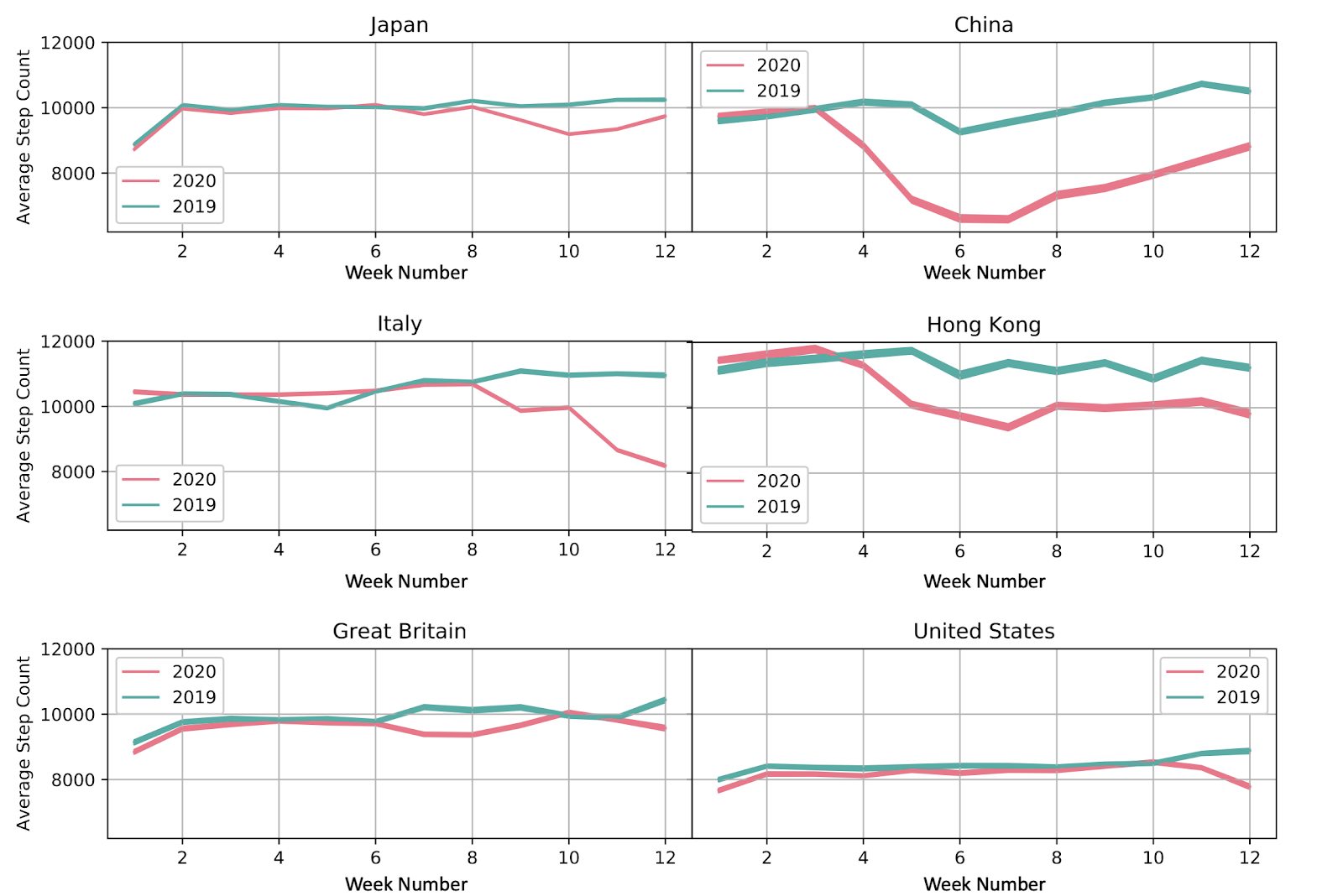
Fitbit data reveals the impact of Covid-19 on global activity

With social distancing schemes and full-on community quarantines cropping up across the globe, the Covid-19 pandemic has had a major, palpable impact not just on public health systems but on all our daily lives. Activity and health tracking firm Fitbit found that, among its 30 million active users around the world, nearly every country studied by the fitness company experienced a statistically significant decline in average step count compared to that of the same period the previous year.

Fitbit data scientists established a baseline for normal activity levels around step count in each area by analyzing the activity of millions of Fitbit users with similar characteristics during the same week from the previous year. Their team correlated step count to general activity, and found that as Covid spread from country to country, activity declined accordingly.

The analysis found that during the week of March 22, 2020, the United States saw a 12% decline in step count. The deviation from normal activity for this time last year, for example, occurred much earlier in the year for countries like China and Hong Kong, which were the first to face Covid-19.

There are reasons for optimism nonetheless, as the data shows that step counts are starting to rise again in China, Japan, and Hong Kong.

Keeping tabs on one’s health during a lockdown

Here are some tips to help focus on your own health and fitness given the current challenges:

  1. Take advantage of guided programs. Health has been made more accessible thanks to a variety of guided programs available online. Discover the best option for you and take advantage of expert insights, food and fitness inspiration, and sleep and mindfulness tools.
  2. Maintain healthy habits like eating nutritious food. Incorporate food rich in protein, vitamins A, C, and E as well as zinc in your daily diet. A good tip would be to add more color to your plate.
  3. Find moments of calm throughout your day. Remembering to take regular mental health breaks is crucial especially in times of uncertainty. Studies show that taking a few moments to relax each day can reduce blood pressure and lower your risk of cardiovascular disease.
  4. Support one another. Invite friends and family to join you in virtual weekly step challenges. Find ways to be physically active whilst keeping in touch with your network.

Industrial design students, faculty create face shields for COVID-19 frontliners

Amidst the COVID-19 pandemic, students and faculty of the University of Santo Tomas (UST) and the De La Salle-College of Saint Benilde (DLS-CSB) have begun producing face shields in a joint effort to help address the shortage of Personal Protective Equipment (PPE) in hospitals and other essential services.

The team, assembled by DLS-CSB professor Joseph Rastrullo and supported by DLS-CSB School of Design and Arts Dean Architect Asela Domingo and Associate Dean Architect Choie Funk, utilized 3D printers to produce laser-cut reusable acrylic plastic.

These frames were designed by students from UST, supervised by Professor Manny Dacanay, who teaches in both institutions. Safety and durability were said to be the main features of the design.

“As to how it actually developed, within the Industrial Design faculty, members were doing separate initiatives along with alumni and eventually came into a united front when we all discussed and shared our ideas online,” said Romeo Catap, Jr., DLS-CSB Industrial Design Chairperson.

So far, 300 units have been produced, with the goal of producing more.

The team has also coordinated their efforts with the De La Salle Philippines network, DLSU-College of Engineering, Benilde’s Fashion Design and Merchandising Program, and the Benildean Industrial Designers to acquire and produce their own PPE substitutes.

#COVID-19 Regional Updates (04/01/20)

Police sets up quarantine facility inside headquarters

THE Kiangan Billeting Center inside the police national headquarters has been temporarily converted as a quarantine facility for officers who are considered patients under investigation (PUI) and persons under monitoring (PUM) for the coronavirus disease 2019 (COVID-19). A total of 152 police personnel are listed as PUIs or those with symptoms of the virus, while 1,422 are PUMs, or those with travel histories and contacts with COVID-19 patients. Ten police officers have so far tested positive for COVID-19, mostly deployed in Metro Manila and parts of Luzon. Meanwhile, Philippine National Police (PNP) chief Gen. Archie Franciso F. Gamboa has tested negative for the disease. “He underwent tests and the result was negative… He remains healthy but is adapting strict biosafety measures,” PNP spokesman Brig. Gen. Bernard M. Banac said on Wednesday. — Emmanuel Tupas, PHILSTAR

In the sardines capital, households get fresh fish as part of food relief program

BFAR-9

THE BUREAU of Fisheries and Aquatic Resources-Zamboanga Peninsula (BFAR-9) office has initiated a program to deliver fresh fish to poor households in Zamboanga City amid restrictions in line with preventing the spread of the coronavirus disease 2019 (COVID-19). The city, dubbed as the sardines capital of the country, is under an enhanced community quarantine, wherein public transport has been suspended apart from limited movement for people. BFAR’s #FishStayAtHome program is in collaboration with the local government, the Philippine Fisheries Development Authority, Southern Philippines (SOPHIL) Deep Sea Fishing Association Inc., and other fishing companies based in Zamboanga City. Under the program, two cold storage facilities have been identified as drop-off points for fresh fish donations from fishing companies. The fish are then distributed to households, with priority given to poor communities, in coordination with barangay officials. As of March 31, BFAR-9 said they have already made four delivery batches with over 1,500 kilos of fish delivered. “Not only the barangays were given food fish donations, but also other government front liners specifically the Philippine National Police,” BFAR-9 reported. Groups — such as restaurants and one led by a Western Mindanao State University professor — that are preparing cooked food packs for frontliners have also been made beneficiaries of the #FishStayAtHome program. Meanwhile, the city government has also been distributing the usual food relief packs containing, among other items, rice and canned sardines. Zamboanga City hosts 12 major canning factories. — Marifi S. Jara

Entire Guimbal town under COVID-19 monitoring after local transmission

RESIDENTS of Guimbal, a town with a population of about 34,000 as of 2015, have all been placed as persons under monitoring (PUM) after local transmission of the coronavirus disease 2019 (COVID-19) was confirmed by health authorities. Two of the 22 confirmed COVID-19 cases in the Western Visayas Region as of March 31 are from Guimbal, located about 33 kilometers west of Iloilo City. “Guimbal fell under the definition of local transmission, meaning the source of the infection is within the reporting location,” Department of Health-Center for Health Development Region 6 (DOH-CHD-6) Director Marlyn W. Convocar said on Tuesday. “Because of that (local transmission), all of the residents should be monitored as PUMs and undergo (14-day) home quarantine,” she added. DOH-CHD-6 officials met with local government leaders of Iloilo province last Tuesday to help address Guimbal’s situation. Guimbal Vice Mayor Jennifer Garin-Colada said the declaration of all Guimbal residents as PUMs would mean an extension of their enhanced community quarantine (ECQ), which already ended March 27. The new 14-day ECQ, which means residents cannot exit the town and no entry will be allowed, started March 31. — Emme Rose S. Santiagudo

Factory activity plunges to record low

FACTORY ACTIVITY slumped to a record low in March, snapping a 43-month growth streak, as the Luzon-wide lockdown due to the coronavirus disease 2019 (COVID-19) pandemic brought factories to a halt.

In a statement on Wednesday, IHS Markit reported that the Philippines Manufacturing Purchasing Managers’ Index (PMI) decelerated to 39.7 last month from the 13-month high of 52.3 in February, signaling a “marked deterioration in operating conditions.”

March was the first time the Philippines’ manufacturing PMI slumped below the 50 neutral mark, breaking its streak of steady growth since August 2016 when the survey for the Philippine leg started.

A PMI reading below 50 signals deterioration in operating conditions compared to the preceding month, while a reading above 50 denotes improvement. The headline PMI measures manufacturing conditions through the weighted average of five indices: new orders (30%), output (25%), employment (20%), suppliers’ delivery times (15%) and stocks of purchases (10%).

“The COVID-19 pandemic took its toll on goods production in the Philippines in March, as the enforced lockdown of Luzon island led many manufacturers to halt operations until restrictions are lifted. These shutdowns led to sharp declines across the sector, with output, new orders, employment and stocks of purchases all falling at record paces,” David Owen, an economist at IHS Markit, was quoted as saying.

The Philippines had the second worst-performing manufacturing activity among Association of Southeast Asian Nations (ASEAN) countries last month, ahead of Singapore’s PMI which fell by a record 18.1 points to 27.7.

IHS Markit said ASEAN manufacturers had their worst month on record, as operating conditions contracted by its steepest pace since the survey began in July 2012. The region’s headline PMI fell to 43.4 in March from 50.2 in February.

“ASEAN manufacturers felt the full force of the coronavirus pandemic in March. The headline PMI dropped to the lowest in the survey’s near eight-year history, amid record contractions of output, new orders, inventories and employment. Notably, March was the first time on record that all of the seven constituent countries posted a deterioration in the health of their respective manufacturing sectors simultaneously,” Lewis Cooper, economist at IHS Markit, said.

Mr. Cooper noted the fallout from the COVID-19 pandemic is likely to be felt for “several months to come, if not longer.”

IHS Markit said the downturn in manufacturing production was due to the enhanced community quarantine implemented by the government in Luzon. This led to shutdowns of factories and a decline in production levels.

Demand from customers also plunged, with volume of new orders falling “at the fastest pace in the series history,” IHS Markit said.

“Exports were similarly down as surrounding countries enforced their own lockdowns whilst curtailing foreign orders,” Mr. Owen said.

IHS Markit also cited lower buying activity as companies scrambled to recover costs and restructure stocks, while inventories of raw materials and stocks of final products also fell.

As input costs fell, companies lowered selling prices drastically to drive sales, IHS Markit said.

However, some manufacturers also had to lay off workers due to production shutdowns.

IHS Markit noted suppliers experienced problems as they saw slower deliveries from China and the ECQ restricted movement of supplies.

“Firms that remained open meanwhile saw a large delay in supplier delivery times, restricting their ability to operate at full capacity,” Mr. Owen said.

As expected, outlook of Philippine manufacturers “fell to its least optimistic in the series history in March.” Overall confidence was slightly positive as uncertainties over the economic fallout from the pandemic remains, IHS Markit said.

“However, hopes of a swift return to normal operations and a rebound in new contracts helped to partly offset these downbeat predictions,” the report added.

UnionBank of the Philippines, Inc. Chief Economist Ruben Carlo O. Asuncion said the government’s move to restrict movement in Luzon, where 73% of the country’s economic activity occurs, “is easily locking down way more than half of the economy.”

“The downward trend may continue unless a modified version of the ECQ is pushed in the coming months, where more restrictions on the movement of people will be lifted including a freer supply chain flow,” Mr. Asuncion said in a Viber message yesterday.

He said implementing a modified community quarantine where movement restrictions will be eased partially along with more relaxed supply chain flow will give the economy higher chances of a sharp recovery.

“As the ECQ buys time for healthcare systems to prepare and not be overwhelmed, the likelihood of economic activity coming back to pre-COVID-19 levels is higher,” he said.

“The ECQ and its effect on limiting mobility and shutting down offices and factories knocked down both new orders and production and we can expect this trend to worsen for the April figures should the ECQ continue,” ING Bank N.V.-Manila Senior Economist Nicholas Antonio T. Mapa said in a note sent to journalists yesterday. — Beatrice M. Laforga


Manufacturing purchasing managers’ index of select ASEAN economies, March (2020)

Manufacturing purchasing managers’ index of select ASEAN economies, March (2020)

FACTORY ACTIVITY slumped to a record low in March, snapping a 43-month growth streak, as the Luzon-wide lockdown due to the coronavirus disease 2019 (COVID-19) pandemic brought factories to a halt. Read the full story.

Manufacturing purchasing managers’ index of select ASEAN economies, March (2020)