Home Blog Page 9723

Peso inches higher ahead of US data

THE PESO traded sideways on Thursday due to profit taking and as the market stayed on the sidelines ahead of US data on unemployment due overnight.

The local unit ended trading at P50.85 per dollar yesterday, appreciating by three centavos from its P50.88 close on Wednesday, according to data from the Bankers Association of the Philippines.

The peso started Thursday’s session at P51 per dollar. Its weakest showing for the day was seen at P51.03, while its strongest was at P50.80 against the greenback.

Dollars traded went up to $424.90 million from $346 million on Wednesday.

A trader said investors were cautious as they await the release of key US data.

“Most currencies globally saw sideways trading as market is awaiting data on US unemployment data,” the trader said in a phone call.

Reuters said the number of Americans filing for unemployment benefit claims likely inched up for the second week in a row with more areas put under stay-at-home measures to prevent spreading the virus.

Initial claims for state unemployment benefits probably surged to a seasonally adjusted 3.50 million for the week ended March 28, according to a Reuters survey of economists. Estimates in the survey were as high as 5.25 million.

Another trader said the peso’s stronger close was on the back of profit taking despite weakness early in the day due to market fears over the impact of the coronavirus disease 2019 (COVID-19).

“The peso closed stronger from intraday profit taking near the 51-peso level after opening weaker as investors grew more wary over the adverse impact of the COVID-19 to the global economy,” a trader said in an e-mail.

COVID-19 has sickened more than 900,000 across the world and caused the death of over 47,000. In the Philippines, infected patients reached 2,311 as of Wednesday, with deaths hitting 96, according to Health department officials.

The first trader sees the peso moving around the P50.70 to P51 levels on Friday, while the second trader gave a forecast range of P50.80 to P51.00. — L.W.T. Noble with Reuters

ADB implements $5 M food aid project for vulnerable communities

THE Asian Development Bank (ADB) rolled out its $5-million project to provide food to up to 55,000 poor households in Luzon affected by the month-long enhanced community quarantine (ECQ).

In a statement, the bank said the $5-million Rapid Emergency Supplies Provision Projected will benefit poor families and workers in the informal sector who lost their livelihoods due to quarantine protocols and business closures.

The first batch was delivered Tuesday, including 2,000 50-kilogram sacks of rice and various food items to the cities of Caloocan, Manila, Pasay, and Quezon.

It said the second batch containing rice, drinks and canned goods will be delivered to families in Malabon Friday.

“This project will ensure that tens of thousands of the poorest and most vulnerable households in the Philippines, our host country, will continue to be able to put food on the table as they cope with the impacts of COVID-19,” ADB President Masatsugu Asakawa was quoted as saying.

He said the program is a joint effort of the ADB, the Philippine government and private institutions here and overseas.

“Through collaboration with philanthropic, private entities, ADB aims to attract more contributions to support the expansion of the program, so more vulnerable households can be supported and for longer periods of time,” according to the statement.

The ADB earlier approved a $3 million grant to the government for medical supplies, testing kits and other equipment.

The bank said it will launch a funding package worth at least $1.6 billion for the Philippines in the coming weeks, consisting of three “quick-disbursing, policy-based loans” worth $1.1 billion and another $500 million in disaster resilience financing. — Beatrice M. Laforga

Current account deficit seen widening to 2.6% of GDP as exports weaken — Fitch Solutions

THE CURRENT account deficit is expected to expand this year to about 2.6% of Gross Domestic Product (GDP) due to weak external demand during the coronavirus disease 2019 (COVID-19) epidemic, according to Fitch Solutions Macro Research.

The current account was in deficit by $464 million in 2019, narrowing from the $8.773 billion deficit in 2018, according to the central bank.

The 2019 deficit was equivalent to 0.1% of GDP, against 2.4% of GDP in 2018.

Fitch Solutions said it is revising its current account balance forecast to a deficit equivalent to 2.6% of GDP in 2020, from the previous outlook of 1.2%.

“The Philippines economy will be hit by the duel shock of a sharp drop off in global demand and a concurrent tightening of global financing conditions,” Fitch Solutions said in a note issued Thursday.

In its report, the Fitch unit noted that the lockdown restricted activity in Luzon, which is the “most important economically.”

Fitch Solutions said the Philippines is likely to experience a pickup in domestic activity that is stronger than the external demand recovery when the outbreak is contained.

“We expect a strong fiscal response in the Philippines focused on infrastructure investment and boasting consumption, which will mean a stronger recovery in import demand relative to exports, as tourism and travel have a delayed recovery,” Fitch Solutions said.

“However, this view is contingent on how long domestic lockdowns last and whether they are indeed expanded to the entire country, instead of just the main island (Luzon),” it added.

Fitch Solutions said that the tourism industry is likely to bear the brunt of the virus which will weigh on service exports. It noted that transport and travel account for around 30% of service export receipts.

“We also do not expect travel restrictions to be lifted quickly, given government’s desire to limit imported cases, distrust of reporting standards abroad and a reluctance to allow capital outflows amid strains on external financing conditions,” Fitch Solutions said.

Before the outbreak, the Bangko Sentral ng Pilipinas (BSP) estimated in November that travel receipts will grow 12% this year.

Fitch Solutions also expects weaker remittance inflows from Overseas Filipino Workers (OFWs) all over the world given the “synchronized slowing global growth.. It expects remittances from the US to grow 1%, the slowest rate since the 2008 financial crisis, with unemployment there expected to rise.

“This will weigh on remittance flows from the US and globally, given the importance of the US as a global source of demand. In addition, a slump in cruise travel will hurt sea-based remittances, which are around 21.7% of the total,” Fitch Solutions said.

Fitch Solutions downgraded its 2020 GDP forecast for the Philippines to 4% from 6% estimated in early March when the lockdown was yet to be imposed and the country had only a few cases. The Philippine economy grew 5.9% in 2019. — Luz Wendy T. Noble

Finding relief from COVID-19

Following the World Health Organization’s declaration of COVID-19 as a pandemic, President Rodrigo R. Duterte issued Proclamation No. 929 on March 16, placing the country under a State of Calamity for six months and ordering an Enhanced Community Quarantine (ECQ) for Luzon to significantly limit the movement of people in the hopes of preventing the spread of the virus.

With the declaration, immediate action is expected from the government, especially when border closures from the lockdown hamper the delivery of essential goods and medical supplies. There is news of donated medical supplies and Personal Protective Equipment (PPE) from neighboring countries, yet calls for more PPE due to scarcity are not unusual on social media. It raises the question of whether the government has implemented any policy to expedite the release of foreign donations and medical imports to reach the vulnerable.

ON RELIEF CONSIGNMENTS
What is the current policy on imports? Under the revised Customs Modernization and Tariff Act of the Philippines, imports are generally subject to customs duties and taxes unless otherwise exempted. One such exemption is imports of Relief Consignments (RC) during a State of Calamity.

RC refers to goods such as food, medicine, equipment, and materials for shelter, which are donated or leased to government institutions and accredited private entities for free distribution or use by victims of calamities. However, there are set criteria and procedures which must be followed to avail of duty and tax exemptions. Otherwise, the imports will be processed as normal and will, therefore, be subject to customs tax and duties.

In a bid to make clearance of RCs a matter of priority, various department of the Executive Branch, Bureau of Customs (BoC), and National Disaster Risk Reduction Management Council issued Joint Administrative Order (JAO) No. 1-2020 on March 16 for the expedient and transparent release of RCs. Below are the salient points of the inter-agency policy:

• To avail of the duty and tax exemption, donated RCs such as food, medicine, medical supplies, clothing, and other in-kind donations must be imported during the state of calamity; must be donated only to a Qualified Donee (i.e., a government agency or private entities accredited by the Department of Social Welfare and Development, Department of Foreign Affairs, Department of Health, and Office of the Civil Defense); and must be for free distribution or use by the affected population.

• RCs which are classified as equipment and materials for shelter must be intended for a specific calamity or disaster-affected area during relief and rescue operation or leased to government institutions or registered, licensed, and accredited private entities.

• The Philippine International Humanitarian Assistance Reception Center One Stop Shop, currently set up at the Ninoy Aquino International Airport customs house, will serve as the facilitator of donated RCs and will be directly responsible for the issuance of permits and identifying entries as RC, including expedited release from customs custody. However, it is still the responsibility of the BoC to release the RCs within 24 hours from receipt of the RC Supplemental form based on the established procedures.

ON CUSTOMS DECLARATION
To further expedite the clearance of significant imports, the BoC issued Customs Memorandum Order (CMO) No. 07-2020 on March 6 to allow provisional declarations. A Provisional Goods Declaration (PGD) is an incomplete declaration allowing the tentative release of shipments as long as the missing information or documents are provided within a reasonable time. It is authorized under the following circumstances:

(1) When no regulatory permit, clearance or license, have been presented at the time of lodgement, provided the importer has filed the application for such permits before departure of goods from the country of origin, before or after the arrival of the goods in the Philippines;

(2) When the Tax Exemption Indorsement from the Department of Finance or Authority to Release Imported Goods from the Bureau of Internal Revenue has not yet been issued, but an application has been filed at the time of lodgement; and

(3) Where the declarant lacks certain information or documents to make a complete declaration, provided it is not due to the declarant’s fault or negligence, and that the mandatory information and documents are present.

In line with this directive, the BoC issued a Memorandum dated March 18, specifically allowing PGD for RCs, provided the Donee, as defined in the JAO above, issues an undertaking to submit the missing documents within 45 days from the release of the shipment, and to use or distribute these only if cleared by regulatory agencies, in case required.

ON FOOD AND DRUG ADMINISTRATION (FDA) CLEARANCE
To align with the BoC’s initiative of expediting the clearance and release of PPE shipments, the FDA issued Advisory No. 2020-420, exempting all foreign donations and company imports of PPEs from securing FDA clearance. The exemption covers face masks, including N95 masks, shoe covers, gloves, head covers, and gowns.

Imports of face masks by companies other than medical device establishments is also exempt from the clearance requirements provided the face masks are used by the employees in the performance of their jobs and are strictly for company use. For imports of PPEs intended for commercial use, the importer need only present his License to Operate and proof of application for notification (such as electronic acknowledgment) for the BoC to release the shipment.

ON EXTENSION OF DEADLINES
The BoC also extended the validity of accreditations of Stakeholders (Importers and Customs Brokers, among others) that will expire during the ECQ under BoC Memorandum dated March 19. They are likewise given one month from the lifting of the ECQ to submit their renewal application. Generally, an importer whose accreditation has expired will be treated as a new applicant if the renewal is filed after the expiry of its license. New applications are usually subject to a more stringent review than a renewal application. Hence, this initiative is vital for importers of medical supplies, among others, to keep up with the increasing demands from hospitals, health workers, and everyone else concerned, which we expect to increase even after the lifting of the ECQ.

Undeniably, the government must provide protective gear for those in the front lines who risk their lives in duty. With the rising cases of COVID-19 infections, the importation and distribution of medical supplies and equipment has become more urgent than ever. Good policies are useless if not implemented properly since time is of the essence in saving lives. I can only hope that we come out victorious from this crisis, regardless of what the government has done, or what it could do better.

The views or opinions expressed in this article are solely those of the author and do not necessarily represent those of Isla Lipana & Co. The content is for general information purposes only, and should not be used as a substitute for specific advice.


Toni Rose Capistrano-Flojo is a Manager with the Tax Services Group of Isla Lipana & Co., the Philippine member firm of the PwC network.

(02) 8 845-27 28

toni.rose.capistrano@pwc.com

What they’re in power for

The Department of Health (DoH) has stopped the local government of Marikina City from testing its residents for COVID-19 despite the considerable efforts and costs of setting up the facility. The DoH said it should be located in a separate building all its own.

The disapproval came in the context of the growing public clamor for mass testing. It has been questioned and criticized for being seemingly driven by the intention to prevent some local government units, specially those run by the political opposition, from being perceived by the public as more efficient and caring than the national government.

Whether valid or not, the suspicion is understandable: the DoH hasn’t exactly been immune from politicking during these difficult times. It ruled out mass testing earlier, presumably and understandably because there were not enough test kits for the entire 108 million population of the Philippines. But the Department nevertheless tested President Rodrigo Duterte, his live-in partner and the rest of his family, as well as administration senators, cabinet members and others whom the media habitually refer to as “VIPs,” or “Very Important Persons.”

We can all quite safely assume that the families and kin of these worthies, and most likely even their friends and acquaintances, have also been tested, test kit shortage or no test kit shortage. But the DoH has coyly denied that it tested and has been testing “VIPs” because, well, they’re “VIPs,” and instead said that testing them was and is being done as “a courtesy.” It’s a distinction that defies understanding, since the “courtesy” was obviously extended to such people as Senator and former Special Assistant to the President (SAP) Christopher “Bong” Go because they’re “VIPs.” All have themselves, or through their accomplices and spokespersons, justified the preferential treatment they’ve been getting from DoH because of the “responsible positions” they hold in government.

He has, so far, not used his being a senator and his having once been Senate President as excuses, but both were obviously in the minds of his cohorts in the Duterte administration when they condoned Aquilino “Koko” Pimentel III’s taking his wife to the Makati Medical Center (MMC) last March 24. Pimentel had tested positive for COVID-19 (the results came in while he was at the MMC) but he may have violated existing quarantine protocols as well as those mandated by Republic Act 11332 by going to MMC while he was already under quarantine, and probably exposing its staff and other individuals to the virus. Among others, Defense Secretary Delfin Lorenzana, who heads the COVID-19 National Task Force, dismissed public outrage over the incident by saying that criticism of Duterte ally Pimentel had “gotten out of hand,” while the Department of Justice (DoJ) said it won’t file charges against Pimentel and will “temper the rigor of the law with human compassion.”

Whether the DoJ will similarly “temper the rigor of the law with human compassion” when it comes to ordinary folk for violating quarantine protocols or even for spreading false information (“fake news”) despite the provisions of the so-called “Bayanihan To Heal As One ” or Emergency Powers Act remains to be seen. But no one should bet anything of value that it will, given its and other government agencies’ enthusiasm with prosecuting the poor and the powerless and excusing the wealthy and well-connected.

The latter is a phenomenon with a long history in this country. It’s now widely known as the impunity of the powerful. As everyone knows by now, if a lesser mortal had done what Pimentel did, the Philippine National Police (PNP) would have arrested and thrown him or her into one of the filthy prisons this country is known for without a warrant and without so much as reading him his or her rights.

The preferential treatment of so-called “VIPs” and their exemption from the application of the very laws they themselves pass are based on the sense of entitlement — of having rights and privileges above others including those who voted them into power — that has always been so characteristic of the upper levels of the government bureaucracy. It’s one more symptom of the authoritarian syndrome that afflicts much of officialdom, and which has always been a threat against this alleged democracy.

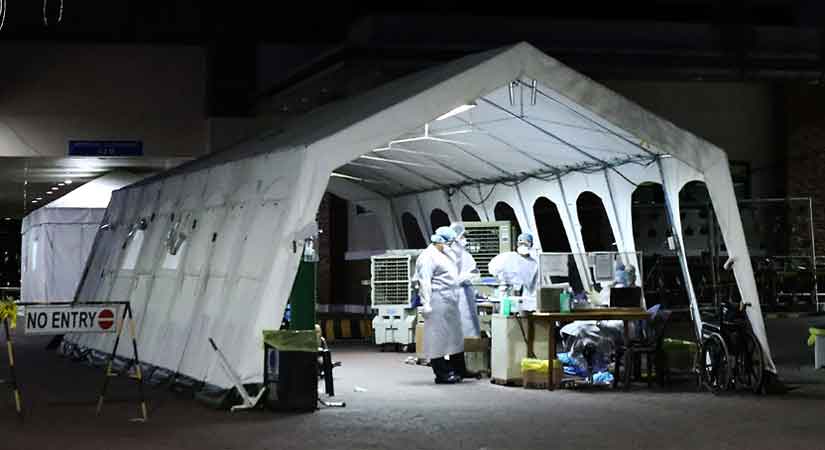
The National Kidney and Transplant Institute set up a tent to serve as a receiving area where medical workers can screen possible COVID-19 patients in Quezon City. — PHILIPPINE STAR/MIGUEL ANTONIO DE GUZMAN

Unaware that there were journalists present, in 1949, or 71 years ago, Jose Avelino of the Liberal Party (LP) summed up in a few sentences the fundamental but secret conviction of this country’s politicians that being in power means not only being above everyone else but also being exempt from the ethical and legal standards to which ordinary folk are subject.

One of his allies denied that he ever said what one of the journalists present later reported by claiming that the reporter could not understand Spanish, which was the language of choice among the Philippine ruling elite. But time has since confirmed that then Senate President Avelino did ask his partymate, then President Elpidio Quirino, what the point of their being in government was, if, like ordinary mortals, they too can be investigated if suspected of corruption and of violating the law.

During a Liberal Party caucus in Malacañang, Avelino was quoted by journalist Celso Cabrera of the Manila Chronicle newspaper as asking Quirino why he was allowing an investigation into government corruption. Translating his remarks from the original Spanish, Cabrera said Avelino went on to say that if Quirino could not permit abuses, he must at least tolerate them, because that is the prerogative of those in power.

Avelino’s subsequent “What are we in power for” bluster has since become the most indicative statement of all on what values drive the Philippine political class, together with his declaration that “We are not hypocrites,” and “We are neither saints nor angels.” Avelino also said that “when we die we will all go to hell. It is better to be in hell because in that place there are no investigations, no secretary of justice, no secretary of the interior to go after us.”

Avelino’s statements still resonate today, seven decades after they were first made. The words are different and said in what the speakers think is English. But whether it’s a president threatening to kill human rights defenders, a congressman justifying his supposed right to pork barrel funds, or a policeman berating, shooting or beating a confession out of a suspect, they still mean the same. They reek with the same entitlement to, and expectation of impunity — the exemption from prosecution and punishment the powerful believe to be their birthright whatever wrong they may commit that in various forms, words and acts the bureaucrats constantly remind us all is their prerogative.

One can imagine today’s politicians’ asking the same thing as Avelino and company did of their fellows and bosses during their closed-door gatherings, and their demanding that they be exempt from the application of the laws they themselves sponsored, approved, and signed because those are only for the observance of the poor and powerless. But beyond that is also the assumption that together with their limitless franchise on impunity is the prerogative of being the first in, and of having the best of, everything, whether wealth, power, education, or health — which during the COVID-19 crisis therefore means the right to be tested first, and, quarantine or no quarantine, the freedom to go and do wherever and whatever they please while the country goes to hell in a handbasket.

That’s what they’re in power for, and they won’t let anyone forget it.


Luis V. Teodoro is on Facebook and Twitter (@luisteodoro).

www.luisteodoro.com

Public strategies against COVID-19: the fine print

Except perhaps for Bill Gates, even top economists and thinkers never expected COVID-19 to be this devastating.

The pandemic has resulted in dramatic shifts in the forecasts of New York University’s Nouriel Roubini. On March 1, Roubini was tentative: “the global recession sparked by Coronavirus doesn’t look totally farfetched.” The tone changed two weeks later: “we will be sure to have a global recession.” He described the virus as the most immediate tail risk, with markets entering correction territory.

Along with PIMCO, JP Morgan, and Morgan Stanley, Roubini predicted two quarters of US economic decline. Underlying this is the expectation that the contagion is yet to peak in three months, in June 2020. Roubini stressed the importance of providing huge subsidies to people who might starve without work. He supported the imperatives of fiscal stimulus given weak economic prospects. He highlighted the need for easy Fed monetary policy given frozen credit and debt markets with overleveraged corporates. He was all for a social protection package of giving every American $1,000, as unemployment hits the roof.

Twice in late March 2020, the economist explained that the pandemic could lead not just to a recession, but to a Greater Depression in the US with adverse global implications. Roubini dismissed a “V”, “U” or an “L” type of downturn and recovery. Instead, he said an “I” is more likely as financial markets and economic activities plummet precipitously. He reiterated the need for loose monetary policy and massive fiscal support.

Roubini assumed a trifecta, or what he called Bermuda Triangle, for the Greater Depression to happen.

First, there is failure of US public health policy. This happens when the government prematurely eases travel bans and lifts quarantine, especially in most heavily infected areas. Restarting the US economy too soon is a bad idea. While this could lead to a temporary resumption of economic activities, there could be a more acute resurgence of the virus, perhaps in a mutated form. The economic and social costs could be many times greater.

This should be a warning to the Philippines. Since health authorities are unconvinced of the viral spread being arrested, the government should not lift the lockdown too soon. Our war is against the virus. It is a virus that kills. Social protection and economic recovery must be considered secondary even as some business tycoons believe that “a floundering economy would be just as dangerous as the coronavirus… pandemic itself.” Lifting the lockdown prematurely would be reckless and might bring us back to a more devastating and uncontrollable “square one.”

Second, higher inflation is induced by sustained monetization of public debt. With imprudent money printing, the US risks becoming like Zimbabwe, Argentina, or Venezuela where hyperinflation is an economic fixture. With negative supply shocks due to workers sent home for quarantine, the US economy might go into stagflation: economic stagnation, recession, and high inflation.

The Philippines should take heed. This warning modifies Roubini’s advice that central banks should throw the kitchen sink of unconventional measures against the uniquely virus-induced economic decline. One example is monetization of public debt because it is cost-free, convenient and it can soften any tendency for market rates to increase. But debt monetization cannot forever support unconstrained fiscal response. Adverse supply shocks like what we are seeing today could reduce the country’s potential growth and printing money could just nurture the seeds of inflation.

Finally, the geopolitics of US-China trade and global cyberwarfare adds more tension to economic depression. This could spell untold global spillovers to the rest of the world, including the Philippines.

Roubini revised his economic assessment within one month. But former US Treasury Secretary Larry Summers of Harvard University was more steadfast. He shared a different view and advised authorities, “to help people get better and to avoid contracting this disease; … (it) is a much better strategy anyway than reducing interest rates below one percent.”

Summers observed, “we are looking at an event that will possibly dwarf the events that have taken place in wars.” He disagreed with the Fed’s recent easing of monetary policy, stressing the superiority of fiscal policy. He argued that “a recession… induced by …people… afraid to gather together in crowds (will be) more difficult to combat with lower interest rates than normal recession.”

Summers urged US officials to “prioritize resolving the pandemic’s medical emergency before trying to rectify its economic fallout.” He was firm that regardless of money to be made available by the US Fed and the budget deficit to run, the problem cannot be solved unless the virus is first contained.

He cautioned the US against abandoning the war too early.

Nonetheless, President Trump appears swayed to open up businesses soon — within

Weeks — regardless of where the virus stands, coupled with efforts to target the unseen virus.

This has local resonance. It is the same view expressed by Philippine businessmen to the Inter-Agency Task Force for the Management of Emerging Infectious Diseases (IATF). Recommendation is to do a parallel approach: put safeguards against the virus, while trying to revive the economy. There is a proposal to allow selected workers to report for work again, with production and distribution of goods and services re-starting. People will just have to be extra careful.

The announced end of the Luzon-wide lockdown should not be the reckoning date of the proposed modified quarantine. The more competent advice of our health experts and scientists should be heeded. Life is more precious than business or politics.

How is the market reacting to public policy announcements so far?

External developments more than dominate the rollout of policy support against COVID-19. With the IMF’s announcement of a global economic recession, global equity markets including the Philippines’ plunged to historic lows. Philippine debt spreads in US dollar over US Treasuries for the two-year and five-year instruments widened by more than 210 bps and nearly 217 bps, respectively, from the end of 2019 to the end of March 2020. Credit default swaps for the same instruments rose from 5.44% and 10.55% at end-2019 to 20.6% and 36.76% respectively, at end-March 2020.

While this viral pandemic is global, the Philippines’ own triumph over the unseen virus is a fundamental element to restoring confidence. Assurance will only come once the budget finally equips our health frontliners, strengthens our healthcare infrastructure, and protects the disadvantaged and the vulnerable. Preparing for economic recovery can then follow.

Summers could be abrasive sometimes. But he was very admirable when he urged US policymakers to spend whatever it takes to control the virus.


Diwa C. Guinigundo is the former Deputy Governor for the Monetary and Economics Sector, the Bangko Sentral ng Pilipinas (BSP). He served the BSP for 41 years. In 2001-2003, he was Alternate Executive Director at the International Monetary Fund in Washington, DC. He is the senior pastor of the Fullness of Christ International Ministries in Mandaluyong.

Running Dry

The imagination is a creative fountain, a source of inspiration and ideas. Occasionally, it is overworked and it runs dry. Artists, writers, composers, architects, designers, professors and scientists experience the disconcerting, disturbing phenomenon called a “mental block.”

The dry spell occurs after a burst of energy _ a theatrical performance, a major thesis, an art exhibition, a book launch, a musical production, the completion of a research project, the discovery of a new serum or an invention of a gadget.

The drought happens after a trauma — from an accident, a debilitating illness, or depression after the death of a loved one. The drive to create and produce is physically exhausting and emotionally draining. Depleted energy cannot be replenished quickly — despite attempts to snap into action.

Burnout appears in the form of listlessness, inertia or the blues. Sometimes, after exhilaration come feelings of frustration or exasperation. After grief, there is a slow period of recuperation and healing.

An Oscar award-winning movie about Shakespeare showed the young English bard undergoing “writer’s block.” He was not able to compose or write until he met an inspiring muse. The romantic movie blended fact and fiction — legend, fantasy, and history. Imagination was used to weave a colorful tapestry that depicted life, love, literature, and theater during the Elizabethan era. Humor and wit gave the film sparkle and incandescence to transcend the elitist aura of the hero. It was created for a broad audience – for a world that does not necessarily appreciate Shakespearean literature.

The director portrayed the literary genius of sonnets and dramatic plays as a young man brimming with passion, at the early part of his career. All these elements explain why he was driven to excel, and the creative force that propelled him to create masterpieces. Despite his immense talent, the proverbial quill of the writer ran dry. In a desperate way. Like ordinary mortals, the young Will needed a spark to ignite the intense flame.

Unlike many of us, the impetuous writer was extraordinarily gifted. His muse inspired him to write Romeo and Juliet.

At some point in life, everyone passes through a sensory desert and into a dimension of suspended animation. Time ticks by in the real world but in limbo, everything seems to be in slow motion (or fast forward). It is as though one is a zombie walking through a dark tunnel or into a vast expanse of nothingness.

Everything seems to be diffused and unfocused. Sounds are muffled or discordant. Fragrances, aromas, tastes are indistinct. Words do not flow.

Images do not take shape.

The numbers and charts seem disjointed. Formulaic computations and rhythms seem out of sync. The zing and zest are missing. Like the elusive pieces of a jigsaw puzzle. It happens suddenly like a mild flu or an allergy that wears you down and forces you to rest against your will. In defiance of your busy schedule and commitments.

A favorite professor once said that one should not panic during a mental block. The mind is never really asleep. It is just undergoing a much needed period of “passivity.” The mind is at rest but it is open to the world around. It is aware and continues to absorb ideas and sensations. He called it a period of “creative idleness.” One can consider it the calm before the storm, the simmering before the explosion. The pen and brush are still.

Months later, the block will dissolve. The dreams shall begin to bloom in full color. Passion will soon burst and flow into the cascading splendor of luminous creativity.

In this prolonged season of eerie silence, we have a forced retreat away from the normal busyness of daily life.

Everything is frozen in the city. One cannot hear the sounds of playful children in the park. Occasionally, one hears a distant toot. The absence of noise and toxic fumes is soothing. One sees the cloudless blue sky. The tired trees are shedding leaves. New buds are appearing on the twigs and bushes. The river and the sea are no longer gray. The water is becoming clear and the fishes are swimming freely. Mother Earth is starting to heal.

People are becoming introspective. Families are bonding and praying.

One day, divine grace will flow and a miracle will happen. This crisis will pass.


Maria Victoria Rufino is an artist, writer and businesswoman. She is president and executive producer of Maverick Productions.

mavrufino@gmail.com

Duterte and prudential judgment

The thing is: absolutely no one really knows where we are and what’s going to happen as far as this pandemic is concerned. There’s data available but even numbers by themselves can’t give the exact picture. Also, subtle differences in context can lead to hugely different implications.

Take, for example, the test kits everyone is relying on to spot a person infected with the new coronavirus. Diagnostically, such are immensely helpful in treating an infected person. But for data purposes, that’s another story. A test could only tell if a person is infected — at that time — but what it can’t do is predict the condition of that person’s health later. Add to that the problems with false negatives, which can happen if a person is tested too early, or — worse — false positives, which occurs due to possible cross reactivity with other medical conditions.

Even numbers that seem straightforward, such as the death rate, have complications. As Matthew Lee Anderson points out: “In Italy, about 10% of people known to be infected have died. In Iran and Spain, the case fatality rate is higher than 7%. But in South Korea and the US it’s less than 1.5%. And in Germany, the figure is close to 0.5%.”

“So what gives? The answer involves how many people are tested, the age of an infected population and factors such as whether the healthcare system is overwhelmed.” It can even happen that “the numbers may look different even if the actual situation is the same.”

Then there are the conflicting expert reports. Imperial College’s study, upon which the United Kingdom based its early “herd immunity” strategy, forecast a possible 500,000 deaths within the UK. This was seemingly (“seemingly” because, as commentators contend, Imperial College did lay caveats) contradicted later by an Oxford study, ironically released a day after the UK abandoned its “herd immunity” strategy for a lockdown. Oxford offered the possibility that half of the British population is already infected, implying the virus has far less lethality (forecasted deaths at 20,000 or less, with a UK population of around 68 million).

This leads to the question of the probable situation in the Philippines. As of this writing, the Department of Health (DoH) announced 2,084 people infected. But the fact is, that doesn’t mean 2,084 people are infected. It only means the DoH tested X number of people out of 110 million Filipinos and found 2,084 infected as of that date.

Hence, if the Oxford study is applicable, millions of Filipinos have already been infected, are walking around freely or in their homes, asymptomatic or exhibiting mild or tolerable symptoms. It also offers the possibility of the pandemic’s peak being earlier. Notably, just this week, The Lancet published a study claiming a much lower death rate: .66%.

Then, there’s the heat: which doctors say expands the virus and slows transmission. Currently, Philippine temperature is at 35°C. Wuhan’s was 10°C in February 2020, Italy 16°C last March.

The virus reportedly also has a more negative effect on older people or those with underlying health problems. And indeed, our data shows 75% of deaths are those 60 years old and above. With that, our demographics gain significance: 53% of our population is 0-24 years, 0-54 is 90%. Our median age is 23.7. Compare that with Italy’s 47.3 (23% of residents 65 or older), the US’ 38.3, and China’s 38.4. Looking at our neighbors with almost similar weather and circumstances, Indonesia’s infected to population rate (to date) seems to be at .0008%, Thailand .002%, and Malaysia logging badly at .005%. The Philippines (as of March 31) is .0019%. Italy, worst hit worldwide so far, hasn’t breached 1%.

If we assume Malaysia’s current numbers, then we likely have a peak of 8,800 infected, with 616 deaths (assuming 7%). If we use however Malaysia’s own assumption of peak infections at .02% of the population, then we’re looking at 22,000 infected for the Philippines. Assuming a high range death rate, 7% (currently ours stands at 4%), we are looking at 1,540 deaths. If The Lancet is correct, then 145 deaths (using 22,000 infected as base).

For context, there are annually 580,000 deaths in the Philippines, with flu or pneumonia accounting for 76,000 (or 12%) per year.

Which leads us to the concept of “prudential judgment,” defined (Wiki) as “one where the circumstances must be weighed to determine the correct action. Generally, it applies to situations where two people could weigh the circumstances differently and ethically come to different conclusions.” It is “the application of moral principles to a particular case… [recognizing] that we live in an imperfect world, in which achieving pure goodness is not always possible.”

Prudential judgment recognizes that we obviously are without the luxury of hindsight, that data can be interpreted in various ways, and people of good faith working on similar information can still disagree on the conclusions.

Prudential judgment is now in play because President Rodrigo Duterte, amidst all the uncertainty, conflicting opinions, and unimaginably difficult trade-offs, is confronted with a stark (not necessarily binary) choice: lift the Enhanced Community Quarantine as scheduled (on April 15) or keep going for a longer period (perhaps even indefinitely).

Either option comes at considerable costs.

Definitely, every single life is valuable, and the abovementioned 145 to 1,540 deaths are not mere numbers but actual people. On the other hand, it’s palpable that the population is under considerable physical, psychological, and financial strain. As usual, the worst hit are the poor. People must realize: one can get sick or die from the virus but a broken economy or the stress of being locked-up or unemployed can also sicken or kill people, perhaps even on a worse scale.

First Things’ RR Reno, writing about this monumentally tortuous choice faced not only by the Philippines but other nations as well, reminds us somberly that: “Alexander Solzhenitsyn resolutely rejected the materialist principle of ‘survival at any price.’; It strips us of our humanity. This holds true for a judgment about the fate of others as much as it does for ourselves. We must reject the specious moralism that places fear of death at the center of life.”

So everything now rests on President Duterte’s judgment.

“Executive power shall be vested in the president,” says Article VII of the Constitution.

Not the Congress or the Supreme Court. Not even the Executive Branch. The president. Our constitutional system was so designed that in times of crisis, decisions are to rest with one individual for “speed, flexibility, unity, and dispatch.”

It’s overwhelming to think that such a huge decision rests with one man but there it is. That is the system we’ve chosen.

All things considered, this column believes reasonable effort should be made to consider lifting the lockdown by Easter Sunday, with flexibility of deciding otherwise depending on events or circumstances on the ground.

Thus, it’s suggested here that the best course of action is to open businesses, transportation (domestic land, sea, air), and then, a week later, open classes. With the following maintained:

Strict health and social distancing policies in all public or work places;

Apply random testing for data gathering and monitoring;

Mass testing through schools, offices, parishes, or Barangay centers;

Continued quarantine for those 65-above, and those with chronic illnesses;

Continue indefinitely the travel ban for tourist and non-essential travel, with two week quarantines for those coming from abroad;

Stop POGO operations completely;

Transfer all coronavirus testing and treatment to specially designated medical centers, away from other public and private hospitals;

Allow religious services but discourage larger public gatherings;

Close theaters, restaurants, and bars by 10 p.m. for one more month; and

Focus medical attention, monitoring, and care for those 55-64 years old (6% of population), above 64 (4%), and those with chronic illnesses.

Also suggested are further citizen assistance, through the president’s additional powers or by Congress itself, including:

Income tax holiday for Metro Manila/Calabarzon employee salaries from March-June;

Income tax holiday for vital industries (including medical and academic institutions) and Metro Manila/Calabarzon SME’s, to the 3rd quarter;

Near zero interest on and continued availability of bank credit or loans for individuals and SME’s;

Waive Metro Manila/Calabarzon electric and water bills for March-June.

Studying other countries’ experience and actions may be helpful but, in the end, the Philippines, with our own particular circumstances and conditions, must decide on its own path.

Example: it’s misleading to think “lockdowns” are uniformly applied everywhere, even if the same terminology is used. The nature of a US lockdown (the extent usually decided at the State level) or Italy (with a continually operating transportation system) is different from here where masses of people live utterly close to each other and where food supplies are reportedly hampered due to varying local government checkpoints.

Ultimately, for us, it all boils down to one man. Let’s hope, for everyone’s sake, that President Duterte’s prudential judgment decides correctly for the Philippines.


Jemy Gatdula is a Senior Fellow of the Philippine Council for Foreign Relations and a Philippine Judicial Academy law lecturer for constitutional philosophy and jurisprudence.

https://www.facebook.com/jigatdula/

Twitter @jemygatdula

The Philippines was an economic star. Until Covid-19

By Daniel Moss

JUST WHEN THE PHILIPPINES was finding its groove after decades in the economic wilderness, along came the Covid-19 pandemic.

During the past five years, growth averaged more than 6% and was projected to exceed 7% this year, vaulting ahead of long-time regional stars like China, Indonesia and India. More likely now is an expansion of just 3% in January to March, followed by a contraction the next two quarters, according to the central bank. Steep cuts to interest rates and purchases of government bonds won’t alter that prognosis; it’ll merely prevent the damage from being worse still.

Now the capital, one of the world’s most densely populated cities, is on lockdown to stem the surge of infections. The Philippines had at least 2,084 cases and 88 deaths as of Tuesday. Cargo is piling up unclaimed at Manila’s port and food is being held up at some checkpoints. The main island of Luzon, which is home to 60 million people and generates about 70% of the country’s gross domestic product, is effectively shut off from the rest of the archipelago and the world.

As sobering as these numbers are, the human drama behind them is even starker. More than 10 million Filipinos, or about 10% of the population, work abroad at any given time, cooking, cleaning, providing care, building things, and staffing commercial ships. Their remittances account for about 10% of GDP. From construction workers in Saudi Arabia to nannies in Italy and Singapore, this diaspora keeps an entire ecosystem afloat at home. Their wages help feed, clothe, educate, and put a roof over the heads of the grandparents and siblings who often raise their children.

That revenue stream is bound to take a hit this year; the central bank reckons that remittance growth may be closer to 2% than the 3% previously projected. Leaving aside travel curbs at home, much of western Europe is shuttered and major airlines are mothballing fleets. In an effort to curb large scale gatherings, Singapore authorities have strenuously discouraged foreign workers — many of whom are Filipino — from congregating around places like Lucky Plaza on Orchard Road during their day off. The mall is home to a plethora of remittance services, a vital channel for getting cash back home given that almost half of foreign domestic workers lack bank accounts in the city-state.

Then consider call centers, another key pillar of the Philippines economy. Known as business process outsourcing, or BPO, the industry has surged in the past two decades to account for about 8% of GDP from almost nothing in 2000. For many young people, who speak American-tinged English, these centers were a critical local alternative to life working overseas. When I visited one in mid-January — RPV Native Commerce, which has since been renamed Scalewind Corp. — its chirpy young employees said they felt lucky to be working in one of the world’s great back offices.

The sector’s success helps explain why President Rodrigo Duterte has granted exemptions for BPOs to keep running despite the broader lockdown. The hassles of getting to work during curfew, however, make the loophole almost worthless. Malou Sebastian, who runs the Scalewind facility, scrambled to keep operations running after Duterte’s announcement. She originally set aside space for workers to sleep and eat, then resorted to distributing laptops to staff who faced obstacles commuting, given curbs on public transport.

“The decree lasts until April, but frankly, things are changing by the day,’’ she said when I caught up with her by phone, adding that it feels like she’s living in the television action-drama 24 (TV series), where each episode is an hour in the life of a counter-terrorism agent. There’s little use being open for business when employees have trouble walking through the door. “I just went out on the street and couldn’t see a single bus.”

The economic blow comes just as the Philippines’s growth prospects had reached an inflection point. In recent decades, as many East Asian nations began to develop manufacturing export bases, the country was held back by graft, ineffective autocracy, and powerful oligarchs in agriculture and property, many of whom traced their privilege to the era of Spanish colonial rule. As a result, the country missed the big wave of Japanese investment that followed the Plaza Accord in 1985, which triggered a huge appreciation of the yen and made production abroad cheaper. By the 1990s, China and economies along its supply chain were the hot game. Again, the Philippines missed out. It exported people, but not a lot else. In 2000, per capita GDP was basically stuck at 1980 levels.

Then things started to turn around, largely thanks to Beijing’s outward investment. China was the largest foreign investor in the fourth quarter of 2019, exceeding the US and South Korea. Mainland money has flooded into sectors spanning infrastructure, telecommunications and gaming. During my visit, it was impossible to miss the banks, spas, realtors, hotels, and concert arenas dotting a neighborhood near Manila Bay, all geared toward Chinese tourism and investment. The big question is whether that largesse will evaporate in the post-virus era and if the Philippines, a former US colony, can tap China’s financial heft without acceding to its strategic goals.

This pandemic will no doubt test the nation’s economic aspirations. But long used to adversity, citizens must resort to their wits and pragmatism. “Filipinos are very flexible and resourceful people,” Sebastian told me. “We will get through this.”


BLOOMBERG OPINION

Wimbledon cancelled

LONDON — The Wimbledon championships were cancelled for the first time since World War Two on Wednesday as the coronavirus pandemic struck another blue-riband sports event off the calendar and wiped out the entire tennis grasscourt season.

While the decision had looked inevitable for some time, since the virtual shutdown of world sport and the postponement of the Tokyo Olympics, Wimbledon had been one of the few events not to have been officially cancelled or postponed.

But after emergency talks between the various stakeholders over the last few days, the All England Lawn Tennis Club (AELTC) announced that it was impossible for the grasscourt Grand Slam, scheduled for June 29–July 12, to take place.

“It is with great regret that the main board … have today decided that The Championships 2020 will be cancelled due to public health concerns linked to the coronavirus epidemic,” the AELTC said in a statement.

“The 134th Championships will instead be staged from June 28 to July 11, 2021.”

Following the cancellation of the grasscourt major, and with the pandemic worsening in Europe and the United States, the men’s ATP Tour, women’s WTA Tour and the International Tennis Federation extended the suspension of professional tennis for another five weeks to July 13.

“At this time, tournaments taking place from July 13, 2020 onwards are still planning to proceed as per the published schedule,” said a joint statement from the governing bodies.

Britain’s death toll from the virus reached 2,352 on Wednesday, according to National Health Service figures.

The French Open, originally due to be held from May 24–June 7 was postponed and controversially rescheduled by the French tennis federation for Sept. 20–Oct. 4, shortly after the end of the US Open.

The US Open organizers said they were continuing with their plans to host the hardcourt Grand Slam in New York as scheduled from Aug 31–Sept. 14.

NO VACCINE = NO TENNIS
Players across the tennis fraternity reacted with shock and sadness at the cancellation of Wimbledon.

Roger Federer, whose record haul of 20 Grand Slam titles includes eight Wimbledon trophies, said he was “devastated.”

“There is no gif for these things that I am feeling,” he added.

In a statement from the organizers of the Halle Open, which was also cancelled, Federer said: “We are going through difficult times but we will emerge stronger. I already look forward to returning to Halle next year. Stay healthy.”

Former Wimbledon champion Amelie Mauresmo did not think either the US Open or the French Open would go ahead this year.

“I think we’re going to have to draw a line under the 2020 tennis season,” Mauresmo said on Twitter this week.

“International circuit = players of all nationalities plus management, spectators and people from the 4 corners of the world who bring these events to life. No vaccine = no tennis.”

Unlike the French Open which is played on clay, Wimbledon’s scope for re-arranging the start date was extremely limited.

While Centre Court and Court One boast a roof, playing elite-level tennis outside on grass would have been extremely challenging in late summer or autumn with a lack of light and problems caused by dew forming on the surface late in the day.

Shortening the format of the tournament, or playing behind closed doors, would also have proved extremely unpopular with the players.

“While in some ways this has been a challenging decision, we strongly believe it is not only in the best interests of society at this time, but also provides certainty to our colleagues in international tennis given the impact on the grass court events in the UK and in Europe and the broader tennis calendar,” AELTC Chief Executive Richard Lewis said.

Tickets holders will be offered the chance to purchase tickets for the same day and court for 2021 championships as well as being issued with a refund for this year’s event, organizers added.

Wimbledon had been held every year since 1946 after a six-year hiatus because the country was at war. — Reuters

ESPN hopes docu The Last Dance provides an escape amid COVID-19

AS THE WORLD continues to grapple with the growing concern over the coronavirus disease 2019 (COVID-19) pandemic, American sports channel ESPN hopes to provide some form of escape by moving up the showing of the much-anticipated documentary series The Last Dance.

The 10-part series about basketball legend Michael Jordan and his 1990s Chicago Bulls squad will now be shown beginning April 19, much earlier than its original intended screening date in June.

ESPN said by doing so it would be providing people who are longing for their steady fix of live sporting events with a temporary reprieve from the cloud of uncertainty and concern that the COVID-19 pandemic has brought.

“As society navigates this time without live sports, viewers are still looking to the sports world to escape and enjoy a collective experience. We’ve heard the calls from fans asking us to move up the release date for this series, and we’re happy to announce that we’ve been able to accelerate the production schedule to do just that,” said ESPN in a statement as it announced the early release of The Last Dance.

“This project celebrates one of the greatest players and dynasties ever, and we hope it can serve as a unifying entertainment experience to fill the role that sports often play in our lives, telling a story that will captivate everyone, not just sports fans,” it added.

To reach more people, the documentary series has been made available outside of the United States as well by way of Netflix.

The Last Dance chronicles the quest of Jordan and the Bulls and features never-before-seen footage from the 1997–98 season as the team pursued its sixth NBA championship in eight years.

It was directed by Emmy Award-winning director Jason Hehir whose body of work includes The Fab Five, The ’85 Bears and André the Giant.

The series takes the audience to Jordan’s early roots as player, how he built his legend with the Bulls, showing their struggles as a team after drafting “MJ” in the 1984 draft and eventual ascent to the NBA summit.

It provides the backdrop for the inside tale of the 1998 championship run, with extensive profiles of Jordan’s key teammates including Scottie Pippen, Dennis Rodman and Steve Kerr, head coach Phil Jackson, and featuring dozens of current-day interviews with rivals and luminaries from basketball and beyond.

All throughout the documentary, the tension and conflict that defined that final championship run, culminating in the six-game conquest of the Utah Jazz in the finals, are very much on display.

“Michael Jordan and the ‘90s Bulls weren’t just sports superstars, they were a global phenomenon,” said Mr. Hehir.

“Making The Last Dance was an incredible opportunity to explore the extraordinary impact of one man and one team. For nearly three years, we searched far and wide to present the definitive story of an era-defining dynasty and to present these sports heroes as humans. I hope viewers enjoy watching our series as much as we enjoyed the opportunity to make it,” he added.

The Last Dance runs for five weeks over ESPN until May 17. Outside of the US over Netflix, episodes 1 and 2 will be aired on April 20 and succeeding episodes every week after until May 18. — Michael Angelo S. Murillo

Data from Fitbit show global physical activity slowdown due to coronavirus

THE coronavirus disease 2019 (COVID-19) pandemic has undoubtedly affected how people do their affairs, including in engaging in physical activities.

In data shared by global wearables brand Fitbit, as the battle against COVID-19 rages on, physical activity levels worldwide as seen from its 30 million active users have slowed down.

As countries adapt to social distancing and community quarantines in light of COVID-19, countries studied by Fitbit experienced a statistically significant decline in average step count, compared to that of the same time in the previous year.

In coming up with their numbers, Fitbit data scientists established a baseline for normal activity levels around step count in each area by analyzing the activity of millions of Fitbit users with similar characteristics during the same week from the previous year.

The result showed much decline, with the United States, for instance, during the week of March 22, seeing a 12% decline in step count.

In the Philippines, the slowdown was pegged at a bigger drop of 27% with the entire island of Luzon put on enhanced community quarantine (ECQ) to stop the spread of COVID-19. Other parts of the country then followed suit.

Under ECQ, people are asked to stay at home and limit movement outside so as not to increase the chances of developing the disease.

The Fitbit data also showed that in countries like China and Hong Kong, which were the first to face COVID-19, the deviation from normal activity for this time last year occurred much earlier in the year when they were in the thick of the battle against the disease.

Numbers in said countries have steadily been improving with step counts on the rise anew as they try to get back to normalcy.

While the decline in physical activity is to be expected considering the situation the world is in with COVID-19 and concentrating on health and fitness is a challenge, Fitbit still underscored the need for people to be on top of things as far their health goes.

It has offered some tips to assist individuals, particularly Fitbit users, during these tough times.

Fitbit said maintaining healthy habits like drinking lots of water and eating nutritious food would go a long way as well taking mental health breaks.

Submitting to various programs including those offered on Fitbit Premium should help as well as these would jolt them to move and work out.

Supporting each other by way of the Fitbit Challenges where one can start friendly competitions with friends and family would be a big boost as well.

In the Philippines, Fitbit has steadily grown its presence, riding eagerly on its mission of making health and fitness accessible to more consumers with new and innovative products. — Michael Angelo S. Murillo