Home Blog Page 9715

Politics and Crisis: A Discussion SeriesFraming the Crisis Conversation

By the Ateneo de Manila Department of Political Science

(First of an eight-part series)

EACH CRISIS is disruptive and instructive.

The Department of Political Science of Ateneo de Manila University (AdMU) invites readers to join this series as we attempt to make sense of the ongoing COVID-19 crisis and learn early lessons from it. We read the coronavirus outbreak as primarily a public health and safety concern with attendant issues of politics and power dynamics in decision making. As the crisis unfolds, political decisions will not only affect lives, but also the course of States the world over.

Each piece in this series examines sites of consensus and points of tension and debate at the local, national, regional and global levels of governance, as well as in critical spaces where they overlap. We hope to highlight effective political practices and problematic ones and the social and political constraints that citizens and governments need to confront in addressing the crisis.

Even in times of crisis, the AdMU Department of Political Science continues to advocate for: evidence-informed policy making; institutional over personal political agendas; and, critical pedagogy as an approach to citizenship education. Hence, this political discussion series.

COVID-19 CRISIS AND STRUCTURAL CHANGE
Each crisis carries the potential for structural change.

The COVID-19 crisis is not only claiming lives, it is changing structural relations all over the world: how nations are governed, how nations cooperate, how nations secure themselves, how markets and industries are run, how work is organized, how products are consumed, how services are exchanged, how learning is conducted, how communication is delivered, and, how states and societies relate to one another. Because of the crisis, new concepts and practices have surfaced. People across the globe are adjusting to new practices: “social distancing,” “online learning,” “working from home,” “lockdown,” “travel ban,” “community quarantine.”

The potential for change, however, is often not as visible as existing structural flaws. The COVID-19 pandemic has exposed the flaws, for example, in public health systems everywhere, in both developed and developing countries. Furthermore, that all-dominant phenomenon of globalization where global markets rule is now being questioned. Countries everywhere are now putting up borders instead of breaking them.

People are now questioning what global wealth and abundance mean given the evident lack of resources to combat COVID-19. The pandemic is highlighting global poverty and insecurity, not global wealth and security. The world is now reckoning with the human, social and environmental costs of unbridled, borderless, global production and exchange.

The putting up of national barriers is not entirely new. In recent years we have witnessed various advocacies for the fortification of national borders. We have also seen how these advocacies are linked to racism and protectionism (think Trump and Brexit). Today, these right-wing advocates are quick to use the COVID-19 crisis as a pretext to bolster their racist and protectionist calls. Meanwhile, the call by left-wing advocates for the world to “deglobalize” is also now being heard.

The “global” in this “global pandemic” must thus be thoroughly examined. While borders are being put up to contain the pandemic, the fact of the matter is, no nation can sufficiently address the pandemic on its own. No matter the current questioning of globalization, the world will have to cooperate to combat a virus that doesn’t recognize race or borders.

GLOBAL PANDEMIC, LOCAL CONTEXTS
This crisis is unique for each context.

“Global” does not only mean scale. “Global” also means depth. This entails not just a perspective from global norms but also an appreciation of the inevitable dropdown to the local context. And, while there is a need to “learn from best practices,” there is also a need to understand what will make a national situation unique: which sector is most vulnerable, which intervention is most effective and which weaknesses and strengths can be drawn from previous experiences.

As of this writing, in the Philippines, the sectors made most vulnerable by the COVID-19 crisis are the health workers and frontliners, workers in the informal economy, and, small- and medium-sized enterprises (SMEs). It must be remembered, however, that for the Philippines, “the global” has one face: the Overseas Filipino Worker (OFW). The strategic impact of the crisis on OFWs and on our economy that is remittance-driven and consumption-led cannot be overstated.

The status of OFWs as a vulnerable sector is now amplified because of the emerging stigma attached to OFWs as likely carriers of the coronavirus. OFWs are often valued by Philippine society and their hometowns as sources of remittances and by their countries of destination as much needed labor. Here or abroad, these OFWs are viewed primarily as workers or consumers and not as citizens. In both home and host countries, the needs of the more “permanent” population are first attended to by national and local governments and the needs of the “mobile” population viewed as secondary concerns.

Governments neglect the reality, for example, that social distancing is very difficult for OFWs. Living conditions for many OFWs (i.e communal or dormitory type quarters) already put them at risk and most OFWs receive little or no support from employers or host states at a time of crisis. Moreover, their prospective return has been viewed largely as a risk by some LGUs who have refused to accept even their own returning OFWs. The reality is, for mobile populations, exposure to the virus is real along with the potential to infect others. However, there should be a way to address this concern with inclusive social guidelines that do not stigmatize and exclude them.

Given the series of political upheavals especially in the Middle East, natural calamities, and migration policy changes in OFW-heavy host States, migration sector advocates have been repeatedly warning the public about the country’s capacity to absorb returning migrants in the case of the “big one.”

The COVID-19 pandemic could be that “big one.” Massive OFW job loss will mean OFW families moving from “middle class” or “non poor” to “poor” as remittances abruptly stop. National and LGU response must include the welfare of OFWs and their families which include solo parents, senior citizens, and school aged children. In 2019 alone, these remittances reached $35.1 billion.

The government (both national and local) will have to keep an eye on the occupations that will be hit the hardest: domestic workers, cruise ship workers, hotel workers. The government must also anticipate that the demand for healthcare workers abroad will increase, and this will further burden our already tapped out healthcare system.

Given our highly mobile population, the transmission of any disease will always be “international” and never just “local.” This means that our public health system must be equipped to care for both permanent and mobile populations.

The COVID-19 crisis reveals a break in the “OFWs as new heroes (mga bagong bayani)” discourse because it asks the Philippine State to genuinely assist these OFWs as part of the larger Philippine population, rather than “reward” them for their service to the country. They are returning, their situation is vulnerable, and they are ours.

CRISIS GOVERNANCE: FLEXIBLE, NOT DRACONIAN
Draconian measures do not equate to strong crisis response.

Crisis governance is often equated with giving governments the license to implement draconian measures even at the expense of democratic checks and balances and democratic rights.

In the context of a crisis, decision making stakes are evidently higher. The expectation for government to put forward a novel policy and strategy immediately is unavoidable.

Some scholars (see Martin, 2013), suggest that flexible governance has been proven to be more effective than command systems in times of crisis. This means that “there are methods for making and implementing decisions affecting entire communities in ways that enable rapid adaptation to new situations.” This kind of governance, Martin further claims, requires “flexible technological systems” and is based on “participation, high skill levels, robust debate, and mutual respect.”

This is reflected by evidence from an earlier outbreak (the SARs experience in Singapore) that highlights coupling “fast moving” social policies that required adherence with winning public support as necessary to effectively communicate the urgency of the task at hand (Yan, Pang and Cameron, 2006). The article asserts that the policy of strict regulation on patients, caregivers and medical practitioners was implemented alongside financial relief in this sector: subsidized hospital rates and drugs for patients; and paying for medical costs of the medical practitioners in recognition of their frontline role in the crisis.

During crisis moments, the challenge to governments, including our own, is to direct citizen participation towards critical thinking, innovation, and cooperation — not to suppress it. Change will not come from those who govern alone. Crisis governance also requires governments and citizens to be guided by data and not by alarmist or baseless assumptions. Moreover, governments must be strategic in communicating concerns and decisions to its various publics.

Nationwide round-up

Charter airline grounded after medevac plane crash

THE ENTIRE fleet of charter airline Lionair, Inc. has been grounded following Sunday night’s crash of one of its medical evacuation (medevac) planes at the Ninoy Aquino International Airport in Manila, killing all eight people onboard. “While investigation on the medical evacuation plane RP-C5880, which crashed last night, 29 March, Lionair, Inc.’s entire fleet has been grounded while the investigation is ongoing,” the Civil Aviation Authority of the Philippines (CAAP) said in a statement on Monday. Another Lionair medevac flight crashed in Laguna last September. The Manila International Airport Authority (MIAA), in a separate statement, said Lionair’s business jet suddenly burst into flames when it was about to take off at 7:57 p.m., killing the eight people onboard, including crew and passengers. MIAA said the aircraft was on a medevac mission bound for Haneda, Japan. Benito P. Atienza, vice president of the Philippine Medical Association, told CNN Philippines on Monday that those onboard included one flight attendant, a nurse, a doctor, two pilots, one crew member, one patient and his assistant. MIAA said two of the passengers were foreign nationals, an American and a Canadian. Mr. Atienza said the patient was not being treated for the coronavirus disease 2019 (COVID-19). Meanwhile, CAAP said the cockpit voice recorder of the 10-seater A 1124A Westwind ll aircraft has been recovered from the scene. Lionair, which is registered and operates in the Philippines, is not affiliated with low-cost airline Lion Air Indonesia. — Arjay L. Balinbin

Cases vs quarantine violators to be filed through e-inquest

CASES against violators of the enhanced community quarantine provisions in Luzon will be filed through the online platform e-inquest, Department of Interior and Local Government (DILG) Secretary Eduardo M. Año said. In a radio interview Monday, Mr. Año said they have made arrangements with the Department of Justice on the use of the e-inquest. Hearings on the cases will be held after the lockdown. In another development, the DILG chief also reminded local government officials that they cannot order the closure of hospitals amid the coronavirus disease 2019 (COVID-19) threat. Last Saturday, Angeles City Mayor Carmelo Lazatin Jr. ordered the closure of a private hospital in the city designated as a COVID-19 facility after it admitted a patient confirmed to have the disease and three persons under investigation who are all from another city. “Hindi ka pwede magpasara ng ospital, lalo na ngayon, kailangan natin (You cannot order the closure of a hospital, especially now that we need these),” Mr. Año said. — Genshen L. Espedido

SSS to open online application for unemployment claims

PHILSTAR

THE Social Security System (SSS), which covers private sector workers, is launching an online system for the application of unemployment benefit claims, which is expected to increase as the coronavirus disease 2019 (COVID-19) affects the economy. SSS President and Chief Executive Officer Aurora C. Ignacio, in a media briefing Monday, said the system will be ready within April. SSS members can apply for the benefit within one year from the time of separation from work. The National Economic and Development Authority earlier said job losses arising from COVID-19 could reach up to 60,000 in the Philippines. The Department of Finance said the SSS is ready to release P1.2 billion in unemployment benefits. — Gillian M. Cortez

BoC assures continued speedy processing for PPE shipments

THE BUREAU of Customs (BoC) assured the quick processing of cargo containing items crucial to the battle against the coronavirus disease 2019 (COVID-19) as it reported the completion of nearly 3,000 shipments of personal protective equipment (PPE). Customs Assistant Commissioner Vincent Philip C. Maronilla, in a media briefing Monday, said 2,865 shipments have been processed and releasing is ongoing. “Patuloy ang pag-re-release ng mga shipments ng PPEs pati ang pag-prioritize ng essential goods ng mga pagkain, medisina, at kung ano kailangan ng ating gobyerno upang malabanan itong epidemya na ‘to (Releasing of these PPE shipments is ongoing, also prioritizing essential goods such as food, medicine, and other necessities for our government to fight this epidemic),” Mr. Maronilla said.— Gillian M. Cortez

Life during lockdown, martial law, and the Japanese Occupation

My daughter Monica, who was less than 10 years old during the martial law years, asked me if life in today’s lockdown is like life in those days. “Not quite,” I said. There was fear and anxiety in the beginning — fear of indiscriminate arrest and anxiety over what the government in the hands of military officers would be like. But after Marcos had political enemies, journalists critical of him, and militant labor and student leaders arrested, things normalized. Business resumed, schools reopened, and people moved about freely. The shutdown of Congress, the judicial system, and the independent media had little impact on the life of regular folk during the days of military rule.

What the lockdown reminds me of is the Japanese Occupation. I lived through the three years of that dark era. I was three and a half years old when war broke out. The family lived alternately between Manila and Pampanga during the occupation.

Just as we now live in fear of the coronavirus and in anxiety over how long the crisis will last, we then lived in fear of the ruthless Japanese soldiers and in anxiety over the prospect of the Japanese Imperial Army occupying the country forever.

There are gaps in my memory of the Japanese Occupation but I still remember vividly certain episodes and personal experiences during that dark period, although I have forgotten their chronological order. My earliest memory is of the days before the outbreak of war. My parents and my sister lived in the house built by my paternal grandparents on Maria Clara Street, about 20 meters from where the street intersects Dimasalang, not far from Dimasalang Bridge, which crosses not a river but the Manila Railroad tracks.

Like most of the houses built during the Commonwealth Era, my grandparents’ house was large enough to accommodate married children and their families. Also living in that house aside from my grandparents were my father’s younger and unmarried siblings, three brothers and two sisters. I remember one uncle was always in a soldier’s parade uniform. I was told when I was older that he was an ROTC cadet.

Then one day sirens blared, causing the entire family to grab bundles, rush out of the house, and run to the open area off the side of the railroad tracks. An uncle carried me on his back. I didn’t know why we had to do that and why my mother and aunties were crying. I learned later that the sirens warned of Japanese air raids. People assumed Japanese planes bombed only buildings and houses. When the sirens blared at night, all lights were turned off, the entire neighborhood falling into total darkness. I heard the word “blackout” for the first time. Days later, I would see convoys of trucks carrying soldiers in battle gear speeding on Dimasalang towards the north. Then my ROTC cadet uncle, this time in combat boots and helmet, bade the family goodbye. He had been called to war. We would never see him again. The family was told after the war that he survived the Death March but died in Camp O’Donnell in Capas, Tarlac.

What I remember next is that we (all the residents of the house on Maria Clara house) were living in my paternal great-grandfather’s house (still standing but now half buried in lahar) in Barrio San Francisco, about four kilometers from the poblacion of Minalin, with great uncles and their families. My great-grandfather owned rice fields and a rice mill across the river. The Japanese confiscated all the sacks of rice in storage at the ground floor of the ancestral house. They didn’t cross the river to inspect the rice mill, where a few sacks of rice were. The Japanese had also taken much of the livestock in the barrio.

The extended family (there were at any time more than 20 people living in the ancestral house) had to make do with the limited supply of rice the Japanese had overlooked and whatever the men could fish out of the river or catch in the rice fields. There were times when meals consisted of boiled rice and roasted mice, which were in abundance in the rice fields.

Most of the time we stayed inside the house as Japanese soldiers would sometimes come around. They slapped or kicked those who didn’t bow properly. The young women, fearful of abduction by the soldiers, hid in the dugout at the back of the house.

There was no plumbing in the provinces, unlike in Manila. Water for drinking, cooking, and washing was drawn from artesian wells. The ancestral house had one in the azotea, the open back portion of the house where clothes were laundered and pots and pans washed, and a smaller one by the banguerra (the rack jutting out of the window of the dining room on which the washed plates and glasses were placed to dry). Typical of bahay-na-bato, the house had only one toilet, an adjunct connected to the house by a foot bridge.

The toilet was reserved for the women in the family. The men went out to the field for their morning ritual. Likewise there was only one bathroom, also reserved for women in the family. The men bathed in the azotea, some in the garden with water collected from the artesian wells.

When the fighting subsided, my paternal grandparents and my father’s siblings went back to Maria Clara. We moved into my maternal grandparents’ house in the poblacion of Minalin. Also living there aside from my grandparents were my mother’s three spinster-sisters. Her brother (a doctor) and his family. He was the epitome of a man true to the Hippocratic Oath. Armed men came to the house in the dead of night to fetch the doctor to attend to a wounded comrade. The women in the family were weeping, begging him not to go for if the Japanese found out, he would be executed. “I took an oath,” said he and went with the men. His wife, mother and sisters including my mother continued to cry as they thought they would never see him again. The men brought him back at dawn, alive and well.

Weeks later, a detail of Japanese soldiers came to the house. This is it, they have come to get him and execute him, the family told him. But he picked up his medical bag before he left with the soldiers. They too had come to fetch him to attend to a sick Japanese soldier.

There was a time when we spent much time cruising on a river and sailing out to Manila Bay in a casco. At that time a livelihood popular among breadwinners was what was called “buy and sell.” Men bought anything they thought they could sell to someone else with a mark-up. My father would buy things from different towns of Pampanga, transport them to Manila by casco (barge), sell them off in Manila and in turn buy things in Manila to sell in Pampanga. Helping him man the casco were some skilled sailors.

He brought us along in those trips to and from Manila. We ate dinner as we cruised on the Pampanga River, slept as we set sail for Manila along the coastline of Manila Bay. We arrived at the mouth of the Pasig River around noon time. I was too young to know how dangerous those trips were. Sometimes somewhere along the route, Japanese soldiers would board the casco to inspect the cargo. Another time we encountered inclement weather in Manila Bay.

After many casco trips, my father decided to confine his buy-and-sell activity to Manila. We would take a caretela to hear Sunday Mass at the UST chapel. I remember seeing Caucasians sunning themselves outside the building beside the chapel. I did ask who they were and why they didn’t hear Mass. I didn’t understand what my father said.

Then the sirens blared once again. This time it was planes with star symbol flying over the city. The Americans were returning. There would be fierce fighting in the city, the elders said. It was time to pack up again and leave for Minalin. My mother, my 88-year-old but still ambulatory great-grandfather (I don’t know why he was with us and why my father and sister were not) left Manila at dawn on a caretela. Along the way, I would ask my mother for water. My mother would not buy water hawked on the road. She bought me singkamas (jicama) instead to quench my thirst.

We arrived at my maternal grandparents’ house at dusk. From the back window of the house we could see the aerial battle over Clark Field. We saw planes from both sides go down and pilots bailing out.

One early morning. We were roused by shouting and cheering in the town plaza. We all looked out the window… We saw American GIs being hugged by the townsfolk. My parents rushed out of the house and joined in the celebration of the end of the Japanese Occupation.

Going back to the martial law period. In June of 1972, the Asian Institute of Management, where I was teaching engaged the services of a travel agency to handle the travel requirements of the many foreign students studying in the institute. At the time, I was developing case studies on marketing management in the region. I was scheduled to interview executives in Singapore, Bangkok, and Hong Kong. Martial law disrupted my travel plans.

But as the research project had an international character, the military government gave me permission to travel. However, my travel papers needed clearance from many military officers. That was when the general manager of the travel agency got personally involved. Through her zealousness and resourcefulness, I was cleared to travel. I expressed personally my profuse thanks for her efforts upon my return and gave her the presents I brought back from my trip. We became personal friends. Soon the friendship turned into romance. I married her eventually.

Monica is our first born.


Oscar P. Lagman, Jr. is a retired corporate executive, business consultant, and management professor. He has been a politicized citizen since his college days in the late 1950s.

Medicine innovation and politics vs innovators

This column will briefly tackle two discoveries related to the Wuhan/China virus, a.k.a. SARS-CoV-2 which causes coronavirus disease 2019, better known as COVID-19. Take note that global deaths from regular flu, pandemics not included, is between 300,000 to 646,000 per year.

First, excess deaths over average deaths in Europe in flu season 2019-2020 (about 2,000+) were lower than flu season 2018-2019 (about 5,000), or flu season 2017-2018 (about 10,000) or 2016-2017 (about 12,000). It is a surprising revelation from official European government data itself. I learned this from a post by Dr. Roy Spencer (see Figure 1). Excess mortality by age brackets, five charts, are found here, https://www.euromomo.eu/index.html.

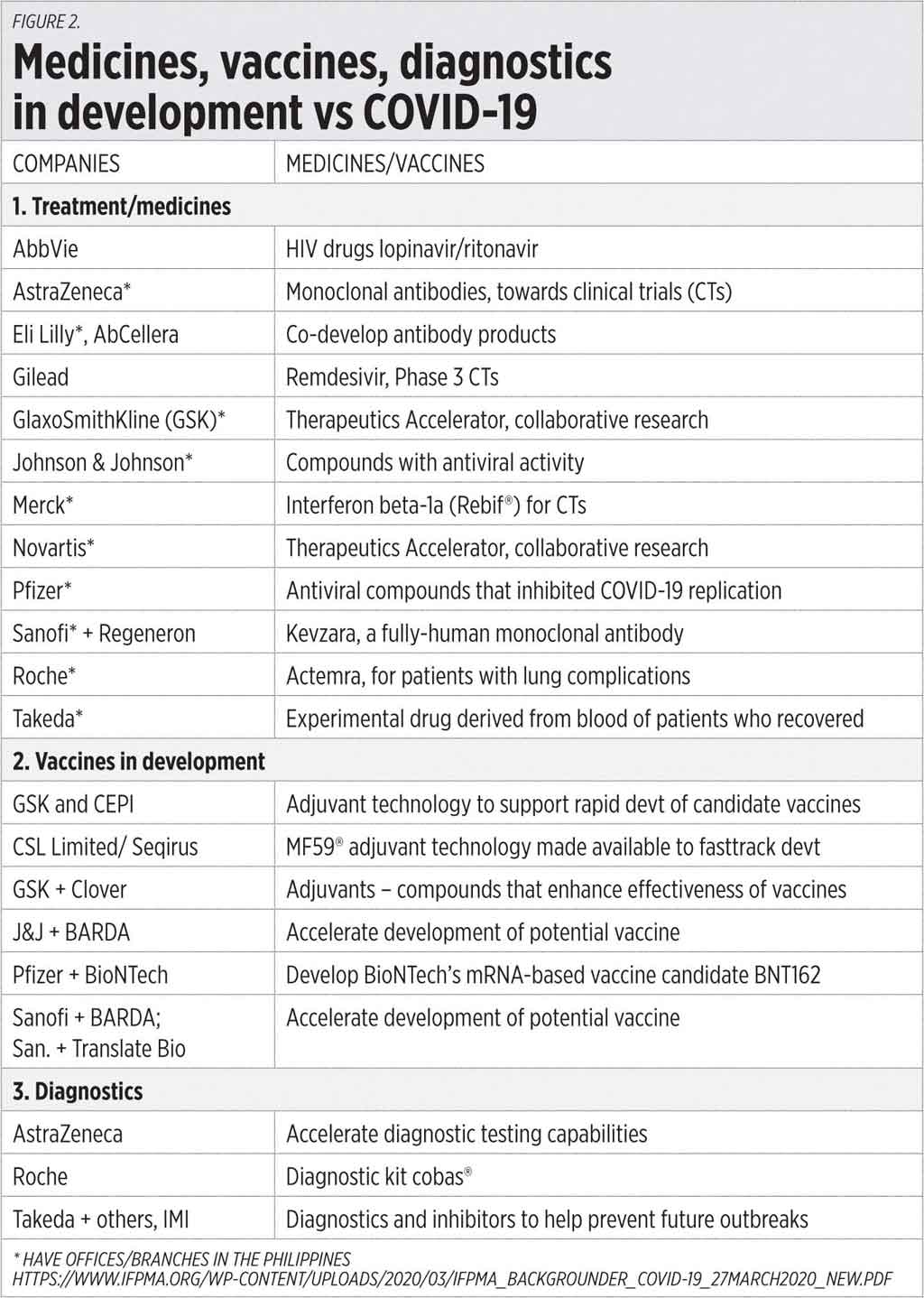
Second, the level of new medicines, new vaccines and new diagnostics to detect whether patients are genuinely infected with the virus or not, are developing at a fast rate. As of mid-March 2020, more than 20 vaccines and antiviral medicines are being developed against this virus, undergoing nearly 80 clinical trials in various phases in various countries, data from the International Federation of Pharmaceutical Manufacturers Association (IFPMA) (see Figure 2).

Now the same innovator companies seeking various treatment and inhibitors to this virus are being subjected to political harassment and confiscation of their successful, more disease-killing medicines in the Philippines via Executive Order (EO) 104 signed by President Duterte on Feb. 17. It aims to impose a second round of drug price controls mainly at the maximum wholesale price (MWP), then at maximum retail price (MRP). The first round of price controls was in July 2009, through EO 821 of the Gloria Arroyo administration.

I attended the Department of Health (DoH) Advisory Council meeting on March 6 at Axiaa Hotel, Quezon City, and I questioned certain provisions of EO 104.

One, the four criteria of EO 104 where price control can be imposed are not found in the Cheaper Medicines Act of 2008 (RA 9502) or its Implementing rules and regulations (IRR), they have no legal basis as DoH just invented and legislated new criteria on its own.

Two, the so-called “studies showing PH medicine prices are much higher than Asian neighbors” say as of 2018 or 2019 are actually not available, I searched for them many times online, and not in some DoH hard literature.

Three, DoH’s criteria #4, if medicines are most prescribed by physicians, then it should be price controlled. This is based on envy, penalizing successful, more disease-killing medicines. And perhaps hoping that the manufacturers of these medicines will pull out their products, not selling at a loss, so that the less-prescribed medicines by some local manufacturers will become famous?

The DoH officials in the room responded as follows:

On #1: The DoH can cover any molecules for MRP, they can establish any criteria to have “fair” pricing.

On #2: There are several studies available.

On #3: They are not penalizing success, they just want medicines that are priced “fairly.”

Consider a hypothetical situation where a new medicine or vaccine has been discovered already to be effective and safe vs the China virus and it’s high priced (high costs to develop it, etc.). Do we expect the DoH to impose price control on it?

By the DoH insistence on “fair” pricing based on very subjective criteria, the answer is very likely, “Yes.”

And that is a danger that Philippine patients and health practitioners might face. Effective treatment vs the virus is available in Singapore, Malaysia, Thailand, but not in the Philippines because the government has a political harassment EO waiting for it when it lands in the country.

The government should rethink this EO 104, pull it out without fanfare. Encourage innovators, not scare them.


Bienvenido S. Oplas, Jr. is the president of Minimal Government Thinkers.

minimalgovernment@gmail.com

Navigating the Future: The Udenna Way

(Second of two parts)

Today, the world is moving so fast and yet, Filipinos can’t even venture big time in the tech space. There are a lot of tech-savvy Filipinos who have brains and ideas. But they lack capital and the stomach to just do it. It’s hard, especially if one lacks access to capital markets, bank loans or other debt instruments. It entails hundreds of millions of pesos, and there are only a handful of VCs (venture capitalists) here to seed. All financial institutions, at least on the creditors side, want collateral, and it takes a lot of effort and size to issue notes, bonds, etc., if you’re not a big conglomerate. But the future is around the tech space, that’s why even though the telco project is so challenging, we are deeply inspired by it. We are hungry to see it succeed. Is it easy? No. Is it financially challenging? Yes. But can it be done? Why not?

You see, in our group, we have a special culture called the 5Hs. You can only work in Udenna if you have them. The first thing I always tell our people is to stay Hungry​ — Hungry for change, for​ opportunities to do things better, to do things that have not been done before. Then there’s Hard work​ — Work hard not just to accomplish but to exceed our goals, to not​ stop when we’re tired but when we’re done. Next, be Honest​ — in all dealings, even if nobody’s looking. Fourth, stay Humble — “Bawal ang hambog.” Stay humble and​ keep yourself grounded despite the many accomplishments. Last, be Holy​ — When all​ has been said and done, recognize that there is always a Greater Hand at work behind every success.

We in Udenna do the things we do because we want to help local businesses grow, compete, and thrive with the resources and expertise we have. We see a future where consumers, particularly our countrymen, are the ultimate beneficiaries.

What I shared are just some of the challenges we had to endure in the past to reach today, which is the future we were aiming for many years ago. We still have a lot of battles to be won, now on an even bigger scale. When you disrupt something, prepare to be disrupted. The bigger the market position, the tougher. If you observe the industries we are in, they are very competitive. Anybody can enter. But we grow because we work hard to get a considerable market share organically, or through strategic M&As.

But if there is a challenge, why do we insist on doing business? Because the potential and possibilities of success far outweighs them all. We invest in businesses not because of what they are now but because of what they can be.

The business landscape has drastically changed globally, and is changing still. Comparing the Fortune 500 companies between 1955 and 2019, there are only 52 companies that appear in both lists since it started. Where did the 448 companies go? The fact that nearly nine of every 10 Fortune 500 companies in 1955 are gone or merged, shows that there’s been a lot of market disruption and churning over the last six decades. It’s not surprising that the tech sector is the key catalyst for this change in the world.

But can the same be said of the Philippines? What were the top companies 20 years ago and the top 20 today? What new companies are emerging in our country?

In terms of capital markets over the past 20 years, we see that there’s been growth in the Philippine capital markets as shown by the bellwether Philippine Stock Exchange Index (PSEi). However, it’s still the same business groups that are in the top 10 stocks that are in the PSEi. There has not been a single new entrant into the top 10 rankings in the past 20 years.

The future of the Philippines is in its people, and entrepreneurs have a big role to play. We need more new entrepreneurs to rise up. “Magaling ang Pinoy”​ (Filipinos are good).

There’s no doubt about our creativity and passion. Filipinos will never run short of world-class ideas. To cite, Dr. Leonardo Gasendo, a US-based Chemical Engineer who originates from Bacolod City, invented the self-charging car which was granted a US Patent. His vision is for the Philippines to be the renewable energy capital of the world. Another brilliant example is Dado Banatao, the Bill Gates of the Philippines who developed the first Windows Graphics accelerator chip for personal computers. He’s a native from Cagayan Valley and is now a tech innovator and venture capitalist in Silicon Valley. Dado points out a big flaw in the Philippines that prevents the flourishing of tech companies: the lack of venture capitalists. He cites Silicon Valley which was built by entrepreneurs and investors.

I dream of a time when brilliant entrepreneurs have better access to funding and are not forced to sell. And whose companies can land in the top 20 companies of the country. I see a future where the best global entrepreneurs are Filipinos who possess the 5H. I look forward to the day when top global companies are from the Philippines; companies that have a vision for the nation, are doing what is right not only for the business but for the country and all its consumers, and are embracing competition to provide better products and services. Success in business is not just for a privileged few. As millennials would say, “Sana all.”​

We in Udenna see a future where just because it’s difficult doesn’t mean we don’t do it. We don’t get it done right all the time. But we get it right most of the time. Let’s do our fair share to help other entrepreneurs, to raise a new breed of visionaries, to champion a gritty generation, because the future belongs to the bold and persevering. I always say that I have more balls than brains because business is not easy, especially because of the ever-changing landscape.

We are thankful to those ahead of us who paved the way for entrepreneurs like me to break through. We pay it forward by doing our own share and making a difference in the industries that we are in and giving others that same opportunity.

As we always remind the Udenna Group: we are in the business of business. We set our eyes on industries we are not currently in, to see if there are any gaps we could potentially address, markets we can serve. More broadly, we hope that through our investments, we are able to do our part in building a stronger business community here in the Philippines.

We stand on the back of people who have trusted us, and are cheering for us to succeed. “Mura lang ang pera. Mahal ang tiwala. (Money is cheap, trust is expensive)​ We realize hindi namin kaya (we can’t do it) on our​ own. We need the help of others. Kaya nga may slogan kami (that is why we have a slogan), ‘Success is not complete without U.’”​ This is not just a business for us. It is a mission. We hope that you will continue to support us in our mission to improve the lives of Filipinos. Most especially, we hope that you will support young entrepreneurs. There’s a lot of them who are more brilliant, but just don’t have the break or support needed. Let’s cultivate an environment that will allow them to thrive.

So how do you navigate the future? The theme says it all: overcome challenges — there will be many — and maximize opportunities. Is it easy? No. Is it challenging?​ Yes. But can it be done? Why not?

We, in Udenna, started as a challenger, and we will always be a challenger.

It’s never business as usual.

We will constantly challenge the status quo, challenge possibilities, challenge ourselves to get up again each time we fall, and challenge ourselves to outperform not just the competition but ourselves — all for God and for the Filipino.

This article was based on the speech delivered by the author at the recent The Manila Times 11th Business Forum.


Dennis A. Uy is Chair and CEO of Udenna Corp. and of Phoenix Petroleum Philippines Inc.

dennis.uy@phoenixphilippines.com

map@map.org.ph

http://map.org.ph

Team USA weighing options in the event of spring Olympics

USA Basketball is weighing alternative roster options in the event of a potential conflict between the delayed Tokyo Olympics and the National Basketball Association season.

If the postponed Games are moved from a July 2020 start to March or April of 2021, NBA players would not be eligible to participate. The NBA regular season typically ends in mid-April, when the playoffs begin.

There is no set timetable for the Olympics after the International Olympic Committee announced last week the Games wouldn’t start as scheduled on July 24 due to the coronavirus pandemic.

USA Basketball managing director Jerry Colangelo, who is committed to the organization through 2021 along with head coach Gregg Popovich, said there is no action to be taken until a date for the Olympics is known.

“We will follow the leader. We have to wait to see how everything is laid out and we’ll make the adjustment,” Colangelo said. “Our players are NBA players first, let’s face that.”

If the Olympics moves back a calendar year to July 2021, many NBA players would be available. If the events are held in March or April, the availability of amateurs — college basketball players — would be on a case-by-case scenario. The Final Four and national championship games are scheduled for April 3 and 5 in Indianapolis.

Commissioner Adam Silver said the 2020–21 NBA schedule still could be adjusted radically depending on how the current season, on hiatus since March 12, wraps up. Silver said teams have been asked to confirm availability of their home arenas through August. If the current season ends in August, next season might not begin until winter instead of the typical October tipoff.

“Changing the window for the NBA is easier said than done. There’s a lot of logistics and contracts to deal with,” Colangelo said. “Same for the Olympics. You have to assume it will be around the same dates.” — Reuters

Even in MotoGP’s virtual world, a Marquez still rules

LONDON — Alex Marquez celebrated a first MotoGP win — even if only virtually — in a ‘#StayAtHomeGP’ esports race featuring 10 top riders including older brother and six-time world champion Marc.

Due to the coronavirus pandemic that has brought live sport to a standstill, the 23-year-old Moto2 champion is still waiting to debut in the top category after moving up to partner Marc at Repsol Honda.

The opening race in Qatar on March 8 was cancelled and all other races up to May 17 have been postponed, with more likely to be stalled.

Sunday’s light-hearted online race, with riders joining remotely, was put on by MotoGP organizers to give fans something to watch while reinforcing the message about staying safe at home.

“I am really pleased to win my first race!” joked Alex, whose brother has won the last four MotoGP titles and triumphed in 12 of last year’s 19 races with single-season point and podium records.

The Spaniard said Indonesian esports racer Putut Maulana had given him some useful tips, which he had kept to himself out of sibling rivalry.

Italian Francesco Bagnaia was second for Pramac Ducati with Yamaha’s Spaniard Maverick Vinales third in a crash-strewn race over six laps around the virtual Italian Grand Prix circuit at Mugello. Marc Marquez was fifth.

Second only to Italy in fatalities, Spain is preparing to enter its third week under near-total lockdown with most of the population housebound as the country tries to curb the virus.

Seven of Sunday’s 10 riders were Spanish.

Petronas Yamaha’s French rider Fabio Quartararo came fourth, and set the fastest lap, after starting from pole position but taking out future team mate Vinales at the first corner of a chaotic opening lap. — Reuters

Candidates Tournament halted

FIDE Candidates Tournament
Yekaterinburg, Russia
March 15–April 5, 2020

Current Standings (round 7 of 14)

1–2 Maxime Vachier-Lagrave FRA 2767, Ian Nepomniachtchi RUS 2774, 4.5/7

3–6 Fabiano Caruana USA 2842, Alexander Grischuk RUS 2777, Anish Giri NED 2763, Wang Hao CHN 2762, 3.5/7

7–8 Kirill Alekseenko RUS 2698, Ding Liren CHN 2805, 2.5/7

Average Rating 2774 — Category 21

Time Control: 100 minutes for the first 40 moves, then 50 minutes for the next 20 moves, then 15 minutes for the rest of the game with 30 seconds added to the clocks after every move starting move 1

Special Rules: No draw offers allowed until after move 40

Tie Breaks: The following are used to break a tie for 1st place: (1) Direct encounter, (2) Wins, (3) Sonneborn-Berger. If they are still tied after the three systems are applied then a playoff beginning with four 25-minute games is played

Maxime Vachier-Lagrave defeated erstwhile tournament leader Ian Nepomniachtchi in the 7th round of the Candidates Tournament and tied with him for the lead.

Opening Note: In December 2017 Demis Hassabis (a former world-ranked junior chess player) and his DeepMind team (DeepMind is a subsidiary of Google Inc.) introduced AlphaZero to the world. It is an artificial intelligence which can play chess. What is so revolutionary about it is that whereas the usual chess engines (the big 3 of which is Stockfish, Komodochess and Houdini) are taught by their programmers and GM consultants on how to play chess AlphaZero had a different approach. Through the process of machine learning it is just given the rules of the game and by playing against itself the algorithm determines the moves which are more likely to give you a win. As it plays more and more games it naturally gets better and better. This is the so-called Monte Carlo method.

AlphaZero was matched against Stockfish 8, the acknowledged computer chess champion, in a series of twelve 100-game matches and the Monte Carlos engine won 290, drew 886 and lost 24.

This new artificial intelligence chess engine really played some awesome games and naturally the openings it played (which, I emphasize, were not fed into it by humans but which it developed itself) were put under great scrutiny.

Many articles and even books (especially the one written by GM Matthew Sadler and Natasha Regan entitled Game Changer is very good) have been written about its “groundbreaking chess strategies.” One of its favorite maneuvers is to push its h-pawn towards the opponent’s kingside castled king. If it is not blocked it will continue its march as far as h6. This of course goes against the long-held classical strategy of not advancing one’s flank pawns but the results speak for themselves.

Many GMs are now adopting this strategy. For example in the Gruenfeld Exchange we have lately been seeing 1.d4 Nf6 2.c4 g6 3.Nc3 d5 4. cxd5 Nxd5 5.e4 Nxc3 6.bxc3 Bg7 7.Bc4 c5 8.Ne2 O-O 9.O-O Nc6 10.Be3 b6 11.h4 and sometimes without waiting to castle first himself: 1.d4 Nf6 2.c4 g6 3.Nc3 d5 4.cxd5 Nxd5 5.e4 Nxc3 6.bxc3 Bg7 7.Bc4 c5 8.Ne2 O-O 9.Be3 Nc6 10.h4.

That is the historical background to the following game we are about to see.

Vachier Lagrave, Maxime (2767) — Nepomniachtchi, Ian (2774) [C18]
FIDE Candidates 2020
Yekaterinburg (7.2), 25.03.2020

1.e4 e6 2.d4 d5 3.Nc3 Bb4 4.e5 c5 5.a3 Bxc3+ 6.bxc3 Ne7 7.h4

We have entered the realm of the French Winawer Variation, and the main line starts with 7.Qg4 leading to a very sharp struggle. Lately, with all this AlphaZero groundbreaking strategies stuff the text move has become very popular. There was a series of articles many years ago in Inside Chess by Yasser Seirawan trying to show that the Winawer has been refuted. Bobby Fischer agrees with him — many years earlier he had said that “I may be forced to admit the Winawer is sound. But I doubt it! The defense is anti-positional and weakens the K-side.” But don’t let Yasser or Fischer discourage you, for there are many great players who passionately played the line and have legions of brilliant games — Mikhail Botvinnik, Wolfgang Uhlmann (who used the Winawer almost exclusively for over 50 years up to now), Tigran Petrosian, Viktor Korchnoi, former double Soviet Champion Lev Psakhis and perhaps the entire Armenian chess nation! It is still very much alive and kicking.

7…Qc7

At the risk of sounding obvious, Black is threatening …cxd4 followed by …Qc3+. You would think that White is forced to respond with Nc3, but no he is not.

8.h5

A few rounds earlier Alekseenko played 8.Nf3 but after 8…b6 9.Bb5+ Bd7 10.Be2 Ba4 11.0–0 Nd7 12.Be3 h6 13.Ra2 Nf5 14.Bf4 Qc6 15.Rb2 a6 16.dxc5 Qxc5 17.Rb4 b5 Black held easily. Alekseenko, K. (2698) — Nepomniachtchi, I. (2774) FIDE Candidates 2020 1/2 40.

8…h6

[8…cxd4 9.cxd4 Qc3+ 10.Bd2 Qxd4 11.Nf3 Qe4+ 12.Be2 Nf5 13.Kf1 b6 is a well-known gambit which might be too risky (for both sides!) to be played in a Candidates tournament]

9.Rb1

[9.Nf3 is the normal move but apparently MVL did not want to block his queen from going to g4]

9…b6 10.Qg4 Rg8!?

In the 2017 Champion’s Showdown in Saint Louis Wesley So defeated the newly-transplanted US (formerly Cuban) GM Leinier Dominguez with 10…Kf8 11.Rh3 Ba6 12.Bxa6 Nxa6 13.Ne2 cxd4 14.cxd4 Qxc2 15.Rb2 Qe4 16.Qxe4 dxe4 17.Nc3 Rc8 18.Bd2 Rc4 19.Nxe4 Rxd4 20.Nd6 Nc5 21.Ke2 Rd5 Wesley is better. Dominguez Perez,L-So,W Saint Louis 2017 0–1 (32).

11.Bb5+ Kf8 12.Bd3 Ba6 13.dxc5 Bxd3 14.cxd3 Nd7

White cannot play 15…cxb6? Qxc3+ 16.Bd2 Qxd3 when Black is clearly better.

15.d4 bxc5

Black is threatening to play 16…cxd4 17.cxd4 Qc2 with very annoying threats.

16.Qd1 Qa5 17.Bd2 Rb8

MVL is not afraid of 17…Qxa3 because after 18.Ne2 Qa6 (Black has to move his queen out of the way in order to make advancing the a-pawn a threat) 19.0–0 Qc8 20.Bc1 followed by Ba3 and White has castled, can put his bishop on a3 to control the a3–f8 diagonal and incidentally block the Black a-pawn advance, and in general threaten the enemy King.

18.Ne2 c4

“I don’t think this was the right plan. Closing the center makes sense, but I do not think he is in time” (Vachier-Lagrave).

19.0–0

MVL took 25 minutes over this move. Perhaps he was weighing castling kingside against Rh1–h3–f3 or g3.

19…Rb6 20.Qc2

Going for f2–f4–f5 which probably Black must prevent with …f7–f5.

20…Rh8

Crowther, Mark: “Stopping Qh7 but it seems like a waste of time and might even be the decisive error in an already difficult position.”

21.a4 Ke8 <D>

POSITION AFTER 21…KE8

Black’s play in the opening makes a strange impression. He moved his rook from h8–g8 back to h8, and his King from e8–f8 and then back to e8.]

22.Rb4!

A very strong move, preparing an exchange sacrifice.

22…Nc6

[22…Rxb4 23.cxb4 Qb6 24.b5 followed by Bb4 is too strong for White]

23.f4!

With the queenside basically sealed MVL takes action against the Black King. Things are looking rather grim for Black.

23…Ne7

After the earlier …Rh8–g8–h8 and …Ke8–f8–e8 now Nepo goess …Ne7–c6–e7. He didn’t have a choice now though for taking the rook is a disaster: 23…Nxb4 24.cxb4 Qa6 (giving the exchange back is not an option, for 24…Rxb4 25.Qc3 wins an entire piece) 25.b5 Qc8 26.f5 Black’s game is collapsing. MVL pointed out that in addition to the kingside threats he also has Bb4, Nc3 followed by a4–a5.

24.Rfb1 f5 25.Rb5 Qa6 26.Bc1!

Repositioning his bishop to a3.

26…Kf7 27.Ba3 Rhb8 28.Bxe7! Kxe7 29.g4! Rxb5

[29…fxg4 30.Rxb6 Rxb6 31.Rf1! followed by f4–f5]

30.axb5 Rxb5 31.gxf5 Rxb1+ 32.Qxb1 exf5 33.Ng3 Qb6 34.Nxf5+ Kf8 35.Qa1!

Prevents Black from advancing his passer on the queenside while threatening to infiltrate the black position.

35…Qe6 36.Ng3! Qg4

[36…Qb6 then White proceeds with 37.Qa3+ (Careful! The “obvious” 37.f5 is refuted by 37…Nxe5 and the tables have turned) 37…Kf7 38.Kg2 followed by f4–f5 or Nf5 and Black cannot survive this]

37.Kg2 Qxf4 38.Qxa7

Coolly threatening the black knight. MVL is not afraid of the queen checks.

38…Ke7 39.Qa3+ Kd8 40.Qd6 g5

[40…Kc8 41.Qc6+ Kd8 42.Qxd5 mops up the black pawns in the center.]

41.hxg6 h5 42.g7 Qd2+ 43.Kh3 1–0

After this game Maxime Vachier-Lagrave tied for the lead at the halfway mark. The next day FIDE suspended the tournament because of the coronavirus pandemic.

We will continue this story on Thursday.


Bobby Ang is a founding member of the National Chess Federation of the Philippines (NCFP) and its first Executive Director. A Certified Public Accountant (CPA), he taught accounting in the University of Santo Tomas (UST) for 25 years and is currently Chief Audit Executive of the Equicom Group of Companies.

bobby@cpamd.net

Boon or bane?

In the midst of the National Basketball Association’s suspension of its 2019–20 campaign, not a few quarters have argued that the development benefits the Lakers’ LeBron James. After all, they claimed, he’s a relatively old 35, with significant miles on his odometer and in need of rest. Significantly, it’s a narrative that he’s pushing back against. And it isn’t merely because, prior to the league making the decision to hold the season in abeyance, he had just come off a productive weekend that saw him lead the purple and gold to victories against the Bucks and Clippers, noted powerhouses and deemed to be their biggest stumbling blocks en route to a projected championship.

Parenthetically, it bears noting that James didn’t just quarterback the Lakers to a win, as he had been doing through their schedule to date. He did so by taking over the contests in the crunch. He actively hunted mismatches and then framed his actions according to what the defense gave him. His first instinct was still to pass, waiting for additional coverage to come to him and subsequently finding the open teammate for an easy bucket. Barring that, he sought to barrel his way as close to the hoop as possible, again for an easy bucket. In short, he shifted to playoff mode, deconstructing the game to full advantage, as he invariably did so in nine Finals stints for the Cavaliers and Heat.

For all the queries about James’ health moving forward, he has contended, with ample reason, that the break actually hurts his cause. For one thing, his immediate past exploits created momentum to boost his bid for a fifth Maurice Podoloff Trophy. He bested fellow contenders in highly anticipated matchups, with his marked shift to a higher gear enabling him to gain ground on reigning Most Valuable Player Giannis Antetokounmpo. More importantly, his elevated numbers coincided with the Lakers’ rise in the standings; before the forced lull, they had claimed eight of their last 10 outings and moved to just two behind the pace-setting Bucks in the loss column.

From this perspective, the stoppage of play becomes a virtual reset that James could have done without. Should the NBA be fortunate enough to continue with the remainder of the season (or, more likely, some semblance thereof), he will need to work hard to make voters do a double take anew. Antetokounmpo remains the leader in the clubhouse, and, not coincidentally, recovered from an injury suffered before the new coronavirus threw a monkey wrench on the proceedings.

At this point, James will probably finish runner-up to Antetokounmpo. That said, he’s not deterred from his real goal: to bring the Lakers to glory once more. He insists two weeks is all they need to get back on track. Whether he’s right or not remains to be seen. Meanwhile, there’ll be no rest for him. He will remain focused on the hardware, working out and staying in shape in the confines of his home while occasionally needing to throw wary glances at the clock. He has, so far, kept time remarkably in check. For how long, though? The answer will determine his success, or lack thereof.


Anthony L. Cuaycong has been writing Courtside since BusinessWorld introduced a Sports section in 1994.

alcuaycong@bworldonline.com

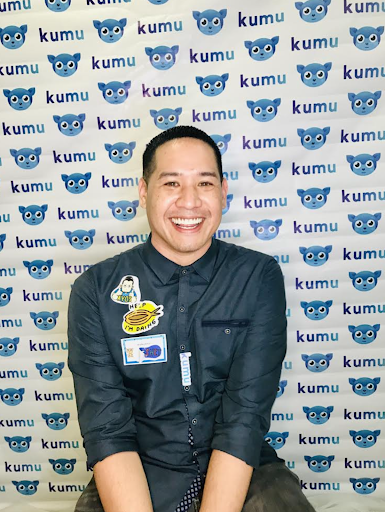
Kumu’s KC Montero on creating quality online content

Earlier this year, KC Montero took on the role of Head of Content at KUMU, the fastest-growing social media app in the country.

Perhaps best known as MTV’s longest-running VJ, KC’s career includes billings as host and producer on a number of shows like Celebrity Car Wars, Survivor Philippines, Discovery Channel’s Worst Vacation Ever, and GOOD TIMES on Magic 89.9. While KC’s star power and marketing talent are undeniable, what helps KC perform in the boardroom is his unique brand of creativity that ensures content on the app stays relevant to a young mobile audience.

As KUMU’s head of content, KC often gets asked, “what is good content?” It’s a question he thinks is fundamentally misguided.

“The term “good content’ can be used in such a broad sense,” he said. “Some would say that if you can watch a piece of content from start to finish, that it should be considered good content. That isn’t totally true because what’s inside that content can captivate you and keep your attention for three minutes but it doesn’t mean, to me, that it’s any good.”

KC believes audiences today want more than just flashy visuals, catchy wordplay, and a coherent aesthetic. What they’re looking for, he says, is something that makes them feel good about themselves.

“I like to use the phrase “quality content” which means that it’s thought-provoking, entertaining, and leaves you with a positive feeling,” KC said. This triumvirate guides every bit of programming KC oversees at KUMU, from the messaging to the technical executions—everything is designed to maximize quality.

The KC recipe for effective content

KC shares these three useful insights to aspiring content creators on how to keep things creative, dynamic, and worth sharing:

  • If it’s a long video, make sure you show a quick look at what happens in the video right away. You have to grab attention as fast as possible.
  • Get close. The closer the subject is, the closer the audience feels, but don’t overdo it. No one wants to see your pores.
  • Know your audience. Know what makes them tick and play into their wheelhouse.

Pushing innovative technology

More than any other device in history, smartphones are the most immediate, on-demand platforms for content consumption. With livestreaming, the bridge between consumption and creation has narrowed nearly to non-existence.

For the team at KUMU, it’s an inmate understanding of the relationships between platform, product, and people that guide their growth into everything from arts to online marketplaces.

This formula proves to be effective as KUMU now engages more than three million Filipinos around the world with its online contests, game shows, celebrity live streams, live e-commerce, and just recently audio streaming features.

“I think that content is really only bound by technology and how it’s delivered,” KC said. “I think at the moment, we’re on the cusp of an e-commerce boom and the faster and closer you can get to humanizing your process the more success you will have.”

Kumu’s James Rumohr on how to build positive online communities

James Rumohr attributes everything he’s learned about management to his service as a military police officer in the United States Air Force. After seven years—and a few medals—in the USAF, as well as a decade working in public school districts, sports teams, and non-profit organizations, James busies himself these days as the chief of staff and head of Kumunity at KUMU, the Philippines leading livestreaming platform.

James has now put his passion online and puts on his everyday hero hat and study, studying what KUMU users need to blossom into a “Kumunity” of storytellers and content creators that can inspire more people all over the world.

“Fostering good Kumunity support begins with listening to the stories of our user community and acknowledging their unique experiences,” he said. “Encouraging the Kumunity to be their authentic selves eliminates false narratives and allows support towards each other on a more personal level.”

A safe space for every Filipino online

James’s vision for these Kumunities is to create a transparent culture of support and genuine care among users which has now been quite evident to many since the mobile app’s launch in August 2018. “Creating a positive Kumunity culture starts with a committed intention to provide users a positive, safe, and welcoming environment,” he said.

“We encourage our Kumunity to support each other in everything they do via the app,” said James. This strategic outlook has led KUMU to be the premier social media app for Filipinos who are looking for a positive and welcoming culture both on and offline.

For James, there are mainly three things to build an online positive community.

  • By cultivating and activating user groups to offer their mutual support, Kumunizens experience a spirit of camaraderie and belongingness.
  • By offering online activities that are accessible and available for all user groups, we foster a culture of inclusivity—a safe space for users to be who they want to be and be accepted into a community of like-minded people. KUMU somehow helps in breaking the barriers and fears that seclude some users into online anonymity and out into a welcoming platform where they can be themselves.
  • KUMU ensures that users’ voices are heard in decision-making for their events. We want to make sure that it’s their vision and mission that comes into fruition as long as these activities foster stronger Kumunity and reflect the positivity that the brand stands for.

With James’s expertise, KUMU pushes users to break bread with peers on a broader scale through their app and establish a Kumunity that keeps on getting stronger.

StartupBlink launches global map of innovations around Covid-19

StartupBlink has launched the  Coronavirus Innovation Map, a global digital map pinpointing innovations and solutions that help people cope with and adapt to the changes brought about by the ongoing Covid-19 pandemic. Simply typing in a location (such as a city or country), users are greeted with a list of innovations developed out of that locale.

The search can be further narrowed by choosing through five categories:

  • Prevention – tracking and preventing the spread of the virus
  • Diagnosis – diagnosing and identifying the infected
  • Treatment – precautionary treatments such as medicine; accessing medication without having to leave home
  • Information – spreading timely and accurate information about the pandemic and ongoing innovations
  • Life and business adaptation – adjusting daily lives to the current situation through virtual applications

According to StartupBlink, the map was created not only to stay informed but also to honor humankind’s innovative spirit. “One of the things we need more than ever is to stay well-informed and to be aware of not only the bad but the good that is happening in the world. It is also important to know that public institutions, corporations, and startups around the globe have been working tirelessly since the emergence of the coronavirus in hopes to find a solution or contain this virus.”

StartupBlink also hopes to connect more innovators and integrate more solutions into their map. “We know that curating all relevant data in a short amount of time is not achievable by a single person or company. This is why we will need everyone’s help. Through crowdsourcing and the help of the community, we will be able to cover the gaps and have as much information as possible.”

Those who would like to have their innovation or solution integrated into the map may apply through this form.