Home Blog Page 961

PEZA approves nearly P49B worth of investments in Sept.

THE Philippine Economic Zone Authority (PEZA) said it approved P48.87 billion worth of investment proposals in September, helping it exceed 60% of its approvals target in the year to date.

The September total is 9.8% lower year on year, it said. The 36 approved projects are expected to create 10,312 jobs and generate $1.113 billion worth of exports.

Of the total, 16 are manufacturing projects, while nine are information technology and business process management (IT-BPM) projects.

Five of the approved investment pledges were economic zone (ecozone) developments, three are to develop facilities, two are logistics projects, and one is a domestic market enterprise.

Eighteen of the projects approved in September plan to locate in Region IV-A, while others selected sites in the National Capital Region, Region VII, Region III, Region I, Region V, and Region XI.

Approvals in September brought the nine months’ total to P154.7 billion, up 33.5% from a year earlier.

These comprise 215 projects which are projected to generate 50,430 jobs and $4.49 billion in exports.

“These approvals demonstrate enduring investor confidence in the Philippines,” PEZA Director General Tereso O. Panga said in a statement on Tuesday.

“Backed by sustained momentum and robust investment activity, we are on track to attain our P250-billion goal and strengthen our standing as a leading investment destination in Asia,” he added.

He said that he expects the approvals to further increase in the last quarter amid the agency’s “expanded regional engagements.”

Of the projects approved so far this year, 98 are manufacturing projects, 55 are IT-BPM projects, 18 are domestic enterprises, 17 are ecozone developments, 16 are facilities projects, seven are logistics projects, and four are utilities projects.

“The manufacturing sector remains the backbone of PEZA’s growth, with notable gains in electronics, automotive and auto parts, and food processing,” PEZA said.

“These industries collectively contributed more than P42.4 billion in approvals from January to September, reinforcing the Philippines’ position as a vital hub for advanced and diversified manufacturing in Asia,” it added.

JAPANESE INVESTMENTS
Investments from Japan led the foreign investment approvals in the first nine months, worth P14.778 billion, or 9.55% of the total.

“This rebound firmly puts Japan back on top as PEZA’s leading investment partner, reaffirming its long-standing role as a driver of Philippine industrial growth and innovation,” PEZA said.

These approvals include a P9.1-billion project of a domestic market enterprise that will manufacture food products and processed foods inside the TARI Estate, which will cater to both domestic and export markets.

“Japan’s return as our leading partner reflects the fruit of our investment missions and strong collaborations with stakeholders,” said Mr. Panga.

“With nearly 10% of this year’s total project approvals coming from Japanese companies, we see undeniable proof of the Philippines’ standing as a trusted and highly competitive hub in Asia,” he added.

Meanwhile, P13.142 billion came from the Cayman Islands, P10.765 billion from South Korea, P6.322 billion from China, and P6.105 billion from the US.

“Given the robust interest and caliber of projects underway, we are not merely on track to meet our goal; we are positioned to deliver even bigger economic wins for the country and our people as we achieve our 2025 investment targets,” he added. — Justine Irish D. Tabile


Ornamental plants seen as potential growth pillar for agriculture industry

PHILSTAR FILE PHOTO

ORNAMENTAL PLANTS are being touted as a potential growth driver for agriculture according to participants at the 2nd annual Philippine Horticulture and Urban Agriculture Summit, also known as Pagsibol.

Roger V. Navaro, agriculture undersecretary for Operations and Agri-Fisheries Mechanization, said horticulture or garden cultivation, as well as urban agriculture are potential “pillars of national strategy” if backed by proper investments.

Urban residents make up around 49.3% of the population, Mr. Navarro said.

Antonieta J. Arceo, agriculture training institute director said the drive for profits must be balanced “with protecting biodiversity and safeguarding our ecological heritage.”

Nevertheless,” (We must) hold fast to our vision of agriculture as a profitable investment and a viable and modernized career for Filipinos,” Ms. Arceo said in a speech.

The International Association of Horticulture Producers valued the global industry at $70 billion in 2024. — Andre Christopher H. Alampay

Carabao genetic program boosts milk yields

LILIAN VILLAMOR VIA UPD-CS IB/PHILSTAR FILE PHOTO

THE Philippine Carabao Center (PCC) said a carabao genetic improvement program has improved milk output, allowing farmers to tap into the rise in milk prices.

The PCC, an arm of the Department of Agriculture, said 12 million kilograms of milk have been produced since the program began, putting carabao raisers in position to benefit from the rise in milk prices from P63.27 per liter in 2020 to P84.87 in 2024.

The program produced 145,181 calves with upgraded genetics between 2019 and 2024, directly assisting 227 cooperative-led enterprises.

About 90% of such calves are raised for milk and meat. Smallholder farmers grow 99% of carabaos.

PCC Executive Director Liza G. Battad said: “The accelerated shift toward a more productive carabao population is expected to strengthen farmer cooperatives due to higher volumes of milk and meat handled collectively.” 

Carabaos are the most numerous dairy animal in the Philippines with 82,908 heads, according to the National Dairy Animal Inventory. The program produced 36,618 calves in 2024. — Andre Christopher H. Alampay

Gov’t lacked authority to deny VAT zero-rating to DMEs — SC

WIKIMEDIA/PATRICKROQUE01

By Erika Mae P. Sinaking

THE Supreme Court (SC) said domestic market enterprises (DMEs) registered under the Corporate Recovery and Tax Incentives for Enterprises (CREATE) Act are entitled to Value-Added Tax (VAT) zero-rating on local purchases.

In an en banc decision made public on Sept. 29 and written by Associate Justice Mario V. Lopez, who has since retired, the SC struck down Rule 18, Section 5 of the CREATE Act IRR and BIR issuances — including Revenue Regulations No. 21-2022 and Revenue Memorandum Circulars No. 24-2022 and 49-2022 — which had limited VAT incentives to registered export enterprises (REEs).

“The issuances altered the provisions of existing law by carving out DMEs from those entitled to the VAT zero-rating incentive,” according to the ruling, declaring the rules “ultra vires” (beyond legal authority) and void.

The CREATE Act, signed in 2021, exempts all registered business enterprises (RBEs), including DMEs and REEs, from VAT on imports. It also allowed VAT zero-rating on local purchases of goods and services directly used in their registered projects.

Benjamin E. Antonio III, Subic Bay Freeport Chamber of Commerce, Inc. chairman, had mounted a legal challenge to the IRR and BIR rules, claiming they unfairly excluded DMEs from the exemption, forcing them to pay 12% VAT on purchases from local suppliers.

“There is no distinction between DMEs and REEs under the CREATE Act. All registered enterprises should enjoy the same benefits,” Mr. Antonio said in his filing.

His legal challenge was initially dismissed at the Regional Trial Court level, but the SC exercised its discretion and intervened due to the “strong public interest involved.”

The High Court ruled that government agencies cannot expand or restrict incentives beyond what the law permits. “The legislative power to grant or withdraw tax exemptions is vested exclusively in Congress,” it read.

Senior Associate Justice Marvic M.V.F. Leonen, in a concurring opinion, supported the SC’s deviation from normal procedure, noting the urgent need to correct the unlawful exclusion of DMEs.

The ruling places DMEs on equal footing with export enterprises in enjoying VAT zero-rating.

Eight builders submit bids for Bataan-Cavite interlink bridge phase 1

A 3D render of the Bataan-Cavite Interlink Bridge | Source: The Office of Congressman Albert S. Garcia, 2nd District of Bataan

THE first phase of the $3.91-billion Bataan-Cavite Interlink bridge has attracted eight bidders, the Department of Public Works and Highways (DPWH) said.

The DPWH said the contract involves a package to build the Bataan-side approach to the bridge, capped at P7.25 billion.

The foreign builders were identified as Beijing Urban Construction Group Co. Ltd., which offered P5.88 billion; China Harbour Engineering Co. Ltd. with P4.87 billion; Sino Road and Bridge Group Co. Ltd., P6 billion; the consortium of China Wu Yi Co. Ltd. and Fujian Road & Bridge Construction Group Co. Ltd., P5.87 billion; and the joint venture of Hunan Road & Bridge Construction Group Ltd. and China Civil Engineering Construction Corporation, P4.94 billion.

The EEI Corp. joint venture with Premium Megastructures, Inc. offered P7.20 billion, while D.M. Consunji, Inc., offered P7.83 billion.

The Bataan land approach contract package consists of a five-kilometer road, an interchange connecting to the Roman Highway, the Roman Interchange Bridge, the Alas-Asin Main Bridge, the Alas-Asin Overpass, the Mt. View Overpass, the Mt. View Waterway Bridge, and the Bataan Land Viaduct, the DPWH said.

The 32.15-kilometer interlink bridge across the mouth of Manila Bay is expected to boost regional economic integration and development.

In 2023, the Asian Development Bank (ADB), which is co-financing the project, approved a $2.11-billion loan. The government is responsible for the remaining $664.23 million.

According to the ADB, the civil works for the Bataan-Cavite Interlink bridge will be broken up into six contract packages.

Contract package 2 or the Cavite land approach covers 1.3 kilometers of roads, while Contract package 3 involves the north and central marine viaducts. Contract package 4 covers the south marine viaducts. Contract packages 5 and 6 involve the bridge’s navigational channel cable and high-level approach spans.

Nigel Paul C. Villarete, senior adviser on public-private partnerships at the technical advisory group Libra Konsult, Inc., said China has capable construction firms with experience in such projects.

“China is a large country with plenty of competent firms. As long as the bidding process is robust and strictly follows our laws and processes, Chinese involvement is all right. What matters is that those qualified are really qualified,” he said when asked to comment.

“DPWH must closely monitor the works, especially if the winning bidder starts sub-contracting many of the works. While that is generally allowed, it should be strictly monitored and ensure that the quality and workmanship is not compromised,” he said. — Ashley Erika O. Jose

DPWH commissions digital ledger to track foreign-funded projects

RAWPIXEL.COM-FREEPIK

THE Department of Public Works and Highways (DPWH) said it tapped Blockchain Council of the Philippines (BCP) to develop a blockchain digital ledger that will track foreign-assisted infrastructure projects.

“By placing our foreign-assisted projects  — those funded by Official Development Assistance (ODA) — on the Integrity Chain, we welcome the scrutiny of the private sector, academe, and civil society. This is DPWH’s strong response to the President’s directive to ensure transparency and accountability is enforced for its projects,” Public Works and Highways Secretary Vivencio B. Dizon said on Tuesday.

On Tuesday, the DPWH and BCP — a non-stock, non-profit organization of blockchain professionals and advocates, signed the memorandum of agreement to launch the Integrity Chain.

Integrity Chain will embed, digitize, and secure key data on selected national projects which will be made available to the public.

The data to be made available include budgets, procurement processes, and construction milestones, Mr. Dizon said.

“The Integrity Chain aims to transform infrastructure governance by offering a real-time public dashboard that tracks project spending and progress, enabling citizen feedback and anomaly reporting, and providing tamper-proof records to deter corruption,” the DPWH said.

The BCP said it hopes to have the Integrity Chain available within 60 days.

“In the coming weeks, we will gather all representatives of each organization. We are going to set up a technical working group,” BCP President Donald Patrick L. Lim told reporters.

In September, Senate Bill No. 1330 was filed by Senator Paolo Benigno A. Aquino IV calling for the use of the blockchain for the budget process.

The DPWH is currently engulfed in scandal due to substandard or non-existent flood control projects, and is under pressure to make public works procurement more transparent.

President Ferdinand R. Marcos, Jr. said 15 contractors cornered more than P100 billion worth of flood control projects between July 2022 and May 2025.

Last week, the DPWH asked the Anti-Money Laundering Council (AMLC) to freeze billions of pesos worth of aircraft and vehicles belonging to persons connected to the flood control projects.

In particular, the DPWH asked AMLC to freeze aircraft valued at P4.7 billion associated with Party-list Rep. Elizaldy S. Co and certain companies, such as Misibis Aviation and Development Corp. and Hi-Tone Construction and Development Corp., which was founded by his brother Christopher S. Co.

Hi-Tone and Sunwest, Inc. founded by Rep. Co were among the 15 contractors found to have won multiple flood-control projects.

On Tuesday, Mr. Dizon said the Civil Aviation Authority of the Philippines (CAAP) informed the DPWH that Rep. Co had tried to de-register his aircraft as a preliminary to their disposal.

“I have received new reports from CAAP that there were attempts to deregister three choppers,” he said.

“CAAP said you cannot sell the aircraft to anyone unless they are deregistered.”  Ashley Erika O. Jose

House bill seeks to raise taxes on sweet beverages

REUTERS

A HOUSE BILL filed on Tuesday seeking to raise excise taxes on sugar-sweetened beverages could raise about P55 billion annually, legislators said.

House Bill No. 5003 proposes to raise the excise tax on drinks sweetened using caloric or noncaloric sweeteners to P20 per liter from the current P6, and to charge P40 per liter from P12 for beverages containing high fructose corn syrup.

The proposal also seeks to levy a P6 per liter tax on flavored milk and non-dairy milk beverages, with excise tax rates to be hiked by 6% per year starting in 2026.

About 40% of revenue generated from the proposal would be allocated to the Philippine Health Insurance Corp. (PhilHealth), 10% to the Department of Health’s facilities improvement fund and 50% to the Department of Interior and Local Government (DILG), according to the measure.

“This is not just an economic measure, not just about increasing revenue,” House Deputy Minority Leader and Party-list Rep. Leila M. de Lima, author of the bill, said at a briefing. Her co-authors are Albay Rep. Cielo Krisel B. Lagman and Dinagat Islands Rep. Arlene J. Bag-Ao.

“Ultimately, it’s about improving our right to health,” she added.

Finance Secretary Ralph G. Recto said in August that the government is not keen on introducing new tax proposals in the 20th Congress, reaffirming the government’s fiscal consolidation strategy as debt levels hit records.

Ms. Lagman said the campaign for the proposed sugar tax hike will be pitched as a public health initiative rather than an added levy on consumption. — Kenneth Christiane L. Basilio

Oil and gas developers offered more perks 

BW FILE PHOTO

THE Department of Energy (DoE) said it will offer petroleum service contractors “special allowances” to encourage investment in the upstream energy industry.

“There is a need to offer improved fiscal terms to service contractors to complement the other government initiatives in attracting more exploration and production companies to spur exploration activity,” the DoE said in a department circular dated Sept. 23.

Oil and gas exploration in the Philippines has attracted limited investment due to the risks, it said.

According to the circular, the special allowances will consist of deductions from gross proceeds with the proviso that the government’s share be less than 60% of the difference between gross income and operating expenses.

Reimbursement of all operating expenses is capped at 70% of the gross proceeds from production in any year.

The DoE is also granting special allowance on cost recovery of exploration expenses for some service contracts.

For marginal petroleum operations, the government is extending a special allowance when annual operating expenses exceed the cost recovery allowance of 70%.

To encourage the development of new petroleum fields discovered in frontier areas, the DoE is providing an allowance of 5% of the gross proceeds to the first commercial development.

“Providing special allowances that allow for maximum benefits to the country and at the same time provide reasonable returns to private companies that render financial and technical services and assume all the risk of petroleum exploration will make the Philippine service contract regime more attractive to investment and will improve the state of the oil and gas exploration in the country,” the DoE said.

Edgar Benedict C. Cutiongco, president of the Philippine Petroleum Association, welcomed the development, saying the allowances are attractive for companies of all sizes.

“Granting special allowances to petroleum service contractors creates a more supportive environment for exploration and production,” he told BusinessWorld via Viber.

“It supports marginal fields by giving companies the flexibility to continue operations even when the economics are tight — this helps avoid stranding petroleum reserves that still have potential,” he said.

Mr. Cutiongco said the incentives promote exploration in areas that have not been tested.

“It boosts local gas production, especially in new and emerging plays, which is key to strengthening our energy independence,” he said. — Sheldeen Joy Talavera

Prices steady in typhoon-hit areas — DTI

THE Department of Trade and Industry (DTI) said that prices and the supply of basic necessities and prime commodities were stable in areas affected by severe tropical storms.

“The DTI Regional Operations Group confirmed stable supply in affected regions, noting no reports of delivery delays or panic buying in the provinces and municipalities placed under a state of calamity,” the department said in a statement on Tuesday.

According to the DTI, a 60-day price freeze is in effect in Cagayan, Masbate, Oriental Mindoro, Biliran, and Romblon provinces.

The freeze is also in place for Pagudpud, Ilocos Norte, Dagupan City, Pangasinan, Calbayog and San Vicente, Samar, and Ibajay, Aklan.

Meanwhile, the DTI said most markets, groceries, and supermarkets remain operational apart from some business closures in Masbate.

Trade Secretary Ma. Cristina A. Roque said: “Despite the impact of the storms, we assure the public that prices of essential goods will remain stable and consistently accessible.”

“Our regional and provincial monitors are on the ground daily to safeguard market stability,” she added.

The DTI warned that violators of the price freeze may face penalties of up to 10 years’ imprisonment and fines of up to P1 million. — Justine Irish D. Tabile

People’s Survival Fund approves 24 projects 

THE Department of Finance (DoF) said 24 climate adaptation projects and project development grants were approved by the People’s Survival Fund (PSF) Board.

In a statement on Tuesday, the DoF said the approved projects were worth a combined P1.42 billion.

The PSF was established under Republic Act No. 10174 to finance adaptation programs and projects of local government units and accredited community organizations.

The board organized a caravan starting in Mindanao to help local government navigate climate finance and deliver locally led adaptation projects.

“The purpose of this caravan is to help fast-track and scale up local governments’ access to the Fund. And because the PSF provides long-term finance specifically for local adaptation projects, it has the power to shape communities’ resilience and save lives,” Finance Chief of Staff and Undersecretary Maria Luwalhati C. Dorotan Tiuseco said.

The caravan conducted seminars, technical consultations, and interactive workshops in Butuan City on Sept. 18 to 19.

The next leg will be held in October and will continue until the first quarter of 2026. — Aubrey Rose A. Inosante

DPWH to probe ‘ghost’ farm-to-market road projects in Marcos anti-graft drive

DPWH.GOV.PH

THE Department of Public Works and Highways (DPWH) will investigate irregularities in farm-to-market road projects flagged by the Agriculture department, widening the Marcos administration’s anti-graft drive.

Public Works Secretary Vivencio “Vince” B. Dizon has ordered close monitoring of the claims, Palace Press Officer Clarissa A. Castro told a news on Tuesday, noting that anomalies in public works must be addressed swiftly.

“All cases like this involving anomalies — not just in flood control projects but in all infrastructure — will be closely monitored,” she said in Filipino.

Agriculture Secretary Francisco P. Tiu Laurel, Jr. earlier reported “ghost” farm-to-market road projects in Davao Occidental and Zamboanga del Norte, some of which either do not exist or remain incomplete despite funding.

Two of the questionable projects date back to 2021 and 2022, he said, adding that the findings would be forwarded to President Ferdinand R. Marcos, Jr.

The disclosures came as senators probe overpriced and substandard flood control projects. During hearings, contractors Cezarah Rowena “Sarah” C. Discaya and her husband Pacifico F. Discaya admitted to bribing lawmakers and officials to secure government contracts.

High-profile politicians have been linked to the scandal, including Speaker Ferdinand Martin G. Romualdez, resigned Party-list Rep. Elizaldy S. Co, Senators Francis G. Escudero, Jose “Jinggoy” Estrada, and Joel J. Villanueva, as well as former Senators Nancy S. Binay and Ramon “Bong” B. Revilla, Jr.

The controversies have sharpened scrutiny of infrastructure spending, stoking calls for greater transparency and stricter oversight as the government seeks to restore credibility in public works.

Meanwhile, Senator Francis Pancratius “Kiko” N. Pangilinan urged the Independent Commission for Infrastructure (ICI) to reconsider its decision not to livestream proceedings in its probe of the multibillion-peso flood control scandal, warning that the move could undermine public trust.

“Transparency is fundamental to public accountability,” he said in a statement. “With all due respect, the decision of the ICI to prevent the public from monitoring its proceedings online is ill-advised.”

ICI Executive Director Brian Keith Hosaka earlier said the commission would keep its hearings closed to avoid “trial by publicity” and prevent them from being used for political gain.

He said the ICI’s role is fact-finding, with cases to be turned over to bodies such as the Office of the Ombudsman.

Political analysts have cautioned that Mr. Marcos’s anti-graft push could be dismissed as political theater unless it leads to prosecutions and convictions. Business groups have also pressed for stronger accountability measures.

“The last nail on the coffin of public accountability is in the unacceptable delays in the resolution of corruption cases and the paltry conviction rates,” Mr. Pangilinan said.

He added that real accountability rests with the Judiciary, calling for swift trials, stiffer penalties and an end to impunity.

The scandal centers on irregularities in flood control projects, where about P500 billion has been allocated since 2022.

Mr. Marcos has since created the ICI with powers to recommend criminal, civil and administrative charges in both flood-related and other infrastructure projects.

Critics warn the controversy threatens to weaken disaster-preparedness spending in a country hit by an average of 20 storms a year and widely seen as the world’s most disaster-prone nation.

Also on Tuesday, House Deputy Minority Leader and Party-list Rep. Antonio L. Tinio said the President has approved about 3,700 public works projects worth P214 billion in regions flagged as hotspots for questionable infrastructure deals.

During plenary debates on the 2026 budget, the congressman said Mr. Marcos had approved funding for the projects through unprogrammed appropriations, alleging the President shares responsibility in the widespread infrastructure corruption issue.

“The one who approved all the projects under unprogrammed appropriations was the President himself,” he told the floor.

Ms. Castro did not immediately reply to a Viber message seeking comment.

Mr. Tinio said about P29.4 billion in public works funding was allocated to the Mimaropa region in the past two years, with P25 billion directed to infrastructure projects in Central Luzon and P16 billion in the National Capital Region.

The corruption scandal came to light after the President used his July State of the Nation Address to accuse lawmakers of profiting from government projects. Since then, the President has ordered lifestyle checks on officials, conducted surprise inspections of projects and created the ICI to pursue cases.

Subsequent inquiries by several agencies have flagged irregularities, citing recycled documentation and substandard construction materials.

On Sept. 21, thousands of Filipinos marched in the capital in the biggest protest in years against the multibillion-peso flood control scandal, turning weeks of online outrage over corruption into mass street demonstrations that rattled the political establishment. — Chloe Mari A. Hufana and Adrian H. Halili

Philippine military denies rumors of coup scheme

PHILIPPINE STAR/EDD GUMBAN

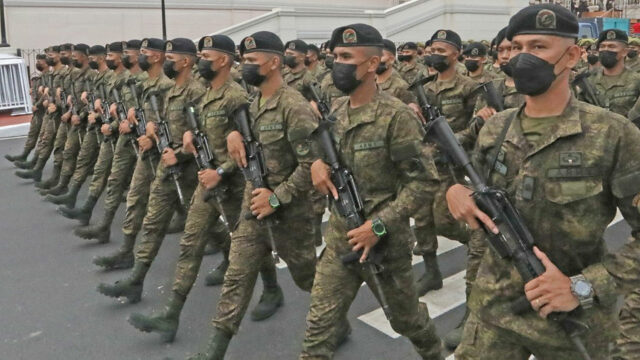
A PHILIPPINE military official on Tuesday dismissed rumors of a brewing coup, saying that troops would not participate in any attempt to overthrow President Ferdinand R. Marcos, Jr.

Reports of a possible military coup against Mr. Marcos on Sept. 21 circulated on social media as thousands of Filipinos took to the streets in the biggest protest in years over the multibillion-peso flood control scandal.

“These movements… [and] claims that there’s some kind of plot are clearly unfounded,” Philippine military spokeswoman Francel Margareth A. Padilla told a news briefing in Filipino. “There’s no truth to them.”

“The Armed Forces of the Philippines (AFP) remains intact, professional and disciplined,” she added.

The Southeast Asian nation is no stranger to coup attempts, having seen more than a dozen military mutinies since the restoration of democracy in 1986, after the late former President Ferdinand E. Marcos, Sr. was overthrown by a popular street uprising.

The last serious attempt to unseat a civilian government was in 2006, during the presidency of Gloria Macapagal Arroyo, but it was foiled by state security forces and led to the arrest of several military and police officials. A week-long national state of emergency was declared to quell the uprising.

Each succeeding President has seen the threat of a coup by disgruntled troops, with the government of ex-President Rodrigo R. Duterte having to deal with alleged plots to unseat him during his 2016-2022 presidency.

Ms. Padilla said the Philippine military remains neutral and won’t meddle with political matters, underscoring that it is now a “professional organization” and would shun calls for a coup amid the deepening flood control scandal.

The President faces mounting pressure as his administration is rocked by an unfolding scandal involving substandard, incomplete or nonexistent infrastructure in a country regularly battered by flooding.

Reports of irregularities in infrastructure contracts have fueled public outrage after a series of typhoons and monsoon rains earlier this year left Metro Manila and nearby provinces flooded despite extensive flood control projects.

The controversy stems from Mr. Marcos’ revelation in August that more than 6,000 flood control projects launched since 2022 lacked key details. About P545 billion has been allocated for flood control since then, with P100 billion cornered by top contractors.

“Politically motivated distractions are like static on a radio,” Ms. Padilla said. “They make noise, but they don’t actually change the signal. Our focus is locked on our mission, and that is to protect the people and secure the state,” she added. — Kenneth Christiane L. Basilio

ADVERTISEMENT
ADVERTISEMENT