Home Blog Page 95

Filipinos push back as flood-control scandal sparks fresh protest wave 

VARIOUS religious and civil society groups joined the second Trillion Peso March along Epifanio de los Santos Avenue (EDSA) in Quezon City, Nov. 30. — PHILIPPINE STAR/MIGUEL DE GUZMAN

By Kenneth Christiane L. BasilioReporter

BJ I. MABINI didn’t plan on joining a street protest. But when he saw videos of politicians’ relatives flaunting designer bags and luxury cars online — days after headlines warned that billions of pesos meant for flood control had vanished — he said he had reached his limit. 

So on a sweltering afternoon in September, the 35-year-old freelance video director covered his face with a balaclava, pulled on a black shirt and found himself among thousands gathered at Manila’s Luneta Park. The crowd stood behind a flag showing a skull wearing a straw hat taken from the popular Japanese animé “One Piece,” a symbol that spread across social media as anger over the scandal grew. 

“We’re tired of this kind of system,” he said in Filipino. “So many people are suffering. So many Filipinos are struggling.” 

What pushed him into the streets, he said, was the sense that corruption had become too big to ignore. “If this doesn’t wake people up, what will?” 

His frustration reflects a mood that President Ferdinand R. Marcos, Jr. has sought to contain as he confronts what may be the biggest crisis of his two-year administration — a multibillion-peso scandal involving hundreds of flood control projects that the government said were substandard, poorly documented or did not exist at all. 

Mr. Marcos has tried to reassure the public by promising jail time for those involved before Christmas. Last week, he announced arrest warrants for a former congressional leader and several others linked to an anomalous public works deal in Bulacan, north of the capital. 

He earlier flagged about P545 billion in flood control spending since 2022, saying about P100 billion in contracts went to only 15 contractors, including companies tied to political clans. 

“So much money was lost,” Mr. Mabini said. “It’s about time we wake up as to how the system plays us.” 

Corruption is a familiar story in the Philippines, but this one cuts deeper. The country is among the world’s most disaster-prone, with storms and monsoon rains routinely inundating towns and cities. Many Filipinos are now asking why immense spending on drainage, waterways and dikes has failed to ease frequent flooding. 

The scandal resonated because the alleged theft is visible in daily life, said Athena Charanne R. Presto, who teaches social inequalities and development at the Australian National University. 

“People can see what was bought using the supposed people’s money, compounded by the fact that the Philippines is submerged in floods,” she told BusinessWorld. “And it’s further compounded by the way families of officials flaunt it all online as if they feel no shame.” 

The outrage has placed the Philippines within a broader wave of political unrest spreading across Asia. In Indonesia, public anger over lawmakers’ housing perks led to violent clashes, culminating in the death of a 21-year-old motorcycle taxi driver after a police vehicle hit him. 

In Nepal, youth-led protests over social media restrictions forced the government to resign, while in Bangladesh, rallies against job quotas spiraled into a nationwide uprising that drove out the prime minister. 

MASS UPHEAVAL
The Philippine movement shares some of the same elements seen in those countries — strong youth participation, widespread frustration and online mobilization — yet analysts doubt it will escalate into mass unrest. 

“It is more costly for civil society groups protesting against the corruption scandal to resort to violence because it may be used and weaponized by various groups against them,” Bubbles Beverly N. Asor, an associate professor of sociology at De La Salle University, said in a Facebook Messenger chat. “Mass protest violence will further create tensions, factions and divisiveness in an already divided society.” 

Fears briefly rose in September when some masked protesters clashed with police near the presidential palace after the main Luneta rally. Organizers disowned the incident, and no widespread unrest followed. 

Ms. Asor said mass violence rarely erupts by design. “It is a complex situation that emerges from the interaction between protesters and authorities rather than a planned violence,” she said. Groups, she added, try to maintain “internal discipline” to prevent actions that could undermine their objectives. 

Francis A. Gealogo, a history professor at the Ateneo de Manila University, said today’s grievances echo those that motivated past uprisings. 

“What we are seeing now is a continuation of this threat of protest actions against state corruption, bureaucrat capitalism, foreign intervention and unequal social relations,” he said. The enormity of the controversy, he added, is likely to fuel more demonstrations. 

Still, public anger faces obstacles because corruption in the Philippines is deeply embedded, said John Lee Candelaria, an assistant professor at Hiroshima University in Japan. 

“Corruption functions as both a visible problem, centering on specific scandals, and a systemic issue — institutional cultures and patronage networks that span administrations,” he said. That dual nature, he added, makes the issue “easier because specific cases generate immediate outrage; harder because the solutions require transforming deeply embedded practices and power structure.” 

Corruption has shaped Philippine political and economic life for decades, affecting procurement, infrastructure projects and relationships between local and national officials. That breadth makes quick fixes unlikely. 

“We cannot expect real solutions to issues when the ones supposed to solve the problems are the source of the problem themselves,” Mr. Candelaria said. 

ECHOES OF EDSA
Many analysts see parallels between today’s protests and the 1986 People Power uprising that toppled the late dictator Ferdinand E. Marcos, Sr., father and namesake of the incumbent president.  

“The peaceful approach to rallies has a ‘People Power’ mark in it,” said Ms. Asor. She noted that organizers have drawn support from universities, faith-based groups, civic associations and left-leaning organizations, similar to the coalition that demanded change almost four decades ago. 

Micah Jeiel R. Perez, an associate professor of history at the University of the Philippines, said People Power transformed the role of churches in political mobilization. The wave of protests now shows that influence returning. The Catholic Church has joined rallies, while the Iglesia ni Cristo staged a demonstration in mid-November that attracted more than half-a-million people. 

“If you want to fight injustices but reject the violence of insurgency, Christianity-inspired civil society groups offer a viable option,” he said. 

But an EDSA-style upheaval is far from certain. Today’s political climate is more fragmented, with divided loyalties and competing information ecosystems. 

“There would need to be several earth-shattering political developments happening one after another during a time when the majority were already riled up and seeking change,” Mr. Perez said. 

Mr. Lee said modern protests operate in a different media environment. Where earlier movements required slow coalition-building, today’s can ignite quickly through social networks — but may struggle to sustain momentum. 

Mr. Gealogo said social media has made protests more creative and youth-driven, while Ms. Presto noted that online communities such as Reddit’s LifestyleCheckPH have become hubs for public scrutiny of politicians’ wealth. 

But social media has pitfalls too, said Mr. Candelaria. Although it speeds coordination, “it also creates fragmentation,” complicating efforts to form broad alliances. 

THE NEXT TEST
Thousands of protesters gathered again in the Philippine capital on Nov. 30 — a national holiday marking the birth of revolutionary hero Andres Bonifacio — demanding Mr. Marcos’ resignation over the flood scam.  

The rally started at the Luneta National Park in Manila, with protesters marching on to the presidential palace. 

“Nov. 30 is about accountability,” said Renato M. Reyes, Jr., president of Bagong Alyansang Makabayan. “We are not going to avoid the issue of the accountability of Mr. Marcos, of Vice-President Sara Duterte-Carpio, of all the top officials simply because it might be uncomfortable for some people.” 

A resigned lawmaker who once headed the congressional committee overseeing the national budget has accused the President of involvement, while a reported coup plot by retired military officers fizzled without military backing. 

The Vice-President, who would constitutionally succeed Mr. Marcos, is also facing corruption allegations tied to funds linked to her office and the Education department. She denies wrongdoing. 

For the movement to grow, it needs clarity, said Arjan P. Aguirre, a political science lecturer at Ateneo. “The movement must have clear messaging,” he said by telephone. “They must already have demands.”  

He said the Sept. 21 rally was emotional but lacked a defined agenda. “There should be demands directed at the government, and those demands must be met with bigger protests if unmet.” 

Francis “Kiko” A. Dee, spokesman of anti-corruption group Trillion Peso March Movement, said the progress in cases against erring officials remains slow. He noted that while authorities have taken some action, those held to account so far have mostly been lower-level Public Works officials. 

“What we want is to jail top officials,” he said in an interview on Sunday. “We haven’t seen this yet, and so our protests will continue. People’s anger is real. It’s not something we have to stoke. It’s there and we’re just giving people a space for it.” 

Akbayan Party President Rafaela David pressed the government to file cases, jail perpetrators and advance reforms to prevent “present and future plunderers” from stealing public funds. She said transparency tools such as politicians’ wealth declarations should be used aggressively. 

“Corruption thrives in the dark,” she told BusinessWorld via Facebook Messenger chat. “If people collectively pull the cover of impunity, we can build the momentum towards accountable and transparent governance.” 

Ms. David warned that some groups might try to hijack protests to push for unconstitutional takeover schemes. “We must not let them instigate us to violence,” she said. “We must show citizens that there are multiple forms of peaceful protest.” 

Joshua V. Barbo, a 25-year-old campaign manager at art‑activist group Dakila who joined the Nov. 30 protest, said he would continue attending anti‑corruption rallies until top officials implicated in the scandal are jailed. 

“We are hopeful that people will get involved and join the protest because all of us are affected,” he said in an interview. 

NG gross borrowings decline in October

BW FILE PHOTO

THE NATIONAL Government’s (NG) gross borrowings declined in October amid a drop in foreign debt, the Bureau of the Treasury  said.

Data from the Treasury showed that total gross borrowings fell by 32.07% to P87.81 billion in October from P129.26 billion in the same month a year ago.

Month on month, gross borrowings slid by 31.89% from P128.91 billion in September.

Domestic borrowings, which made up the bulk or 83.19% of the total borrowings, rose by 8.28% to P73.05 billion in October from P67.46 billion in the same month last year.

This was composed of P70 billion in fixed-rate Treasury bonds (T-bonds) and P3.05 billion in Treasury bills (T-bills). There were no fixed-rate Treasury notes and retail Treasury bonds for the month.

On the other hand, external borrowings slumped by 76.12% to P14.76 billion from P61.8 billion in the same month in 2024. This is comprised of project loans.

“(The lower gross borrowings) is consistent with the bigger budget surplus in October 2025 versus a year ago that fundamentally reduced the need for more NG borrowings,” Rizal Commercial Banking Corp. Chief Economist Michael L. Ricafort said in a Viber message over the weekend.

In October, the NG fiscal position stood at a P11.2-billion surplus as revenues and expenditures declined amid a corruption scandal. This brought the budget deficit to P1.11 trillion in the 10-month period.

This was the first budget surplus since April and a turnaround from the P248.08-billion deficit in September.

Despite the decline in October borrowings, the NG’s gross borrowings inched up by 2.19% to P2.48 trillion in the first 10 months of the year from P2.43 trillion a year ago.

The 10-month tally made up 95.5% of the revised P2.6-trillion financing program for 2025.

As of end-October, domestic borrowings made up 81.9% of the total.

Domestic debt went up by 9.13% to P2.03 trillion in the period ending October from P1.86 trillion a year ago. This accounted for 96.29% of the P2.11-trillion domestic borrowing program for this year.

Domestic debt was composed of P1.12 trillion in fixed-rate Treasury bonds, P425.61 billion in retail Treasury bonds, P300 billion in fixed-rate Treasury notes, and P184.2 billion in T-bills.

Meanwhile, gross external debt declined by 20.64% to P449.35 billion as of end-October from P566.25 billion a year ago. This accounted for 92.05% of the P488.174-billion external borrowing program this year.

Broken down, foreign debt was composed of P191.97 billion in global bonds, P172.01 billion in program loans, and P85.38 billion in project loans.

The end‑October external debt reflected the $3.3-billion global bond issuance completed in late January and settled in February.

In the coming months, Mr. Ricafort said that the lower amount of maturing government securities in the fourth quarter could reduce the need for additional borrowings.

“Going forward, anti-corruption measures/reforms and other priority governance reforms would help narrow budget deficits and also fundamentally reduce the need for additional NG borrowings,” he said.

Mr. Ricafort also noted that rate cuts by the Bangko Sentral ng Pilipinas and US Federal Reserve will help reduce interest payments.

As of Nov. 24, Finance Secretary Frederick D. Go said the government had raised P2.08 trillion through a combination of regular Treasury bills and Treasury bond auctions and special issuances. The government had set a P2.11-trillion domestic issuance program for 2025.

Meanwhile, National Treasurer Sharon P. Almanza said the weaker peso will affect the revaluation of foreign currency-denominated debt.

She said the peso, which hit an all-time low on Nov. 12, may hurt the NG’s efforts in bringing down the NG outstanding debt to P17.36 trillion by yearend, as the forecast had assumed a lower foreign exchange rate.

NG outstanding debt slipped by 0.07% to P17.46 trillion at the end of September from P17.47 trillion at end-August.

However, this was still 0.6% above the projected year-end debt level of P17.36 trillion. — Aubrey Rose A. Inosante

DoST honors outstanding MSMEs at National Science, Technology and Innovation Week 2025

By Bjorn Biel M. Beltran, Special Features and Content Assistant Editor

The Department of Science and Technology (DoST) recognized nine outstanding micro, small, and medium enterprises (MSMEs) under its Small Enterprise Technology Upgrading Program (SETUP) during the 2025 National Science, Technology, and Innovation Week (NSTW) held in Laoag City.

The awarding ceremony, held on Nov. 20, highlighted the contributions of MSMEs that have successfully integrated science, technology, and innovation into their operations through DoST support.

Llouisse and Ai Souvenir Shop from Region VIII received the Championing Innovation and Resource Circularity for Local Enterprises (CIRCLE) Award, which highlights businesses that adopt scalable and impactful solutions aligned with environmental and social goals.

Cognitif, Inc. from the National Capital Region received the i-READY Award for being the year’s most Industry 4.0-ready enterprise. The recognition is given to MSMEs that have made notable progress in preparing for digital transformation and integrating Industry 4.0 systems into their operations.

From Region III, BAUERTEK Farmaceutical Technologies Corp. earned the Industry 4.0 Champion of Innovation (ICON) Award, given to enterprises demonstrating exceptional capability in utilizing Industry 4.0 technologies to create value for both their customers and overall business performance.

Lastly, the SETUP PRAISE Award was presented to Nutridense Food Manufacturing Corp. from Region I. The award recognizes MSMEs that excel in productivity, resilience, agility, innovativeness, sustainability, and effective adoption of science and technology in business operations. The company also earned a Special Award for being the Most Resilient Enterprise.

Special citations under the SETUP PRAISE category were also conferred. Alto Peak Chocolates from Region VIII was named Most Productive Enterprise, while JNC Specialty Food Ventures, Inc. from the Negros Island Region was recognized as Most Agile Enterprise, and Lorna’s Processed Food Manufacturing from Region VI was awarded Most Innovative Enterprise. Golden Crown Petals and Herbs from Region III was named Most Sustainable Enterprise.

SETUP is a nationwide initiative that supports MSMEs in adopting technological innovations aimed at improving productivity, operational efficiency, product quality, and market competitiveness. The program provides enterprises with equipment, technical assistance, and guidance to streamline production, increase sales, comply with standards, and strengthen their position in local and global markets.

Over the years, SETUP has enabled numerous Filipino entrepreneurs to modernize their operations, integrate sustainable practices, and expand their reach. The program forms part of the DoST’s broader efforts to deliver science-based and inclusive development solutions under its four strategic pillars: human well-being, wealth creation, wealth protection, and sustainability, which are principles reflected in its banner initiative, OneDOST4U: Solutions and Opportunities for All.


SparkUp is BusinessWorld’s multimedia brand created to inform, inspire, and empower the Philippine startups; micro, small and medium enterprises (MSMEs); and future business leaders. This section will be published every other Monday. For pitches and releases about startups, e-mail to bmbeltran@bworldonline.com (cc: abconoza@bworldonline.com). Materials sent become BW property.

7 startups awarded by Startup QC Cohort 4

The Quezon City Government recognized seven outstanding startups with P1-million equity-free grants each during the Startup QC Cohort 4 Demo Day.

In collaboration with startup accelerator Launchgarage, the event gathered founders, investors, and policy makers in celebration of the city’s growing reputation as the country’s innovation and startup capital.

Out of nine finalists, seven startups were chosen for their innovative, scalable, and socially attuned solutions. They represent key industries that mirror the evolving needs of Filipino communities — from clean energy and human resource development to recreation, health innovation, and digital transformation.

The grantees are: Briyo, a builder of modular, bamboo-based wind and hydro turbines for off-grid communities; Hireable, an AI-powered freelance hiring and KPI matching platform; Kazam On-Demand Services, a flexible online marketplace for part-time household help; Laro, a sports and recreation booking and community app; Agap.ai, an AI-powered developmental screening tool for parents; Soolok, a property technology solution designed to streamline foreclosure data and home acquisition within 45 days; and Xamun.AI, an AI platform that converts business requirements into applications in weeks.

This year’s Cohort 4 grantees show how startups in Quezon City are responding to real challenges faced by Filipinos.

Hireable and Kazam On-Demand Services reflect changes in work today, from hybrid jobs to the gig economy, providing flexible income opportunities and fair access to employment for freelancers and informal workers.

Agap.ai, meanwhile, supports parents in monitoring their children’s developmental milestones, promoting early intervention even outside formal healthcare settings. While it is not a diagnostic tool, it aligns with Quezon City’s goal of inclusive support for all children, including those with disabilities.

Together, these startups show that innovation in Quezon City is practical, socially aware, and designed to improve lives while contributing to broader conversations on sustainability and technology.

The Startup QC Program empowers early-stage startups through funding, mentorship, and access to a vibrant innovation network — driving inclusive economic growth, sustainability, and digital transformation across the city.

Beyond financial support, the Startup QC Program provides capacity-building, mentorship, and access to investors and potential clients.

Furthermore, to further strengthen its innovation ecosystem, the city is also finalizing the Business Investment and Trade Incentives for Startups (BITIS) Ordinance, which will provide fiscal incentives and a supportive environment for entrepreneurs to scale and succeed. The Local Economic Development and Investment Promotions Office (LEDIPO) will spearhead its official launch under the Invest with QC campaign.


SparkUp is BusinessWorld’s multimedia brand created to inform, inspire, and empower the Philippine startups; micro, small and medium enterprises (MSMEs); and future business leaders. This section will be published every other Monday. For pitches and releases about startups, e-mail to bmbeltran@bworldonline.com (cc: abconoza@bworldonline.com). Materials sent become BW property.

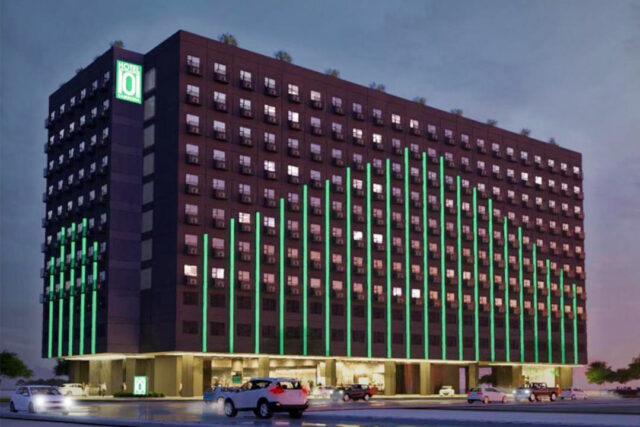
Hotel101 to open 429-room Milan condotel, its 2nd Europe property

HOTEL101-SIHANOUKVILLE — HOTEL101 GLOBAL PTE. LTD.

HOTEL101 GLOBAL HOLDINGS Corp., the Nasdaq-listed hospitality arm of DoubleDragon Corp., is expanding further into Europe with a 429-room development in Milan, marking its second project in the region as it accelerates its international rollout.

The company signed a joint venture with binding agreements to develop the condotel on a 1.4-hectare site in San Donato Milanese, a business district southeast of central Milan, it said in a statement on Sunday.

The project is targeted for completion in 2028 and is projected to generate about €85.8 million (P5.8 billion) in unit sales.

Hotel101 Global is banking on its standardized “condotel” model — in which individual units are sold to investors while hotel operations are centrally managed — to anchor its global expansion. Unit pricing for the Milan project is estimated at €200,000, according to the company.

The property will offer mid-range pricing and four-star amenities, including round-the-clock reception, an all-day dining outlet, a 25-meter pool, a gym, business facilities, function rooms and children’s play areas. The development will also incorporate energy-efficient features such as solar panels.

Hotel101 said its Milan site sits about 7.1 kilometers from Linate Airport and four kilometers from the Metro Milano San Donato station, positioning it to attract both business and leisure travelers.

The company expects the project to draw local and foreign buyers and contribute to Milan’s economy through investment inflows, job creation and tourism-related activity.

“This expansion marks a significant milestone in the company’s European growth strategy, bringing its novel globally standardized ‘condotel’ business model to one of the world’s most dynamic cities,” the company said.

Hotel101 has nine operating properties in the Philippines and is developing projects in Hokkaido, Madrid and Los Angeles. In May, the company signed an agreement with Saudi Arabia’s Horizon Group to build 10 hotels in the kingdom.

The Milan project forms part of Hotel101’s target to establish a presence in 25 countries over the next three years, with a long-term goal of operating one million rooms across 100 markets.

DoubleDragon said it remains the only Philippine company with a unit listed on the Nasdaq. Hotel101 Global had a market capitalization of about US$1.9 billion (P112 billion) as of end-November. — Beatriz Marie D. Cruz

T-bill, bond rates may be mixed on easing hopes

BW FILE PHOTO

RATES of the Treasury bills (T-bills) and Treasury bonds (T-bonds) on offer this week could end mixed as the market prices in expectations of further monetary easing from both the Bangko Sentral ng Pilipinas (BSP) and the US Federal Reserve this month.

The Bureau of the Treasury (BTr) will auction off P22 billion in T-bills on Monday or P7 billion in 91-day papers and P7.5 billion each in 182-day and 364-day debt.

On Tuesday, the government will offer P35 billion in dual-tenor T-bonds, or P20 billion in reissued seven-year papers with a remaining life of two years and four months, and P15 billion in reissued 10-year debt with a remaining life of nine years and four months.

T-bill yields could be mixed to track secondary market movements as both the BSP and the Fed are expected to deliver rate cuts at their meetings this month, Rizal Commercial Banking Corp. Chief Economist Michael L. Ricafort said in a Viber message.

The bonds on offer on Tuesday could also fetch average yields close to those at the secondary market, he said.

A trader said the reissued seven-year debt could be quoted at 5.2-5.25% and the reissued 10-year bond could fetch rates of 5.825-5.85%, with both expected to see “good reception” from the market.

“[The bond] auctions should still be well bid as these will be the last for the year,” the trader said.

At the secondary market on Friday, the 91-day T-bill inched up by 1.44 basis points (bps) week on week to yield 4.8820%, based on the PHP Bloomberg Valuation Service Rates data as of Nov. 28 published on the Philippine Dealing System’s website. Meanwhile, the 182-day and 364-day debt slipped by 0.33 bp and 1.41 bps to end at 4.9999% and 5.0711%, respectively.

For the bonds, the seven-year paper climbed by 1.12 bps week on week to fetch 5.7291%, while the three-year debt — the benchmark tenor closest to the remaining life of the issue to be auctioned off on Tuesday — also rose by 3.63 bps to end at 5.3310%. For its part, the 10-year bond went up by 4.08 bps week on week to yield 5.9364%.

BSP Governor Eli M. Remolona, Jr. earlier said they could deliver a fifth straight 25-bp cut at the Monetary Board’s Dec. 11 meeting to help provide economic stimulus following the slower growth seen last quarter as a corruption scandal involving government infrastructure projects has weakened consumer and investor confidence.

The central bank has lowered borrowing costs by a total of 175 bps since it began its easing cycle in August 2024, with the policy rate now at an over three-year low of 4.75%.

Meanwhile, traders conclude that weakening labor data will lead to more rate cuts, even as many Fed policymakers express concern about still-elevated inflation, Reuters reported.

The US federal government is releasing a backlog of economic data after reopening from a record 43-day shutdown.

Fed funds futures traders are pricing in 87% odds of a cut at the conclusion of the Fed’s Dec. 9-10 meeting, up from 71% a week prior, according to the CME Group’s FedWatch Tool.

Signals from some US central bank officials, led by New York Fed President John Williams and Governor Christopher Waller, that a December rate cut may be warranted due to labor market weakness have added downward pressure on Treasury yields and reinforced dovish bets in futures markets.

Their stance, however, contrasted with several regional Fed presidents advocating a pause in easing until inflation shows a more convincing move toward the 2% target.

Both the trader and Mr. Ricafort said S&P Global Ratings’ move to affirm the Philippines’ investment-grade “BBB+” rating and its positive outlook on Thursday also helped improve sentiment in the bond market.

Last week, the BTr raised P25 billion from the T-bills it auctioned off, higher than the P22-billion plan, as total bids reached P84.87 billion or almost four times the amount on offer.

Broken down, the Treasury borrowed P7 billion as planned via the 91-day T-bills as total tenders for the tenor reached P28.31 billion. The three-month paper was quoted at an average rate of 4.849%, inching up by 0.7 bp from the previous week. Yields accepted were from 4.828% to 4.873%.

The government also sold the programmed P7.5 billion in 182-day securities as tenders for the tenor totaled P29.55 billion. The average rate of the one-year T-bill was flat at 4.97%. Bids awarded carried yields from 4.95% to 4.973%.

Lastly, the government increased its award of 364-day securities to P10.5 billion from the P7.5-billion plan as tenders hit P27.01 billion. The average rate of the one-year T-bill was at 5.003%, decreasing by 1.4 bps week on week. Accepted rates were from 4.998% to 5.013%.

Meanwhile, the reissued seven-year bonds on offer on Tuesday were last auctioned off on Oct. 7, where the BTr borrowed P15 billion as planned at an average rate of 5.698%. Accepted yields ranged from 5.6% to 5.71%.

The reissued 10-year bonds up for sale this week were last offered on Nov. 4, with the government raising P15 billion as programmed at an average yield of 5.894%, with accepted tenders carrying rates of 5.889% to 5.898%.

The BTr wants to raise P101 billion from the domestic market this month, or P66 billion via T-bills and P35 billion through T-bonds.

The government borrows from local and foreign sources to help fund its budget deficit, which is capped at P1.56 trillion or 5.5% of gross domestic product this year. — ARAI with Reuters

Fintech platform LenderLink tops local innovation champions in KMC Startup Awards 2025

LenderLink CEO and Founder Christo Georgiev claims gold awards for Startup of the Year and Customer Experience Excellence categories.

For the third consecutive year, flexible office spaces and offshore solutions provider KMC Solutions recognized the Philippines’ best and brightest startup companies at the KMC Startup Awards 2025 gala night held last Nov. 13, within the Philippine Startup Week.

This year’s competition received 140 entries from different startups nationwide, culminating in 24 finalists awarded gold, silver, and bronze distinctions across eight major categories.

LenderLink led this year’s roster of gold awardees, securing both gold for Startup of the Year and Customer Experience Excellence categories. The fintech platform earned praise from judges for addressing critical access gaps in lending and setting new standards in user-first financial services.

LITHOS Manufacturing captured the gold for Culture and Community Excellence, recognized for its strong employee-first workplace practices and commitment to local industry development.

Serbiz earned Tech Innovator of the Year for its solutions that streamline field service operations and empower grassroots workers through technology.

ZendEase was hailed as this year’s Growth Champion for its rapid scale-up locally and globally.

Philippine Coding Camp took home the Innovation in Marketing award for its creative education campaigns that drive digital literacy among Filipino youth.

Kredit Hero, Inc. rounded out the gold awardees with the FutureTech Leadership prize, a testament to its contribution to next-generation financial technologies.

The silver winners are: Mylo Speech Buddy (Startup of the Year, Growth Champion, and Innovation in Marketing), Flying Tigers Express’ CEO Dave Overton (Breakthrough Leader of the Year), Rezbin (Culture and Community Excellence), Pili AdheSeal, Inc. (Tech Innovator of the Year), NextPay (Customer Experience Excellence), and Serbiz (FutureTech Leadership).

Meanwhile, the bronze winners include: Rezbin (Startup of the Year), BCremit’s Co-Founder Jose Angelo “Gio” Calma (Breakthrough Leader of the Year), Bambuhay (Culture and Community Excellence), Twala (Tech Innovator of the Year), Jia Financing, Inc. (Growth Champion), Dehusk (Innovation in Marketing and Customer Experience Excellence), and Rezbin (FutureTech Leadership).

Notable entrepreneurs were also present at the awards ceremony. This includes Siargao-based businessman Christophe Bariou, owner of bronze awardee and plant-based milk brand Dehusk, and young businesswoman Iyana Argañoza, CEO of Serbiz.

Reflecting on the success of the KMC Startup Awards and its relevance to the Philippines’ startup community, Michael McCullough, co-founder of KMC Solutions, urged new ventures to use the awards as a platform to foster strong connections between Filipino startups.

“At KMC, we remain committed to supporting this community — to building an environment where founders and teams can think boldly, work together, and grow,” Mr. McCullough said.

First inaugurated in 2023 by KMC Solutions, which once was a startup itself, the KMC Startup Awards was born out of a desire to spotlight innovators who are transforming industries.

“What began in 2023 as a way to shine a light on emerging founders has grown into a movement — one that recognizes imagination, resilience, and the determination to turn ideas into reality,” said Mr. McCullough.

With this year’s theme, “Innovation Without Limits,” the co-founder further encouraged startups to look for fresh ideas and break boundaries.

“We believe that meaningful solutions can start anywhere, and that progress comes from the courage to create what has not existed before,” he said.


SparkUp is BusinessWorld’s multimedia brand created to inform, inspire, and empower the Philippine startups; micro, small and medium enterprises (MSMEs); and future business leaders. This section will be published every other Monday. For pitches and releases about startups, e-mail to bmbeltran@bworldonline.com (cc: abconoza@bworldonline.com). Materials sent become BW property.

BDO shares slip as $500M from dollar bond sale tests appetite

BW FILE PHOTO

By Pierce Oel A. Montalvo, Reporter

BDO UNIBANK, Inc. was the most actively traded stock on the Philippine Stock Exchange (PSE) last week, with investors closely eyeing the bank’s $500-million bond sale, its first offshore debt issue in three years.

A total of 37.69 million BDO shares worth P4.89 billion changed hands over the week, according to PSE data. The stock closed at P131, down 0.4% from P131.50 a week earlier, underperforming the financial sector and the broader Philippine Stock Exchange index (PSEi), which rose 0.6% and 0.4%, respectively.

Compared with its P142.70 close on the last trading day of 2024, BDO’s shares were down 8.2%, slightly worse than the financial sector’s 7.1% decline and the PSEi’s 7.8% slump.

The bank raised $500 million through five-year dollar-denominated bonds, which were oversubscribed more than three times, attracting tenders totaling roughly $1.6 billion. The notes carry a 4.375% coupon rate. BDO’s last offshore bond issuance was a $100 million seven-year blue bond in May 2022, in partnership with the International Finance Corp.

Market analysts said the bond proceeds would strengthen BDO’s funding base and support loan growth while enhancing foreign currency liquidity.

“For this issuance to be profitable for shareholders, BDO needs to generate a return exceeding its 4.375% annual interest expense on the bond,” Toby Allan C. Arce, head of sales trading at Globalinks Securities and Stocks, Inc., said in a Viber message.

“The bank must achieve a minimum return on the $500-million proceeds of at least 4.5-5%, considering not just interest costs but also issuance fees and foreign exchange hedging expenses,” he added.

BDO must earn more than the bond’s interest cost for the issuance to benefit its returns, said Luis A. Limlingan, head of sales at Regina Capital Development Corp. “Any return modestly above the coupon and related costs already avoids dilution to shareholder returns,” he said in a Viber message.

The funds are likely to be deployed toward higher-yielding dollar corporate loans, trade finance and treasury placements, Mr. Arce said.

However, refinancing risks loom for 2030 maturity bonds amid potential US Treasury yield spikes and widening emerging-market credit spreads. A weaker peso could also raise effective costs if hedging expenses increase.

Despite these risks, BDO’s A-level credit ratings, strong capital ratios and diversified funding base provide a buffer. Mr. Arce said the bank’s ability to roll over dollar assets offers a natural hedge against refinancing shocks, while maintaining liquidity and credit discipline will be key.

Investor sentiment around the stock was influenced by these dynamics, with market watchers citing mixed reactions to global and local economic signals. Softer November consumer data and Fed rate uncertainties added caution, though expectations of potential Bangko Sentral ng Pilipinas policy rate cuts have supported banking shares. The central bank reduced its policy rate to 4.75% in October, the lowest in over three years.

Support for BDO shares is seen around P125-P128, with resistance at P134-P140. Analysts said a break above resistance could push the stock toward P145-P150, while a breach of support could trigger a correction toward P120.

DBP eyes peso bond issue late next year

COURTESY OF DBP FACEBOOK PAGE

THE DEVELOPMENT BANK of the Philippines (DBP) is planning to tap the domestic bond market again in the second half of 2026 to raise fresh funds for its lending activities.

“We have some maturities, but the idea is to get fresh funds,” DBP Executive Vice-President and Treasury & Corporate Finance Sector Head Carel D. Halog told reporters on Thursday. “The procurement process alone takes around six months… It might spill over into the third quarter. That’s the most realistic scenario.”

The bank wants to borrow P10 billion to P50 billion and issue a bond with a medium-term tenor, possibly with a five-year duration, depending on market demand, he said.

“As a borrower, of course you want to extend your duration and lock in your rates while it’s still low… As an investor, you don’t want to lock in. So, it’s a balance between supply and demand.”

The notes will be issued out of DBP’s expanded P150-billion program, he added.

He said a sustainability-themed issuance is unlikely as there are extra costs for certifying the bonds.

“There are extra procedures for sustainability and extra cost for us. So, we want to make it cost-efficient. We will just do a straightforward bond.”

DBP last tapped the domestic bond market in July, raising P8.25 billion in fresh funds from its second dual-tenor bond offering for the year.

GROWTH
Meanwhile, DBP expects Philippine gross domestic product (GDP) growth of 4% to 5% next year amid an expected recovery in sentiment that was hit by the corruption scandal and with the Bangko Sentral ng Pilipinas (BSP) seen cutting rates further to support domestic demand. This is below the government’s 6-7% growth target.

“We are cautiously optimistic. At least for DBP, our outlook is good. But for the economy as a whole, obviously that depends on investor confidence… I think the government is doing everything they can to restore that confidence,” DBP President and Chief Executive Officer Michael O. de Jesus said.

This, even as he said that they expect the bank’s net income to decline by P1 billion to P2 billion this year due to higher provisioning as the corruption scandal has affected repayments by contractors. He added that they see a rebound as soon as the first quarter of next year.

DBP’s net income dropped by 51.77% year on year to P2.257 billion at end-September.

Mr. Halog added that weakening economic prospects could cause the BSP to become more aggressive in its easing cycle. He said they see another 25-basis-point cut this month and two more quarter-point moves in 2026.

“They’re balancing growth and inflation,” he said.

“With GDP at 4%, you can’t afford to hike rates. And in fact, even without the rate hike, we’re looking at a GDP probably of not higher than 5%. Growth is very weak because we are a consumer-driven economy. And government spending is weak. So, consumer confidence is at the lowest. No one wants to spend. So, how can you drive the economy?”

Philippine GDP grew by 4% in the third quarter, the slowest in over four years, as the corruption mess affected public investment and household spending. This brought the nine-month average to 5%, well below the government’s 5.5-6.5% GDP growth target for the year. — A.M.C. Sy

Seven-seater contender

Not your average SUV. The Mitsubishi Destinator draws from the brand’s rally roots. — PHOTO BY MANNY N. DE LOS REYES

Mitsubishi unveils all-new Destinator

MITSUBISHI MOTORS Philippines Corp. (MMPC) introduced recently its newest nameplate for the SUV-crazy Philippine market — the all-new Destinator.

The seven-seater Destinator presents a commanding SUV-proportioned body with a strong stance. Its signature Dynamic Shield fascia projects a bold and upscale presence, while the stylish LED headlamps and daytime running lights enhance visibility on the road. Sleek character lines flow seamlessly along the sides, complemented by handsome 18-inch machine-cut two-tone alloy wheels that add a touch of sportiness and sophistication.

With its best-in-class 214-mm high ground clearance and a new 1.5-liter 4B40 turbocharged engine that produces 163ps and 250Nm, it combines performance and efficiency in one refined package. Drawing from Mitsubishi’s rich rally heritage — most notably from the legendary Lancer Evolution — the Destinator sports five selectable Drive Modes: Normal, Wet, Gravel, Mud, and the new Tarmac, ensuring optimal performance and stability in every road condition.

The Destinator also features Mitsubishi Connect, which makes it the brand’s first vehicle equipped with Connected Car Services (CCS) in the Philippines — giving drivers enhanced safety, convenience, and peace of mind.

With the advanced safety technologies and Mitsubishi Motor’s commitment to durability and reliability, the Destinator achieves the highest five-star safety rating in the ASEAN NCAP, a comprehensive safety performance assessment program for new vehicles in the ASEAN region.

The Destinator offers a spacious and roomy interior for seven people, providing ample room for families and friends on a road trip. Flexible utility and cargo configurations also make every drive effortless. High-quality materials and an ergonomic layout ensure a comfortable experience for every passenger. For enhanced safety, the Destinator is also equipped with Mitsubishi Motors Safety Sensing (MMSS) with Multi-Around Monitor (MAM), making every drive safe and secure.

The Destinator redefines everyday comfort and sophistication with a suite of thoughtfully integrated premium features. Inside, it features a monolithic display panel that combines a 12.3-inch Smartphone Display Audio (SDA) with wireless Apple CarPlay and Android Auto, Smart Rear View Mirror for an unobstructed view from behind the vehicle, and an eight-inch Multi-Information Display (MID), creating a seamless, high-tech experience.

Passengers enjoy a luxurious and intuitive cabin experience, enhanced by 64-color ambient lighting front and rear, a panoramic sunroof, and an eight-speaker Yamaha Dynamic Sound Premium Audio System for immersive sound. Practical touches such as seatback tables on the second row, a NanoeX air purification system, and a console box with cooling function elevate convenience, comfort, and refinement.

The Destinator comes in three variants, ensuring that every customer can own one that fits their needs and lifestyle: GLX Turbo CVT (P1.389 million, with an introductory price of P1.289 million), GLS Turbo CVT (P1.599 million, with an introductory price of P1.499 million), and GT Turbo CVT (P1.929 million, with an introductory price of P1.799 million). Introductory pricing is available for reservations and vehicle releases made from Nov. 10, 2025 until Jan. 31, 2026, inclusive of Destinator Adventure Gear merchandise. The new Destinator comes with a three-year standard warranty plus two-year extended warranty coverage, giving customers added peace of mind.

The Destinator is available in six colors (Quartz White Pearl, Lunar Blue Mica, Graphite Gray Metallic, Jet Black Mica, Blade Silver Metallic, and Red Metallic), including a pair of two-tone color options featuring a black roof — exclusive for the GT variant.

Yields on gov’t debt rise on profit taking

YIELDS on government securities (GS) ended mostly higher last week as market players repositioned before the month’s end amid domestic political concerns and with expectations of another rate cut from the Bangko Sentral ng Pilipinas (BSP) this month already priced in.

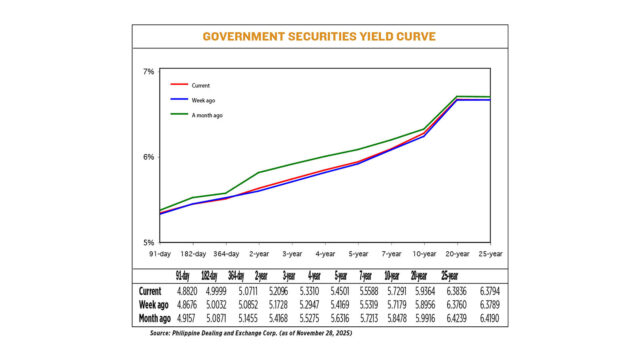
GS yields, which move opposite to prices, rose by an average of 1.73 basis points (bps) week on week, according to PHP Bloomberg Valuation Service Reference Rates data as of Nov. 28 published on the Philippine Dealing System’s website.

The short end of the curve was mixed, with the 91-day Treasury bill (T-bill) going up by 1.44 bps to 4.8820%, and the 182- and 364-day T-bills slipping by 0.33 bp (to 4.9999%) and 1.41 bps (5.0711%), respectively.

At the belly, yields climbed across the board. Rates of the two-, three-, four-, five, and seven-year Treasury bonds (T-bonds) climbed by 3.68 bps (to 5.2096%), 3.63 bps (5.3310%), 3.32 bps (5.4501%), 2.69 bps (5.5588%), and 1.12 bps (5.7291%), respectively.

Tenors at the long end likewise ended higher. Yields on the 10-, 20-, and 25-year T-bonds rose by 4.08 bps, 0.76 bp, and 0.05 bp to 5.9364%, 6.3836%, and 6.3794%, respectively.

Total GS volume traded went up to P91.27 billion last week from P62.52 billion recorded previously.

“Profit-taking was the theme this week as investors de-risk ahead of the Nov. 30 rally, which comes after confirmation by some parties that there as sides who are plotting a transition government,” a trader said in a text message.

The trader said expectations of further rate cuts from both the BSP and the US Federal Reserve are already mostly priced in.

Noel S. Reyes, Security Bank Corp. Trust Asset Management Group chief investment officer,  likewise said in a phone interview that market activity was mostly muted throughout the week, with players mostly reducing their risk positions amid domestic political concerns as the flood-control mess continues to unravel.

“There’s been a gradual steepening of the curve. The 10-year bond’s yield went up slightly, but overall, it’s still pretty much within the range that we’ve been seeing,” he added.

He said US Treasury yield movements also partly affected the GS market. “But since it was also in a range for the past week, it’s not as relevant as an influence in terms of peso government securities yield movements.”

The market is already looking ahead to the Monetary Board’s Dec. 11 meeting, Mr. Reyes added.

“Inflation is manageable for us and the GDP (gross domestic product) was very soft for the third quarter, which now means the BSP will likely need to act more than what is necessary,” he said.

“I think originally, they were still contemplating on whether 25 bps was certain for December. I think because of recent events, that has become a larger possibility.”

BSP Governor Eli M. Remolona, Jr. earlier said they could deliver a fifth straight 25-bp cut at this month’s policy review to help provide economic support following the weak growth seen last quarter as a corruption scandal involving government infrastructure projects has dampened consumer and investor confidence.

The central bank has lowered borrowing costs by a total of 175 bps since it began its easing cycle in August 2024, with the policy rate now at an over three-year low of 4.75%.

Philippine GDP grew by 4% in the third quarter, the slowest in over four years. This brought the nine-month average to 5%, below the government’s 5.5-6.5% GDP growth target for the year.

Thousands of protesters in the Philippines, including Roman Catholic clergy and civil society groups, on Sunday gathered in the capital for another rally triggered by a government corruption scandal, Bloomberg reported.

Manila police estimated about 3,000 demonstrators assembled at a major public park in Manila. Some shouted chants calling for the jailing of corrupt officials, while ranking Church officials in the predominantly Roman Catholic nation separately held Mass at a site where a public uprising erupted nearly four decades ago.

“Let us unite in repentance for corruption in our society,” said Cardinal Pablo Virgilio David, president of the Catholic Bishops’ Conference of the Philippines. “We need a moral and spiritual reset if we want a brighter future for the Philippines.”

For this week, Mr. Reyes said GS yields could be range-bound before the Monetary Board’s policy meeting next week.

“Unless there is a significant risk that occurs on Sunday… if it becomes violent, then there could be some sell-off on that day. It’s really more the event on Sunday and anticipation of BSP action,” he added.

“Fundamentally, we think that yields will eventually move lower to reflect the rate cut,” the bond trader said. — Matthew Miguel L. Castillo

Airlines finish Airbus software update

PHILIPPINE STAR/EDD GUMBAN

LOCAL AIRLINES have finished updating the software on their Airbus aircraft after an urgent advisory from the manufacturer prompted carriers to ground several planes.

“Cebu Pacific is pleased to inform its passengers that it has successfully completed the mandatory software update across the affected Airbus A320/A321 aircraft, and normal operations have been restored,” the airline said in a statement on Sunday.

On Saturday, the Transportation department said 75 aircraft operated by Philippine Airlines (PAL), Cebu Pacific and AirAsia Philippines were affected by the required update.

Airbus issued the directive after a technical advisory flagged a potential safety risk across its A320 family — the A318, A319, A320 and A321 models — following a reported malfunction in October.

“Analysis of a recent event involving an A320 Family aircraft has revealed that intense solar radiation may corrupt data critical to the functioning of flight controls,” Airbus said on its website. A “significant number” of A320 Family aircraft in service might be affected, it added.

PAL said all aircraft scheduled for commercial flights that were covered by the mandatory update have completed the upgrade.

“Our technical and engineering teams worked swiftly and meticulously to ensure full compliance within the prescribed timeframe, prioritizing the highest standards of safety and reliability,” it said in a separate statement.

AirAsia Philippines Chief Executive Officer Suresh Bangah said the airline moved quickly to meet Airbus’ requirements. “We want to assure our guests that safety is, and will always be, our top priority,” he said in a statement on Saturday.

The Transportation department said 93 flights were affected by the issue — 82 were canceled and 11 delayed — affecting at least 14,000 passengers. Airlines are offering flexible options, including free rebooking and conversion to travel credits.

“Regardless of how small the glitch might be, when it comes to aviation, it will always have a considerable impact on passenger perception and confidence,” Nigel Paul C. Villarete, senior adviser on public-private partnerships at Libra Konsult, said via Viber.

Air travel continues to recover. Passenger volume reached 46.84 million in the nine months through September, up 6.25% from a year earlier, driven by domestic traffic, the Civil Aeronautics Board reported.

Mr. Villarete said the software update should help strengthen public confidence by ensuring a safer, more reliable avionics system. “We just need to go through the reaction and learning curve as we grapple with passengers’ trust and confidence in our systems,” he said. — Ashley Erika O. Jose