

Home Blog Page 9488

Why the IATF’s strategy did more harm than good

British banking giant HSBC recently published its forecast for the Philippine economy and the outlook is bleak. After clocking-in a 0.2% contraction in gross domestic product (GDP) in the first quarter, the bank forecasts a deep contraction of 7% in the second quarter, another contraction of 4.3% in the third quarter, and yet another shrinkage of 3.9% for the fourth quarter. This will bring the full year contraction rate to 3.85%. The last time the Philippines posted negative growth was in 1998.

HSBC’s forecast coincides with the projections of the National Economic and Development Authority (NEDA) which predicted an economic contraction of 4.3% to 4%.

The 10 industries most affected by government’s quarantine measures are: the arts, entertainment and recreation industry whose revenue loss amounted to 82.3% of pre-COVID levels; the travel, hotel and restaurant industry that lost 81.9% of revenues; technical repair services plunged by 77%; educational services dropped by 76.8%; construction activities dove by 74.6%; servicing of motorized vehicles sank by 73.4; financial and insurance services fell by 71.2%; sports and fitness services dropped by 70.4%; real estate plummeted by 68.6%; and professional, scientific and technical services fell by 67.1%

As of this writing, 4.9 million Filipinos have already lost their jobs and unemployment is now at an all time high of 17.7%. Out of the 998,342 micro-, small- and medium-sized enterprises (MSMEs) in operation, it is estimated that at least 40% will not survive the quarantine and its aftermath.

The economic damage of the pandemic could have been avoided had the Inter-Agency Task Force on Emerging Infectious Diseases (IATF) not prescribed such harsh quarantine measures. Granted, a level of lockdown was necessary to contain the spread of the virus, but the Enhanced Community Quarantine (ECQ) and even the General Community Quarantine (GCQ) were too severe and needlessly destroyed parts of the economy. It relegated millions to unemployment and drove thousands of MSMEs to insolvency.

If the IATF took the advice of the business sector, it would have adopted Vietnam’s strategy. Vietnam addressed the pandemic by immediately declaring a travel ban on China. It embarked on aggressive contact tracing and focused its quarantine efforts only on the hotspots — the very streets, buildings, and neighborhoods where those infected reside. Meanwhile, it allowed the economy to keep operating including all facets of commerce, factories, and services.

Vietnam’s strategy proved more effective. Its infection rates are down and so are its death rates. The economic impact on MSMEs and job losses was minimized. It shielded its economy from a recession as it is still forecasted to grow by 1.6% this year.

In contrast, the IATF prescribed a shot-gun approach to address the pandemic in the Philippines. Instead of closing only the barangays where infections were recorded, it chose to close the entire island of Luzon and key cities in the Visayas and Mindanao. Its strategy consigned the 10 industries mentioned above to the brink of death. It caused our economy to spiral into recession.

What burns acerbically is that despite such draconian measures, infections in the Philippines are still on the rise. The IATF can’t even determine where we are in the infection curve since its base data is grossly inaccurate. Let’s not forget, the IATF only started to talk about ramping-up testing and tracing in April when it should have done it in January when the first COVID-19 case was discovered. Even today, it has yet to achieve 30,000 COVID-19 tests per day.

The militaristic quarantine measures that Health Secretary Francisco Duque, General Carlito Galvez, and the rest of the IATF put into play was a mistake. They did more damage than good. Curiously, none of the members of the economic team are represented in the IATF, which is probably why Duque and Galvez implemented their shotgun strategy without regard to the effects it would have on the economy.

Unfortunately, President Rodrigo Duterte, who has the last say on the matter, was not able to discern the faults in the IATF’s militaristic plan. Sadly, our jobless countrymen and bankrupt MSMEs must bear the brunt of his lapse in judgement.

A V-SHAPED RECOVERY
In the early days of the ECQ, the IATF used fear to scare the public into obeying the harsh measures of the quarantine. As a result, the populace became excessively fearful (and paranoid) of both infection and arrest.

As we begin to re-start the economy, the fear that the IATF perpetuated has become the greatest barrier to recovery. See, fear prevents people from going out to consume goods and services. Fear causes a drop in consumer demand. A drop in demand translates to a corresponding drop of production. A drop in production consequently causes more layoffs and more companies going belly up.

The IATF failed to realize that fear will destroy the very foundation of our consumer-driven economy. This is why a V-shaped recovery is not something we can expect. The use of fear was another miscalculation of the IATF.

LONG-TERM RECOVERY
The NEDA and the Department of Finance (DoF) were banking on the Corporate Recovery and Tax Incentives for Enterprises Act, or the CREATE Law, to facilitate our long term recovery. Apart from lowering the tax burden of local firms (to help them survive), CREATE would have made us more competitive in the race to attract foreign investments, what with the flexibility to tailor-make incentive packages for them. The entry of foreign investments is vital to rebuild our industrial base and provide jobs for our displaced countrymen.

But despite the urgent call of NEDA, the DoF, and 31 business organizations from the private sector, the self serving clowns in Congress chose to prioritize the passage of the Anti-Terror Bill over CREATE. Congress is now in recess and that puts CREATE and our economic recovery program in limbo.

In one fell swoop, the IATF destroyed our once strong economy through its wrong strategy and many missteps. Congress just made our recovery harder to achieve. Sorry to say but the manner by which this pandemic is being handled is a disaster.


Andrew J. Masigan is an economist.
Diaz: Staying the course in Olympic return mission

WHILE HER PREPARATION and journey for a possible return to the Olympic Games were greatly disrupted by the coronavirus disease 2019 (COVID-19) pandemic, decorated Filipino weightlifter Hidilyn Diaz said she remains undeterred of seeing her mission through, doing everything she can to stay the course.

Currently in Malaysia with her team where they are training, Ms. Diaz said COVID-19 has thrown a curveball to what they want to accomplish but also shared that they are steadily finding their way back.

And that is something she is very grateful for.

“I’m grateful that we were able to survive the last three months. I’m grateful that I’m still here to continue my dream [of making it back to the Olympics],” said Ms. Diaz on Tiebreaker Vods’ “So She Did!” podcast episode last week.

Ms. Diaz is looking to make another trip to the Summer Games after winning a silver medal in the last edition of the quadrennial sporting meet in 2016 in Brazil.

She and her team were stuck in Selangor when the pandemic hit and subsequent lockdowns were raised by different countries, including the Philippines and Malaysia, making travel very difficult.

Ms. Diaz said early on it was tough for them as they had to make a lot of adjustments with their training regimen and routine, apart from finding an area where they are safe to continue.

But as the days went by, she shared they regained their footing and figured a way to continue with training.

They are hoping now that as the restrictions in Malaysia are eased, they get to further elevate their regimen and resume with the kind of pace they were having pre-COVID-19.

A three-time Olympian already, Ms. Diaz, 29, said the Olympics remains a strong motivation for her, never mind if her wait was stretched further with the Tokyo Games pushed back to 2021 because of COVID-19, which is why she is leaving no stone unturned in trying to get back to it.

As things stand, she is virtually qualified for the Tokyo Games, being in the top five in her category and needing to compete in at least one more qualifier to formalize her entry.

Ms. Diaz ranks No. 5 in the women’s 55kg category with 3,717.0982 points behind Jiang Huihua (4,667.8878), Liao Qiuyun (4,288.9622), Zhang Wangqiong (4,212.6639) and Li Yajun (4,099.0223) all of China.

However, only one lifter can represent a country per event in the Olympics, which would likely push Ms. Diaz to the No. 2 spot.

“Qualifying in the Olympics is very tough because you’re up against elite athletes but I’m confident of what I can do. Also we really need all the support we can get,” she said.

In the Tokyo Games, the Philippines is looking to win its first-ever gold medal.

Filipinos already qualified in the Olympics next year are pole-vaulter EJ Obiena, gymnast Carlos Yulo and boxers Eumir Felix Marcial and Irish Magno. — Michael Angelo S. Murillo

NBA young stars want insurance protection

AS THE NATIONAL Basketball Association and its players continue to negotiate an attempt to restart the season, several young stars reportedly spoke with the NBA Players Association (NBPA) on Friday about the possibility of league-financed insurance policies to protect against career-threatening injuries.

According to a report Saturday by ESPN, Miami’s Bam Adebayo, Sacramento’s De’Aaron Fox, the Los Angeles Lakers’ Kyle Kuzma, Utah’s Donovan Mitchell and Boston’s Jayson Tatum spoke with NBPA executive director Michele Roberts and senior counsel Ron Klempner about engaging with the NBA about the possible policies.

Those five were drafted in 2017, making them eligible for rookie extensions following the season.

The league and the NBPA have been hashing out details of the return-to-action plan in the wake of the NBA’s hiatus prompted by the coronavirus pandemic. The season was halted March 11 after Utah Jazz center Rudy Gobert tested positive for COVID-19.

Earlier this month, owners approved a plan to resume the season at the Walt Disney World Resort in the Orlando, Florida, area. The plan would call for 22 teams to take part, with teams sequestered in what is being called a “bubble.” Players are tentatively scheduled to arrive at Disney World from July 9–11 with the season resuming July 30.

But players around the league have reportedly become concerned about increased risks of injury with a prolonged shutdown due to COVID-19, a shortened training camp should play resume, and heightened risk of contracting and spreading the virus with players so closely confined in the bubble.

According to the ESPN report Saturday, the NBA and the union are still negotiating the revised terms of the collective bargaining agreement, and protections for players in the event of serious illness or injury has been part of the discussions.

Citing a source, ESPN said policies for players on the brink of signing max extensions worth more than $100 million could cost $500,000 to cover the remainder of this season.

Multiple outlets also reported Friday night that Nets guard Kyrie Irving lobbied some 80-plus players on a separate call to boycott the scheduled resumption of the season as a protest against racial injustice, but added he would support the players if they do decide to proceed with the scheduled restart. — Reuters

Hadley uses red-hot putter to move into contention at Colonial

TORONTO — Chesson Hadley used a superb putting display to charge up the third-round leaderboard at the Charles Schwab Challenge in Forth Worth, Texas, on Saturday before overnight leader Harold Varner III even teed off.

Hadley opened his round with four consecutive birdies and added another at the eighth and 11th holes en route to a bogey-free, six-under par 64 at Colonial Country Club that left him three shots back of Varner.

American Hadley, who has not won on the PGA Tour since his maiden triumph in 2014, showed his intentions early on the spectator-free course as his approach shot from a greenside bunker settled two feet from the cup.

After making birdie putts of 16 feet and seven feet at the next two holes Hadley then converted a 43-yard putt at the par-three fourth to reach four under on the day after only four holes.

Hadley, who missed the cut in his previous two starts before the PGA Tour halted action due to the COVID-19 pandemic, was a model of precision as he hit 12 of 14 fairways and 15 of 18 greens in regulation and did not miss any putts within 10 feet.

Varner, who is one shot clear of Jordan Spieth and Bryson DeChambeau, is among the late starters.

World number one Rory McIlroy, who is two shots back of Varner, is scheduled to tee off at 1:50 p.m. ET (1750 GMT). — Reuters

Inaugural FIBA esports tourney unravels this week; PH team named

By Michael Angelo S. Murillo, Senior Reporter

ALL IS SET for the staging of the inaugural FIBA Esports Open this week, which will feature various national teams, including that from the Philippines.

A series of exhibition e-basketball games, the FIBA Esports Open 2020 will take place from June 19 to 21.

Competing teams include Argentina, Australia, Austria, Brazil, Cyprus, Indonesia, Italy, Latvia, Lebanon, Lithuania, New Zealand, the Philippines, Russia, Saudi Arabia, Spain, Switzerland and Ukraine.

For the tournament each team will consist of seven players, five on the court and two reserves. Games will be played remotely on NBA 2K using the Pro-AM mode and allowing full customization of player avatars, uniforms and arena designs.

At the weekend, the Samahang Basketbol ng Pilipinas (SBP) named the squad that will be competing in the FIBA Esports Open 2020.

Culled from the growing esports scene in the country, the team is composed of Aljon “Shintarou” Gruzin (point guard), Rial “Rial” Polog Jr. (shooting guard), Custer “Aguila” Galas (small forward), Rocky “Rak” Brana (center/power forward), Philippe “Izzo” Alcaraz IV (center), Clark “Clark” Banzon (power forward) and Al “Alt” Timajo (center/power forward).

The entire FIBA Esports Open 2020 series will be produced from the brand-new FIBA Esports Studio located in Riga, Latvia, with a daily four-hour show featuring up to six games.

Each game will be live-streamed on FIBA’s Facebook, Twitch and YouTube channels with live commentary in English.

Matches can also be seen over the Samahang Basketbol ng Pilipinas (SBP) Facebook page.

“FIBA is extremely proud and excited to start its esports journey with the FIBA Esports Open 2020, a pilot project of exhibition games between national teams in collaboration with NBA 2K,” said Frank Leenders, FIBA Media and Marketing Services Director General in a statement.

“The esports initiative was identified by the FIBA Central Board as important and consistent with the strategic objective to enlarge the FIBA Family. In these challenging times, we feel encouraged by the enthusiasm of some of our National Federations who are already active in this space and have been our charter partners during the last few months,” he added.

The inaugural FIBA esports tournament comes as the basketball community continues to await the return of regular play after being halted by the coronavirus disease 2019 (COVID-19) pandemic in March.

Local basketball community mourns passing of pioneering coach Jorge

THE LOCAL basketball community is mourning the passing of respected and pioneering coach Nicanor “Nic” Jorge, who died in his sleep on Saturday. He was 78.

Mr. Jorge was considered a pillar in Philippine basketball, particularly in the push for grassroots development for the sport that saw him founding the Basketball Efficiency and Scientific Training Center (BEST Center) in the late 1970s.

The BEST Center since its founding has become the go-to basketball clinic for many who wanted to develop their game, some of whom went on to become stars in the Philippine Basketball Association (PBA) like Jerry Codiñera, Benjie Paras, Jun Limpot, Chris Tiu and Kiefer Ravena.

A product of the University of the Philippines, Mr. Jorge coached the Fighting Maroons when he was just 21 years old.

He also was the coach of the Philippine team that competed in the 1978 FIBA World Cup held here in Manila.

Mr. Jorge paraded his coaching skills as well in the PBA, coaching the Galleon Shippers and Manhattan Shirtmakers in the early 1980s.

He was a steady presence in the local basketball scene in the last 40 years.

Apart from overseeing the operations of the BEST Center, Mr. Jorge was secretary-general of the Basketball Association of the Philippines and a founding board member of the Samahang Basketbol ng Pilipinas Inc. (SBP).

Mr. Jorge was also a strong supporter of women’s basketball.

TRIBUTES POUR IN
With the kind of impact he had on local basketball, tributes to Mr. Jorge poured in once news of his passing came out.

Tributes came from organizations he had been part of, former basketball students and parents of those who took part in the BEST Center.

UP, SBP and the PBA celebrated his life and mourned the loss of a “valued” family member.

Former national team coach Chot Reyes highlighted how a true advocate of grassroots Mr. Jorge was.

“So many have spoken about grassroots development. He went out and did it. #RIP Coach Nic,” he wrote on Twitter.

“My story is unique because of this man. Coach Jorge, thank you for believing in me ever since I was young- ever since I started basketball. BEST Center Sports Inc. was my very first introduction to Philippine Basketball, where I developed all my fundamental basketball skills and understanding of the game,” Filipino-American female player Ella Fajardo, for her part, wrote on her Facebook page.

“Your immeasurable [sic] amounts of love and support towards my family will never be forgotten, for because of you, my sisters and I wouldn’t be the student athletes that we are today. Rest in Peace Coach, your legacy will be continued through us athletes,” added Ms. Fajardo, who is making waves in the basketball scene in the United States and represented the Philippines in the FIBA 3×3 Asia Cup last year.

For Michael Papa, whose son was of the many products of the BEST Center, Mr. Jorge’s contribution to basketball is immeasurable and thanked the coach for providing a platform for aspiring players to develop themselves not only on the court but also outside of it.

“Thank you Coach Nick Jorge… I [dreamt] of being there at the MILO BEST gym. But that dream I gave to my son Nathan Josh Papa. Rest in Peace,” Mr. Papa wrote on Facebook.

Mr. Jorge is survived by wife Marilyn, children Nick, Veronica and Victor, and Monica and grandsons Niccolo and Enzo. — Michael Angelo S. Murillo

Kyrie’s views

First things first: Opinions can and will vary over time. People are entitled — and, given the introduction of significant information, actually enjoined — to alter their thought processes and beliefs, even value systems. Outside of fundamental mores and ideals, anything is fair game. In life, the only thing constant is change. Which is to say Kyrie Irving has every right to oppose the move of the National Basketball Association to resume the 2019-20 campaign under extraordinary circumstances shortly after he got behind it.

Why Irving did a 180-degree turn is relevant to the discussion, to be sure. When the players association, of which he is a vice-president, held a conference call to discuss the issues a week and a half ago, he was, according to ESPN, an “active participant,” but one who confined queries to “mundane” matters. And the final tally, a unanimous 28-0 vote acceding to the decision of the Board of Governors to restart the season, certainly reflected his position. For some reason, however, he then went the other way — even going so far as to lead calls to sit out the proceedings. “I don’t support going to Orlando,” The Athletic quoted him as saying in a subsequent virtual meeting among close to a hundred players. “I’m not with the systematic racism and the bull—.”

Granted, Irving has subjected himself to valid criticism for his seeming flip-flop. At the time of his yes vote, civil unrest was already hogging headlines half a month removed from George Floyd’s utterly avoidable death. Why he didn’t speak up then, only he can answer. It also doesn’t help his cause that he’s convalescing from surgery to his right shoulder, and therefore cannot suit up at the ESPN Wide World of Sports Complex in Walt Disney World even if he were so predisposed. Then again, there can be no discounting the power of his message, and why it resonates to many other players.

In the short term, Irving’s impassioned views should spur discussions and move issues forward. All sides, including his, need to be heard, and the hope is that the ultimate outcome will have been arrived at following healthy debate among open-minded quarters. In this regard, he is serving his role extremely well, prompting relevant, if awkward, second-guessing and subjecting plans to all eventualities. And in compelling the crediting of contrarian considerations, collaboration is counted as critical to creating consensus.


Anthony L. Cuaycong has been writing Courtside since BusinessWorld introduced a Sports section in 1994. He is a consultant on strategic planning, operations and Human Resources management, corporate communications, and business development.

Number of Filipinos going hungry doubles on virus, survey shows

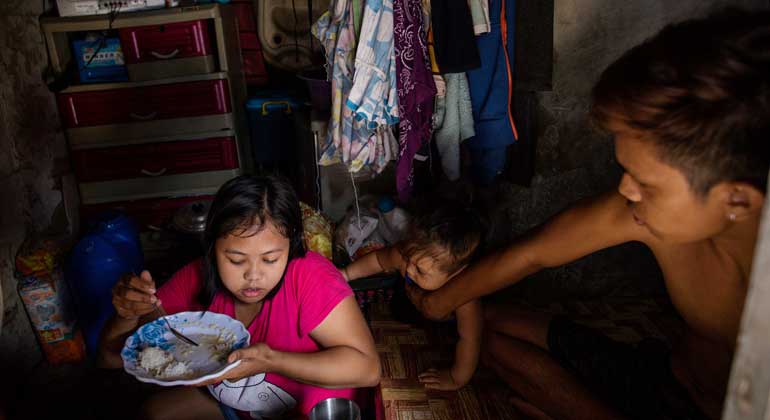
Hungry and hopeless: slum life a struggle in the lengthiest of lockdowns. Mary Jane Basbas, 21, and Jomar Santos, 23, attempt to feed their child in their shanty home, amid the coronavirus disease (COVID-19) lockdown, in Caloocan City, Metro Manila. — REUTERS

THE number of Filipinos going hungry has doubled in the past six months and more than 90% of its residents are experiencing stress as the country battles the coronavirus pandemic, according to a survey released Friday.

About 4.2 million people can’t afford to eat, soaring from December, while 91% of Filipinos aged 15 or older are feeling anxious, according to a Social Weather Stations poll conducted May 4 to 10.

Anti-virus lockdown restrictions since March have devastated jobs and hurt incomes in the Philippines, with the jobless rate surging to a record 17.7% in April. The country’s economy will contract this year, the World Bank forecast. While some businesses have been allowed to restart, many curbs remain in place particularly in the greater Manila region, which is the main driver of the economy.

President Rodrigo Duterte is set to decide on Monday whether more restrictions will be loosened. Transportation is still very limited in Manila, as the government seeks to boost activity while minimizing the risk of infections spreading. Total coronavirus cases, approaching 25,000, have risen faster this month than in May.

Interior Secretary Eduardo Año, vice-chair of the government’s virus response task force, said it may be necessary to maintain Manila’s general community quarantine status, CNN Philippines reported Friday. Another senior member of the task force, Defense Secretary Delfin Lorenzana, lent his support to a modified form of quarantine. He said in a virtual briefing that the level of quarantine restrictions will depend on the situation in the coming days, according to the report.

SWS surveyed 4,010 people using mobile phones and computer-assisted telephone interviews. The poll is non-commissioned. — Bloomberg

China vows to prioritize Philippines for coronavirus vaccine

China has pledged to prioritize the Philippines once it finds a vaccine for the novel coronavirus, Malacanang said in a statement on Friday, citing a phone call between the nations’ two leaders.

China has also promised to provide critical medical supplies and equipment to its neighbor in the battle against the global pandemic, while assuring the free flow of goods and services between them, according to the statement.

Chinese President Xi Jinping and President Rodrigo R. Duterte talked on the phone for 36 minutes on Thursday evening, during which they both vowed to “uphold peace, stability, prosperity and principles of international law, including the rule of law.”

Mr. Duterte has sought closer trade and investment ties with China since he became president in 2016, unlike his predecessor who sued China before an international court and won.

The United Nations arbitral court in the Hague favored the Philippines in that lawsuit, voiding China’s claim to more than 80% of the South China Sea based on a nine-dash line.

Mr. Duterte had vowed to pursue an independent foreign policy, announcing a pivot to China away from the US.

The tough-talking leader in February officially notified the US that he was ending a two-decade-old military pact with the US on the deployment of troops for war games.

Earlier this week, Mr. Duterte suspended the termination of the visiting forces agreement “in light of political and other developments in the region,” according to the Department of Foreign Affairs (DFA).

The suspension of the 21-year-old visiting forces agreement (VFA) is effective for half a year and may be extended by six more months, DFA told the US Embassy in a letter dated June 1.

Ending the VFA complicates Washington’s efforts to maintain an Asia-Pacific troop presence amid friction over the presence of US personnel in Japan and South Korea and security concerns about China and North Korea. — Gillian M. Cortez

Yasay, ex-regulator who helped oust Estrada dies

Perfecto R. Yasay, Jr., the former corporate regulator who helped oust President Joseph Estrada in 2001, has died. He was 73.

Mr. Yasay, who was battling cancer, died of pneumonia, the United Church of Christ in the Philippines said in a Facebook post, citing Mr. Yasay’s wife Cecile Joaquin. His death was not coronavirus-related, it said.

Mr. Yasay was chairman of the Securities and Exchange Commission when he testified against Mr. Estrada in his impeachment trial for corruption. The trial was aborted after the former leader was ousted in a popular street uprising known as the EDSA People Power II.

Nine years later, Mr. Yasay apologized to Mr. Estrada for “hurting and offending him” but said he was not retracting his testimony.

Mr. Yasay ran for vice president in 2010 and lost.

The former corporate regulator in 2016 led President Rodrigo R. Duterte’s pivot to China away from the US as Foreign Affairs secretary. But lawmakers rejected his appointment a year later due to issues about his citizenship.

Mr. Yasay was married to Cecile Joaquin and they had three children. — Norman P. Aquino and Charmaine A. Tadalan

March remittances sharply drop as pandemic, oil price war weigh

By Luz Wendy T. Noble, Reporter

Remittance inflows declined in March, as the coronavirus outbreak accelerated and tensions among global oil producers escalated.

Cash remittances of overseas Filipino workers (OFWs) that were coursed through banks dropped by 4.7% to $2.397 billion in March from the $2.514 billion a year ago, data from the Bangko Sentral ng Pilipinas (BSP) showed.

The 4.7% decrease in cash remittances is the first contraction since the -2.9% in June 2019 and the highest drop since the -9.8% in March 2018, when inflation skyrocketed and the peso reached the P52 level versus the dollar.

“The countries that registered the declines in cash remittances in March were mostly from oil producing countries (Saudi Arabia, United Arab Emirates and Kuwait) where demand for workers was affected by depressed oil prices in the world market,” the BSP said Thursday night.

For the first quarter of 2020, inflows grew by 1.4% to $7.403 billion from the $7.299 billion in the comparable year-ago period.

The central bank on Thursday released its latest projection which estimates cash remittances to decline by 5% this year, a reversal from the 2% growth forecast in May and the baseline 3% estimate back in November. The World Bank estimates a 20% drop in global remittances as the pandemic continues.

Personal remittances slumped 5.2% to $2.652 billion in February from the $2.557 billion during the same month in 2019. This is the first decline in personal remittances since June 2019 and the 9.9% contraction in March 2018.

According to the BSP, personal remittances from land-based workers with work contracts of one year or more slipped by 6.7% to $2.014 billion in March coming from the $2.157 billion recorded last year. On the other hand, remittances from sea-based workers and land-based workers with work contracts of less than one year rose by 2.7% to $591 million from $575 million in March 2019.

Year-to-date, personal remittances rose by 1.5% to $8.218 billion in March from the $8.098 billion last year.

Economists said the virus took its toll on remittances in March, adding to tensions in the oil market.

“The decline in March remittance inflows can be attributed to the oil price collapse due to the disagreement between Russia and Saudi Arabia. Biggest hit by this oil price shock are Filipino workers from the Middle East that comprise more than 50% of total overseas workers,” UnionBank of the Philippines, Inc. Chief Economist Ruben Carlo O. Asuncion said.

In March, Saudi Arabia slashed oil prices by nearly 10% in retaliation against Russia for not joining the large production cuts made by the Organization of the Petroleum Exporting Countries in response to waning demand.

Mr. Asuncion said the sea-based luxury travel industry as well as the land-based hotel and accommodation sector were already feeling the pain in March, as the coronavirus outbreak spread rapidly around the world.

“You have countries like Hong Kong, Macau, and the Middle East as major sources of these inflows from this said sector,” he said.

The drop in remittances will likely bottom out in the next few months as countries imposed restrictions to combat the spread of the virus.

“In view of the recent repatriation of some OFWs, as displaced by COVID-19 pandemic, OFW remittances could still continue to decline by single-digit levels in the coming months of 2020, with the bigger declines that could be seen at the height of the lockdowns from April-May,” Rizal Commercial Banking Corp. Chief Economist Michael L. Ricafort said in an e-mail.

Despite this, Mr. Ricafort noted OFWs who managed to save money still have the ability to continue to send to their families at this difficult time.

“Another offsetting factor is the fact that some OFWs in many host countries belong to essential industries especially medical professionals who would still continue to work and send remittances during the lockdown periods,” Mr. Ricafort added.

More than 36,000 OFWs have been repatriated since the outbreak as of June 8, according to data from the Department of Foreign Affairs.

The coming months will likely remain bleak for remittance inflows as uncertainties over COVID-19 continue, according to John Paolo R. Rivera, an economist at the Asian Institute of Management.

“Unless all economies have been bootstrapped and the pandemic has been contained, then we cannot expect a significant improvement in remittance inflow,” Mr. Rivera said in an e-mail.

“That is why there is a need for a global collective effort to contain the pandemic if economies will continue to rely on the phenomenon of temporary labor migration (we rely on remittances, they rely on the services of our manpower),” he added.

Cash remittances is a vital part of the economy as it boosts consumption which forms part of about 70% of the country’s gross domestic product.

Meralco’s force majeure claims lead to lower generation rates for 3rd straight month

Power rates down again this June

Manila Electric Company (MERALCO) announced today another downward adjustment of power rates, as the overall rate for a typical household decreased by P0.0216 per kWh, from last month’s P8.7468 per kWh to P8.7252 per kWh this June. This is equivalent to a reduction of around P4 in the total bill of residential customers consuming 200 kWh.

With three straight months of generation rate reduction, and a total rate decrease of more than one peso per kWh since the start of the year, this month’s total rate is also significantly lower than that of June 2019, which was P10.0918 per kWh. This month’s total rate is also the lowest since February 2018.

Lower Generation Charge as MERALCO Claims Force Majeure

From P4.3848 per kWh last May, the generation charge decreased by P0.0435 per kWh to P4.3413 per kWh this June.

Because of the very significant reduction in power demand in its service area during the Enhanced Community Quarantine (ECQ) and Modified ECQ period, MERALCO invoked the Force Majeure provision in its Power Supply Agreements (PSAs) for the duration of the lockdown, reducing fixed charges for generation capacity that would have been charged by suppliers. This June, the Force Majeure claim totaled P614 million, equivalent to customer savings of P0.2208 per kWh, representing reduction in fixed costs from its baseload supply contracts and avoided charges from the temporary suspension of the mid-merit supply contracts recently approved by the Energy Regulatory Commission (ERC). Without the FM claims, generation charge and the total rate would have increased by 18-centavos and 24-centavos, respectively, from last month’s rate. For the past 3 months, the savings due to Force Majeure claims totaled around P1.6 billion.

PSA charges decreased by P0.0613 per kWh mainly due to MERALCO’s Force Majeure claim. Cost of power from Independent Power Producers (IPPs) also decreased by P0.2334 per kWh due to higher average plant dispatch. PSAs and IPPs accounted for 50.4% and 47.1% of MERALCO’s total supply, respectively.

Meanwhile, charges from the Wholesale Electricity Spot Market (WESM) increased by P0.3132 per kWh due to tighter supply conditions in the Luzon grid mainly due to higher incidents of plant outages and slight increase in demand. The share of WESM to MERALCO’s supply needs was only at 2.5%.

Movements in Other Charges

Other pass-through charges registered an increase of P0.0219 per kWh. This was mainly due to the resumption of the P0.0495 per kWh Feed-In-Tariff Allowance (FIT-All). The ERC suspended the collection of FIT-All for April and May billing months in consideration of the ECQ. Meanwhile, ERC suspended the collection of Universal Charge-Environmental Charge amounting to P0.0025 per kWh beginning this June, until further notice.

MERALCO’s distribution, supply, and metering charges, meanwhile, have remained unchanged for 59 months, after these registered reductions in July 2015. MERALCO reiterated that it does not earn from the pass-through charges, such as the generation and transmission charges. Payment for the generation charge goes to the power suppliers, while payment for the transmission charge goes to the NGCP. Taxes and other public policy charges like the Universal Charges and the FIT-All are remitted to the government.

MERALCO keeps its doors open for customers during General Community Quarantine (GCQ)

Customers may visit their nearest Meralco Business Center, which will continue to open its doors during the ongoing GCQ, and accept service applications, payments, and other transactions.

Strict safety measures continue to be implemented, like the “No Mask, No Entry” rule, Social Distancing and Temperature Check. Frontliners are available and ready, but strictly follow Social Distancing guidelines. Visitors can rest assured that these frontliners have passed the rapid COVID-19 testing authorized by the Pasig City Health Office. There are also acrylic barriers set up in the Meralco branches to protect both the customer and the frontliner.

But, for maximum safety and convenience, Meralco still encourages customers to use Meralco Online to transact from the safety of their homes. Multiple options for transactions have also been offered by the distribution utility, including the Meralco Mobile App via https://onelink.to/meralcomobile, Meralco Online via www.Meralco.com.ph, and the Meralco authorized payment channels at bit.ly/MeralcoPaymentPartners.

For more information and concerns, customers may visit MERALCO’s website at www.MERALCO.com.ph, its social media accounts, twitter @MERALCO and facebook at www.facebook.com/MERALCO or may also call the MERALCO Hotline at 16211.