Home Blog Page 942

PSE says Shari’ah-compliant securities fell to 47

BW FILE PHOTO

SHARI’AH-COMPLIANT securities dropped to 47 from 53 after the quarterly screening for the period ending June 25, the Philippine Stock Exchange, Inc. (PSE) said.

The latest list, released on July 4, showed the removal of nine securities, the PSE said.

These included investment holding company AbaCore Capital Holdings, Inc.; educational institution Centro Escolar University; property developer DM Wenceslao & Associates, Inc.; investment holding company GEOGRACE Resources Philippines, Inc.; and Pangilinan-led power distributor Manila Electric Co.

Also included in the removals were petrochemicals company Metro Alliance Holdings & Equities Corp. “A,” Metro Alliance Holdings & Equities Corp. “B,” packaging company Steniel Manufacturing Corp., and investment holding company Zeus Holdings, Inc.

Securities added to the list were telecommunications provider Converge Information and Communications Technology Solutions, Inc.; mining company East Coast Vulcan Mining Corp.; and flour manufacturer Liberty Flour Mills, Inc.

The PSE issues the list of Shari’ah-compliant securities every quarter. The previous list was released on April 4, covering the compliance period ending March 25.

Shari’ah refers to the moral and religious code of Islam that includes rules, regulations, teachings, and values governing the lives of Muslims.

The market operator tapped the services of Islamic finance information provider IdealRatings, Inc. to screen listed companies in accordance with the standards for Shari’ah compliance under the Accounting and Auditing Organization for Islamic Financial Institutions.

Under the business screening, a company’s income derived from activities such as adult entertainment, alcohol, cinema, defense and weapons, financial services, gambling, gold and silver hedging, interest-bearing investments, music, pork, and tobacco must be less than 5%.

For financial ratio screening, a company’s cash or interest-bearing deposits or investments should not exceed 30% of its market capitalization, while its interest-bearing debt must not go beyond 30% of its market capitalization.

The PSE previously said that Shari’ah-compliant investment instruments allow listed companies to gain potential funding from Islamic investors, including those in Middle Eastern countries and other countries with large Muslim populations such as Malaysia and Indonesia. — Revin Mikhael D. Ochave

Coffee, sugar put forward for possible RCEF-type support

STOCK PHOTO | Image by Kelly Sikkema from Unsplash

THE Philippine Chamber of Agriculture and Food, Inc. (PCAFI) asked the 20th Congress to pass legislation that will boost coffee and sugar production, using as a model the Rice Competitiveness Enhancement Fund (RCEF), which finances rice farm modernization with rice import tariffs.

“Tariff collections should be earmarked to the commodity sector where it was generated to help develop the said industry,” PCAFI, which is composed of over 40 agriculture groups, said in a statement. 

“Government officials, including economic managers, and lawmakers have touted the RCEF as a good model in developing an agricultural industry, since tariffs collected are plowed back for the industry’s sole development.”

It said candidates for competitiveness enhancement include coffee, sugar, tobacco, and vegetables, “most of which have been receiving measly funding allocations compared to other crops,” according to PCAFI.

Tariff collections for commodities imported under the minimum access volume (MAV) have been going to the general fund instead of being earmarked to domestic growers since the Agricultural Competitiveness Enhancement Fund expired in December 2022, PCAFI noted.

It pushed for the immediate signing into law of the proposed Animal Industry Development and Competitiveness Act, which will create a P20-billion fund for the development of the livestock, poultry, dairy and corn industries.

Such a bill will boost government efforts in revitalizing the livestock sector, particularly the hog industry, which has been hit by the African Swine Fever (ASF) outbreak, while providing funding to the poultry and dairy industries, which have been “private sector-driven in the past decades,” PCAFI said.

The upcoming Congress should also abolish the MAV system for pork, chicken meat and corn since it is “outdated and actual annual imports are beyond the MAV,” PCAFI said.

“Furthermore, the in-quota and out-quota rates of most commodities are already at parity, rendering the privilege tariff rate under the MAV system impractical.”

It noted that the volume of imports can exceed the MAV quota by more than 15 times.

“Clearly, there is no need to further reassure our trading partners about the entry of their poultry products by having a MAV.”

PCAFI also proposed the creation of a virology center to enhance the country’s capacity to develop its own vaccines including those against ASF and Avian Influenza.

The industry group also called for the amendment of the 69-year-old Republic Act 1556 or the Livestock and Poultry Feeds Act to cover other feed for aquaculture, game animals, and companion animals. — Kyle Aristophere T. Atienza

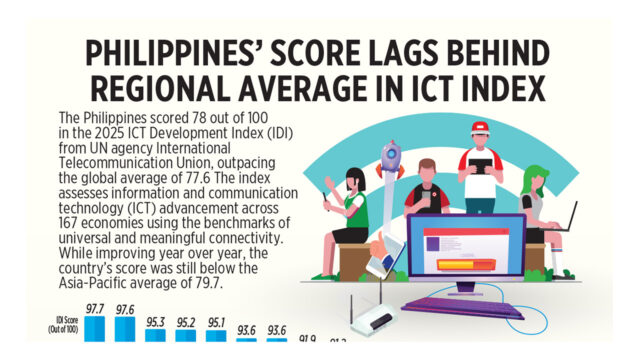
Philippines’ score lags behind regional average in ICT Index

The Philippines scored 78 out of 100 in the 2025 ICT Development Index (IDI) from UN agency International Telecommunication Union, outpacing the global average of 77.6 The index assesses information and communication technology (ICT) advancement across 167 economies using the benchmarks of universal and meaningful connectivity. While improving year over year, the country’s score was still below the Asia-Pacific average of 79.7.

Philippines’ score lags behind regional average in ICT Index

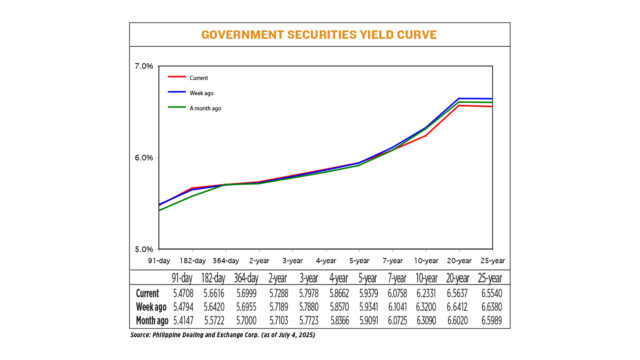
Yields on government debt mixed after dovish comments from Bangko Sentral

YIELDS on government securities (GS) ended mixed last week after the Bangko Sentral ng Pilipinas (BSP) signaled two more rate cuts this year amid slowing inflation.

The yields, which move opposite prices, fell by an average of 2.08 basis points (bps) week on week, based on PHP Bloomberg Valuation service reference rates as of July 4 posted on the Philippine Dealing System website.

Short-term government securities saw mixed movements on Friday, with the three-month Treasury bill slightly easing, while the six- and 12-month tenors posted small increases in yields.

In the mid-range or “belly” of the curve, most bond yields edged higher, except for the seven-year tenor, which declined modestly.

Long-term bond yields, on the other hand, generally fell across the board, led by a notable drop in the 10-year paper.

Total government securities traded rose to over P56 billion, up from around P40 billion in the previous session.

“The yield curve shifted flatter by 3-7 bps [last week] after dovish comments by BSP Governor Eli Remolona that two further rate cuts would be ideal for the economy,” Dino Angelo C. Aquino, vice-president and head of fixed income at Security Bank Corp., said in an e-mail on Friday.

He added that the lower-than-expected June inflation of 1.4% “would likely boost the BSP’s dovish stance, which would be beneficial for local bonds moving forward.”

“Yields are slightly lower partly due to inflation but since the US trade deadline looms, we are still not seeing strong downward momentum for yields,” a bond trader said in a Viber message.

On Thursday, the BSP chief signaled at least two more rate cuts due to benign inflation.

Last month, the central bank cut its benchmark rate by another 25 bps to 5.25% — the second straight reduction this year.

Inflation in June ticked up slightly to 1.4% from 1.3% in May due to higher electricity and education costs, though this was tempered by slowing food prices. It was the fourth straight month that inflation remained below the BSP’s 2-4% target.

Year-to-date inflation averaged 1.8%, still above the revised full-year forecast of 1.6%.

The Monetary Board is scheduled to hold its next policy meetings on Aug. 28, Oct. 9 and Dec. 11.

“Nonetheless, with the solid local macro backdrop, expect local bonds to be well supported and be less sensitive to US bond movements in the short term,” Mr. Aquino said.

“At the end of the day, [the market] will have to consider interest rate differentials versus the US unless there’s a gloomy economic activity locally,” the bond trader said. — LPQB

Fewer people doesn’t always mean better outcomes for nature — just look at Japan

STOCK PHOTO | Image by Korie Cull from Unsplash

Since 1970, 73% of global wildlife has been lost, while the world’s population has doubled to 8 billion. Research shows this isn’t a coincidence but that population growth is causing a catastrophic decline in biodiversity.

Yet a turning point in human history is underway. According to UN projections, the number of people in 85 countries will be shrinking by 2050, mostly in Europe and Asia. By 2100, the human population is on course for global decline. Some say this will be good for the environment.

In 2010, Japan became the first Asian country to begin depopulating. South Korea, China, and Taiwan are following close behind. In 2014, Italy was the first in southern Europe, followed by Spain, Portugal, and others. We call Japan and Italy “depopulation vanguard countries” on account of their role as forerunners for understanding possible consequences in their regions.

Given assumptions that depopulation could help deliver environmental restoration, we have been working with colleagues Yang Li and Taku Fujita to investigate whether Japan is experiencing what we have termed a biodiversity “depopulation dividend” or something else.

Since 2003, hundreds of citizen scientists have been collecting biodiversity data for the Japanese government’s Monitoring Sites 1,000 project. We used 1.5 million recorded species observations from 158 sites.

These were in wooded, agricultural, and peri-urban (transitional spaces on outskirts of cities) areas. We compared these observations against changes in local population, land use, and surface temperature for periods of five to 20 years.

Our study, published in the journal Nature Sustainability, includes birds, butterflies, fireflies, frogs, and 2,922 native and non-native plants. These landscapes have experienced the greatest depopulation since the 1990s.

Due to the size of our database, choice of sites, and the positioning of Japan as a depopulation vanguard for north-east Asia, this is one of the largest studies of its kind.

JAPAN IS NOT CHERNOBYL
Biodiversity continued to decrease in most of the areas we studied, irrespective of population increase or decrease. Only where the population remains steady is biodiversity more stable. However, the population of these areas is ageing and will decline soon, bringing them in line with the areas already seeing biodiversity loss.

Unlike in Chernobyl, where a sudden crisis caused an almost total evacuation which stimulated startling accounts of wildlife revival, Japan’s population loss has developed gradually. Here, a mosaic pattern of changing land use emerges amid still-functioning communities.

While most farmland remains under cultivation, some falls into disuse or abandonment, some is sold for urban development or transformed into intensively farmed landscapes. This prevents widespread natural succession of plant growth or afforestation (planting of new trees) that would enrich biodiversity.

In these areas, humans are agents of ecosystem sustainability. Traditional farming and seasonal livelihood practices, such as flooding, planting, and harvesting of rice fields, orchard and coppice management, and property upkeep, are important for maintaining biodiversity. So depopulation can be destructive to nature. Some species thrive, but these are often non-native ones that present other challenges, such as the drying and choking of formerly wet rice paddy fields by invasive grasses.

Vacant and derelict buildings, underused infrastructure, and socio-legal issues (such as complicated inheritance laws and land taxes, lack of local authority administrative capacity, and high demolition and disposal costs) all compound the problem.

Even as the number of akiya (empty, disused, or abandoned houses) increases to nearly 15% of the nation’s housing stock, the construction of new dwellings continues remorselessly. In 2024, more than 790,000 were built, due partly to Japan’s changing population distribution and household composition. Alongside these come roads, shopping malls, sports facilities, car parks, and Japan’s ubiquitous convenience stores. All in all, wildlife has less space and fewer niches to inhabit, despite there being fewer people.

WHAT CAN BE DONE?
Data shows deepening depopulation in Japan and north-east Asia. Fertility rates remain low in most developed countries. Immigration provides only a short-term softer landing, as countries currently supplying migrants, such as Vietnam, are also on course for depopulation.

Our research demonstrates that biodiversity recovery needs to be actively managed, especially in depopulating areas. Despite this there are only a few rewilding projects in Japan. To help these develop, local authorities could be given powers to convert disused land into locally managed community conservancies.

Nature depletion is a systemic risk to global economic stability. Ecological risks, such as fish stock declines or deforestation, need better accountability from governments and corporations. Rather than spend on more infrastructure for an ever-dwindling population, for example, Japanese companies could invest in growing local natural forests for carbon credits.

Depopulation is emerging as a 21st century global megatrend. Handled well, depopulation could help reduce the world’s most pressing environmental problems, including resource and energy use, emissions and waste, and nature conservation. But it needs to be actively managed for those opportunities to be realized.

THE CONVERSATION VIA REUTERS CONNECT


Peter Matanle is a senior lecturer in Japanese Studies at the University of Sheffield. Kei Uchida is an associate professor, Conservation and Biodiversity Management, at Tokyo City University, and has received funding from JSPS Kakenhi 20K20002. Masayoshi K. Hiraiwa is a postdoctoral researcher, Ecology, Faculty of Agriculture, at Kindai University.


Most ‘dynamically accomplished’ Defender arrives in PHL

IC Land Automotive Vice-President Chris Ward discusses the Defender Octa. — PHOTO BY KAP MACEDA AGUILA

By Kap Maceda Aguila

IF YOU’RE ONE who takes off-road performance as seriously as you value luxury, then the Defender Octa may just be for you. Let’s start with the asking price — from P24.59 million for the standard-issue Octa to a hefty P26.59 million for the Octa Edition One, said to be available through the first year of production. The name alone, derived from the “octahedron” shape of a diamond, suggests the rarity and premium nature of the vehicle.

Based off the Defender 110 but fortified and enriched quite like bread, you might say, the Octa is the range topper (pardon the pun) among its 4×4 ilk. It starts with a stout heart — a 4.4-liter twin turbo mild-hybrid V8 serving up 635ps and 750Nm. Incredibly, the Octa is said to muster sportscar quickness — getting from standstill to 100kph in but four ticks.

Proffers Defender Managing Director Mark Cameron in a release, “With the new Defender Octa, we have been able to unlock the full potential of Defender. It is the very definition of breadth of capability, and a testament to what we can achieve utilizing the very best technologies and talents within our engineering division. With its powerful V8 engine, ground-breaking 6D Dynamics suspension technology, exquisite finishes and unique detailing, it is rare, incredibly tough and inherently desirable.”

The brand reports the presence of “heavily revised chassis components with innovative technologies, including 6D Dynamics suspension.” The Octa’s ride height has been elevated by 28mm, its stance widened by 68mm, and its wheel arches extended. To improve off-roading readiness, the bumpers have been redesigned for greater approach and departure angles, and underbody protection improved. Water-wading depth has been claimed at one meter.

Said IC Land Automotive Vice-President Chris Ward in his presentation at the launch of the Octa, “Ultimately, (6D deals with) all the elements of how the car behaves. Basically, 6D Dynamics aim to neutralize any body roll, pitch, dive, up and down movement. The way it does it is, instead of traditional anti-roll bars which would help prevent the roll, we’ve done away with that and it’s now a hydraulic system. So it’s now feeding directly depending which suspension needs to counter the G, or when we’re off-road, it will look for grip — moving the wheel up and down to find grip.”

The Defender Octa Edition One, on the other hand, features a “curated specification,” getting an exclusive new Faroe Green paint color with a Khaki and Ebony Ultrafabrics polyurethane seamless knit interior, Chopped Carbon Fiber detailing, and 20-inch forged alloy wheels with a choice of all-terrain or optional especially developed advanced all-terrain tires.

Mated to an eight-speed automatic transmission, the Octa’s mill can speed it to a top rate of 250kph when fitted with optional 22-inch lightweight wheels and all-season tires. It also gets uprated 400-mm front brake discs with Brembo calipers and the “fastest steering ratio of any Defender to date” for immediate and precise response. The Defender Octa can automatically detect the surface it is on, and adjust its dynamic setting accordingly. The company said that, “in addition to the default Comfort Mode, Dynamic Mode provides the ultimate performance-focused on-road experience, tuning the vehicle’s steering, throttle and suspension settings with one press of the transparent signature logo button on the steering wheel.”

Speaking of the button, long-press it to access Octa Mode — a first-ever, dedicated Defender off-road mode focused on performance. “This has been especially developed to ensure ultimate control and driver confidence. Octa Mode also enables an Off-Road Launch mode for optimum acceleration on loose surfaces. And, when combined with the lowest traction control settings (TracDSC or DSC off) it also engages a unique Off-Road ABS calibration for optimum braking performance on loose surfaces, too.”

For more technical off-road maneuvers, the Defender still features “specific calibrations” for Sand, Mud and Ruts, Grass Gravel Snow, and Rock Crawl — assisted by off-road driver aids such as ClearSight Ground View, which effectively makes the bonnet transparent for improved visibility and reassurance on difficult, tricky terrain.

Inside, the Octa receives all-new Performance Seats with more supportive bolsters and integrated headrests. An immersive, so-called “Body and Soul Seat” audio technology is available for the first time. Crafted in collaboration with music industry experts SUBPAC and Coventry University, the system allows the driver and front passenger to feel, as well as hear, the music. “Six wellness programs are also available to help relax occupants or help improve cognitive responses on the move, depending on their preference.”

Louis Vuitton Korea says systems breach led to customer data leak

SEOUL — A systems breach at Louis Vuitton Korea in June led to the leak of some customer data including contact information, but did not involve customers’ financial information, the luxury brand’s South Korea unit said on Friday.

“We regret to inform that an unauthorized third party temporarily accessed our system resulting in the leak of some customer information,” the unit said in a statement.

The company became aware of the breach on Wednesday and had notified government authorities, the statement said.

Measures had been taken to contain the breach and to boost system security, it added.

The South Korean units of two other labels, Christian Dior Couture and Tiffany, under the world’s largest luxury group have been under government investigations since May for customer data leaks they reported earlier in the year, according to the country’s Personal Information Protection Commission. — Reuters

SEC seeks support to boost market competitiveness

BW FILE PHOTO

THE Securities and Exchange Commission (SEC) is calling for collaboration with capital market participants to enhance the competitiveness of the country’s financial markets, following President Ferdinand R. Marcos, Jr.’s directive to streamline the agency’s processes.

“We call on all capital market participants to join the SEC in enhancing the global competitiveness of our markets. Through collaboration and a firm commitment to reform, we believe that we can create a financial sector that both local and international investors can trust,” SEC Chairperson Francisco Ed. Lim said in an e-mail statement over the weekend.

Mr. Lim said this as President Ferdinand R. Marcos, Jr. directed the SEC last week to streamline its procedures, remove bureaucratic bottlenecks, and reduce transaction costs following the effectivity of Republic Act No. 12214, or the Capital Markets Efficiency Promotion Act (CMEPA), on July 1.

“The SEC stands ready to deliver on this mandate with urgency, integrity, and accountability,” Mr. Lim said.

“We are confident that the enactment of CMEPA will help the commission in expanding accessibility of investment opportunities to more Filipinos, thereby encouraging them to invest in the capital market,” he added.

CMEPA, signed by Mr. Marcos on May 29, allows for the reduction of the stock transaction tax (STT) to 0.1% from the previous 0.6% to boost local stock market activity.

It also lifts the documentary stamp tax on mutual funds and unit investment trust funds and imposes a 20% uniform final tax rate on interest income.

Meanwhile, the SEC said all its departments and offices have been directed to prioritize the resolution of applications and requests pending before the commission, in line with the time frames mandated by law.

The corporate regulator will also continue to invest in technology to further improve its systems, enhance accessibility, and increase operational efficiency, it said.

The SEC recently opened a public assistance and complaints desk at its headquarters in Makati City.

It also issued Memorandum Circular No. 6, which reduces by 50% the rates for documents requested from the SEC, including articles of incorporation, by-laws, and general information sheets, among others. — Revin Mikhael D. Ochave

Indonesia offers to cut duties on US goods, purchase $500 million of wheat in tariff talks

JAKARTA — Indonesia has offered to cut duties on key imports from the US to “near zero” and to buy $500 million worth of US wheat as part of its tariff talks with Washington, its lead negotiator and a wheat industry association said.

Chief Economics Minister Airlangga Hartarto, who is Indonesia’s lead negotiator, also confirmed that state carrier Garuda Indonesia would buy more Boeing planes as part of a $34 billion pact with US partners due to be signed next week.

Indonesia, which ran a goods trade surplus of $17.9 billion with the United States in 2024 according to the US Trade Representative, is facing a 32% tariff in US markets and has proposed increasing US imports to facilitate trade talks between the two sides.

Mr. Airlangga said the Indonesian government has offered to cut tariffs on key American exports, including agricultural products, to near-zero from between 0% and 5% at present.

“It will be near zero (tariffs for US main exports), but it will depend as well on how much the tariffs we get from the US,” Mr. Airlangga said.

Garuda’s CEO has said it is in discussions with Boeing to buy up to 75 aircraft. Garuda group did not respond to requests for comment.

The chairman of Indonesia’s wheat flour mills association, Franciscus Welirang, said its “members will purchase two million tons in total through tenders with a competitive price.”

“The point is all of the members will buy US wheat,” Mr. Welirang, who is also a director at Indofood, told Reuters.

The US counterparts in the wheat deal include Cargill, Bunge Global SA, Pacificor, Archer-Daniels-Midland, Columbia Grain International, and United Grain Corporation, Mr. Welirang added.

US exports to Indonesia include soybeans, petroleum gases and aircraft, Indonesian government data showed.

When asked whether the trade talks include military deals, Mr. Airlangga said they were “not part of the negotiation.”

Susiwijono Moegiarso, a senior official with Indonesia’s Coordinating Ministry for Economic Affairs, told Reuters that in return, Jakarta has asked the US for preferential tariffs on its main exports, including electronics, textiles and footwear.

“We want them to lower the tariffs (for those goods) as low as possible,” he said.

Indonesia has also offered the US opportunities to invest in critical minerals projects, including in copper, nickel and bauxite. — Reuters

Inflation Rates in the Philippines

Headline inflation slightly inched up in June, driven by higher costs of utilities and education, the Philippine Statistics Authority reported on Friday. Read the full story.

Inflation rates in the Philippines

Yields on BSP securities end mixed

BW FILE PHOTO

YIELDS on the Bangko Sentral ng Pilipinas’ (BSP) short-term securities ended mixed on Friday as both tenors were oversubscribed.

The BSP bills fetched bids amounting to P136.922 billion on Friday, higher than the P110-billion offer and the P119.984 billion in tenders for the P120-billion auctioned off on June 27. Both tenors were fully awarded.

Tenders for the 28-day BSP bills reached P61.221 billion, above the P50 billion placed on the auction block and the P58.887 billion in bids seen for a P60-billion offer seen the prior week. The BSP accepted all the submitted bids.

Banks asked for rates ranging from 5.35% to 5.536%, a narrower margin compared to the 5.35% to 5.6% band seen a week earlier. This caused the average rate of the one-month securities to inch down by 0.83 basis point (bp) to 5.4662% from 5.4745% previously.

Meanwhile, bids for the 56-day bills amounted to P75.701 billion on Friday, higher than the P60-billion offering but lower than the P61.097 billion in tenders for the same offer volume in the prior week. The central bank made a full P60-billion award of the two-month securities.

Accepted rates were from 5.375% to 5.546%, a tighter range compared with the 5.37% to 5.565% margin a week earlier. With this, the average rate of the 56-day securities rose by 8.42 bps to 5.4854%.

The central bank uses the BSP securities and its term deposit facility to mop up excess liquidity in the financial system and to better guide short-term market rates towards its policy rate.

The BSP bills also contribute to improved price discovery for debt instruments while supporting monetary policy transmission, the central bank said.

Data from the central bank showed that around 50% of its market operations are done through its short-term securities.

The BSP bills are considered high-quality liquid assets for the computation of banks’ liquidity coverage ratio, net stable funding ratio, and minimum liquidity ratio.

They can also be traded on the secondary market. — Aaron Michael C. Sy

Weighing the health and economic burden of obesity

STOCK PHOTO | Image from Freepik

Overweight and obesity are growing public health challenges in the Philippines. In just over two decades, the prevalence of overweight and obesity among Filipino adults has doubled, rising from 20% in 1998 to 40% in 2022. Among adolescents aged 10 to 19, the rates more than doubled, from 4.9% in 2003 to 13% in 2022. Alarmingly, 14% of Filipino children aged five to 10 are now also classified as overweight or obese.

The World Health Organization (WHO) defines overweight and obesity as abnormal or excessive fat accumulation that may impair health. The primary cause is a sustained energy imbalance, or consuming more calories than are expended, largely driven by diets high in fat and sugar, along with increasingly sedentary lifestyles. Technological advancements, urbanization, and shifts in transportation and work patterns have all contributed to reduced physical activity.

Obesity significantly increases the risk of a range of serious health conditions, including type 2 diabetes, cardiovascular disease, reproductive and bone health issues, and certain cancers. It also diminishes quality of life, contributing to sleep disturbances, impaired mobility, and psychological stress.

For children and adolescents, the consequences are equally concerning. Obesity during youth raises the risk of early onset of noncommunicable diseases (NCDs) like diabetes and heart disease. Psychosocial effects — such as poor self-esteem, bullying, and reduced academic performance — are compounded by stigma and discrimination. Moreover, overweight children are far more likely to become obese adults, perpetuating a cycle of health risks and social challenges.

Beyond the individual, obesity imposes a heavy economic burden. According to the STOP Obesity Alliance, a coalition of stakeholders committed to addressing obesity in the United States, this burden includes both direct and indirect costs. Direct costs stem from the treatment of obesity and its more than 200 associated comorbidities, including hypertension, type 2 diabetes, coronary heart disease, certain cancers, and asthma. In 2019, the US Centers for Disease Control and Prevention (CDC) estimated the annual medical cost of obesity in the United States at $173 billion (around P9.86 trillion), with individuals affected by obesity incurring an average of $1,861 (P106,020) more in medical expenses than those with a healthy weight.

Indirect costs include lost productivity due to absenteeism, reduced workplace efficiency, premature death, increased disability claims, and loss of Quality-Adjusted Life Years (QALYs). QALY is a measure that reflects both the quantity and quality of life lost due to illness.

While global studies have quantified the cost of obesity, there remains a gap in local data for the Philippines. Addressing this, a landmark study titled “Epidemiological Burden and Cost of Obesity in the Philippines (EpiCOb-PH)” was launched in March this year. The study aims to estimate the national burden of obesity and its economic implications using local disease models, existing epidemiological data, and cost/resource-use analyses.

EpiCOb-PH is led by Dr. Madeleine de Rosas-Valera, former Department of Health (DoH) Undersecretary and former Senior Vice-President at PhilHealth, with support from Novo Nordisk Pharmaceuticals (Philippines). Research support is provided by metaHealth Insights and Innovations.

A recent stakeholder consultation brought together notable figures including Ambassador Franz-Michael Skjold Mellbin of Denmark; Dr. Israel Pargas, SVP for Health Finance Policy at PhilHealth; former Health Secretary Dr. Jaime Galvez-Tan; Novo Nordisk General Manager Wei Sun; and representatives from key health organizations including the Philippine Alliance of Patient Organizations, the Philippine College of Endocrinology, Diabetes and Metabolism, the Philippine Association for the Study of Overweight & Obesity, and the Philippine Society of Nephrology.

The study is designed to answer two key questions: What is the current and projected burden of obesity in the Philippines among adults and children? And what are the associated economic costs, including healthcare spending, productivity losses, and broader socioeconomic impacts?

By developing locally relevant disease models and cost estimates, EpiCOb-PH aims to inform evidence-based policy, guide healthcare resource allocation, and support educational and advocacy campaigns.

Slated for completion by the end of 2025, the study will produce critical data to help decision-makers prioritize and implement sustainable interventions to curb obesity’s rise in the Philippines.

Reliable data is essential. It helps identify at-risk populations, evaluate existing policies, improve clinical care, quantify economic impact, and promote health equity. With the right insights, we can better respond to the obesity epidemic and build healthier communities.


Teodoro B. Padilla is the executive director of Pharmaceutical and Healthcare Association of the Philippines which represents the biopharmaceutical medicines and vaccines industry in the country. Its members are in the forefront of research and development efforts for COVID-19 and other diseases that affect Filipinos.