Home Blog Page 924

DoE proposes higher financial benefits for communities hosting power facilities

SMCGLOBALPOWER.COM.PH

THE Department of Energy (DoE) is proposing an increase in the share of electricity sales that power companies must allocate to host communities.

In a draft department circular, the DoE said the move aims to enhance existing energy regulations to benefit communities hosting generating facilities, energy resources, and energy storage system facilities.

“The provision thereof shall contribute to the acceleration of total electrification in the country and lowering of electricity rates for end-users hosting the energy facilities,” the DoE said.

Energy Regulation 1-94 is the current policy designed to compensate communities for hosting energy projects.

Under the proposal, generation firms and energy resource developers must allocate P0.03 per kilowatt-hour (kWh) of electricity sales as financial benefits, higher than the P0.01 per kWh currently mandated.

The allocation is broken down as follows: P0.005 per kWh for electrification funding, and P0.025 per kWh equally divided to development and livelihood programs; reforestation and watershed management; and health and environment enhancement.

Energy Undersecretary Mylene C. Capongcol said the increase in financial benefits is intended “to provide more flexibility to support the requirements of the host communities.”

Facilities operated by microgrid system providers, small power utilities, and power generation firms with a capacity of 5 megawatts and below are exempted from the obligation.

The DoE said the financial benefits must be remitted to host local government units (LGUs) and/or indigenous cultural communities or indigenous peoples (ICC/IPs). A portion of the fund allocated for electrification should be given to the designated distribution utility.

The benefits will automatically be allocated as an electricity tariff subsidy if the host LGU or ICC/IP fails to submit the required reports or issue a council resolution. Benefits may also be reallocated if the host LGU or ICC/IPs refuse to accept or utilize the funds for up to two consecutive years.

Energy Secretary Sharon S. Garin said the agency is targeting to finalize and issue the enhanced policy “within the month.”

“We understand that the benefits are still lacking, but we are working on it,” she said.—Sheldeen Joy Talavera

The AI threat to Europe’s most valuable software company

CHRISTIAN KLEIN jogs onto the stage at SAP SE’s annual sales conference in a grey sweatsuit like he’s taking a victory lap. And in some ways, he is.

The 45-year-old chief executive officer took the helm six years ago just as the company’s sales were starting to stagnate. SAP — which makes software that runs finance, sales and other corporate functions — missed the industry’s shift to the cloud and was playing catchup. In one of his first earnings reports as CEO, Mr. Klein gave a bleak outlook and the company’s shares plummeted more than 20%. “I needed a glass of wine or two or three,” he said in a Bloomberg TV interview.

That’s when Mr. Klein decided to give his corporate clients an ultimatum: Migrate your data to our cloud products, or we will no longer support you. The gambit paid off. Cloud sales started to boom and SAP today is the most valuable software company in Europe.

Now, Mr. Klein needs a second act. The surge in sales coming from the cloud transition is going to start declining in 2027, when SAP has said it will begin rolling back support for the older software. Clients need to move over their systems by then, so the bulk of the spending will come in the next few years. After that, SAP will have to offer new services to keep up its growth.

The company is targeting artificial intelligence applications as its future, but faces competition from virtually every other tech giant in the world. Many customers are already unhappy with the expensive cloud transformation. Analysts at tech consulting firm Gartner reported concerns this year that the company is losing market share for some newer products outside of its core business and alienating clients because of its hard-nosed sales tactics.

This year, SAP’s cloud sales are set to reach nearly €22 billion ($26 billion), nearly triple 2019 levels. But interviews with more than 20 SAP executives, employees, customers and partners make clear there are serious challenges on the horizon. Internally, some executives are worried that SAP could fail to find a strategy to get customers to use its new AI products. Investors, who had been bullish on SAP’s cloud growth, sold off the stock in recent weeks on concerns the company could be disrupted by AI.

It’s not just SAP’s future that’s at stake. In Europe, the German juggernaut is one of the only software companies that’s managed to become a world-class player in its corner of the industry. Its market cap has far surpassed its old US rival Salesforce, Inc., and SAP’s position as a dominant player means European companies aren’t as dependent on other parts of the world for innovation. SAP’s strength along with a few other standouts – like ASML Holding NV, Spotify Technology SA and Arm Holdings Plc — is a point of pride on a continent that’s ceded tech leadership to the US and Asia.

At the sprawling Orange County Convention Center in Orlando, Florida this spring, Mr. Klein laid out his vision for the future. He explained to the 11,000 employees, customers and reseller partners at SAP’s annual Sapphire sales event how his company will integrate AI across its products. There are assistants to help gather and interpret information and agents to automate work across different applications — all sold in a convenient bundle. “Together,” Mr. Klein said when closing his keynote, “we have seen how the SAP business suite infused with business AI helps you in times of uncertainty, and how we help you to get there faster, simpler and at lower cost.”

But many of the customers who attended the show that week were still digesting the company’s last technological push. Some expressed frustration and exhaustion from the cloud upgrade — an expensive and complex process that most haven’t even started yet.

NBCUniversal technology executive Abhinav Gupta was the first customer on stage in Orlando to discuss his attempts to update the entertainment company’s heavily customized SAP landscape. The business has been growing and becoming more complex, and its systems now need a more refined set-up.

“It takes us a really long time to upgrade our SAP systems, and they are quite expensive to maintain. Does that sound familiar, anybody?” Mr. Gupta said to laughs on stage.

Fatih Nayebi, vice-president of data and AI for shoe company Aldo, said that while he sees AI integration as a necessity, SAP’s offers are sometimes difficult to navigate. “I need to make an effort to really understand this ecosystem myself,” Mr. Nayebi said on the sidelines of SAP’s conference in May. He wants SAP to offer more proactive support. “I really like what I’ve seen, and I think that’s the way to go. But we just started.”

The event is supposed to be a showcase for the company’s prowess. SAP’s valuation has flown past all of Germany’s other 39 largest public companies in the DAX. It’s the only German enterprise worth more than €200 billion, and it has a market valuation about 50% higher than No. 2 Siemens.

It was a hard slog to get there. The company was founded in the 1970s by five German IBM employees who started out building applications for accounting and invoicing. The new company’s key innovation was giving customers access to all their data in one place and significantly speeding up data processing.

From there SAP grew to become the world’s biggest producer of enterprise-application software, but the company struggled to adapt to change. In the early 2000s, cloud computing technology started to take off. San Francisco-based Salesforce popularized the service, leading the way in software that could be delivered and updated over the internet. It took SAP about a decade to start offering its own cloud services, ultimately buying its way into the market.

SAP spent about $30 billion on deals to catch up and had difficulty integrating the new businesses.

Billionaire Hasso Plattner, one of the five founders, hand-picked Mr. Klein to be CEO in 2019. Mr. Klein, who’s spent his entire professional life at the company after first joining as a teenaged student trainee, was tasked with restructuring SAP and its products so that the different cloud businesses could be integrated seamlessly into one SAP software suite and boost growth. Mr. Plattner was the last co-founder to leave the company when he finally stepped away from the chairman role last year at the age of 80, and the move to AI will be Mr. Klein’s first big test steering SAP without his mentor.

Internally, though, some executives in charge of selling SAP’s products are concerned that they’ll be able to maintain momentum.

The growth in cloud sales is set to fade after 2027, when SAP will start charging significantly more to support legacy “on premise” systems, the managers believe, asking not to be identified discussing their observations. SAP said it will end maintenance on the systems in 2030 and that continuing to use the old software will become “increasingly challenging and risk prone.”

Analysts expect cloud and software sales will continue to grow for the next few years, hitting 15% in 2027, according to data compiled by Bloomberg. It’s set to slow after that, though the average analyst outlook predicts growth above 10% through 2030.

To maintain its trajectory, SAP will have to convince its users to buy more services and new AI products. But most customers are still in the midst of dealing with the cloud transition. About 60% haven’t begun at all. For large firms, cloud migration of their intricate software setups can take years and cost millions of dollars.

Mercedes-Benz Group AG is one of those firms trying to figure out how to handle its portfolio of more than 10,000 applications in the move. About 1,200 of the programs are from SAP and most of those still run on software stored on local computers, not the cloud, the German carmaker’s Chief Innovation Officer Katrin Lehmann explained when she stepped on stage at Sapphire. She said she’ll prioritize the most crucial programs and is not yet sure what will happen to the rest.

One of the things that made SAP so hard to quit historically is that customers have bespoke setups, which work in tandem on their local servers to run key business processes on sensitive data. Moving to the cloud and a subscription-based model, while initially a hassle, has made it easier for clients to mix-and-match their service providers.

It’s called the “best of breed” approach, where customers cherry pick applications from different providers, and SAP had that model firmly in its crosshairs at the Sapphire event. The mantra “Best of Breed is Dead” was plastered across slides and screens around the Florida venue this spring.

SAP’s Chief Financial Officer Dominik Asam said the company is focused on increasing the number of cloud products per customer. In 2021, just 9% of cloud customers used at least four SAP products in the cloud. That’s grown to 23%. These setups, where SAP applications can work together, are key to future growth, he said.

Muhammad Alam, SAP’s head of product and engineering, said that the customers he’d met at the conference “universally believe” that picking different services from different providers “is essentially a burden as opposed to value.’’

“You can get the best capability, or you can get seamless integration,” he said. “You can’t get both.”

But users have always been wary of being dependent on one large software company and SAP’s customers, so far, aren’t reducing the number of other vendors they use, according to customers and partners who help businesses plan their SAP rollouts. While many are keeping SAP’s core enterprise products, they’re looking for diversity to decrease dependency and get access to the best software, the people said, asking not to be identified discussing their clients.

For example, Siemens uses SAP for its financial applications, but chose Salesforce for its customer relationship management functions and Workday, Inc. for human resources around ten years ago. “We take a platform approach to ensure that we use the best tool for the job,” a spokesperson said in an e-mail.

“We estimate that outside their core market, SAP is losing share in a number of other markets,” said Christian Hestermann, a Gartner senior director who follows SAP. Those include systems for analytics, customer relationship management and database management. According to Gartner reports, SAP grew by 6.8% in the CRM market in 2024, while average market growth was about 12%. Microsoft saw a rate of about 18% in the analytics space, where SAP also grew significantly slower than the market at 12% in 2024.

In a July report, Gartner wrote that some CIOs moved away from selecting SAP solutions for a number of products because of the pressure SAP exerts on companies to modernize. This prompted a shift from a “SAP-first” to a “SAP-last” strategy, it said.

An SAP spokesperson did not directly comment on the remarks, but said in an e-mailed statement that SAP had simplified adoption “by replacing complex consumption models with transparent, user-based packages — ensuring predictability and flexibility for both cloud and on-premise customers.”

In the past, SAP hasn’t needed to spend as much time cultivating customers. It generally sold its software licenses once and earned maintenance fees no matter if the customer used the programs or not. That’s another aspect of the business that’s changing with the move to cloud: subscriptions can be canceled.

Mr. Klein said he knows the company will have to improve its bedside manners with customers.

SAP needs to enhance its lines of communication, share ideas and provide recommendations, he said in an interview earlier this year. The company has introduced rigorous new training for employees to make sure they understand the products. Even a C-level executive, who asked not to be identified, failed such a test the first time around. It’s also changed bonuses for salespeople to ensure they aren’t just rewarded for an initial sale, Mr. Klein said.

He put board member Thomas Saueressig in charge of improving customer care last year and asked him to make sure clients were able to actually use the products that are being sold to them — not always a sure thing in a complex software environment. Mr. Saueressig said his teams have been helping customers to exploit their full potential and adopt SAP’s AI solutions. He’s satisfied with the progress so far. About 34,000 out of SAP’s 400,000 total customers are now using the AI products.

Internally, SAP employees have expressed concern that the company isn’t really showing customers what its AI products can do, people familiar with the matter said. The company hasn’t come up with convincing arguments to help sellers and partners market the applications, they said. SAP has not disclosed its AI sales.

Gartner’s analysts made a similar observation in their report and said they have seen “very little interest from SAP’s customers and prospects looking to make investments in SAP AI,” likely due to a “complex licensing model and unclear business benefits.”

An SAP spokesperson said in an e-mail that SAP was seeing strong and accelerating demand for its Business AI solutions. “With 240 generative AI use cases already available and 400 planned by the end of 2025, SAP is delivering scalable innovation at pace.” SAP’s AI agents were already automating dispute resolution and financial processes.

SAP is not alone with such struggles. AI employment is still in its early stages, UBS analysts including Karl Keirstead wrote in a research note in August. Some companies told UBS that deploying AI agents for complex use cases could take between two and five years, with one saying agents weren’t ready for “prime time.” They may be “70% accurate for a task, but you don’t know which are the wrong responses,” the customer said. Employees would then take “longer to find out the wrong answers than to do the task,” making it not worthwhile.

Mr. Klein may be targeting opportunities in the AI field that are simply not there yet. The UBS analysts determined that corporate customers mostly want to use AI development platforms, specifically “from cloud providers, namely Microsoft Azure AI Foundry, AWS Bedrock and Google Vertex.”

That will make it hard for SAP to sell customers its suite of services.

“Frankly, across all our checks, we’d argue that most enterprises are still crawling,” the UBS analysts said. Bloomberg

Opening Pandora’s Box

STOCK PHOTO | Image from Freepik

The Sept. 21 demonstrations against corruption carried deep symbolism. People poured into the streets of Metro Manila, their anger focused on anomalous flood control projects. The date was not lost on anyone: it was the 53rd anniversary of the proclamation of Martial Law in 1972. The demonstrations were, at once, about the present and the past.

Ironically, the spark came from President Ferdinand Marcos, Jr. himself. By exposing and then ordering investigations into a corruption scandal, he opened the proverbial Pandora’s Box. What may have begun as a bid to control the narrative quickly became less predictable. Once the lid was lifted, anger took on a life of its own.

The protests may well be the unintended consequence of the President’s initiative. In exposing corruption, he invited scrutiny not just of officials and agencies but also of his own family’s legacy. By pushing for reform, whatever his reason, the box is now open, and the forces unleashed cannot be contained.

At the same time, the President’s offensive against corruption created an atmosphere of expectancy. For a public numbed by recurring scandals, his words, actions, and the ensuing events sparked a faint flicker of hope: that this time, the powerful might not be spared.

Yet the historical baggage of the Marcos family casts a long shadow. To some, this looks less like genuine reform and more like false hope, a calibrated move to address public dissatisfaction with the government, win back approval ratings after the midterm elections, and consolidate political legitimacy before 2028.

The Pandora’s Box image is apt. Once opened, the narrative unleashes both real anger against corruption and unavoidable reminders of the Marcos family’s past. This is the risk the President may have unwittingly taken, and only time can tell when and how the situation will end.

The possible motivations are layered. The 2025 midterms were sobering with the administration’s coalition underperforming, and public discontent harder to ignore. By going after corruption in flood control projects, the President taps into one of our people’s most visceral grievances, perhaps betting that a bold gesture might help his government recover ground for 2028.

There is also the benefit of control. By exposing the shenanigans at Public Works himself and leading the charge, he frames the issue on his terms. He positions himself as the reformer of a broken system, even if that system is historically tied to his own lineage.

At the same time, his campaign against ghost projects has struck both allies and opponents, suggesting either a willingness to sacrifice friends or a calculated move that selective casualties, including within his own circle, demonstrate credibility.

The entanglement of House Speaker Martin Romualdez, his cousin and strongest ally, in allegations tied to anomalous projects complicates the picture. Was this an unintended casualty of a scattershot probe, or deliberate distancing? If unintended, it shows the danger of opening Pandora’s Box: once unleashed, corruption inquiries can scorch even kin, eroding family solidarity.

If calculated, the President is wagering that burning bridges, even familial ones, is worth the price of political survival to 2028, and maybe beyond. Either way, the move risks splitting his power base at a delicate time, without any certainty that the nation’s best interest will be served.

Likewise entangled are Senators Jinggoy Estrada and Joel Villanueva, Representative Zaldy Co, former Caloocan Representative Mary Mitzi Cajayon-Uy, former Senator Bong Revilla, and former Public Works Undersecretary Roberto R. Bernardo. Senators Estrada and Revilla had been at the center of the Janet Napoles “pork barrel” scandal a decade ago — charged, jailed, and then acquitted, only to return to the Senate with fresh mandates.

Now, once again, they are cast in a bad light in a new corruption scandal that also involves the misuse of the national budget. This implies that those who tried to reform the budget system by going after Napoles and her beneficiaries may have lit themselves up for nothing. The budget process remains as problematic as ever. And the electorate, seemingly blind to history or accountability, votes back into office even those tainted by scandal.

This validates the argument that anti-corruption initiatives cannot stand alone. They must be coupled with political, fiscal, and electoral reform. Without structural change, without breaking the hold of patronage, “pork barrel,” and celebrity politics, the fight against corruption collapses into a mere spectacle.

From whatever angle, the President’s move to expose corruption in flood control projects was bold and decisive, and credit must be given to him. If only people could judge him solely on this one act, the choice to expose and investigate corruption despite personal and political risk.

He could, for a moment, embody the statesman willing to face down a monster that has undone past presidents, becoming a catalyst for reform. He could be seen lighting the way at the risk of his own political loss. Or he could be dismissed simply as a shrewd political strategist and operator, performing boldness only to salvage trust ratings without real intent to cleanse institutions.

The lid has been pried open. Now the questions multiply, and the ghosts of the past walk freely again. Pandora’s Box rarely closes without consequence. One can only wonder how long this political episode will play out, and what else the President stands to lose or gain in the process.

One recalls the words of Islamic scholar, reformer, and theologian Muhammad Rashid Rida (1865-1935), who was born in what is now known as present-day Lebanon. An advocate for creating an “Ideal Caliphate,” he once said: “To revolt on behalf of an ignorant people is like setting yourself on fire in order to light the way for a blind man.”

Is the President, and all those who claim reform, advocating for or defending a people unwilling or unable to wean themselves from the system of patronage politics? Noble intentions alone do not guarantee meaningful change, especially if those they seek to help are incapable of receiving that help.

The President would not want to be the image of a man setting himself on fire: sacrificing political capital, credibility, and even family alliances to light a path, while risking being consumed by the flames before they illuminate anything. Perhaps the one-eyed can still be made to see the light before it dies out.

For reform to take hold, the voting public must also be willing to change and to wean themselves from election corruption. Unwillingness is not rooted in malice but in poverty, patronage, and celebrity politics. Voters choose leaders based on popularity, name recall, or handouts rather than track record or competence.

Those leading the charge against corruption may soon face a rude awakening: Philippine politics, even when up against an angry mob, may not easily yield to reform. There are limits, and perhaps heavy personal costs, when attempts at reform meet indifference or stubborn resistance. Voting behavior is a major factor to consider.

Many voters act not out of informed choice but out of constrained options, disinformation, or systemic conditioning. It is less about malice than about structural ignorance and survival politics. This shifts the blame away from individual voters to the system that fails to educate and empower them.

The system must change. At this point, follow-through is more than critical; it is crucially urgent and necessary. Without clear, resounding, immediate, and publicly acceptable reforms, the President may have unnecessarily set himself on fire in order to light the way for men who are blind by choice.

Just as the blind cannot see the light, a public trapped in patronage politics may be unable or unwilling to recognize budget and electoral reforms as beneficial. This is why the President must push on, no matter the consequences. The Independent Commission probing corruption in Public Works is only the beginning.

While corruption is investigated, political reforms must also take shape. This is the only guarantee that we will not return to the old ways. The President must march forward to stamp out systemic ignorance. The vicious recycling of ill-intentioned politicians is real, but not unbreakable.

The President should push Congress for practical reforms with visible results, not only in terms of fighting corruption but also in crafting the national budget, and in how people run for office and vote. Reform must anchor itself in tangible benefits that can be seen. Otherwise, the President may just end up only as a catalyst for deceptive expectation


Marvin Tort is a former managing editor of BusinessWorld, and a former chairman of the Philippine Press Council

matort@yahoo.com

Claudia Cardinale, Tunisian-born star of Italian cinema, 87

CLAUDIA CARDINALE in a scene from the 1968 film Once Upon a Time in the West.

ROME — Claudia Cardinale, a glamorous symbol of post-war Italian cinema who enjoyed a long and varied acting career on film and in the theater, has died at age 87, according to AFP and other French media.

Raised in Tunisia to a family of Sicilian origin, Ms. Cardinale’s introduction to the movie world came in 1957 after she won a beauty contest in Tunis and was rewarded with a trip to the Venice film festival.

Her voice had to be dubbed for her first Italian screen roles because she had grown up in a family where Sicilian dialect was spoken and had been educated at a French-speaking school.

Her early career was also complicated by a secret pregnancy which she said was the result of an abusive relationship. She gave birth to a son, Patrick, in London in 1958 and passed him off as a younger brother for several years while he was brought up by her parents.

After a series of smaller roles, she shot to international fame in 1963 when she featured in Federico Fellini’s 8-1/2 while she also starred alongside Burt Lancaster in The Leopard in the same year.

Shooting two films at the same time brought complications, with Ms. Cardinale recalling that she had to have different hair colors for the two roles.

In an interview with Britain’s Guardian newspaper in 2013, Ms. Cardinale contrasted the approaches of directors Fellini and Luchino Visconti, who directed The Leopard.

“He (Fellini) couldn’t shoot without noise. With Visconti, the opposite, like doing theater. We couldn’t say a word. Very serious,” she said.

Her growing profile opened the door to Hollywood productions and she appeared in the comedy caper The Pink Panther, directed by Blake Edwards, and Sergio Leone’s Once Upon A Time In the West in 1968.

OSTRACIZED
Ms. Cardinale’s career took a hit in the 1970s, after she separated from film producer Franco Cristaldi to start a life-long relationship with filmmaker Pasquale Squitieri, with whom she had a daughter, also called Claudia.

Angry at being dumped for another man, Cristaldi asked friends and associates in the Italian cinema industry to ostracize Ms. Cardinale, resulting for example in Visconti turning her down for his last film, The Innocent (1976).

“It was a very delicate moment. I discovered I had no money in my bank account,” Ms. Cardinale said about the period.

Franco Zeffirelli eventually came to her rescue, casting her in the 1977 television mini-series Jesus of Nazareth. She then continued working with other European directors, including Werner Herzog and Marco Bellocchio.

The husky-voiced, chain-smoking Ms. Cardinale had a reputation as a fiercely independent, free-spirited woman, who once defied Vatican protocol by showing up for a meeting with Pope Paul VI in a miniskirt.

A 2022 book celebrating her life was called Claudia Cardinale. The Indomitable.

Based for much of the time in France, and friends with presidents Francois Mitterrand and Jacques Chirac, Ms. Cardinale turned to the theater around the turn of this century, winning plaudits for her appearances on the stage.

She carried on making films in a variety of European languages until late in her life, appearing in Swiss TV series Bulle in 2020.

Awarded a lifetime achievement at the Berlin Film Festival back in 2002, she said acting had been a great career.

“I’ve lived more than 150 lives, prostitute, saint, romantic, every kind of woman, and that is marvellous to have this opportunity to change yourself,” she said.

“I’ve worked with the most important directors. They gave me everything.” — Reuters

Asialink’s loan disbursements to women entrepreneurs hit P525 million

ASIALINK Finance Corp. has released P525.148 million in loans to over 1,000 entrepreneurs under its lending program for women-led businesses, its top official said on Wednesday.

Asialink President and Chief Executive Officer Samuel Z. Cariño said the company has approved 876 loans under its Women’s Access to Inclusive Support (WAIS) Loan program that was launched in June.

Nearly half of the total were car loans amounting to P250.3 million, followed by truck loans worth P70.1 million, Mr. Cariño said at an event on Wednesday, where Asialink introduced actress Jolina Magdangal as its first WAIS loan ambassador.

“We also see steady demand for brand new vehicle loans, both cars and trucks, proving that WAIS is flexible enough to support different needs whether for mobility, logistics, or business expansion,” he added.

The WAIS Loan program allows women-led micro, small and medium enterprises (MSMEs) to borrow up to P20 million with interest rates as low as 0.99%.

Asialink Chief Operating Officer Eleanor E. Yap said women entrepreneurs may avail of auto loans worth up to P2 million, payable within two years, and apply for real estate loans amounting to P20 million under a five-year repayment term.

Asialink said the program has benefited 1,025 women entrepreneurs nationwide and provided them with capital to expand their businesses, among others.

The average loan size per borrower is at P500,000, it added.

Mr. Cariño said women-owned MSMEs from various industries such as retail and agribusiness accounted for 57% of Asialink’s nearly P1-billion total loan portfolio as of end-August.

“Our growth shows the strong demand for financing solutions designed for women-led MSMEs, a sector that drives inclusive economic development,” he said.

“The success of WAIS and the trust of our MSME clients nationwide inspire us to keep creating financial solutions that help Filipinos grow their businesses and uplift their communities,” he added. “Moving forward, we aim to reach more women entrepreneurs, equipping them with the right financial tools as they shape a better future.”

The WAIS Loan program is partly funded by the financing facilities that Asialink secured from the International Finance Corp. (IFC) and the Asian Development Bank (ADB) that aim to boost support for small businesses in the Philippines, particularly those owned or led by women.

In January, it received a $130-million credit facility from the IFC, the private sector lending arm of the World Bank Group. In December last year, it signed a $115-million financing package with the ADB to expand its working capital.

Asialink disbursed over P15.5 billion in loans in 2024, with 77% of the total supporting MSMEs. The company targets to reach P24 billion in loan releases this year, Mr. Cariño earlier said.

He also said that he is optimistic that their net income will hit P2 billion this year, up from P1.1 billion in 2024.

Asialink secured a P4-billion strategic investment from Malaysian equity firm Creador in February last year. — Katherine K. Chan

WorldRiskIndex 2025: Philippines Remains World’s Most At-Risk Country for Disasters

THE PHILIPPINES kept its title as the world’s most disaster-prone nation for a 21st straight year, with typhoons and floods battering communities while billions of pesos meant to protect them vanish in graft scandals. Read the full story.

World Risk Index 2025: Philippines Remains World’s Most At-Risk Country for Disasters

Villar-led AllHome, AllDay name new acting presidents

BW FILE PHOTO

ALLHOME CORP., the home improvement retailer under Villar-led AllValue Holdings Corp., announced the election of Maribel N. Sibayan as its acting president and chief operating officer (COO), effective Sept. 24.

In a stock exchange disclosure on Wednesday, AllHome said Ms. Sibayan will replace Frances Rosalie T. Coloma, who stepped down as acting president and COO after 11 months.

The appointments were approved during a special meeting of AllHome’s board of directors on Wednesday.

Ms. Coloma assumed the role of acting president in 2024 following the passing of her predecessor, Benjamarie Therese N. Serrano. She was also appointed COO in May 2024.

Prior to her appointment at AllHome, Ms. Sibayan, 54, served as chairman of the board at People’s Television Network, Inc. She was previously COO of MerryMart Grocery Centers, Inc. until 2022 and vice-president for operations at SM Mart, Inc. until 2023.

She also held leadership roles at Philippine Global Communications, Inc.; Uniwide Sales Warehouse Club; Super Shopper Market, Inc.; Rustan Supercenters, Inc.; Metro Gaisano; and AllDay Marts, Inc.

AllHome posted a 49.5% decline in its second-quarter net profit to P71.76 million. End-June sales dropped 28.9% to P4 billion, pulling down the cost of goods sold by 29% to P2.48 billion.

The company is engaged in the buying, selling, distribution, marketing, and retail and wholesale of various goods and merchandise. It offers a wide range of products for home improvement and construction.

ALLDAY MARTS
Meanwhile, AllDay Marts, Inc., another Villar-led company, elected George Anthonny R. Domingo as its new acting president and COO. He will replace Magdalena G. De Guzman.

Mr. Domingo, 48, held positions at Rustan’s Supercenter Inc. – Shopwise, Filinvest Land, Vista Mall, and Silverbow Events.

AllDay Marts posted an 80% plunge in its second-quarter net profit to P18.01 million. Its net sales were down by 40.3% to P1.4 billion, while the cost of merchandise sold fell by 40.3% to P1.17 billion.

At the local bourse on Wednesday, AllHome shares declined by 5.63% or two centavos to close at 33.5 centavos apiece, while AllDay Marts shares were down by 2.94% or 20 centavos to close at 6.6 centavos per share. — Beatriz Marie D. Cruz

Zoom unveils new digital assistant tool powered by agentic AI

ZOOM Communications, Inc. unveiled the AI Companion 3.0, a digital assistant tool now powered by agentic artificial intelligence (AI) that can retrieve enterprise knowledge, notetaking, and autonomously managing meetings, aimed at improving the experience on the platform.

The video conferencing platform said AI Companion 3.0 promises to transform work on Zoom by providing a proactive digital assistant across Zoom Workplace, Zoom Business, and compatible third-party platforms.

It was officially launched last week during Zoomtopia 2025, the company’s annual flagship conference.

“Our customers’ most important conversations happen on Zoom, and now those conversations can result in critical insights to fuel real progress,” Eric S. Yuan, founder and chief executive officer of Zoom Communications, Inc., said in a statement.

“With AI Companion 3.0, our agentic AI can understand users’ specific context, priorities, and goals to help them cut through the noise, focus on what matters most, and drive meaningful business outcomes,” he added.

Using agentic AI, it can retrieve and synthesize internal and external knowledge, optimize notetaking, manage meetings autonomously, and offer actionable insights to help users save time and deliver higher-quality work.

AI Companion 3.0 also features a new work surface in browsers and the Zoom desktop app, consolidating information into a seamless, context-aware AI experience.

Zoom also introduced advanced AI features across its platform, including lifelike meeting avatars, real-time voice translation, and tools that let users generate clips from presentations.

For businesses, the new Custom AI Companion allows organizations to create tailored AI agents, while Zoom Business Services adds AI-driven capabilities to enhance customer experience, automate tasks, and support smarter sales outreach.

Zoom said that AI Companion 3.0 is set to be generally available in November 2025 for paid Zoom Workplace accounts at no additional cost. Meanwhile, the Custom AI Companion add-on will be available for $12 per user per month. — Edg Adrian A. Eva

Asia and the Pacific at the crossroads: Time to drive growth through decent work in supply chains

FREEPIK/THIS RESOURCE WAS GENERATED WITH AI

By Kaori Nakamura-Osaka

WHEN we buy a shirt, use a mobile phone, or sip a cup of coffee, how often do we think about the people who made it possible?

In Asia and the Pacific, close to half a billion workers, whether in factories, on farms, at sea, or at home, form the backbone of local, regional, and global supply chains. From electronics in Vietnam and garments in Bangladesh, to seafood in Thailand and automobiles in India, the region powers much of the world’s production, an economic engine worth trillions of dollars.

Yet this economic strength hides challenges. Too many jobs are informal or precarious, with work outsourced through opaque subcontracting chains beyond effective oversight. Weak national capacity and inadequate enforcement mechanisms deepen these vulnerabilities, leaving space for exploitation, from unsafe and unfair conditions to child and forced labor. At the same time, only a limited number of workers have adequate social protection and persistent gender pay gaps remain across sectors.

These challenges are not inevitable. With the right policies, stronger institutions and empowered workers, supply chains in Asia and the Pacific can be engines for inclusive growth.

Strengthening public policy, building the capacity of regulators, employers’ and workers’ organizations as well as ensuring workers’ voices are heard are all essential steps. When workers are treated fairly, they are more engaged and productive. Evidence demonstrates that promoting decent work reduces risk, enhances business competitiveness and boosts export performance. Decent work is not just the right thing to do, it’s good for business too.

Supply chains in Asia and the Pacific are also deeply linked to micro-, small- and medium-sized enterprises, the backbone of local economies. Supporting these businesses to formalize jobs, improve skills and adopt technology can unlock better opportunities for millions, especially in lower tiers of production where the most vulnerable workers are found.

Change is certainly underway. We have seen promising initiatives in the region, ethical recruitment practices that protect migrant workers, digital monitoring tools that increase transparency in factories, and sector-wide agreements that raise standards across entire industries. But progress is uneven and the region needs a coordinated, locally grounded approach.

Meanwhile, recent shifts in global trade dynamics create both risk and opportunity. There is a risk of losing momentum, but also an opportunity for Asia and the Pacific to take the lead in shaping a regionally grounded model for labor governance in supply chains. With much of today’s trade occurring amongst countries of the global South, especially within Asia itself, the region is no longer simply responding to rules set elsewhere.

The region can and should forge its own path as a trusted destination for resilient and equitable sourcing that drives decent work, value addition, and sustainable growth across supply chains whether they are local, regional, or global. This requires aligning trade, investment, governance, and responsible business conduct policies to reinforce decent work while boosting social protection coverage, addressing gender pay disparities, reducing informality, and investing in workplace safety.

That is why the International Labour Organization convened governments, employers, workers’ organizations, and other subject matter experts in Bangkok on Sept. 15-16 for the regional policy forum Resilient Supply Chains and Equitable Growth in a Changing World of Work. This was not just another meeting. It was a launchpad for action, a space to move beyond talk and to forge coordinated strategies that can reshape the way supply chains operate in Asia and the Pacific.

The choices we make today will shape the future of work in our region for generations. We can cling to models that chase the lowest cost at the expense of human dignity, or we can build a path where growth is shared and rights are respected. Now is the time to act, to create a just, sustainable and resilient world of work across Asia and the Pacific.


Kaori Nakamura-Osaka is the ILO assistant director-general and regional director for Asia and the Pacific.

Jimmy Kimmel defends free speech as he returns to late-night television from suspension

Jimmy Kimmel in Jimmy Kimmel Live! (2003)

LOS ANGELES — Jimmy Kimmel returned to late-night television on Tuesday defending US political satire against “bullying” by the Trump administration, six days after his on-air comments about the murder of right-wing activist Charlie Kirk led Walt Disney to suspend his show.

“It was never my intention to make light of the murder of a young man. I don’t think there’s anything funny about it,” Mr. Kimmel told his audience, his voice choking with emotion.

“Nor was it my intention to blame any specific group for the actions of what was obviously a deeply disturbed individual — that was really the opposite of the point I was trying to make,” he added.

Disney, parent company of the ABC network which airs Jimmy Kimmel Live!, halted production of his show on Sept. 17, two days after Mr. Kimmel said in his opening monologue that US President Donald Trump’s supporters were desperate to characterize Mr. Kirk’s accused assassin “as anything other than one of them” and accused them of trying to “score political points” from his killing.

Before Mr. Kimmel’s show aired on Tuesday, Mr. Trump wrote that he “can’t believe” ABC gave Mr. Kimmel back his show, and hinted at further action against the network.

“Why would they want someone back who does so poorly, who’s not funny, and who puts the Network in jeopardy by playing 99% positive Democrat GARBAGE,” Mr. Trump wrote Tuesday on Truth Social.

“He is yet another arm of the DNC (Democratic National Committee) and, to the best of my knowledge, that would be a major illegal Campaign Contribution. I think we’re going to test ABC out on this.”

The Trump administration and many of its supporters were enraged by Mr. Kimmel’s comments of last week, which occurred five days after Mr. Kirk, a close Trump ally and radio-podcast host, was shot dead while speaking on the campus of Utah Valley University in Orem, Utah. In response to Mr. Kimmel’s remarks, the Federal Communications Commission (FCC) chairman, Brendan Carr, threatened an investigation and urged television stations to drop Mr. Kimmel’s show or face possible fines and revocation of their broadcast licenses.

Disney’s decision to cut short Mr. Kimmel’s exile marked a high-profile act of defiance in the face of an escalating crackdown by Mr. Trump on his perceived media critics through litigation and regulatory threats from the FCC.

Even though Disney has now brought back Mr. Kimmel to ABC’s lineup in less than a week, the two largest television station groups of ABC local affiliates — Nexstar Media Group and Sinclair — were still boycotting his show.

Mr. Kimmel, a four-time Oscars host, said Mr. Trump was not just after comedians he disliked, but also journalists, saying of the Republican president: “He’s suing them, he’s bullying them.”

“I know that’s not as interesting as muzzling a comedian, but it’s so important to have a free press, and it is nuts we’re not paying more attention to it,” Mr. Kimmel said.

He also said he was “deeply” moved by the forgiveness expressed by Mr. Kirk’s widow, Erika Kirk, for her husband’s accused killer, a 22-year-old technical school student from Utah. — Reuters

GSIS continuously reviewing investment policies, Veloso says

GSIS FACEBOOK PAGE

THE GOVERNMENT Service Insurance System (GSIS) will continue to review its policies for investments after the agency’s president and officials were investigated for purchasing shares in a listed company.

“Policies will continuously be reviewed. But it will never change the result. For me, we will continue to find opportunities to grow the GSIS fund and ensure we follow our investment policy guidelines,” reinstated GSIS President and General Manager Jose Arnulfo “Wick” A. Veloso said in a briefing on Wednesday.

In an order dated Sept. 18, the Office of the Ombudsman lifted the preventive suspension on Mr. Veloso and four other officials as there was “insufficient ground to believe that their continued stay in office may prejudice the investigation of the case filed against the respondents.”

In July, the Office of the Ombudsman ordered the preventive suspension without pay for six months against Mr. Veloso and six other GSIS officials for purchasing P1.45 billion in preferred shares from AlterEnergy Holdings Corp. (AHC) under a private placement.

Mr. Veloso said on Wednesday that GSIS made “calculated” investments in AHC. He added that GSIS’ P1-billion investment in DigiPlus Interactive Corp. was able to yield P139 million in returns.

He added that GSIS will continue to invest in companies as long as they can generate returns.

“As long as it continues to pay dividends, as long as their business allows them to operate profitably, then we continue to generate money. And if our government says that that is no longer a legal investment, then we will immediately abide.”

Mr. Veloso said that 19% of the state-run pension fund’s income comes from equities, which is dependent on the performance of the stock market. Meanwhile, 5% comes from private equity, 40% from government securities, 20% from loans to members, 4% from cash and cash equivalents, and 12% from property investments.

He added that GSIS is looking to invest in properties in Metro Manila to boost its property portfolio.

It will continue to hold discussions for the construction of a transport hub in Quezon City, which is expected to rise on a three-hectare GSIS property at the corner of Elliptical Road and Commonwealth Avenue that it expects to boost its profit.

GSIS is also in talks with the Manila City Government for a housing project at the Manila pier. It also wants to help in the development of the Pasig River transport system, with plans to build an asset within the system such as a terminal.

The pension fund is also eyeing a development in the Jai Alai building across Rizal Park in Manila.

As of end-June, GSIS reported a net income of P77 billion, up by 30% year on year. — AMCS

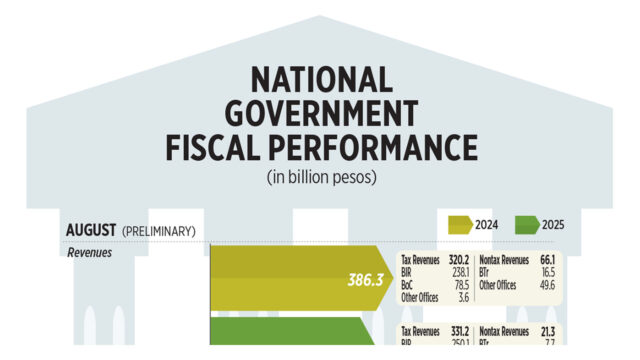
National Government Fiscal Performance

THE PHILIPPINES’ budget deficit widened in August as revenues fell faster than spending, adding pressure on the government to borrow more and keep within its deficit ceiling. Read the full story.

National Government Fiscal Performance