

Home Blog Page 9141

Gov’t fully awards bonds

THE GOVERNMENT fully awarded the reissued five-year Treasury bonds (T-bonds) it offered on Wednesday on the back of low rates and strong demand as investors continue their flight to safer assets.

The Bureau of the Treasury (BTr) raised P30 billion in reissued five-year T-bonds yesterday out of total tenders worth P118.422 billion, or nearly four times the initial offer.

The average rate for the five-year notes dropped 134.2 basis points (bps) to 2.676% from the 4.018% fetched in the March 3 auction.

National Treasurer Rosalia V. de Leon told reporters via Viber that they opened the tap facility to raise another P20 billion via the long-term papers to accommodate excess demand.

A bond trader said the huge demand indicates that investors are “hunting for yields” on long-term papers as they continue their flight to safe-haven assets like government bonds.

The trader said there is also abundant liquidity in the market as “no one’s borrowing for expansion of business” while weak demand and uncertainties persist amid the ongoing coronavirus pandemic.

The trader said investors likely also priced in the growth outlook for this year and beyond which has been substantially affected by the economic fallout from the public health emergency.

The government’s economic team is projecting gross domestic product (GDP) to contract by 2-3.4% this year before bouncing back to 7.1-8.1% in 2021 due to a low base, and to 7-8% in 2022.

GDP contracted by 0.2% in the first quarter, recording its first decline in two decades or since 1998.

Excluding the results of the tap facility on Wednesday, the BTr has raised a P226.3 billion from a mix of Treasury bills (T-bills) and T-bonds in May.

The total borrowings exceeded the P170-billion program set for this month as the Treasury opened its tap facility after each auction, even upsizing the awarded volume for some offerings due to strong demand.

For June, the government is planning to borrow P170 billion from the local market, broken down into P110 billion via its weekly T-bill auctions and P60 billion via T-bonds to be offered fortnightly. — B.M. Laforga

Global film festival aims to bridge coronavirus distances

LOS ANGELES — The Cannes film festival was canceled and the September jamborees in Venice and Toronto are uncertain but this week movie lovers are being offered a taste of the film festival experience from the comfort of their homes.

The 10-day “We Are One: A Global Film Festival,” starting Friday on YouTube, will feature new and classic movies, talks with directors, and music and comedy curated by 21 festivals including those in Berlin, Cannes, Venice, Toronto, and New York.

The coronavirus pandemic has forced the cancellation of multiple cultural events where independent movies are first launched.

“We Are One” will stream more than 100 movies representing 35 nations. The program includes the world premiere of documentary Iron Hammer about former Chinese Olympic volleyball star “Jenny” Lang Ping, talks with directors Bong Joon-ho and Guillermo del Toro, and a 20th anniversary reunion of the cast of Almost Famous.

“You’ll be able to see a premiere of the film and during that premiere the filmmakers will come out and introduce it. There will be a talk afterward,” said Jane Rosenthal, who organized the global event.

Rosenthal said she wanted not just to celebrate film but also to reach out to people who have never been to a film festival.

She said the idea sprang from the Tribeca film festival, which Rosenthal and actor Robert De Niro launched in 2002 to reinvigorate lower Manhattan after the Sept. 11, 2001 attacks on the World Trade Center.

“We are all globally in the same place except this (coronavirus) is even harder. We can’t physically gather. So I started thinking about how do we pull the world together at a time of need,” she said.

While the festival will stream for free, viewers will be asked to donate to the World Health Organization’s COVID-19 Solidarity Response Fund. — Reuters

Asian consumers worried about securing their data

A STUDY by Internet security firm Kaspersky showed the majority of consumers in the Asia-Pacific region are now concerned about their privacy online, but many of them are still willing to sacrifice their private data in exchange for a free service.

Kaspersky said 40% of the consumers it surveyed in the region claimed they had experienced their accounts being accessed by someone without consent, while 39% reported illegal takeover of devices.

It also said 31% reported about confidential data being stolen and used, while 20% confirmed their private information had been accessed and publicly divulged without their permission.

Kaspersky also found out that “more than one-fifth of the users are still willing to sacrifice their privacy to gain a product or a service for free.”

It said 24% of the users “let their guards down by sharing social media account details for funny quizzes.”

“Moreover, 2-in-10 of consumers surveyed also admitted they need some help to learn how to protect their privacy online,” Kaspersky added.

Stephan Neumeier, managing director for Asia Pacific at Kaspersky, was quoted as saying: “Our data on hand suggests a complex online behavior within our region. It is a welcome progress that majority of consumers are now concerned about their online privacy but their virtual habits and security know-how must undergo an overhaul.”

“With the current remote working situation in the majority of the countries in the Asia-Pacific region, digital privacy should be a concern for both personal users and enterprises. Our corporate networks have reached the comfort of our homes, in turn increasing cybercriminals’ surface of attack. It’s definitely high time to improve cyber hygiene for both our personal and professional reputation and peace of mind,” he added.

As for the consequences of a privacy breach, 39% of Kaspersky’s respondents said they were “disturbed” by spam and advertisements.

Some 33% said they were “stressed,” while 24% reported their personal reputation was “damaged.”

“Cybercriminals tend to follow chaos. Whenever there is a major trend or a crisis, they will use it as a perfect opportunity to exploit the heightened human emotions which make users more vulnerable. To protect yourself during this critical time, it is important to be careful about the personal particulars you share online and to understand how these data will be used. Revisit your privacy settings and tweak them accordingly. The internet is a place of opportunities and anyone can benefit from it as long as we know how to intelligently manage our data and our online habits,” Mr. Neumeier explained.

Kaspersky said private data leak can be avoided if users can “identify potentially dangerous or questionable requests made by an application, and understand the risks associated with different types of common permissions.”

Kaspersky said it offers Security Cloud, which incorporates a “Do Not Track” feature to prevent the loading of tracking elements that monitor users’ actions on websites and collect information about them.

“For businesses, teach employees about the basics of cybersecurity. For example, not opening or storing files from unknown e-mails or websites as they could be harmful to the whole company, or to not use any personal details in their passwords. In order to ensure passwords are strong, staff shouldn’t use their name, birthday, street address and other personal information,” it added.

The company said the study, which involved 3,012 respondents from countries in the Asia-Pacific region, was conducted between January and February 2020. — Arjay L. Balinbin

Centro creates anti-virus dividers for PUVs

CENTRO Manufacturing Corp. has designed a ready-to-install divider for public utility vehicles (PUV), adding to physical distancing measures that the government requires for transport operations during the quarantine period.

“The divider material is non-permeable, transparent plastic, and the dividers are installed conforming to physical distancing. They may be installed one seat apart or even at less than one meter apart,” Centro Senior Sales Manager Vic Belisario said in a statement on Wednesday.

The truck body manufacturer will be installing the dividers at any of its three production facilities in Quezon City, Cavite, and Bulacan. These are now being sold in automotive parts markets.

The equipment, which uses clamps, can be easily dismantled if a vehicle will be used to load cargoes, it said.

In its guidelines, the Land Transportation Office (LTO) has specified the use of dividers in public transport servicing laborers returning to work in areas under general community quarantine.

Specifically, it is allowing jeepney operators to install barriers between rows of seats that are less than one meter apart, maximizing the 50% passenger load which the agency permits.

The Metro Manila Council has unanimously agreed to transition the National Capital Region from the modified enhanced community quarantine to a more-relaxed quarantine period starting June 1.

However, the council recommends maintaining the suspension of jeepney and bus operations as transport agencies have yet to finalize a routing scheme.

Centro will soon apply for a patent for its seat dividers. — Adam J. Ang

House approves bill on cash agents

A BILL which seeks to widen unbanked Filipinos’ access to financial services was approved by the House Committee on Banks and Financial Intermediaries on Wednesday.

House Bill 1297 or Bangko sa Baryo Act of 2017 was filed by Deputy Speaker and Camarines Sur Rep. Luis Raymund F. Villafuerte, Jr. The bill was also filed during the 17th Congress but was not passed on second and third readings.

“The Bangko sa Baryo Act endeavors to attain financial inclusion for the Filipino people and to establish robust financial consumer protection frameworks. It shall increase citizen’s financial literacy and capability so they understand different financial services,” Mr. Villafuerte said in his explanatory note.

The bill defines cash agents and provides the corresponding eligibility requirements. It ensures agents, as extensions of the banking system, are able to provide professional service, keep records, handle cash and manage liquidity.

Cash agents should be able to assist in performing bank services, including forwarding account opening applications, cash-in and cash-out services and initial customer identity verification, especially for efforts on anti-money laundering and combating terrorism financing.

The bill also requires the contracting bank to ensure the cash agent follows standard bank protocols and exercise due diligence when dealing with customers.

Cash agents who establish business in a “remote area” will be entitled to the following incentives: free training of cash agent personnel on various bank processes; expedited processing of permits and certificates that are requisites to business registration; and exemption from income tax for one year.

According to the fourth-quarter financial inclusion dashboard of the Bangko Sentral ng Pilipinas (BSP), 31.2% of municipalities in the country have no banking presence. This is 1.6% lower compared to the same period in 2018.

In a statement on April 21, Mr. Villafuerte urged Congress to pass the bill so the government “could download the cash in an instant to each and every family not only through the accredited banks, remittance centers and paycard platforms like GCash and PayMaya, but also through the bill-proposed authorized cash agents.”

“We need to harness digital technology to bring people closer to their government, more so in the ‘new normal’ scenario after this COVID-19 (coronavirus disease 2019) crisis where variations of modified quarantine and social distancing might become the way of life and the government will probably need to extend subsidies to pre-selected groups of families and certain business sectors whenever necessary,” he said. — Genshen L. Espedido

COVID-19 to have no significant short-term impact on Huawei’s operations

CHINESE multinational technology company Huawei Technologies Co., Ltd. said the coronavirus pandemic will not have a significant impact on its operations in the short term but warned that a further spread of the virus will bring uncertainty to the continuity of its market supply.

“The pandemic won’t have much of a short-term impact on Huawei. As of today, most of our factories in China have resumed production and our total production capacity has recovered to normal levels,” the company said in a statement it provided to reporters after the Asia Pacific 5G Online Tour on May 20.

It said its supply hubs outside of China are working with its partners to support efforts to prevent the spread of the coronavirus diseases 2019 or COVID-19.

“Currently, production and operations in these supply centers are normal and supply risks are being adequately managed,” it added.

Huawei also said “further spread” of the virus that cannot be controlled “will create new long-term challenges and bring uncertainty to the continuity of its market supply.”

To ensure supply continuity and stability, the company said it is strictly enforcing infection prevention and control measures across its supplier network.

“These efforts will help them resume production while ensuring that their employees are healthy and safe,” it said.

During the online tour, Huawei officials showed to reporters its 5G exhibition hall named after Italian physicist and astronomer Galileo Galilei.

Huawei said it has invested a total of $4 billion in research and development work for 5G. “We have established nine 5G standards and research centers worldwide, have more than 500 experts working on standards, and hold positions in over 100 standards organizations,” it said.

Citing customer feedback, the company said it is “two to three years” ahead of its competitors.

“We believe that 5G…is much safer than any other technologies such as 4G and 3G. This is the key message we want to share.” Huawei India Chief Executive Officer Jay Chen said.

Huawei, which has been conducting research on 5G since 2009, said it now owns “3,367 families of 5G patents, accounting for more than 20% of the total and ranking No. 1 among all vendors.”

“We are committed to be the enabler of Asia Pacific’s digital transformation, including policy consultant on national digital strategy, and providing faster, safer, more efficient digital infrastructure (4G/5G Wireless +Wired, Ultra Broadband),” the Chinese technology firm also said. — Arjay L. Balinbin

Podium’s restaurants are ready for business

MOVEMENT restrictions in Metro Manila may be loosening but as the pandemic continues, it will still be quite some time before dining in restaurants will be allowed again because of the threat of infection. But that doesn’t mean cravings can’t be satisfied as many restaurants are offering delivery and pick-up services for their specialties. The Podium Mall in Mandaluyong City has launched its own to-go delivery service for some of its restaurants so customers can still order their favorite dishes.

The mall created a restaurant guide that is available on its website and social media channels. Customers can check it out, then call the restaurant of their choice to place their order and meal requirements. The purchase can be paid for in cash or via cashless payment systems agreed upon by the customer and restaurant. The deliveries will be made by the Podium’s partner courier service, Fastrack. Delivery fees depend on the customer’s location.

Several of the restaurants are also delivering via GrabFood, FoodPanda, and LalaFood. The restaurants can also handle pick-up or curbside deliveries.

Among the Podium restaurants that are open are Filipino restaurants Manam and Lola Cafe; Italian restaurants La Vita Ristorante Italiano, Motorino, and Salvatore Cuomo Café; Asian restaurants Marugame Udon, New Bombay, Paradise Dynasty, and Shi Lin; Mediterranean restaurants Cafe Mediterranean and Cyma. Also available for delivery are Michelin-starred Putien restaurant and the famous Wolfgang’s Steakhouse. — ZBC

LRT-1 operator invests in disinfection technology

LIGHT Rail Manila Corp. (LRMC), operator of Light Rail Transit Line 1 (LRT-1), has partnered with the University of the Philippines-Diliman’s National Engineering Center for the use of an ultraviolet technology to disinfect its train sets.

With the partnership, the university and LRMC will develop “different disinfection equipment using UVC (ultraviolet-C) technology that would best serve the LRT-1 trains.” They will also accelerate the mass production of the technology to immediately serve the entire LRT-1 line.

“The UVC technology would be essential in making sure that the LRT-1 trains, facilities, and stations remain safe and virus-free when the line reopens after the lifting of the modified enhanced community quarantine in Metro Manila,” LRMC said in a statement e-mailed to reporters on Wednesday.

Light Rail Manila Corp. (LRMC) teamed up with the University of the Philippines-Diliman’s National Engineering Center to develop “different disinfection equipment using UVC (ultraviolet-C) technology that would best serve the LRT-1 trains.”

LRMC said further that its partner was also tasked “to continue its research into the technology, as well as monitor and test its effectiveness once the LRT-1 resumes operations.”

LRMC Head of Health, Safety, Environment, and Quality Andrea Mellind C. Madrid said: “We are constantly looking for ways to innovate and explore better alternatives to ensure that the LRT-1 is safe for our passengers and employees. With the use of proven technology, we are able to help them feel safer and more confident while riding LRT-1 by effectively reducing the risk of catching COVID-19.”

University of the Philippines President Danilo L. Concepcion said: “The use of UVC is an effective disinfection technology being implemented in hospitals, clinics, and even in other facilities abroad. We are incredibly proud of the UP National Engineering Center for their breakthrough, as we are glad to serve our country and our fellow Filipinos in fighting the threat of COVID-19.” — Arjay L. Balinbin

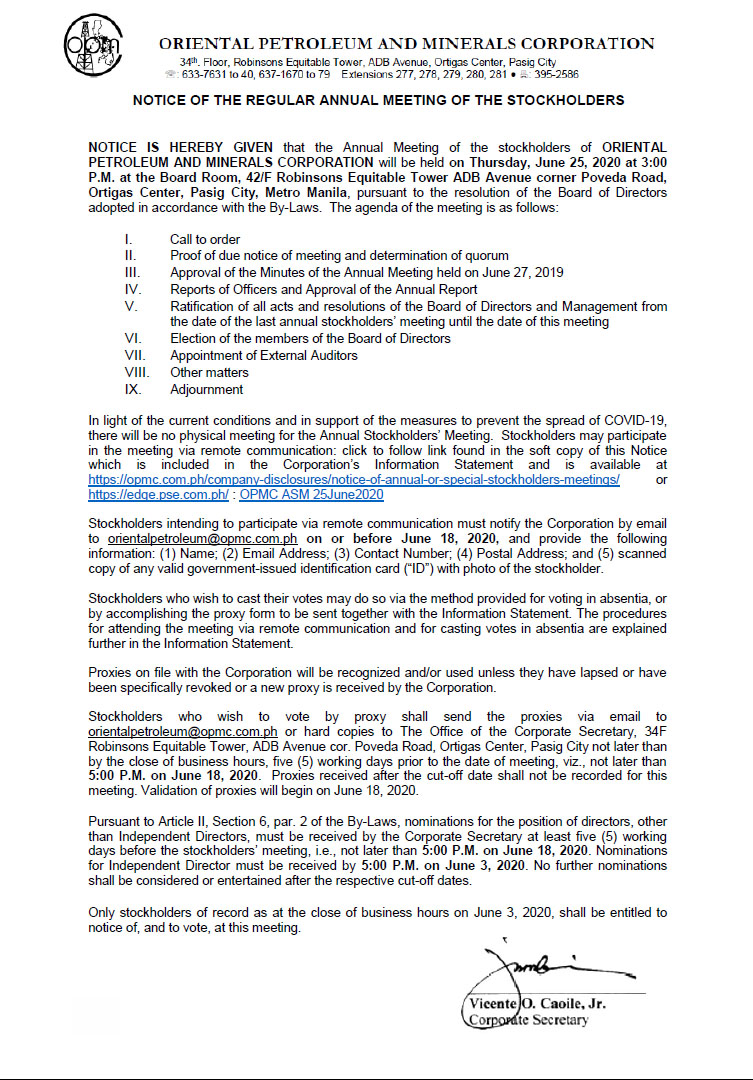
Oriental Petroleum and Minerals Corp. to hold annual stockholders’ meeting via remote communication on June 25

Yields on seven-day term deposits inch lower

YIELDS ON the central bank’s term deposit facility (TDF) slipped on the back of higher bids as well as the slight recovery in oil prices.

Tenders for the seven-day papers offered by the Bangko Sentral ng Pilipinas (BSP) on Wednesday totalled P273.755 billion, higher than the P150 billion on the auction block and also going beyond the P242.052 billion in bids seen last week for the P120 billion up for grabs.

Yields sought by lenders ranged from 2.25% to 2.254%, a slightly narrower band compared to the 2.25% to 2.258% logged on May 20. With this, the average rate of the one-week term deposits settled at 2.2516%, slipping by 0.27 basis point from the 2.2543% logged a week ago.

“[The] auction results continue to reflect market preference for the BSP’s deposit facilities amid ample liquidity in the financial system,” BSP Deputy Governor Francisco G. Dakila, Jr. said in a statement.

The TDF is the central bank’s primary tool to mop up excess liquidity from the financial system and to better guide market interest rates.

The 14- and 28-day day term deposit offerings remain suspended. The BSP halted offering term deposits in mid-March to support the banking system amid the imposition of the lockdown measures.

Rizal Commercial Banking Corp. Chief Economist Michael L. Ricafort said the lower yields came amid a continued increase in demand for the term deposits.

“This still manifests increased peso liquidity in the financial system looking for higher yielding outlets for short tenors such as the 7-day TDF,” he said in an e-mail.

Mr. Ricafort said although yields continued to go down, the decrease became more marginal due to the uptick in oil prices.

“The upward correction in global oil prices to new 2.5-month highs could have also slowed down the weekly decline in the 7-day TDF yield,” he added.

Global oil prices have seen some recovery after sliding to negative territory in April. This, as major oil producers stand by their commitment to cut their output by nearly 10 million barrels per day from May to June amid slower demand brought about by the pandemic.

As some economies start to gradually reopen, there has also been a slight rise in demand from major oil importers such as China.

Mr. Ricafort said the decrease in TDF yields also lessened as rates are already close to the April inflation print of 2.2%.

“Any level below the said inflation rate is already considered negative net interest rate return,” he said.

The April headline print was a five-month low and the slowest since the 1.3% seen in November last year.

The Philippine Statistics Authority will report the May inflation on June 5. — Luz Wendy T. Noble with Reuters

How PSEi member stocks performed — May 27, 2020

Here’s a quick glance at how PSEi stocks fared on Wednesday, May 27, 2020.


Stocks rebound on optimism over virus vaccine

By Denise A. Valdez, Reporter

LOCAL SHARES ended Wednesday’s session higher as prospects of an anti-coronavirus disease 2019 (COVID-19) vaccine lifted investor sentiment.

The benchmark Philippine Stock Exchange index (PSEi) rose 26.95 points or 0.49% to close at 5,523.78 yesterday. The broader all shares index added 16.10 points or 0.48% to 3,329.12.

“The Philippine market rallied on new vaccine news, and optimism over positive signs of global economic recovery,” Regina Capital Development Corp. Head of Sales Luis A. Limlingan said in a mobile message.

Global pharmaceutical company Merck & Co. announced on Tuesday it has ongoing initiatives to develop an antiviral drug against COVID-19, which it said will use the same technology as its Ebola vaccine, Forbes reported.

This news, along with New York’s hiring of over 1,700 contact tracers to mitigate the spread of COVID-19 in the city, boosted investor confidence and lifted US markets on Tuesday.

The Dow Jones Industrial Average, S&P 500 and Nasdaq Composite indices gained 2.17%, 1.23% and 0.17% respectively on Tuesday.

For AAA Southeast Equities, Inc. Research Head Christopher John Mangun, the better performance of the local market on Wednesday was attributable to bargain hunters.

“The PSEi started the day with a minor sell off. Investors were more optimistic (on Wednesday) than (on Tuesday) as they started bargain hunting which pushed the market higher toward the end of the trading session,” he said in an e-mail.

He also noted shares in First Gen Corp. (FGEN) drove up the main index after Singaporean company Valorous Asia Holdings Pte. Ltd. announced interest in buying its shares.

“FGEN was the biggest gainer for the main index today, up 14.2% after a Singaporean firm announced to purchase shares through a tender offer at a premium,” Mr. Mangun said on Wednesday.

Four of six sectoral indices ended trading in green territory. Mining and oil grew 127.73 points or 2.94% to 4,465.23; industrials rose 108.24 points or 1.52% to 7,200.37; financials increased 10.18 points or 0.94% to 1,087.34; and holding firms climbed 31.87 points or 0.57% to 5,573.69.

On the other hand, services shed 3.80 points or 0.28% to 1,315.70 and property lost 7.06 points or 0.25% to 2,757.83.

Value turnover on Wednesday stood at P5.48 billion with 1.51 billion issues switching hands, a slight increase from the previous day’s P5.17 billion with 1.36 billion issues.

Advancers bested decliners, 99 against 78, while 47 names closed unchanged.

Foreign investors remained sellers yesterday, but net outflows dropped to P209.92 million from P1.18 billion on Tuesday.

“The PSEi ended above its 5,500 support level today which may draw more momentum for a move higher. We could see it move higher in the coming days to test resistance,” Mr. Mangun said.