Home Blog Page 8886

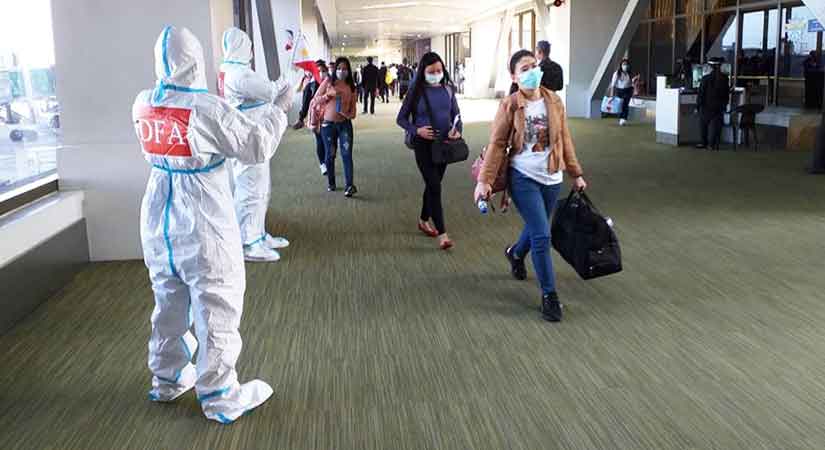
300 more Pinoys come home amid virus crisis

PHOTO COURTESY OF DEPARTMENT OF FOREIGN AFFAIRS FACEBOOK PAGE

THREE HUNDRED overseas Filipinos arrived from Qatar on Saturday amid a coronavirus pandemic that has sickened about 18 million and killed more than 689,000 people worldwide, according to the Department of Foreign Affairs (DFA).

The Filipino who arrived on Saturday included land-based workers, seafarers and returning tourists who got stranded abroad, it said in a statement on Saturday evening.

The repatriates were swab-tested and will be quarantined for 14 days at a facility approved by the Bureau of Quarantine, DFA said.

They were in addition to the 50,887 overseas Filipinos who arrived in July, bringing the total of those who have come home to 115,793 since February.

Of the total, 35,656 came from the Middle East, 6,925 from Asia, 4,943 from the Americas, 3,343 from Europe and 20 from Africa, the agency said.

“The DFA also organized 13 chartered flights this July which brought home 4,147 fellow Filipinos from Japan, Pakistan, Saudi Arabia, Qatar, Lebanon, Malaysia and Vietnam,” DFA said. It said it had paid for the chartered flights, adding that it planned to bring home about 100,000 more Filipinos in the next two months.

“We continue to stand by our promise to bring home every Filipino who wants to come home,” Foreign Affairs Undersecretary Sarah Lou Y. Arriola said.

Meanwhile, DFA said 9,556 overseas Filipinos have been infected with the coronavirus, 3,313 of whom were being treated, 5,572 have recovered and 671 died.

The most number of cases came from the Middle East with 6,770, followed by Europe with 1,111, the Asia-Pacific Region with 913 and the Americas with 762, DFA said. — Charmaine A. Tadalan

Regional Updates (08/02/20)

Free Pasig Ferry service resumes, 6 stations open

FERRY SERVICES along Pasig River will resume operations Monday, Aug. 3, with the rides still free although passenger capacity will be limited to 50%. The Metropolitan Manila Development Authority, which operates the boats, said six stations will be open from 6 a.m. to 6 p.m., Monday to Saturday. The open stations are: Pinagbuhatan, San Joaquin, Guadalupe, Valenzuela, Lawton and Escolta. Health protocols such as wearing of mask and temperature check are required, and only those 21-59 years old will be allowed to board. “We will strictly implement these precautionary measures to ensure the safety of passengers. Personnel of PRFS (Pasig River Ferry Service) can deny entry at the ferry station if a passenger refused to undergo those procedures,” Frisco San Juan, Jr., MMDA deputy chairman and ferry service head, said in a statement Friday. PRFS operations were suspended since March 17 following quarantine measures imposed to mitigate the coronavirus outbreak.

MWSS office reopens Aug. 5

THE CORPORATE OFFICE of the Metropolitan Waterworks and Sewerage System (MWSS) in Quezon City will resume physical operations on Aug. 5 after a two week lockdown. The reopening, however, will be limited to a 25% skeleton workforce on a rotating system, while the rest will be working from home, in accordance with health protocols. Office hours will also be limited from Monday to Thursday. “The extended lockdown provided the time for contract tracing activity of all close contacts of the two employees (who) tested COVID-19 positive, and allowed the mass swab testing for the identification of additional cases,” MWSS said. A total of seven employees tested positive, five of whom were asymptomatic. — Revin Mikhael D. Ochave

Davao restaurant owners ask city government to revert to 2017 realty tax rates

RESTAURANT OWNERS in Davao City have asked the local council to revert real estate tax to 2017 rates to help businesses ride out the coronavirus crisis. “Because the general public are still not confident to dine out. They are scared. Because of this, our sales are very low. If only our sales are enough, rental fee won’t be a problem,” Benjamin A. Lizada, president of the Restaurant Owners Association of Davao City (ROADC) said through Viber. Several homegrown food establishments have already closed shop while those in operation are struggling with mostly take-out and delivery services, he said. “Right now for example I am operating slightly below breakeven, I have small losses but its okay at least we can give something to our workers for food. I have small losses because my lessors lowered down my rental fee, of which I am thankful. However, if lessors will increase our rental fees we will be forced to shut operations,” he said. ROADC’s proposed reversal of tax rates, supported by the Tourism Council of Davao City, covers the third quarter this year to the end of 2021. Commercial property tax rates increased by 11% effective 2019 following an amendment to the Real Property Tax Code in 2017. Residential, agricultural, and industrial rates also went up by 4% to 25%. The city council has approved an extended deadline for property tax payments this year, but Mr. Lizada said having a grace period is not enough. “Extending it is not enough… I am hopeful that they will sit down and compute at the very least, do a cost-benefit analysis of (business) closures,” he said. — Maya M. Padillo

Power lines intact, no major damage reported from 6.4 earthquake in Cotabato City

POWER TRANSMISSION facilities remained intact in the entire Mindanao mainland after a magnitude 6.4 earthquake struck 13 kilometers southeast of Cotabato City at 1:08 a.m. Sunday, the National Grid Corporation of the Philippines reported. “The Mindanao Grid remains intact as there are no reports of power interruption and damaged transmission facilities in Cotabato City and nearby areas where the earthquake was felt,” NGCP said in an advisory. The government’s Philippine Institute of Volcanology and Seismology also said in its bulletin that no damage was expected, but aftershocks were likely.

Nationwide round-up

Tropical storm Hagupit seen out of Philippine area by Monday morning

TROPICAL STORM Hagupit, locally named Dindo, is expected to be out of the Philippine area by Monday morning while staying far from the country’s landmass as it moves northwest towards Japan, weather bureau PAGASA reported Sunday. At 10:00 a.m. Sunday, the storm was located 385 kilometers northeast of Basco, Batanes and heading towards the Ryukyu archipelago in Japan. “Additional intensification remains likely before it makes landfall over eastern China,” PAGASA said. Meanwhile, the southwest monsoon is seen to bring occasional light to heavy rains over Luzon.

DoTr says fate of motorcycle taxis rests on Congress

Department of Transportation (DoTr) logo
THE DEPARTMENT of Transportation (DoTr) supports the use of motorcycles as public transport, but Congress will first have to change the law, an official said on Sunday. DoTr Assistant Secretary Alberto H. Suansing, in a radio interview with DZBB on Sunday, said, “Wala naman kaming problema dun. Ang sinusulong lang namin palagi ay ang kaligtasan ng (We don’t have a problem with that. What we are pushing for is the safety of the) motorcycle taxi).” Under Philippine law, motorcycles can only be registered as private vehicles. Motorcycle taxi services were permitted during a pilot study headed by the DoTr’s technical working group, which ended March this year. Mr. Suansing said they will need a congressional resolution to continue and conduct a pilot run. He added that based on the last hearing, Congress plans to form a new technical working group that it will lead with DoTr representatives as members.  Gillian M. Cortez

2 applicants up for interview for Supreme Court post

THE JUDICIAL and Bar Council is set to interview two applicants for the Supreme Court justice post to be vacated by Associate Justice Jose C. Reyes, Jr., who will retire on Sept. 18. JBC announced that an online public interview will be held on Aug. 11 for Court of Appeals (CA) Associate Justice Apolinario D. Bruselas, Jr. and Sandiganbayan Associate Justice Alex L. Quiroz. Other applicants whose previous interviews are still valid are CA Associate Justices Nina G. Antonio-Valenzuela, Ramon A. Cruz, Japar B. Dimaampao, Jhosep Y. Lopez, Eduardo B. Peralta, Jr., Ricardo R. Rosario, Maria Filomena D. Singh, and Edwin D. Sorongon; Sandiganbayan Presiding Justice Amparo M. Cabotaje-Tang and Associate Justice Oscar C. Herrara, Jr.; and Court Administrator Jose Midas P. Marquez. — Vann Marlo M. Villegas

Finance dep’t rules out luxury-goods tax, to focus on getting tax relief bill approved

THE Department of Finance (DoF) has ruled out a new tax on luxury goods this year, saying it is focusing its efforts on passing the remaining tax reform legislation, particularly the proposed Corporate Recovery and Tax Incentives for Enterprises Act (CREATE), which has been repositioned as tax relief for businesses hurting from the pandemic.

Finance Assistant Secretary Antonio G. Lambino II said there is no immediate plan to reintroduce luxury taxes in the Comprehensive Tax Reform Program (CTRP).

“Not that I know of. We are focused on CREATE when the session resumes as well as Packages 3 and 4 for the rest of the year. We will study, of course, the various proposals filed in Congress… and will make ourselves available to legislators for providing available data and analytical support,” Mr. Lambino said via Viber.

Representative Jose Maria Clemente S. Salceda of Albay, who chairs the House Committee on Ways and Means, expressed support for a luxury tax, pending an effective system to prevent leakages.

“In terms of promoting equity, luxury taxes do elevate general welfare — this is a well-proven economic observation,” Mr. Salceda said in a Viber message.

“We favor luxury taxes, but we need very strong tax administration measures to ensure that we are able to collect them. Otherwise, we will just widen the tax gap,” he added.

Mr. Salceda said luxury taxes are progressive, though luxury spending itself may be dampened because of the uncertain economy.

“We just have to study which luxuries in particular will be worth the effort, since luxury consumption is also depressed during economic crises. They are very progressive taxes, and if we can find luxury goods worth taxing, I prefer luxury taxes over broad consumption taxes,” he said.

In its initial form, the CTRP of the Department of Finance proposed taxes such as higher duties on luxury cars and jewelry if there is a need to “augment” tax revenue.

Tax collections in the six months to June dropped 16% year on year to P1.15 trillion.

CREATE lowers the corporate income tax to 25% this year from 30% currently, while overhauling the fiscal incentive system. The other tax reform measures are a bill simplifying the tax structure for investment instruments; and a single framework for real property valuation and assessment.

Last year, the National Tax Research Center said expanding the coverage of the excise tax to more non-essential goods will redistribute income, improve the tax system, curtail conspicuous consumption, and raise more revenue for the government.

House Bill No. 5445 was filed in the 17th Congress to widen the coverage of the 20% excise tax on non-essential goods as well as imposing an additional 2% ad valorem tax on the sale of certain real properties worth at least P5 million and on shares and memberships in clubs and resorts.

However, the bill did not make it through committee while other tax bills were consolidated to form part of the recently-signed “sin” tax law, Republic Act No. 11467. — Beatrice M. Laforga

Nuclear power plants seen unlikely to be operational by end of Duterte’s term

NUCLEAR POWER within the next two years is unlikely because of the need to complete the appropriate preliminary studies and pass laws regulating the sector, the Senator who chairs that chamber’s energy committee said.

“If you ask me whether nuclear can be part of our energy mix in the next two years, it’s impossible because the study itself will take time and number two, you’ll need legislation to make sure you have safeguards,” Senator Sherwin T. Gatchalian said by telephone Saturday.

Mr. Gatchalian said at least seven measures are needed to develop nuclear power — laws establishing an independent regulator, outline safety standards, ensure nuclear security and manage waste, among others.

“The speed of enacting pieces of legislation on nuclear will depend highly on the quality and the credibility of the study that will be conducted by the DoE (Department of Energy),” he said, noting that the coronavirus pandemic has also delayed the legislative process.

President Rodrigo R. Duterte steps down in less than two years, and policy continuity with the next administration remains unclear.

A measure providing a regulatory framework for nuclear energy development and use nearly hurdled the 17th Congress after securing third-reading approval at the House of Representatives. However, it was still awaiting second reading in the Senate when the session adjourned.

The bill has yet to be refiled in the Senate, while at least six bills relating to nuclear power are now pending at the committee level.

Mr. Duterte issued Executive Order (EO) No.116, authorizing a study on the feasibility of nuclear energy and called for the development of a national policy on nuclear energy.

Mr. Gatchalian has said that the DoE and other government agencies should develop a nuclear program with the “utmost transparency,” considering the risks it poses.

“We plan to conduct a regular oversight hearing… meaning every step of the way the department should clarify and make us understand every inch of nuclear power,” he said.

He added that as the finance committee vice chairman he also will inquire on the progress during budget review.

“My view is we want to give the department elbow room to recommend what type of fuel source and what type of energy source in our country… but there should be some conclusion at one point because we can’t keep on spending on nothing,” he said.

He said the independence of the experts conducting the study will be key, because some experts might be more concerned with selling the Philippines nuclear equipment.

“For example if you ask China to conduct the study, biased na ‘yan (they’ll be biased), because China is trying to be the number one nuclear supplier in the world,” he said.

Carlo A. Arcilla, who leads the Philippine Nuclear Research Institute, said there could still be a significant developments in the last two years of Mr. Duterte’s term.

Mr. Arcilla said the government started “too late” because a version of the EO had been submitted for his signature two years ago.

“Definitely, the nuclear plant will not be finished under President Duterte’s time, but if he agrees with this, construction could still be started,” he said by telephone Sunday. He added that the study is expected to provide an estimate of the costs involved. 

“Sabihin natin na maaprubahan ni President Duterte, may kontrata na, mahirap naman basta basta umatras na doon. Sana ‘yung papalit, igagalang ‘yun.” (Assuming President Duterte approves this and signs a contract, it would be difficult to withdraw from such an agreement. I hope the next administration respects that.)

Mr. Arcilla noted that the fastest route to going nuclear would be to rehabilitate the Bataan Nuclear Power Plant, which would take five years

The United Nations’ International Atomic Energy Agency last year transmitted its 19-point Integrated Nuclear Infrastructure Review of the Philippines’ readiness to develop nuclear energy.

The report among others raised the need for more public consultations, a legal and regulatory framework, and the addressing of infrastructure concerns. — Charmaine A. Tadalan

DoE studying small nuclear plants for remote areas

THE Department of Energy (DoE) is studying the use of small nuclear generators to power off-grid areas, Energy Secretary Alfonso G. Cusi said in a statement.

His announcement over the weekend follows the issuance of Executive Order No. 116 which ordered a feasibility study on nuclear energy.

Mr. Cusi told the nuclear industry at a forum that the Philippines is studying modular nuclear plants for remote areas.

“The possibility of establishing a modular power plant in the country might come sooner,” the DoE quoted him as saying in the statement.

Modular plants are formed from groups of small nuclear reactors and have capacities of 300 megawatts (MW) or less, according to the International Atomic Energy Agency.

At the Nuclear Business Platform webinar, Mr. Cusi addressed concerns about the expected political fallout from going nuclear.

He presented a DoE survey in 2019 which revealed that nearly eight out of ten Filipinos are willing to learn more about nuclear energy.

“With such a positive turnout, I feel that now is time for intensified and informed public discussions on nuclear energy and its potential role in the Philippine energy security agenda,” he said.

New nuclear plants gained 65% approval from respondents and the rehabilitation of the mothballed 621-MW Bataan Nuclear Power Plant was backed by 79%.

The DoE’s Philippine Energy Plan expects the inclusion of nuclear power to the generation mix by 2027. — Adam J. Ang

Work on PNR Clark airport station to start soon

THE construction of the Philippine National Railway (PNR) Clark Phase 2 (Malolos-Clark railway) project’s 6.5-kilometer railway track, an underground station at Clark International Airport, and a depot is set to start within the quarter, Transportation Secretary Arthur P. Tugade said.

“The milestone of this project is running at great speed, from the National Economic and Development Authority (NEDA) Board approval in 2018 to the signing of the Asian Development Bank (ADB) loan agreement in July 2019 until its contract signing today. The PNR Phase 2 is one of ADB’s fastest large-scale projects,” Mr. Tugade said during the virtual contract signing for the two contract packages of the Malolos-Clark Railway project Saturday.

He added: “In fact, based on the projected timeline for the implementation of this project, the target start of the project construction will be in the third quarter of this year.”

One of the contracts signed was Contract Package 4 of the PNR Clark Phase 2 for civil engineering and building works covering approximately 6.3 kilometers of the main line, and 1.6 kilometers of the depot’s access line, with one underground station serving Clark International Airport. 

The successful bidder for this package was a joint venture between Spain’s Acciona Construction Philippines, Inc. and EEI Corp.

Contract Package 5 covering the civil engineering and building works for the Clark Railway Depot was also signed. This package covers 33 hectares, including construction of the operations control center, stabling yard, workshops, training center and other ancillary buildings in Mabalacat, Pampanga, the Transportation department said in a statement. The contract was awarded to South Korea’s POSCO Engineering and Construction Co., Ltd.

The two civil works contracts cost nearly P38 billion or $728 million and will be financed by the ADB and co-financed by Japan International Cooperation Agency (JICA).

ADB said JICA will provide “up to $2 billion in additional funding for the rolling stock and railway systems.”

The flagship Malolos-Clark railway project is part of the 163-kilometer North South Commuter Railway  project.

The ADB said the rail line “will ease road congestion in the capital and nearby provinces and reduce annual traffic-related economic costs, which total $18 billion in Metro Manila alone. It will help push economic activity to regional growth centers like Clark in Pampanga province.”

“The project will cut the travel time between Clark and Manila from two to three hours by bus to one hour by train, while reducing greenhouse gas emissions by more than 60,000 tons annually,” it added. — Arjay L. Balinbin

Gov’t debt at 34.1% of GDP in 2019 vs year-earlier 34.4%

GENERAL GOVERNMENT (GG) debt as a share of the economy fell to 34.1% in 2019 from 34.4% a year earlier, the Department of Finance (DoF) said, providing a baseline for economic conditions before borrowing swelled due to the pandemic.

In a statement over the weekend, the DoF said GG debt stock was P6.65 trillion last year, up 5.9%.

It said the decline was mainly due to a decline in national government debt, which accounted for 39.6% of GDP (gross domestic product) last year, down from 39.9% in 2018.

“The combination of prudent cash and debt management and steady economic growth has continuously brought down the NG (national government) debt-to-GDP ratio in recent years,” the statement read.

GG debt to GDP has been steadily declining from 47.1% in 2013.

Of the total debt stock, some 62% or P4.11 trillion was provided by domestic creditors and 38% or P2.54 trillion by foreign lenders.

GG debt is the outstanding debt of the national government, social security institutions and local governments less the intra-sector debt holding of government securities and the bond sinking fund (BSF).

National government debt, net of BSF, rose 5.6% to P7.17 trillion in 2019. Domestic and foreign debt rose 6.6% and 3.7%.

Both the Government Service Insurance System and Social Security System did not contribute to the debt stock, but were able to increase their holdings of government securities by 3.1% from a year earlier. — Beatrice M. Laforga

Cebu’s Mahiga River to be rehabilitated

REHABILITATION of the 9.1 kilometer Mahiga River in Cebu province will be conducted in partnership with 28 private companies and organizations, the Department of Environment and Natural Resources (DENR) said.

On July 21, Environment Secretary Roy A. Cimatu, Cebu City Mayor Edgardo C. Labella and Mandaue City Mayor Jonas C. Cortes, signed a Memorandum of Agreement with the various partners.

The rehabilitation will take place under the DENR’s “Adopt-an Estero/Water body” program, which enlists private entities in clearing out waste, debris, and silt from the water system.

Under the agreement, the partners will “adopt” the Mahiga River and come up with a program to reduce the pollution load on the river and its tributaries.

Environmental Management Bureau Region 7 Director Lormelyn E. Claudio said the river’s deterioration poses health and safety risks for the communities along its banks.

“Mahiga River Creek is a critical waterway in the city and its current condition requires intensified action from all stakeholders to ensure the sustainability of all rehabilitation measures,” Ms. Claudio said.

Cebu City and Mandaue City will establish integrated solid, healthcare, and household hazardous waste management systems under the agreement.

Meanwhile the DENR will monitor industrial and commercial establishments and perform regular water quality monitoring. — Revin Mikhael D. Ochave

Impairment considerations during COVID-19

(Second of two parts)

In last week’s article, we discussed how to determine the timing of assessment for any impairment for non-financial assets, as well as the indicators of impairment. This article will cover how to measure and estimate the recoverable amount of an asset, how to determine the recognition and reversal of impairment, and provide detailed disclosure on assumptions used to fully understand an impairment assessment especially in these uncertain times.

MEASUREMENT
An asset is impaired when an entity is not able to recover its carrying value (i.e., the amount shown on the entity’s balance sheet) either by using it or selling it. The recoverable amount is the higher of the asset’s (or group of assets’) fair value less costs of disposal (FVLCD) and value in use (VIU).

VIU involves estimating the future cash inflows and outflows that will be derived from the use of the asset and from its ultimate disposal and discounting the cash flows at an appropriate rate. The calculation of an asset’s VIU incorporates an estimate of expected future cash flows, and expectations about possible variations of such cash flows. The forecasted cash flows should reflect management’s best estimate at the end of the reporting period of the economic conditions that will exist over the remaining useful life of the asset. This means entities should consider both short-term effects and long-term effects on assets with longer useful life, such as capital assets and goodwill.

Due to the evolving COVID-19 situation, there are significant challenges to preparing the forecast or budgets for future cash flows. In these circumstances, an expected cash-flows approach based on probability-weighted scenarios may be more appropriate than the traditional single best estimate when estimating VIU. In coming up with scenarios, entities should consider the length and severity of the pandemic, government measures, availability of proper intervention (i.e., vaccine), distribution and supply chains, revenue growth and collections, capital, changes in regulations, and changes in customer behaviors, among others.

Cash flows are discounted at an appropriate rate, which is a pre-tax discount rate that reflects current market assessments of the time value of money and asset-specific risks for which future cash flow estimates have not been adjusted. The discount rate should likewise consider the price for bearing the uncertainty inherent in the asset, and other factors, such as illiquidity, that market participants would reflect in pricing the future cash flows the entity expects to derive from the asset. It is therefore highly important to exercise careful judgement when determining the discount rate to be applied.

RECOGNITION AND REVERSAL OF IMPAIRMENT
An impairment loss is recognized to the extent the carrying amount exceeds its recoverable amount. In subsequent periods, external and internal sources of information (such as significant favorable changes in the market conditions, the asset’s value, use and performance) may indicate that an impairment loss recognized for an asset, other than goodwill, may no longer exist or may have decreased. In this case, previous impairment losses may be reversed. Note, however, that an impairment reversal cannot be recognized merely from the passage of time or improvement in general market conditions. When an impairment reversal is recognized for assets other than goodwill, the adjusted carrying amount of the asset may not exceed the carrying amount of the asset that would have been determined had no impairment loss been previously recognized.

PAS 36 specifically prohibits the reversal of impairment losses for goodwill. If impairment on goodwill was determined and recognized in the interim period, it cannot be reversed in the subsequent interim periods or at year-end.

DISCLOSURE
Disclosure is particularly crucial in these times. Due to sensitivity, it is critical for an entity to provide detailed disclosures on the assumptions used, the evidence these are based on, and the impact of a change in key assumptions. Disclosures include, among others, the valuation methodology used and the approach in determining the appropriate assumptions and key assumptions used in cash flow projections aside from long-term growth rate and discount rate; the values of the key assumptions and the probability weights of multiple scenarios when using an expected outcome approach; and inputs used in determining the discount rate and the source thereof. This makes it also important to go beyond minimum disclosure requirements to help users better understand the impairment assessment.

KEY TAKEAWAY
With the COVID-19 situation, impairment assessment will be a complex and difficult undertaking. Hence, it is imperative for management to be judicious, more prudent and to employ careful judgment in making assumptions, especially when forecasting cash flows and determining the discount rate to be used.

It must be noted that cash flow forecasts may now be substantially — if not completely — different from pre-pandemic or existing budgets. Moreover, historical and comparative data may no longer be relevant and helpful in making such forecasts. Assumptions must be updated and should be drawn from and be reflective of the current pandemic circumstances.

This naturally requires a more cautious outlook for the future. As previously mentioned, the impact of COVID-19 may no longer be reflected in a single set of cash flows due to the high degree of uncertainty involved; there may be a need to develop multiple scenarios and apply probabilities to each scenario to arrive at the expected cash flows. In evaluating these scenarios, those with a downward impact on cash flows and on the value of the asset should be given more weight to reflect the market view of risk and uncertainty.

On the other hand, determining the discount rate is equally challenging given the current market volatility, and that most relevant parameters and inputs to determine discount rates have become unpredictable. Values and assumptions which were accepted, used and applied in the past and in previous impairment assessments and testing may no longer be reasonable or appropriate.

For instance, beta and cost of equity may have increased significantly due to capital market volatility; risk-free rates are reaching lows; and debt liquidity issues are severely affecting the cost of debt for many companies. That said, the risk-adjusted discount rates to be used should be calculated with serious considerations for the current market and economic conditions, the value of comparable reporting entities or assets that is available and evident in the market, and the risks of the asset or cash-generating unit to be valued.

The pandemic continues to evolve and until such time that a proper and permanent intervention is identified, there remains significant uncertainty about our future, our economy and business viability. Until then, the recoverability of most entities’ assets remains the focus and they will need to continuously reassess, recalibrate and be transparent about their assumptions and outlook for the future of their business. Disclosure is key — if not paramount — to understanding all these under the current situation.

This article is for general information only and is not a substitute for professional advice where the facts and circumstances warrant. The views and opinions expressed above are those of the author and do not necessarily represent the views of SGV & Co.


Meynard A. Bonoen is an Assurance Partner of SGV & Co.

COVID-19 and the economy


I am pleased to share with readers excerpts from recent posts to subscribers of GlobalSource Partners (globalsourcepartners.com), a New York-based network of independent analysts, mostly former finance and central bank officials. Its subscribers are “investors and business leaders including asset managers, traders and analysts, investment bank economists, private equity investors, corporate CFO’s, and multilateral officials.” Christine Tang and I serve as their Philippine Advisors.

THE STICK FOR NOW (JULY 22)
President Rodrigo Duterte has found himself caught between a rock and a hard place. On the one hand, COVID-19 cases are rising, with data from the Department of Health (DoH) showing the seven-day average positivity rate for daily tests close to 12% compared with a little over 6% a month ago and with experts estimating the reproduction number in Metro Manila rising from 1.2 to 2. On the other hand, quarantine measures have taken their toll on the economy, with survey data from the trade department showing that most of the country’s largely small businesses are either closed (26%) or in partial operation (52%), and with the finance secretary earlier calling for more easing of quarantine restrictions to revive economic activity.

Left in a bind, the President’s interior secretary, a former army general and member of the COVID-19 task force, has proposed using the police in house-to-house searches and transferring those suspected of carrying the coronavirus to government isolation facilities; an idea that was immediately met with strong public criticism. Stepping back from this proposal, President Duterte instead warned the public yesterday to wear masks and practice social distancing, or face arrest. He called on local government officials and the police to do their duty in enforcing quarantine rules set by the national government or face possible charges of negligence and removal from office.

While the President seems to be responding to the general lack of discipline in observing the most basic quarantine rules, the problem of rising COVID-19 cases may be more directly correlated with inadequate contact tracing and lack of incentives for exposed individuals to self-quarantine. As it is, exposed people with mild or no symptoms may not know that they have been infected while those who suspect themselves infected but are only mildly symptomatic or asymptomatic may not have isolation rooms at homes or may choose to forego testing as they may not be able to afford the income loss from being quarantined. Compared to providing subsidies (the carrot) to suspected carriers to stay home, the threat of arrest (the stick) seems to be a far inferior solution, even putting frontline policemen at risk of contracting the coronavirus, and may even create an incentive to avoid being tested or to hide if feeling unwell.

This puts the upcoming debate over the proposed stimulus bill (Bayanihan 2), expected to start when congress opens next week, front and center. As it stands, fiscal managers maintain that the Constitution bars the executive from proposing a larger than P140-billion stimulus while the lower house of congress remains adamant in passing an outsized package worth P1.3 trillion. There were rumors early on of a middle-of-the-road package brokered by Malacañang; whether or not true remains to be seen.

In addition to Bayanihan 2, the financial community is also looking forward to several bills being proposed by the economic managers, including the Financial Institutions Strategic Transfer Act or FIST and the Government Financial Institutions (GFIs) Unified Initiatives to Distressed Enterprises for Economic Recovery or GUIDE Act. These are intended to keep banks’ nonperforming loans under control by proactively providing a legal framework for dealing with distressed assets and by directly assisting distressed firms through capital increases for GFIs. While banks’ non performing loans (NPLs) remain low based on latest data, the lesson from history is that these will rise after a lag (Chart 1). That said, we think NPLs this time around are unlikely to reach the record levels of the 1980s and ‘90s thanks to stronger macroeconomic fundamentals, monetary policy accommodation that has kept interest rates low and the peso stable, and better capitalized banks.

WHERE TO PHILIPPINE PESO? (JULY 10)
During Wednesday’s pre-State of the Nation Address (SONA) that focused on the Duterte administration’s economic achievements this past year, one chart in particular caught our attention. Presented by Bangko Sentral ng Pilipinas (BSP) Governor Benjamin Diokno, the bar chart shows the Philippine peso alongside eight other east and southeast Asian currencies, with the peso standing out as one of only two currencies that has appreciated against the dollar this year. (Chart 2) Moreover, it topped the other currency, the Japanese yen, in terms of the rate of appreciation. Close competing currencies like the Indonesian rupiah, the Thai baht and the Malaysian ringgit have all depreciated by around 4%.

Why is the peso relatively stronger despite the more aggressive policy rate cuts by the BSP so far this year?

1. Governor Diokno provided one of the reasons, which is the Philippine’s comparatively robust external position. Gross international reserves at the end of May shot up to $93 billion from below $88 billion at the end of 2019. The latter amount per IMF assessment is over twice what the country needed to cover short-term foreign exchange needs, including for trade and debt repayments, and is among the highest in the region. (Chart 3)

2. Expectations about the country’s current account balance have changed. At the start of the year, the consensus forecast was that the current account will remain in deficit of around $9 billion (2.2% of GDP); this forecast has now turned positive or a current account surplus of $0.7 billion (0.2% of GDP). The shift is mainly driven by improved outlooks on the trade in goods deficit, with forecast double-digit contraction in imports outpacing projected fall in exports. The collapse of trade during the lockdown is quite evident in the 53% and 43% drops in imports and exports, respectively in April-May that saw the cumulative five-month trade gap shrink by over 40%. The difficulty of restarting economic activity with local COVID-19 infections still rising is likely to mean more modest import recovery ahead and a better current account position; notwithstanding expected declines in remittances and tourism earnings.

3. Although risk-off sentiments have led to a withdrawal of portfolio investments by over $3 billion in the year to May, dollar inflows from foreign borrowings, both public and private, have provided offsets. Government in particular raised the share of external financing in its higher borrowing program to minimize the risk of higher domestic interest rates. In the year to May, government’s external debt has risen by more than $5.2 billion following increased borrowings from multilateral lenders and a $2.3 billion global bond issuance. Additionally, a number of private firms, banks and nonbanks, have also decided to tap the external commercial bond market, bringing in more dollar flows.

Back in May when we were preparing our quarterly report, we had forecasted the peso to depreciate and approach P52/$ by year end. Yet since June, it has gone the other way and has consistently fallen below P50/$ since late June. Indeed, the peso may continue to linger below P50/$ in the near term given the current economic environment and additional planned external borrowings ahead by several private firms; but we do not think it can appreciate much more from current levels. We expect the BSP to intervene in the event, especially with certain sectors calling for a more active foreign exchange policy to weaken the peso to help overseas workers and their families. Too, we recall that Governor Diokno, in his past life in the academe, had advocated for the BSP to adopt a deliberate competitive exchange rate policy to support the export sector.

As it is, the peso had already appreciated by over 5% in real effective terms as of June. With these in mind, we think that when imports start firming up later this year, the peso will likely reverse course to settle above P50/$ by year end.


Romeo L. Bernardo was finance undersecretary during the Cory Aquino and Fidel Ramos administrations.

romeo.lopez.bernardo@gmail.com

Support the doctors

Oh, mother, mother, I am sick,
Call the doctor very quick!
Doctor, doctor, shall I die?
Tell my mama do not cry

— Yoyoy Villame’s
variation of
a kindergarten song

Our people are getting sick and dying because of COVID-19. Our health system is on the verge of collapse. We are experiencing a new surge of transmission, which could make our urban areas suffer the catastrophe that Italy and New York City went through.

Whom do we call? Whom do we believe? The politician? The general? The businessman? Everyone has an opinion, but the doctor’s word ultimately carries the most weight.

Last weekend, on Aug. 1, doctors banded together in a press conference to present an appeal to President Rodrigo Duterte for a “return to Enhanced Community Quarantine (ECQ) in Mega Manila” for a period of two weeks. So far, 98 medical associations nationwide, and counting, have signed the letter of appeal.

Media organizations tend to highlight the call for a return to ECQ. But the main substance of the medical community’s message is how “to recalibrate strategies against COVID-19.”

The ECQ is necessary not only for the overwhelmed and exhausted health system to recover but also for the whole of government and the whole of society to regroup and build a consensus on the strategies to contain COVID-19.

In other words, the ECQ by itself is insufficient. The ECQ’s role is to wake up the nation, agitate the nation to act as one in pursuing the ideas and practices that work and abandon those that do further harm.

The doctors have outlined the areas that need “recalibration.” To wit: 1) hospital workforce deficiency, 2) failure of case finding and isolation, 3) failure of contact tracing and quarantine, 4) transportation safety, 5) workplace safety, 6) public compliance with self-protection, and 7) social amelioration.

Government is in fact aware of these issues. The problem lies in the weakness, if not failure, of execution. This brings to fore the role of governance and leadership. The statement of the doctors does not dwell on this, but the proposed “recalibration” of strategies around the seven areas enumerated above suggests a rethinking of leadership and governance.

Here, I present some ideas on leadership — in fact, ideas articulated many times over. It is an attempt to tackle the bull by the horns. I may miss other equally important elements, but my intention here is to push the limits of the appeal of the doctors.

First, the communications strategy is a strategy in itself. The war against COVID-19 cannot be won without a lucid and credible communications strategy. Transparency is also embedded in an effective communications strategy.

The recent example of failed communications was the knee-jerk response of Presidential Spokesperson Harry Roque to the appeal of the doctors. The doctors were still having their press conference when Mr. Roque issued a statement that thumbed down the call of the doctors to restore ECQ. Hours later, he took back his earlier pronouncement and said that the Palace would take up the recommendations of the doctors.

Another example of confused messaging, as observed by The Asia Foundation’s Jaime Faustino, is the government’s fixation on acronyms that are indistinguishable to the public. ECQ, GCQ, MECQ and the like make an alphabet soup that is not at all tasty.

Worse, the government becomes the purveyor of fake news. The President’s statement that gasoline can disinfect facemasks is no joke.

On matters relating to public health, let the Department of Health (DoH) do the talking. But even here, the DoH has shortcomings. The noise over the “mass recovery adjustment,” wherein tens of thousands COVID-19 patients were instantly categorized as recovered, could have been avoided. The DoH at the outset could have explained to the public the change in the criteria, consistent with international practices.

Arguably, to boost credibility, the DoH must have a Pinoy Anthony Fauci as the government advisor on the pandemic but who has the independence to call out leaders when they are wrong.

Second, the government suffers from the lack of an integrated over-all command, resulting in the breakdown of policy execution as well as policy inconsistency.

Take the case of contact tracing. The DoH had approved a strategy for contact tracing months ago. It also laid out the plans for an intensified house-to-house campaign in communities with clusters of infection to screen, test, trace, and quarantine. The implementation of this, however, rests on the Department of Interior and Local Government (DILG) and local government units (LGUs). Weeks have passed, but the DILG and LGUs have not moved this strategy.

The best illustration of policy inconsistency is about the issue of rapid antibody tests (RATs). The DoH and expert advice, both locally and nationally, have warned about the inappropriate use of RATs. RATs cannot be used to screen and diagnose people for COVID-19. This test yields a high number of false positives and false negatives. Their use is limited to determining serological prevalence (but even at the height of the pandemic, estimating serological prevalence is difficult to do technically). Yet, till now, some agencies and LGUs continue to use RATs for testing. The inappropriate use of the unreliable RATs has contributed to the virus spread.

The bottlenecks in policy implementation and the policy inconsistencies can be avoided by having an integrated command and an integrated strategy. But having “tsars” outside the DoH ambit, like the contact-tracing tsar and the testing tsar, and allowing LGUs to make their own rules that contradict DoH guidelines have exacerbated this problem.

The flow of decision-making in the Inter-Agency Task Force (IATF) itself is not clear either. Seeing the IATF’s organizational chart is like admiring Imelda Marcos’s doodle. The bottom-line is that the decisions and accountability rest on the different departments.

In truth, despite all the shortcomings of the DoH, it has demonstrated that it can execute good plans and strategies. It has shown this in the recent highly successful campaign to defeat the polio outbreak.

In this light, it is high time Secretary Francisco Duque moved from being the IATF’s chairman of the board to being a general in command of a field army that is the DoH.

Together with the support of the medical associations, the DoH can get a renewed boost. All of us must take in earnestness a whole-of-government, whole-of-society approach to fight COVID-19. Let’s heed the appeal of the doctors, and transform the crisis into an opportunity to put in place the institutional and policy reforms to beat COVID-19.


Filomeno S. Sta. Ana III coordinates the Action for Economic Reforms.

www.aer.ph