NEW YORK — The Trump administration is considering requests from the oil refining industry and its backers for a sweeping nationwide waiver to exempt them from their obligations to blend biofuels, a measure they argue would help them weather the economic impact of the coronavirus pandemic.
US President Donald Trump’s Environmental Protection Agency (EPA) is requesting comment on the potential general waiver for the 2019 and 2020 compliance years and also is proposing a new rule that would remove or alter the labeling for retail gasoline that contains higher ethanol blends, according to notices to be published to the Federal Register on Tuesday.
The proposal for a general waiver could open the door to a contentious debate between the oil and biofuel industries just as Trump leaves the White House.
It is unclear whether the next EPA under President-elect Joe Biden, who takes the oath of office next Wednesday, similarly would consider the requests for a general waiver, as the comment period on the requests ends after Trump will have already left office. Both the EPA and Biden’s transition team did not respond to requests for comment by the time of publication.
While the waiver would save the refining industry money at a time of low fuel demand, biofuels advocates harshly oppose the idea, arguing it risks hurting farmers by undermining demand for products like corn-based ethanol.
In its notice, the EPA said that it had received requests for a general waiver from both refineries and from the governors of several states hosting them.
“These petitions argue that recent events warrant EPA exercising its general waiver authority on the basis of severe economic harm,” it said.
Biofuel groups criticized EPA’s decision to consider the petitions.
“It cannot succeed because EPA has no authority to waive RFS (Renewable Fuel Standard) volumes unless the petitioners show that the RFS itself is the cause of the ‘severe economic harm’ to a state, region, or the nation,” said Renewable Fuels Association President Geoff Cooper.
The biofuel industry, however, supports a labeling change for high ethanol blends of gasoline because it believes current labels that warn of potential engine complications from ethanol can discourage consumption.
Oil industry groups vowed to challenge that proposal.
“We are deeply concerned about the administration’s reckless proposal to deprive consumers of basic information concerning their engine’s compatibility with fuels they purchase,” said a statement from groups including the American Petroleum Institute and the American Fuel and Petrochemical Manufacturers.
Under US law, refiners have to blend billions of gallons of biofuels into their fuel mix or buy tradable credits from those that do. Those credits traded on Friday at 84 cents each, down from 90 cents each the previous session, traders said.
Earlier this week, the EPA signaled it would not act on a slew of pending individual waiver requests submitted by refining facilities because of pending litigation.
In the same document, the agency said it was also proposing to further extend the deadlines for oil refiners to prove compliance with the RFS for both the 2019 and 2020 years.
The EPA’s moves this week follow a year of suppressed demand and weak margins for oil refiners and ethanol producers because of the coronavirus pandemic. — Reuters
NEWS of Globe Telecom, Inc.’s fintech affiliate securing fresh capital through an investment from a New York-based investment firm drove the former’s trading activity last week.
Data from the Philippine Stock Exchange showed a total of 461,060 Globe shares worth P957.73 million exchanged hands from Jan. 11 to 15, making it the 13th most actively traded stock last week.
The share price of the Ayala-led telecommunications firm closed at P2,100 on Friday, up by four percent from a week ago. Year to date, the stock has gained 4.1%.
“The expansion of the fintech arm of Globe has made it to the headlines as it has attracted fresh capital to further spur growth of digital payment and financial services. There is a huge upside in the fintech industry and Globe is taking advantage of it,” Mercantile Securities Corp. Analyst Jeff Radley C. See said in a Viber message.
In a disclosure by Globe to the bourse dated Jan. 8, it announced that Mynt (Globe Fintech Innovations, Inc.) — the fintech arm of Globe and operator of mobile wallet GCash — has raised over $175 million in fresh capital from investment firm Bow Wave Capital Management.
The fresh capital investment, made through a limited partnership fund managed by Bow Wave, is said to further spur the growth of financial inclusion and the digitization of payments and financial services in the country.
Moreover, the fresh capital from Bow Wave and its existing shareholders were raised in multiple tranches, with post-money valuation of the final tranches reaching close to $1 billion.
Bow Wave’s investment in Mynt will translate to a “minority equity interest” in Mynt, Globe said without disclosing further the terms of the investment.
“The capital injection raises GCash’s valuation close to $1 billion, which encouraged investors to speculate what Globe’s new valuation will be in light of this recent development,” said Philippine National Bank (PNB) Senior Equity Research Analyst Jonathan J. Latuja in an e-mail.
Mynt is owned by Globe, its parent Ayala Corp., and Ant Financial, an affiliate of Jack Ma’s Alibaba Group.
News reports noted the transaction brought Bow Wave’s stake in Mynt to 14%. On the other hand, shares of Globe and Ant Financial in Mynt have each been diluted to 40% from 46%. Ayala Corp.’s share was likewise reduced to 6% from 8%.
Globe saw its attributable net income for the first nine months of 2020 decline 10.15% to P15.89 billion from the previous year’s P17.68 billion. Service and nonservice revenues during the period reached P119.59 billion, 3.1% less than a year ago.
PNB’s Mr. Latuja forecast Globe’s revenues this year to grow by 4.2% year on year, mainly driven by a 28% expansion in its fixed service segment.
Mr. Latuja estimates Globe’s discounted cash flow-based target price at P2,200 per share.
For Mercantile Securities’ Mr. See: “Globe might move sideways with an uptrend bias [this] week as it pierces through its initial resistance at P2,100. Support level is between P2,050 and P2,000, while resistance levels are at P2,140 and P2,200.”
YIELDS ON government securities traded sideways last week after the Bangko Sentral ng Pilipinas (BSP) signaled it would maintain the low-interest-rate environment until the economy improves.
GS yields inched down by an average of one basis point (bp) week on week, based on the PHP Bloomberg Valuation Service (BVAL) Reference Rates as of Jan. 15 published on the Philippine Dealing System’s website.
At the end of trading on Friday, yields ended mixed across the board with Treasury bills (T-bills) edging down, as the 91-, 182-, and 364-day debt dropped by 0.4 bp, 1.7 bps, and 1.9 bps, respectively, to fetch 1.129%, 1.387%, and 1.607%.
At the belly of the yield curve, the two-, three-, and four-year Treasury bonds (T-bonds) decrease by 3.7 bps, 2.7 bps, and 0.9 bp, respectively, to 1.83%, 2.102%, and 2.357%. The five- and seven-year notes, however, went up by 1.2 bps and 1.9 bps to 2.571% and 2.794%.
At the long end, the 10-year paper inched up by 0.4 bp to 3%, while the 20- and 25-year papers declined by 1.7 bps and 1.4 bps, respectively, to fetch 3.945% and 3.932%.
“Recent movement was driven by the central bank ruling out further monetary action for the first half of this year over expectations of a major rebound in growth,” Security Bank Corp. Chief Economist Robert Dan J. Roces said in a viber message.
“The downside remains limited for now given expectations the BSP will remain accommodative for long,” Mr. Roces said.
BSP Governor Benjamin E. Diokno said at the BusinessWorld One-on-One interview on Wednesday that it will keep borrowing costs low until the economy rebounds to reach the government’s 6.5% to 7.5% growth target.
Fourth-quarter and full-year gross domestic product data will be reported by the Philippine Statistics Authority on Jan. 28.
The central bank slashed rates by a total of 200 bps last year to support the economy amid the coronavirus pandemic, bringing down overnight reverse repurchase, lending, and deposit rates to record lows of 2%, 2.5%, and 1.5%, respectively.
For this week, ATRAM Trust Corp. Head of Fixed Income Jose Miguel B. Liboro said investors’ eyes will be on the Bureau of the Treasury’s offering of seven-year T-bonds.
“The auction is likely to clear within the 2.75%-2.875% range and generate decent demand given that the five- and seven-year tenors continue to offer the most value along the yield curve,” Mr. Liboro said in an e-mail.
On Tuesday, the Treasury will auction off P30 billion in reissued 10-year bonds with a remaining life of six years and three months.
The Treasury is looking to borrow P140 billion from the local debt market this month: P80 billion via weekly T-bill auctions and P60 billion in fortnightly offerings of T-bonds.
The government plans to raise P3 trillion from local and foreign lenders this year to plug a budget deficit seen to hit 8.9% of gross domestic product. —J.E. Hernandez
LEXUS marks its 12th year since entering the Philippines. In 2009, the premium Japanese car maker joined the local industry at a time when the market “was rapidly evolving with more breakthroughs in technology and innovation,” according to a Lexus Philippines release. “The luxury car market was no different as it was a time when affluent car buyers were searching for amazing products and an exceptional customer experience that comes with the car. Lexus heeded the call.” The brand led with an initial salvo comprised of the following models: the LS luxury flagship sedan; the ES midsize sedan; the RX midsize luxury SUV; the LX flagship luxury SUV; the sporty IS compact sedan; and the GS midsize sedan.
With its efforts expressed through a single showroom at the Bonifacio Global City, Lexus has established a reputation for quality vehicles and service. “This ultra-luxury dealership was (and still is) an architectural and interior-design statement that continues to dazzle customers who set foot inside. Prior to 2009, a car dealership with a Zen garden interior with natural landscaping was unheard of at the time,” continued Lexus Philippines.
The company said that each step of the “purchasing journey” has been shaped to make people feel the exceptional hospitality of Lexus — raising the bar for the luxury car-buying experience. “This extends to after-sales service as well, exemplified by dedicated receiving/turnover bays that show the care that its Lexus associates give its patrons and their well-loved vehicles. This warm reception that anticipates the needs of clients is known as omotenash — and for more than a decade this is what Lexus has been showering on its valued customers.”
With an avowed goal to be number one in quality, Lexus committed to offering vehicles that emotionally appeal to its customers.
In 2011, Lexus brought in its CT line of luxury hatchbacks — marking the first time that luxury models featured a hybrid drivetrain. “This was proof that Lexus stayed true to its pledge of offering its customers the latest in green technology — even very early on in the game,” averred the company. The GX luxury SUV made its local debut this year as well, followed by the launched of the LFA supercar the next year. It was in 2012 as well when the so-called “spindle grille” debuted (on the GS).
The RWD coupe RC and its performance-oriented RC F sibling arrived in 2014, providing the market with excitement and performance, and then were followed by the NX compact luxury SUV. The GS F performance sedan was launched in 2015 — a model seen as an alternative to more established European models.
“Not long after, the stunning, out-of-this world LC coupe was revealed in 2017, setting the market ablaze not only with its style, but surprising the public with how quickly a concept car can go from design study to actual production vehicle. The UX compact luxury crossover arrived in 2018, giving first-time customers a more accessible model packed with the features and craftsmanship expected from Lexus. The year 2020 also saw the introduction of the LM — a breakout luxury van which is fast becoming a best-seller,” continued Lexus.
The brand says that its customers can expect a future-focused road ahead with the company prioritizing personalization, innovation, hybrid vehicles, and crafted experiences.
RUSTAN’S Boxing Day sale has been extended until Jan. 31. Discounts of up to 50% are being offered on items like Charles Rennie Mackintosh’s Goebel Wassail — Artis Orbis Tealight, which is now available for P1,770from an original price ofP2,950; Rebecca Minkoff’s M.A.B. Quilted Satchel in Pinot Noir, which is now available for P13,125 from an original price of P17,500; and John Hardy’s Classic Chain Gold and Silver Jawan Cuff, which is now available for P90,000 from an original price of P150,000 on Rustans.com.
Plant bazaar sprouts anew in Araneta City
ARANETA City reopens the Green Corner plant bazaar for a limited time this month at the Times Square Food Park, featuring horticulturists from the Cactus and Succulent Enthusiasts Society (CASES). Green Corner offers a wide variety of uncommon to rare indoor and outdoor plants to choose from. There will be a showcase of plants imported abroad and floras cultured from Benguet. Green thumbs will also find gardening supplies and planting materials exhibited by members of CASES. The Green Corner is open from Jan. 15 to 20, 3 to 11 p.m., at the Times Square Food Park Araneta City.
Shangri-La Plaza’s January sales
PLANNING home improvement projects this year? Get a head start by checking out the True Value Super Sale on Jan. 21-24 at the Grand Atrium, and The Great Appliance Sale on Jan. 28-31 also at the Grand Atrium, Level 2 in the Main Wing. Shop for home appliances from participating brands Abenson, True Value, and Rustan’s Department Store and enjoy up to 70% off. For inquiries, visit www.facebook.com/shangrilaplazaofficial.
Ayala Malls launches loyalty app
AYALA Malls has launched Zing, its fully integrated digital and loyalty platform that brings an all-in-one online to offline mall shopping experience to one’s fingertips. The app assists the consumers by giving them access to goods and services from Ayala Malls’ merchant partners. It features mall navigation and search directory, event and promo updates, digital concierge services, online commerce and e-gift marketplace, as well as a digital loyalty and rewards program. Among Zing’s offerings are membership perks through the Zing or Zing Plus membership options. Zing members get access to general information such as Home and Explore, three complimentary passes to the Ayala Malls Customer Lounges, and one-hour free WIFI; while Zing Plus members are entitled to earn Zing points to redeem good-as-cash vouchers, receive notifications and updates on exclusive promos, have unlimited access to Ayala Malls Customer Lounges and get three hours of free WIFI per day. One can earn points and rewards, with each P200 spent at participating Zing partner establishments earning one Zing point, even when using GCash. Zing is also a virtual mall and online ordering system. Shop Online brings together over 60 brands and stores from various categories namely food, fashion, beauty, sports active, gadgets and appliances, specialty, and Pinoy Artisano, which showcases quality artisanal and authentic homegrown finds. Meanwhile, eFood Choices is set to go live soon to connect shoppers with restaurants. The app also includes mall navigation and P2P (point-to-point) bus routes and schedules. It also offers the e-Gift Marketplace which has a wide selection of electronic gift certificates from Ayala Malls stores in Zing’s e-Gift Marketplace which can be sent to the recipient’s e-mail address or mobile number. There is also an eConcierge with access to the phone numbers of Ayala Malls restaurants, personal care services including salons and barber shops, to book reservations. One can download Zing from the AppStore or Google Play.For more information about Zing, visit or follow @iloveayalamalls on Instagram and ZingbyAyalaMalls on Facebook.
Kate Spade, Michael Kors, and Gucci lunar new year specials
TO KICK off the Lunar New Year and the Year of the Ox, Kate Spade New York, Michael Kors, and Gucci have all come up with special collections. Kate Spade New York has partnered with Disney to bring the iconic Clarabelle & Friends characters to life in an assortment of ready to wear, handbags, small leather goods and accessories. Inspired by Clarabelle and her group of famous friends, the six-piece collection features classic Kate Spade New York silhouettes, all re-imagined highlighting each unique character, including Clarabelle, Minnie Mouse and Daisy Duck. The collection is now available in Kate Spade New York stores around the globe and online at katespade.com. In the Philippines, Kate Spade New York stores are found at Central Square in Bonifacio High Street Central, Greenbelt 5, Power Plant Mall, Rustan’s Makati, Shangri-La Plaza, and Rustan’s Cebu. Visit facebook.com/katespadenewyork.philippines for more information.Meanwhile, Michael Kors, has come up with the 2021 Capsule Collection featuring a luxe selection of the brand’s most-loved bags, including the SoHo shoulder bag, exclusively offered in a new, special edition Red or Black Tweed. Gift this bag to a loved one, and then, as per tradition, slip one of the brand’s logo-embossed red money envelopes inside. In the Philippines, Michael Kors stores are found at Central Square in Bonifacio High Street Central, Greenbelt 5, Newport Mall, Power Plant Mall, Rustan’s Makati, and Shangri-La Plaza Mall. Meanwhile, to celebrate the upcoming Lunar New Year, which starts on Feb. 12, Gucci’s Creative Director Alessandro Michele has imagined a dedicated collection of special items that feature the famous Japanese manga and anime character, Doraemon — the cat-type robot sent from the XXII century to help a young boy called Nobita Nobi with secret gadgets from his four-dimensional pouch. The resulting Doraemon X Gucci collaboration is also marking the manga’s 50th anniversary. The special collection for men and women featuring pop icon Doraemon in his classic blue color over the GG motif, across different product categories debuted on Jan. 12. Later in the month, a new special Doraemon look, exclusively created in tribute to the year of the Ox, will be revealed. The Gucci 2021 Lunar New Year Collection has its own sustainable packaging, which comprises fully recyclable green bags and matching swing tickets referencing the 50th anniversary of the cartoon, all featuring Doraemon. For details, visit www.ssilife.com.ph or follow @ssilifeph on Instagram for more information.
KUALA LUMPUR — Malaysia’s medical glove makers face weeks of delays in delivering products to customers abroad due to a global shortage of shipping containers, hampering their ability to meet demand during the coronavirus crisis, industry officials said.
Supramaniam Shanmugam, president of the Malaysian Rubber Glove Manufacturers Association (MARGMA), told Reuters on Friday the container shortage had eased after year-end festivities but the situation had yet to return to normal, with exports by glove makers still facing delays of two to five weeks.
Malaysia, the world’s biggest producer of medical gloves, has been racing to meet skyrocketing demand due to the pandemic.
MARGMA said the lead time to deliver gloves to customers had increased by more than six months even as manufacturers ramped up production to cope with new orders.
Industry officials say the situation could return to normal by the end of February, after previously estimating export delays could continue until March.
“There are more empty containers available now. However, there may not be enough vessel space and we need to manage this till February,” Shanmugam said.
China saw a container crunch at the end of last year, sending cargo costs to record highs and hampering the ability of manufacturers to meet fast-recovering global goods orders.
The Malaysian National Shippers’ Council said its members faced severe container shortages in the second half of last year and were still scrambling to secure space on vessels. It does not see the situation easing this quarter.
The shortage drove up freight rates by 300%-400%. The council’s Chairman Andy Seo said higher rates were becoming the benchmark with exporters ready to pay a premium.
“Members have indicated that container booking requests get canceled by the shipping lines at the very last minute unless manufacturers were able to pay higher freight rates, he said. — Reuters
PHILIPPINE SHARES are expected to move sideways this week, with investors seen remaining cautious as they wait for more firm signs of economic recovery.
The bellwether Philippine Stock Exchange index (PSEi) closed Friday’s session at 7,238.46, climbing by 34.69 points or 0.47% from the previous trading day.
Week on week, however, the benchmark index inched down 0.71% or 51 points.
The market’s average value turnover declined 1.22% week on week to P10.5 billion, while average net foreign selling dropped 85% to P40 million last week.
AAA Equities Head of Research Christopher John Mangun said in a market note that he expects local shares to move sideways this week.
“We are expecting the PSEi to continue moving sideways between its psychological support of 7,000 and resistance at 7,300 in the coming week. Investors are comfortable with current blue chip valuations, but are hesitant to buy any higher until more signs of economic recovery come to light,” Mr. Mangun said on Sunday.
He added that imports and exports are expected to continue declining after peaking in September, while gross domestic product (GDP) likely continued to contract by up to eight percent year on year for the fourth quarter.
“We are not seeing the surge in new COVID-19 (coronavirus disease) cases, which most expected after the holiday season. There is a slight uptick, specifically in Central Visayas. However, it is not significant enough to be a cause for alarm. This may be one of the reasons that the PSEi has remained above 7,000,” Mr. Mangun said.
Michael L. Ricafort, chief economist at Rizal Commercial Banking Corp., said in an e-mail that the market corrected on Jan. 15.
“Offsetting positive local major factors include new COVID-19 vaccine supply deals for the Philippines and the latest affirmation of the country’s credit ratings by Fitch despite the COVID-19 pandemic,” Mr. Ricafort said on Friday.
Meanwhile, online brokerage 2TradeAsia.com said in a market note that market sentiment remained weak due to uncertainty over the tightening of restrictions following news about the first local case of the new COVID-19 strain.
“This may reinforce range-bound sessions (strong resistance at 7,300-7,500) until clearer rules for February and March get announced, which will coincide with the fourth quarter earnings season,” the brokerage said on Friday.
“The lower visibility for stronger recovery stories might also explain extra attention on second and third liners, especially those with M&A (mergers and acquisitions), SRO (stock rights offering). and expansion angles,” 2TradeAsia.com added.
THE PESO is seen climbing further against the greenback this week, with the market likely to be bullish amid the leadership change in the United States.
The local unit finished trading at P48.065 against the dollar on Friday, inching up from its P48.07 close on Thursday, data from the Bankers Association of the Philippines showed.
Week on week, it also appreciated by 2.3 centavos from its P48.088-per-dollar close on Jan. 8.
The peso strengthened on the back of the record high gross international reserve (GIR) level seen at end-2020, Rizal Commercial Banking Corp. Chief Economist Michael L. Ricafort said in a text message.
The country’s GIR stood at $109.8 billion at end-December, up by 4.8% from the $104.8 billion as of November and by 20% from $87.839 billion a year earlier, data from the Bangko Sentral ng Pilipinas released Friday showed. This exceeded the BSP’s $105-billion projection.
For this week, the peso is likely to extend its gains with the upcoming inauguration of a Democrat-led US government that will likely help bring calm to the market, with prospects of bigger fiscal stimulus ahead, UnionBank of the Philippines, Inc. Chief Economist Ruben Carlo O. Asuncion said in a text message.
US President-elect Joseph R. Biden, Jr. and Vice-President-elect Kamala G. Harris will be sworn into office on Jan. 20. Mr. Biden last week announced a $1.9-trillion stimulus package meant to speed up the recovery of the world’s largest economy.
At home, the market will be monitoring progress on key legislation meant to provide relief to businesses amid the crisis, including the Corporate Recovery and Tax Incentives for Enterprises or CREATE bill as well as the Financial Institutions Strategic Transfer or FIST bill. Congress will resume its session today (Jan. 18).
For this week, Mr. Ricafort gave a forecast range of P48.02 to P48.12 per dollar, while Mr. Asuncion expects the peso to move within a slightly stronger range of P48 to P48.10. — L.W.T. Noble
Recovery, growth trajectories hinted in BusinessWorld One-on-One with Gov. Diokno
Economies around the world absorbed the deep impact of the coronavirus disease 2019 (COVID-19) — with closed businesses, disrupted operations, and shifting consumer preferences, among others.
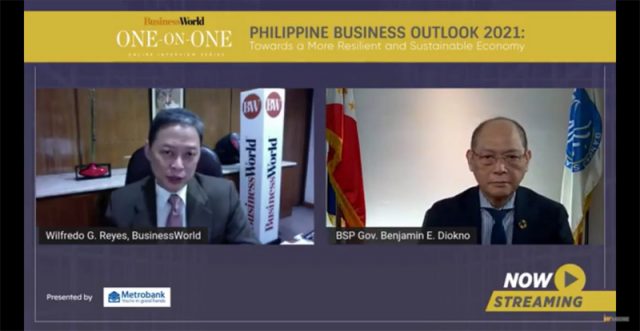
BusinessWorld Editor-in-Chief Wilfredo G. Reyes (left) virtually interviews Bangko Sentral ng Pilipinas Governor Benjamin E. Diokno about his economic outlook for 2021 and other significant issues in BusinessWorld One-on-One held last January 13. Rewatch the whole interview here: https://bit.ly/3sr4z8S.To respond to such impacts, the Bangko Sentral ng Pilipinas (BSP), along with other economic institutions, tapped the tools within their reach to address the widespread issues caused by COVID-19.
Seeing how these measures have helped keep the economy afloat, the central bank’s governor, Benjamin E. Diokno, is optimistic about the Philippine economy steadily recovering and returning to pre-pandemic levels in two years.
In BusinessWorld‘s “One-On-One” online interview, Mr. Diokno told BusinessWorld Editor-in-Chief Wilfredo G. Reyes that amid the Philippine economy feeling the effects of the pandemic, it is in a much better position than in previous crises like the Asian Financial Crisis (AFC) in 1997.
“I’ve seen that whenever we have a crisis in the Philippines, we run out of dollars because we have a huge foreign debt; and because we do not want capital exiting the country, we raise interest rates,” Mr. Diokno said.
Yet, Mr. Diokno recognized, “the government has been fairly aggressive in making sure that there is enough liquidity to the system” as the battle against COVID-19 continues.
Reflecting this better position, BSP’s gross international reserves amount to more than USD 100 billion. He expects this to grow at USD 110 billion this year and at USD 120 billion the following year. “This is a major departure from previous crises when we had to scramble for dollars to pay for foreign debt,” he said.
The debt-to-GDP (gross domestic product) ratio, meanwhile, was at less than 40%, which Mr. Diokno finds as “a good number compared to other countries” and so has removed the need to increase interest rates to protect the peso.
The BSP governor added that the reforms the central bank has put in place amid the public health crisis have added about P2 trillion into the financial system or about 10% of the country’s GDP.
“This will carry us on to this year and next year; and, hopefully, by the middle of next year, we will be able to go back to where we were before in 2019,” Mr. Diokno said.
Economic growth by up to 7.5%
With the economy slowly recovering, Mr. Diokno is confident of economic growth this year albeit it remains contracted. The projected GDP growth, which indicates the value of final goods and services produced within a country during a specific period, is expected to be at 6.5% to 7.5% this 2021, rising from the expected contraction of 8.5% to 9.5% in 2020.
BW FILE PHOTO
While figures from the last quarter of the previous year are yet to be released, Mr. Diokno expects the performance in the fourth quarter (Q4) to be “much better than the first three quarters”.
Moreover, expecting COVID-19 vaccines to reach more people in the second quarter (Q2) this year, he shared that the economic growth will be sustained and increased by 8% to 10% in 2022.
“This revised projection is based on the assumption that the vaccine will be introduced on a massive scale by the first half of 2022. Anytime that it is introduced much earlier is a plus for the Philippine economy,” Mr. Diokno said.
In contrast to the slump in Q2 of 2020, this year’s Q2 will be strong and Q4 will even be stronger, according to the BSP governor.
“Knowing the pent-up demand of consumers, businesses, and the Philippines’ propensity to observe the Christmas season, I think we’re very confident that we’ll have a strong Q2 this year and an extremely stronger Q4 this year. That will add up to the 6.5%-7.5% [projected growth],” Mr. Diokno explained.
Aside from the factors aforementioned, he sees the ongoing “Build, Build, Build” program, the early approval of the 2021 national budget (which amounts to a total of P4.5 trillion), and even the expected mild La Niña season as key drivers in economic growth this year.
Last year, numerous projects were completed amid the pandemic, among them the final section of Tarlac-Pangasinan-La Union Expressway Rosario, the Metro Manila Skyway Stage 3 Project, the Sorsogon City Coastal Road, the Laguna Lake Highway, Cagayan de Oro Port, and a new terminal in Mactan-Cebu International Airport.
“With the Build, Build, Build and the early approval of the 2021 budget, the government can frontload the disbursement of that budget. They can frontload the expenditures for infrastructure to coincide with the weather pattern. That would be a big boost,” Mr. Diokno suggested.
Remittances to add up
The BSP governor is also optimistic that the remittances from overseas Filipino workers (OFWs) will pick up this year and the next.
“We expect that as we send more Filipinos abroad… there would be higher remittances in the years to come. It will expand by 4% this year, and even by a higher percent next year,” Mr. Diokno shared.
He noted as well that contrary to the prediction that remittances would plunge by 20% last year, it shrunk by only 0.9%. For him, this “supports the view that remittances take the nature altruistic gestures by Filipinos working abroad to support families here”.
Employing a young population
Regarding employment, Mr. Diokno shared that the country’s employment rate is targeted to return to 2019 levels, which was within 5% to 7%.
Backing up this optimism in employment is his observation that the Philippines has a younger population compared to other countries. “Europe is aging, Japan is aging, China is aging; but we have a very young population,” he said.
In order to tap this young population, given the digital transformation accelerating since the pandemic’s onset, they should be adequately trained in a new digitalized economy, Mr. Diokno stressed. “I think we’ll be ahead if we train them, give them good education, take care of their health.”
Based on data from the Philippine Statistics Authority, the median age is 24.3 years old. The Commission on Population, meanwhile, expects Filipinos in their working age (15-64 years old) to increase by just over one million from 2020 and will reach more than 71 million this year, making up 64.15% of the entire Philippine population.
Rates, reserves to remain low
The BSP governor also sees benchmark interest rates to stay low in order to support economic recovery.
Photo by Miguel De Guzman
The central bank cut those rates by a total of 200 basis points (bps) last year, causing overnight reverse repurchase, lending, and deposit rates to go down to 2%, 2.5%, and 1.5%, respectively.
Mr. Diokno also said that reserve requirements for banks are likewise aimed to be reduced further to encourage lending and boost economic activity.
Reserve requirements, which is the amount of money banks have to deposit to the central bank, were slashed to 200 bps, half of what was authorized to the BSP chief last year.
Adding to these reduced requirements, the BSP allowed banks to include new loans to micro, small, and medium enterprises (MSMEs) as part of their compliance with the required reserve ratio.
While some economists found the cuts in benchmark rates to be ‘too much, too soon’, Mr. Diokno believes that it has never been too early to make such decisions since the pandemic is not yet over. “Our policy stance is that we will keep this policy for long until such time we have seen [the economy] growing at the same pace as before,” he said.
Mr. Diokno aims to reduce reserve requirements from 18% to a single digit by 2023, when his term ends. So far, this was cut by 600 basis points to 12%.
“Whether we will cut further will depend on whether there is still need for more liquidity. But, at the moment, there is ample liquidity; so I don’t see any need for additional cuts at this time,” the BSP chief said. “Maybe things will change once the economy starts recovering; and with the speed of recovery, we may consider an additional cut in reserve requirements.”
Banking system to remain stable
Mr. Diokno sees the Philippine banking system to remain stable, capable enough of weathering the pandemic since it has learned its lessons from the AFC. “Our banking industry is sound, well-capitalized,” he said.
He shared that the system’s capital adequacy ratio hovers around 15% to 16%, which is higher than the central bank’s prescribed rate of 10% and the international standard of 8%.
Its non-performing loans (NPL), meanwhile, is at 3% to 4%, which Mr. Diokno said is manageable and significantly lower than the peak during the AFC.
Moreover, Mr. Diokno does not see any emerging risks in the system. In fact, he finds the Financial Institutions Strategic Transfer (FIST) bill to help banks further by reducing NPLs.
“[FIST is] just a fallback position. But we don’t see any situation worsening at this time. Even without the FIST bill, the banking industry can handle the current crisis,” Mr. Diokno said.
Pending on the Office of the President after it was approved by the bicameral conference committee in December, FIST will allow lenders to offload bad loans to asset management corporations.
Going cash-lite, maybe coinless
Prior to the pandemic, Mr. Diokno envisioned a cash-lite society in the country, with 50% of transactions projected to be in digital form and 70% of Filipino adults targeted to have a bank account.
The pandemic has seen these targets being accelerated, and such move is bound to continue, although Mr. Diokno said it will not be fully cashless in his lifetime.
Yet, he said a coinless society is possible by 2025 as this will be replaced by the QR Ph, or the national QR code standard, which is intended to be put into the national ID.
With electronic payments further used since the country went on lockdown, the BSP chief sees the need to invest further in telecommunications.
“It’s now more convenient for people to transact with the banks just at the comfort of their homes… but that means we have to ramp up our investment in telcos,” Mr. Diokno said. “That’s also one of the reasons why we’re optimistic that the heavier investment now on telcos will also help economic activity.”
A look back at economic upsets during lockdown and initial rebound upon relaxed quarantine
The year that passed can be described as disruptive and tumultuous for the Philippine economy due to the widespread effects of the coronavirus disease 2019 or COVID-19.
Stranded commuters are seen at Commonwealth Ave. in Quezon City during the implementation of modified Enhanced Community Quarantine on Aug. 4, 2020. — Photo by Michael Varcas
Sandwiched into the pandemic’s impact are the effects brought by the Taal Volcano eruption back in January 2020 and the typhoons that struck the country in the last quarter of that year, with Typhoon Ulysses causing the biggest damage.
With the pandemic forcing the government to implement an enhanced community quarantine (ECQ) last March, many shops were closed, open businesses were limited to essentials, and a lot of professionals had to adjust to working from home. Seventy-five percent of the economy was brought to a halt.
As the pandemic made a broad impact that has been felt across industries, businesses, employees, and households, it called for economic deciders to quickly address the issues that emerged. On the other hand, it pushed businesses to adapt to accelerated disruptions, although many were forced to cut operations and manpower or, worse, close down.
COVID-19’s impact on the economy has been initially confirmed and reflected by the country’s gross domestic product (GDP) in the first quarter of 2020, which according to the Philippine Statistics Authority (PSA) fell by 0.7%. The first contraction of GDP since the fourth quarter of 1998, the drop was even faster than the initially reported 0.2%.
The services sector dropped to 0.6%, while the industry sector dropped to 3.4%. A 0.3% decline was recorded in the agriculture, hunting, forestry, and fishing sector.
A further decline was recorded in the second quarter (Q2) when the GDP slumped by 16.9%, confirming a recession in the country since 1991. While this figure was revised in November after the initial 16.5% four months earlier, this is the biggest contraction based on PSA’s data, compared to the 10.7% decline tallied in the third quarter of 1984.
The drop in the services sector is at 17%, while contraction in the industry sector was at 21.8%. Agriculture, forestry, and fishing was the only sector that posted growth, with 1.55%.
Aside from the GDP, other indicators also reflected COVID-19’s impact on the economy.
Employment woes
The pandemic gravely hit unemployment levels as many jobs were lost and work opportunities turned apparently scarce. On April 2020, PSA’s Labor Force Survey posted the unemployment rate at a record-high 17.7%. This equates to around 7.25 million jobless Filipinos, 4.98 million more than those who were jobless in April 2019.
People line up at a remittance center in Marikina on Aug. 9, 2020 as they wait they turn to get their financial aid through Social Amelioration Program of the government amid the pandemic. — Photo by Michael Varcas
Also worth noting, the labor force participation rate was at 55.6%, translating to approximately 41.02 million out of 73.7 million Filipinos aged 15 years old and up. This rate was the lowest in the history of the country’s labor market, according to the PSA.
The underemployment rate, meanwhile, increased from the previous year’s 13.4% to 18.9%, an equivalent of 6.39 million underemployed Filipinos.
The employment rate, on the other hand, declined from 94.9% to 82.3%, amounting to approximately 33.76 million Filipinos.
Lows in stocks, trade
Furthermore, the local bourse experienced a ‘free fall’ upon the lockdown. On March 19, four days after the Luzon-wide lockdown took place, the Philippine Stock Exchange index sank 13.34% to close at 4,623.12, its lowest level since Jan. 26, 2012. This plunge in the index erased P1.16 trillion in market value.
Photo by Edd Gumban
Trade, both international and domestic, also showed plunges.
At international trade, a losing-streak in merchandise exports started in March, with a 24.7% decline. It further slipped by 50.8% to $2.78 billion in April.
From a 26.2% decline in March, merchandise imports further dropped by 65.3% to $3.28 billion in April.
Based on available PSA data, these declines both in exports and imports were the biggest year-on-year. Also, the figures were marked the lowest since the $2.51 billion worth of exports in February 2009 and $3.06 billion of imports in April 2009.
Domestic trade, on the other hand, experienced a sharp decline in the first quarter of 2020. The total value of domestic trade dropped by 42.7% to P125.31 billion, below the previous year’s P218.53 billion.
Grounded on fundamentals
These aforementioned numbers are just some of the indicators of the upsets in the Philippine economy brought by the pandemic. Yet, for the country’s economic planners, they find the economy strong enough to face the pandemic’s impacts.
Karl Kendrick T. Chua, Acting Secretary of National Economic and Development Authority (NEDA), noted in last November’s BusinessWorld Virtual Economic Forum that the Philippine economy is grounded on positive macroeconomic fundamentals before the pandemic. Among these fundamentals are the average GDP growth of 6% achieved between 2016 and 2019 and the upgrading of credit rate from BBB+ to A-. Given these fundamentals, he stressed that “the economy is strong enough to recover if we enable it to do so”.
Also, Bangko Sentral ng Pilipinas (BSP) Governor Benjamin E. Diokno finds reason for optimism on the economy’s prospects in spite of COVID-19’s gloom.
“The long reform agenda that the government has consistently pursued across administrations has allowed the country to achieve a more broad-based growth. The volatility of real GDP and inflation considerably declined over time. Aggregate demand in the post [Global Financial Crisis] period expanded at an average rate of 6.4% annually, comparable to the growth rates of China and India,” Mr. Diokno shared during a webinar of the Makati Business Club last May.
The governor added that the country has “ample FX buffer, low public sector debt, manageable external payments position, and a solid credit profile”. He also noted that while the pandemic caused gloomy signs in the economy, “the peso is the less depreciated currency” compared to regional currencies that “have depreciated significantly against the US dollar”.
Stimulus response
Among the several responses dealing with COVID-19’s impacts, several bills were passed to stimulate the economy amid the pandemic. On March, the President signed the P275 billion Republic Act No. 11469, more known as the Bayanihan to Heal as One Act (Bayanihan I). The legislation, which granted the President special powers to realign funds from within the 2020 national budget, provided for cash handouts between P5,000 to P8,000 a month over two months for 18 million low-income families.
Photo by Edd Gumban
Bayanihan I also grated special powers, among others, to ensure availability of credit to productive sectors of the economy and to provide a grace period on residential rents within the period of ECQ. It also called for direct banks and other financial institutions to implement a grace period for payments of loans and credit card bills.
Heeding the call for more stimulus, Bayanihan I was followed up by Bayanihan II, more known as the Bayanihan to Recover As One Act. Bayanihan II, technically known as Republic Act No. 11494, was signed into law last September. It provides a P165.5 billion fund to boost the country’s response to the pandemic while extending the special powers to deal with the health crisis. Composed of a P140 billion stimulus package and a P25.5 billion standby fund, Bayanihan II was expected to benefit industries and sectors affected by COVID-19.
Among other allocations, a total of P50 billion is intended as capital infusion to government financial institutions for supporting state-owned banks and funding credit guarantee program and lending programs to micro, small, and medium enterprises (MSMEs).
Initial recovery
After months of ECQ and modified enhanced community quarantine (MECQ) in Luzon, the National Capital Region has been placed under General Community Quarantine (GCQ) since June, and other areas soon transitioned to Modified General Community Quarantine (MGCQ).
These relaxed quarantine measures allowed the economy to slowly reopen as the so-called ‘new normal’ proceeds. More businesses reopened, including malls (beyond essential stores); and transportation gradually returned to service passengers.
While a slow and steady bounce back was temporarily paused when most of Luzon returned to MECQ for two weeks last August upon the request of medical frontliners, initial recovery has been seen.
While GDP remains contracted in the third quarter (Q3), it nonetheless has got up from Q2’s plunge, garnering an 11.5% contraction. The services sector recorded a 10.6% decline; while the industry sector tallied 17.2% decline. Both declines are slower than the Q2’s figures.
The unemployment rate started to ease in since July, which recorded a lower 10%, an equivalent of 4.571 million jobless Filipinos. In October, the rate went much lower at 8.7%, translating to 3.813 million jobless Filipinos.
For Mr. Chua of NEDA, these changes show the economy’s flexibility to whatever policies are set in place. “The economy is very flexibile and will respond to the policy we will put,” he stressed.
Underemployment, likewise, went down as restrictions ease. The underemployment rate went down by 17.3% in July, equivalent to 7.135 million underemployed Filipinos. It further decreased to 14.4% in October, translating to 5.747 million underemployed Filipinos.
Employment, on the other hand, jumped to 90% in July, translating to 41.306 million employed Filipinos, then inching up to 91.3% in October, representing 39.836 million.
The stock exchange, meanwhile, gradually bounced back with the resumption of business. Last December, it even rose to 7,200 level with investor optimism sparked with the impending rollout of a COVID-19 vaccine, which has been first approved and used in the United Kingdom.
In trade, exports snapped its losing streak last September with a revised 2.9% growth. The following month, though, recorded a decline of 2.2% year-on-year to $6.202 billion. Imports remain contracted, with a 19.5% decline in October.
Projections
While the remaining figures are yet to be released, estimates are hinting on the country’s overall economic performance.
The government, through the interagency Development Budget Coordination Committee, expects the economy to shrink between 4.5% and 6.6%, or an average of 5.5%, this year.
Asian Development Bank, meanwhile, expects Philippines’ GDP to contract by 8.5%, the sharpest among its Southeast Asian neighbors such as Thailand (-7.8%), Malaysia (-6%), and Indonesia (-2.2%). The multilateral lender cites declines in household consumption and investment as reasons for its estimate.
Likewise, the International Monetary Fund sees the country’s economy to slide the worst among the region with an 8.3% GDP decline.
The World Bank, on the other hand, forecasts the GDP to decline by 8.1%, considering the GDP slump in Q3 and the damage by the stream of strong typhoons last year.