Home Blog Page 848

How a quiet Dutch retiree helped uncover Nazi-stolen art in Argentina


COMMONS.WIKIMEDIA.ORG

MAR DEL PLATA, Argentina — Dutch systems specialist Paul Post had glimpsed the notebooks that contained his father’s Nazi-era diaries before, but when he rediscovered them in an attic 15 years ago, the recent retiree finally had time to closely examine them.

Mr. Post, 74, had no idea that they would ultimately lead to Argentina, where in September the daughter of a high-ranking Nazi official was charged with concealing an 18th century painting looted during the Holocaust.

In his diaries, Mr. Post’s father described working in the Netherlands’ diamond bureau when it was taken over by the Nazis. As Mr. Post began researching the events, one name jumped out: the Nazi official Friedrich Kadgien.

Mr. Kadgien oversaw the Nazi looting of diamonds and gold from occupied countries. Mr. Post began to follow Mr. Kadgien’s wanderings after the war, hoping to solve the mystery of the diamonds that historians say are still missing. He learned by chance that Mr. Kadgien was believed to have also possessed looted art.

The hunt led him and Dutch journalists to the peaceful residential neighborhood home of Patricia Kadgien, 60, in the seaside town of Mar del Plata in Buenos Aires province, where Portrait of a Lady had been hanging prominently in her living room. The reporters spotted it in a real estate listing in August.

Her attorney, Carlos Murias, told Reuters that she did not know about claims the painting had been looted from the collection of Jewish art dealer Jacques Goudstikker and she has denied having hidden it.

Nazi-related discoveries like this occasionally pop up in Argentina, which after the war received both Holocaust survivors and dozens of Nazi war criminals, including Adolf Eichmann and Josef Mengele. In February, President Javier Milei met with representatives of the Simon Wiesenthal Center, who asked for help accessing materials to investigate Nazi banking activities in Argentina. And last May, the Supreme Court announced it had found thousands of Nazi labor organization membership booklets in its basement archive.

Mr. Post’s unlikely role in the painting’s discovery underscores the complexities of finding Nazi-looted art today. An estimated 600,000 pieces were stolen from Jewish families, and more than 100,000 have never been returned.

“I’m just an amateur, I’m not a historian, nothing at all,” said Mr. Post. “I knew I was right on Kadgien.”

A FATHER’S WAR DIARIES RESURFACE
In 2010, Mr. Post’s family was cleaning out his mother’s house in Driehuis, a town just outside of Amsterdam. In the attic, they found three diaries written by his father, who died in 1976 at age 60.

In the diaries, Wim Post recounted how in 1942 the Nazis ordered the country’s diamond traders to turn over their precious stones, confiscating about 71,000 carats at the Amsterdam Diamond Exchange.

Paul Post, then recently retired from Hewlett-Packard, began visiting the Netherlands’ national archives to research the diamond confiscation. There he came across Mr. Kadgien’s name.

Shortly before Germany’s surrender in May 1945, Mr. Kadgien fled to Switzerland, where officials received a tip that he had carried out large transfers of diamonds, according to Regula Bochsler, a historian in Zurich. But in 1950, Mr. Kadgien received a visa to travel to Brazil, ultimately making his way to Buenos Aires.

Mr. Post reached out to the Dutch newspaper Algemeen Dagblad to share his father’s account of the diamond raid, and in 2015, investigative reporter Cyril Rosman published a piece about the diaries. Post later published The Diamond Heist, a book on the subject.

In 2020, Mr. Post noticed that the Cultural Heritage Agency of the Netherlands listed Mr. Kadgien online as possibly having possessed Portrait of a Lady by the Italian artist Giuseppe Ghislandi — although art historians have said the painter was likely his contemporary Giacomo Ceruti — as well as an Abraham Mignon still life. He met with the agency’s researcher Perry Schrier, and told him he had tracked Mr. Kadgien’s family to Mar del Plata. But Mr. Schrier, who confirmed he had met with Mr. Post, couldn’t help him.

“I said, ‘I think I know the location, where it could be, and that is in Argentina,’” recalled Mr. Post. “But he said, ‘Yeah, ok, it could be possible, but how can we know that it is on the wall in their homes?’”

In June 2024, Mr. Post contacted Yael Weitz, an attorney for Mr. Goudstikker’s family. In an e-mail exchange seen by Reuters, he offered to provide leads on the two missing paintings if she could provide him with information on Mr. Kadgien. She ultimately said that her team didn’t have anything to share.

Mr. Post then turned to journalists again. Last April, he reached out to Mr. Rosman with more information on Mr. Kadgien’s post-war travels. They had tried to contact Mr. Kadgien’s daughters in Argentina through the years and Mr. Rosman asked Peter Schouten, a freelance journalist in Buenos Aires, to try again.

“We were not looking for the paintings in particular,” said Mr. Rosman. “At that time we were mostly thinking about the diamonds that were looted, so we wanted to know what happened to that.”

When Mr. Schouten rang the bell at Patricia Kadgien’s home in August, there was no answer. But he saw a for-sale sign in her yard. The reporters checked the real estate listing and spotted the painting in one of the photos of the property. They could barely believe their luck.

“I thought, ok, is it really this simple, a picture that’s missing for 80 years is here above a couch in the living room?” said Mr. Rosman.

The day after they published a story on the painting’s discovery, police raided the home. But in the painting’s place was a tapestry of horses. Eight days later, Mr. Kadgien’s attorney handed the painting over to authorities.

Federal prosecutors have charged Patricia Kadgien, who runs a small clothing business, and her husband, Juan Carlos Cortegoso, a go-kart mechanic, with aggravated concealment and are investigating more than 20 drawings and prints, as well as two portraits, also seized from their home and from the home of Patricia’s sister in Mar del Plata.

“The attitude was to hide the painting,” the case’s prosecutor, Carlos Martinez, told Reuters. “We think that isn’t indicative of someone that doesn’t know what they have.”

COMPETING CLAIMS TO THE PAINTING
Mr. Goudstikker’s family have fought for decades to get his paintings back.

The art collector died when he fell into the hold of a boat as he was fleeing the advancing Nazis with his family in May 1940. But in a small black book, he had listed Portrait of a Lady along with more than 1,000 pieces in his collection.

In what historians describe as a forced sale after his death, top Nazi official Hermann Goering purchased about 800 of Mr. Goudstikker’s paintings. Ms. Weitz, the attorney who represents Mr. Goudstikker’s family, said that Mr. Goering’s associate, Alois Miedl, sold Portrait of a Lady to Mr. Kadgien in 1944.

The family has recovered 300 to 350 works of art, including 200 that had been mostly hanging in museums that the Netherlands agreed to return in 2006.

Charlene von Saher, Mr. Goudstikker’s granddaughter who lives in Greenwich, Connecticut, said her family informed the Kadgiens of their claim to Portrait of a Lady after the journalists published their story. Paolo Plebani, curator at the Accademia Carrara in Bergamo, said it is worth upwards of $100,000, but attorneys for the Goudstikker family said it is impossible to determine the value before examining the condition and confirming the artist’s identity.

“I just hope that they would be people who would feel like doing the right thing and correcting a historical injustice,” Ms. Von Saher told Reuters, saying that the discovery was “like a movie.”

But Patricia Kadgien hasn’t relented. She has filed a claim in civil court that says her father’s sister-in-law bought the painting from the Wallraf-Richartz Museum in Cologne in 1943. It said the painting was “legitimately possessed” by her father and that she inherited it after he died. The museum told Reuters the painting was never part of its collection.

The claim said that she removed the painting from her home “for security reasons,” thinking she was the victim of “a virtual scam” when she started receiving calls from a journalist in August.

As for Mr. Post, he still wants to know what happened to the diamonds that were tied to Mr. Kadgien. Mr. Martinez, the prosecutor, said authorities did not find jewels of value or from the war period in the Mar del Plata home.

Saskia Coenen Snyder, a Dutch professor of modern Jewish history at the University of South Carolina, said it is very hard to prove that Nazis took diamonds with them to South America. “I’ll give him credit for at least spending years of his time pursuing, uncovering stories and truths that not everybody wants to do or has been able to,” she said of Mr. Post. “He’s a bit of a pit bull.” — Reuters

Ice maker taps MPower to energize more plants

MRFREEZETUBEICE.COM

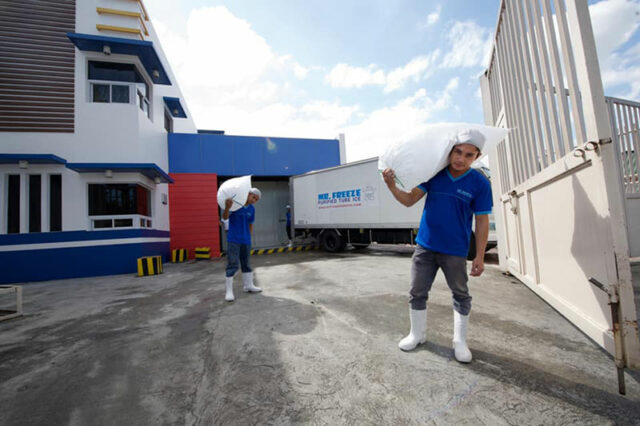
MPOWER, the retail electricity arm of Manila Electric Co. (Meralco), has expanded its partnership with ice manufacturer Mr. Freeze Tube Ice, Inc. to power several of the latter’s plants across the southern part of Luzon.

Mr. Freeze has aggregated the power demand of its ice plants in Metro Manila, Cavite, Laguna, Batangas, and Bulacan to participate in the government’s Retail Aggregation Program (RAP), MPower said in a statement on Tuesday.

RAP allows smaller electricity end-users to consolidate multiple accounts within the same franchise area and purchase power in bulk from retail electricity suppliers.

MPower began its partnership with Mr. Freeze in 2005 through the energization of the company’s first ice plant.

“Our business has always been built on strong relationships, and we’re happy to continue growing with Meralco and MPower. We look forward to sustainable growth and continued success as we power our Mr. Freeze ice plants, and we’re excited for this new journey with MPower by our side,” Mr. Freeze President and Chief Operating Officer Philip Gerald Santos said.

The company said the move reflects Mr. Freeze’s commitment to operational efficiency and energy cost management.

“This partnership is not just about business, it’s about the shared goals we believe in: sustainability, responsible energy use, and putting the customer first,” Meralco First Vice-President and Head of MPower Redel M. Domingo said.

“MPower is more than just a supplier, we’re a partner committed to growing with you and supporting what matters most,” he added.

MPower serves contestable customers, including large corporations within Meralco’s franchise area. It currently holds more than a 25% share of the competitive retail electricity market within Meralco’s coverage.

Meralco’s controlling stakeholder, Beacon Electric Asset Holdings, Inc., is partly owned by PLDT Inc. Hastings Holdings, Inc., a unit of PLDT Beneficial Trust Fund subsidiary MediaQuest Holdings, Inc., has an interest in BusinessWorld through the Philippine Star Group, which it controls. — Sheldeen Joy Talavera

Small sample, big impact: How talking to just five people can improve startup success

FREEPIK/ATLASCOMPANY

AS CANADA navigates an ongoing tariff dispute with the United States, small businesses and startups are emerging as a source of economic growth that could help Canada assert greater independence from its largest trading partner.

Prime Minister Mark Carney has warned that Canada cannot rely on the US any longer and must instead achieve “economic autonomy.” Ottawa’s efforts to remove internal trade barriers and expand infrastructure projects are central to this objective, paving the foundation to revitalize the Canadian economy.

Another key part of this agenda is fostering entrepreneurship — the engine for new opportunities and economic growth.

Small- and medium-sized enterprises (SME) are the backbone of the Canadian economy. As of December 2023, small businesses made up 98.1% of all employer businesses in Canada, accounted for 63.7% of the private labor force and 48% of Canada’s GDP (gross domestic product) over the 2017-21 period. They also represented 38.2% of the total value of exported goods.

Although exporting has traditionally been dominated by larger, innovation-intensive SMEs — particularly those with significant intellectual property — recent data shows an increase in exports from smaller, service-oriented firms, many of them immigrant-led.

These businesses are playing an increasingly important role in diversifying Canada’s export base and reducing dependence on any single market — particularly the US

THE LEAN STARTUP MODEL
For many aspiring entrepreneurs, one of the most popular frameworks for launching a business is the lean startup method, developed by Silicon Valley entrepreneur Eric Ries and expanded on in his 2011 book, The Lean Startup.

This practice has been widely adopted by incubators and accelerators, some of which require new ventures to meet hundreds of mentors and potential customers for consultation.

The Lean Startup provides a recipe for starting businesses with minimal cost, fast iteration and higher success rate. The philosophy behind it is for entrepreneurs to validate their market before investing tons of resources into building a product.

Since its publication, The Lean Startup has been used by millions of entrepreneurs around the world. The book advises entrepreneurs to “get out of the building” and talk to potential customers, but it doesn’t specify how much effort entrepreneurs should invest in market validation — how many people to consult or how often to do so.

Market validation is the process of testing a product or service idea with its target market to confirm if there’s real demand for it and whether it is viable for success. Although it’s central to the lean startup approach, many entrepreneurs shy away from it for different reasons.

Some entrepreneurs want to protect their business ideas from being stolen by others. In addition, new ventures have scarce resources that need to be allocated to multiple tasks, and market validation competes for the limited attention and resources of entrepreneurs.

‘SWEET SPOT’
In a recent study, my co-author Stephen X. Zhang and I set out to understand which entrepreneurs are more likely to invest in market validation, and how much investment is optimal for new venture performance. We conducted a three-wave survey with 210 entrepreneurs and their co-founders from Canada, Chile and China.

We measured the self-efficacy of entrepreneurs — how confident they felt about market and entrepreneurial success — and asked co-founders to report their ventures’ market validation frequency and hours. We found that entrepreneurs with moderate levels of confidence invested most resources into market validation. They sought feedback more frequently and invested more time in understanding potential customers.

Entrepreneurs with low confidence either didn’t think market validation was worthwhile or they found it too intimidating. Those with high confidence didn’t think it was necessary to validate their market because they were already convinced of their success.

More importantly, we found that a moderate level of market validation led to the strongest new venture performance. Checking in with about four to five people monthly was the most efficient. Interestingly, this number coincides with the most efficient size of social network, as well as the number needed for user testing.

The results suggest that effective market validation is more about quality and consistency than quantity. Talking to a small, diverse group of knowledgeable contacts on a regular basis is optimal for enhancing new venture performance.

Yet there is a precaution: we did not study the quality of informants. Five people may be enough for qualitative methods such as interviews, but it may not be enough for quantitative methods such as surveys.

Our findings can make the task of starting a new business less daunting for entrepreneurs. Instead of trying to interview hundreds of customers or skipping validation entirely, early-stage entrepreneurs can start small.

If you have an idea, find five people that are most knowledgeable and relevant for the idea, and ask for their opinions about the product or service you envisioned. If they like the idea, develop a minimum viable product to test it out. If not, revise your idea or try a different one.

In addition, understanding the way confidence has an impact on how entrepreneurs seek feedback can help organizations and mentors improve their coaching methods.

Entrepreneurs with low confidence may benefit from support that builds self-efficacy through vicarious learning, such as observing and simulation, to make feedback less intimidating. Those with excessive confidence may need to be challenged to provide evidence for their assumptions and reminded of the value of customer feedback in challenging even deeply held convictions. — The Conversation Via Reuters Connect

Freezing the funds and fruits of flood control: An overview of the effects and extent of freeze orders

STOCK PHOTO | Image from Freepik

The flood control fiasco has permeated our daily lives, consistently making its way to headlines, conversations, and in typical Filipino humor. It has become a relevant and timely national issue in our country as it placed in hot water both public and private individuals allegedly involved in the massive dissipation and misuse of public funds for private gain.

Despite the frequent use of the term “freeze order” in news reports and official statements, many are still unfamiliar with what it truly means, how it is issued, how far it can go, and what its effects are on the assets and rights of those subjected to its chilling repercussions.

Far from being a mere legal phrase, a freeze order directly affects a person’s ability to access, manage, and use money or property. Freeze orders play a vital role in preserving assets while investigations, such as those conducted in relation to the flood control issue, are ongoing. Understanding freeze orders is therefore imperative in appreciating how the law balances accountability with fairness in the midst of a highly publicized and sensationalized controversy.

WHAT IS A FREEZE ORDER?
As discussed by the Supreme Court in the case of Republic of the Philippines v. Roberto V. Ongpin, et al. (G.R. No. 207078, June 20, 2022), a freeze order is an extraordinary and interim relief issued by the Court of Appeals to prevent the dissipation, removal, or disposal of properties that are suspected to be the proceeds of, or related to, unlawful activities. The purpose or objective of a freeze order is to temporarily preserve monetary instruments or property that are in any way related to an unlawful activity or money laundering, by preventing the owner from utilizing them during the duration of the freeze order.

The issuance of a freeze order is governed by Section 10 of Republic Act No. 9160, otherwise known as the Anti-Money Laundering Act, as amended. Since its enactment in 2001, the Anti-Money Laundering Act has been amended five times, primarily to broaden its definition of covered persons, suspicious transactions, and predicate crimes. The State’s efforts to fortify the legal framework against money laundering and related illegal activities, particularly in cases where public funds may be involved, are reflected in these amendments in order to keep up with crimes that emerge over time.

Moreover, Section 10 of the same law makes it clear that the freeze order shall be limited to the value of the money or property found to be related to a predicate crime and shall not apply to amounts in the same account in excess of the value of the proceeds of the predicate crime. Otherwise stated, a freeze order may cover only the amount of cash, monetary instrument, or value of real or personal property that the Court of Appeals believes to be the proceeds of an unlawful activity, and not more.

For a freeze order to be issued, the Anti-Money Laundering Council must file a verified ex parte petition, that is, without notice to the account holder, before the Court of Appeals. Once the Court of Appeals determines that the accounts sought to be frozen are probably related to any of the predicate crimes under the Anti-Money Laundering Act, the Court of Appeals may issue a freeze order, which shall be effective immediately for a period of 20 days.

Within this period, the Court of Appeals should conduct a summary hearing, this time with notice to the parties, to determine whether or not to extend the freeze order. Should the Court of Appeals decide to extend the freeze order, the extended period may not exceed six months, which includes the initial 20 days. This post-issuance hearing is significant because it is during this hearing that the Court of Appeals will determine whether or not to modify, lift, or extend the freeze order, and account holders will have the opportunity to move and argue for the lifting of the freeze order.

SHOULD THERE BE A PENDING CASE BEFORE FREEZE ORDERS CAN BE ISSUED?
The common question is whether or not a case must first be filed against the account holders before a freeze order may be issued. The law says no. A criminal case is not a prerequisite for the issuance of a freeze order because the purpose is to preserve assets while investigations or case build-up are still ongoing.

However, the law contains a built-in safeguard: if there is no case filed against the account holder within the period determined by the Court of Appeals, then the freeze order shall be deemed ipso facto lifted. In other words, once the period of extension imposed by the Court of Appeals passes, the freeze order automatically expires or is lifted by operation of law, without requiring another resolution or motion to end it. This ensures that freeze orders are not issued for an indefinite period of time.

REMEDIES UNDER THE LAW
Account holders are not without any recourse under the law as they are allowed to file a motion to lift the freeze order or participate in the post-issuance hearing to be conducted within the 20-day period.

As stated, the post-issuance hearing must be with notice to the parties because it is during this proceeding that the Court of Appeals will determine whether or not to modify, lift, or extend the freeze order, subject to the presentation of evidence to prove that the monetary instruments or properties frozen are legitimate or in excess of what is allowed by law.

WHAT NOW?
As of Oct. 10, the Anti-Money Laundering Council has obtained six freeze orders in connection with the flood control fiasco, with total frozen assets amounting to at least P4.6 billion. This is a clear demonstration of both the far-reaching effects of the situation and the significance of freeze orders as a legal tool. Indeed, freeze orders serve to protect potential evidence and ensure that assets possibly linked to unlawful activities remain intact. At the same time, they are subject to clear limits on scope and duration, and cannot be used indefinitely without violating the law.

The views and opinions expressed in this article are those of the author. This article is for general informational and educational purposes only and not offered as and does not constitute legal advice or legal opinion.


France Kevin T. Degamo is an associate of the Angara Abello Concepcion Regala & Cruz Law Offices (ACCRALAW), Cebu Branch.

ftdegamo@accralaw.com

Peso rises amid trade concerns

BW FILE PHOTO

THE PESO edged higher against the dollar on Tuesday amid mixed signals on renewed trade tensions between the United States and China and as markets looked for new trading drivers.

The local unit closed at P58.215 versus the greenback, rising by three centavos from its P58.245 finish on Monday, Bankers Association of the Philippines data showed.

The peso opened Tuesday’s session slightly stronger at P58.222 versus the dollar. Its intraday best was at P58.155, while its worst showing was at P58.305 against the greenback.

Dollars exchanged went down to $1.52 billion on Tuesday from $1.66 billion on Monday.

The peso inched up against the dollar amid signals from US President Donald J. Trump that trade tensions with China could be easing, Rizal Commercial Banking Corp. Chief Economist Michael L. Ricafort said in a Viber message.

Trade and tariffs have been the main focus since dramatic market moves on Friday when Mr. Trump threatened to slap additional 100% tariffs on goods from China, in response to Beijing’s curbing of exports of critical minerals, Reuters reported.

While a more conciliatory tone from Mr. Trump at the weekend helped fuel some optimism at the start of this week, Tuesday served as a stark reminder that ties between the two nations remain on thin ice.

The United States and China on Tuesday were set to begin charging additional port fees on ocean shipping firms that move everything from holiday toys to crude oil.

“The dollar-peso closed a tad lower amid range trading as there were no major catalysts,” a trader said in a phone interview.

For Wednesday, the trader expects the peso to move between P58 and P58.40 per dollar, while Mr. Ricafort sees it ranging from P58.10 to P58.30. — AMCS with Reuters

Italy opens ‘Commodus Passage’ in Colosseum to public

COMMONS.WIKIMEDIA.ORG

ROME — A once-secret passageway in the Colosseum, named after the fearsome ancient Roman emperor who features in the Hollywood blockbuster Gladiator, has opened to the public for the first time.

The so-called Commodus Passage allowed emperors to enter the arena and watch gladiator fights and other spectacles without mixing with crowds.

It was cut through the Colosseum’s foundations between the end of the 1st century AD and the beginning of the 2nd century AD, in an addition to the original design.

The Colosseum was inaugurated in 80 AD.

“This passage is now open to the public, it’s the first time. And so (visitors will) appreciate what it was like to be an emperor,” archaeologist Barbara Nazzaro told Reuters.

The corridor was discovered in the 19th century, and linked to Commodus because historical chronicles say he survived an assassination attempt in an underground passage.

“It was very easy to make the connection,” Ms. Nazzaro, who oversaw the corridor’s restoration prior to its opening, added.

It once had marble walls, later replaced with plaster decorated with landscapes, the Colosseum Archaeological Park said in a statement.

It also had stuccowork showing mythological scenes on the vault, and representations of arena spectacles, including bear fights and acrobats, in niches at its entrance.

Some traces of the decorations remain, but very damp conditions in the underground passageway have made conservation a struggle.

Nevertheless, visitors will be able to have an idea of what it looked like in antiquity thanks to a virtual reconstruction shown in a video, Ms. Nazzaro said. — Reuters

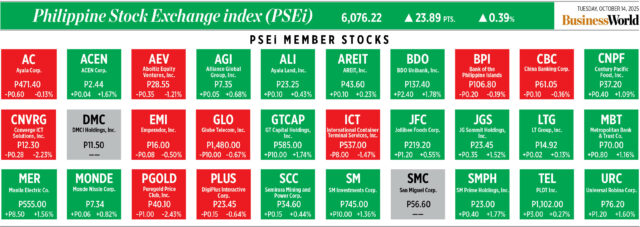
How PSEi member stocks performed — October 14, 2025

Here’s a quick glance at how PSEi stocks fared on Tuesday, October 14, 2025.


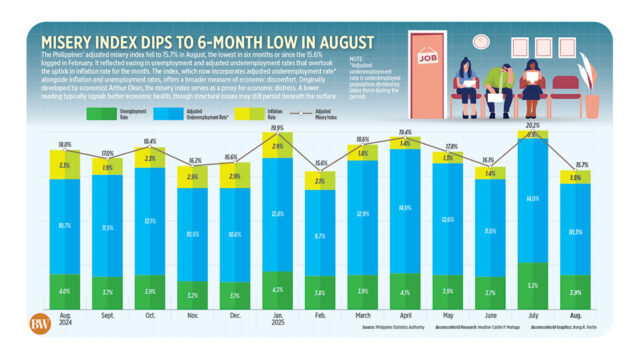
Misery Index Dips to 6-Month Low in August

The Philippines’ adjusted misery index fell to 15.7% in August, the lowest in six months or since the 15.6% logged in February. It reflected easing in unemployment and adjusted underemployment rates that overtook the uptick in inflation rate for the month. The index, which now incorporates adjusted underemployment rate* alongside inflation and unemployment rates, offers a broader measure of economic discomfort. Originally developed by economist Arthur Okun, the misery index serves as a proxy for economic distress. A lower reading typically signals better economic health, though structural issues may still persist beneath the surface.

Misery Index Dips to 6-Month Low in August

Philippine, Aussie armies hold drills in Visayas; US reaffirms treaty with PHL

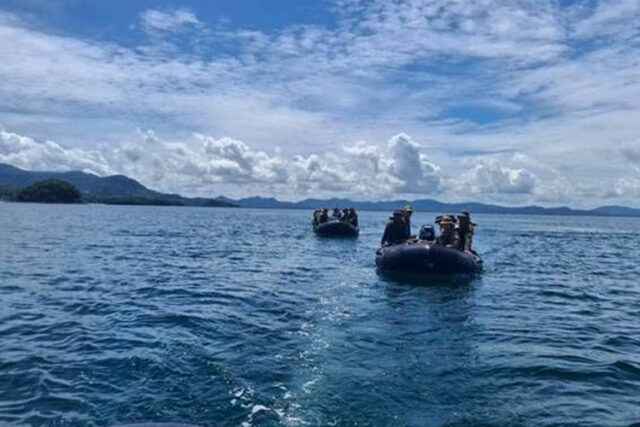
PHILIPPINE and Australian army troops train together on coastal defense operations in Camp Jamindan, Capiz on Oct. 13. — PHILIPPINE ARMY

THE PHILIPPINE and Australian armies held defense drills on Monday aimed at bolstering interoperability between the two nations amid shared security concerns over China’s growing assertiveness in the South China Sea.

About 171 Philippine troops and 90 Australian soldiers participated in exercises held in Capiz province in central Visayas. The drills covered coastal defense, missile survivability and mortar and drone operations, according to the Philippine Army.

The drills are part of the broader Exercise Kasangga — Filipino for ally — traditionally held on Luzon island, which faces the South China Sea to the west and the volatile Taiwan Strait to the north.

“Conducting the said exercise outside of the traditional training areas in Luzon sends a clear message about the army’s commitment to strengthen its operations in areas of strategic importance to regional stability,” the Philippine Army said in a statement.

Australia has been one of the Philippines’ closest allies in the eastern hemisphere, and in 2007, the two countries forged a visiting forces agreement allowing their troops to hold joint exercises in each other’s territories. The pact came into force in 2012.

The Philippines has sought to expand its security ties beyond its traditional ally, the US, engaging with other western countries and regional allies as it faces an increasingly assertive China over disputed features in the South China Sea.

Beijing claims almost all of the strategic waterway via a U-shaped, 1940s nine-dash line map that overlaps with the exclusive waters of the Philippines, resulting in clashes at disputed maritime features, as both the countries uphold their claims in the marine-rich water.

‘COERCIVE ACTIONS’
Meanwhile, the US on Monday stood by the Philippines and emphasized their Mutual Defense Treaty after vessels from China and the Philippines clashed amid heightened tensions in the South China Sea.

US State Department spokesman Tommy Pigott condemned China’s “ramming and water cannoning” of a Philippines vessel and said Washington stood with its ally “as they confront China’s dangerous actions which undermine regional stability.”

In a statement, Mr. Pigott reaffirmed that Article IV of the 1951 US-Philippines Mutual Defense Treaty “extends to armed attacks on Philippine armed forces, public vessels or aircraft — including those of its coast guard — anywhere in the South China Sea.”

Earlier, China’s Foreign Ministry urged Manila not to challenge Beijing’s efforts to “safeguard its territorial sovereignty and maritime rights and interests” after Sunday’s incident in the Spratly Islands, in which the Philippines said China deployed water cannon and rammed a Filipino vessel.

China and the Philippines have traded accusations over the confrontation near Sandy Cay, a coral reef within the Spratly Islands.

The two nations have confronted each other repeatedly in recent years in the South China Sea, a strategic trade route that facilitates more than $3 trillion in annual ship-borne commerce, and which China claims most of.

Tensions have heightened recently and Lin Jian, a spokesman for China’s Foreign Ministry, told a press briefing the Philippines should immediately stop “violations and provocations.”

The State Department said: “China’s sweeping territorial and maritime claims in the South China Sea and its increasingly coercive actions to advance them at the expense of its neighbors continue to undermine regional stability and fly in the face of its prior commitments to resolve disputes peacefully.”

Last year, during the former Biden administration, two senior Republican US senators called for a list of options developed by the Pentagon and State Department to support the Philippines against Beijing in the South China Sea, saying that limiting responses to verbal assurances of the applicability of Article IV undermines the credibility and value of these commitments. — Kenneth Christiane L. Basilio with Reuters

Ex-Speaker appears before ICI, denies kickback claims

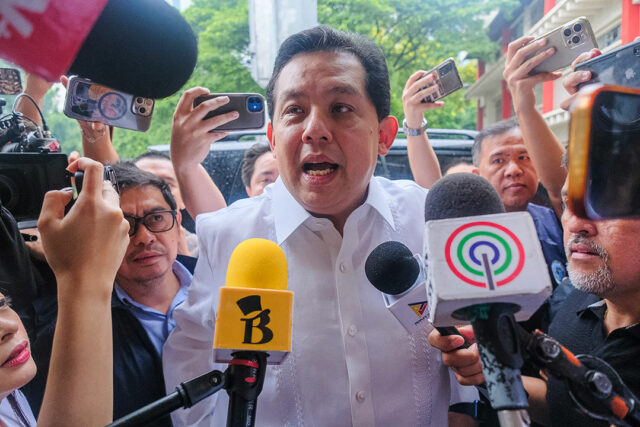
LEYTE REP. and former Speaker Ferdinand R. Martin G. Romualdez faces the media after arriving at the Taguig office of the Independent Commission for Infrastructure, which is investigating irregularities in flood-control projects. — PHILIPPINE STAR/RYAN BALDEMOR

By Erika Mae P. Sinaking

LEYTE REP. Ferdinand Martin G. Romualdez on Tuesday appeared before the Independent Commission for Infrastructure (ICI), submitting an affidavit that detailed his role in the budget process as the body pressed ahead with its probe into alleged kickbacks from flood control projects.

The former Speaker denied receiving any illegal payments for approving or facilitating government contracts, saying he was “not part of the bicameral conference committee” that finalized the national budget.

He said his decision to appear before the ICI was meant to “clarify issues and help the commission in its work.”

“My appearance demonstrates my resolve to tell the truth and keep politics from distorting it,” he said in a separate statement. He added that he wants the truth to come out — “not speculation or political theatrics.”

His testimony came a week after the ICI summoned him following allegations made by Orly Regala Guteza, a former security aide to Party-list Rep. Elizaldy S. Co. Mr. Guteza told a Senate Blue Ribbon Committee hearing that he had delivered luggage filled with cash — each allegedly worth about P48 million — to several locations, including a Taguig residence supposedly linked to the former Speaker.

Mr. Romualdez dismissed the testimony as “fabricated” and politically motivated, saying the Taguig property mentioned had been under renovation since early 2024.

“The witnesses that were presented have already been discredited for having presented falsified documents, and their testimonies have already been denied,” he told reporters after the ICI’s closed-door session.

ICI spokesman Brian Keith F. Hosaka said Mr. Romualdez’s affidavit helped clarify his role in the budget process and that of other lawmakers tied to the anomalies. He will return for a follow-up hearing as the commission continues to study the documents he submitted, he added.

Mr. Romualdez said he was ready to appear “any time” he is invited again and would submit his statement of assets, liabilities and net worth (SALN) at the commission’s request.

Budget Secretary Amenah F. Pangandaman also appeared before the ICI in a separate session, explaining how projects move from the National Expenditure Program (NEP) to the General Appropriations Act, and how the Budget department releases funds.

“We don’t really know where those insertions come from,” she told reporters. “They usually come from the departments proposing projects to the Department of Budget and Management.”

She added that the Commission on Audit should examine whether government agencies are implementing their projects properly, especially those of the Department of Public Works and Highways.

OCTA POLL
Meanwhile, a large majority of Filipinos support President Ferdinand R. Marcos, Jr.’s move to expose corruption in flood-control projects, according to an OCTA Research survey that also revealed widespread anger over misuse of public funds.

The poll, conducted from Sept. 25 to 30, found that 83% of respondents backed Mr. Marcos’ decision to reveal irregularities in the multibillion-peso flood-control program, even if it could have political consequences. Only 3% disagreed, while 13% were undecided.

Support was highest in Metro Manila (91%) and the rest of Luzon (90%), and lowest in the Visayas (64%) and Mindanao (78%).

About 60% of respondents said they felt anger or outrage over corruption in infrastructure projects, while 30% reported fear or anxiety and 9% said they felt sadness or disappointment. OCTA said anger was most pronounced among younger Filipinos and residents of Luzon and the Visayas.

OCTA said 46% trusted the newly formed Independent Commission for Infrastructure (ICI) to lead the investigation of the scandal. The Senate ranked second with 23%, followed by the House of Representatives with 13%, indicating a preference for a nonpolitical probe.

When asked about their expectations, 68% said they want corrupt officials and contractors held accountable, while 58% sought imprisonment of those found guilty and recovery of stolen or misused funds.

OCTA interviewed 1,200 adults for the poll, which had a ±3% error margin.

At a palace briefing on Tuesday, Presidential Communications Office Undersecretary Claire A. Castro said the President is determined to pursue the probe “until accountability is achieved,” but urged the public to allow investigators to complete their work.

OCTA said the results show Filipinos strongly back the anti-corruption campaign but expect visible follow-through and structural reforms to ensure transparent and efficient implementation of infrastructure projects.

Ombudsman reopens public access to officials’ SALN

PHILSTAR FILE PHOTO

By Erika Mae P. Sinaking

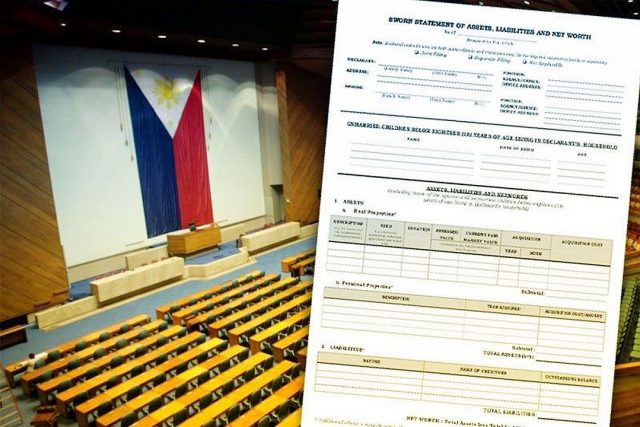
THE Office of the Ombudsman has restored public access to the statements of assets, liabilities, and net worth (SALN) of government officials, reversing a restrictive policy imposed during the Duterte administration that had limited transparency for more than four years.

Under Memorandum Circular No. 3 issued on Tuesday by Ombudsman Jesus Crispin C. Remulla, the public can again request copies of SALNs, subject to safeguards that balance transparency and data privacy.

The move effectively revokes former Ombudsman Samuel R. Martires’ 2020 memo that required notarized consent from the official concerned before any SALN could be released.

The circular reinforces our constitutional duty to uphold public accountability while respecting the privacy of individuals, Assistant Ombudsman and spokesperson Jose Dominic F. Clavano IV told a news briefing.

He outlined the procedures for requesting access, including redactions of sensitive information such as home addresses, minors’ details and government-issued identification numbers.

Requesters must file a prescribed request form with valid identification. Access may be denied if the information will be used for commercial purposes, poses security threats or is linked to harassment or fictitious requests.

Each released document will carry a watermark, control number and disclaimer, and requesters must shoulder reproduction and certification costs.

Media, research institutions and other entities that publish materials derived from SALNs must provide the Ombudsman with copies or accessible links to their publications within five days of release.

Transparency advocates hailed the decision as a significant reversal of what critics called a “dark period” for public accountability. The 2020 restrictions had made it nearly impossible for journalists and watchdogs to investigate discrepancies in officials’ wealth declarations, shielding potential conflicts of interest and corruption from public scrutiny.

Mr. Remulla earlier vowed to “restore transparency” and design clear guidelines to prevent both abuse and obstruction of the public’s right to information.

Legal experts said the reform is a critical step toward rebuilding institutional trust.

“The worms of corruption thrive in the dark,” lawyer and political analyst Jesus Nicardo M. Falcis III told BusinessWorld in a Facebook Messenger chat. “Releasing the SALN will shine a light that prevents those worms from thriving and multiplying.”

Dennis V. Blanco, a political science professor at the University of the Philippines Diliman, said public access ensures accountability and allows citizens to track the financial conduct of their leaders.

“It restores the constitutional right to scrutinize how officials acquire and spend wealth,” he said in an e-mailed reply to questions. The directive must, however, be applied consistently and without political favor, he added.

Ester B. Onag, an Adamson University professor and governance analyst, said the reform reaffirms the constitutional tenet that “public office is a public trust.”

“The success of this reform will depend on how ‘reasonable access’ is defined and applied consistently across cases,” she said via Messenger chat. “At the end of the day, it is the people who will judge the actions of these officials.”

Tighter rules for unprogrammed funds sought

PHILIPPINE STAR/ MICHAEL VARCAS

By Adrian H. Halili and Chloe Mari A. Hufana, Reporters

THE PHILIPPINES’ Finance chief said the proposed 5% cap on unprogrammed funds is excessive, as the Marcos administration faced renewed scrutiny over their use amid a multibillion-peso infrastructure scandal.

“A 5% limit is too big for the National Government,” Finance Secretary Ralph G. Recto told reporters on the sidelines of a Senate budget hearing on Tuesday. “We can probably implement a benchmark — it’s something we can look into.”

Asked if a 2% threshold would be sufficient, he said: “Maybe.”

Budget Secretary Amenah F. Pangandaman earlier said she wanted to limit unprogrammed appropriations to 5% of the national budget. These standby funds can only be used if revenue collections exceed targets or if more grants or foreign funds become available.

Mr. Recto said the funds should be reserved for “unforeseen situations” such as disasters or foreign-assisted projects excluded during the budget preparation.

“The government should respond quickly [to calamities] — you cannot really program for that,” he said, adding that the President should have flexibility to release funds for emergencies.

Under the proposed 2026 national budget, unprogrammed appropriations amount to P250 billion, largely earmarked for pre-planned initiatives instead of emergency contingencies.

Major allocations include P80.9 billion for infrastructure and social programs, P97.3 billion for foreign-assisted projects, P50 billion for the Armed Forces modernization and P6.7 billion for health emergency allowances.

Meanwhile, Malacañang defended the inclusion of unprogrammed funds, saying they serve as a fiscal buffer rather than a political tool.

“The budget will be handled carefully and will not be released immediately — contrary to fears that it will become a pork barrel fund,” Palace Press Officer Clarissa A. Castro told a news briefing in Filipino.

She said the Department of Budget and Management (DBM) considers unprogrammed funds a “safety net” to supplement the National Disaster Risk Reduction and Management Council (NDRRMC) fund when disaster costs rise.

“When contingent funds are depleted, that’s when we draw from unprogrammed appropriations,” Ms. Castro said.

The House of Representatives on Monday approved on third reading the proposed P6.7-trillion General Appropriations Bill for 2026 amid criticism from the opposition. The Makabayan bloc said the measure perpetuates the “pork barrel” system that enabled misuse of public work funds.

Lawmakers removed P35 billion in unprogrammed appropriations for infrastructure, leaving P45 billion for the Strengthening Assistance for Government Infrastructure (SAGIP) and Social Programs.

House appropriations committee Chairperson Mikaela Angela B. Suansing said the adjustment aims to prevent fund diversion while maintaining support for foreign-assisted projects that require counterpart funding.

Ms. Castro dismissed opposition claims that unprogrammed funds could again be abused, noting that President Ferdinand R. Marcos, Jr. has ordered a probe into anomalies in flood-control and other infrastructure projects.

“With the President leading the probe into irregularities, we can expect even greater vigilance in managing the budget,” she said. “The administration will ensure that these funds are used properly and not wasted.”

Mr. Marcos created the Independent Commission for Infrastructure (ICI) to investigate the multibillion-peso fraud, which he flagged in his state of the nation address in July. The commission has since been holding hearings to trace irregularities in project funding.

ADVERTISEMENT
ADVERTISEMENT