Home Blog Page 826

Multistakeholder collaboration to enhance breast cancer care

FREEPIK

October marks Breast Cancer Awareness Month, a time to honor survivors, remember those lost, and strengthen efforts to save more lives. Globally, breast cancer is the most common cancer among women and the second most common cancer overall. A new analysis by the International Agency for Research on Cancer (IARC) warns that unless urgent action is taken, breast cancer cases and deaths will continue to rise, especially in countries with lower levels of human development.

Published in Nature Medicine in February, the IARC study projected that by 2050, the world could see 3.2 million new breast cancer cases each year, which is a 38% increase. The IARC study also forecast 1.1 million related deaths, up 68% from current figures. Worryingly, most of these new cases and deaths will occur in low- and middle-income countries (LMICs).

The study, which analyzed global data from 185 countries, found that breast cancer affected 2.3 million women and caused 670,000 deaths in 2022 alone. While some high-income countries have seen declining mortality rates, thanks to early detection and advanced treatment, many others continue to experience rising incidence rates of one to five percent annually.

In fact, only seven countries, including Belgium and Denmark, are currently on track to meet the World Health Organization (WHO) Global Breast Cancer Initiative (GBCI) goal of a 2.5% annual decline in mortality.

To change this trajectory, the IARC and WHO recommend that governments and health systems adopt stronger prevention, early detection, and treatment policies. This includes integrating breast cancer screening and treatment into universal health coverage, a crucial step to avoid delays in diagnosis and care.

The GBCI, launched in 2021, provides countries with a framework built on three pillars: health promotion and early detection, timely diagnosis, and comprehensive breast cancer management. Evidence shows that when breast cancer is caught early, five-year survival rates can reach 99%. The challenge is ensuring that this becomes the reality for women everywhere, not just in high-income settings.

The Philippines ranks in the “high human development” category with a score of 0.720, but it continues to face serious challenges in breast cancer control. The country has the highest incidence of breast cancer in Southeast Asia, and it remains the most common cancer among Filipino women, accounting for nearly one-third of all cancer cases.

While five-year survival rates in many high-income countries exceed 90%, the figure drops to 44% in the Philippines. Late diagnosis is a major reason. Many Filipino women seek consultation only after symptoms become advanced — when treatment is more complex, costly, and less likely to succeed.

According to Dr. Diana Edralin, president of the Pharmaceutical and Healthcare Association of the Philippines (PHAP), awareness and access to healthcare are essential for early detection and effective treatment.

“Filipino women should be mindful of any changes in their breasts,” she emphasized. “A lump or thickening, even if painless, changes in size or shape, redness or dimpling of the skin, or discharge from the nipple should never be ignored.”

The Department of Health (DoH) advises women aged 20 and above to perform monthly breast self-examinations and consult a healthcare provider if they notice anything unusual. Annual clinical breast examinations are also recommended, along with mammography starting at age 50.

Dr. Edralin also urged employees to never skip their annual physical examinations and to consent to breast palpation, which can help detect suspicious changes early.

Beyond awareness, Dr. Edralin believes that multistakeholder collaboration is the key to improving breast cancer care in the Philippines.

“We at PHAP have been partnering with PhilHealth and local government units to establish patient navigation systems,” she said. “We need to put all our efforts together to ensure that patients can access diagnostics, innovative medicines, and treatment on time — and that they can complete their therapies.”

The fight against breast cancer is not one that any single institution can win alone. It requires a united front with healthcare providers, policymakers, the private sector, communities, and women themselves working together to turn awareness into action and ensure that no woman is left behind in the fight against breast cancer.


Teodoro B. Padilla is the executive director of Pharmaceutical and Healthcare Association of the Philippines, which represents the biopharmaceutical medicines and vaccines industry in the country. Its members are at the forefront of developing, investing and delivering innovative medicines, vaccines, and diagnostics for Filipinos to live healthier and more productive lives.

GWM expands dealership network

From left are GWM Philippines Dealer Network Development Manager John Mabulay, GWM Tarlac’s Miguel Jocson, GWM Philippines Sales Director Jude Racadio, GWM Lucena’s Joseph Divina, GWM Lucena President Patrick Licup, GWM Philippines President Ruben Tan, GWM Tarlac President Ralph Go, GWM Tarlac’s Rae Go and Ransel Go, GWM Philippines Brand Head Dax Avenido, and GWM Philippines Business Development Director River Wang. — PHOTO FROM GWM PHILIPPINES

LUXURIANT AUTOMOTIVE GROUP, INC. (LAGI), official importer and distributor of GWM vehicles in the Philippines, continues to expand its footprint in the country with the recent signing of two additional dealer groups: GTRS Automotive, Inc. for GWM Tarlac, and Auto Lucena South, Inc. for GWM Lucena.

In a release, LAGI said that the network expansion program reinforces “the brand’s commitment to providing greater accessibility and quality service to Filipino customers.” Both dealerships will be 3S (full-service) facilities, ensuring that customers in Central Luzon and Southern Luzon get comprehensive support throughout their ownership journey. “These partnerships… bring us closer to our vision of making GWM vehicles accessible to more Filipinos nationwide,” said GWM Philippines Brand Head Dax Avenido. “Our growing dealer network not only ensures convenience for customers but also strengthens the trust and confidence in our brand.”

In August, GWM Philippines recorded its highest sales since it entered the market, representing a 30% increase from the previous month. This achievement is driven largely by the sustained demand for the GWM Cannon pickup and underscores the brand’s growing appeal in the market highlighting its strong potential for continued growth in the industry.

Style (10/13/25)


I spy a new Fendi Spy size

FOLLOWING the comeback of the Fendi Spy Bag (a 2000’s icon) for the maison’s centenary, Fendi unveiled the Mini Fendi Spy Bag. The Spy Bag was originally launched in 2005. The new mini size embodies the signature bag’s spirit in a compact form. It retains the bag’s original allure while refining its design, with the hidden pocket turning into a smooth, uninterrupted flap. To be carried by hand from day to night with twisted handles, it also features a removable and adjustable strap, offering the versatility of shoulder or crossbody wear. Crafted in leather, the Mini Fendi Spy Bag is available in a range of colors, from timeless black and honey brown to bright red and baby pink. A version in calfskin with ponyhair effect and Fendi Leo animalier print completes the offer. It’s already available in Fendi boutiques worldwide and on fendi.com.


I spy a sale

MARKDOWN MADNESS is returning to the Tektite Auditorium in Ortigas, Pasig City, from Oct. 13 to 17, 9 a.m. to 7 p.m. daily. Snag deals with up to 70% off on a wide selection of items, from brands like Sperry, Keds, Merrell, Pony, and Polo Ralph Lauren. For every P6,000 purchase, one can get a P500 voucher for free. Follow them on Facebook and Instagram at @MarkdownMadness for exclusive updates and sneak peeks.


Pimple patches get fashionable upgrade

POSH SKIN has released its latest collection of fashionable pimple patches which feature eye-catching designs while still delivering powerful skincare benefits. The collection includes Microneedle Patches which target and flatten stubborn pimples fast with precision care; Sports Patches which are sweat-proof and workout-ready, made for active lifestyles; the Flower Collection for a playful way to personalize one’s OOTD; and the Black & White Collection, which is sleek, minimal, and effortlessly cool. Posh Skin has also increased the patch count from 24 pieces to 32 pieces, now including 10mm mini patches, all while maintaining the same price of P199. The new collection is now available exclusively at Watsons, and will be coming soon to Shopee, Lazada, TikTok Shop, and Posh Skin Co.’s official website.

Analysts: No lasting effect from SEC chief’s retracted market loss statement

SEC.GOV.PH

MARKET ANALYSTS said Securities and Exchange Commission (SEC) Chairperson Francisco Ed. Lim’s retracted claim that corruption issues wiped out P1.7 trillion in market value was an honest mistake and unlikely to have a lasting effect on investor confidence or the broader market.

“It’s just an honest mistake; the basis was a fake news article circulating before claiming that it came from a reputable source,” COL Financial Group, Inc. Chief Equity Strategist April Lynn Lee-Tan said in a Viber message.

She noted that Mr. Lim’s observation on market sentiment had merit. “Atty. Lim is not wrong in saying that the ongoing corruption issues are hurting sentiment for stocks. It’s just difficult to measure how much.”

Jarrod Leighton M. Tin, equity research analyst at DragonFi Securities, Inc., said the incident is not a significant cause for concern.

“It’s unlikely to have any lasting negative impact on investor confidence in the SEC or the broader market. In fact, it may even come as a relief that reports of P1.7 trillion in market value losses were unfounded. This clarification should be viewed as a positive development for overall market sentiment,” Mr. Tin said.

He added that market movements respond to multiple factors, including company performance and the broader economy, rather than isolated comments from officials.

“I don’t believe the SEC Chair’s statement had any meaningful influence on investor sentiment or stock performance last week. It’s easy for headlines to become sensationalized, especially when prominent figures mention large numbers, but investors tend to focus more on underlying fundamentals than on isolated remarks,” Mr. Tin said.

He advised investors not to overreact to alarming headlines, urging them to assess whether a company’s fundamentals have truly weakened before selling.

“The market seems to be back to business as usual. This should help calm investors and remind them not to overreact to exaggerated headlines,” Mr. Tin added.

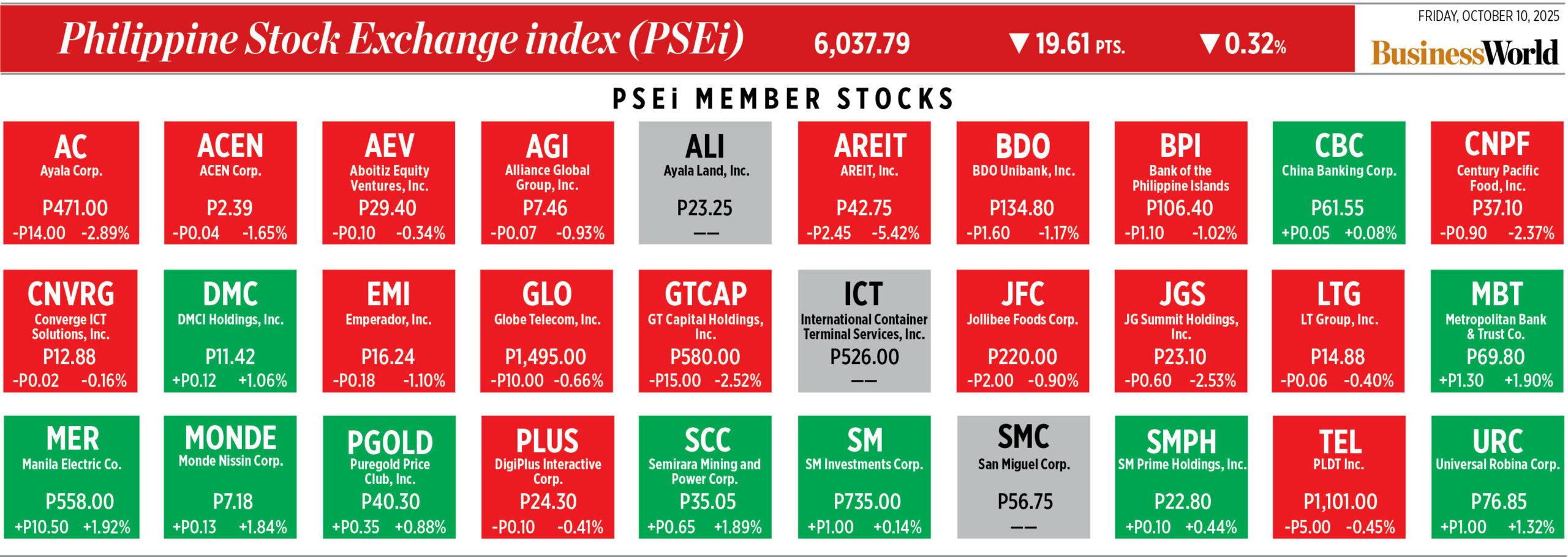
On Friday, the benchmark Philippine Stock Exchange index (PSEi) fell 0.32% or 19.61 points to close at 6,037.79, while the broader All Shares index dropped 0.23% or 8.57 points to 3,658.44.

On Thursday, Mr. Lim clarified his earlier comments made during a speech at the Financial Executives (FINEX) forum on Oct. 7, acknowledging that the report he had referenced was “fictitious.”

“The information, which had been circulating within business circles and cited by some media outlets, was based on what I believed at the time to be a credible industry report. I have since learned that the report was fictitious. I deeply regret any confusion or concern that my statement may have caused,” Mr. Lim said in a statement.

The clarification came hours after Special Assistant to the President for Investment and Economic Affairs Frederick D. Go debunked claims of a 12% drop in the Philippine stock market.

Data from the Philippine Stock Exchange (PSE) showed only a 1.58% decline from Aug. 11 to 29, with market capitalization down 1.4%, disproving the exaggerated P1.7-trillion figure circulating online.

“I have personally confirmed this with the PSE President and the top brokers in the stock market,” Mr. Go said. — Alexandria Grace C. Magno

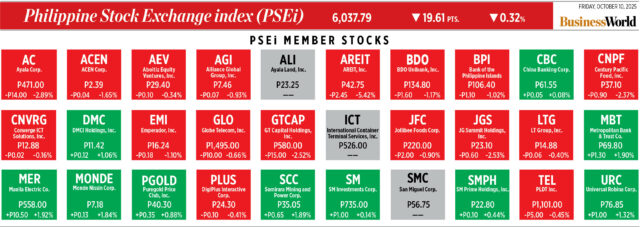
How PSEi member stocks performed — October 10, 2025

Here’s a quick glance at how PSEi stocks fared on Friday, October 10, 2025.


Shares may slide further on bearish sentiment

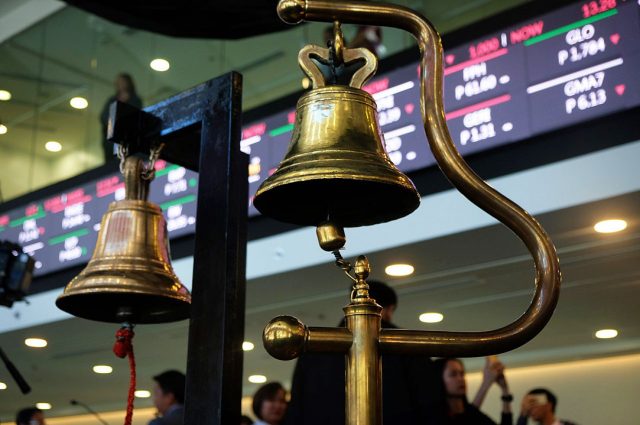
BW FILE PHOTO

PHILIPPINE STOCKS may continue to drop this week as bearish sentiment due to corruption concerns weighs on domestic financial markets.

On Friday, the benchmark Philippine Stock Exchange index (PSEi) fell 0.32% or 19.61 points to close at 6,037.79, while the broader all shares index dropped 0.23% or 8.57 points to 3,658.44.

Week on week, the PSEi also decreased by 71.07 points from its 6,108.86 close on Oct. 3.

“The local market remains bearishly biased as seen in its direction and value turnover. The market is still on a downtrend as corruption issues and the peso’s weakening continue to weigh. Trading remains tepid, implying weak investor confidence,” Philstocks Financial, Inc. Research Manager Japhet Louis O. Tantiangco said in a Viber message.

“The local market ended the week lower as selling pressure persisted despite a softer-than-expected September inflation print and the Bangko Sentral ng Pilipinas’ (BSP) surprise fourth consecutive 25 basis points (bps) rate cut,” online brokerage 2TradeAsia.com said in a market note.

On Thursday, the BSP unexpectedly cut benchmark borrowing costs by 25 bps to bring the target repurchase rate to 4.75%, the lowest since September 2022. Only six of the 16 analysts polled by BusinessWorld expected the reduction.

BSP Governor Eli M. Remolona, Jr. said they cut rates to support growth as the widening corruption scandal involving state flood control and infrastructure projects has affected business sentiment and the outlook for the economy.

He said another reduction is possible at their last meeting for the year scheduled for Dec. 11, with more cuts beyond that also on the table.

The surprise move caused the peso to return to the P58 level anew on Thursday. On Friday, it closed at P58.24 per dollar, slipping by half a centavo from its P58.235 finish on Thursday.

For this week, Mr. Tantiangco said the market may continue to move lower, even as investors could take advantage of the PSEi’s recent slump to buy cheap shares.

“Bearish sentiment is expected to linger fueled by concerns over the Philippines’ corruption issues and their impact on our economic growth outlook. Investors are also expected to monitor the movement of the local currency against the US dollar. A further depreciation for the peso is expected to drag the local bourse,” he said.

“In addition, revived global economic worries as the US imposes new tariffs against China are expected to aggravate market pessimism.”

He put the PSEi’s major support at 6,000 and major resistance at 6,150.

Meanwhile, 2TradeAsia.com placed the PSEi’s immediate support at 6,000 and secondary support at 5,800, while resistance is pegged at 6,200. “Follow-through data points from the US government shutdown could introduce added volatility over the next few weeks, exacerbated by regional pressures amid recent sharp gradients in currencies, on top of the BSP’s most recent rate move.” — Alexandria Grace C. Magno

Philippines says China Coast Guard ship hit vessel near Thitu Island

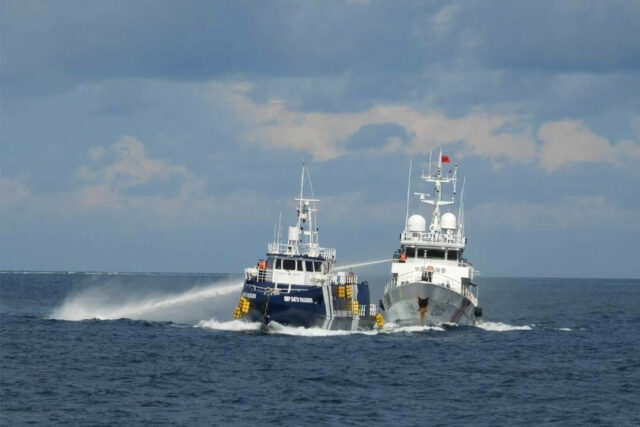
FILE PHOTO of a China Coast Guard vessel fires a water cannon at the BRP Datu Pagbuaya near Thitu Island, in the latest flare-up between Manila and Beijing in the disputed South China Sea. — PCG

A CHINESE COAST GUARD ship collided with a Philippine fishery bureau vessel in the waters off Thitu Island in the contested South China Sea on Sunday, Manila’s coast guard said.

The Philippine Coast Guard (PCG) said Chinese coast guard and maritime militia vessels carried out “dangerous and provocative maneuvers” against Philippine government ships near Thitu Island, where Manila keeps a military outpost in the disputed Spratly Islands.

Shortly after, a China Coast Guard (CCG) vessel fired a water cannon at the Bureau of Fisheries and Aquatic Resources’ (BFAR) BRP Datu Pagbuaya before ramming it, causing minor structural damage but no injuries, the PCG said.

“The harassment we faced today only strengthens our resolve,” PCG Commandant Admiral Ronnie Gil L. Gavan said in the statement. “Filipino fisherfolk depend on these waters, and neither water cannons nor ramming will deter us.”

Manila’s National Maritime Council said Chinese maritime forces conducted “illegal and reckless actions.”

The incident caused minor structural damage to the Philippine ship but no injuries, it said, adding that it would take diplomatic action in response.

“The proximity of CCG’s illegal and reckless actions to Pag-asa Island is of grave concern to the Philippines,” it said in a statement.

US Ambassador to the Philippines MaryKay L. Carlson condemned the incident in a post on social media platform X, describing it as a “dangerous ramming” and “aggressive actions” by Beijing that violate international law.

A CCG official said its vessel took “necessary control measures” to expel Philippine ships that it accused of intruding into waters of the disputed Sandy Cay that lies near Thitu Island, adding that its actions were “legitimate and lawful.”

“The responsibility lies entirely with the Philippine side,” CCG spokesman Liu Dejun said, based on a state-run China Military Online report.

Competing claims between the Philippines and China in the disputed waters have led to frequent confrontations involving repeated use of water cannons and sideswiping maneuvers against Philippine ships.

‘BULLYING TACTICS’
Beijing claims nearly all of the South China Sea via a U-shaped, 1940s nine-dash line map that overlaps with the exclusive waters of the Philippines and neighbors like Vietnam and Malaysia despite a 2016 ruling by the Permanent Court of Arbitration in The Hague that voided its claims.

“Despite these bullying tactics and aggressive actions, the PCG and BFAR remain resolute. We will not be intimidated or driven away,” Manila’s coast guard said.

Thitu, which the Philippines calls Pag-asa, is part of the resource-rich Spratly Islands. It is about 12 nautical miles (22 kilometers) from China’s air and naval base at Subi Reef. The island is the largest of the Philippine-occupied islands in Spratlys and is the only one with a permanent civilian settlement.

“Our presence in the Kalayaan Island Group is crucial for protecting the rights and livelihoods of Filipino fishermen,” it added, referring to the Philippine name for parts of the Spratly Islands claimed by Manila.

The Philippine government earlier this year launched a program aimed at sustaining the presence of Filipino fishers near contested areas in the country’s western seaboard, which have become flashpoints amid China’s increasingly assertive claims over the South China Sea.

The PCG and BFAR resupplied Filipino fishermen operating near disputed maritime features in the South China Sea on Oct. 8, defying heightened Chinese presence in the contested waters.

In a statement on Wednesday, the coast guard said it had delivered thousands of liters worth of fuel, tons of crushed ice and hundreds of food packs to fishermen off Scarborough and Sabina shoals, despite what it described as “aggressive actions” by Chinese vessels.

Access to Scarborough Shoal has been restricted for Filipinos after China seized control of the atoll in 2012 following a standoff with Philippines forces. It is a vast fishing lagoon that lies within the Philippines’ 200-nautical-mile exclusive economic zone.

Philippine Coast Guard said it deployed the 96.6-meter BRP Teresa Magbanua, its biggest multi-role ship, and the 44-meter patrol ship BRP Cape San Agustin to Scarborough Shoal to support six BFAR vessels that distributed aid to Filipino fishing boats.

Manila’s coast guard said it monitored seven China Coast Guard ships and 10 Chinese militia vessels in the disputed feature, with a Chinese Navy ship issuing a radio warning of a live-five exercise near the Philippine resupply point.

Philippine authorities also distributed about 48,000 liters of fuel to more than 35 fishing boats at Sabina Shoal within the heavily contested Spratly Islands, which are claimed by Taiwan and Vietnam aside from China.

The PCG deployed its second 96.6-meter multi-role ship BRP Melchora Aquino and the 44-meter patrol ship BRP Cabra to Sabina, where it accused a Chinese military helicopter of intimidating the Filipino fishing party by performing “low-altitude monitoring flights.”

Manila’s fishery bureau sent five ships to the disputed shoal, where eight Chinese Coast Guard ships and nine militia vessels were observed during the resupply mission, the PCG said.

The Marcos administration has recalibrated the Philippines’ South China Sea strategy, deepening security ties with allies and launching missions to support fishers in contested waters, all while pursuing upgrades to the country’s aging fleet. — Kenneth Christiane L. Basilio

Marcos’ legislative push seeks stability over turmoil

PRESIDENT FERDINAND “BONGBONG” R. MARCOS, JR. — PRESIDENTIAL COMMUNICATIONS OFFICE

By Chloe Mari A. Hufana, Reporter

PHILIPPINE PRESIDENT Ferdinand R. Marcos, Jr.’s post-midterm legislative agenda signals a shift from political maneuvering to institutional consolidation, but analysts warned that his cautious, technocratic approach risks entrenching the same structural weaknesses that have long held back the Philippine economy.

“Post-midterms, the Marcos administration has entered a phase less about electoral maneuvering and more about institutional consolidation,” Ederson DT. Tapia, a political science professor at the University of Makati, said in a Facebook Messenger chat.

“The agenda shows a preference for amending and modernizing existing laws rather than wholesale disruption, a cautious but steady approach… Marcos is stabilizing the system while signaling that governance is as much about endurance as it is about reform,” he added.

He noted that Mr. Marcos is pairing fiscal discipline with socially resonant programs such as village empowerment and scholarships to reinforce political stability while advancing selective reforms.

The President and congressional leaders have identified 44 priority bills under the common legislative agenda for the 20th Congress, with a focus on fiscal reform, transparency and governance modernization.

As he entered the second half of his six-year presidency, his administration’s flagship proposals were a general tax amnesty, amendments to the Bank Deposits Secrecy law and revisions to the Anti-Money Laundering Act (AMLA) — measures the administration said would strengthen financial integrity, expand revenue collection and align the Philippines with global standards.

Mr. Tapia added that the government’s focus on transparency, through long-delayed measures such as the Freedom of Information bill, bank secrecy waivers, and AMLA compliance, reflects an effort to bolster credibility both at home and abroad.

“Yet these are carefully offset by populist and constituency-friendly laws,” he said. “Marcos is not positioning himself as a reformist disruptor, but as a manager of equilibrium, marrying modernization with political pragmatism.”

He said such technocratic balancing could prove unsustainable without structural change.

Corruption issues are at the forefront of Mr. Marcos’ remaining three years in office following his State of the Nation Address in July where he called out government officials engaged in public works corruption.

Since then, various branches of the government have conducted several probes in the hopes of holding erring officials accountable.

Jose Enrique A. Africa, executive director of research group IBON Foundation, said the administration’s legislative priorities are “deeply inadequate” to address the economy’s structural weaknesses.

“The underlying limitation is that the agenda isn’t defined by a coherent development framework to transform the Philippine economy away from overdependence on low-productivity services, foreign capital and imports,” he said via Viber.

Mr. Africa said even the seemingly progressive measures — tax amnesties, infrastructure masterplans and agricultural support — fail to address the root causes of inequality.

“Corruption is so bad and enforcement so weak that amnesties just worsen noncompliance. The biggest beneficiaries are the wealthy and powerful.”

He added that agriculture, despite its importance, continues to receive “token” funding of barely 4% of the national budget.

He warned that the government’s investment policies remain tilted toward attracting foreign capital rather than strengthening domestic industries.

“Without strategic reviews of foreign investments, the Philippines risks deepening corporate control over public services,” he said.

A more effective strategy, according to the economist, would be to require reviews of foreign investments to assess their impact on national industrialization and security and to ensure investment deals prioritize technology transfer, local linkages and broader contributions to the Philippines’ industrial growth.

John Paolo R. Rivera, a senior research fellow at the Philippine Institute for Development Studies, said the government’s approach reflects an attempt to reconcile short-term fiscal goals with longer-term institutional reform.

“Measures like a general tax amnesty aim to boost revenue in the short term, while easing bank secrecy and updating the AMLA… reflect a push to improve transparency, accountability, and compliance with global standards,” he said via Viber.

“Together, they show a strategy focused not just on growth but on rebuilding trust and governance integrity as pillars for sustainable development,” he added.

The 44-item legislative package seeks to improve the investment climate, expand social services and bolster agricultural and energy security.

Key transparency-related bills were also included, specifically the long-delayed Freedom of Information measure, a proposal requiring civil servants to waive bank secrecy, and a Progressive Budgeting bill aimed at enhancing accountability in public spending.

The common legislative agenda also outlined digital-era legislation, including the Cybersecurity Act, Digital Payments Act, regulations on online gambling and rules governing the use of artificial intelligence in elections, underscoring the administration’s push to modernize the country’s regulatory framework.

The full list also covers proposed changes to agrarian reform and social service laws, infrastructure planning and the Local Government Code.

Trump’s envoy pick to strengthen PHL security alliance with US, analysts say

LEE LIPTON — US DEPARTMENT OF STATE official Website

By Adrian H. Halili, Reporter

THE APPOINTMENT of a new US ambassador to the Philippines is expected to deepen Washington’s political and security ties with Manila as the Trump administration refocuses on the Indo-Pacific region, analysts said.

US President Donald J. Trump last week named Florida businessman Lee Lipton as ambassador to the Philippines, replacing MaryKay L. Carlson, who held the post from 2022. The selection comes amid escalating tensions with China in the South China Sea and renewed US efforts to reinforce alliances across Asia.

“Such appointment may signal further deepening of our political and economic ties given that we are undoubtedly the US’ closest ally within the region, alongside Japan,” Josue Raphael J. Cortez, a diplomacy instructor at De La Salle–College of Saint Benilde, said in a Facebook Messenger chat.

The move underscores Washington’s intent to strengthen its regional partnerships under Mr. Trump’s second term, according to Chester B. Cabalza, founding president of the think tank International Development and Security Cooperation.

The long-overdue appointment of the envoy will trumpet the US’ foreign policy reset in the Indo-Pacific region, he said via Messenger chat. “Trump will embolden its relationship with Manila due to its strategic proximity in the first island chain.”

He said Mr. Lipton is expected to carry Washington’s message of deterrence toward Beijing, signaling that the US would step up its “ironclad” commitment to defend its allies and maintain freedom of navigation in the contested waters.

The Philippines has emerged as a key player in regional security, challenging China’s expansive maritime claims in the South China Sea and expanding defense cooperation with the US, Japan, and Australia. Manila and Washington are treaty allies under a 1951 Mutual Defense Treaty, which obligates both nations to come to each other’s aid in the event of an armed attack in the Pacific, including the South China Sea.

The alliance has faced renewed tests amid China’s growing military assertiveness, with Chinese vessels repeatedly harassing Philippine supply missions in the West Philippine Sea. The vital waterway handles an estimated $3 trillion in annual trade and is considered a flashpoint for potential regional conflict.

Mr. Cortez said Mr. Lipton’s appointment reflects the Trump administration’s intent to wield greater influence in the region as China challenges US dominance.

He added that Washington is likely preparing for contingencies involving Taiwan, which Beijing considers a breakaway province. “The Philippines, as the closest host of around three US military bases, will certainly be tapped to aid American troops in case of deployment,” he said.

China has threatened to annex Taiwan by force, a move that could endanger the island’s 23 million people and disrupt the global supply of semiconductors.

Analysts said Mr. Lipton could push additional fortifications at Philippine bases near the South China Sea, as both nations expand defense cooperation under their Enhanced Defense Cooperation Agreement (EDCA). The pact allows US access to military sites across key Philippine locations, including those near Taiwan and the Spratly Islands.

“The Philippines will become an instrument of intensified American presence in the region in the years and decades to come,” Mr. Cabalza said.

Higher allowance for PCG pushed

Philippine Coast Guard personnel during the flag ceremony for the Day of Valor. — COURTESY OF PCG

A PHILIPPINE SENATOR on Sunday pushed for higher subsistence pay for Coast Guard personnel, citing increasing risks during patrols in the South China Sea.

In a statement, Senator Sherwin T. Gatchalian said that he is looking to increase the subsistence allowance of the Philippine Coast Guard (PCG) amid the “harassments and challenges” they face during patrols.

He added that PCG personnel currently receive only P150 per day compared to P350 for other uniformed personnel.

“Even though the situation is challenging, what is important is that we sustain the high morale of our colleagues in the Coast Guard,” Mr. Gatchalian said. “Whenever you patrol the West Philippine Sea, not only do you risk your life, but you also assert our sovereignty.”

If implemented, the increased allowance can benefit about 20,000 personnel of the Coast Guard.

“The work of the PCG is not only for the Philippines but also for ASEAN. Anything that happens in the West Philippine Sea affects the entire region, even North Asia,” he added.

The South China Sea has become a flashpoint in the long-running territorial dispute between Manila and Beijing, with the latter claiming more than 80% of the disputed waterway.

In 2016, a United Nations-backed tribunal based in The Hague voided China’s expansive claim on the South China Sea, where more than $3 trillion worth of trade passes through each year, for being illegal. China continues to ignore this ruling. — Adrian H. Halili

UK reintegration network launched

THE DEPARTMENT of Migrant Workers (DMW) launched its first overseas National Reintegration Network (NRN) in London, United Kingdom over the weekend, extending livelihood and reintegration support to hundreds of overseas Filipino workers (OFWs).

Led by the Overseas Workers Welfare Administration (OWWA), the caravan featured the first international rollout of the NRN, a DMW initiative aimed at strengthening coordination among government agencies to help OFWs transition back home through livelihood, training and reintegration programs.

The network serves as a “one-stop reintegration support system,” formalized through a joint memorandum signed by 16 agencies, the DMW said in a statement on Sunday.

The caravan offered OWWA membership renewals, e-card printing, welfare assistance, legal consultations, health checkups and recreational activities, alongside booths from the Department of Trade and Industry, Department of Tourism, Pag-IBIG Fund, Social Security System and the Philippine Embassy in London.

OWWA reported that nearly 500 OFWs availed themselves of the services, including 270 who received new e-cards and 123 who sought reintegration guidance through the NRN.

The DMW said the London launch will serve as a blueprint for future caravans across Europe and other regions.

DMW Secretary Hans Leo J. Cacdac, Undersecretary Bernard P. Olalia, Assistant Secretary Francis Ron C. de Guzman and OWWA Administrator Patricia Yvonne M. Caunan spearheaded the event. — Chloe Mari A. Hufana

DBM sees P8.58-B tax from pickups

Vehicles are stuck in traffic along EDSA, Cubao in Quezon City, Aug. 18. — PHILIPPINE STAR/ MIGUEL DE GUZMAN

ABOUT P8.58 billion is expected to be collected from the excise tax on pickups by 2028 under the newly signed Capital Markets Efficiency Promotion Act, a Department of Budget and Management (DBM) report said.

In an Oct. 10 document, “Technical Notes on the Proposed National Budget” for 2026, the DBM said the excise tax on pickups will generate P8.58 billion by 2028 for the Bureau of Customs (BoC).

Customs is projected to collect P2.80 billion this year, P6.46 billion in 2026, and P7.44 billion in 2027.

Pickup trucks have been exempted from excise tax under the Tax Reform for Acceleration and Inclusion Law, to support small business owners and professionals.

Assistant Commissioner Vincent Philip C. Maronilla previously said the pickup truck tax and potential rice tariff hike could offset the foregone revenue due to lower tariff on rice, electric vehicles (EVs), pork, corn, and mechanically deboned poultry meat.

In a separate statement on Sunday, the BoC said public auctions of seized and abandoned goods from various ports generated P106.93 million in the July-to-September period.

The BoC said the auctioned items include various consumer goods, vehicles, fuel products, industrial materials, furniture, and assorted merchandise from forfeited shipments.

The 17 auctions were handled by the BoC’s Auction and Cargo Disposal Division of the Port of Manila, Manila International Container Port, and Ninoy Aquino International Airport.

“Through the consistent conduct of lawful and transparent auctions, the Bureau fulfills its dual mandate of protecting government revenues and facilitating legitimate trade,” Commissioner Ariel F. Nepomuceno said.

The proceeds will contribute to the BoC’s run to achieve its P958.7-billion target for 2025, which will finance priority programs and essential public services.

Data from the Bureau of the Treasury showed that Customs collections edged up by 1.1% to P621.4 billion as of end-August, supported by efforts against smuggling and illicit trade.

The auction was in compliance with the mandate of Customs to dispose of seized and abandoned goods through public auction, negotiated sale, or donation, ensuring transparency and compliance with established procedures. — Aubrey Rose A. Inosante