Home Blog Page 80

BSP bills fetch higher average rate on weak demand

BW FILE PHOTO

YIELDS on the Bangko Sentral ng Pilipinas’ (BSP) short-term securities climbed on Monday as the offer was met with weak demand.

The 28-day BSP bills drew only P42.501 billion in bids on Monday, lower than the P60-billion offer and the P70.788 billion in tenders for the same volume auctioned off on March 13. The central bank did not hold the auction on Friday due to the Eid’l Fitr holiday.

This translated to a lower bid-to-cover ratio of 0.7084 times from 1.1798 previously.

As a result, the BSP accepted all P42.501 billion in tenders for a partial award of its offering.

Accepted yields widened to the 4.4% to 4.6% range from 4.3875% to 4.545% in the previous auction. With this, the average accepted rate of the 28-day bills rose by 3.92 basis points to 4.4856% from 4.4464%.

The BSP has not auctioned off the 56-day bills since Nov. 3.

The central bank uses the BSP securities and its term deposit facility to mop up excess liquidity in the financial system and to help guide short-term market yields towards its policy rate.

BSP Deputy Governor Zeno Ronald R. Abenoja earlier said the central bank has reduced its issuance of short-term papers to enhance monetary policy transmission and encourage banks to better manage their liquidity.

Data from the BSP showed that around 50% of its market operations are done through its short-term securities.

As of mid-November 2025, the central bank’s monetary operations have siphoned off P1.5 trillion in liquidity from the market. Of this, 42.4% was absorbed through BSP securities, 34.6% from overnight reverse repurchase agreements, 17.6% via the overnight deposit facility, and 5.4% through the term deposit facility.

The BSP bills also contribute to improved price discovery for debt instruments while supporting monetary policy transmission.

The central bank began auctioning off short-term securities weekly in 2020, initially offering only a 28-day tenor and adding the 56-day bill in 2023. — Katherine K. Chan

Ayala Land rebrands flexible office offering as Click Space

AYALA LAND

AYALA LAND OFFICES, the office development and leasing arm of Ayala Land, Inc. (ALI), is rebranding its flexible office offering Clock In as Click Space, a plug-and-play workspace solution with build-to-suit options and enterprise support tailored for hybrid work, technology shifts, and evolving business needs.

“This evolution reflects our vision to go beyond providing space. We are building ecosystems that help businesses scale, stay resilient, and thrive in a world that is changing faster than ever,” Ayala Land Offices President and Chief Executive Officer Hamm E. Katipunan said in a statement on Monday.

The company said the new offering targets larger tenants in the technology, creative, and professional services sectors.

“While its identity and offerings have evolved, its core remains unchanged, continuing to deliver high-quality workspaces, foster a meaningful community, and uphold a steadfast commitment to customer care and operational excellence,” the company said.

Ayala Land Offices said it plans to launch a flagship location at One Ayala, featuring an updated design, additional services, and a new Deuces coffee branch. It added that it is scouting expansion sites in key business districts over the next one to two years.

At the local bourse on Monday, shares in ALI declined by 7.44% to P16.92 each. — Alexandria Grace C. Magno

BTS comeback show’s turnout falls short, sparking Hybe sell-off

WIKIMEDIA COMMONS

HYBE CO.’S shares plunged as much as 15% after a heavily promoted comeback concert by K-pop megastars BTS drew a smaller crowd than authorities initially expected.

Stock in BTS’ agency recorded its biggest intraday decline since June 2022. The group’s event at Gwanghwamun Square attracted 104,000 fans versus the 260,000 initially estimated by police, according to Chosun Ilbo. Stringent crowd control measures — reflecting in part the authorities’ focus on avoiding a repeat of the Itaewon incident years ago — may have played a part.

The concert was live-streamed by Netflix, Inc., which should release viewership figures later this week. The group performed 12 songs during the hour-long show, ranging from new tracks on their album Arirang to hits such as “Butter” and “Dynamite.” The event also drew more viewers on Netflix, topping daily charts in countries including South Korea over the weekend.

BTS is returning to the global stage after a near-four-year hiatus, when its seven members underwent mandatory South Korean military service. They’re embarking on their largest-ever tour, with 82-stops already sold out.

The preliminary reception to their new work was strong. The album quickly topped Spotify charts after its release. Several songs led rankings including on Spotify and iTunes, while the album sold 4 million copies on its first day.

The stakes are immense for both BTS and Hybe. The success of the group will dictate the future of Hybe, its management company and record label. Despite Hybe’s global expansion through the acquisitions of labels from Hollywood to Latin America, BTS remains the company’s core earnings driver. Profit growth had been sluggish during the group’s hiatus. — Bloomberg

BoJ’s narrative shift signals dogged commitment to rate hikes

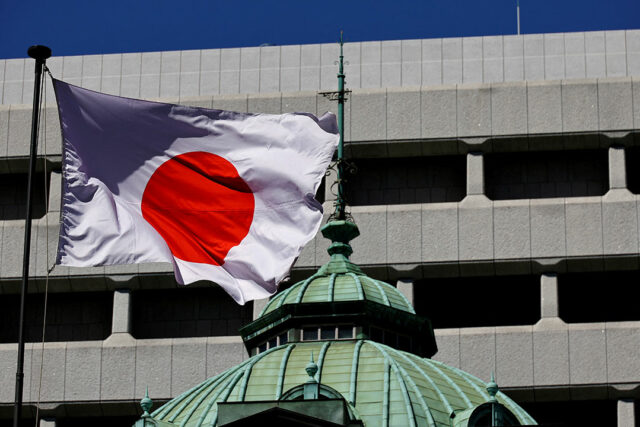
THE Japanese national flag waves at the Bank of Japan building in Tokyo, Japan on March 18, 2024. — REUTERS/KIM KYUNG-HOON/FILE PHOTO

TOKYO — The Bank of Japan (BoJ) is laying the groundwork for tweaks to its policy language in April, keeping alive the chance of a near-term interest rate hike as the weak yen and Middle East conflict pile inflationary pressures on the economy.

While the central bank kept rates steady last week, Governor Kazuo Ueda signaled that the bank was shifting away from a focus on downside risks to the economy that required a slow, cautious approach in pushing up borrowing costs.

For one, Mr. Ueda said the board will debate next month tweaking guidance that rate increases would come “in accordance with improvements” in the economy — language seen by some analysts as ruling out the chance of a hike when growth was under pressure.

“Even if the economy comes under downward pressure, if we judge that such downward pressure would be temporary and will not affect underlying inflation, it would be possible for us to raise interest rates,” he said in unusually hawkish remarks that contrast with his typical emphasis on risks to growth.

Any such change would leave scope for the BoJ to hike rates, even if the board cuts its growth forecasts in new quarterly forecasts due at the April 27-28 policy meeting, analysts say.

CHANGING THE STORY ON INFLATION
Another tweak Mr. Ueda revealed was a plan to disclose by summer a new indicator on inflation and an updated staff estimate on Japan’s neutral rate of interest, a move he described as part of the BoJ’s efforts to enhance communication.

The new price gauge adds to data the BoJ looks at in determining Japan’s underlying inflation, or price moves driven by domestic demand rather than cost-push factors.

While the central bank already releases estimates of consumer inflation excluding the impact of fresh food and fuel costs, such indices have been swayed by various government steps to cushion the blow to households from rising living costs.

The new indicator will strip away the effect of such government steps that work to push down inflation, including subsidies to slash school tuition fees and gasoline bills.

The gauge is expected to help the BoJ argue that underlying inflation remains on track to stably hit 2%, even if headline inflation briefly slides below the level, analysts say. 

“All else equal, such new measures could potentially help the BoJ to navigate through short-term disinflationary measures and justify a faster pace of rate hikes,” said Naomi Fink, chief global strategist at Amova Asset Management.

The BoJ could start releasing the new indicator in April and revise up its price forecasts to account for rising import costs from a weak yen, said Mari Iwashita, executive rates strategist at Nomura Securities.

“The BoJ appears to be doing what it can, including on the communication front, to proceed with policy normalization. It seems well prepared for the next rate hike,” she said.

MONETARY POLICY AND POLITICS
With the escalation in Middle East tensions jolting markets, however, there is no guarantee the BoJ can convince markets and dovish premier Sanae Takaichi of the need for more rate hikes.

Mr. Ueda’s hawkish remarks failed to sustain a rebound in the yen, which fell near the key ¥160-per-dollar mark on Monday to the disappointment of policymakers fretting of rising import costs from the currency’s weakness.

Japan’s heavy reliance on imports makes its economy vulnerable to surging fuel costs caused by the conflict.

In a sign of her focus on propping up growth, Ms. Takaichi has signaled the chance of compiling an extra budget to ramp up stimulus. Her reservations over near-term rate increases have not budged, two government sources told Reuters, with one saying the government may not nod to an April hike.

Mr. Ueda played down the likelihood of a rift, saying the government’s view on underlying inflation likely did not deviate much from that of the BoJ. With the weak yen and rising fuel costs piling inflationary pressure on Japan, markets still see roughly a 60% chance of an April rate hike.

But former BoJ executive Akira Otani, who is currently managing director at Goldman Sachs Japan, expects the central bank to wait until July for evidence the hit to profits from the Iran war does not discourage smaller firms from hiking wages.

“Given uncertainty over Middle East developments and comments from the government, we see the hurdle for an April rate hike as quite high,” he said. “For the BoJ, deciding on an April rate hike won’t be as easy as markets expect.” — Reuters

South Asia’s Industrial Revolution is switching off gas

STOCK PHOTO | Image from Freepik

By David Fickling

OMER ASHRAF isn’t losing any sleep over the impact of the Iran conflict on his fleet of energy-hungry cement plants.

The Chief Financial Officer of Pakistan’s Fauji Cement Co. installed its first solar array in 2019 at Jhang Bhatar, about 50 kilometers west of the capital Islamabad. There are now 69 megawatts (MW) of panels across the company’s five main sites, at least twice what Tesla, Inc. appears to have on the rooftops of its gigafactories in Nevada and Texas.* They contribute about 23% of the company’s electricity, with a further 35% coming from recovering waste heat from its coal-fired clinker kilns.

The cost is just five to six rupees (about two cents) per kilowatt hour, around a fifth of grid prices, Ashraf told me. On-site gas-fired generators are available as back-up, but are barely used these days, given the cheaper options. There won’t be a major impact from the situation in the Strait of Hormuz, he said.

He’s not alone. In Pakistan and India, once key customers for the Persian Gulf’s liquefied natural gas exports, energy-hungry industries have been rapidly shifting away from both gas and grid power to make use of cheap, abundant solar energy.

Bangladesh, for years South Asia’s economic success story, made the opposite bet. That was the wrong decision. With the world’s largest LNG terminal, Qatar’s Ras Laffan, shut down and suffering extensive damage from Iranian attacks this week, a fifth of global supplies are now offline.

Solar’s advantages are most apparent in the textile business. Since the Industrial Revolution spread through England’s cotton mills in the 18th century, garment factories have been many countries’ first step toward development. Clean energy is speeding the process.

India’s apparel plants now derive about 28% of their electricity from renewables, according to a recent study by Moody’s Corp. affiliate ICRA ESG Ratings. Large factory roofs make installation of solar arrays straightforward.

Plenty are already surging ahead of rich-world companies in their clean power ambitions. Pakistan’s Nishat Mills Ltd. and Interloop Ltd., which supply Gap, Inc. and Hennes & Mauritz AB, respectively have 35 MW and 25 MW of photovoltaic panels, comfortably on a par with Tesla. Bengaluru-based Gokaldas Exports Ltd., whose customers include Adidas AG, derives 79% of its energy from solar, biomass and other clean sources.

Green motivations aren’t completely absent. Fashion companies have for many years been under pressure to clean up their supply chains. That trend is being accelerated by the European Union’s Carbon Border Adjustment Mechanism, which came into force this year and adds a sort of tariff onto imports equivalent to the carbon price they’d have paid if manufactured locally. Exporters who build out renewables will spare themselves those levies.

But the payoff in power bills is sufficient to justify the switch. Solar provided electricity equivalent to a fifth of Pakistan’s grid power in the year through March 2024, the most recent available data, according to Renewables First, a pro-energy transition group. This has left the country with less need for imported LNG.

About 35 gas shipments are now being diverted every year because they’re not needed, said a recent report by AKD Securities Ltd., equivalent to about a quarter of typical import volumes. This has already spared Pakistan about $12 billion of spending on imported LNG and oil and could save a further $7 billion this year, wrote Lauri Myllyvirta, co-founder of the Center for Research on Energy and Clean Air.

Countries that threw in their lot with LNG are in a tighter spot. Bangladesh, whose 4,000-odd garment factories are key suppliers for the global fast-fashion industry, has been far slower to switch to renewables. Just 1.6 gigawatts (GW) of solar has been connected nationwide, compared to as much as 34 GW in Pakistan. Import tariffs for photovoltaic equipment of nearly 30% deter businesses from deploying rooftop power. While Pakistan’s LNG imports have shrunk since the Ukraine war, Bangladesh’s have almost doubled.

With the crisis in Hormuz disrupting supplies of gas and diesel for back-up generators, the country’s utilities are now scrambling to get their hands on coal, which costs almost twice as much as gas on the grid. Those shortages, combined with the effect of energy-related inflation on garment worker wages, will erode Bangladesh’s longstanding cost advantage over rival apparel factories elsewhere in the region.

It’s a far cry from the banal truisms used to market gas to emerging economies. As missiles flew across the Persian Gulf and buyers scratched around for alternative supplies, Shell Plc’s annual LNG outlook hailed the fuel as a “stabilizing force in the energy system.” About 70% of demand growth out to 2040 will come from Asia, Shell wrote, “because it is versatile, flexible, and reliable.”

That’s a remarkable assertion amidst the chaos of 2026. In future, gas producers are going to need more than platitudes to convince customers they’re worth the risk. n

BLOOMBERG OPINION

*Tesla doesn’t disclose figures for its rooftop generation. We estimated a figure of about 13 megawatts at each facility, based on 2026 satellite photos of the plants.

Foxmont eyes to invest P4B in PHL startups, key sectors

STOCK PHOTO | Image by Rawpixel.Com from Freepik

FOXMONT CAPITAL Partners (Foxmont), a venture capital firm focused on tech-enabled startups, plans to invest P4 billion in Philippine companies over the next few years, focusing on heavy manufacturing, solutions-driven enterprises, and the health technology sector.

“In investing in the Philippines, there is a lot of interest. We have a lot of international investors that are making maiden investments, that means that investors that have not invested in the Philippines before are now increasingly allocating capital to the Philippines,” Foxmont Managing Partner Franco Varona told reporters during the 2026 Philippine Private Capital Report launch on Monday.

Foxmont has invested in 44 startups since 2018.

Foxmont said private capital funding in the Philippines grew 34% year on year to $490 million in 2025, supported by a surge in debt financing alongside moderate gains in equity activity.

It said financial technology (fintech) and health technology companies continued to attract strong investment interest.

“The increase was driven by larger transactions and a broader mix of financing structures, signaling sustained investor interest despite tighter regional and global capital conditions,” it said.

Foxmont said that while funding in the Philippines is rising, the country is undergoing a shift from a consumption- and labor-driven growth model to one led by productivity, where private capital will play a key role.

“The Philippines has long benefited from favorable demographics and resilient demand, but the next phase of growth will depend on productivity, capital formation, and stronger firms,” Foxmont Managing Partner Jelmer Ikink said in a separate media release.

China Bank Capital Corp. Managing Director Juan Paolo E. Colet said the private market is likely to remain resilient despite ongoing geopolitical tensions that could weigh on sentiment.

“So far, private markets appear to be resilient with a number of potential deals in the pipeline, but it’s a fluid situation given the effects of the Middle East war. Depending on the duration and scale of the conflict, some transactions might be reassessed or delayed because of rising financing cost as well as the war’s impact on certain business assumptions,” he said in a Viber message. — Ashley Erika O. Jose

PHL real estate seen buffering long-term investments from inflation — Cushman

STOCK PHOTO | Image by Bantersnaps from Freepik

THE PHILIPPINE real estate sector’s “strong fundamentals” may help cushion long-term investments from global inflation linked to the Middle East conflict, although higher construction costs remain a risk, according to real estate services firm Cushman & Wakefield.

“The recent geopolitical developments in the Middle East, particularly concerning energy transit routes, have introduced new inflationary pressures globally. While this may influence local construction and operational costs, the Philippine real estate sector’s strong fundamentals provide a substantial buffer for long-term investments,” Cushman & Wakefield Philippines Director and Head of Research, Consulting and Advisory Services Claro Cordero, Jr. said in the company’s fourth annual Southeast Asia Outlook report released last week.

In 2025, Southeast Asia’s real estate investment market recovered, with volumes rising 16% to $21.8 billion despite global economic challenges and policy uncertainty, the report said.

The increase came from stronger capital flows into industrial and digital infrastructure, as investors focused on sectors linked to supply chain shifts and artificial intelligence growth.

The report noted that global geopolitical risks persist, including unresolved trade agreements and potential tariff changes affecting transshipment and sectors such as pharmaceuticals and electronics. However, it said the Philippines has lower exposure than Vietnam, Thailand, or Malaysia due to its larger domestic market and lower reliance on US exports.

“Headwinds do not erase opportunity, they reveal it. In a dynamic global environment, the Philippine real estate market continues to surface strategic pockets of growth that are set to stand out in 2026 for investors and developers with a disciplined, long term view,” Cushman & Wakefield Philippines Country Head Dom Fredrick Andaya said.

Wong Xian Yang, head of research for Singapore and Southeast Asia and author of the report, said Singapore continues to provide core liquidity in the region, while Southeast Asia is positioned for the next phase of growth amid diversifying supply chains and expanding institutional-grade assets.

“The recovery in 2025 reflects more than cyclical momentum — it signals a structural shift in capital allocation. Investors are increasingly targeting sectors aligned with manufacturing expansion and digitalization, particularly logistics and data centers,” he added.

Industrial investment sales across the region reached $1.3 billion in 2025, up 48%, with demand centered on prime logistics and warehouse spaces supported by e-commerce growth, third-party logistics expansion, and Southeast Asia’s growing role in global manufacturing.

Singapore, Malaysia, Thailand, and Vietnam benefited from strong trade flows and manufacturing activity, while Indonesia and the Philippines were supported by steady domestic consumption.

Data centers led Southeast Asia’s property investments by volume in 2025, with Johor capturing spillover demand from Singapore. Thailand, Indonesia, the Philippines, and Vietnam remain underserved but are seen as having strong growth potential.

“SEA countries remain an attractive growth target for data centers development and remain underserved, though markets are at different stages of development,” the report said.

For 2026, Southeast Asia is projected to grow by 4.3%, reinforcing its position as one of the world’s fastest-growing regions.

Private consumption across Southeast Asia, excluding Singapore, is projected to reach $5 trillion by 2035, growing at about 8% annually, supported by easing inflation, lower policy rates, and stable unemployment.

“Southeast Asia’s momentum is being fueled not only by investor appetite, but by the region’s expanding consumer base, young workforce and ambitious infrastructure build-out,” Anshul Jain, chief executive – India & Southeast Asia & APAC Office and Retail at Cushman & Wakefield, said.

“We’re seeing stronger cross-border capital movement, deeper participation from global corporates, and growing demand for high-quality, sustainable space — particularly in data centers, where hyperscale expansion continues to accelerate across the region. These fundamentals are enhancing Southeast Asia’s competitiveness and will shape the next phase of real estate growth,” he added. — A.G.C. Magno

Kevin Spacey settles UK civil lawsuits over alleged sexual assault

KEVIN SPACEY in House of Cards

LONDON— Oscar-winning US actor Kevin Spacey has reached a confidential settlement with three British men who had filed civil lawsuits at London’s High Court accusing him of sexual assault between 2000 and 2013, according to a court order made public this week.

Two of the claimants were complainants who gave evidence during Mr. Spacey’s 2023 criminal trial in London, where the now 66-year-old actor was acquitted of all charges.

Mr. Spacey, one of Hollywood’s biggest stars before he was first accused of sexual assault in 2017, has consistently denied accusations of sexual misconduct and said the incidents alleged in the lawsuits did not happen or were consensual.

A court order dated March 13 said that the lawsuits have been stayed following the settlement, meaning a trial that had been scheduled for October will now not take place.

Mr. Spacey’s lawyers did not immediately respond to a request for comment. A spokesperson for the claimants’ lawyers declined to comment.

Mr. Spacey, who won Oscars for American Beauty and The Usual Suspects, was dropped from the TV drama House of Cards and removed from the movie All the Money in the World after the first allegations of sexual assault emerged.

A civil lawsuit against Mr. Spacey in the United States was dismissed by a jury in 2022, and he stood trial in London the following year, charged with sexually assaulting four men in Britain. He was acquitted of all nine charges. — Reuters

Report: Filipino young adults face mental health crisis more than older adults

The Philippines’ average Mind Health Quotient (MHQ) for young adults aged 18-34 rose to 59 while adults (ages 55 and above) have an average MHQ of 110 in the latest edition of the Global Mind Health Report, formerly the Mental State of the World Report, by US-based not-for-profit organization Sapien Labs. This means that Filipino young adults experience mental health challenges or crisis more than Filipino adults. The MHQ is an assessment of mind health and well-being that encompasses all aspects of mental function, emotional, cognitive, and social as well as drive and resilience of an individual which positions them on a spectrum from -100 (distressed) to 200 (thriving).

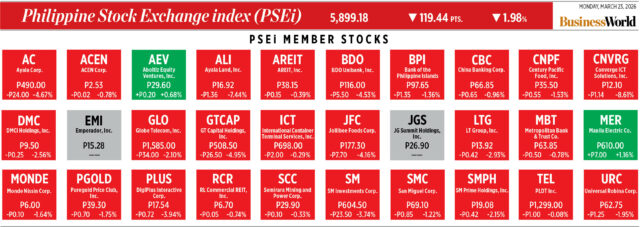
How PSEi member stocks performed — March 23, 2026

Here’s a quick glance at how PSEi stocks fared on Monday, March 23, 2026.


Philippines plans repatriation of 1,200 more OFWs from Middle East

PRESIDENT Ferdinand R. Marcos, Jr. personally welcomed 343 Filipinos repatriated from the Middle East at Villamor Air Base on Monday. — PHILIPPINE STAR/RYAN BALDEMOR

PRESIDENT Ferdinand R. Marcos, Jr. welcomed repatriated Filipinos from the Middle East at the Villamor Air Base in Pasay City on March 23.

The Philippine government is preparing to bring home at least 1,200 more overseas Filipino workers (OFWs) from the Middle East as war in the region disrupts flights, supply chains, and daily life for millions of migrants.

Migrant Workers Secretary Hans Leo J. Cacdac said authorities are seeing a steady rise in repatriation requests, with more Filipinos seeking help as conditions on the ground remain uncertain.

“We have an increasing number… At least 1,200 [have asked] to be repatriated in the coming days,” he told reporters.

The planned repatriations add to government efforts to help Filipinos affected by the escalating tensions. The Department of Foreign Affairs (DFA) in a statement said there have been 1,262 repatriation requests, underscoring growing concern among workers in the region.

A key challenge has been restricted airspace across parts of the Middle East, complicating evacuation plans.

Countries such as Kuwait, Qatar and Bahrain have limited flight availability, forcing Philippine authorities to explore alternative routes.

“The challenges continue with those with closed airspace — there’s Kuwait, Qatar and Bahrain,” Mr. Cacdac said. “The United Arab Emirates (UAE) has more flights, so we could charter out there.”

The UAE has emerged as a critical transit hub due to its relatively open air corridors and large Filipino population.

Authorities said chartered flights from the UAE would be deployed in succession as part of a sustained repatriation effort.

The scale of the operation reflects the Philippines’ deep labor ties with the region. Government data show about 2.4 million Filipinos live and work across the Middle East, with the largest concentrations in the UAE and Saudi Arabia, followed by Qatar and Kuwait.

On Monday, 343 Filipinos from Bahrain, Kuwait, Qatar and Saudi Arabia arrived at Villamor Air Base in Pasay City near the Philippine capital. The group included both workers and their dependents.

Mr. Cacdac said 234 Filipinos including their dependents came from Qatar, Kuwait and Bahrain, while 109 came from Saudi Arabia.

They were received by Mr. Marcos, signaling the government’s continued focus on the welfare of overseas workers amid the crisis.

Mr. Cacdac said a portion of the returnees — those coming from Qatar, Kuwait and Bahrain — had to travel over land for several hours to reach safer exit points, highlighting the operational complexity of the evacuations.

“It was a land-crossing effort, and it took on average about seven to eight hours to get to Riyadh,” he said.

Since early March, the Department of Migrant Workers has facilitated the return of about 1,600 Filipinos, including both workers and their families.

Despite the deteriorating security situation, the government has so far held off on imposing a deployment ban.

Mr. Cacdac said this decision hinges on official travel alert levels, which have not yet been raised to a point that would trigger mandatory restrictions.

“The embassies and ourselves have issued advisories, and the DFA has also released safety protocols,” he added.

The escalating conflict in the Middle East has placed millions of migrant workers in the region, including Filipinos, in increasingly precarious situations, as canceled flights, missile strikes and attacks on oil hubs disrupt livelihoods and mobility. — Adrian H. Halili

Palace awaits Congress transmittal of fuel tax bill

PHILSTAR FILE PHOTO

THE Philippine government is preparing to roll out fuel tax relief measures once President Ferdinand R. Marcos, Jr. receives and signs the emergency power bill approved by Congress, Malacañang said on Monday, signaling possible intervention to temper surging petroleum prices driven by the Middle East war.

Palace Press Officer Clarissa A. Castro said the bill granting the President authority to suspend or reduce excise taxes on fuel products had yet to reach his desk as of the weekend.

“The only reason that he could not do it is that the bill has not reached the President as of now, so there is no reason for him to sign,” she told a news briefing, adding that Mr. Marcos would act on the measure immediately once it is transmitted.

Senate President Vicente C. Sotto III told reporters via Viber he had received and was about to sign enrolled copies of the bill approved by the House of Representatives.

The House adopted Senate Bill No. 1982, effectively bypassing a bicameral conference committee.

The Philippines is heavily dependent on imported oil, leaving it vulnerable to external shocks such as the conflict in the Middle East, which has disrupted global energy markets and pushed oil prices higher.

Earlier this month, Mr. Marcos asked Congress to grant him emergency powers to suspend or reduce excise taxes on petroleum products as a way to cushion the impact of rising fuel prices on consumers. He certified the measure as urgent.

However, the President has said that “complicated calculations” must be undertaken before invoking the emergency powers, reflecting the need to balance fiscal concerns with consumer relief.

Despite the delay, Ms. Castro said the President supports the measure and sees no reason to withhold approval once it reaches Malacañang. She stressed, however, that signing the bill is separate from enforcing it.

Under the law, any suspension or reduction of excise taxes on fuel products may only be implemented once global oil prices reach at least $80 per barrel for 30 straight days. Ms. Castro said government agencies are prepared to issue the necessary orders swiftly once the conditions are met.

Dubai crude oil has recently traded between $130 and $153 per barrel, well above the threshold. Local diesel prices have climbed to as high as P114 per liter.

Ms. Castro also said excise taxes are imposed “upon entry” of imported oil, meaning the timing of any tax adjustment would depend on actual import arrivals.

“If we do not import oil, then the reduction or suspension of the excise tax cannot be exercised,” she said in Filipino.

Despite the sharp rise in prices, Malacañang maintained that the Philippines is not experiencing an oil crisis.

“At this time, we are not considering it an oil crisis because supply remains sufficient,” Ms. Castro said, echoing Energy Secretary Sharon S. Garin. She clarified that price disruptions stem from the conflict in the Middle East rather than domestic supply shortages.

The government is negotiating additional fuel shipments, including 440,000 barrels followed by another 600,000 barrels, to bolster inventories and prevent shortages.

Ms. Castro said Mr. Marcos’ earlier reference to an “oil crisis” pertained to the situation in the Middle East, not domestic conditions.

To manage prolonged fuel price pressures, the President has ordered the creation of a crisis management committee, although its composition had yet to be finalized.

Meanwhile, the government is preparing additional cash assistance for public utility drivers affected by rising fuel and food prices. Social Welfare Secretary Rexlon T. Gatchalian said aid would be distributed in tranches to maximize its impact. 

The move follows complaints from transport groups that existing subsidies are insufficient. Mr. Marcos last week suspended a proposed fare increase for public utility vehicles, citing the need to protect commuters.

The government has begun distributing P5,000 cash aid to tricycle drivers in Metro Manila, with jeepney, taxi, bus and ride-hailing drivers to follow. The program is expected to reach provinces by April.

Labor groups have also renewed calls for wage increases as inflation squeezes household budgets, though Malacañang said proposals for legislated wage hikes remain under Congress’ authority.

The fuel price surge follows the Iran war that erupted on Feb. 28 after coordinated US and Israeli airstrikes on Iranian military targets, triggering retaliatory attacks and disrupting oil supply routes, including the Strait of Hormuz. — Chloe Mari A. Hufana and Kaela Patricia B. Gabriel