SM Foundation, in a virtual gathering, recognized the 219 SM scholar-graduates for 2020 and 2021 — 38 of whom graduated with honors/distinction.
SM Foundation’s Scholarship Program, which was established in 1993, aims to contribute in eradicating the intergenerational cycle of poverty in the country by giving scholarship grants to poor but deserving students. It has already produced almost 7,600 college and tech-voc scholar-graduates — enabling them to uplift the lives of their families out of poverty.
This program is anchored on the belief of SM Group late founder, Henry Sy Sr., that education is the greatest equalizer and that if he could help send one child to school, that child can then help his or her siblings finish schooling and together, they can help uplift their family out of poverty.
The country’s first MITSUKOSHI will rise at Grand Central Park in Bonifacio Global City (BGC).
By Bjorn Biel M. Beltran
When you think of life in Japan, you think of the vibrant metropolis of Tokyo, the scenic mountainsides and hot springs, and cherry blossoms in spring. You may also think of the fascinating innovative technology, a rich and storied culture, and world-class cuisine. Indeed, the Japanese lifestyle is one that is evocative and immediately recognizable.
Federal Land, Inc., together with Nomura Real Estate Development Co., Ltd., and Isetan Mitsukoshi Holdings, Ltd., is bringing that lifestyle to the Philippines, as it aims to set a new global standard in the real estate industry through the premier four-tower residential development — The Seasons Residences at Grand Central Park.
Own a piece of Japan at The Seasons Residences in BGC.
The Seasons Residences is the country’s first residential project with a distinct Japanese concept and is located right at the heart of Bonifacio Global City (BGC), one of the country’s premier central business districts.
Grand Central Park in North BGC is a master-planned community home to the newest go-to-lifestyle district Grand Hyatt Manila, where people can live, work, shop, and dine. It is also very accessible, proximate to major highways, link roads going to Makati, Ortigas, EDSA, and transportation hubs like airports and bus terminals making it a very attractive option for those who like to be in the center of activity in the city.
BGC’s accessibility will further improve with the completion of various infrastructure projects such as the BGC-Ortigas Link Road, Mega Manila Subway, BGC-Makati Skytrain and BGC-NAIA Bus Rapid Transit.
The Seasons Residences, rising alongside Grand Hyatt Manila, is inspired by the four seasons of Japan. It is designed to fuse Filipino hospitality with Japanese efficiency, allowing its future residents to experience an elevated lifestyle at the heart of BGC.
It will bring the Japanese tradition of excellence, innovation, and artistry to the Philippines, elevating Filipino lifestyle through the introduction of Japanese technology and quality. Its architecture and design marry Japanese design, technology, and innovation with the Filipino sense of community.
The Seasons Residences amenity floor is influenced by the seasons of Japan, with the arrangement of the elements inspired by spring, summer, autumn, and winter.
The four residential towers — Haru (Spring), Natsu (Summer), Aki (Autumn), and Fuyu (Winter) — will feature Japanese design innovations and technologies to elevate your lifestyle with convenience, safety, cleanliness, and eco-friendliness.
Interest from home seekers and investors has continuously been high for The Seasons Residences since the launch of its first tower (Haru) in 2018. The third tower, Aki, is targeted to be launched in third quarter of this year.
Meanwhile, The Seasons Residences stays true to its name with an amenity floor influenced by the seasons of Japan, with the arrangement of the elements inspired by spring, summer, autumn, and winter.
A modern gym, zen garden amidst natural landscapes will evoke the fresh beginnings of spring, while the pool, karaoke room, and a game room call to mind the fun of summer. Quiet autumn is an inspiration to creativity, so a music room, reading lounge, and a business center is provided to accommodate that. Lastly, The Seasons Residences offers its authentic onsen or Japanese hot spring and spa to warm away the chilly weather.
The Seasons Residences also features a unique amenity offering called The Guest House. Inspired by traditional Japanese architecture, it will be made available for lease to relatives and friends of residents so they too can experience the lifestyle of The Seasons Residences homeowners.
Units at The Seasons Residences come with a sunken slab technology for convenient pipe maintenance and repair, Japanese storage system, as well as a shower toilet.
Finally, at the podium of The Seasons Residences will be the first MITSUKOSHI in the country. The four-storey mall will feature well-curated selection of Japanese fashion items, food and cosmetics brands, and will highlight the Japanese way of polite service known as Omotenashi.
Touted to be the ‘next Manila lifestyle’, MITSUKOSHI aims to become the new lifestyle destination in BGC. It is designed for customers living in today’s fast-paced environment, providing new and elevated retail experiences with a merchant selection ranging from splendid global labels to the best local retail names.
A beauty section will also be one of the highlights of the mall, serving as an anchor with luxury cosmetic brands. At the center of this section will be a modern beauty store by Isetan Mitsukoshi Holdings, Ltd., which will offer natural and organic cosmetic brands and beauty salon service.
At the basement level will be MITSUKOSHI’s signature depachika, a haven of top-shelf Japanese food and related products. It will feature a supermarket with a wide array of treats and produce, as well as food halls of international culinary offerings.
The mall will also feature well-loved Japanese accessories and household goods to introduce modern Japanese culture.
To know more about The Seasons Residences visit this website.
SOURED LOANS held by Philippine banks continued to rise in April, bringing the nonperforming loan (NPL) ratio to its highest in nearly 12 years as borrowers’ capacity to pay debts were affected by the reimposed restriction measures.
The banking industry’s nonperforming loans surged 84% to P463.659 billion in April from P251.984 billion a year ago, based on central bank data posted on its website over the weekend. The April figure was also higher by 3.39% from the P448.44 billion in March.
This brought the system-wide NPL ratio to 4.35%, rising from the 2.31% in April 2020 as well as the 4.21% in March. This is also the highest NPL ratio since the 4.37% recorded in May 2009.
Bank loans are recognized as nonperforming once they are left unpaid for at least 30 days beyond the due date. These soured loans are risky to asset quality of banks as borrowers are likely to default on these debts.
Analysts said the reimposition of lockdown restrictions in late March hurt business activity and affected the capacity of borrowers to repay their debts.
“Many small businesses have had to shut shop as revenues plunged with the lockdowns. Household incomes have been disrupted due to job losses and salary cuts,” S&P Global Ratings analyst Nikita Anand said in an e-mail.
Metro Manila and four adjacent provinces were placed under the tightest form of lockdown for two weeks from late March to mid-April to curb a spike in coronavirus infections. Restrictions in these areas have since been eased.
“The recent lockdowns resulted to temporary and permanent closure of some businesses as well as temporary or permanent losses of some employment, thereby impairing the ability to pay by some borrowers, both businesses and individuals,” Rizal Commercial Banking Corp. Chief Economist Michael L. Ricafort said.
Banks also continued to recognize the rise in bad loans following the expiration of the loan payment extension under Republic Act 11469 or the Bayanihan to Heal as One Act (Bayanihan II) in December, further contributing to the rising NPL ratio, Mr. Ricafort added.
Due to the uptick in bad loans, banks remained risk averse, causing the total loan portfolio to drop by 2.47% to P10.649 trillion from P10.919 trillion last year and by 0.1% from the P10.66 trillion in March.
In April, past due loans rose 38.13% to P574.128 billion from P415.619 billion. This brought the ratio to 5.39% from 3.81% a year ago.
Restructured loans also increased 411% to P242.044 billion from P47.354 billion logged in April 2020. These loans made up 2.27% of banks’ credit portfolio from merely 0.43% last year.
Banks also continued to boost their loan loss reserves to P377.811 billion, up 58% from a year ago’s P238.675 billion. This brought the ratio to 3.55% from 2.19% a year ago.
Despite this, NPL coverage ratio — a gauge of allowance for potential losses due to NPLs — declined to 81.48% from 94.72% a year ago.
BSP Deputy Governor Chuchi G. Fonacier has said that banks’ NPL ratio may continue to climb to a little over 5% by the end of 2021. She assured the banking industry continues to remain stable as it has ample capital.
Central bank officials expect the Financial Institution Strategic Transfer (FIST) Law could bring down the NPL ratio by about 0.63 to 0.71 percentage point. Under the law, banks may sell assets or loans that will be recognized as nonperforming until Dec. 31, 2022.
The BSP estimates at least P152 billion in nonperforming assets (NPAs) will be offloaded by banks through FIST.
“We believe banks will wait and assess the impact of recurrent pandemic waves and vaccination progress to evaluate the amount of NPLs they want to sell,” Ms. Anand said, noting the law could help banks to focus on growth opportunities instead of spending on recoveries from stressed loans.
The central bank has released implementing rules and guidelines for financial institutions that seek to transfer their NPAs to FIST corporations. The BSP will be accepting applications for certificate of eligibility to sell these NPAs until Feb. 24, 2023.
MERGERS that have avoided government scrutiny since a suspension on some reviews could be difficult to unwind, a competition watchdog commissioner said as he urged Congress to retain the agency’s authority to assess mergers in the proposed Bayanihan III law.
Johannes Benjamin R. Bernabe, a commissioner at the Philippine Competition Commission (PCC), said he hoped Bayanihan III will not extend the exemption from compulsory notification all mergers and acquisitions with transaction value of less than P50 billion that were entered into two years from the effectivity of Republic Act No. 11494 or Bayanihan II.
“I just hope that (Bayanihan III) will not go in the direction of Bayanihan II, which had a last-minute insertion which curbed the powers of the PCC,” Mr. Bernabe said in a phone interview.
Signed in September 2020, Bayanihan II also suspended the PCC’s review of these transactions, conducted on its own initiative, for a year.
“That’s something that I hope Bayanihan III will not extend,” Mr. Bernabe said, noting that the proposed stimulus measure, which offers cash aid and wage subsidies, will help the Filipino people.
Mergers without PCC scrutiny could result in one entity’s market dominance of key sectors, he said.
“(The suspension) has nothing to do with trying to protect MSMEs (micro, small and medium enterprises) which are probably failing and in need or white knights or businesses that will acquire them or infuse equity in them,” the PCC official said.
Small businesses under standard PCC merger review thresholds prior to the measure would not have required a review.
Only companies whose parent company assets exceed P6 billion and whose merger and acquisition transactions exceed P2.4 billion were required to notify the commission, according to rules implemented in March last year.
Although the thresholds are usually adjusted yearly based on the nominal gross domestic product growth of the preceding year, the PCC did not set new thresholds for 2021 because of Bayanihan II.
House of Representatives passed House Bill 9411 or the Bayanihan to Arise as One Bill (Bayanihan III) last week. The Senate version was still pending at the committee level, as Senate leaders and Malacañang have signaled the measure is not a priority.
Mr. Bernabe said the commission would have liked to have reviewed certain mergers and acquisitions since the suspension, but he declined to name the sectors the firms belong to.
“I can think of one or two off the top of my head which probably deserve review, but if the P50-billion threshold is maintained it will probably avoid our scrutiny and that might not be to the long-term benefit of the country and our economy.”
Some acquisitions might result in some important sectors being controlled by one entity, he said.
“That entity will have dominance or market power which will allow it to control the flow of goods and services… once you acquire dominance over a particular phase of the value chain, and it gets cleared from any scrutiny by a competition authority, it’s going to be very difficult to unravel, to unwind such acquisition.”
Such dominant firms, he said, can control prices and service quality.
The PCC plans to resume reviews conducted on its own initiative after the year-long pause, unless Bayanihan III extends the higher threshold.
Francisco E. Lim, professor of Competition Law at Ateneo de Manila Law School, last year said that the provision will be good for business in the short term because less time would be required for transactions but noted that the commission may still challenge their validity post-transaction.
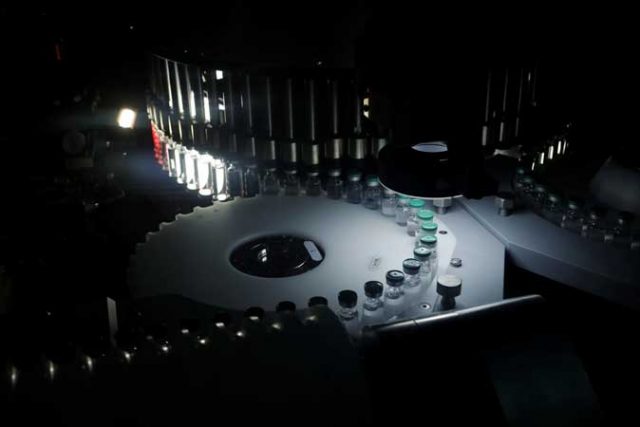
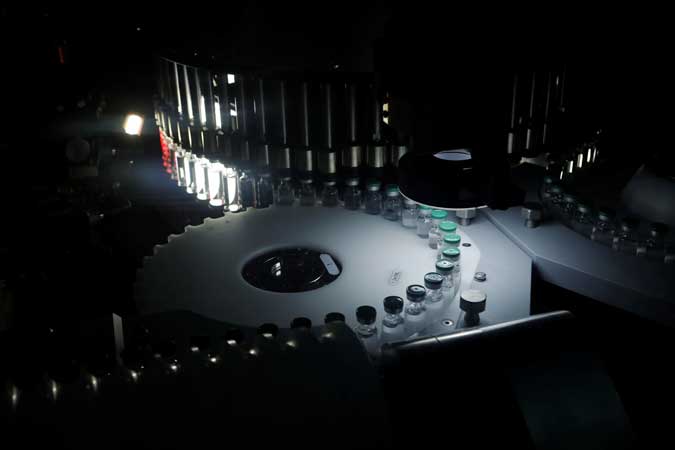
The Philippines is hoping to attract investments in science and technology sector. Photo shows vials of a coronavirus vaccine inside a lab at the Serum Institute of India, in Pune, India, Nov. 30, 2020. — REUTERS/FRANCIS MASCARENHAS
By Beatrice M. Laforga, Reporter
COMPANIES investing in science, technology and other sectors considered “critical” to the economy’s industrial revolution will be granted the longest period of incentives, according to the Fiscal Incentives Review Board (FIRB).
The FIRB last week adopted the Strategic Investment Priorities Plan (SIPP) framework, which sets the menu and length of perks for key industries eligible under the Corporate Recovery and Tax Incentives for Enterprises (CREATE) Act.
In a statement, the Department of Finance (DoF) said industries will be classified into three tiers based on their ability to make high-value and labor-intensive investments that will create more jobs and boost the country’s competitiveness.
Companies under Tier 3 will receive the longest period of incentives, with a total of 16-17 years of income tax holiday and special taxes or enhanced deductions for export companies and 11 years for domestic-focused businesses, based on a document sent by Trade Secretary Ramon M. Lopez on Sunday.
Export enterprise refers to a company who exports at least 70% of its total output, while domestic market enterprise should be registered with an Investment promotion agencies (IPAs).
The validity of tax incentives will also vary depending on the location of investments: shorter for those in the capital region and its nearby areas, while those in other areas will be longer by a year.
Tier 3 will include sectors that will play key roles in “structural transformation and industrial revolution” of the country, such as research and development activities; breakthroughs in health and science; generation of new knowledge; commercialization of patents, industrial designs, copyrights and utility models; and highly technical manufacturing activities.
Trade Undersecretary Rafaelita M. Aldaba said activities under Tier 3 would involve vaccine development and production; manufacture of 3D printers, drones, robots and electrical vehicles; predictive agriculture; new technologies; and innovative processes using artificial intelligence and machine learning.
For Tier 2, tax perks will be available for 15-17 years for export market activities and 10-12 years for local enterprises, while Tier 1 incentives will be available for 14-16 years for exporting companies and 9-11 years for those focused on domestic market.
Sectors under Tier 2 would include companies manufacturing supplies and parts not being produced in the Philippines, Ms. Aldaba said, adding this will promote local production and address gaps in the domestic supply chain.
For instance, production of iron, steel and non-ferrous metals, copper rods, plastics and synthetics in primary form, basic chemicals, pharmaceuticals, fiber optic cables, refined petroleum, semiconductor devices, and other electrical components, would be under Tier 2.
Ms. Aldaba said investments in Tier 1 sectors would generate a significant number of jobs, add value to products, and provide support to sectors critical to industrial development.
Tier 1 activities would include modern agriculture and food processing; design-focused industries like furniture, games and toys, jewelry and garments; energy efficiency and environment-friendly activities; health and medical products; industrial parks; and ports, airports and seaports.
Republic Act No. 11534 or the CREATE Act lowered the corporate income tax and reformed the country’s fiscal incentive system. Under the law, sectors that the government identified would enjoy income tax holidays for 4-7 years, then a special corporate income tax for 10 years.
Finance Secretary Carlos G. Dominguez III asked the Department of Trade Industry to select at least two potential foreign companies that are highly qualified in each tier level.
IPAs will then offer incentives to these companies to encourage them to set up operations in the country, Mr. Dominguez said.
Mr. Lopez said IPAs will serve as the “marketing arms,” on top of their existing function processing investment applications.
During the same meeting, the FIRB agreed that it will approve tax incentives for all investments worth at least P1 billion until the end of next year, while its technical committee will handle the approval for investments worth P1-3 billion starting 2023.
ECONOMIC BILLS Sought for comment, John Forbes, senior advisor of the American Chamber of Commerce of the Philippines, said the list of priority sectors is “very appropriate” for American investors.
“The Philippines has many attractions but so does its regional competitors. The SIPP approach has been thoroughly studied by the government and the Congress and is very sensible,” Mr. Forbes said in a mobile phone message.
“Because the world is still in an extended period of depressed FDI (foreign direct investments), it will take time to identify new investments and market new reforms the government is still making, especially PSA (Public Service Act) and Retail Trade Liberalization (RTL) Act,” he added.
President Rodrigo R. Duterte earlier certified as urgent three bills that will ease foreign investment restrictions in the country, namely the amendments to the PSA, RTL and Foreign Investments Act.
“While we believe there are merits to such a classification, the more important aspect when attracting foreign investments to the country lies in the passage of economic reforms such as the amendments to the PSA, FIA and RTL,” Nabil Francis, president of the European Chamber of Commerce of the Philippines, said via Viber on Sunday.
Passing these reform measures will not only drive economic growth and create jobs but also level the playing field for businesses and promote competition, Mr. Francis said.
However, Mr. Forbes said new investments should still come from businesses already present in the country such as those in electronics and business process outsourcing sectors.
THE Philippines needs to shift to flexible power plants and renewables, according to some experts, after rotating “brownouts” hit parts of Luzon last week.
Alberto R. Dalusung III, energy transition advisor of nongovernment organization Institute of Climate and Sustainable Cities, said the recent plant outages show that “reliability of our power plants is falling below expectations.”
The National Grid Corp. of the Philippines (NGCP) last week placed the Luzon grid under red alert for three consecutive days after four major coal plants cut more than 1,300 megawatts (MW) in available capacity.
Data from the Energy department showed that forced outages from four coal plants removed 1,314 MW of available capacity from the Luzon grid, while 435 MW from three units of a hydro plant were declared unavailable on Thursday. Meanwhile, some 484 MW was shaved off of KEPCO Ilijan Corp.’s gas power plant on the same day.
“We don’t need new baseload capacity…. The new plants that we need are renewables and (those that allow for) flexible generation or those which can adjust to varying levels of load,” Mr. Dalusung told BusinessWorld in a video call on June 4.
He noted that coal and natural gas plants are the ones that mainly provide baseload capacity.
“Coal is touted as one that (provides) cheap baseload capacity, and that it’s available 24/7. That’s not the only characteristic that we should bear in mind. The other characteristic is — not only is it available 24 hours in a day, you practically have to run it at that same level the whole day, every day. That’s not what our system needs,” Mr. Dalusung said.
Coal is considered as an inflexible plant, he said, because they can only adjust to a limited degree. “When they do that, they harm themselves because…you’re asking them to operate beyond their designed operating point,” he said.
Mr. Dalusung emphasized the country needs a grid which can deliver reliable power every day.
“If the country can generate power from various renewables, it only needs to run flexible power plants at certain hours of the day.”
On Thursday, the de-rated or reduced output of solar, hydro, geothermal, biomass and wind plants reached 1,558 MW. Of the amount, majority or 820 MW came from hydro plants. Mr. Dalusung said it is natural for hydro facilities to have low output during the summer season.
For his part, University of the Philippines Diliman Associate Professor Joey D. Ocon, who teaches energy engineering, told BusinessWorld in a June 4 e-mail that “the need for flexible power plants and energy storage is warranted with the increasing amount of variable renewables we are connecting to the grid.”
Green groups and consumer rights advocates cautioned against turning to fossil gas to ensure the country’s energy security.
In a statement, the Power for People Coalition said that the rotating blackouts and low power reserves is “a glimpse into sustained unreliability of power systems in the country, if it turns to another fossil fuel — natural gas — to address the Philippines’ power needs.”
Last month, the Senate committees on energy and finance approved of proposed Midstream Natural Industry Gas Development Act, which seeks to develop and regulate the industry.
WHO SHOULD BE BLAMED? Mr. Ocon said that while the lack of supply could have been avoided early, the blame should not fall on one company or agency.
“But there’s obvious negligence on why we do not have enough operating reserve in the middle of the pandemic, where the demand is supposedly lower than what was expected years ago,” he said.
Mr. Ocon said generation companies need to ensure that their plants are in top shape to avoid unplanned outages. Meanwhile, the government has to be “proactive” in reducing red tape while enticing investments that increase the country’s operating reserves.
He said power consumers are now placed at a “disadvantage since they now have to pay the price of incompetence and lack of foresight.”
Terry L. Ridon, convenor of public policy think tank Infrawatch PH, said that the Department of Energy (DoE) has yet to slap penalties on erring generators whose plants went offline in 2019 and caused red alerts.
“Consequently, it has no penalty mechanisms on power plants involved in the current red alert situation. We maintain that (these) mechanisms should be undertaken on power generators that have been involved in unplanned outages, and price fluctuations in the spot market as a result of their activities should not be borne by the public,” he told BusinessWorld in an e-mail on June 4.
Mr. Ridon said that generating companies involved in the unplanned outages should pay the additional spot market charges. “This should be their market penalty for failing to contract standby power supply in the event of unplanned outages,” he added.
On Friday, the DoE said that red alerts on the Luzon grid are still likely to happen until this week if power plants do not return to service.
THE Securities and Exchange Commission has extended to July 31 the deadline for the mandatory disclosures under Sections 6 and 8 of Memorandum Circular No. 01, Series of 2021 or the Beneficial Ownership Transparency Guidelines.
According to a notice on the commission’s website, the extension was given in consideration of the implementation of several lockdowns.
The circular provides transparency guidelines to prevent corporations from being misused for but not limited to money laundering and terrorist financing.
Section 6 covers required declarations for the incorporators, directors, trustees, and shareholders of stock and nonstock corporations applying for registration with the commission on or after the effective date of the circular, which fell on Jan. 29.
Under Section 6, a beneficial ownership transparency declaration (BOTD) form and consent agreement form are required for incorporators registering the corporation or on behalf of someone else, nominee incorporators, nominee directors or trustees, and nominee shareholders.
Nominee directors or trustees and nominated shareholders are required to disclose their principals, which may be a natural person or a juridical entity.
It must be made clear if directors/trustees/shareholders/incorporators are not nominees, and if the corporation was not applied for on behalf of another person. Non-nominated directors, trustees, shareholders, and incorporators of applicant corporations are required to submit a declaration and consent form.
Meanwhile, Section 7 of the circular requires nominee directors or trustees and nominee shareholders of existing stock and nonstock corporations to submit a BOTD form and a consent agreement form. — Keren Concepcion G. Valmonte
THE Securities and Exchange Commission (SEC) flagged Xian Coin, which is an unregistered “digital currency” promising big returns with Christian Albert Gaza or Xian Gaza as the sole issuer.
Xian Coin is said to be a centralized digital currency powered by the Etherium Blockchain traded exclusively by its coin holders. A blockchain or distributed ledger is a “peer-to-peer” database across computer networks, recording transactions that may never be altered.
“Unlike other digital assets which are decentralized and use consensus [mechanisms] such as proof-of-work/proof-of-stake or mining and whose value is dependent on supply and demand, Xian Coin is centralized, pre-mined or generated and whose supply and purported value is controlled by Xian Gaza,” the SEC said.
Xian Coin is not registered with the SEC as a corporation or as a partnership and it is also not authorized to solicit investments from the public.
It is also not registered as a Virtual Asset Service Provider with the Bangko Sentral ng Pilipinas, as required under Circular No. 1108, series of 2021, or the Guidelines for Virtual Asset Service Providers.
The advisory noted Xian Coin is not registered and traded with recognized cryptocurrency exchanges and has no particular use cases.
The commission also pointed to the “unsavory reputation” of Mr. Gaza to warn the public. Mr. Gaza apparently said he would be using the money generated from Xian Coins to support his “underground activities.”
Mr. Gaza has been the subject of another SEC advisory for his Cristiano Alberto Real Estate Fund.
The commission noted that Xian Coin does not have a white paper, which should detail how it will generate business, and neither does it have a working model that “[determines] how the money of the investors will make returns.”
“The scheme employed by Xian Coin clearly shows indication of a possible Ponzi scheme, where monies from new investors are used in paying ‘fake profits’ to prior investors and is designed mainly to favor its top recruiters and prior risk takers and is detrimental to subsequent member in case of scarcity of new investors,” the SEC said.
BusinessWorld sought comments from both Mr. Gaza and NYEAM VLOGS Facebook Page, where Xian Coin transactions are facilitated, but neither has responded as of writing.
The SEC reminded that those who are involved in the venture may be held criminally liable under the Securities Regulation Code, and may face a fine of up to P5 million, may be jailed for 21 years, or both. — Keren Concepcion G. Valmonte
SOME of the outfits shown during the Panasonic Manila Fashion Festival by: Bessie Besana — PHOTO FROM PMFF WEBSITE
1 of 6
SOME of the outfits shown during the Panasonic Manila Fashion Festival by: Bessie Besana — PHOTO FROM PMFF WEBSITE
Mark Rancy — PHOTO FROM PMFF WEBSITE
Alodia Cecilia — PHOTO FROM PMFF WEBSITE
Benjie Panizales — PHOTO FROM PMFF WEBSITE
Dexter Alazas — PHOTO FROM PMFF WEBSITE
Benjie Panizales — PHOTO FROM PMFF WEBSITE
PMFF relaunches fashion shows at an empty Okada
By Joseph L. Garcia, Reporter
IT SHOULD be of no surprise that fashion shows and fashion itself were asleep last year, when we launched PPEs at work or lounged in pajamas at home. As society opens again slowly, we try to see what it would be like to step out again in our threads.
The Panasonic Manila Fashion Festival (PMFF) relaunched its show series last week. It had been active from 2014 to 2019, but went into slumber like the rest of the fashion world in 2020. While globally, the fashion industry had been able to stage shows in unconventional venues and platforms (Moschino’s puppet fashion show comes to mind), Manila hasn’t been able to catch up: this reporter recalls attending only two Filipino shows last year, both online: one by designer Rajo Laurel, and another through Singapore’s first virtual fashion show, streamed through thefrontrow.style, featuring Filipino talents Jojie Lloren, Paolo Raymundo, Ezra Santos, Bea Samson, and Furne Amato.
PMFF called its 12th season “A Fashion Reboot.” The title seems apt in more ways than one: PMFF used to be held by impresario Art Personas, but has since shifted management to its new organizer, Go Lifestyle Group, according to its website.
Still, the goals are the same: to bring Filipino fashion to the world (a much easier task thanks to streaming) but also collecting talents from all over the Philippines (as opposed to focusing on designers based in the capital).
Day 4 of the show series showed Bessie Besana’s collection, “Pavement,” predictably in grays. Blues were thrown into the mix, executed as a blue floral print on a black background. As for the silhouettes, there was a surprising boiler suit for men, which shows a cheerful look into a possible dystopia (or that’s just the pandemic creeping on to me).
Uniformly, across all collections in Day 4 and 5, we see a relaxed, loosened fit, which points to two factors: the youth are rediscovering the baggy styles of the late 1990s and early 2000s; but also that the relaxed styles and fits of pandemic loungewear has trickled up from sofas to runways.
Chris Diaz’s collection, “Neo Desiderium,” fights the sobriety of the first show with bright outfits trimmed with, of all things, feathers. Dexter Alazas makes a case for fun with attractive and functional pieces in what I call the new neutral — leopard print.
Some designers, however, have a bit of an out-of-touch extravagance during these times. I completely understand bright tones and trimmings, but I certainly can’t imagine huge ballgowns at a time like this; and neither the annoying tendrils of fabric extending from the shoulder and trailing on the floor, seen on the looks of at least three more designers. I can’t quite imagine anyone wanting to wear a potential safety hazard, with or without a pandemic; plus the fact that there are hardly any parties to go to and show off. I imagine a scenario where these gowns could go into the night, into a better world, and they’d still be outsized and ill-constructed.
We’re not making a case against luxury: there’s a lovely tulle dress by Mark Rancy, that, while using a questionable bubblegum color palette, has a weight and silhouette perfect for walking around your own home reminiscing about the chatter of parties.
On another note, Steph Tan’s collection, “Spill The Tea” (a play on an idiom for gossip) is perfectly polite and girlish, with a palette of pastels and details like ruffles and bell sleeves. The collection is perfect for the garden parties and weddings that have come to dominate the scene since the pandemic began.
Alodia Cecilia’s collection, meanwhile, makes a case for appropriate, sober luxury: while her palette speaks of sunshine, tones like mustard are splashed on to well-cut shift dresses beneath white coats, bubble-hemmed hoodies paired with blush-toned shorts, and, a personal favorite, hooded sweaters beaded in the baroque style, combining magisterial extravagance with functionality and comfort.
Benjie Panizales also looks towards the local with a collection called “Thrive My Tribe,” showcasing indigenous fabrics on such delightful pieces as a fire-alarm red cocoon-sleeved pantsuit.
The shows were shot at an eerily empty Okada, along walks, fountains, and pools once filled with people. The outdoor setting, at least, can be used to its full advantage, such as a moment during Mr. Panizales’ show where a gray silk vest was whipped into a frenzy by the wind, showing off multiple possibilities where the outfit might be worn. Gil Macaibay III’s collection, simply titled “Hope,” shows chili-red youthful outfits (and some mustard — must be a trend), but also these well-constructed tulle outfits.
Mavy de Leon Ladlad, with a collection romantically called “Kiss of the Silver Moon,” starts strong with a silver evening dress with a flowing cape (perhaps my earlier distaste from shoulder-based ornamentation comes from bad construction); and follows up with a line of silver evening wear for both men and women.
Here was also a familiar shade of blue — former Miss Universe and Albert Andrada really did a number by winning a pageant in that blue dress, now all one can ever think about when one sees a tall woman in royal blue is that she’s out there to win something. A model for this collection already looked like she won a prize, thanks to a blue number with a really, really big bow.
RATES of government securities on offer this week could move downward on strong investor demand and following the release of data showing steady inflation in May.
The Bureau of the Treasury (BTr) is looking to raise P15 billion via its offer of Treasury bills (T-bills) on Monday, broken down into P5 billion in 91-day debt, P5 billion in 182-day papers, and P5 billion from the 364-day securities.
On Tuesday, the BTr will offer P35 billion in reissued seven-year Treasury bonds (T-bonds) with a remaining life of six years and 10 months.
A bond trader said the yields of the T-bills on offer on Monday will decline by 5 to 10 basis points (bps) due to the lower volume on offer and as inflation remained steady in May.
The government wants to raise P215 billion from the local debt market this month: P75 billion via weekly offers of T-bills and P140 billion from weekly auctions of T-bonds.
This is bigger than the P170-billion program for May, which was broken down into P100 billion from T-bills and P70 billion from T-bonds. The government adjusted the volume of the weekly T-bill offerings to P15 billion from P25 billion previously and scheduled a T-bond auction per week instead of fortnightly.
Meanwhile, inflation was steady for the third straight month at 4.5% in May, matching market expectations.
The figure was within the 4-4.8% estimate by the Bangko Sentral ng Pilipinas (BSP) for that month and also matched the median estimate in a BusinessWorld poll.
Year to date, inflation was 4.4%, higher than the 2-4% target of the BSP and its revised forecast of 3.9% for the year. May was the fifth month in a row that inflation went beyond target.
On the other hand, the trader expects the reissued seven-year bonds on offer on Tuesday to fetch a rate between 3.75% and 3.875%.
“There are more factors to consider for this one — how convinced the market is on the phase of reopening of economy and the tone of US Treasury yields come day of auction,” the trader added.
The BTr raised P21 billion from its offer of T-bills last week, higher than its P15-billion program, after it accepted more non-competitive bids for all the tenors amid a decline in rates.
Total bids for the short-tenored securities stood at P87.173 billion on Monday, making the offering over five times oversubscribed.
Broken down, the Treasury awarded P7 billion in 91-day debt papers, higher than the initial offer of P5 billion, as it accepted P4 billion in non-competitive bids versus the original program of P2 billion. Tenders for the tenor reached P22.15 billion.
The three-month T-bills fetched an average rate of 1.235%, down by 3.4 bps from the 1.269% quoted previously.
The Treasury likewise borrowed P7 billion from the 182-day T-bills versus the P5-billion program after bids hit P27.41 billion. The average rate of the six-month papers went down by 6.9 bps to 1.472% from 1.541%.
Lastly, for the 364-day securities, the government awarded P7 billion, up from the P5-billion plan, as the tenor attracted tenders worth P37.613 billion. The one-year papers were quoted at 1.723%, 7.3 bps lower than the 1.796% seen in the previous auction.
Meanwhile, the reissued seven-year bonds on offer on Tuesday were first offered on April 21, where the Treasury raised P35 billion as planned. Total tenders reached P90.386 billion, making the offer 2.6 times oversubscribed.
The seven-year notes fetched a coupon rate of 3.625% at that auction.
At the secondary market on Friday, the 91-, 182-, and 364-day T-bills were quoted at 1.3026%, 1.4738%, and 1.7548%, respectively, while the seven-year bond fetched a rate of 3.6775%, based on the PHL Bloomberg Valuation Reference Rates published on the Philippine Dealing System’s website.
The government is looking to borrow P3 trillion from domestic and external sources this year to help fund a budget deficit seen to hit 8.9% of gross domestic product. — IBC
THE high court has affirmed the Court of Tax Appeals’ (CTA) decision for the Commissioner of Internal Revenue (CIR) to refund Philex Mining Corp.’s P18.6-million unutilized and excess input value-added tax (VAT) attributable to its zero-rated sales for the fourth quarter of 2009.
In its ruling dated Jan. 18 and made public on May 26, the Supreme Court (SC) said it found “no reversible error” in the assailed CTA decision.
It also ruled that it need not review Philex’s substantiation of its claim for refund as the CTA had already proven its validity and because the SC “is not a trier of facts.”
The Court also found “no merit in the CIR’s contention that Philex’s judicial claim was premature or that its supporting documents were incomplete” as Philex observed the rules for timely claim of refund under Section 112(c) of the National Internal Revenue Code (NIRC) and submitted complete documents.
Further, under the NIRC, the CIR has to decide on the application for a tax refund within 120 days from the date of submission of complete documents.
If it fails to do so, the taxpayer may appeal the unacted claim with the CTA.
The Court also said in its decision that the CIR could have asked Philex to submit additional documents within the 120-day period, but it failed to do so.
Meanwhile, the completeness of documents for the start of the 120-day period was clarified in the Bureau of Internal Revenue’s Revenue Memorandum Circular No. 49-2003 as being ultimately determined by the taxpayer. — Bianca Angelica D. Añago
ADIDAS’ 30-plus collection ‘Love Unites’ draws inspiration from the DIY culture that has played an important role in LGBTQ+ sport communities.
1 of 2
ADIDAS’ 30-plus collection ‘Love Unites’ draws inspiration from the DIY culture that has played an important role in LGBTQ+ sport communities.
ADIDAS’ 30-plus collection ‘Love Unites’ draws inspiration from the DIY culture that has played an important role in LGBTQ+ sport communities.
IN CELEBRATION of Pride Month 2021 this June, adidas recently released its “Love Unites” collection in the local market.
A 30-plus collection, Love Unites draws inspiration from the do-it-yourself (DIY) culture that has played an important role in LGBTQ+ sport communities. It was also released alongside a global campaign spotlighting influential members and allies of the community.
The collection is an extension of the first-ever adidas Pride Pack released in 2015, which served to symbolize the brand’s rich history in sport and merging it with its long-standing support for the LGBTQ+ movement.
The DIY aesthetic highlighted in Love Unites, adidas said, features fluid geometries and expressive and layered graphics.
These can be seen in special Pride colorways of classic adidas silhouettes like Nizza, Forum, UltraBoost 5.0 DNA and AdiZero Pro V1 as well as a colorful lineup of apparel from bucket hats and jumpsuits to sports bras, shorts, and jerseys.
adidas said in coming up with its latest Pride Pack, it was also important that it gets to sustain its push in helping break down barriers for LGBTQ+ communities, including ending homophobia and transphobia in sport, which they have been doing in partnerships with organizations like Athlete Ally and Stonewall UK.
For this year’s “Love Unites” campaign, it has teamed up with a collective of athletes and artists who have made strides forward as champions of inclusivity.
They include Layshia Clarendon, the first openly transgender professional basketball player; Amanda Zahui B, professional basketball player and vocal supporter of the Black Lives Matter movement; Ashlyn Harris and Ali Krieger, professional soccer players, teammates, and married couple; Tom Daley, former world champion 10m diver and current World Series champion; Thebe Magugu, aSouth African fashion designer; and Cody Rigsby, a famed fitness trainer.



 SM Foundation’s Scholarship Program, which was established in 1993, aims to contribute in eradicating the intergenerational cycle of poverty in the country by giving scholarship grants to poor but deserving students. It has already produced almost 7,600 college and tech-voc scholar-graduates — enabling them to uplift the lives of their families out of poverty.