Home Blog Page 7970

Mines regulator proposes 3-5% royalties for mining operations outside reservations

THE MINES and Geosciences Bureau (MGB) said it supports a bill that would extract royalties for those mining outside designated mineral reservations.

At a hearing of the House Committee on Natural Resources Wednesday, MGB Director Wilfredo G. Moncano said that only those within mineral reservations currently pay mineral royalties of 5%.

“Those outside mineral reservation areas do not pay this 5%. These operations are about 75% (of the industry). There are more (miners) outside the mineral reservation areas that are not paying mineral royalties,” Mr. Moncano said.

Mr. Moncano said the royalties will be a readily-available source of added to the government.  

“We are proposing between 3-5% royalties for those outside the mineral reservation areas,” he added.

Rowena S. Sta. Clara, a representative from the Department of Finance (DoF), said during the hearing that the department also backs such a royalty scheme.  

“We are also proposing the imposition of mining royalties both inside and outside mineral reservation areas, applicable to metallic and non-metallic minerals in both small- and large-scale mines,” Ms. Sta. Clara said, noting that the DoF also backs a range of 3-5%, but implemented in phases.

“We propose that the first year be at 3%, the fourth year 4%, and the fifth year 5% for those outside mineral reservations,” Ms. Sta. Clara said.

On April 14, President Rodrigo R. Duterte signed Executive Order No. 130 that lifted the ban on new mineral agreements.

The government has said that 100 mining projects are in the pipeline, estimated to generate P21 billion in revenue which can be used to fund the government’s pandemic response.  

The MGB estimates that the value of metallic mineral output in the first quarter rose 14.11% to P28.91 billion.

Nickel ore and other nickel-by products accounted for 47.12% or P13.62 billion, followed by gold at 40.49% or P11.71 billion, copper 11.51% or P3.33 billion, and silver, chromite, and iron ore less than 1% or P254.92 million. — Revin Mikhael D. Ochave


Cavite extends deadline for Sangley bid documents

PHILSTAR

By Arjay L. Balinbin, Senior Reporter

CAVITE PROVINCE has extended by 45 days the deadline to buy bid documents for the Sangley Point International Airport project, citing the need to provide more time due to the quarantine.

“In view of the GCQ (general community quarantine) status with heightened restrictions for NCR (National Capital Region) Plus including the province of Cavite up to May 31, the deadline for the purchase of the RFP (request for proposals) and the registration of candidate joint venture partners is extended further by 45 days from May 14. The new deadline is June 28, 2021,” Cavite’s Public-Private Partnership Selection Committee Legal Officer Jesse R. Grepo told BusinessWorld by phone Monday.

He said the joint venture proposal and bid submission deadlines are also extended with the new deadlines to be announced later.

The province had initially targeted to sign the joint venture and development agreement by around July 1.

The responsibilities of Cavite’s joint venture partner include an equity investment and accessing debt financing.

The selected partner should also contract out or perform engineering, procurement, and construction services for the land and airport development components of the 1,500-hectare Sangley airport project.

Lucio C. Tan’s MacroAsia Corp. and its partner China Communications Construction Co. Ltd. negotiated with the province for the project last year, but the latter cancelled its notice of selection and award due to the “various deficiencies in the submission of requirements to conclude the joint venture agreement.”

Water franchise bills remove 12% cap on returns

PHILIPPINE STAR/GEREMY PINTOLO

THE PROPOSED franchises to be granted to the two water companies serving the National Capital Region will not cap the concession-holders’ returns at 12%, in contrast to their recently-signed revised water agreements with the government, a senior legislator said Wednesday.

“These bills as they currently stand contain no mention of this cap and may provide the concessionaires a means to earn more than that set by law and the Revised Concession Agreement,” Deputy Speaker Bernadette Herrera-Dy said in a statement.

She added that the prospective franchise holders must “prove” themselves to be “worthy,” after the bills regulating their proposed franchises were approved on second reading May 25. 

Ms. Herrera-Dy said Manila Water Co., Inc. and Maynilad Water Services, Inc., “must prove themselves worthy of a franchise as a public utility, answerable not to Congress but to the Filipino people.” 

She said the companies must meet the standards for public utilities, calling their services critical for the public.

“We must ensure that these franchises respect and retain these numerous safeguards of the Revised Concession Agreement and in fact I urge that these safeguards be implemented in future franchise agreements or renewals of water public utilities,” Ms. Herrera-Dy said.

“Should these concessionaires not win (franchises), then a company truly deserving of a franchise shall be issued one by Congress,” she added.

Manila Water and Maynilad signed their revised water concession contract with the government with the Metropolitan Waterworks and Sewerage System on March 31, 2021 and May 18, 2021, respectively. — Bianca Angelica D. Añago

Customs exceeds May target as collections top P49B

THE Bureau of Customs (BoC) exceeded its collection target in May by 6.6% after collecting P49.334 billion on the strength of a revised import valuation system, and improved volumes, the agency said in a statement Wednesday.

The preliminary collection total was also 60.4% higher year on year, with all the months of 2021 running above target.

“The BoC’s positive revenue collection performance is attributed to the improved valuation and volume of imports, and the intensified efforts of all the ports to prevent revenue leakage and collect all lawful revenues,” the agency said.

It said 12 out of 17 collection districts exceeded their collection targets for the month: the ports of Batangas, Cagayan de Oro, Clark, Davao, Iloilo, Legaspi, Manila, San Fernando, Subic, Surigao, Tacloban, and the Manila International Container Port.

Customs collected P249.79 billion in the first five months, 2.1% higher than its goal for the period and exceeding year-earlier levels by 18.7%.

The five-month revenue total is the equivalent of 40.5% of its P616.749-billion collection target for 2021. — Beatrice M. Laforga

FDA releases over 400 delayed drug approvals

REUTERS

THE Food and Drug Administration (FDA) released more than 400 drug applications after it was issued a show-cause order seeking an explanation for the delay by the Anti-Red Tape Authority (ARTA).

ARTA said that the FDA drug regulation center released 408 out of 412 automatic renewal applications, with four pending due to incomplete submissions or after re-routing to other FDA units.

An Ambica International Corp. application submitted in 2017 was approved on May 28, ARTA said in a statement Wednesday.

ARTA last month issued a show-cause order to the FDA for delays in processing 600 drug applications, requiring the drug regulation center to conduct an inventory of all pending permits, release pending applications, and submit a compliance report to ARTA.

Several pharmaceutical firms signed affidavits detailing delays on their applications submitted as far back as 2014.

“The (FDA) is now evaluating (the center for drug regulation’s) reply before recommending an appropriate action,” the agency said.

ARTA added that it is calling on the public to submit affidavit complaints on pending applications with government agencies. — Jenina P. Ibañez

IPOPHL signs partnership with Ateneo Law School

THE intellectual property (IP) office has entered into a partnership with Ateneo de Manila University’s law school to improve the IP skills of the law school’s student body.

The Intellectual Property Office of the Philippines (IPOPHL) will support the law school in seeking accreditation with the World IP Organization in promoting its programs to prospective international students.

Through an agreement signed on May 28, the two organizations plan to collaborate to ensure that Ateneo’s Master of Laws program and other professional programs “maintain an international standard of knowledge and skills relevant to global and local IP laws and trends,” IPOPHL said in a statement Wednesday.

IPOPHL plans to promote the graduate program to its government and private sector partners, and it will look into training its own personnel through the program.

In turn, Ateneo Law School will encourage students to take up an internship in IPOPHL, promote the agency’s training programs, and support IP-related research project. The school will also explore scholarship and grant options.

“It is such a privilege to join hands today with the Ateneo Law School and secure its commitment to help IPOPHL in its mandate of promoting IP as a tool for technological progress and economic growth,” IPOPHL Director General Rowel S. Barba said. — Jenina P. Ibañez

Fitch Solutions sees nickel supply increasing due to growth in Indonesian output 

FITCH SOLUTIONS said the supply of nickel is expected to rise because of  a 33% year-on-year increase in Indonesian output, and forecast prices to average $16,500 per ton this year.

In a report, Fitch Solutions said its previous forecast of $18,180 per ton was adjusted after prevailing year-to-date prices slipped below that level to about $17,382 per ton, as Indonesian production rose.

“We forecast Indonesian nickel metal production to experience 33.0% year-on-year growth in 2021, and Chinese nickel inventories at seven key ports have begun to show signs of increasing likely for the remainder of the year with domestic mining activity recovering at the end of the rainy season in the Philippines,” it said in the report.

Fitch Solutions said Chinese demand for nickel, used in stainless steel production, remains strong, with that country’s stainless steel output up 23.5% year on year in the first quarter.

In the Philippines, Fitch Solutions said nickel ore prices dropped between 11.5% and 21% from their March levels but were stable in May.

“(This is suggesting) looser demand dynamics, in combination with recovering mining activities following the end of the rainy season” in parts of the Philippines where the mineral is mined. Solid growth in demand in 2021 will keep the overall nickel market in deficit, pushing prices above the 2020 average of $13,860 per ton up to $16,500 per ton,” Fitch Solutions said.

Over the long term, Fitch Solutions said nickel prices are expected to rise gradually with the global supply-demand balance still negative.

“Nickel demand is expected to remain supported, particularly due to China, as the construction and autos industries continue to grow,” Fitch Solutions said.

“The rise in demand will exceed production growth in the short term, underpinning a prolonged deficit in the market, pushing prices higher. Rising prices will then incentivize smelters to ramp up output over the long term, pushing the market deficit back into balance,” it added.

Fitch Solutions said the electric vehicle market will also be a demand driver for nickel, adding that manufacturers are starting to use more nickel in batteries.

“We expect this trend to begin taking hold over the coming years as consumers favor electric vehicles with longer range between recharges, making nickel-based battery compositions the optimal choice for vehicle producers,” Fitch Solutions said.

Asked to comment, Nickel Asia Corp. Vice-President for Corporate Communications Jose Bayani D. Baylon said the projections are expected to have little impact on the company.

“Our targets are based on our long term mine plans, so they’re not affected by this report. Our sales volume has averaged around 18.7 million wet metric tons (WMT) in the last five years,” Mr. Baylon said.

“The Fitch report in general reflects our own positive outlook about our business — whether in the short medium or long term,” he added. — Revin Mikhael D. Ochave

House bill extending Bayanihan II validity wins 2nd reading approval

PHILIPPINE STAR/ MICHAEL VARCAS

HOUSE BILL 9538, which extends the validity of funds authorized by Republic Act (RA) No. 11494 or the Bayanihan to Recover as One Act (Bayanihan II), has been approved by the chamber on second reading.

The extension runs until the end of 2021. They had been due to expire on June 30. The law’s original spend-by date was Dec. 9, 2020, before the June extension was granted with the signing of RA 11519 in January.

Bayanihan II is a P165.5-billion economic stimulus measure seeking to aid sectors hit hardest by the coronavirus disease 2019 (COVID-19) pandemic.

P140 billion was sourced from general appropriations and the remaining P25.5 billion is contingent on fund availability.

 According to the Department of Budget and Management, as of April 15, 2021, only 51.1% of Bayanihan II funds have been obligated.

 The House of Representatives’ second regular session will go into sine die adjournment on June 4. — Bianca Angelica D. Añago

Quorum misconception

In simple terms, a quorum is the minimum number of attendees required to be present before an official meeting can take place. Without it, a meeting by the organizers and participants may be questioned for being legally infirm or defective. The foundation of this principle in corporate law is Section 51 of the Corporation Code, which defines a quorum as that consisting of the stockholders representing a majority of the outstanding capital stock or a majority of the members in the case of non-stock corporations. Having this in mind, does a quorum always require a majority or 50% plus 1? For instance, can one/third (1/3) of the outstanding capital stock or the members be considered a quorum?

In a recently issued Securities Exchange Commission (SEC) opinion, a non-stock, non-profit, condominium corporation sought confirmation on its intention to amend the quorum requirement in its by-law provisions on members’ meetings. Prior to the amendment, the by-laws stated that the presence of members in good standing, representing at least a majority of the relevant number of units entitled to be represented and vote at the meeting, shall constitute a quorum.  In the proposed amendment, however, the condominium corporation sought to lower the requirement, such that the presence of members in good standing, representing at least 30% of the relevant number of units entitled to be represented and vote at the meeting, suffices to constitute a quorum.

Ruling in the affirmative, the SEC declared that stock corporations or non-stock corporations are authorized to define what constitutes a quorum based on its by-laws, citing two other opinions in support of its argument. Nevertheless, the provision in the by-laws relative to quorum will not hold in those instances where the Corporation Code or applicable special law explicitly prescribes a higher proportion of stockholders or members necessary to resolve or carry out a particular corporate proposal. Thus, any corporation, whether stock or non-stock, is authorized to provide in its by-laws a specific number of stockholders or members necessary to constitute a quorum for the transaction of corporate business, except in cases where the law requires a minimum stockholders’ or members’ vote for a certain corporate action (e.g., two-thirds of the stockholders representing the outstanding capital stock or the members in case of amendment of articles of incorporation), which would in effect be the required quorum.

Thus, in response to the query, the SEC confirmed that the condominium corporation can indicate in its by-laws 30% as necessary to constitute a quorum for the transaction of corporate business, even if the same is less than the majority of all its members.

It is worthy to note that the guidelines are strictly for stockholders or members’ meetings only.  It does not apply to, and should not be confused with, the quorum for regular or special meetings of the board of directors or trustees.  Under Section 52 of the Corporation Code, unless the Articles of Incorporation (AoI) or the by-laws provide for a greater majority, a majority of the directors or trustees as stated in the  AoI shall constitute a quorum to transact corporate business, and every decision reached by at least a majority of the directors or trustees constituting a quorum, except for the election of officers which shall require the vote of a majority of all the members of the board, shall be valid as a corporate act. A careful reading of the provision implies that quorum for regular or special meetings of the board of directors or trustees shall be the majority of the number appearing in the AoI unless a greater majority is indicated in the AoI itself or the by-laws.  Therefore, lowering the quorum to less than the majority is not sanctioned by the law.

In the interest of convenience, and while the above precedents may serve as bases for corporations to fix a specific number of shares or members to constitute a quorum lower than the majority, it rarely happens in actual practice. The by-laws would often require at least a majority or even two-thirds of the outstanding capital stock or members as the quorum for the meeting, thereby giving a false impression that it should always be the majority.  It comes as no surprise though due to practical considerations.  For one, providing a quorum of majority of the outstanding shares or members ensures that the will of the majority of shareholders or members is adequately represented.  Or, in the case of a publicly-listed company already subject to additional reportorial requirements and stricter rules, having a quorum of only 10% of all its outstanding capital stock would invite scrutiny.  Regardless of the reason, as we have learned by now, majority is not always the rule. Corporations are authorized to define what constitutes a quorum based on its by-laws unless otherwise specified by the law. As a good rule of thumb, we should be wary of the fallacy of the common notion — or should I say the quorum misconception.

The views or opinions expressed in this article are solely those of the author and do not necessarily represent those of Isla Lipana & Co. The content is for general information purposes only, and should not be used as a substitute for specific advice.


Reynaldo Q. Marquez, Jr. is a manager with the Tax Services Group of Isla Lipana & Co., the Philippine member firm of the PwC network.

+63 (2) 8845-2728

reynaldo.q.marquez.jr@pwc.com

Spirit of resiliency motor behind NCAA Season 96, says official

By Michael Angelo S. Murillo, Senior Reporter

ANCHORED on the spirit of resiliency, the National Collegiate Athletic Association (NCAA) is pushing through with the staging of its Season 96.

This was reiterated by Fr. Vic Calvo, OP of host Colegio de San Juan de Letran in his session on the online Philippine Sportswriters Association Forum on Tuesday as they gear up for the league’s opening of its new season on June 13.

Fr. Calvo shared that while the pandemic still has the local sporting community limited in what it can do, they in the NCAA feel that they have to push through to show that it can be done; that collegiate sports can move forward amid the prevailing conditions if carefully planned and within set parameters.

“While others have decided to cancel their season, we in the NCAA from the start believed that there will be a season. We did not think of canceling,” said Fr. Calvo, who was joined in the forum by NCAA Management Committee member Peter Cayco of Arellano University.

“This is about rising up, to show that even with the pandemic, we’re not down. Despite odds, we will push through with this season,” he added.

NCAA Season 96 will be conducted under the banner theme of “Rise Up Stronger” and tweaked to adapt with the current situation with the pandemic.

For now, the league, the country’s oldest, will be staging virtual competitions which include those for chess and taekwondo (poomsae and speed kicking).

Later on, after further clarification from government authorities and other league stakeholders, virtual basketball and volleyball skills challenges will be staged.

Fr. Calvo admitted that the staging of Season 96 will be different from the traditional way of doing things for the league, but said the NCAA has to do some pivoting to continue functioning.

The league official also expressed excitement over their newly formed link-up with new broadcast partner GMA Network.

Fr. Calvo said their collaboration so far has been fluid, allowing their vision for Season 96 to come to life.

“This will be one of the best, if not the best, opening the NCAA will ever have in its history. Considering our situation with the pandemic, creativity and resiliency are needed, which I think we were able to do with GMA,” he said.

Recently, GMA launched Rise Up Stronger: The Road to NCAA Season 96, a 21-episode primer on GTV which serves to drum up interest for the return of the NCAA from the pandemic-forced break.

Meanwhile, league officials said they might include the inoculation process as part of the eligibility requirements to guard against the spread of the coronavirus.

“Discussions are ongoing on it (vaccination),” said Fr. Calvo.

Mr. Cayco, for his part, added that they are carefully evaluating their options so as to come up with the best possible setup for including the vaccination process in the eligibility requirements.

“We recognize the rights of the students to choose whether they will be vaccinated or not. But we also have to consider the rights of the other students who want to,” he said, adding the NCAA is in consultation with the league’s lawyers in order to avoid any legal issue about the matter.

The league is also conducting an information campaign to allay fears of students of getting vaccinated.

The NCAA abruptly ended its Season 95 in March last year as the pandemic started to make its presence felt in the country.

Affected sports were those scheduled for the second semester, which include indoor volleyball, football, lawn tennis, soft tennis, track and field, beach volleyball and cheerdance competition.

Kiefer Ravena signs with Japan B.League team, too

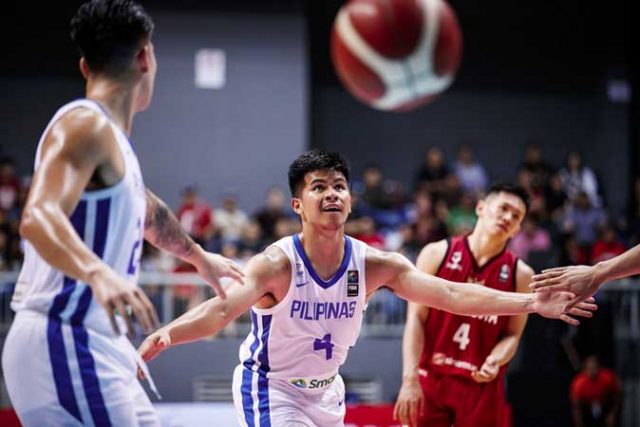
KIEFER RAVENA has been signed by the Shiga Lakestars to play in the Japan B.League, the team announced on Wednesday. — FIBA

IF plans push through, make it two Ravenas playing in the Japanese basketball league.

In a surprise announcement on Wednesday, Japan B.League team Shiga Lakestars relayed on social media that it has signed Kiefer Ravena to play for them in the 2021-22 season.

The development will see Mr. Ravena play in the same league as his younger brother Thirdy, who made his B.League debut this year with the San En NeoPhoenix team.

In signing Mr. Ravena, the Lakestars took note of his showing in FIBA-sanctioned tournaments as well as the large following the player has as a player.

With Shiga, Mr. Ravena, part of the NLEX Road Warriors in the Philippine Basketball Association (PBA), will join a team which finished last season with a 23-36 record in the West region of the B.League. He will play in the same region as his brother.

Mr. Ravena is set to be formally introduced by Shiga in a press conference set for Monday next week.

News of Mr. Ravena playing in Japan came out early this year, with no less than NLEX coach Yeng Guiao confirming the news that his player got a good offer to play in Japan.

The coach said they are aware of Mr. Ravena’s desire to pursue the opportunity presented to him, but said it was going to be easier said than done as a number of requirements had to be met before it becomes a reality.

The Road Warriors have yet to issue a comment on the latest development and the status of Mr. Ravena’s contract with the team, with whom he signed an extension with last year.

PBA Commissioner Willie Marcial, however, said under existing rules, Mr. Ravena playing in Japan is going to be tricky.

“Under PBA rules, it is not allowed since he is under contract,” the league chief said.

Mr. Ravena was selected second overall by NLEX in the 2017 rookie draft. He saw his full takeoff in the PBA derailed when he was imposed an 18-month suspension by FIBA for testing positive for banned substances during one of its tournaments.

In the PBA’s tournament “bubble” last season, Mr. Ravena and the Road Warriors narrowly missed the playoffs with a 5-6 record. He posted averages of 19.4 points, 5.5 rebounds, 4.6 assists, and a steal throughout their bubble run.

The Japan B.League usually starts its season in October where competing teams play a set of home and away matches in the regular season. It has become a viable option for Filipino players of late as the league allows the hiring of Asian imports. — Michael Angelo S. Murillo

Terrafirma looks forward to having top rookie back for training

THE TERRAFIRMA Dyip are looking forward to having top rookie pick Joshua Munzon back in training after he represented the country in the recent FIBA 3x3 Olympic Qualifying Tournament. — FIBA

IN the thick of their preparation for the Philippine Basketball Association’s (PBA) Season 46, the Terrafirma Dyip are looking forward to welcoming back top rookie pick Joshua Munzon in training.

Away from his mother ball club for some time as he went on a tour of duty with the national men’s three-a-side team at the recently concluded International Basketball Federation  (FIBA) 3×3 Olympic Qualifying Tournament (OQT) in Austria, Mr. Munzon arrived in the country this week but have to undergo quarantine first before being able to rejoin Terrafirma.

“Maybe by the second week of June, he gets to join the team,” Terrafirma coach Johnedel Cardel was quoted as saying by the official league website.

Mr. Munzon was drafted by the Dyip first overall in the regular rookie draft early this year.

The country’s top 3×3 player, Mr. Munzon, who also made waves during his stint in the PBA D-League, is hoped to be among the key pieces in Terrafirma’s “rebuilding.”

He is expected to help cushion the departure of league-leading scorer CJ Perez, who the team traded in the offseason to San Miguel for the latter’s picks in this year’s draft and next season and a host of complementary players.

Terrafirma got big man James Laput with the eighth pick it got from the Beermen while another player, Filipino-Australian Jordan Heading, was selected first in the special Gilas Pilipinas draft by the Dyip and is currently on loan to the national team.

Mr. Munzon is coming off a tough FIBA OQT campaign where they finished dead-last in the tournament.

The Philippine team, composed of Messrs. Munzon and Perez and Mo Tautuaa (San Miguel) and Leonard Santillan (Rain or Shine), was not able to get its collective game going and went winless in their four matches, with an average losing margin of 7.75 points.

Mr. Munzon was among the top scorers in the competition with 27 total points, good for sixth place overall, but it was not enough to tow his team to a win.

Terrafirma is currently holding scrimmages as part of its preparation for PBA Season 46 in Batangas City in accordance with existing government policies that require the league to do such activities in areas under Modified General Community Quarantine (MGCQ).

EXPANDED ACTIVITIES
Meanwhile, the PBA is batting to expand training activities it can do in preparation for its new season.

The league is eyeing a setup of team workouts by small batches in the National Capital Region as an added option for teams to their regular sessions and scrimmages done outside the NCR and nearby provinces of Bulacan, Rizal, Cavite and Laguna, collectively dubbed NCR Plus.

NCR Plus remains under GCQ with “heightened restrictions” until June 15, preventing member PBA teams from taking their preparation fully in Metro Manila.

PBA chief Willie Marcial said they have communicated to concerned national government agencies as to their plan and are hoping to get a favorable response.

“Hopefully at least, the individual training in NCR gets approved,” Mr. Marcial said.

The PBA is targeting to start its Season 46 in late June or early July so as to allow it to have two conferences this year.— Michael Angelo S. Murillo