Home Blog Page 796

Money lost to flood control scam could have funded climate mitigation — Oxfam

PILIPPINE STAR/MIGUEL DE GUZMAN

FUNDING lost to corruption from the flood control scandal could have been used for climate adaptation programs, advocacy group Oxfam Pilipinas said, noting potential vulnerability to climate disasters.

“It leaves communities physically exposed to hazards from intensifying storms, floods, and other artificial disasters,” Joel Chester Pagulayan, Oxfam Pilipinas Climate Justice Portfolio Manager, said in a news briefing on Monday.

The government has been facing increasing public scrutiny over flood control projects, where billions of pesos in public funds were siphoned off through padded contracts and shell companies.

“It’s climate plunder in practice, where our public resources meant to reduce our climate risks, and our vulnerabilities are captured by a powerful few,” Mr. Pagulayan added.

He said that “climate plunder” has worsened climate vulnerability for ordinary Filipinos.

“When public flood control funds, or climate funds for that matter, become private profit, we don’t just lose money, we also lose lives, we also lose livelihoods,” he added.

He added that the government, which is also facing criticism over disaster preparedness, should have used funding meant for flood mitigation infrastructure toward other climate adaptation measures.

“We are losing sight of other potential solutions that can be used to adapt to the climate crisis,” he added. “Climate adaptation is not only about flood control projects or constructing infrastructure buffers.”

The government should invest in nature-based and ecosystem-based solutions, like mangrove rehabilitation, to mitigate potential climate disasters, he said.

Mr. Pagulayan added that the government should also invest in early warning systems that would enable vulnerable local governments to create their own disaster preparedness policies.

“These adaptation measures could have been prioritized by the government instead of hard infrastructure projects,” he added.

Citing an October study by Oxfam International, Mr. Pagulayan said that those within the global south along with women and indigenous groups may be more impacted by climate disasters.

The Philippines is located within the so-called pacific ring of fire where numerous earthquakes and disasters occur, an average of 20 storms also enter the Philippines annually. — Adrian H. Halili
RTC denies Estrada’s TRO request

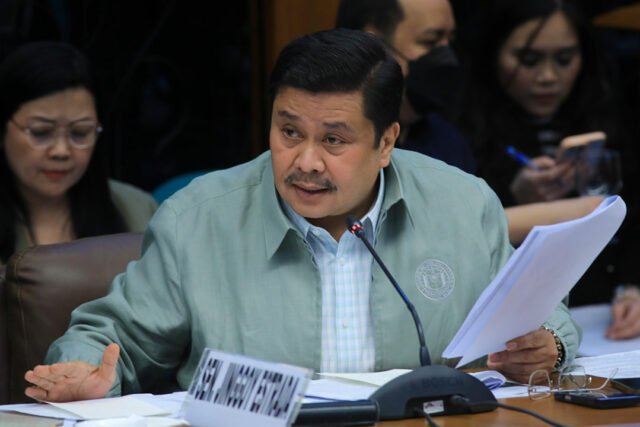
SENATOR Jose P. Estrada vehemently denied allegations that he demanded a percentage from government contracts during a Sept. 18 hearing, led by the Senate Blue Ribbon Committee. — SENATE PRIB

A REGIONAL Trial Court (RTC) in San Juan has denied Senator Jose “Jinggoy” P. Estrada’s request for a temporary restraining order (TRO) against former Public Works engineer Brice Ericson D. Hernandez, who accused him of receiving kickbacks from alleged anomalous flood control projects.

In a resolution dated Oct. 30, 2025, Presiding Judge Caron Aicitel E. Lascano-Nethercott said the TRO would “no longer serve its purpose” since the statements had already circulated widely through media outlets and social media.

The court said that the acts sought to be restrained had already taken place as the remarks were made during public, televised legislative hearings.

The court also found no “extreme urgency” to justify immediate relief, citing that the hearings were delayed at Mr. Estrada’s request. However, it clarified that the decision does not prevent Mr. Hernandez from testifying before Congress, emphasizing the court’s “constitutional respect” for inquiries in aid of legislation.

Ms. Lascano-Nethercott reminded both parties that any further public comments about the case outside official proceedings fall under the court’s rule, warning that statements intended to influence or prejudge the issue are prohibited.

A hearing for Mr. Estrada’s pending plea for a writ of preliminary injunction is set for Nov. 12.

Mr. Estrada said he fully respects the court’s directive and will abide by the order, affirming his faith in the rule of law and the integrity of the judiciary. “The proper forum for the vindication of rights is the courtroom, not the media,” his office said in a statement.

It added that Mr. Estrada will continue to pursue legal remedies against those who allegedly violated his rights or spread falsehoods about him, expressing confidence that “the truth will prevail through due process and impartial justice.” — Erika Mae P. Sinaking

Bill boosts transparency in infra spending

Men are working on a construction project in Manila. — PHILIPPINE STAR/RYAN BALDEMOR

A SENATOR on Monday said that he has filed a bill that will strengthen transparency and accountability for infrastructure spending, amid the multibillion-peso scandal involving flood control projects.

Senate Bill No. 1461, authored by Senator Francis “Chiz” G. Escudero, proposes that all government infrastructure projects undergo feasibility studies and include traceable features like geotagging and geodetic coordinates to prevent the misuse of public funds.

“Geotagging is one of the most important mechanisms for us to see the status of a project — whether it is actually being done or whether it is just on hold while the government continues to release funds,” he said in a statement.

The proposed Infrastructure Appropriations Integrity Act also mandates that no infrastructure project should be included in the budget unless it has gone through a feasibility study.

“All proposed projects must be vetted otherwise it should not receive a single centavo in public funds,” Mr. Escudero said.

It also requires the technical and financial bases for the projects, along with detailed unit price analyses, standard cost of materials, and quantity estimates.

The bill also prohibits “budget splitting” or the division of the appropriations for infrastructure projects in phases. — Adrian H. Halili

PPA logs 1.51M port passengers

PHILIPPINE STAR/EDD GUMBAN

THE PHILIPPINE Ports Authority (PPA) has recorded a total of 1.51 million passengers at the country’s major ports during All Saints’ and All Souls’ Day.

Data provided by the port regulator showed that it has recorded a total of 1.51 million for the Oct. 27 to Nov. 3 period.

PPA is expecting a total of 2.2 million passengers for the Oct. 27-to-Nov. 5 period, higher by 14.58% than the recorded 1.92 million in the same period last year but still lower than the pre-pandemic passenger count of 2.51 million for the period.

For the second quarter, passenger traffic rose 13.74% to 26 million from 22.86 million in the same period last year.

For the January-to-June period, passenger volume jumped by 8.61% to 45.3 million from 41.71 million in the comparable period last year.

The port regulator is expecting a total of 85.41 million passengers this year, exceeding the 2024 target by 9.5%. — Ashley Erika O. Jose

Bill vs online harassment filed in the Senate

PHILIPPINE STAR/PAOLO ROMERO

A PHILIPPINE Senator on Monday has filed a bill seeking to prohibit harassment on social media platforms, citing potential effects among vulnerable users like the youth.

“While social media serves as a platform to advocate for truth, it has also given room for ruining reputations, spreading fake news, rumors, false accusations, and violence,” Senator Joseph Victor “JV” Ejercito said in a statement.

Senate Bill No. 1474, the Anti-Online Hate and Harassment Bill, proposed to penalize acts such as cyberlibel, online hate speech, and harassment, including expressions inciting hatred or discrimination based on one’s gender or sexuality, cyberstalking, and the non-consensual sharing of private information.

The measure mandates all digital platforms to remove or block harmful content within 24 hours of verified complaints or court orders. It must also suspend or ban users, preserve digital evidence, and provide accessible reporting.

Perpetrators may face potential jailtime and P50,000 to P200,000 worth of fine for violating the proposed law.

The bill maintains that fair commentary, satire, criticism, and opinions, especially those directed at public officials, remain fully protected.

It also seeks to create a Victim Support and Protection Program that offers psychosocial support and counseling through the departments of Social Welfare and Development and Health.

It also tasks the Department of Justice to provide legal aid as well as securing protection orders when necessary. All costs will be shouldered by the offenders. — Adrian H. Halili

DoJ underscores need to protect Filipino children

THE DEPARTMENT of Justice (DoJ) on Monday underscored the need to strengthen the justice system’s response to cases involving children facing abuse, neglect, exploitation, and discrimination, as it opened its 2025 Justice Summit.

“This summit calls to expand access to justice covering not just courtrooms and barangays but also communities — even homes in our everyday lives,” DoJ Undersecretary Raul T. Vasquez said at the opening ceremony in Pasay City.

The summit, which runs until Nov. 6, forms part of the department’s push to align justice reforms with the Philippine Development Plan 2023-2028, which seeks broader access to legal services for marginalized sectors.

Its first day coincided with National Children’s Month and focused on the state of child rights in the justice sector, particularly the need for more coordinated case management among law enforcement, social workers, and local institutions.

DoJ Acting Secretary Fredderick A. Vida said many children continue to face abuse and neglect without adequate legal support.

“Children are not just the future of our nation but the heart of it,” he said in a speech. “They deserve a justice system that protects their innocence and ensures their safety.”

He added that many cases remain unreported as victims are often afraid to speak up.

According to Normina “Jhie” E. Mojica of the Council for the Welfare of Children, children make up 36.5% or 39.7 million of the Philippines’ 109 million population.

About 23.4% of children live in poverty, ranking fourth among the highest poverty incidences in the country.

Ms. Mojica also cited data on online sexual abuse and exploitation, noting a 192% increase in child sex trafficking and online enticement cases globally to 546,000 in 2024 from 156,000 in 2023.

The Philippines recorded 1.7 million CyberTipline reports this year, down from 2.7 million in 2023, but reports of self-generated child sexual abuse materials surged by over 1,300%.

Child labor remains a concern, with children working in farms, plantations, mines, factories, streets, and private homes. The Department of Labor and Employment has identified hazardous sectors such as mining, construction, and deep-sea fishing as among the worst forms of child labor.

Budget Secretary Amenah F. Pangandaman, in her message of support, said open government and open justice “are two sides of the same coin,” both grounded in transparency, accountability, and participation.

She said resource allocation for access-to-justice programs, women’s protection, and prison reform “is an investment not only in projects, but in people and in principles.”

“We must ensure that every reform we pursue, whether in policy, budgeting, or justice delivery, leads to tangible improvement in people’s lives,” she added.

In a brief interview, Ms. Pangandaman said she welcomed the DoJ’s focus on children and women, noting that it aligns with the government’s budget priorities.

“I’m happy to know that the DoJ is focusing on children and women, so we can help the public access government programs and projects for them — especially budget-wise,” she said.

The three-day event, themed “Advancing a Human Rights-Based Justice System,” gathers representatives from government agencies, nongovernment organizations, civil society, and the justice sector to improve coordination in protecting vulnerable groups. — Erika Mae P. Sinaking

PSEi sinks to 7-month low on growth concerns

BW FILE PHOTO

THE MAIN INDEX sank to the 5,800 level on Monday, hitting a near seven-month low, due to heavy selling amid expectations that Philippine economic growth may have slowed in the third quarter.

The Philippine Stock Exchange index (PSEi) plunged by 1.71% or 101.62 points to close at 5,828.06, while the broader all shares index dropped by 1.23% or 44.38 points to 3,548.90.

This was the PSEi’s worst finish in nearly seven months or since it ended at 5,822.85 on April 7.

“The PSEi gapped down as sellers heavily influenced the market early in the session. Traders are likely already pricing in the upcoming GDP (gross domestic product) and inflation data to be released this week, while overall sentiment remains cautious,” Regina Capital Development Corp. Head of Sales Luis A. Limlingan said in a Viber message.

“The local market plunged as investors anticipate dismal third-quarter GDP data to be released later this week amid government underspending and tempered business confidence caused by the country’s corruption issues,” Philstocks Financial, Inc. Research Manager Japhet Louis O. Tantiangco said in a Viber message.

The Philippine Statistics Authority will release October inflation data on Nov. 5 (Wednesday) and third-quarter GDP data on Nov. 7 (Friday).

Finance Secretary Ralph G. Recto last week said that underspending in the third quarter, mainly due to a corruption crackdown that curbed public disbursements, could have weighed on growth. The government only disbursed P1.46 trillion in the third quarter versus its P1.6-trillion spending program for the period, Treasury data showed.

Meanwhile, a BusinessWorld poll of 17 analysts yielded a median estimate of 1.8% for October headline inflation. If realized, this would have picked up from the 1.7% clip in September but slowed from the 2.3% seen in the same month last year. It would also be the fastest clip in eight months or since the 2.1% in February and would match the 1.8% in March.

Still, the median estimate falls within the Bangko Sentral ng Pilipinas’ (BSP) 1.4-2.2% forecast. It would also mark the eighth month in a row that inflation undershot the BSP’s 2-4% annual target.

Most sectoral indices closed in the red. Financials sank by 3.33% or 65.35 points to 1,896.58; mining and oil dropped by 2.11% or 269.39 points to 12,488.29; property fell by 1.96% or 42.58 points to 2,123.15; holding firms went down by 1.34% or 64.66 points to 4,754.79; and industrials retreated by 1.24% or 110.14 points to 8,757.08.

Meanwhile, services edged up by 0.03% or 0.75 point to 2,265.25.

Market breadth was negative as decliners overwhelmed advancers, 134 to 56, while 62 issues were unchanged.

Value turnover went up to P9.80 billion on Monday with 801.95 million shares changing hands from Thursday’s P4.98 billion with 660.39 million issues traded.

Net foreign selling jumped to P1.33 billion on Monday from P354.32 million on Thursday. — Alexandria Grace C. Magno

Ilocos, W. Visayas wage boards grant domestic-worker pay hikes

BW FILE PHOTO

TWO REGIONS in the Philippines approved a P500 to P700 pay bump for domestic workers, according to the National Wages and Productivity Commission (NWPC) on Monday.

In a wage order posted on the NWPC’s website, domestic workers in Region I (Ilocos) will receive an additional P700 per month in starting pay. This brings their monthly minimum salary to P6,700.

The new order covers the cities of Alaminos, Batac, Candon, Dagupan, Laoag, San Carlos, San Fernando and the provinces of Ilocos Norte, Ilocos Sur, La Union, and Pangasinan.

Meanwhile, domestic workers in Region VI (the Western Visayas) will receive a P500 monthly pay bump, bringing their starting monthly pay to P6,500.

This includes the provinces of Aklan, Antique, Capiz, Guimaras, Iloilo and Negros Occidental, along with their component cities and the highly urbanized cities of Iloilo and Bacolod.

Both orders will take effect on Nov. 19.

The two regions’ wage boards earlier approved new increases in the daily minimum wage.

In the Ilocos Region, non-agricultural workers in establishments with at least 10 employees will receive a P37 increase, bringing their daily wage to P505, while those in smaller firms and agricultural workers will get a P45 increase to P480.

In the Western Visayas, non-agricultural, industrial, and commercial workers in establishments with more than 10 employees were granted a P37 hike to P550 per day, while those in smaller establishments got a P45 increase to P530. Agricultural workers received a P40 increase to P520.

Labor Secretary Bienvenido E. Laguesma has said that at least four more regions are set to issue new wage orders adjusting the minimum daily wage.

The Cordillera Administrative Region, Mimaropa, the Eastern Visayas and Zamboanga Peninsula will hold public hearings this month, with the corresponding wage orders expected to be released by December.

The Philippines adjusts wage levels via regional wage boards, but labor groups are pushing for a legislated nationwide increase to standardize pay and guarantee a living wage. 

Labor leaders contend that the current regional wage-setting system leaves workers in less developed provinces at a disadvantage, as pay adjustments often fail to keep up with the rising cost of essential goods. — Chloe Mari A. Hufana

Banana export push to focus on containing Panama disease, boosting market access

ANFLOCOR.COM/TADECO

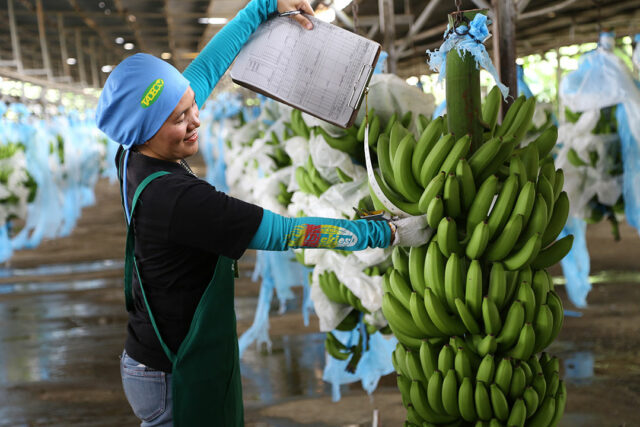
AGRICULTURE SECRETARY Francisco P. Tiu Laurel, Jr. said he hopes to arrest the decline in banana exports by focusing on the containment of Panama disease and improving overseas market access.

In a statement, the Department of Agriculture (DA) quoted Mr. Laurel as saying at the 32nd Joint General Assembly of the Philippine Banana Growers and Exporters Association and the Banana Export Industry Foundation that Fusarium wilt tropical race 4 (Panama disease) was the industry’s most urgent threat, affecting around 15,500 hectares in the Davao Region, endangering the main export variety, the Cavendish banana.

Under the High Value Crops Development Program for 2025, the DA plans to distribute banana planting materials and organic planting materials to expand and rejuvenate farms.

The DA will also deploy biological control agents such as Trichoderma to protect plant health and reduce postharvest losses, the DA said.

He noted that Vietnam has overtaken the Philippines as China’s top banana supplier, while Philippine exports to Japan continue to face higher tariffs than those from Vietnam, Mexico, and Peru.

“Unless these inequities are addressed, our market share will remain at risk,” Mr. Laurel warned, urging continued advocacy for fairer trade terms in the upcoming review of the Japan-Philippines Economic Partnership Agreement.

He also cited the need for research on disease tolerance, breeding strategies, and new technologies such as gene editing to secure the industry’s long-term viability.

PHL rice samples added to seed vault in Norwegian Arctic

PHILIPPINE STAR/WALTER BOLLOZOS

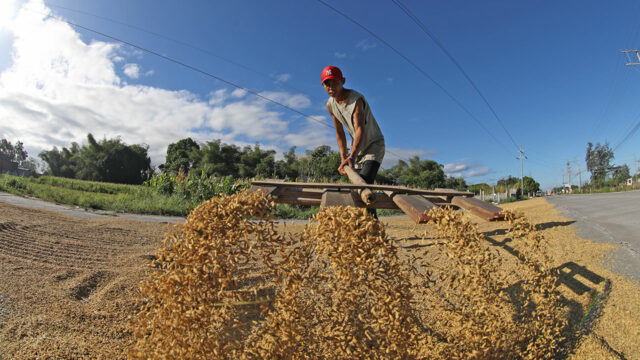
ABOUT 4,417 samples of Philippine rice seed were added to the Svalbard Global Seed Vault in Norway, a secure Arctic facility that will be tapped should the world need to start agriculture from scratch in the event of a global calamity, the Department of Agriculture (DA) said in a statement.

Many Philippine samples added in October were collected by the Philippine Rice Research Institute since the 1980s, with a further batch expected to be added next year to preserve global rice biodiversity, the DA said.

The so-called “Doomsday Vault” on Spitsbergen Island near Longyearbyen is intended to protect the genetic blueprints of the world’s crops from climate change, war, natural disasters, or the next pandemic.

The Svalbard samples mark the first case of Philippine rice samples being stored overseas, ensuring that the country’s genetic heritage can be recreated should calamities threaten Philippine rice diversity.

The samples include heirloom grains tended by Cordillera farmers to varieties like Dinorado and Milagrosa, as well as modern hybrids bred for drought resistance.

Bond markets urged to stand ready as funding sources during crises

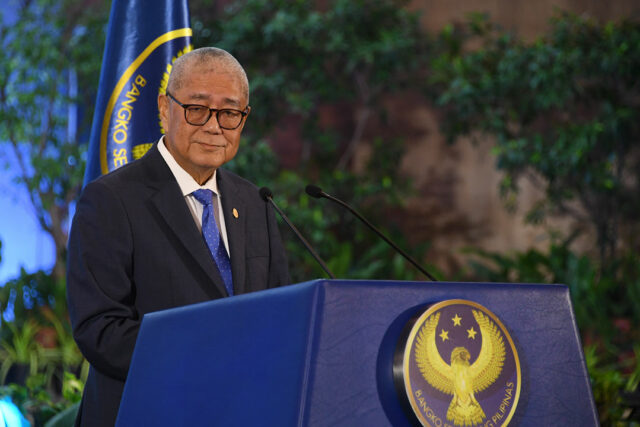
BANGKO SENTRAL ng Pilipinas Governor Eli M. Remolona, Jr. — COURTESY OF BANGKO SENTRAL NG PILIPINAS

CORPORATE BOND markets need to serve as the Philippines’ “spare tire” during crises that strike the banking system, the Bangko Sentral ng Pilipinas (BSP) said.

Speaking at a joint general assembly of financial market organizations on Oct. 23, BSP Governor Eli M. Remolona, Jr. said the market must be an alternative source of funding if banks fail to meet their financial obligations, as happened during the 1998 financial crisis.

“In 1998, in the wake of the Asian crisis, Alan Greenspan said the crisis turned out so badly because the financial systems in Asia had no spare tire,” Mr. Remolona said. “What he meant was we had banks, but we had no corporate bond market. When banks run flat, we need other sources of financing, like the corporate bond market.

He cited the need to emulate Thailand, whose corporate bond market is much larger than that of the Philippines.

Mr. Remolona noted that 96% of the country’s corporate bond issuers have an “AAA” rating.

“We are told that this is a sign of a strong market. But actually as we all know, it is a sign of a thin market,” he added.

On the other hand, Mr. Remolona said although 58% of Thailand’s corporate bond issuers hold an “A” rating, with only 6% rated “AAA,” its corporate bond market relative to gross domestic product is five times bigger than that of the Philippines.

“I think that is the kind of market Greenspan had in mind,” he added

“We need a real spare tire,” he said. “Indeed, deeper money and bond markets will help us steer the economy and keep it going when things get tough.”

Among the organizations present during the assembly were ACI Philippines, the Fund Managers Association of the Philippines, Inc., the Investment House Association of the Philippines, the Money Market Association of the Philippines, the National Association of Securities Broker Salesmen, Inc. and the Trust Officers Association of the Philippines. — Katherine K. Chan

DPWH sees savings of P60 billion from cutting cost of materials

Portions of the revetment wall along the Tullahan River collapsed in North Fairview, Quezon City, Aug. 29, 2025. — PHILIPPINE STAR/MIGUEL DE GUZMAN

THE Department of Public Works and Highways (DPWH) said it expects to generate savings of about P60 billion from construction materials, which it found to be overpriced in the course of conducting the flood control corruption investigation.

“This is probably the single biggest reform in DPWH… For decades, there have been significant price differences, but we really need to address this. Once we lower the prices, we will be able to minimize corruption,” Public Works and Highways Secretary Vivencio B. Dizon said at a briefing on Monday.

The DPWH will focus on bringing down the cost of cement, asphalt, steel, gravel, sand, and other aggregates, Mr. Dizon said.

“We will adjust the prices to market level. If the private sector can build roads at those prices, why can’t the government?,” he said.

The DPWH said it found overpricing of construction materials in Mimaropa, Central Luzon, and the National Capital Region.

Separately, the DPWH said it signed a memorandum of agreement with Philippine Space Agency (PhilSA) to tap satellite technology in monitoring infrastructure projects.

Under this collaboration, PhilSa satellite imagery, sensors and artificial intelligence will help monitor the progress of infrastructure projects.

“This initiative aligns with PhilSA’s goal of using space tech to promote accountability, efficiency and innovation across the government,” Gay Jane P. Perez, officer-in-charge at PhilSA, said during the  briefing.

The DPWH has removed around P255 billion worth of flood control projects from its proposed 2026 budget, including duplicated or completed works. — Ashley Erika O. Jose

ADVERTISEMENT
ADVERTISEMENT