Home Blog Page 7906

Nat Re sees slower new business creation

THE National Reinsurance Corporation of the Philippines (Nat Re) expects slower creation of new business among its clients this year as the economy is still struggling to recover, its top official said, but noted the company could post “profitable growth” despite this.

“With intermittent surges in COVID-19 infections and delays in the arrival of the vaccines, the country’s economic recovery could be slower than initially expected. It is still too early to give any definitive statement, but we can expect a slowdown in the new business generation of our clients,” Nat Re President and CEO Allan R. Santos said during their annual stockholders meeting on Wednesday.

“At any rate, we continue to identify pockets of growth, such as opportunities resulting from the need for capital relief solutions, higher health insurance covers, partnerships with foreign reinsurers, and the development of reinsurance facilities,” Mr. Santos added.

Nat Re, the country’s national reinsurer, saw its net profit drop by 24% to P120 million in 2020 from P157 million in 2019 on lower investment income.

Around 60% of its P8.6-billion investment portfolio went to government bonds while the remaining 40% was invested in corporate bonds, equities, and short-term deposits.

The pandemic pulled down the reinsurer’s equity investments, but last year was a good one for its fixed-income assets, Mr. Santos said.

Meanwhile, the company’s underwriting earnings grew last year, Nat Re said. Its gross written premiums inched up by three percent to P4.4 billion, while its underwriting income jumped 151% to P342 million.

“As we face 2021, we assure you that we will continue to pursue profitable growth, as well as entrench Nat Re in its role of being a stable anchor and champion for the insurance industry,” Mr. Santos said.

Meanwhile, he said the company will be distributing software licenses for the first open access framework catastrophe model for floods in the Philippines. They will also run ad hoc model analyses for them, he said.

Nat Re is also working with the Insurance Commission and the Philippine Insurers and Reinsurers Association on the Philippine Catastrophe Insurance Facility, which will help the industry manage risks by pooling them.

Mr. Santos said this facility will provide improved access to protection against natural disasters as previously, local companies had to have these kinds of products reinsured overseas. — BML

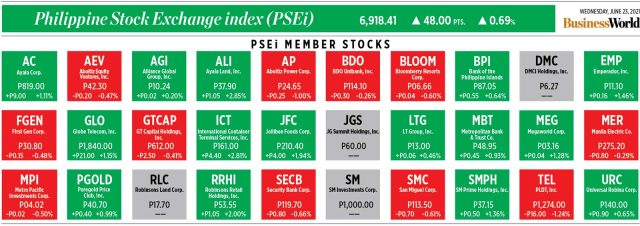
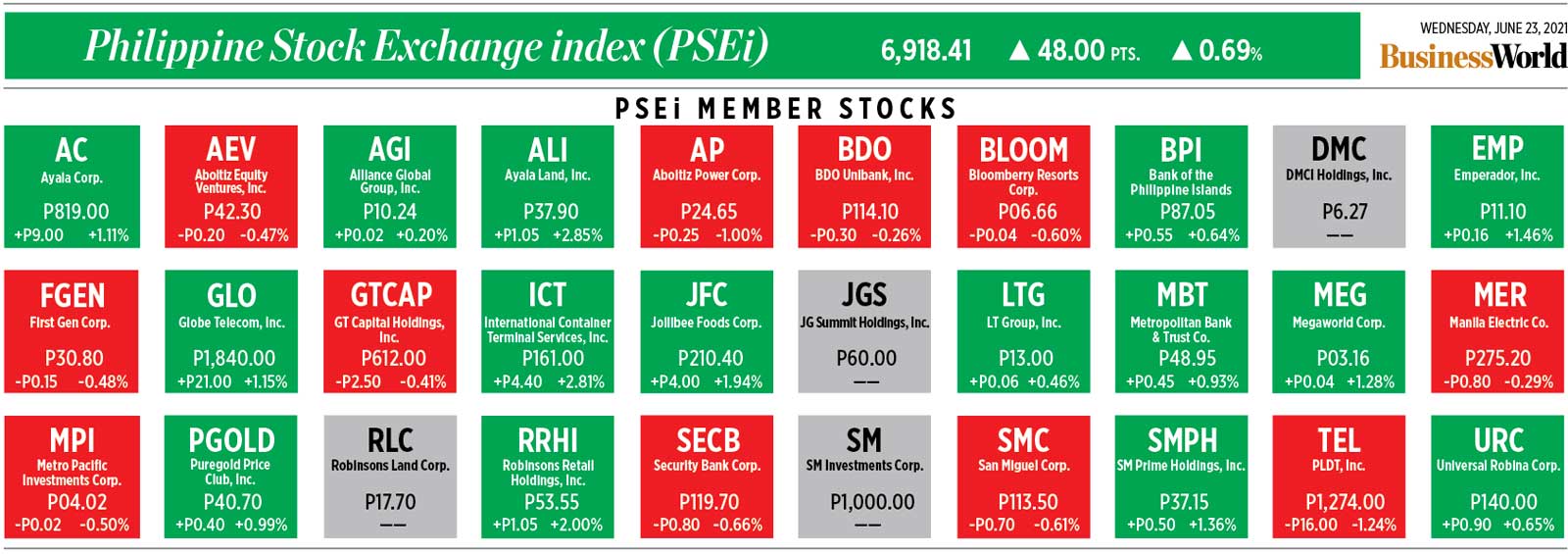
How PSEi member stocks performed — June 23, 2021

Here’s a quick glance at how PSEi stocks fared on Wednesday, June 23, 2021.


Despite living in third-most stressful city in the world, Manileños are happy — cannabis startup

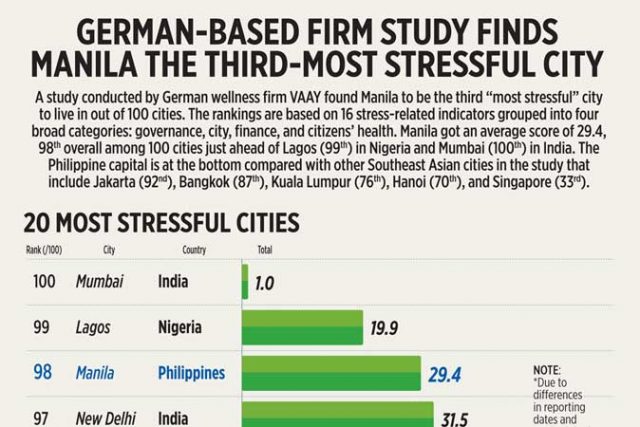
Manila is the third-most stressful city in the world, behind only Mumbai, India, and Lagos, Nigeria, according to a list compiled by Vaay, a Berlin-based wellness company focusing on cannabinoids and terpenes from the hemp plant. 

Manila ranked 98th out of 100 cities in “The Least And Most Stressful Cities Index 2021,” faring worse than war-torn cities like Baghdad, Iraq (96), and Kabul, Afghanistan (95). Reykjavik, Iceland, was judged the least stressful city.  

Vaay ranked cities according to four criteria: government factors (safety and security, gender and minority equality, and socio-political stability); physical environment (population density, pollution levels, weather patterns, and traffic congestion); financial stress (unemployment rates, social security structures, amount of disposable income); and health and wellbeing. 

“The final results show which cities overall have the most stressful social, environmental and economic conditions, and which cities lead the way in reducing the stress levels of their inhabitants,” said Vaay. — Brontë H. Lacsamana

Stressful_Cities

Mandanas says LGUs must have free hand on use of IRA agri funds

ADB.ORG

THE OFFICIAL who successfully petitioned the Supreme Court to expand the share local government units (LGUs) are entitled to from National Government revenue said LGUs need the freedom to decide how much they can spend on agriculture, rather than have quotas dictated to them by law.

Batangas Governor Hermilando I. Mandanas was speaking at a joint hearing of the Senate Committees on Local Government; Agriculture, Food, and Agrarian Reform; and Finance on Wednesday, noting that each LGU’s priorities are different, and cannot be set a one-size-fits-all rule in regard to their spending on agriculture.  

“LGUs should be delegated with the power to decide on the minimum budget to be allocated to their agriculture sectors since their situations may vary. For example, there are barangays in Manila (which) do not need to allocate a budget for agriculture,” Mr. Mandanas said.

The hearing participants were discussing Senate Bill 1138 or the proposed Local Government Agriculture Development Act, filed by Senator Cynthia A. Villar in November 2019.

The bill if passed, will require LGUs to set aside 10% of their internal revenue allotment (IRA) from the National Government for agriculture and fisheries programs.  

Mr. Mandanas petitioned the Supreme Court to expand the definition of “National Government revenue” as it relates to the funds that will go into the IRA pool, greatly expanding the funding that will be available to LGUs starting next year. In response, the National Government has decided to reduce its workforce by devolving many functions formerly carried out by its agencies to the LGU level.

President Rodrigo R. Duterte signed Executive Order No. 138 on June 1 which set the timetable for the devolution, which is to be completed by 2024.

Ms. Villar, who chairs the Senate Committee on Agriculture, Food, and Agrarian Reform, said during the hearing that the Supreme Court’s Mandanas-Garcia ruling set to take effect in 2022 will increase the IRA allotment of LGUs to P1.08 trillion.

She urged that a portion of the expanded funding be used for agriculture.  

“It is important also that we have a minimum budget set for the agriculture (sector). After all, we are an agricultural country. We are not an industrial country. The poorest people in the Philippines are the farmers,” Ms. Villar said.  

“If we do not invest in agriculture, we will have problems with our food security. Local governments should give importance to that especially now amid the coronavirus disease 2019 (COVID-19) pandemic. If we do not die from COVID-19, we will die of hunger,” she added.

Ms. Villar said she wants to legislate a minimum budget to be allocated by LGUs for their respective agriculture sectors.

She said a law is better that leaving LGUs with discretion on the matter to ensure that some LGUs do not underfund the sector.  

“Not all LGUs are developmental in terms of thinking for their respective areas. LGUs should give more attention to agriculture because it is very important. Agriculture is the source of our food. It is very necessary for our food security,” Ms. Villar said.

“If we do not allot a minimum budget to the sector, the Philippines will not succeed as a middle-income country since we will not be able to improve the lives of our farmers,” she added. — Revin Mikhael D. Ochave

Spot market power prices decline in June

THE AVERAGE price for power on the wholesale electricity spot market (WESM) was P6.53 per kilowatt hour in June, down from P7.66 in May, the Independent Electricity Market Operator of the Philippines (IEMOP) said Wednesday.

In a virtual briefing, IEMOP Manager for Pricing Validation and Analysis John Paul S. Grayda said that the secondary price cap (SPC) was implemented during 103 trading intervals from the start of the month until June 20.

The SPC is a price mitigating mechanism designed to limit high prices in the spot market. Mr. Grayda said that the IEMOP “imposes the cap when it observes sustained high prices for the past five days.”

He said that the IEMOP started implementing the price cap last month.

“There are frequent high prices particularly at the start of May billing, triggering the SPC. On May 31 and June, (the Luzon grid) had yellow and red alerts so the system operator (National Grid Corp. of the Philippines) declared a market intervention as the grid experienced manual load dropping due to generation deficiencies,” Mr. Grayda said.

In May, the IEMOP imposed the SPC during 55 trading intervals.

Earlier this month, the grid operator placed the Luzon grid under red alert for three consecutive days due to thinning reserves, plant shutdowns and higher temperatures. Portions of Luzon experienced rotating brownouts during this time.

On Wednesday, the market operator also announced that it is ready to launch its enhanced WESM design and operations (EWDO) in Luzon and the Visayas by June 26.

The EWDO seeks reduce the time between scheduling and dispatch of power.

“We will be implementing the commercial operations which means that all five-minute dispatch schedules… shall be implemented from June 26, 2021 effectively at 12:05 in the morning,” IEMOP Manager of Operations Planning and Modeling Edward I. Olmedo said during the briefing.

He added that Luzon and the Visayas will undergo “relaxed dispatch operations” for up to three months where the market operator will observe the participants but will “not be very strict” about compliance during the period as long as they can provide valid reasons.

Mr. Olmedo said that Mindanao-based participants still had to complete their registration for the planned power spot market there, with the IEMOP allowing for a one-month extension.

“We are opting to start already — upon approval by the DoE — what we call WESM central scheduling. Now, this will only involve central scheduling (of) all contracted capacities in Mindanao but there will be no WESM settlement, WESM or spot market transactions,” he said. — Angelica Y. Yang 

DoE to regulate reserve power procurement, require 5-year forecasts from NGCP

THE Department of Energy (DoE) said it will set a competitive process for the grid operator’s procurement of reserve power, known as ancillary services (AS), and also require it to submit five-year forecasts for power demand to help ensure that expected needs are sufficiently covered.

According to a draft department circular posted on its website, the DoE said AS providers must be engaged via a competitive selection process (CSP), after having flagged the National Grid Corp. of the Philippines (NGCP) earlier for not contracting enough firm contracts for the power grid’s needs at the end of 2020.

Last week, the NGCP announced that it will be holding a public auction to secure reserves in order to meet government requirements on reserve levels and ensure “best pricing” for customers.

In its draft rules, the DoE said that the CSP for AS must be transparent and non-discriminatory, promote competition and protect the interests of the general public by ensuring sufficient reserves at the least cost.

The department also proposed the presence of observers during the auction to ensure that the event is being conducted in an “open, transparent, effective, efficient, and equitable manner.” Observers may come from the DoE, Energy Regulatory Commission (ERC) and National Transmission Corp. (TransCo).

The proposed guidelines also require the submission of an annual AS agreement procurement plan (ASAPP) which must contain projections of reserve requirements for the next five years.

“The system operator (NGCP) shall develop and submit to the DoE its annual ASAPP not later than 31 March of every year,” according to the draft circular.

The DoE said that the ASAPP must contain the type of AS requirement per grid, existing ancillary service procurement agreements, and monthly levels of reserves needed per grid, among others.

If approved and implemented, the draft rules will cover various groups in the energy industry including NGCP, the market operator, the wholesale electricity spot market’s governance arm, all generating facilities, the TransCo, and ERC.

On its website, the DoE announced that it plans to hold a public consultation on the draft circular on June 24 between 1 and 4 p.m.

Around 400 participants from distribution utilities, generation companies, NGCP, civil society and consumer groups, and DoE-attached agencies including the ERC are expected to attend.

Comments and suggestions on the draft circular may be submitted on or before July 8 via e-mail to doe.csp@gmail.com. — Angelica Y. Yang

¥20-B loan funded subsidies, pandemic response — DoF

PHILIPPINE STAR/ MICHAEL VARCAS

THE Department of Finance (DoF) said the government allocated the proceeds from Japan’s ¥20-billion loan — equivalent to around P8.71 billion — for emergency subsidies in April for people affected by the pandemic, as well as other spending items related to the public health crisis.

The enhanced community quarantine (ECQ) enforced in April served as the trigger for the Japan International Cooperation Agency (JICA) to release the third tranche of its standby loan to the Philippines, Finance Undersecretary Mark Dennis Y.C. Joven said Wednesday.

The loan helped fund the P23-billion emergency subsidy program that month, and also supported other items.

The government issued emergency cash aid worth P1,000 per person or up to P4,000 per household to poor families in Metro Manila and nearby provinces to help them deal with the two-week ECQ.

“We hope to utilize the amount to be disbursed under PDSL-2 (Post-Disaster Standby Loan 2) to support a portion of the total requirement for the implementation of the SAP (Social Amelioration Program) and other mechanisms necessary to properly implement COVID-19 (coronavirus disease 2019) response and recovery interventions in the country,” Finance Secretary Carlos G. Dominguez III said in his request to JICA Philippines Chief Representative Eigo Azukizawa on May 11. 

Japan released ¥20 billion earlier this month as the third tranche of its ¥50-billion standby loan. This followed the ¥10 billion released in January and ¥10 billion in October.

An ECQ declaration was deemed a trigger event to disburse further tranches. Other conditions include the declaration of a state of calamity or of a state of public health emergency, natural disasters such as typhoons.

The credit line must be tapped within three years, subject to four extensions of the loan’s validity of three years each.

The loan charges a fixed interest rate of 0.01% and matures in 40 years, inclusive of a 10-year grace period.

In July 2020, the Philippines obtained a separate ¥50-billlion loan from JICA for its pandemic response.

Japan was the country’s top source of official development assistance with outstanding grants and loans equivalent to $8.537 billion at the end of March 2020, or 42.66% of the Philippines’ foreign aid. — Beatrice M. Laforga

Card to facilitate aid distribution issued to farmers

PHILIPPINE STAR/ MICHAEL VARCAS

THE Department of Agriculture (DA) said it introduced a card that will serve both as identification and a cash card to access government assistance for farmers enrolled in the farmer’s registry.

Agriculture Secretary William D. Dar launched the ‘Interventions Monitoring Card’ for farmers listed in the registry system for basic sectors in agriculture (RSBSA) during the DA’s anniversary on Wednesday.

Mr. Dar said during the launch that the card was a collaboration with the Development Bank of the Philippines (DBP), Rural Bank Association of the Philippines (RBAP), and SquidPay.

“With the ID cum cash card, RSBSA-listed farmers can now have easy access to government interventions, starting with the second round of the Rice Farmers’ Financial Assistance (RFFA) worth P5,000 each. It is funded by the excess tariffs collected from imported rice as provided under Republic Act No. 11203 or the Rice Tariffication Law. The RFFA payout will commence in October 2021,” Mr. Dar said.

The launch of the card was formalized with the signing of a memorandum of agreement among Mr. Dar, DBP President Emmanuel G. Herbosa, RBAP President Elizabeth Carlos-Timbol, and SquidPay President May Arboleda-Cuevas.

According to Agriculture Assistant Secretary Arnel V. De Mesa, the RFFA is given to rice farmers tilling or owning rice farms two hectares or less.

The card will also benefit other farmers in the agriculture sector such as hog raisers as well as fishing communities.

According to the DA, a total of 3.55 million are enrolled in the RSBSA.

The DA said the highest number of registered farmers and fishermen are from the Western Visayas at 369,281, followed by the Ilocos Region at 363,119, Cagayan Valley at 275,045, and Central Luzon at 247,833.

“The registry system contains the names and addresses of legitimate farmers, farm laborers, and fishers, and their respective production areas, among other basic information. It serves as the primary requirement in availing of the DA’s programs and services such as the Rice Competitiveness Enhancement Fund (RCEF), insurance coverage, credit and financing, and farm and fishery inputs, among others,” the DA said. — Revin Mikhael D. Ochave

Mung beans, native onion, bitter gourd top PSA Q1 production growth report  

PHILIPPINE STAR/ MICHAEL VARCAS

THE major vegetable crops that posted the strongest uptick in production during the first quarter were mung beans, native onion, and bitter gourd (ampalaya), the Philippine Statistics Authority (PSA) said.

In its quarterly bulletin on major vegetables and root crops, the PSA said mung bean production in the three months to March rose 6.2% year on year to 9,168.34 metric tons (MT). The top producer was the Ilocos Region with 35.9% of the crop.

Native onion output during the quarter rose 3.2% to 28,616.16 MT, dominated by Ilocos farmers who accounted for 93.3% of production.

Ampalaya production for the period rose 2% to 18,630.31 MT, led by Central Luzon with 41.8% of the harvest.

Also posting production gains were tomato (95,869.09 MT, up 1.8%) and eggplant (76,119.94 MT, up 1%).

Major declines were reported for potatoes (17,022.18 MT, down 26.4%), Bermuda onion (112,581.43 MT, down 17.2%) cabbage (29,208.55 MT, down 9.6%), cassava (477,676.62 MT, down 7.3%), and sweet potato (115,408.58 MT, down 1%).

In the first quarter of 2021, the PSA said the value of production of the overall farm sector fell 3.3%. Livestock and poultry production dropped 23.2% and 7.4%, respectively. Crop output by value rose 3.3% and that of fisheries rose 0.6%.

The Agriculture department has a target for the farm sector of 2.5% growth in 2021. — Revin Mikhael D. Ochave

In the name of fair play

Have you ever felt silenced after your explanation was left unheard? Perhaps, as a child, you were scolded without getting a chance to defend yourself; as an adult, perhaps you were handed a traffic violation ticket for an infraction you were wrongly accused of.

In tax assessment cases, taxpayers often feel anxious when investigated, a reaction that shouldn’t be the case for one whose transactions are above board. However, this sense of despair may be rooted in the fear of an uneven hand in judgment or perhaps the lack of a transparent system of assessment.

To appreciate this problem, let us look at the assessment process. Under Revenue Regulations (RR) No. 12-1999 as amended by RR Nos. 18-2013, 7-2018 and 22-2020, after the Bureau of Internal Revenue (BIR) has conducted an examination of the books of account and other accounting records of the taxpayer, a Notice of Discrepancy will be issued informing the taxpayer of the preliminary findings.  Should the revenue officers and the taxpayer fail to agree on the issues, the findings shall be indorsed for the issuance of the Preliminary Assessment Notice (PAN).  

The PAN should show in detail the facts, applicable law, regulations, or jurisprudence on which the assessment is based.  The taxpayer has 15 days from the receipt of the PAN to file a written response.  If the taxpayer fails to respond or submit a letter disagreeing with the findings, a Formal Letter of Demand and Final Assessment Notice (FLD/FAN) is then issued.  The FAN should likewise contain the facts and the applicable law, regulations or jurisprudence on which the assessment is based.  The taxpayer may thereafter file a request for reinvestigation or reconsideration, within 30 days from the receipt of the FAN/FLD, and if applicable, submit supporting documents within 60 days from the submission of the protest letter.  The BIR’s decision on the taxpayer’s protest will be communicated through another document called the Final Decision on Disputed Assessment (FDDA).

While the rules acknowledge the taxpayer’s remedy of submitting a written reply to the PAN, the question is how much weight does the BIR accord to the taxpayer’s arguments and documents? In a Court of Tax Appeals (CTA) case decided last year, the Court noted that the explanations and/or documents provided in the taxpayer’s reply to the PAN were left unheard as the FAN merely reiterated the findings in the PAN, with only an updated computation of the interest.  The BIR affirmed its initial position without giving any reason for rejecting the taxpayer’s explanations. For failure to state the facts, law, rules, or jurisprudence upon which the assessment is based, the CTA concluded that the taxpayer’s right to due process was violated, rendering the assessment null and void.

That decision was likewise echoed in the recent tax court case (CTA Case No. 9267, 28 May 2021) ruling for the cancellation and withdrawal of assessment for deficiency value-added tax (VAT).  In this case, the taxpayer received the PAN, with attached details of discrepancies, notifying the taxpayer of the proposed assessment for deficiency VAT.  Within the 15-day reglementary period, the taxpayer filed a request for reconsideration of the PAN.  The taxpayer explained and addressed each line item or finding of the BIR and endeavored to refute the alleged deficiency assessment as being void for lack of legal and factual bases.  On the fourth day after the filing of the request for reconsideration with the BIR, the taxpayer received an FLD, with an attached FAN, containing the very same issues and the same amount of deficiency taxes stated in the PAN. Further, the FLD/FAN did not even address or cite the arguments raised by the taxpayer in its request for reconsideration.

In this respect, the Court held that the right of the taxpayer to answer the PAN carries with it the correlative duty on the part of the BIR to consider the taxpayer’s response. The issuance of the FLD/FAN without even considering the side of the taxpayer is anathema to the cardinal principles of due process.  Due process requires that a person be accorded an opportunity to be heard.  However, such opportunity would be put to waste if the reply or protest submitted to the BIR is not taken into account.  The BIR should consider the defenses raised and documents submitted by the taxpayer, and render a decision based on the submissions. Failure to adhere to these requirements constitutes a denial of due process and taints the administrative proceedings with invalidity.

As explained by the Court, indeed, the Commissioner is not obligated to accept the taxpayer’s explanations.  Nevertheless, when the protest is denied, the Commissioner must give reasons for doing so and must give the particular facts and law upon which the conclusion is based, which must appear on the record. As a consequence of such due process violation, the deficiency tax assessment was rendered void and cannot be enforced against the taxpayer.

The takeaway from these court decisions is that due process entails not only the opportunity to be heard but also the assurance of actually being heard and not merely be brushed aside. Apart from the taxpayer’s right to speak up and explain his side, now, the BIR is obliged to address the taxpayer’s arguments with reason, regardless of its denial or acceptance. Since tax collection is a form of exaction, no one should be denied his income or property without fair play.

The views or opinions expressed in this article are solely those of the author and do not necessarily represent those of Isla Lipana & Co. The content is for general information purposes only, and should not be used as a substitute for specific advice.


Charilyn R. Caliwag is a manager at the Tax Services Department of Isla Lipana & Co., the Philippine member firm of the PwC network.

charilyn.caliwag@pwc.com

PHL shares climb on Fed chief’s dovish testimony

COURTESY OF PHILIPPINE STOCK EXCHANGE, INC.

SHARES climbed on Wednesday on dovish remarks from the US Federal Reserve chief and as the market remained hopeful the Philippine economy could be reopened further.

The 30-member Philippine Stock Exchange index (PSEi) went up by 48 points or 0.69% to close at 6,918.41 on Wednesday, while the all shares index rose by 20.69 points or 0.49% to end at 4,203.59.

“With most of the regional markets continued on the uptrend after US Fed Chairman Jerome Powell’s testimony on Congress revealed that US inflation was mainly caused by [a] sudden upsurge in consumer demand tied to the reopening of economy though persistent but will wane over time as it is transitory, [the] local market followed and sustained its upward momentum,” Diversified Securities, Inc. Equity Trader Aniceto K. Pangan said in a text message.

Mr. Powell on Tuesday reaffirmed the US central bank’s intent to encourage a “broad and inclusive” recovery of the job market, and not to raise interest rates too quickly based only on the fear of coming inflation, Reuters reported.

“We will not raise interest rates pre-emptively because we fear the possible onset of inflation. We will wait for evidence of actual inflation or other imbalances,” Mr. Powell said in a hearing before a US House of Representatives panel.

“The PSEi advanced led by substantial gains in large-cap property firms, port-operator ICT (International Container Terminal Services, Inc.), and fastfood giant JFC (Jollibee Foods Corp.), AAA Southeast Equities, Inc. Research Head Christopher John Mangun said in an e-mail, adding the performance of mentioned stocks is consistent with the economy’s reopening.

“Trading volumes remain below average and declined further which may be a sign that most investors are on the sidelines, looking forward to the results of the central bank’s meeting which will be out by the end of the week,” Mr. Mangun added.

Value turnover increased to P6.14 billion with 4.2 billion shares switching hands on Wednesday, from the P5.22 billion with 2.55 billion issues traded the previous day.

All sectoral indices posted gains on Wednesday. Property went up by 60.3 points or 1.79% to 3,412.18; services improved by 14.07 points or 0.9% to 1,574.10; mining and oil climbed 83.07 points or 0.89% to 9,340.20; industrials gained 58.96 points or 0.62% to finish at 9,479.34; financials bumped up by 1.98 points or 0.13% to 1,488.09; and holding firms inched up by 6.65 points or 0.09% to 6,922.54.

Advancers outperformed decliners, 116 versus 94, while 52 names closed unchanged. Net foreign selling surged to P1.44 billion on Wednesday from P101.57 million on Tuesday.

“With the fears allayed by the US Fed Chairman, we may see the market retest the index 7,000 psychological resistance level,” Diversified Securities’ Mr. Pangan said.

“The rebound has confirmed the PSEi’s immediate support at 6,780,” AAA Southeast Equities’ Mr. Mangun said. “It may continue to trade between this… and resistance at 7,000 until the end of the week.” — KCGV with Reuters

Peso sinks ahead of BSP decision

BW FILE PHOTO

THE PESO retreated further versus the greenback on Wednesday due to foreign selling at the stock market and cautiousness ahead of the central bank’s policy review.

The local unit closed at P48.805 a dollar on Wednesday, shedding 10.5 centavos from its P48.70 finish on Tuesday, data from the Bankers Association of the Philippines showed.

The peso opened Wednesday’s session at P48.695 per dollar. Its weakest point was at P48.85 while its intraday best was logged at P48.68 against the greenback.

Dollars exchanged inched up to $1.103 billion on Wednesday from $1.067 billion on Tuesday.

The peso weakened due to continued foreign outflows in the stock market, Rizal Commercial Banking Corp. Chief Economist Michael L. Ricafort said in a text message.

Net foreign selling at the local bourse ballooned to P1.44 billion on Wednesday from the P101.57 million seen on Tuesday.

Meanwhile, a trader said risk-off sentiment ahead of the policy meeting of the Bangko Sentral ng Pilipinas (BSP) on Thursday also caused the peso to depreciate.

The BSP’s policy-setting Monetary Board is widely expected to keep benchmark interest rates at record lows at its meeting on Thursday.

BSP Governor Benjamin E. Diokno last week said their policy stance will be supportive “for as long as necessary, until the economic recovery gets underway.”

For Thursday, Mr. Ricafort and the trader gave a forecast range of P48.70 to P48.90 versus the dollar. — LWTN