Home Blog Page 7822

Now boarding: Aston Martin DBX


Delayed by the pandemic, the V8-powered DBX makes an appearance in the Philippines. — PHOTO FROM ASTON MARTIN MANILA

The British luxury brand’s first-ever SUV finally lands

UNDOUBTEDLY, Aston Martin surely received, well, a shot in the arm with its highly publicized return into the world of Formula 1 racing — with no less than four-time world champion Sebastian Vettel leading the charge.

But it doesn’t stop there. The marque’s very visible reappearance in the highest echelon of motorsport is further underscored by the involvement of two of its vehicle models in the actual races. This season, Aston Martin shares safety car and medical car honors with Mercedes-Benz. The Aston Martin Vantage alternates with the Mercedes AMG GT R as official safety car, while the Aston Martin DBX and C63 S Estate take charge as medical cars.

That’s a whole lot of eyeballs the British brand is going to get over the course of the racing season, and the DBX in particular should be served well by the attention.

After all, this is the very first sport utility vehicle for James Bond’s automotive brand of choice.

Now, the DBX finally touches down in the Philippines. “Since its global release in 2019, the Philippines has been anticipating its arrival and DBPhils Motorsports, Inc., under the Tagle Group of Companies, is finally marking its territory with the local launch of this most-awaited luxury sports utility vehicle,” said the distributor in a release.

Aston Martin Manila Chairman and President Marc Louie Y. Tagle added, “We are confident that this move of Aston Martin will be warmly embraced by the Filipino market. Admittedly, we are an SUV nation — we love to cruise with our adventurous spirit, and bring family, friends, and loved ones along for the ride. Aston Martin captures this passion and adds its trademark luxury and beauty for the ultimate driving experience.”

Mr. Tagle said during a virtual press conference ahead of the DBX launch last Friday that since Aston Martin set up shop in Manila in 2015, less than 100 total units have been sold, which speaks to “exclusivity of owning an Aston Martin.”

So, even with the enthusiasm surrounding the local release of the DBX, the executive expects to sell at least five units for the rest of the year. And that’s actually good.

Consider that the Aston Martin DBX is priced in the neighborhood of P24.5 million — no chump change, and you get not only the vaunted Aston Martin exclusivity, but a whole lot of vehicle.

Under the hood growls a new version of the company’s 4.0-liter, twin-turbo V8 — also found in the DB11 and Vantage. Tuned for the DBX, it delivers 550ps and 700Nm. To temper its thirst, the V8 has cylinder deactivation to enhance fuel economy. Still it can slingshot the DBX from standstill to 100kph in 4.5 seconds — onto a top speed of around 290kph.

The lucky driver can access the performance promises through a nine-speed torque converter automatic gearbox, connected to an all-wheel drive system with active differentials featuring an active central differential and an electronic rear limited slip differential (eDiff). This means torque can be managed between the front and rear wheels, and even across the two rears. “When combined with the bespoke steering system that has been tuned to deliver feel and sports car-like response, DBX imbues the driver with an overriding sense of control, whatever the conditions,” said Aston Martin.

Aston Martin Director of Operations for Asia-Pacific Patrik Nilsson shared that in countries that have started taking deliveries of the DBX, the model is already carving out its share of the niche in luxury market. “We’re proud to have particularly strong market share right here in Asia-Pacific,” he averred.

Meanwhile, Aston Martin Manila Marketing Head Fiel Tan said, “Aston Martin owners are those who love cars that are not just jaw-dropping to look at, but also thrilling to drive, and the DBX lives up to these qualities. This is a pivotal moment for the brand, and we could not have been more excited to showcase this to the Philippine market.”

Replying to a question from “Velocity,” Mr. Tagle said that there is a lot of excitement surrounding the DBX, which is a very important model for the brand indeed. “The company invested in a brand-new factory just for the DBX,” he shared. Commensurately, as soon as word got out about the SUV, local fans of the brand “lined up.”

Quipped Mr. Tagle, “We had more than 100 leads!”

Obviously though, not all will have the wherewithal for a vehicle such as the DBX, and those who do will be welcomed into a (rightfully so) luxuriously handcrafted interior. Aston Martin also reports that the “DBX has been designed to provide equal space and comfort whether sitting in the front or rear of the car. Class-leading headroom and legroom combines with a full-length glass panoramic roof and frameless door glass to offer a fantastically light and spacious cabin environment.”

Front sports car seats not only provide adequate bolstering for dynamic driving, but has the additional benefit of ensuring knee and footwell clearance for those sitting in the second row. Other accoutrements include separate central armrests, glovebox, and the ergonomic positioning of the car’s key control systems, “have been guided carefully by the input of the brand’s Female Advisory Board, dealership feedback and a variety of private focus groups held worldwide.” The company said that the guidance, not limited to this area, “has been key to the success of DBX’s overall design.”

Full-grain leather sourced from longtime partner Bridge of Weir covers the seats; the headlining and electric roof blind are available in Alcantara finish. Metal, glass, and wood are tastefully used elsewhere — leading to “authenticity.” The personalization service, Q by Aston Martin, is also available for even greater levels of customization.

Mr. Tagle concluded by inviting people to take a look at the DBX in the sheet metal. “It looks much better in person than in photos,” he promised with smile.

The Aston Martin Manila Showroom is located at W Fifth Building, 5th Avenue Cor. 32nd St., Taguig. For more information, call (02) 8771-0007.


K-12 graduates seen as vehicle for digitalization of rice farming

GRADUATES from the K-to-12 agriculture track are being positioned as possible evangelists for digitizing rice production, the Department of Agriculture (DA) said in a statement last week.

The DA’s Philippine Rice Research Institute (PhilRice) proposed the employment of K-to-12 graduates as so-called “infomediaries” in municipal agriculture offices.

The recommendation was made in the June issue PhilRice’s policy-brief series, Rice Science for Decision-Makers.

Others that can step into such roles are graduates of state universities and colleges, and members of youth organizations.

According to PhilRice Supervising Science Research Specialist Jaime A. Manalo IV: “It is just wise to start with young people given their tech-savvy nature.”

The Rice-Based Farm Households survey taken from 2016 to 2017 indicates that information technology access among farmers was high at 93%, but its use in rice cultivation is 31%.

The department also proposed to integrate agriculture lessons into the high school curriculum.

In the fourth quarter last year, crop output fell 0.4%, turning around from the growth of 1% a year earlier.

Agriculture Secretary William D. Dar has said that rice production is expected to increase in 2021 on the assumption that no strong typhoons traverse the major production areas. — Angelica Y. Yang

Ikea already gunning for 100,000 loyalty club members before opening in Q4

A PUBLICITY shot from Ikea shows a family amidst a room-full of Ikea’s furniture.

EVERYBODY’s been waiting for global home furnishings giant Ikea’s opening in Manila, an event announced as early as 2018, but gossiped about already in 2016. It will, finally, open this year (fingers crossed).

Georg Platzer, Store Manager for Ikea Pasay —  which will be the first Ikea store in the country and, at 65,000 sq.m., the world’s biggest —  said that his branch will soon open. “We are leaning to open our store in Quarter 4 this year. We are working hard to make this happen soon,” he said during a press conference on July 1.

Even before it opens, the brand is already enticing Filipino shoppers with a membership in its loyalty program, Ikea Family. Mr. Platzer says that the benefits include special offers and discounts on some items, special offers at the restaurant, and some other benefits like special shopping events. Best of all, membership is free. “I will try it in Tagalog. ‘Walang bayad,’” he said.

They’re gunning for 100,000 members to sign up on the Ikea Family website’s first day on July 7. To sweeten the deal, they’re offering P5,000 worth of vouchers for seven customers (or “Family” members) and three winners can win a P50,000 shopping spree at Ikea with exclusive design consultation with Ikea interior designers. “No other Ikea store in my 32 years working for this lovely brand has ever reached this goal. We have big dreams. It’s a fantastic country. We are so happy to be here, finally. We would like to celebrate that,” said Mr. Platzer.

Visit family.IKEA.com.ph to register. One must be 21 years old to join, and currently using a valid Philippine mobile number. Winners for the July 7 Family Day promo will be announced on July 10. —  JLG

Profit taking drags SM Prime shares

BW FILE PHOTO

SM PRIME Holdings, Inc. (SMPH) was the most actively traded stock in the local bourse last week as market players chose to take profits following news of the company’s partnership with other property firms to develop a 26-hectare sustainable waterside district in Cebu.

A total of 71.37 million SM Prime shares worth P2.64 billion were traded from June 28 to July 2, data from the Philippine Stock Exchange showed.

The share price of the Sy-led property firm closed at P37 apiece, down 2.1% from June 25’s closing price of P37.8 per share. For the year, the stock has gone down by 5.73%.

“Investors likely sold on news when it was reported that Ayala Land, Inc., along with SMPH and [Ayala Land subsidiary] Cebu Holdings, Inc., will be developing the 26-hectare waterside district in Cebu, hence the 3% slide in its share price mid-week,” Regina Capital Development Corp. Equity Analyst Anna Corenne M. Agravio said in an e-mail.

“Nonetheless, this means that the volatility was not caused by something purely fundamental, but by investors just taking profits after a solid rally in the past few trading sessions,” she added.

Meanwhile, Diversified Securities, Inc. Equity Trader Aniceto K. Pangan in a mobile phone message said that while SMPH’s development project in Cebu brings a positive outlook for the company in the long term, near-term uncertainties brought by the pandemic on recovery “continues to be a challenge” to SMPH, which explains the persisting volatilities in the stock.

Dubbed as South Coast City, the waterside project located within South Road Properties in Cebu will have nearly two million square meters of built-out area, 30% of which will be for residential spaces and 70% for commercial centers. The site is said to be home to “prime entertainment and commercial concepts” in the area, complemented by “other mixed-uses to serve diverse market needs.”

The land development construction for South Coast City was announced in a media briefing conducted by Ayala Land last Tuesday. The project is ongoing and is slated for completion by May next year.

The day after the announcement, SMPH’s stock price fell 3.18% to P36.5 per share on Wednesday from the previous day — the largest day-on-day stock price movement last week. The next two days saw the stock’s price partially rebound by 1.1% on Thursday and 0.27% on Friday.

SMPH had a consolidated net income of P6.5 billion for the first quarter, down 22% from the P8.3 billion earned in the same period last year. Quarter on quarter, it posted an improvement of 80% compared with the P3.6-billion profit recorded in the fourth quarter of 2020.

“Certainly, the improvement in the economy coupled with ease of restrictions will be a positive development for the performance of SMPH unless undermined by the continued presence of the pandemic virus that tends to restrict the mobility of the population,” said Diversified Securities’ Mr. Pangan.

Regina Capital’s Ms. Agravio shares a similar outlook: “[B]eing the largest mall operator in the country, [SMPH] will benefit from increased foot traffic in its retail areas. This is a particularly big deal since, historically, its malls have on average accounted for more than half of the firm’s total revenues,” she said.

Ms. Agravio placed the stock’s support and resistance levels at P36.50 and P37.80, respectively. For Mr. Pangan, support and resistance for SMPH is pegged at P36 per share and P38.15 per share. — Bernadette Therese M. Gadon

SEC revokes lending firm’s license, warns vs unauthorized investment schemes

THE Securities and Exchange Commission has revoked a lending firm’s license to operate over unfair debt collection policies and also released advisories against two unauthorized entities collecting investments from the public.  

The regulator canceled the certificate of authority (CA) of KingABC Lending Corp., which runs Pondo Loan, Start Loan, Green Loan, and Loan Club.  

In an order dated June 7, the SEC’s Corporate Governance and Finance Department (CGFD) said it found that KingABC committed 15 violations of SEC Memorandum Circular No. 18, Series of 2019. This circular contains regulations on the debt collection practices of financing and lending companies.

There were also 53 complaints against KingABC on top of these violations.  

“It is likewise clear that at this point, the revocation of Respondent’s CA is not merely appropriate, but rather necessitated by the gravity and number of its offenses,” the CGFD said.

KingABC was said to be threatening its borrowers with shaming on social media by tagging them as scammers and involving people named in these borrowers’ contact lists even if they are not included as co-makers or guarantors.

It also threatened its borrowers with lawsuits with made-up legal bases.

KingABC likewise used insults and profane language in collecting debt, with borrowers receiving messages with death threats and profanities.

“Even more telling is the fact that subsequent to the issuance of the formal charge, the abusive collection practices of the respondent only became worse and more hostile based on the evidence submitted by the complainants,” the CGFD said.

The number of financing and lending companies with revoked licenses due to various violations of SEC regulations is now at 35.

The corporate watchdog canceled the primary registration of over 2,081 lending companies for their failure to secure the required CA. Last year, 58 online lending applications were ordered to cease operations for their lack of authority to operate as lending or financing companies.  

UNLICENSED INVESTMENT ENTITIES
Meanwhile, the SEC also warned investors against Ching Empiretans/Ching Empire, E-Ambag, or Geever and PetroMobil Corp. for unlicensed solicitation activities.

Ching Empiretans/Ching Empire, E-Ambag, and Geever are said to be run by Analie Tuyor, who also goes by Ericah Cassandrah Lee Ching. None are registered with the commission and none of the entities are authorized to collect investments from the public.

Ching Empiretans offers investors a P850 entry fee to receive two soap bars allegedly worth P1,000 to resell. They will also have access to audiobooks and an e-commerce website to source products to resell.  

Investors of Ching Empiretans are also offered direct referral bonuses, sequence bonuses, leveling and pairing bonuses, “making it appear that the possibility of lucrative income is infinite.”

E-Ambag promises a 180% profit after 45 days and investors may put in as low as P500 to P100,000. These will apparently earn a four percent daily profit.

Meanwhile, Geever masks its investment scheme by offering profits in exchange for “donations.” An investor or “donor” may invest from P1,000 to P5,000 with a guaranteed five percent daily return for 40 days. It also offers investors an opportunity to earn more via direct referrals.  

For its part, PetroMobil has various investment programs, one of which involves offering a co-ownership program for a minimum capital of P400,000 in exchange for a guaranteed profit amounting to P100,000 within three months.  

This is on top of a chance to co-own 17 gas stations PetroMobil is planning to build. It is promising would-be investors 60% of the net income, which will be distributed on a quarterly basis, and shares of stocks issued via a deed of assignment.  

The SEC told the public to stop investing in the programs offered by PetroMobil as it did not secure registration and/or the license to collect investments from the commission.  

BusinessWorld reached out to both entities for comment but neither had replied as of press time. — Keren Concepcion G. Valmonte

Style (07/05/21)

BATIK by jewelry-sculpture artist and art educator Minnette “Ming” Ong-Moya

Batik jewelry and fabric workshops go online

BATIK, the Southeast Asian artisanal craft, is spotlighted in back-to-back public workshops on two consecutive Wednesdays, July 7 and 14. Both sessions guide the participants how to utilize batik as a new method of image-making and its incorporation in the contemporary creative industry. It provides opportunities for material exploration apart from the conventional wax and the tjanting method, which utilizes a pen-like tool to apply hot wax. The first session allows the registrants to build jewelry out of classic motifs such as the curvilinear okir or okyir designs. It covers discussions on the universal history of jewelry, its purpose and its relevance today. The second day teaches attendees to modify the traditional batik-made fabrics into pastel-colored contemporary designs and patterns inspired by Philippine flora and fauna. The class delves on the history and creative process of the craft as well as the modified materials necessary for innovating it. Hosted by the Design Foundation and Arts and Culture Cluster of the De La Salle-College of Saint Benilde, the workshops are facilitated by jewelry-sculpture artist and art educator Minnette “Ming” Ong-Moya, who currently teaches foundational courses at the Benilde School of Design and Arts. Ong-Moya has a wearable art brand, Kathang Kamay, using copper, resin and fiberglass for jewelry. The classes will be held via Zoom and will run from 3 to 5 p.m. Interested participants may register through https://forms.gle/3h1aRqFiSLYXE4aZ7.

Rustan’s Frequent Shopper Program marks anniversary

RUSTAN’S Frequent Shopper Program (FSP) celebrates its third anniversary by rewarding loyal customers with exclusive promos during its Customer Appreciation month which runs from July 9 to Aug. 8. Existing Premium and Regular members get access to exclusive shopping discounts, as well as three times the bonus points for every minimum purchase of P3,000. Members enjoy access to exclusive offers for Home brands including 20% off on select items from SIP, Cuisinart, and Beka; and free gifts when they meet the minimum purchase requirement of select brands. Shop for Men’s and Women’s fashion and accessories and get discounts of up to 15-30% off on regular items from Pedro del Hierro, Hackett, Emporio Armani, Dopp, New Balance, Natori, Lafayette, Keepsake, Echo, and more. Receive the same discounts on bespoke orders from Ascot Chang. Prices at Lady Rustan, Luna, Lotus, U My Philippines, and Criselda Lontok will be marked-down during the weekends of July 9 to Aug. 8. Get five times the FSP bonus points for every purchased item from Graco, Leapfrop and Nuk in the children’s section from July 9 to August 8. Philips Avent are also offering up to 20% off on select electric items. Beauty brands like Laura Mercier, L’Occitane and Estee Lauder will have gifts with purchase during the same period. Receive up to 10% off on select items from Perricone MD and Anastasia Beverly Hills. New members of Rustan’s Frequent Shopper Program also receive perks during the promo month. Every new registrant automatically receives 30,000 Points, which can be redeemed any time for purchases and offers. Additionally, new signups will receive a free FSP Card and a Canvas Tote that can be used whenever they shop at Rustan’s to earn additional points. Terms and Conditions apply and can be read here: https://rustans.com/pages/frequent-shoppers-program-terms-conditions.

SNK ATK mixes streetwear and gaming

LOCAL technical clothing brand SNK ATK Design Lab has designed a streetwear collection with hardcore Mobile Legends: Bang Bang (MLBB) fans in mind. The collaboration between MLBB and SNK ATK includes cyberpunk jackets, hoodies, sweatshirts, T-shirts, and face masks. This limited edition MLBB x SNK ATK 515 eParty Capsule Collection came into play to spice up this year’s 515 eParty, a month-long community event for Mobile Legends: Bang Bang. Also on board for this collaboration is artist Massive Method who helped create limited edition art shirts and masks. Watch the official video on https://www.youtube.com/watch?v=BJxRjobToGg to see the pieces. Pre-order at website (https://snkatk.co/collections/ml-x-snk-atk-515-eparty-capsule-collection) or visit Bren Esports on Facebook (https://www.facebook.com/BrenEsports).

Swarovski Wonderlab’s new collections

AT ITS 125th year anniversary, Swarovski steps forward with a bold new vision for the future set in an imaginary Wonderlab. Swarovski Creative Director Giovanna Engelbert envisions the modern crystal lifestyle, a radically inclusive laboratory of creativity that invites the world to celebrate their individuality and partake in the fantasy. The first expression of the Wonderlab comes to life in Engelbert’s first collection, Collection One. The collection is an array of necklaces, earrings, rings, bracelets and body jewelry that manifest the fundamental but magical properties of crystal. An inventive approach to scale, cut and color creates a hyper-chunky, hyper-expressive, and hyper-versatile collection. Other Wonderlab collections are Millenia, described as being as fundamental to the wardrobe as the White T, these bold and timeless touches of refinement in a rainbow of cuts and colors are made to have and wear forever. Constella features crystal constellations set on thin metal bars in unexpected combinations. Mesmera, “mesmerizing, innovative crystal clusters bind uniquely shaped stones for the ultimate evening statement.” Harmonia, oversized cushion cut crystals in a suspended setting; Dulcis, “challenging the sharp with the soft through a Modern Art lens.” Curiosa, unexpected shapes, intricate and complex designs; Gema, the widest variety of stone cuts and rich, vibrant colors all-in-one set of pieces; and Chroma, boldly layered stones with multi-color on classic white. In the Philippines, Swarovski is available in Rustan’s Alabang, Rustan’s Makati, Rustan’s Shangri-La, and Rustan’s Ayala Cebu, and at Swarovski boutiques at Alabang Town Center, Glorietta, Newport Mall, TriNoma Mall, The Podium Mall, Power Plant Mall, and SM Mall of Asia.

Anytime Fitness gives incentive for COVID jabs

GLOBAL fitness chain Anytime Fitness recently reopened its doors with an incentive-based campaign that encourages individuals to roll up their sleeves and get vaccinated, as fitness facilities nationwide are now permitted to operate at a limited capacity. Dubbed “Get Back on Track,” the initiative entitles anyone who has received at least one dose of the coronavirus disease 2019 (COVID-19) vaccine with a waived joining fee, free Health Optimization Program (HOP) assessment, and one complimentary personal training session. These incentives are available upon presenting proof of vaccination when signing up for a 12-month membership at any Anytime Fitness club nationwide. The campaign lasts through September. The 24-hour fitness center reopened in June at 20% capacity after a three-month closure to help curb the spread of the virus. Members can expect enhanced safety measures within the fitness club, including temperature checks, requiring masks at all times, maintaining a two-meter distance between gym equipment, accessible handwashing stations, and frequent sanitation of all equipment, accessories, and areas after each use.

Levi’s shoes for kids up to 30% off at Zalora

LEVI’S Footwear introduces Shot Sneakers for kids — a round toe, low cut sneaker with a color-blocking colorway, made with Polyurethane polyester upper and a Polyester inner plus rubber soles. The Shot Sneaker features a hook and loop closure. Available in Navy Blue, Regular White and Regular Black. Shop for this and other styles from Levi’s Footwear Kids SS21 Collection such as the Block Sneakers, Ivette Sneakers, Fast Trainers, Betty Mega Sneakers, Irving Sneakers and Ellis Sneakers with a special introductory offer at 30% off with a minimum purchase of P1,950 from July 1-7 using the voucher code LEVISKIDS30. Discounts of up to 30% are available during that period on Levi’s Footwear storewide at Zalora. Avail the exclusive voucher to get a special 30% off on the new arrivals with a minimum P1,950 spend; or browse through the previous collection and shop up to 30% off with no minimum spend. Shop Levi’s Footwear for men and women up to 20% on all styles from July 1-6. And from July 7-11, enjoy exclusive discounts on select styles up to 30% off plus exclusive voucher deals up to 25% off.

Method Race Wheels now available at Wheel Gallery

PHOTO FROM METHOD RACE WHEELS

METHOD RACE WHEELS are now locally available through Wheel Gallery, Inc. which has been designated as the official country distributor. A US-based company, Method Race Wheels “designs, develops and distributes high performance wheels and accessories for race and street applications.”

Of note, Wheel Gallery will be the first distributor to make the MR107 Bead Grip wheel available to the public. “This is the same wheel used on the factory Toyota Gazoo Racing Hilux in the Dakar Rally,” said the company in a release. The wheel is said to be the culmination of Method’s years of off-road racing experience and technological expertise to be able to withstand the harshest conditions while boasting a load rating of up to 4,000 lbs.

“Wheel Gallery has proven to be an automotive aftermarket leader in the Philippines and we are excited to partner with a well-known and established brand to bring our industry-leading products to market. Our commitment to customer experience, product quality, and persistent innovation will be represented well through our new partner,” said Method Race Wheels Global Sales Director Matt Harris. “We also look forward to visiting the Philippines soon to explore trails with the off-road community.”

Method Race Wheels prides itself in innovation, and it is bringing this to the fore in its recently patented Bead Grip technology — developed from the demands of off-road racing. Bead Grip holds tires securely in place despite lower pressure as is the usual demand in off-roading. The company said it has tested its wheels fitted with tires boasting as low as 10psi of inflation — even without the use of a mechanical beadlock ring, a first in automotive wheel engineering.

Method continued that the reduced weight over a traditional beadlock wheel “allows for less strain on vehicle drivetrain while simultaneously unleashing more available horsepower to the driver.” Bead Grip products by Method Race Wheels are also safe for on-road vehicles, a departure from traditional beadlock wheels which are off-road use only and require regular maintenance.

Concept One Wheels is located at 318 Santolan Road, San Juan. Its authorized dealers will also get the Method Race Wheels. For more information, visit www.conceptonewheels.ph.

Global meat demand is under threat like ‘never before’ as prices surge

REUTERS

IN THE US, sales of meat at grocery stores are down by more than 12% from a year ago. In Europe, overall beef demand is predicted to fall 1% this year. And in Argentina, home to one of the world’s most carnivorous populations, per-capita beef consumption has dropped almost 4% from 2020.

While some of those numbers might seem small, even a tenuous decline is a rarity in the meat world, which until the pandemic hit last year saw years-long growth in consumption to ever-new record highs. Now demand is waning across the globe in what could signal the start of a new broad shift away from animal protein. 

The biggest demand deterrent has been a relentless climb for prices that started in October, propelled higher by tightness in global supplies of animal feed and supply-chain disruptions. The United Nations’ global meat price gauge has risen for eight straight months, the longest streak since 2011, and is near a multi-year high. The price shock comes at a time when consumers are still dealing with COVID’s economic fallout, forcing families from Brazil to the Philippines to buy less and swap in other proteins like eggs if they can afford it, or instead just fill their plates with rice or noodles.

For Eudelia Pena, a 48-year-old who lives in New York City with her husband and one of her three children, meat has become a luxury. Retail ground beef prices in the US have surged about 6% since before the pandemic, while whole chickens are up about 9% and pork chops jumped 13% to roughly $3.88 a pound in May, government data show. That’s making animal protein almost unaffordable for Pena’s family, which is now down to one income after she lost her job at a clothing store.

“With what I spend today, I don’t bring back even half of what I used to,” she said. “I used to buy two chickens. Now I just buy one and split it in half.”

But demand has waned with previous financial downturns, only to bounce back. What’s different now, of course, is the plant-based boom. More consumers are choosing to forgo meat because of concerns about the environment, animal welfare and health. And that shift isn’t just limited to California’s fad dieters and East London hipsters. Increasingly, it’s being taken up across the world and across income groups — so much so that the twin forces of inflation and food trends are now coming together to signal a seismic shift away from meat eating in the world.

“Meat is under threat like possibly never before,” said Tom Rees, industry manager at market researcher Euromonitor International in London.

“When meat becomes too expensive to eat, then absolutely consumers will move away from it if they can’t afford it. The fundamental changes come about more from consumers shifting” in their attitudes about things like health and climate impact, Rees said.

Take the case of Mario Cruz, a public school teacher who lives north of Manila in the Philippines’ Bulacan province. As the country suffered through one of Southeast Asia’s biggest economic hits from the pandemic, Cruz started growing vegetables in his backyard last year to feed his family of four. Before that, he used to spend almost P2,000 a week on meat. Now, he buys almost nothing. Cruz, a diabetic, said he planted the vegetable garden “to meet our needs and survive,” but it’s had an unexpected outcome.

“We’re now on a mostly plant-based diet, and I feel healthier,” he said.

In some parts of the world, the change to a plant-based diet is coming amid the proliferation of more alternatives like Beyond Meat veggie burgers. But in others, it’s just a back-to-basics approach of eating more beans and vegetables. In either case, climate campaigners might rejoice over the shift away from meat. By some measures, agriculture accounts for more global greenhouse gas emissions than transport, thanks in large part to livestock production.

But this shift can’t be seen as some kind of universal good. In fact, for many, forgoing meat is exacerbating one of the deepest inequalities in the world: who gets enough food with enough sources of nutrition, and who doesn’t.

Insufficient access to livestock and other animal-sourced foods is a major factor behind high rates of malnutrition that persist in many parts of Asia and Africa, UN Nutrition warned in June. Analysis from the group shows that meat and other animal products can help combat the undernourishment that causes stunting in about a fifth of young children worldwide.

“Vegetables, fruits, legumes and cereals are essential. But nutrient-dense animal products are uniquely effective for pulling young children back from the brink of acute and chronic malnutrition,” Naoko Yamamoto, the chair of UN Nutrition and the World Health Organization’s assistant director-general for universal health coverage, said in a statement.

That’s a point deeply felt by Fabiana Ribeiro da Silva, a 36-year-old mother of four who lives on the outskirts of Colombo in Brazil’s southern state of Parana. She’s been forced to cut back on spending after losing her job in elderly care. Before the pandemic, chicken was on her family’s dinner table almost daily and beef once a week. Now, they mostly eat just rice and beans. Once in a while she gets some temporary cleaning work, which allows the very rare purchase of some eggs or chicken. Her three-year-old is only able to have a bit of milk when there’s extra money to come by, and she worries about her five-year-old daughter, who’s started to lose weight. 

“She is not eating much,” Da Silva said.

There’s no one data point that’s the smoking gun showing falling global meat demand. That’s because most comprehensive measures estimate consumption only in relation to production. It’s assumed that when supply is available, it will all be eaten. And livestock production is expected to grow this year as China recovers from an outbreak of African swine fever, a pig-killing disease that had devastated the country’s hog herd. Given that formulation, the United Nations’ Food and Agriculture Organization estimates global per-capita meat consumption to grow 1.2% in 2021 after contracting 0.7% last year, with its forecast mostly driven by the scale of the rebound for China’s pork production.

Regional sales data that show declines from last year may also be somewhat skewed because of the surge in grocery buying during the first few months of the pandemic, partly fueled by restaurant shutdowns. Still, interviews with consumers, food sellers, analysts and experts across the globe point to a clear trend: meat demand is under what looks to be a long-term threat. 

Even in China, where meat inflation is now relatively tame compared with some other regions, plant-based eating is gaining new traction, according to Darin Friedrichs, a Shanghai-based analyst at StoneX Group, Inc. Younger generations are increasingly health conscious and more likely to opt for less meat or poultry, while trendy and upscale restaurants now serve plant-based options, he said.

Meanwhile, things have gone quiet for Ricardo Lamboglia who works as a butcher in the Mataderos neighborhood of Buenos Aires. The area — nicknamed Nueva Chicago because of its similar historic roots as a hub for slaughterhouses and meat shops — used to be buzzing, with “hardly room to move” on the sidewalks where sellers advertise their wares on colorful signs.

“The pandemic has killed us,” Lamboglia said pointing to the mostly empty street from the open-air entrance of his store.

“We used to sell 4,000 to 5,000 kilos a month, and it’s now more like 2,000. People these days are counting their pennies.” — Bloomberg

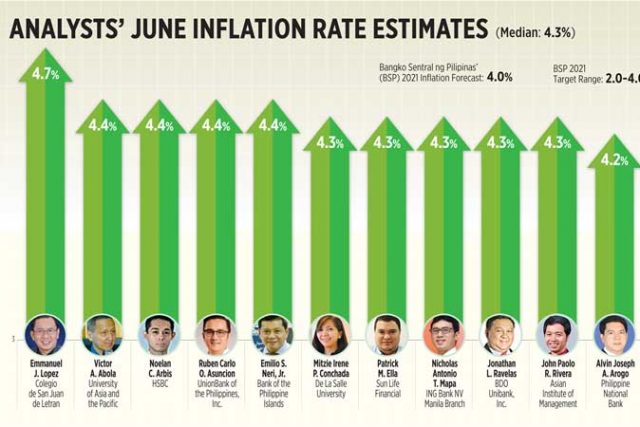
Analysts’ June inflation rate estimates (2021)

INFLATION IN JUNE likely breached the Philippine central bank’s target for the sixth straight month, though slower due to improving food supply and falling transport prices, analysts said. Read the full story.

Analysts’ June inflation rate estimates (2021)

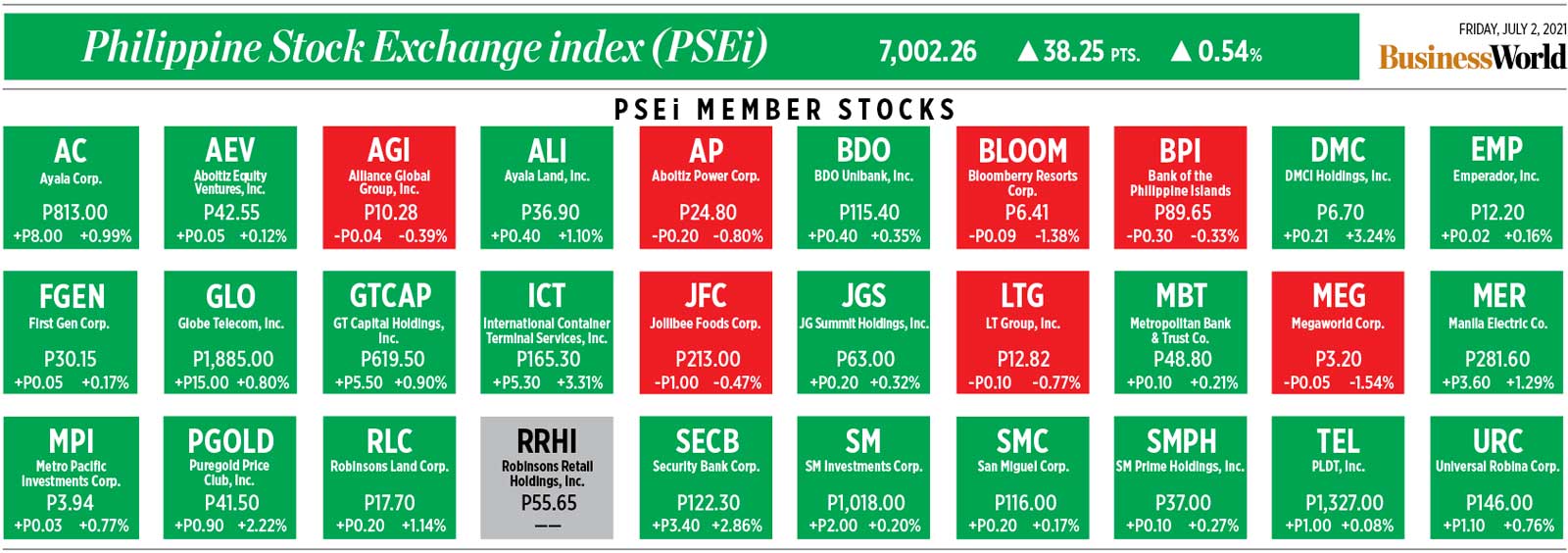
How PSEi member stocks performed — July 2, 2021

Here’s a quick glance at how PSEi stocks fared on Friday, July 2, 2021.


Peso may rise on slower inflation expectations

BW FILE PHOTO

THE PESO is likely to rebound versus the greenback this week on expectations of slower inflation in June.

The local unit closed at P49.20 per dollar on Friday, weakening by nine centavos from its Thursday finish of P49.11, based on data from the Bankers Association of the Philippines. This was the peso’s weakest close in nearly a year or since it ended at P49.25 per dollar on July 27, 2020. It also shed 71.9 centavos from its P48.481-per-dollar finish on June 25.

The peso depreciated on Friday as investors flocked to the greenback on the back of an expected rebound in the US job market in June, Rizal Commercial Banking Corp. (RCBC) Chief Economist Michael L. Ricafort said in a text message.

Data from the US Labor department released on Friday showed nonfarm payrolls increased by 850,000 jobs in June, higher than the 700,000 estimated additional jobs in a Reuters poll. The increase also surpassed the 583,000 new jobs in May.

The report also showed that women, who were the hardest hit by the pandemic, took nearly half of the 9.3 million job openings last month. Reuters reported.

The peso’s weakness last week was also caused by market concerns on the increasing possibility of an earlier unwinding of easy monetary policy in the US amid improving economic data, UnionBank of the Philippines, Inc. Chief Economist Ruben Carlo O. Asuncion said in an e-mail.

Federal Reserve Bank of San Francisco President Mary Daly said the US central bank may be able to start reducing “a little bit” of its extraordinary support for the US economy by the end of this year, Reuters reported.

“The economy is really shaping up nicely,” Ms. Daly told the Associated Press in an interview, a recording of which was provided to Reuters by the San Francisco Fed.

Fed policy makers have been surprised at the strength of the US recovery this year, fueled by $2.8 trillion in federal pandemic aid and a faster-than-expected rollout of vaccines against COVID-19. 

That has touched off an internal debate over when and how to start reducing their purchases of Treasuries and mortgage-backed securities, which they had promised to continue doing at a pace of $120 billion a month until the economy makes “substantial further progress” towards the Fed’s employment and inflation goals.

For this week, Mr. Asuncion said the market is waiting for June inflation data, which will be released by the Philippine Statistics Authority (PSA) on Tuesday, July 6.

A BusinessWorld poll of 14 analysts yielded a median estimate of 4.3% for June inflation, matching the midpoint of the 3.9% to 4.7% estimate given by the Bangko Sentral ng Pilipinas (BSP) for the month.

If realized, this will mark the sixth straight month of inflation exceeding the BSP’s 2-4% target for the year and will be faster than June 2020’s 2.5% print. Still, this would be slower than the 4.5% in May.

Analysts said the better supply conditions that likely brought down food prices and easing transport prices will be key factors for slower inflation in June. On the other hand, the sustained increase in global oil prices continues to be an upside risk.

May trade data to be reported on Friday could also affect the peso, RCBC’s Mr. Ricafort said.

The trade deficit stood at $2.73 billion in April, slightly narrower than the $2.75-billion shortfall in March but bigger than the $187.10-billion gap a year earlier, latest PSA data showed.

Exports that month climbed 72.1% to $5.71 billion from a year earlier, while imports surged 140.9% to $8.45 billion.

For this week, Mr. Ricafort gave a forecast range of P48.90 to P49.40 per dollar, while UnionBank’s Mr. Asuncion expects a stronger band of P48.85 to P49.25. — L.W.T. Noble with Reuters

Shares may move sideways before inflation data

COURTESY OF PHILIPPINE STOCK EXCHANGE, INC.

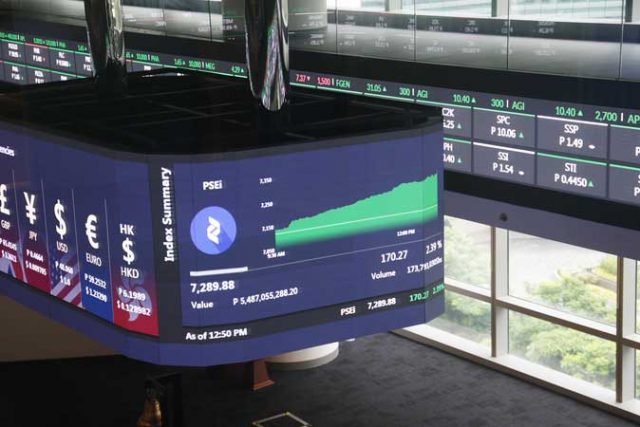
PHILIPPINE shares are expected to trade sideways this week on continued market optimism ahead of the release of June inflation data and as investors monitor the country’s coronavirus disease 2019 (COVID-19) situation.

The Philippine Stock Exchange index (PSEi) rose by 38.25 points or 0.54% to close at 7,002.26 on Friday, while the broader all shares index went up by 19.54 points or 0.45% to finish at 4,294.97.

Week on week, the benchmark index gained 51.75 points from its 6,950.51 close on June 25.

“The market continued higher after more positive economic data was released. Investors gained more confidence on clearer signs of the economy’s recovery despite elevated COVID-19 cases and the extension of current restrictions,” AAA Southeast Equities, Inc. Research Head Christopher John Mangun said in an e-mail on Saturday.

“The PSEi ended the week just a few points above the 7,000 psychological level after a couple of weeks of momentum building,” he added.

Preliminary results of the Philippine Statistics Authority’s (PSA) Labor Force Survey showed a lower unemployment rate of 7.7% in May from 8.7% in April.

Meanwhile, IHS Markit reported that manufacturing activity improved in June. The Philippine Manufacturing Purchasing Managers’ Index (PMI) went up to 50.8 in June from 49.9 in May due to less stringent quarantine restrictions.

Analysts said market optimism following these positive economic data may continue this week.

“Adding to this is the rise in consumer sentiment according to the Bangko Sentral ng Pilipinas’ (BSP) [second quarter] 2021 survey. The economic recovery hopes, however, could be tempered by the decline in business confidence also according to the BSP’s survey,” Philstocks Financial, Inc. Senior Research Analyst Japhet Louis O. Tantiangco said in a Viber message on Saturday.

“Investors are also expected to watch out for the upcoming June inflation data to see if the price pressures weighing on the local economy have eased,” Mr. Tantiangco added. “Finally, investors are expected to remain cautious while waiting for the latest financial reports following the end of the second quarter. We may see sideways movement for the local market with an upward bias [this] week.”

The PSA is scheduled to release June inflation data on July 6.

Mr. Tantiangco expects the index to trade between 6,932.13 to 7,300.

“Risk seen for the market [this] week is the Delta variant of COVID-19. Detection of more cases in our country with the said strain may tilt the market’s bias to the downside,” he said.

Meanwhile, AAA Southeast Equities’ Mr. Mangun placed the PSEi’s support at 6,900 and resistance between 7,200 and 7,260.

“Optimism has outpaced cautiousness as vaccination progress outweighs the concerns of elevated COVID-19 cases,” Mr. Mangun said. — Keren Concepcion G. Valmonte