Home Blog Page 778

Meralco sees recovery in energy sales volume by second half

MERALCO.COM.PH

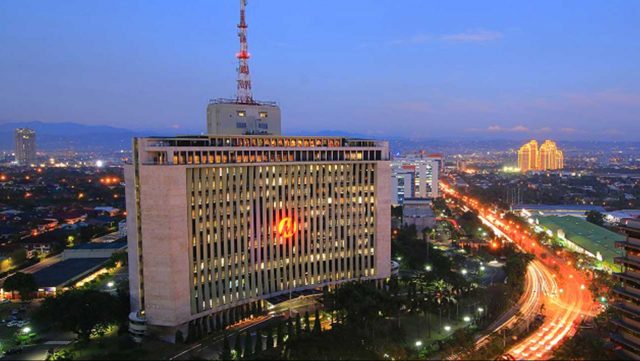
POWER distributor Manila Electric Co. (Meralco) expects a recovery in energy sales volume by the second half of the year, driven by a pickup in certain sectors within the commercial and industrial segments.

“On the second half, I think there will be some sort of a recovery,” Meralco Senior Vice-President and Chief Revenue Officer Ferdinand O. Geluz told reporters on Thursday.

Mr. Geluz said they expect the impact of the exit of Philippine offshore gaming operators (POGOs) last year — which affected the power consumption of several key commercial subsegments such as real estate and retail trade — to “normalize.”

The energization of data centers last year may also affect sales due to anticipated demand from their clients.

“We’re seeing some uptick in the construction industry, cement as well as glass. And somehow still after a long period of downturn, we are seeing a slight growth,” he said.

Meanwhile, Meralco expects “flattish” growth in energy sales volume for the first half, due to cooler weather during the period.

For this year, Meralco is targeting a 4.5% increase in energy sales volume, or at least 56,000 gigawatt-hours (GWh).

In 2024, Meralco’s energy sales volume rose by 6.4% to 54,325 GWh from 51,044 GWh in the previous year, driven by warmer temperatures due to El Niño and sustained customer energizations.

This exceeded the company’s target of 53,473 GWh for the year. 

Meralco’s controlling stakeholder, Beacon Electric Asset Holdings, Inc., is partly owned by PLDT, Inc.

Hastings Holdings, Inc., a unit of PLDT Beneficial Trust Fund subsidiary MediaQuest Holdings, Inc., has an interest in BusinessWorld through the Philippine Star Group, which it controls. — Sheldeen Joy Talavera

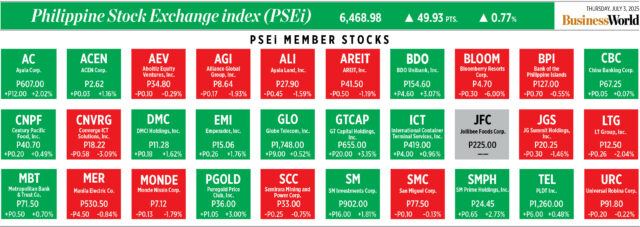
How PSEi member stocks performed — July 3, 2025

Here’s a quick glance at how PSEi stocks fared on Thursday, July 3, 2025.


‘Minimal’ hit to remittances expected from Trump tax bill

PHILIPPINE STAR/ MIGUEL DE GUZMAN

By Aubrey Rose A. Inosante, Reporter

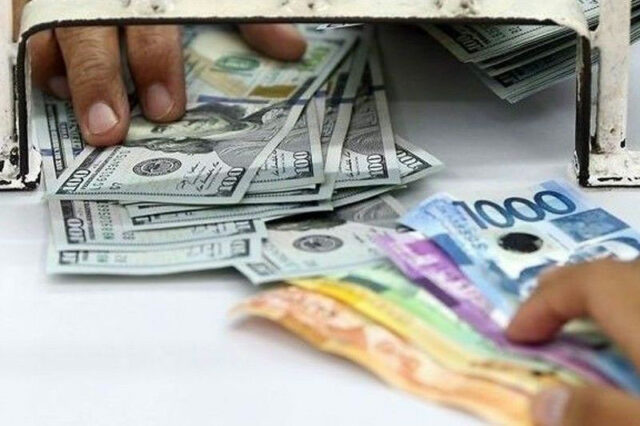
THE Department of Finance (DoF) said US President Donald J. Trump’s proposed tax on remittances will put a “minimal” dent of between $19.1 million and $148.4 million on money sent home by overseas Filipinos.

“We see that the estimated effect is minimal on the economy. The expected loss in remittances might only be $19.1 million to $148.4 million, out of the $36.5 billion projected remittances in 2026,” the DoF told BusinessWorld on Thursday.

The central bank has maintained its cash remittance growth projection at 2.8% this year and 3% for 2026.

Mr. Trump’s so-called One Big Beautiful Bill, which more broadly sets out his administration’s taxation plans, won Senate approval with some modifications from the US House of Representatives bill approved in May.

Among the key changes is a 1% excise tax on all remittances, which also apply to US citizens, softening the initially proposed 3.5% levy targeting foreign workers.

The bill will go before the House again, and may require reconciliation before proceeding to final passage and the President’s signature.

The DoF said the US Senate version of remittance tax will affect 4.4 million overseas Filipinos in the US.

“Although 41% of remittances are routed through the US, not all of these are from Filipinos in the US because remittances are routed to the US via correspondent banks,” it said.

Cash remittances rose 3% to $34.49 billion in 2024. The US remained the top source of cash remittances, accounting for 40.6% of the total.

Mon Abrea, founder and chief tax advisor of the Asian Consulting Group (ACG), said the legislation will slow down remittance flows—either by reducing the volume of formal remittances or by driving them underground.

“While the Department of Finance estimates the impact at only 0.003% of GDP, this additional burden may push senders — especially undocumented Filipinos — to use informal or unregulated channels, which are riskier and harder to monitor,” he said.

The lower rate on remittances in later versions of the legislation offers some relief to overseas Filipino workers, but could still dampen remittances and consumption.

“Certainly, the lower rate is much better. To the extent that this tax is imposed only on US-based remittances, then the negative impact is likely less, and not only because the rate is lower at 1%,” Calixto V. Chikiamco, president of the Foundation for Economic Freedom, said.

“However, the impact on our economy is that the amount that OFW families receive here will be less and they will likely reduce their spending,” he said.

Pantheon Macroeconomics Chief Emerging Asia Economist Miguel Chanco said the rate reduction is a “positive development.”

Over the long haul, Mr. Chanco believes that money transfers will not materially be affected even if the 3.5% rate were reimposed.

House bill seeks to set 6% of GDP spending minimum for education

PHILIPPINE STAR/ MICHAEL VARCAS

By Kenneth Christiane L. Basilio,  Reporter

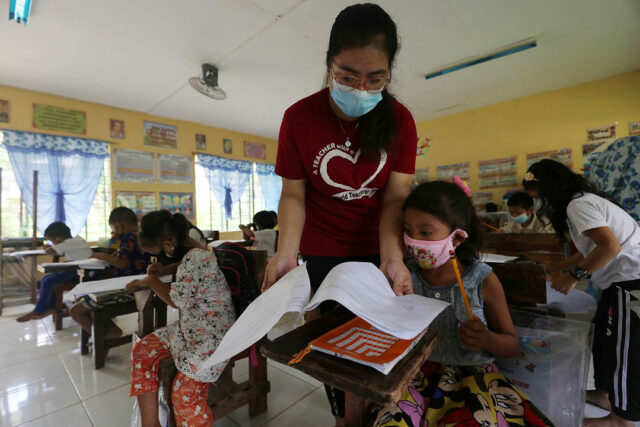
A HOUSE bill seeks to set a floor of 6% of gross domestic product (GDP) for spending on education, which would reverse recent trends in government spending favoring infrastructure.

Party-list Rep. Antonio L. Tinio and Renee Louise M. Co proposed in House Bill (HB) No. 204 to set the 6% benchmark for funding for the Education department, state universities and government trade schools.

They cited a United Nations (UN) spending recommendation of up to 6% spending to improve education access and quality.

“The bill intends to take a stand that will favor our children and youth, our teachers and education personnel,” they said in the bill’s explanatory note. “Rather than consider it as mere spending, we must view it as high-yield investments in the future.”

The Philippines allocated 3.6% of GDP to education in 2023, according to the World Bank, missing the 4-6% benchmark set by the Incheon Declaration.

With 2025 nominal GDP estimated at $497.5 billion by the International Monetary Fund (IMF), the 6% spending proposal would imply education funding of $29.8 billion, or about P1.67 trillion.

The Development Budget Coordination Committee has proposed a P6.793-trillion national budget for 2026, equivalent to 22% of GDP and 7.4% higher than this year’s budget.

“The Philippines’ public expenditure for education never breached 4.4% from 1980 to 2020, and generally below the global average on most years from 1999 to 2019,” the legislators said, citing World Bank data.

“It is also among the worst countries in the Asia-Pacific region in terms of public expenditure for education,” they added.

HB No. 204 falls in line with the constitutional mandate to prioritize education funding. The charter binds the government to make education its largest budget item.

The 2025 national budget has drawn fire over claims that funding for public works was larger than the budget for education, leading the spending plan to be challenged in the Supreme Court as unconstitutional.

This year’s spending plan allotted P1.055 trillion for education, 4.3% higher than the P1.007-trillion funding for the Department of Public Works and Highways.

“The 2025 General Appropriations Act has been criticized as according the highest spending to infrastructure… education is already suffering from the disastrous effects of perpetual underfunding,” the legislators said.

MSRP for imported rice set for P2 reduction in mid-July

Workers unload sacks of rice in this file photo. — PHILIPPINE STAR/RYAN BALDEMOR

THE Department of Agriculture (DA) said it will lower the maximum suggested retail price (MSRP) for imported rice to P43 from P45 per kilogram starting July 16.

The P2 adjustment was initially scheduled for July 1 but had been postponed due to heightened volatility in global commodity markets as fighting broke out in the Middle East.

“Global conditions have stabilized enough to resume planned price interventions,” the DA said in a statement, citing the ceasefire between Israel and Iran.

“Global rice prices have since declined, alongside softening oil prices,” it said.

Oil prices have been falling since the start of July after two major hikes in June, the second taking place after the US intervened in the Israel-Iran bombing and missile exchanges.

The strength of peso was also considered in adjusting the MSRP, it said.

“We are also seeing positive projections for record harvests from key producers like India, Pakistan, and Thailand,” the DA said.

“These developments could improve global supply and help pull prices further down,” it added.

The MSRP applies specifically to the 5% broken-grain variety, the highest-grade and most commonly consumed type of imported rice.

The DA said the MSRP imposed earlier this year has contributed to a downward trend in domestic retail rice prices.

Rice inflation continued to decline, falling 12.8% in May from the 10.9% decline a month prior.

The DA said it is also finalizing plans to introduce MSRPs for imported pork in August and potentially for chicken by September.“These measures aim to moderate retail prices amid tight domestic meat supply caused by ongoing animal disease outbreaks.” — Kyle Aristophere T. Atienza

ASEAN wholesale cross-border payments seen requiring monitoring of capital flows

REUTERS

THE EVENTUAL integration of wholesale cross-border payments in the ASEAN Regional Payment Connectivity (RPC) system will require regulators to monitor and manage capital flows, the ASEAN+3 Macroeconomic Research Office (AMRO) said in a report.

“Cross-border connections facilitating large amounts of payments can also pose a risk from a capital flows perspective. The speed and ease of the transfers can make the capital flows more volatile and in extreme situations, may cause liquidity stress for institutions. These cross-border transfers depend on a chain of participants working seamlessly together, but the system is only as strong as its weakest link.”

As ASEAN RPC technology and regulations develop, AMRO said its scope will expand to integrate wholesale payment solutions such as real-time gross settlement from the current focus on retail payment solutions, which caters to individuals and small- or medium-sized businesses.

“This integration will help generate high-value transactions and further reduce the costs associated with cross-border transactions. The integration of wholesale payment infrastructure can also provide a significant boost to local currency usage,” AMRO said.

However, larger transactions will require tighter risk management, due diligence, proper implementation of anti-money laundering and counter-terrorism financing (AML//CFT) protocols, and capital flow monitoring and management measures, it added.

AMRO added that fraud detection and dispute resolution procedures will need to be strengthened.

“Cybersecurity lapses, platform outages, data security breaches, and process failures at any participant could compromise the integrity of payment systems on either side of the linkage. While these risks also exist in retail payment integrations, the systemic risk is lower due to the regulated transaction sizes, and in many cases, the limited number of participating organizations,” AMRO said.

AMRO said ongoing regional initiatives such as the Bank for International Settlements’ Project Nexus, can speed up the scaling of ASEAN RPC.

In April, the Bangko Sentral ng Pilipinas, along with the Reserve Bank of India, Bank Negara Malaysia, the Monetary Authority of Singapore, and Bank of Thailand, incorporated Nexus Global Payments in Singapore into their domestic instant payment systems.

The five central banks will contribute the initial capital required to build and establish the Nexus platform for its live operation.

“A centralized hub-and-spoke model can offer a scalability solution for the RPC and could be the way forward. Initiatives such as Project Nexus… explore direct linkages between domestic FPS (fast payment system) networks, allowing real-time transactions across borders without significant infrastructure overhauls,” AMRO said.

Emerging technologies such as distributed ledger technology (DLT) could also be adopted to improve transparency, security, and efficiency in cross-border transactions.

Central banks are also looking at Central Bank Digital Currencies due to their application in cross-border payments, allowing for instant, low-cost international transfers.

“However, this innovation can only adapt quantifiable and configurable measures and require a highly digitalized payment system. Private institutions also use DLT technology to develop private stablecoins or private DLT-based infrastructure to facilitate cross-border transactions, although the usage is limited to certain customers,” AMRO said. — Aaron Michael C. Sy

WESM rates fall in June as decline in demand outweighs supply drop

BW FILE PHOTO

THE average price of power on the Wholesale Electricity Spot Market (WESM) declined 3.9% in June, the Independent Electricity Market Operator of the Philippines (IEMOP) said on Thursday.

IEMOP reported a WESM system-wide average of  P3.86 per kilowatt-hour (kWh) in June, against P4.01 per kWh a month earlier.

Between May 26 and June 25, the available supply decreased 3.5% month on month to 21,432 MW. Demand declined 4.1% to 14,545 MW.

On Luzon, the average power rate slipped 7.5% month on month to P3.91 per kWh, with supply going falling 3.5% to 15,076 MW. Demand declined 5.4% to 10,400 MW.

IEMOP said that WESM rates in the Visayas increased 4.3% to P3.93 per kWh a month earlier.

Supply decreased 1.1% to 2,635 MW while demand dropped 2.2% to 2,003 MW.

Power prices in Mindanao rose 13.2% to P3.54 per kWh from P3.11 per kWh a month earlier.

The grid’s available supply slipped 5.4% to 3,721 MW. Demand grew 0.7% to 2,112 MW.

IEMOP operates the WESM, where energy companies can purchase power when their long-term contracted power supply is insufficient for customer needs. — Sheldeen Joy Talavera

Navotas project taps Korean aid

PHILSTAR FILE PHOTO

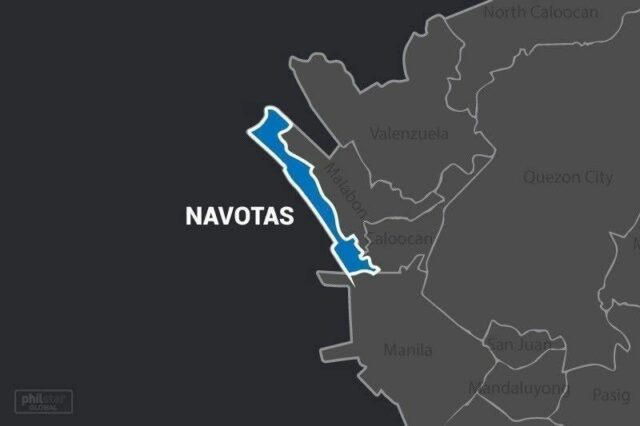
SOUTH KOREA will fund a $10-million circular-economy project for Navotas focused on a network of upcycling and recycling facilities penetrating to the barangay level.

The proposed project, which runs from 2026 to 2031, will tap Korean aid in creating materials recovery facilities, Yoo Ji-young, the Korea International Cooperation Agency (KOICA) Philippine Office deputy director, said at a forum hosted by the ASEAN-Korea Centre on Thursday.

The project hopes to encourage the development of upcycling and recycling startups, she added.

KOICA approved the project proposal in March after a preliminary review in January.

The Korean government’s final approval is expected by the third quarter.

An implementation survey is scheduled for the third or fourth quarter of 2025.

South Korea is also set to turn over a marine clean-up vessel to the Philippine government in February. — Kyle Aristophere T. Atienza

Mindanao infra projects backed by ADB on track

BW FILE PHOTO

THE Department of Finance (DoF) said on Thursday that the Asian Development Bank (ADB)-funded road and bridge projects in Mindanao are on track to be completed on schedule.

In a statement, the DoF said it found that the Improving Growth Corridors in Mindanao Road Sector Project (IGCMRSP) to be on schedule following an inspection conducted with the Department of Public Works and Highways and the ADB.

The $491.32-million project aims to expand the capacity of the Brunei Darussalam–Indonesia–Malaysia–Philippines East ASEAN Growth Area road network.

This is expected to the unlock economic potential of Mindanao, it said.

The DoF said the ADB provided $380 million for the project, alongside government counterpart spending of  $111.32 million.

The IGCMRSP includes the R.T. Lim–Siocon Road that traverses Zamboanga Sibugay and Zamboanga del Norte.

The 4.6-kilometer road project is currently 95% complete and is scheduled to be opened by September.

“The DoF also visited the Nalil-Sikkiat Bridge No. 1, another subproject, in Tawi-Tawi Province, which spans 380.8 meters with a 160-meter approach road. The bridge has a total length of 541 meters,” it said.

Nalil-Sikkiat No. 1 will link Bongao Island to Sanga-Sanga Island and ease the transport of goods, services, and people.

The bridge is 96% complete and is scheduled to be opened to the public next month. — Aubrey Rose A. Inosante

PHL stocks rebound before June inflation report

BW FILE PHOTO

PHILIPPINE STOCKS climbed on Thursday amid expectations that domestic inflation remained below target last month despite an expected uptick due to the Iran-Israel conflict.

The Philippine Stock Exchange index (PSEi) jumped by 0.77% or 49.93 points to close at 6,468.98, while the broader all shares index climbed by 0.16% or 6.42 points to 3,803.33.

“The local market bounced back this Thursday on optimistic expectations that inflation last June had remained tepid despite certain upside risks, thereby giving the Bangko Sentral ng Pilipinas (BSP) leeway to continue their policy easing,” Philstocks Financial Inc. Research Manager Japhet Louis O. Tantiangco said in a Viber message.

The Philippine Statistics Authority is scheduled to release June inflation data on July 4 (Friday). A BusinessWorld poll of 17 analysts yielded a median estimate of 1.5% for the June consumer price index, faster than 1.3% in May but below the BSP’s 2-4% annual target, as the spike in fuel costs due to the Middle East conflict may have been offset by steady food prices.

“Local shares edged higher ahead of the June inflation report, with sentiment lifted by optimism over a new US-Vietnam trade deal,” Regina Capital Development Corp. Head of Sales Luis A. Limlingan said in a Viber message.

The United States will place a lower-than-promised 20% tariff on many Vietnamese exports, Donald J. Trump said on Wednesday, cooling tensions with its tenth-biggest trading partner days before the US president could raise levies on most imports, Reuters reported.

Vietnamese goods would face a 20% tariff and trans-shipments from third countries through Vietnam will face a 40% levy, he said. Vietnam could import US products with a zero percent tariff, he added.

Mr. Trump’s announcement comes just days before a July 9 deadline before he ramps up tariffs on most imports. Under that plan, announced in April, US importers of Vietnamese goods would have had to pay a 46% tariff.

Most sectoral indices closed in the green on Thursday. Holding firms went up by 1.25% or 70.63 points to 5,688.88; financials increased by 0.95% or 21.38 points to 2,268.24; property rose by 0.4% or 9.99 points to 2,464.66; and mining and oil climbed by 0.1% or 9.97 points to 9,523.39.

Meanwhile, services dropped by 0.59% or 12.81 points to 2,142.12 and industrials retreated by 0.33% or 30.72 points to 9,076.59.

“GT Capital Holdings, Inc. continues to lead the index, this day rising by 3.15% to P655. Bloomberry Resorts Corp. was at the tail end, plunging 6% to P4.70,” Mr. Tantiangco said.

Value turnover increased to P10.23 billion on Thursday with 1.77 billion shares traded from the P7.77 billion with 792.46 million issues exchanged on Wednesday.

Decliners outnumbered advancers, 126 versus 84, while 60 names were unchanged.

Net foreign buying surged to P1.11 billion on Thursday from P258.04 million on Wednesday. — R.M.D. Ochave with Reuters

Peso rises to near 3-week high as US data bolster Fed cut bets

BW FILE PHOTO

THE PESO climbed to a near three-week high against the dollar on Thursday amid weak US data that bolstered bets of further US Federal Reserve cuts.

The local unit closed at P56.25 per dollar, jumping by 11.5 centavos from its P56.365 finish on Wednesday, Bankers Association of the Philippines data showed.

This was the peso’s strongest close in nearly three weeks or since it finished at P56.21 on June 13, or the start of the 12-day Israel-Iran conflict.

The peso opened Thursday’s session slightly stronger at P56.33 against the dollar. It traded better than Wednesday’s close the entire day as its worst showing was at just P56.34, while its intraday best was at P56.21 versus the greenback.

Dollars exchanged went down to $1.46 billion on Thursday from $1.59 billion on Wednesday.

“The dollar-peso closed lower following the release of softer private payrolls and ADP data, fueling bets of another Fed cut. Expectations for nonfarm payrolls tonight are also lower, which resulted in dollar selling,” a trader said in a phone interview on Thursday.

The peso was also supported by easing trade tensions after US President Donald J. Trump announced a trade deal with Vietnam, Rizal Commercial Banking Corp. Chief Economist Michael L. Ricafort said in a Viber message.

For Friday, the trader expects the peso to move between P56.10 and P56.40 per dollar, while Mr. Ricafort sees it ranging from P56.15 to P56.35.

The dollar remained close to this week’s 3-1/2-year lows on Thursday ahead of a key jobs report, and as a US-Vietnam trade accord fanned expectations for other potential deals ahead of July 9 when US tariffs take effect, Reuters reported.

The pound edged higher by 0.2% and last fetched $1.3665, while the euro was muted at $1.180, still near the September 2021 top it hit earlier this week. The yen was a tad weaker at 143.80 per dollar.

The US dollar index, which measures the greenback against six other currencies, was flat at 96.748, remaining close to the 3-1/2-year lows it has been rooted to this week. The index is on course for a 0.5% drop for the week.

All eyes are on the US Labor department’s comprehensive employment report for June, due for release on Thursday ahead of the July 4 holiday, which is expected to show that unemployment edged up to a more than a 3-1/2-year high of 4.3%, according to economists polled by Reuters.

Wednesday’s private survey painted a grim picture of the labor market, pushing traders to shift expectations of when the Federal Reserve will lower interest rates. Traders are pricing in a 25% chance of a cut in July versus 19% a day earlier, data compiled by LSEG showed.

Meanwhile, ahead of the July 9 tariff deadline, Mr. Trump said the United States had struck a deal with Vietnam and that he could push other countries to reach similar agreements.

Although details were scant, Mr. Trump said Vietnamese goods would face a 20% tariff and trans-shipments from third countries through Vietnam will face a 40% levy.

The Vietnamese dong slid to a record low, with UBS analysts suggesting the passing of tariff costs to exporters will likely be mitigated by the central bank through the allowance of a steady depreciation of the dong.

Progress on other deals has been slow. Japan has invoked national interests as talks with the US struggled, while South Korea’s President Lee Jae Myung on Thursday said negotiations were looking difficult and that he could not say whether talks would conclude by next Tuesday. — A.M.C. Sy with Reuters

Landslide, flood alert raised in eight Metro Manila cities and 24 provinces

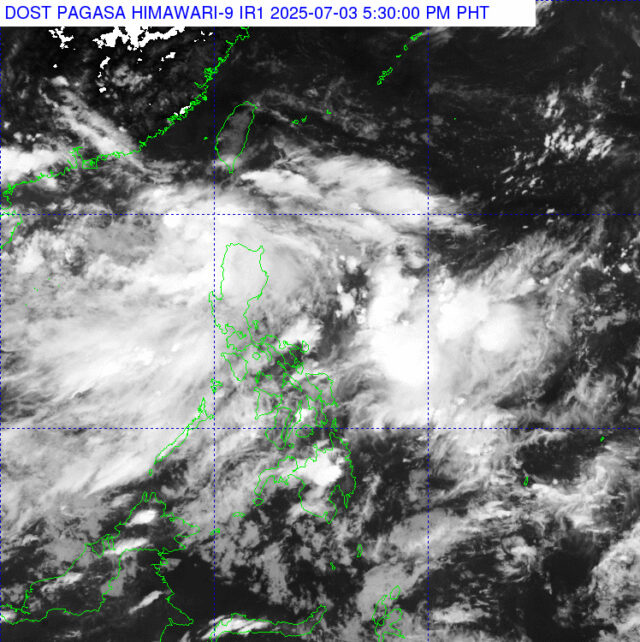
A SATELLITE photo of the low-pressure area that is causing heavy rains in the Philippines. — DOST/PAGASA

By Katherine K. Chan and Adrian H. Halili, Reporter

THE MINES and Geosciences Bureau (MGB) on Thursday urged communities and local governments in Luzon and Mindanao to stay on high alert for rain-induced landslides and flash floods as a low-pressure area (LPA) strengthens the southwest monsoon.

In an advisory posted on Facebook, the bureau under the Environment department warned at least eight cities in Metro Manila and 24 provinces of landslides, floods or flash floods, and debris flows starting Thursday until Sunday.

Some provinces not on the MGB list and mentioned in the weather bureau’s separate advisories should activate the appropriate preparedness measures and monitor for future geohazard advisories, should there be any sudden changes in the rainfall forecast or weather conditions, it added.

Several local government units suspended classes on July 3 due to heavy rains.

The MGB said moderate to very high flooding and moderate landslides might hit 412 villages in Manila, Marikina, Pasig, Quezon City, Caloocan, Malabon, Navotas and Valenzuela in the National Capital Region.

Meanwhile, at least 3,358 other villages in Calabarzon, Mimaropa, Cagayan Valley, Central Luzon, Cordillera Administrative Region, the Ilocos Region, Caraga Region, and Northern Mindanao might encounter moderate to very high flooding, moderate to very high landslides and debris flow.

Moderate floods are 0.5 to one meter high that could last for as long as three days. High floods reach one to two meters, while very high floods are more than two meters, both lasting over three days.

“The threshold values were lowered in Metro Manila due to the nature of flooding in highly urbanized areas, wherein the rains are not readily absorbed by the land,” the MGB said.

“This leads to increased surface runoff that overwhelms the drainage system and causes flooding in low-lying areas, as well as those proximal to waterways,” it added.

The MGB urged local governments, local disaster risk reduction and management councils and communities to be vigilant.

The bureau also asked mining companies, particularly those in hazard areas, to have their emergency response and preparedness teams on standby and coordinate with local government units (LGU).

Meanwhile, the state weather bureau said the low-pressure areas had a “medium potential” to develop into a tropical depression in the next 24 hours.

If it intensifies, it will be the second tropical depression in the country this year and will be named Bising, the Philippine Atmospheric, Geophysical, and Astronomical Services Administration (PAGASA) said in a separate weather bulletin.

As of 3 p.m. on Thursday, the low-pressure area, which entered the Philippine Area of Responsibility (PAR) on Sunday evening, was spotted over the coastal waters of Sabtang, Batanes in northern Philippines.

It was expected to bring cloudy skies with scattered rains and thunderstorms in the Ilocos Region, Cordillera Administrative Region, Cagayan Valley and Aurora.

Meanwhile, the southwest monsoon could cause occasional rains over Metro Manila, Pangasinan, Zambales, Bataan, Cavite, Batangas, and Occidental Mindoro, and cloudy skies with scattered rains and thunderstorms in Western Visayas and the rest of Luzon.

The rest of the country might see partly cloudy to cloudy skies with isolated rain showers or thunderstorms, it added.

PAGASA was also monitoring another tropical storm outside the Philippine area of responsibility.

FLOOD MITIGATION
The Philippines lies along the typhoon belt in the Pacific and experiences about 20 storms each year. It also lies in the so-called Pacific Ring of Fire, a belt of volcanoes around the Pacific Ocean where most of the world’s earthquakes strike.

The country often experiences unavoidable losses and damage equivalent to 0.5% of its annual economic output mainly due to an increasingly unpredictable climate, according to the Finance department.

Also on Thursday, the palace said President Ferdinand R. Marcos, Jr. would study the Interior and Local Government department’s request to give it the authority to suspend classes during typhoons.

The present system, where mayors decide whether to suspend classes, would remain in place, Palace Press Officer Clarissa A. Castro told a news briefing.

She said the President had ordered agencies to step up flood mitigation efforts during the typhoon season.

“The President has ordered the immediate cleaning of drainages because this will help prevent rapid flooding, especially here in Metro Manila,” she said.

Last month, the state weather bureau declared the onset of the southwest monsoon,  which could increase the chances of tropical cyclone activity in the next few months.

Ms. Castro said the Metropolitan Manila Development Authority (MMDA) has identified 23 priority estuaries in Metro Manila for clean-up. Displaced workers would be tapped in the clean-up drive, she added.

The Department of Interior and Local Government was also ordered to strengthen the disaster preparedness measures of LGUs.

The agency is also intensifying the activation of emergency operation centers, evacuation preparedness, updated contingency plans, community drills and exercises and the enforcement of no-build zones, she added.

“Local disaster offices need to be prepared as first responders in these types of situations,” she said.