Home Blog Page 7745

Ease of paying taxes bill in House priority list
PHILSTAR

By Russell Louis C. Ku

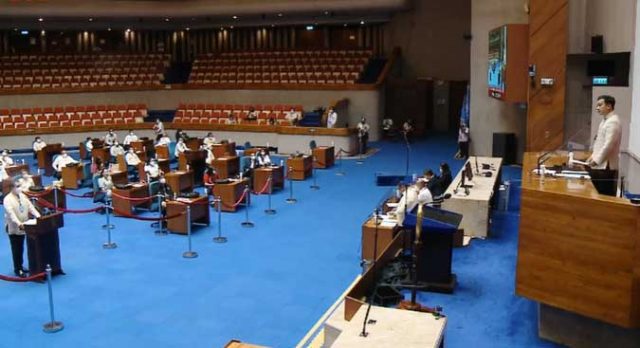
THE HOUSE of Representatives will include the ease of paying taxes bill among its priorities, Speaker Lord Allan Jay Q. Velasco said on Monday as the 18th Congress reconvened for its third and final regular session.

“The lockdowns and other restrictions being imposed due to the pandemic heightened the need for flexible and more efficient ways of doing business in administering access,” Mr. Velasco said in his speech to House members. 

House Bill 8942 seeks to simplify rules and processes in filing and paying taxes such as removing venue restrictions and segmenting taxpayers; remove the P500 annual taxpayer registration fee; create registration facilities for non-resident taxpayers; and institutionalize a “Taxpayer’s Bill of Rights.”

The measure has been approved by the House Committee on Ways and Means and is currently undergoing plenary deliberations.

Albay Representative Jose Ma. Clemente S. Salceda welcomed the inclusion of the bill among the priority measures and said he expects it to be passed in the House by August.

He explained that the streamlining of tax procedures can provide additional government revenue, adding that the measure eliminates “tax uncertainty” amongst potential investors and lowers the tax gap due to “outdated” policies.

The bill is one of the priority legislations being pushed by business groups and foreign chambers.

“The increased tax compliance resulting from the tax administration efficiency introduced through this measure may bring in an estimated P73.1 billion for the government in the first five years of implementation,” Mr. Salceda told  BusinessWorld.   

The other House priorities cited by Mr. Velasco include the Philippine Creative Industries Bill along with measures earlier listed such as Philippine Virology Institute Bill, Center for Disease Control Bill, Medical Stockpiling Bill, and Unified Military and Uniformed Services Personnel Separation, Retirement, and Pension Bill. 

“We also recognize the devastating impact of COVID-19 (coronavirus disease 2019) on our creative industries and truly support to organize and institutionalize the Philippine creative economy,” he said.

2022 BUDGET
On next year’s budget, the House leader said they aim to begin deliberations as soon as the administration submits the 2022 National Expenditure Program to Congress.

“We have to scrutinize, refine, and construct the budget properly in order to address the growing needs of our country, especially in the midst of an ongoing pandemic,” Mr. Velasco said in Filipino. 

In the upper chamber, Senate President Vicente C. Sotto III emphasized the urgency of passing all important bills before receiving the budget or General Appropriations Bill from the House.

Mr. Sotto, who has announced that he is running for the vice presidency in the 2022 elections in tandem with Senator Panfilo M. Lacson, said he trusts that all senators will not let the campaign preparations affect their work.

“Most of the senators act like statesmen. They will prioritize their work. That is the leadership that I always show. I don’t see the campaign becoming a problem. I’m sure work will be the priority because that will be my priority and our priority,” he said.

Among the measures that the Senate will focus on, according to Mr. Sotto, include the Retail Trade Liberation Act, Foreign Investments Act, and Public Services Act, which have all been certified as urgent by President Rodrigo R. Duterte and pending in the bicameral committee.

If these are not settled, Mr. Sotto said, only then will the Senate prioritize the third COVID-19 stimulus package under the Bayanihan III bill of the House and Bayanihan to Heal as One Act by the Senate.

Mr. Sotto and Senate Majority leader Juan Miguel F. Zubiri said the potential impact of the more transmissible coronavirus Delta variant, with more than 100 cases already recorded in the country, could also push the Bayanihan III bill at the top of the priority list.

On charter change involving economic provisions, Mr. Sotto said no talks had been undertaken, but Mr. Zubiri said there will be time to tackle it early next year.

“We have plenty of time to discuss it because at the latest, we have to have this passed by February, before the break,” he said in a mix of English and Filipino. — with Alyssa Nicole O. Tan
Local transmission being assessed on Delta variant cases

PHILIPPINE STAR/ MICHAEL VARCAS

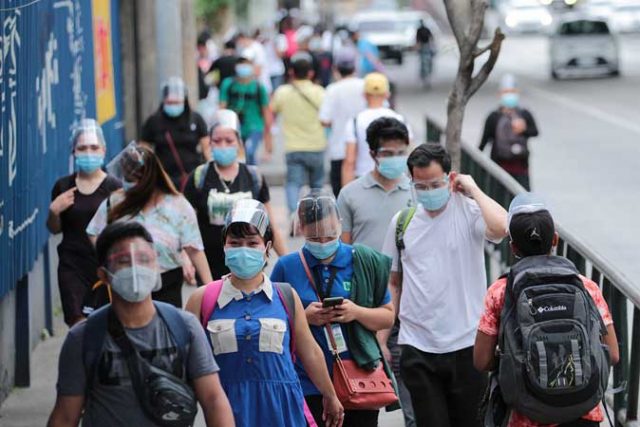
THE DEPARTMENT of Health (DoH) is already studying whether there is already a community transmission of the more contagious coronavirus Delta variant, the type that is ravaging southeast Asian countries.

Health Undersecretary Maria Rosario S. Vergeire told a virtual press briefing Monday that they are waiting for the “phylogenetic analysis” of the Philippine Genome Center to establish local transmission.

Ms. Vergeire earlier explained that there is a community transmission when health authorities “do not see any linkage of the cases anymore.”

Of the 55 new Delta cases reported on Sunday, 37 were local patients, 17 were returning migrant Filipinos and one was still being verified, DoH said.

Fourteen of the 37 were in Southern Luzon, eight in Northern Mindanao, six each in the capital region and Central Luzon, two in the Davao Region and one in Ilocos.

Meanwhile, the Health official confirmed that only nine of the total 119 Filipinos infected with the Delta variant were vaccinated against the coronavirus.

Of the nine vaccinated, four received two doses, while five received one dose, she said. Of those fully vaccinated, three had mild coronavirus symptoms while one was asymptomatic. Three of those who received initial doses were mild cases and two did not show symptom.

More than 20 Delta variant cases were unvaccinated while 86 cases are still being verified.

Meanwhile, DoH reported 6,664 coronavirus disease 2019 (COVID-19) infections on Monday, bringing the total to 1.55 million.

Ms. Vergeire said the increase in additional cases nationwide could not be classified yet as a new surge.

“Cases are going up, that we can verify,” she said.

The death toll rose to 27,247 after 23 more patients died, while recoveries increased by 5,766 to 1.47 million, it said in a bulletin.

There were 55,140 active cases, 93.6% of which were classified as mild, 1.1% were asymptomatic, 2.3% were severe, 1.61% were moderate and 1.4% were critical. — Kyle Aristophere T. Atienza

Nurses’ group slams continued shortage of health workers

A GROUP of nurses slammed the administration of President Rodrigo R. Duterte for its failure to address the shortage of nurses and other healthcare workers.

In a statement, the Filipino Nurses United (FNU) said the total 9,088 health workers hired through the Department of Health’s (DoH) emergency hiring program is “way below” Mr. Duterte’s vow in his 2020 State of the Nation Address to hire more than 20,000 this year.

Instead of mass hiring nurses, the group noted that the Health department “resorted to emergency hiring of contract of service for three months’ employment that included 3, 909 nurses.”

“This is even way below the FNU’s recommendation of 48,000 nurses more so considering that there are 1,700 COVID 19 referral centers all over the country,” it said.

Citing data from DoH, the group said the number of deployed nurses were reduced by 12% or 2,319 nurse slots. The 13,000 vacant plantilla positions of health workers since 2016 remain unfilled, it said.

“The preventive and promotive aspects of health care have become even much less at a time when people are in critical need of basic, essential health services to prevent increase of COVID-19 infection,” the group said.

The group also lamented that many health workers still have not received their special risk allowances under the country’s second stimulus law, known as Bayanihan II, which expired last June 30. In a virtual press briefing on Monday, Health Undersecretary Maria Rosario S. Vergeire said the DoH would look into bottlenecks preventing the release of the special allowances. — Kyle Aristophere T. Atienza

SONA protesters take to the streets amid rains, coronavirus threat 

PHILIPPINE STAR/ RUSSELL PALMA

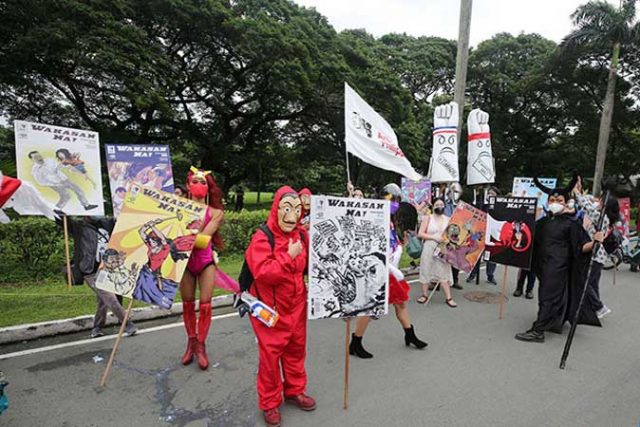
VARIOUS GROUPS carried on with their march Monday despite the rain and continued threat of coronavirus transmission to voice their objection to President Rodrigo R. Duterte’s political plans as he delivered his final State of the Nation Address (SONA).   

With the theme “Goodbye, Duterte,” the rallyists expressed opposition to Mr. Duterte’s recent pronouncement that he might run for vice president in the 2022 elections to protect himself from lawsuits.  

Under the Philippine Constitution, a president cannot run for reelection.   

“The law says if you are vice president, you have immunity, so I will just run for vice president,” Mr. Duterte said during a political party’s assembly on July 17.   

Protesters also called on the government to increase social pension, end contractualization, junk the Anti-Terror Law, hasten justice for victims of extrajudicial killings, and to fight for the country’s jurisdiction over the South China Sea, among others.   

Police chief Guillermo Lorenzo T. Eleazar and the Quezon City local government allowed the protest as long as the minimum health protocols such as social distancing and wearing of face masks and face shields were followed.   

The protesters were also only allowed to march from the University of the Philippines Diliman compound to Tandang Sora, which is about 10 kilometers away from House of Representatives complex where the SONA is held every year.    

Mr. Eleazar instructed policemen to exercise maximum tolerance while being on alert at pre-designated areas for protesters who might violate the rally permit and health protocols. — Bianca Angelica D. Añago  

Philippine Coast Guard’s ‘largest’ vessels to arrive next year from Japan 

@COASTGUARDPH

THE TRANSPORTATION department announced on Monday that the two 94-meter multi-role response vessels (MRRVs) it acquired for the Philippine Coast Guard will start arriving in Manila by March next year.  

“Through the accelerated construction of the Japanese shipbuilder, the first 94-meter MRRV is expected to arrive in Manila by March 2022, while the second vessel will arrive two months later or by May 2022,” the Department of Transportation (DoTr) said in a statement.  

It said one of the vessels was launched at the Shimonoseki Shipyard of Mitsubishi Shipbuilding Co. Ltd. in Japan on Monday.  

“The two MRRVs will be the largest vessels of the PCG’s fleet, once delivered. These MRRV’s modeled after the Japan Coast Guard Kunigami-class vessels are expected to improve the PCG’s maritime security and maritime safety capabilities,” the department added.  

The vessels measure about 94 meters. They have a maximum speed of not less than 24 knots, and an endurance of not less than 4,000 nautical miles, the DoTr said. 

“The ships are capable of conducting sustained maritime patrols in the country’s maritime jurisdictions, including the West Philippine Sea and Philippine Rise,” the department noted.  

The vessels were acquired under the Maritime Safety Capability Improvement Project Phase II, a Japan-assisted project funded by an official development assistance loan from the Japan International Cooperation Agency amounting to approximately JPY16.5 billion. — Arjay L. Balinbin 

DA hastening transition to province-led support system for farmers, fisherfolk 

THE DEPARTMENT of Agriculture (DA) aims to improve the delivery of extension services and provision of technical and marketing assistance to farmers and fisherfolk in the last year of President Rodrigo R. Duterte’s term.    

In a statement on Monday, Agriculture Secretary William D. Dar said the department, in the remaining time of Mr. Duterte’s administration, will transition to the province-led Agriculture and Fisheries Extension Systems (PAFES).   

The shift will be undertaken in partnership with local government units (LGUs), state universities and colleges, the private sector, and farmers’ organizations.  

Mr. Dar said efforts to strengthen the delivery of extension services to farmers is also in anticipation of the Mandanas-Garcia ruling set to take effect in Jan. 2022, which will give LGUs a bigger share from national taxes.    

“PAFES would serve as the modality of implementing banner programs in the provinces. Under the system, we at the national government will do the steering, while the LGUs will do the rowing,” Mr. Dar said.    

According to the DA, agricultural extension and advisory services have an important role in strengthening farm productivity and income, increasing food security, improving rural livelihood, and promoting agriculture.    

Mr. Dar said PAFES will help improve the ability of provincial LGUs in accomplishing agri-fishery extension services and combining multiple programs of the DA with the respective provinces serving as the operations hub.    

“We have to understand that agriculture is local. Agriculture is provincial. Therefore, the LGUs are in a much better position in identifying and supplying these services that would bring more progress to the countryside, and make the country food-secure and resilient,” he said.    

Meanwhile, Mr. Dar said the potential of the country’s agriculture and fishery sector can be further tapped with the provision of the appropriate budgetary support and private sector investments.    

“For 2022, we are proposing a budget of P250 billion, which is three times more than this year. We pray that the country’s agriculture sector could be afforded that long-delayed financial support so the Philippines could keep pace at least with our counterparts in the ASEAN (Association of Southeast Asian Nations) region,” Mr. Dar said. — Revin Mikhael D. Ochave   

Gov’t eases entry rules for foreign family members  

FOREIGNER PARENTS, spouses, and children of Filipino citizens will be allowed to enter the Philippines without the need for entry exemption documents starting Aug. 1, the Bureau of Immigration announced on Monday.  

Immigration Commissioner Jaime H. Morente said the new travel guidelines approved by the national task force handling the coronavirus response apply to foreigners who are not accompanied by their Filipino spouses, parents, or children in entering the country.   

They need to secure a tourist visa from Philippine consulates abroad.  

“Foreigners who are traveling with their Filipino spouses or parents are eligible for the Balikbayan program and they may be admitted visa-free for a one-year stay,” Mr. Morente said.   

Meanwhile, the travel ban on those coming from India, Pakistan, Nepal, Bangladesh, Sri Lanka, Oman, United Arab Emirates, Indonesia, Malaysia, and Thailand will also be lifted by Aug. 1, unless the task force announces an extension within the week. — Bianca Angelica D. Añago  

7 Luzon roads closed, 3 with limited access due to incessant rains 

THE DEPARTMENT of Public Works and Highways (DPWH) announced Monday that seven national roads in Luzon were impassable, while three had limited access due to rains from the southwest monsoon that triggered flooding and landslides.  

“Seven national road sections are still closed to traffic while three are inaccessible to light vehicles per 12:00 noon Monday,” the department said in an advisory.  

Roads that were impassable to all types of vehicles were the Baguio-Bontoc Road, Busa Bridge in Sabangan, Mt. Province; Abra-Kalinga Road in Gacab, Malibcong, Abra and Abra-Ilocos Norte Road in Nagaparan, Danglas, Abra; Junction Layac Balanga Mariveles Port Road Zigzag Section in Bataan and Mindoro West Coastal Road, Pag-asa Section, in Sablayan, Occidental Mindoro.  

The Kalinga–Abra Road in Bulac, Balbalan, Kalinga and the Mt. Province-Ilocos Sur Road via Tue, Beto Section, in Tue, Tadian, Mt. Province were also closed due to soil and rock collapse.   

“Quick Response Teams have been mobilized to conduct clearing operation along the affected sections,” the department said.  

Closed to light vehicles due to flooding were the Apalit Macabebe Masantol Road at Intermittent Sections and Sto Tomas-Minalin Road (Minalin-Macabebe Section) in Pampanga; and Bigaa Plaridel via Bulacan and Malolos (Panginay Section).  

The department noted that all other national roads and bridges in other affected regions were passable to all types of vehicles. — Arjay L. Balinbin 

Iloilo City sets tax incentives for new investment zones 

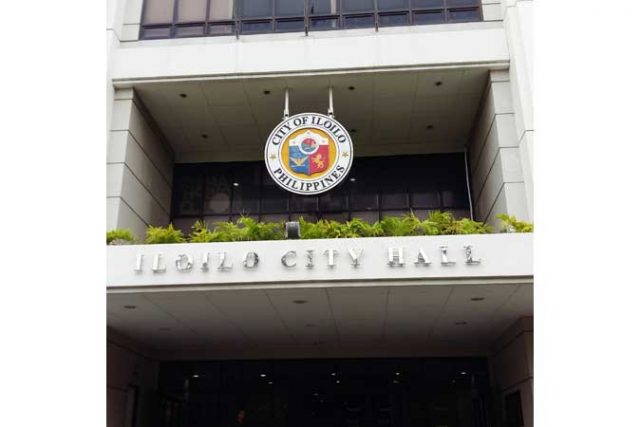
THE ILOILO City government is giving tax incentives to investors that will set up shop in areas identified as new growth zones.  

“Businesses that will settle along road networks in the metropolis identified as investment hubs” will be able to avail of tax discounts over a certain number of years, the city government said in a statement.  

The areas include the entire stretch of the “Circumferential, Coastal and Radial roads” as defined in earlier regulations issued by the local government.  

Under Regulation Ordinance No. 2021-196 providing for The Iloilo City Investment Incentives for Specific Areas of Development, qualified businesses are those with an investment of at least P5 million.   

The applicable tax holidays are 100% on the first year, 75% on second year, and 50% on the third year of operation.  

Investments of P5 million to less than P40 million are entitled to the incentive for one year; P40 million to less than P100 million for two years; and P100 million and above for three years.  

The identified investment priority sectors include manufacturing and processing; export-oriented; tourism; and utility companies engaged in power generation and distribution, water, transportation, and transportation support facilities. 

Other priority areas are information and communication; agri-fishery; social services and facilities such as health care service and educational institution; commercial and industrial buildings; solid waste management and disposal system; and research and development and innovation start-up companies.  

Mayor Jerry P. Treñas initiated the additional incentives to boost economic revival amid the continuing coronavirus pandemic. 

ADB $1.75-B loan for south rail project up for board approval

BW FILE PHOTO

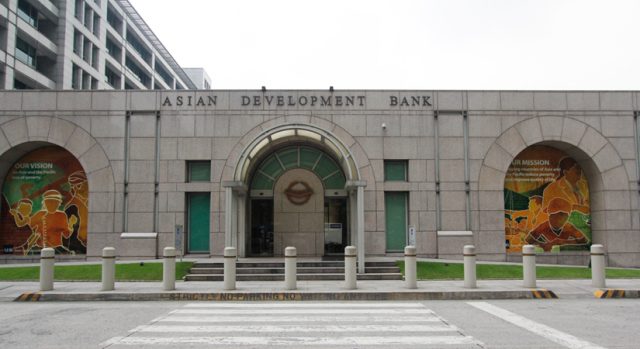
THE ASIAN Development Bank (ADB) said it is scheduled to approve a $1.75-billion loan for the South Commuter Railway project, which will connect Tondo, Manila and Calamba, Laguna, by the fourth quarter.

“The Philippine government held successful biddings for civil works contracts for a combined 40.5 kilometers (km) of viaduct structures for the South Commuter Railway Project, a major flagship project the ADB is preparing for funding support for consideration by its Board of Directors in the fourth quarter of this year,” the bank said in a statement Monday.

The loan is the biggest ADB financing package for the Philippines this year.

The P344.6-billion south railway system is part of the flagship 147-kilometer North-South Commuter Railway System project, which will link Pampanga, Manila and Laguna by 2025.

It was also poised to become the country’s first airport express system since it will be connected to Clark International Airport in Pampanga.

During the bidding last week, the South Commuter Railway project, also referred to as the Philippine National Railways (PNR) project, attracted 34 bids from 17 international and six local companies wanting to take part in the construction of the railway system.

Transportation Secretary Arthur P. Tugade said the bidding attracted a “record-breaking turnout” from both Philippine and foreign companies. The government is planning to offer more contract packages for the project’s electromechanical systems and airport express train cars this quarter.

“We congratulate the Department of Transportation and PNR on the successful bidding turnout, which reflects robust local and global interest and confidence in the Philippines’ ‘Build, Build, Build’ infrastructure development program and for a strong post-pandemic economic recovery,” ADB Philippine Country Director Kelly Bird said in the statement.

“We are pleased to partner with the Philippine government in this transformative project that will have substantial multiplier effects on the economy and regional development,” he added.

The bank is planning to lend the government $3.9 billion this year.

The south rail transport system is also linked to another ADB-funded project, the 53-km Malolos-Clark Railway Project, for which the bank extended $2.75 billion worth of financing in May 2019.

The North-South Commuter Railway line was co-financed by the ADB and Japan International Cooperation Agency (JICA). It will have 37 stations and 464 train cars or 58 trains sets, which includes airport express trains.

The system, with capacity of up to 1 million passengers daily, is expected to cut the travel time between Clark airport and Calamba, Laguna to 1.5 hours, from four hours currently.

In 2019, JICA also lent the government P80 billion for the first phase of the North-South Commuter Railway system. — Beatrice M. Laforga

ARTA wants 100% return to office for gov’t frontline staff

PHILSTAR

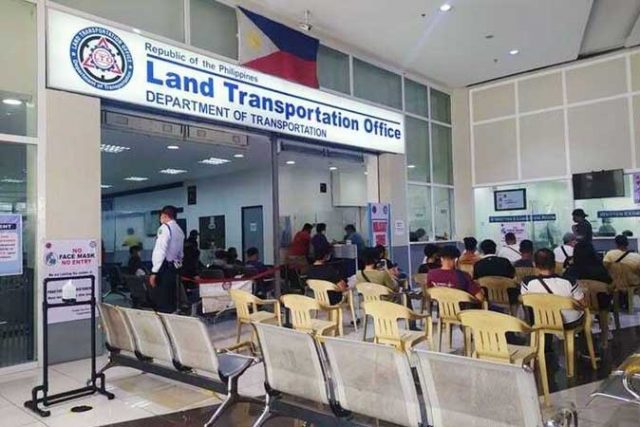
THE ANTI-RED Tape Authority (ARTA) has thrown its support behind requiring 100% office capacity for all frontline government workers to ensure speedy processing and maintain quality of services.

Reintegration of all government workers in frontline services into daily office work will head off any deterioration in service quality, the agency said in a statement Monday. Back-end operations supporting frontline services should be included in any return-to-office arrangements, ARTA added.

The government recently imposed stricter quarantine restrictions in Metro Manila after confirmation of the local transmission of the more contagious Delta variant of the coronavirus disease 2019 (COVID-19). Over a hundred Delta variant cases have been confirmed in the Philippines.

ARTA said it does not support requiring a return to work for senior citizens, persons with comorbidities and persons with disabilities, and pregnant and nursing mothers. Such workers, it said, may be assigned to other units.

“Other offices or units of the agency may operate at 50% capacity. This may decrease or increase depending on the health crisis situation,” the agency said.

ARTA Director General Jeremiah B. Belgica said that the agency has received complaints about inefficient government work, including backlogs of pending applications.

“With long queues and government delays and inaction on transactions, some applicants resorted to engaging with fixers,” ARTA said.

“Temporary or half-baked online services were developed and deployed in a bid to continue providing services to the public but these did not last as technical glitches forced them to cease operations.”

Some government agencies have also not provided employees with internet allowances and shuttle services.

Business groups have been pressing the government to digitalize its services to allow it to continue functioning during lockdowns. 

Consultations with government agencies will be conducted before personnel are required to report to their offices, ARTA added. — Jenina P. Ibañez

‘More equitable’ net metering needed for solar

By Angelica Y. Yang, Reporter

THE PRESIDENT of Energy Development Corp. said Monday that higher net metering rates will encourage power consumers to invest in solar technology for their homes and buildings.

“This simple policy change will accelerate the adoption of solar in our country,” Richard B. Tantoco, president and chief operating officer of Energy Development Corp. said during the virtual BusinessWorld Insights: Kickstarting Green Recovery event Monday.

Mr. Tantoco said that he participates in the government’s net metering scheme, which allows eligible customers to generate their own electricity through their own renewable energy (RE) facilities, with the excess power being exported to distribution utilities (DU) for peso credit which will offset their power bills.

He said he is able to sell the extra power generated by his solar panels at P4, but purchases electricity from his DU at almost thrice the price or P11.

“In other jurisdictions, this offsetting happens at a much more equitable rate like (in) Hawaii. For example, you can buy (from the grid) at P11 but when you produce extra, instead of selling it at P4, you (can) end up selling it at about P10,” Mr. Tantoco said.

There is a need to integrate RE into the power system, according to House Deputy Speaker and Antique Rep. Loren B. Legarda, who was also present during the event.

Based on estimates from the Energy department, coal accounted for 44.5% of the power generation mix, while RE sources made up a combined 25% in 2015.

“We need to cast out misplaced notions on RE. Otherwise, our limited understanding will cloud our ability to meet our goal of achieving energy independence. We need to wake up to the reality that coal and other fossil fuels are on their way to becoming stranded assets (and) obsolete,” Ms. Legarda said.

The legislator said RE sources provide clean and indigenous power. “They also provide thousands of green jobs for people, improve air quality and protect our ecosystems,” she said.

Greenpeace Southeast Asia Executive Director Naderev Sano said the transport, food, building, and energy sectors must reduce their carbon footprint in order to contribute to the green recovery.

He said climate change affects all sectors, and it is a duty to limit its effects.

“The planet is hurtling in a dangerous trajectory that may go beyond (the warning) beyond (the global temperature increase of) 1.5 degrees Celsius and we need to avert that,” he said.