Home Blog Page 7682

E-conferencing rises to the top in health sector as pandemic rages on

THE Philippines’ Health department has logged 2.3 million minutes in conference calls and telemedicine on Cisco Systems, Inc.’s platform, demonstrating the impact of technology on citizens and organizations during the pandemic crisis.

“Over the past year, the Department of Health (DoH) conducted 17,400 sessions over Webex, amounting to over 2.3 million minutes of meetings and consultations,” Cisco said in an e-mailed statement on Tuesday.

“In the past three months alone, the DoH has engaged with over 100,000 stakeholders and patients per month,” it added.

Cisco Managing Director for the Philippines Karrie C. Ilagan noted telehealth is not new in the Philippines, but it was not the norm before.

“Because of the pandemic, health institutions had to make many of their offline services available online, which is a complicated process,” she added.

Available online conferencing platforms are helping private and public sectors continue their services amid a public health crisis.

Webex is a technology solution for video conferencing, online meetings, screen share, and webinars.

“Cisco Philippines extended support to the DoH in building its capacity to conduct online consultations, virtual meetings, and respond to large volumes of calls from patients all over the country via Cisco Webex licenses and devices,” the company said.

“Hundreds of Webex licenses were distributed to various health facilities all over the country,” it added. — Arjay L. Balinbin

World’s cryptocurrencies face possible hurdles ahead

EVOLVING RULES, environmental concerns and competition from central banks threaten to undermine many of the world’s fast-growing crypto assets, crypto and macro experts said, while creating opportunities for those able to adapt.

Europe and the United States are both working on regulating digital assets and their providers — moves welcomed by investors, who hope the new ground rules will encourage institutional investors to plunge in.

Anatoly Crachilov, co-founder and CEO of Nickel Digital Asset Management, which manages assets worth $200 million, told the Reuters Global Markets Forum that regulatory uncertainty was a drag on the development of the crypto space.

He described the promise by the US Securities and Exchange Commission’s new Chairman Gary Gensler, to provide “guidance and clarity” to the market during his confirmation hearing in March, as a turning point.

For its part the European Commission’s proposed “Markets in Crypto-assets,” or MiCA regulation, will regulate crypto-assets and their service providers in the European Union.

“It will be a new banking sector, with passporting possibilities,” digital asset trading solutions company H-Finance CEO Vytautas Zabulis said, referring to the prospect of EU-wide cryptocurrency trading licences.

Alongside the evolving regulatory framework, some countries, including China, Britain and Russia, are considering launching their own central bank digital currencies (CBDCs).

That is likely to be followed by legislation to tax gains, said Robert Carnell, chief economist and head of research at ING Asia. “That may be the death knell for these other cryptocurrencies, though central bank coins are on the up and up,” he said.

Mr. Zabulis said that if CBDCs were developed in a way that they were “easy to interact with,” most digital currencies used for settlements will likely lose their both their goal and value.

There was not a big argument for bitcoin becoming a settlement tool, Mr. Zabulis cautioned. “Blockchain technology is for that, so, CBDCs will be built on blockchain.”

Bitcoin traded around $54,000 following a 10% surge on Monday, driven by reports that JPMorgan Chase is planning to offer a managed bitcoin fund.

CBDCs are expected to have a limited impact on Bitcoin in particular, due to its progressively limited supply, which is in contrast to traditional fiat systems, Mr. Crachilov said.

“No central bank currency, however digital, can offer scarcity at this stage, as its supply can be inflated by a respective central bank issuing entity,” Mr. Crachilov said.

If China saw bitcoin as a threat to its own planned digital currency, that could affect the whole industry, Mr. Zabulis said.

GREEN REVOLUTION?
Creating crypto assets leaves a heavy carbon footprint, and is being increasingly seen as environmentally unsustainable.

ING Asia’s Mr. Carnell said there was “a strong argument on environmental grounds for limiting crypto mining, or at least having them offset their wasteful practices.”

However, bitcoin enthusiast Raoul Pal said he was not worried about the “unsustainability narrative”.

Pal, founder and CEO of on-demand financial TV channel Real Vision, said he believed it would drive a “green revolution” because in the end that was “the only way to win.”

Nickel Digital’s Crachilov said his fund was seeing a higher demand for ESG-compliant cryptos. “The price competition drives miners towards the cheapest sources of energy — renewables are increasingly falling into this category,” he said.

Garrett Minks, chief technology officer at Delaware-based RAIR Technologies, said the idea is to “trade brute force electricity burning with fancier math.” — Reuters

Winners of food writing tilt out

THE DOREEN Gamboa Fernandez Food Writing Award (DGF Award) has announced the winners of the 2020 competition. The subject matter was “Livestock,” which, in the Philippines refers to cattle, pigs, goats, carabaos, and horses.

Kaye Leah Cacho-Sitchon won first prize for her essay Sinanglaw for Breakfast. Second and third prizes went to Jeanne Rebollido Jacob-Ashkenazi for Bile. More Than Just an Unlikely Condiment and Welcoming the Goat to Our Tables, respectively.

There were three honorable mention awardees. Wilson Lee Flores wrote about his mother in A Literature Teacher’s ‘Magical’ Kitchenette. Rosy Mina won for Are You What You Eat? and Shulamite Maiden Pormentira won for The Bitter, the Better.

The DGF Award is now in its 19th year. Named after the late dean of food writers, Doreen Gamboa Fernandez, it was founded to encourage writers to contribute to Philippine food literature. The winning essays of the first 15 years have been published in two books — Savor the Word and Sangkap.

As tech faces a reckoning, what you do offline can get you banned

EARLIER this month, Twitch announced it would start banning users for behavior away from its site.

The move by Amazon, Inc.’s live-streaming platform involved hiring a law firm to conduct investigations into users’ misconduct, a new twist in the latest prominent example of tech companies acting on “off-service” behavior.

How platforms enforce against activities conducted not just on their services but on other sites and offline, is often only described vaguely in their rules. But as lawmakers and researchers examine tech’s relationship with real-world violence or harm, this moderation is gaining attention.

While some groups have praised platforms for being proactive in protecting users, others criticize them for infringing on civil liberties.

“This isn’t content moderation, this is conduct moderation,” said Corynne McSherry, legal director at the digital rights group Electronic Frontier Foundation, who said she was concerned about platforms that struggle to effectively moderate content on their own sites extending their reach.

In interviews, platform policy chiefs described how they drew different lines around off-service actions that could impact their sites, acknowledging a minefield of challenges.

“Our team is looking across the web at a number of different platforms and channels where we know that our creators have a presence… to understand as best as possible the activities that they’re engaging in there,” said Laurent Crenshaw, policy head at Patreon, a site where fans pay subscriptions for creators’ content.

Facebook, Inc.’s rules ban users they deem dangerous, including those involved in terrorist activity, organized hate or criminal groups, convicted sex offenders and mass murderers. People who have murdered one person are mostly allowed, a spokeswoman said, due to the crime’s volume. Last year, Facebook expanded the list to include “militarized social movements” and “violence-inducing conspiracy networks” like QAnon.

Twitch’s new rules say it may ban users for “deliberately acting as an accomplice to non-consensual sexual activities” or actions that would “directly and explicitly compromise the physical safety of the Twitch community,” categories which a spokeswoman said were intentionally broad.

Twitch’s change in policy largely stemmed from the gaming industry’s #MeToo moment in Summer 2020 when the site saw harassment at real-life gaming events and on sites like Twitter and Discord, Chief Operating Officer Sara Clemens told Reuters.

Looking beyond their own sites has helped companies remove extremists and others who have “learned the hairline cracks” in site rules to stay online, said Dave Sifry, vice-president of the Anti-Defamation League’s Center for Technology and Society, which has pushed for major platforms to incorporate this behavior into decisions.

Self-publishing site Medium established off-service behavior rules in 2018, after realizing attendees of the August 2017 white nationalist rally in Charlottesville, who had not broken rules on specific sites, appeared to be “bad actors on the internet in general,” it said.

Last summer’s protests over the murder of George Floyd prompted Snap, Inc. to talk publicly about off-platform rules: CEO Evan Spiegel announced Snapchat would not promote accounts of people who incite racial violence, including off the app. In December 2020, TikTok updated its community guidelines to say it would use information available on other sites and offline in its decisions, a change that a spokeswoman said helped it act against militia groups and violent extremists.

Notably, this year, sites like Facebook, Twitter, Inc. and Twitch took into account former US President Donald Trump’s off-service actions that led to his supporters storming the US Capitol on Jan. 6 when they banned him.

FROM MURDER TO MONEY LAUNDERING
Tech companies differ in approaches to off-platform behavior and how they apply their rules can be opaque and inconsistent, say researchers and rights groups.

Twitter, a site where white nationalists like Richard Spencer continue to operate, focuses its off-service rules on violent organizations, global director of public policy strategy and development Nick Pickles said in an interview.

Other platforms described specific red-flag activities: Pinterest, which took a hardline approach to health misinformation, might remove someone who spreads false claims outside the platform, policy head Sarah Bromma said. Patreon’s Crenshaw said while the subscription site wanted to support rehabilitated offenders, it might prohibit or have restrictions around convicted money launderers or embezzlers using its platform to raise money.

Sites also diverge on whether to ban users solely for off-service activity or if on-site content has to be linked to the offense.

Alphabet, Inc.’s YouTube says it requires users’ content to be closely linked to a real-world offense, but it may remove users’ ability to make money from their channel based on off-service behavior. It recently did this to beauty influencer James Charles for allegedly sending sexually explicit messages to minors.

Charles’ representatives did not respond to requests for comment. In a statement posted on Twitter this month, he said he had taken accountability for conversations with individuals who he said he thought were over 18 and said his legal team was taking action against people who spread misinformation.

Deciding which real-life actions or allegations require online punishments is a thorny area, say online law and privacy experts.

Linking the activity of users across multiple sites is also difficult for reasons including data privacy and the ability to attribute actions to individuals with any measure of certainty, say experts.

But that has not deterred many companies from expanding the practice. Twitch’s Clemens said the site was initially focusing on violence and sexual exploitation, but it planned to add other off-site activities to the list: “It’s incremental by design,” she said. — Reuters


First Gen says it secured Norway firm’s LNG vessel ahead of others

FIRST GEN Corp. said on Wednesday that Norway’s BW Gas Ltd. had committed to provide a liquefied natural gas (LNG) vessel to the Lopez-led firm’s unit ahead of a similar deal with another local company.

It said BW Gas, which owns a subsidiary that will deliver the floating storage and regasification unit (FSRU), made the commitment as early as November last year.

First Gen’s clarification in a disclosure to the stock exchange came a few days after the Department of Energy (DoE) approved Vires Energy Corp.’s application to proceed with its planned gas-fired power plant, which is integrated with an LNG storage and regasification facility, in Batangas.

The FSRU is said to have a storage capacity of around 162,400 cubic meters, based on a DoE media release issued on Sunday.

The DoE referred to “BW Paris” as the vessel, which First Gen claims has already been contracted to its unit FGEN LNG Corp. since November.

First Gen said BW Gas even issued a commitment undertaking to FGEN LNG on Nov. 3, 2020 “pursuant to which it agreed to ensure and procure” that the owner of the BW Paris (BW FSRU IV Pte. Ltd.) was not contracted, either conditionally or unconditionally, to any other entity.

It said the commitment was made to ensure that BW Paris would be available to be chartered by FGEN LNG to meet the requirements and timeframe of its project “up to and including” April 7.

First Gen said that before the commitment undertaking, BW Gas received preliminary inquiries on BW Paris from various firms, including Vires Energy. It said “the nature of such inquiries never went beyond the exploratory.”

BW Paris can provide ancillary services, plus storage and regasification, First Gen previously said, adding that the vessel can reload LNG into trucks and small-scale LNG vessels, which will distribute the gas to nearby areas.

Earlier this month, FGEN LNG and BW FSRU IV entered into a five-year agreement for the charter of BW Paris as an FSRU for the former’s interim offshore LNG project.

A Brown Co., Inc., which owns Vires Energy, said in a previous disclosure that at the time of its initial application with the DoE for a notice to proceed, it was “still in talks with BW Paris.”

“The negotiations with BW, however, did not progress to a successful closure. [Vires Energy], therefore, is still currently considering options and/or arrangements of other potential vessels,” A Brown said in a disclosure on Tuesday.

Vires Energy said that its integrated LNG project is targeted to begin its commercial run by January 2023.

On Wednesday, First Gen shares at the local bourse were unchanged at P31.05 apiece, while those of A Brown fell by 3.06% or three centavos to close at P0.95 apiece. — Angelica Y. Yang

Huarong mess shows China needs US-style reform of financial system

DRAMA AROUND the future of one of China’s biggest bad-debt managers is highlighting the urgent need for the country to simplify oversight of its financial system.

As investors looked for clarity over a possible restructuring of state-owned China Huarong Asset Management Co., the issue was made more complex by the number of government agencies involved.

There’s the finance ministry, which is the company’s majority shareholder. It may sell its stake to the sovereign wealth fund, thereby transferring responsibility, according to a Bloomberg News report. The China Banking and Insurance Regulatory Commission (CBIRC) has its say as a top watchdog, and has asked banks to extend loans to China Huarong by at least six months, another report said. The central bank, which is considering taking on some assets, is required to step in as part of its mandate to maintain overall financial stability.

Above them there’s the Financial Stability and Development Committee, chaired by Vice Premier Liu He — a key adviser to President Xi Jinping. There are signs the influential body will expand its remit and increase oversight of local financial institutions.

The CBIRC is the only agency to have publicly commented on China Huarong, though regulators have held several meetings to discuss the company’s fate, people familiar with the matter have said.

How China handles the growing challenges to its financial system is becoming more relevant to global markets. With unprecedented capital inflows and wider access for Chinese money to invest overseas, it’s never been more important for Beijing to strengthen its regulation in a transparent way.

Central bank Deputy Governor Liu Guiping urged reforms in a detailed article in March. China’s has “scattered” financial rules and could learn from the setup in the US, which has the Dodd-Frank Act, and other major economies that overhauled their financial regulations in recent decades, he wrote. Liu’s main takeaway: China needs a coordinated financial stability law.

Liu submitted the proposal to the National People’s Congress and suggested introducing the legislation “as soon as possible when conditions are ripe.” Completion of such legislation may take three to five years, according to Yang Zhaoquan, a partner at Beijing Weinuo Lawfirm.

“Risky incidents have emerged one after another, harming the marketplace and damaging financial and social stability,” said Yang. “This calls urgently for more powerful legal tools.”

For a government obsessed with control, the Communist Party’s oversight of its $54-trillion financial system — which includes the world’s largest banking industry — looks disjointed. A lack of oversight allowed companies like China Huarong to dabble in risky businesses, and meant that others like Ant Group Co. grew far too influential.

When China started to experiment with market-oriented reforms in the late 1970s, the People’s Bank of China (PBoC) was the only authority responsible for managing and overseeing the financial system.

The subsequent economic boom led to the creation of multiple commercial banks, insurers and brokerages, prompting the government to set up separate watchdogs for each industry and relieve the PBoC from day-to-day oversight. First came a securities regulator in 1992, followed by an insurance regulator in 1998 and a dedicated banking regulator in 2003.

China dealt with the 2008 global financial crisis with an impromptu plan reliant on debt, resulting in the bloated financial system the country has today. Fueled by asset management products and peer-to-peer lending, shadow banking assets grew to $10 trillion in the decade that followed. The market was a lifeline for cash-strapped Chinese companies with no access to regular bank loans.

But then came the crackdown on financial risk. Since Xi made deleveraging a top priority in 2017, China has given more power to the PBoC and increased efforts to consolidate its many regulatory bodies by merging the banking and insurance watchdogs. Chinese banks may still have 3 trillion yuan ($463 billion) in legacy wealth-management products to clean up before an end-2021 deadline, according to S&P Global Ratings.

The country’s rapid integration with the global financial system means a bolder strategy is needed to strengthen its patchwork of rules and regulations.

“China used to be closed off,” said Liu Feng, chief economist at China Galaxy Securities Co. “But now, foreign capital is flowing in and our capital is going out, and that requires our law and regulation to match that of other countries.” — Bloomberg

PLDT expects sustainability from energy efficiency projects

PLDT, Inc. and its subsidiaries have embarked on energy efficiency initiatives to ensure sustainability in the delivery of their products and services.

In a press release on Wednesday, the group said it recently submitted its annual energy efficiency and conservation, and yearly energy utilization reports to the Department of Energy (DoE) in compliance with Republic Act No. 11285 or the Energy Efficiency and Conservation Act.

The PLDT group, which includes Smart Communications, Inc. and ePLDT, said the reports cover more than “10,000 cell sites and 200 offices, business centers, and data centers, and will serve as a baseline from which progress from energy efficiency initiatives will be measured.”

The group said PLDT now operates oil-free chillers in its Sampaloc, Ortigas and Dansalan facilities. It said the upgraded chillers provide the highest efficiencies and reliability.

“The switch to oil-free magnetic bearing chillers eliminates the use of lubricating oil on chiller compressor bearings. This reduces bearing pressure, making the compressor more efficient and in turn, result in lower energy consumed,” the group said.

Smart, PLDT’s wireless arm, recently announced its foray into fuel cell-powered sites, which are described as an “environment-friendly alternative” that will help address connectivity issues in grid-challenged areas across the country.

The group added that its information and communication technology arm ePLDT embarked on several energy conservation programs, including the replacement of old high-power equipment with new and energy-efficient machines.

Alfredo S. Panlilio, PLDT chief revenue officer and Smart president and chief executive officer, said: “As greenhouse gas emissions arise from energy consumed in the operation of our business, particularly by our network, our offices and data centers, and emissions from our transport vehicles, the PLDT Group aims to do its share in protecting the environment through energy efficiency programs that will result in reducing our carbon footprint.”

PLDT and Smart’s energy efficiency projects are aligned with the group’s commitment in helping the country achieve the United Nations’ Sustainable Development Goals 7 (Clean and Affordable Energy) and 13 (Climate Action).

Hastings Holdings, Inc., a unit of PLDT Beneficial Trust Fund subsidiary MediaQuest Holdings, Inc., has a majority stake in BusinessWorld through the Philippine Star Group, which it controls. — Angelica Y. Yang

Dining In/Out (04/29/21)

Mother’s Day dessert boxes
Clockwise from Bottom Left — Do with Mom, Sonia, and Veronica Dessert Boxes by Benilde Culinary Alumna and Pastry Chef Lovely Jiao of Sugarplum Pastries

Mother’s Day dessert boxes and more by pastry-chef-mom

PASTRY chef-mom Lovely Jiao, the innovator behind Sugarplum Pastries’ head-turning eight-foot dessert towers, lighted anti-gravity cakes and twirly whirly rotating toppers, introduces a series of flamboyant sweets in time for Mother’s Day. She housed her bestselling treats in dainty containers. The Veronica and Sonia Gift Boxes come with  truffles, chocolate macarons, meringue kisses and bite-sized marshmallows, a special Mom sugar cookie and two Hearty Surprise smash chocolates. Veronica, named after her grandmother, contains cheesecake shortcrusts, choquares and mini donuts. Sonia, dedicated to her mother, features delicate heart chocolates. A complimentary wooden mallet is included for an equally sweet yet fun activity. Other Mothers Day specials are the simple, yet elegant Beatifloral Cheesecake, the snow globe look-alike Cheesecake To Remember that comes with macarons, meringues, donuts, truffles, and chocolate bars, and the extravagant foot-tall caramelized Cream Puff Tower Story. There is also a Do With Mom DIY cookie set with sugar cookies, colored piping bags, a variety of sprinkles and décors such as ribbons and flowers. Armed with her culinary degree from the De La Salle-College of Saint Benilde, backed up by experience at the Makati Shangri-La and F1 Hotel Taguig, the baker launched Sugarplum Pastries in 2011. For inquiries, contact sugarplum_pastries@yahoo.com or +63917 516 1411 via Viber or visit www.sugarplumpastries.com. They are also available on Facebook (@sugarplumpastriesph) and Instagram (@sugarplumpastries).

Fortnum & Mason launches new book: Time for Tea

FORTNUM & Mason has released Time for Tea, an entertaining and authoritative guide filled with everything from recipes and pairings to history and hacks, all about the most widely consumed drink, after water, in the world. The result of extensive collaboration between a host of Fortnum’s experts, including tea buyers, chefs, tearistas, mixologists and its own archivist, this new guide is anchored by food writer Tom Parker Bowles. The new book takes readers on a journey of discovery behind the history of tea, with an in-depth look into how to make the perfect brew and identify a wide range of teas to suit different tastes, occasions and times of day. Readers will discover 50 sweet and savory recipes curated by Roger Pizey the Executive Pastry Chef, each one paired with a different tea. Tea cocktail recipes have been provided by Mustafa Tumuri — Fortnum’s chief mixologist. Elsewhere, the book guides readers through seasonality, terroir, grading, the benefits of drinking loose leaf and even a history timeline. Featuring exclusive illustrations by BAFTA-nominated cartoonist Zebedee Helm and photography by the award-winning David Loftus, Time for Tea is more than a book. It is a distillation of Fortnum’s passion, knowledge and love of all things tea — and will be the ultimate gift for a tea lover for years to come.

Rustan’s hosts Zoom cooking classes

RUSTAN’S Home Department collaborates with resident restaurant consultant of Rustan’s East Café Him Uy de Baron for Zoom-instructed sessions of tested and family approved recipes in the HIMpossible Recipes Class which will run until the end of this year. Each class will have a unique theme that will require specific kitchen tools and equipment, which can be found at Rustan’s. The recipes of dishes and an e-catalog of cooking tools and equipment will be sent to the participants prior to each session. Classes and their corresponding equipment can be ordered through Rustan’s Summer on Call program, which allows one-on-one service with Rustan’s Personal Shoppers through call or messaging apps. All the ingredients for each session will be sourced, portioned, and delivered right to the student’s doorstep by Rustan’s. As a bonus, the luxury department store will also give out special prizes to students during a Q&A portion of select Himpossible Recipes classes. To join, send a message to the HIMpossible Recipes Facebook or Instagram pages at @himpossible.recipes with the following details: name, preferred class, delivery address, and contact number. A Viber message from an administrator of Himpossible Recipes will be sent regarding confirmation and payment details. Once validated, you will be updated with the delivery schedule, while the Zoom link for your class will be sent two hours before the session. To know more about the program, check the Highlights on HIMpossible Recipes’ Instagram Page under “How To Join.”

Summer dishes on Casa Daza

CHEF Sandy Daza’s cooking show Casa Daza returns to Metro Channel with all-new episodes airing Sundays at 8 p.m. starting May 2 featuring must-try recipes to spice up the summer. Now on its 5th season, Casa Daza is known for easy-to-follow recipes inspired by Mr. Daza’s own family favorites. From food preparation to plating, the renowned chef shares a systematic guide to cooking while talking about the stories behind each featured dish. Among the dishes to be tackled in the new season are his versions of staple noodle dishes like birthday noodles or Cha Misua, pancit puti, and bam-I (May 2); his original recipes for carbonara, Caesar salad, and croquet monsieur (May 9); Asian fare like Hainanese chicken with adlai sauce, soy chicken, and Indian chicken curry dishes (May 16); more Asian cooking with his recipes for crispy fish fillet with garlic sauce, coconut chili shrimps, and tuna tataki nicoise (May 23); and pork dishes like crispy pata, pata humba, and Daza’s recipe for creamy pork with oyster sauce (May 30). The new season of Casa Daza wil air every Sunday starting May 2 on Metro Channel with a simulcast on Metro.Style’s YouTube channel at 8 p.m. Metro Channel is available on SKYcable channel 52 (SD) and channel 174 (HD), Cignal channel 69, and GSAT channel 70.

English Tea Shop’s new packaging highlights Virtuous Circle of Support

TO HIGHLIGHT the positive properties of organic tea, English Tea Shop introduces a serene mandala on its new packaging. Coming from the previously more playful and light-hearted teapot emblem, the brand is now introducing a mandala-inspired brand element. A geometric figure representing the universe in Hindu and Buddhist symbolism also means “circle” in ancient Sanskrit language. To English Tea Shop, the mandala represents the virtuous support system the brand aims to build between small businesses, society and the environment at large. Additionally, to make it even more appealing to the wellness-conscious audience, the word “organic” is now front and center to emphasize English Tea Shop’s commitment to being 100% free from synthetic chemicals. Tea has properties to help relieve the effects of stress, with flavonoids that act as antioxidants, protecting the body from free radicals. Drinking tea regularly also boosts the immune system, which is very important, especially in times like these. The flavonoids found in tea also serve as a beauty aid, helping skin stay supple and fresh for that all-important healthy glow. Tea’s relaxing properties also help bring a healthier state of mind, as its consumption lowers levels of the stress hormone cortisone. The English Tea Shop carries all-organic teas, from everyday teas such as Chamomile, Perfect Peppermint and English Breakfast to the super-tea combinations such as Turmeric Ginger Lemongrass. It also has the Wellness Me range. The English Tea Shop is represented in the Philippines by Clever Cats International Co., with their teas exclusively available at Robinsons Supermarket, The Marketplace and Shopwise stores nationwide. For more information, visit www.etsteas.co.uk.   

New Jollibee app for ordering ease

FAST food giant Jollibee has now come out with the Jollibee App. The new delivery app has a number of features and upgrades:  customers can now order Jollibee favorites on their smartphones via seamless and easy-to-use interactive menus that allow users to navigate between the latest food options. Ordering is made more convenient with cashless payments, a quick checkout process, and the option between pick-up or delivery. Customers can also avail of exclusive deals and discounts. Those who have already registered to the Jollibee App can get P50 off for minimum orders of P500 and P100 off for orders of P1,000 and up until June 30. First time users get a special welcome gift: coupons that can be redeemed for a free Jolly Spaghetti with Coke or free Tuna Pie with Coke on their first transaction. The promo is valid until June 30. The app can be downloaded from the Google Play Store or the Apple Store.

Grab rewards users with Summer Steals: Bahaycation

GRAB brings summer vacation right to your doorstep with Grab Summer Steals: Bahaycation. From April 26 to May 2, Grab users have the chance to win big prizes through the Bahaycation Deals Wheel and week-long deals and daily flash sales across Grab’s different services. Winners of the Bahaycation Deals Wheel can take home a Dyson Airwrap, KitchenAid Mixer, Philips Air Fryer, Samsung Air Conditioner, Nespresso Lattissima machine, iPad Pro, or even a 50” Samsung TV. Meanwhile, in Grab’s Bahaycation Challenge, make some purchases on GrabMart, and stand the chance to win a P120 off voucher for GrabMart’s Mega Sale from April 29 to May 4. Finally, there are thousands of deals from GrabFood, GrabMart, and GrabPay to summer-at-home. Have summer staples delivered from restaurants like Yellow Cab, Taco Bell, Botejyu, and Coco with “unli free delivery,” while select merchants are offering 50% off when ordering from GrabMart stores like Assi Fresh Plaza, Zagana, Lawson, and Candy Corner. And earn over P1,000 in cashback when shopping at Zalora, Shein, BeautyMNL, ShopSM, and more using GrabPay. The deals and prizes are available on the Grab app from April 26 to May 2. For details, check out the Grab app or visit www.grab.com to learn more about Grab Summer Steals: Bahaycation.

Regulation needed for Apple, Google app stores if changes not made

AUSTRALIA’S competition watchdog said on Wednesday, regulation may be required to address the significant market power app stores owned by Alphabet’s Google and Apple have if they do not take steps to assuage concerns.

The global dominance of Apple’s App Store and Google’s Play Store has been criticized by some app makers for mandatory revenue sharing payments and strict inclusive rules by both companies.

The Australian Competition and Consumer Commission (ACCC), in a digital platforms services inquiry interim report, said app developers should be allowed to provide customers with alternative payment options and data collected by Google and Apple should be kept separate from their other operations.

The ACCC also called for consumers to be allowed to change or remove pre-installed or default apps.

“We have identified a number of areas where action is required and have put forward potential measures to address areas of particular concern,” ACCC Chair Rod Sims said.

“There is a window of opportunity for Apple and Google themselves to take steps to improve outcomes for app developers and consumers.”

Apple and Google did not immediately respond to requests for comment.

A panel of US senators questioned both companies last week over their dominance and whether they were abusing their power at the expense of smaller competitors.

Apple and Google representatives told senators that their tight control over their stores and the associated revenue-sharing requirements were needed to enforce and pay for security measures to protect consumers from harmful apps and practices.

Sims said the ACC would look at changes of laws in other countries and other proposals, but “regulation may be required if Apple and Google fail to take steps to address the concerns identified.” — Reuters

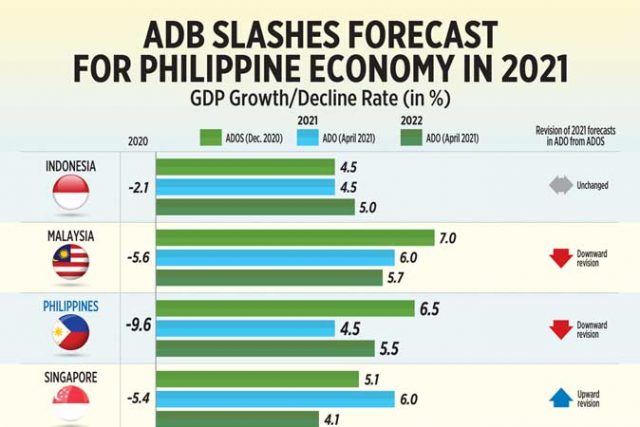
ADB slashes forecast for Philippine economy in 2021

THE Philippine economy’s recovery is expected to be “fragile,” the Asian Development Bank (ADB) said on Wednesday, as it slashed its growth forecast to 4.5% this year due to uncertainties over the prolonged coronavirus pandemic. Read the full story.

ADB slashes forecast for Philippine economy in 2021

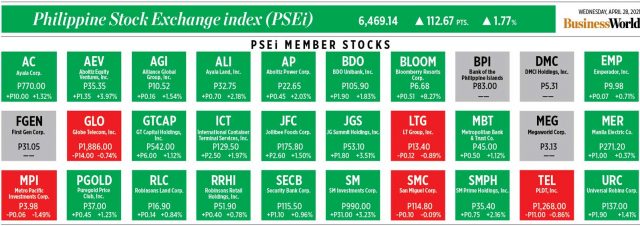
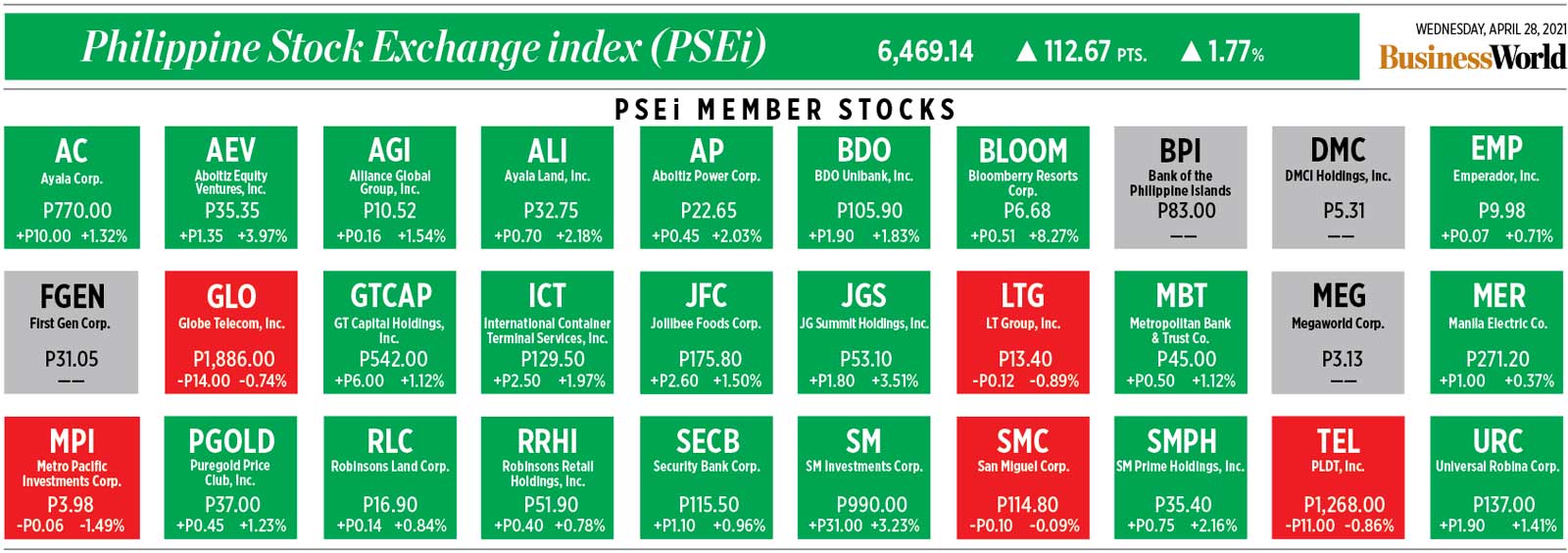
How PSEi member stocks performed — April 28, 2021

Here’s a quick glance at how PSEi stocks fared on Wednesday, April 28, 2021.


Peso declines vs dollar as oil prices inch higher

BW FILE PHOTO
THE PESO weakened against the dollar on Wednesday as oil prices went up. — BW FILE PHOTO

THE PESO retreated against the greenback on Wednesday as oil prices edged higher and as the market was waiting for the US Federal Reserve’s policy decision.

The local unit closed at P48.477 per dollar, depreciating by 9.6 centavos from its P48.381 finish on Tuesday, based on data from the Bankers Association of the Philippines.

The peso opened Wednesday’s session at P48.44 against the dollar. Its weakest showing was at P48.485, while its intraday best was at P48.40 versus the greenback.

Dollars exchanged increased to $854.98 million yesterday from $643.5 million on Tuesday.

The peso weakened versus the dollar due to gains in global oil prices, Rizal Commercial Banking Corp. Chief Economist Michael L. Ricafort said.

Oil rebounded as optimism ahead of a meeting of producer group OPEC+ to discuss output policy offset concern that India’s coronavirus crisis could dent a recovery in fuel demand, Reuters reported.

US crude futures settled at $62.94 per barrel, up $1.03 or 1.66%. Brent crude futures settled at $66.42 per barrel, up 77 cents or 1.17%.

OPEC+, which is responsible for more than a third of global production, has cut output by around 8 million barrels per day (bpd), equivalent to over 8% of global demand. The reduction includes a 1 million bpd voluntary cut by Saudi Arabia.

At the April 1 meeting, the group agreed to bring 2.1 million bpd back to the market from May to July, easing cuts to 5.8 million bpd.

In a report by OPEC+ experts, the group forecast global oil demand in 2021 would grow by 6 million bpd, after falling 9.5 million bpd last year.

The OPEC+ report said it expected commercial oil stocks to reach 2.95 billion barrels in July, taking them below the 2015-2019 average, and expected them to remain below that average for the rest of the year.

Meanwhile, a trader attributed the peso’s depreciation versus the dollar on Wednesday to market caution ahead of the policy decision of the Federal Reserve.

The Federal Open Market Committee held its third policy review for the year from Tuesday to Wednesday and was expected to announce its decision after local financial markets closed.

Fed Chairman Jerome Powell earlier said the US central bank will continue to push policies that will support their mandate of maximum employment and stable prices.

For Thursday, Mr. Ricafort expects the peso to move within the P48.42 to P48.52 levels versus the dollar, while the trader gave a forecast range of P48.35 to P48.55. — LWTN with Reuters