Home Blog Page 760

The painting that haunts me — seven experts share their favorite scary artwork

AS HALLOWEEN approached, we asked seven of our academic experts to tell us about the most unsettling artwork they’ve ever encountered. From gruesome portraits to creepy critters, these are the paintings that have stayed with them long after their first glimpse.

L’INHUMATION PRÉCIPITÉE BY ANTOINE WIERTZ (1854)
Hardly anything is more terrifying than the idea of being buried alive. In Antoine Wiertz’s painting, a cholera victim, presumed dead, revives in the crypt. Lifting the coffin lid, he glimpses a human skull through the gloom. A spider scrambles towards the open lid, while a rat slinks into an adjacent coffin. His face contorts with horror at his realization: he has awakened into a nightmare worse than death.

In 18th and 19th century Europe, the fear of premature burial was rife, and, while rarer than people imagined, the anxiety was not entirely unfounded. During epidemics, bodies were buried hastily and there were few accurate techniques for confirming death.

To guard against the grim possibility of being buried alive, some people specified that their arteries be cut or their heads severed before they were buried. Instant death was preferable to the horror of live burial that Wiertz so frighteningly portrayed. — Chloe Ward, senior lecturer in the history of British art, Queen Mary University of London

JUDITH MURDERING HOLOFERNES BY ARTEMISIA GENTILESCHI (1620)
The sheer visceral impact of this painting is heightened by its composition. Our eyes are drawn to the partially severed head of the still-struggling Holofernes.

The story comes from the Book of Judith, which is included in Catholic and Eastern Orthodox Bibles. To save her city from this Assyrian general, Judith has set forth to seduce and murder him, aided by her servant Abra.

The vivid yellow and blue of the women’s dresses and the red of Holofernes’ bed contrast with the background chiaroscuro (an effect of contrasted light and shadow). This gives the artwork a claustrophobic intensity. Gentileschi painted this subject twice. But it is her 1620 version that is considered the more powerful.

In it she has shown blood spurting parabolically from Holofernes’ wounds, spattering Judith’s arms. Yet it is the grim determination of Judith and the death agonies of her victim that, for me, transports the viewer into the private moment of a gruesome murder. — Pippa Catterall, professor of history and policy, University of Westminster

SATURN DEVOURING HIS SON BY FRANCISCO GOYA (1820-23)
Painted in the aftermath of the Napoleonic wars and during Spain’s revolution of 1820-23, this nightmarish image is the most powerful of Spanish painter Francisco Goya’s 14 “black paintings.”

Said to depict Saturn (or Cronus in Greek myth) eating one of his children to prevent a prophecy that one will usurp him, it gruesomely combines the taboos of cannibalism and filicide (killing your own child). The pure black background forces the viewer to fixate on the dismembered corpse, Saturn’s strangely angular body, and the madness in his eyes.

The title was not Goya’s, and the suggestion that this is a remote mythological scene or an allegory of time destroying youth may be attempts to distance ourselves from its darker meaning.

Beneath such efforts, this painting unflinchingly depicts the callousness of power, the urge to destroy rivals, the old exploiting the young. Two centuries on, it remains a chilling depiction of raw human instincts when the mask of civilization is torn away. — Karl Bell, associate professor of cultural and social history, University of Portsmouth

THREE STUDIES FOR FIGURES AT THE BASE OF A CRUCIFIXION BY FRANCIS BACON (1944)
Fleshy bioforms with outstretched, eel-like necks are writhing in an orange space. They are sightless, but two of them have toothy open mouths: one is snarling, the other is screaming. They are simultaneously human and not human.

These abject creatures are the creation of the Irish-British artist Francis Bacon in his work Three Studies for Figures at the Base of a Crucifixion (1944). The artist completed the triptych over two weeks, fueled by alcohol and hangovers.

The figures are intended to represent the ancient Greek furies: deities of vengeance from the underworld. The work’s exhibition date is poignant: it was first shown to the public in the final days of the Second World War in Europe. Terror leaps out of these paintings: they are at once a visceral reminder of our mortality and bodily materiality, and an expression of the horrors that humans have inflicted upon each other. And we cannot look away. — Daisy Dixon, lecturer in philosophy, Cardiff University

BLOWING FROM GUNS IN BRITISH INDIA BY VASILY VERESHCHAGIN (1884)
This painting by the Russian painter Vasily Vereshchagin depicts the execution of a group of rebels, the Kuka, after an uprising in Malerkotla, Punjab, in 1872. The British struck back harshly, executing the Kukas by blowing from guns. The rebels were tied to the mouths of cannons, which were then fired.

There is no indication that Vereshchagin witnessed the Kuka event himself. He had probably seen illustrations of the Indian rebellion of 1857, with similar compositions.

This painting was exhibited in London’s Grosvenor Gallery as part of a trilogy showing execution methods in different parts of the world. This framing is disturbing, at least to me — placing the brutal scene in combination with the detached, quasi-ethnographic mission. There is another disturbing dimension: the tension between the painting as an anti-colonial-violence statement or as a piece of political propaganda targeting the rule of the British Empire.

The original painting, in storage at University of California, Berkeley, was destroyed due to water damage around 1950. A photogravure in grayscale of the work still exists, as does a color sketch, now exhibited at the Russian Museum in St. Petersburg. — Åsa Harvard Maare, senior lecturer in visual communication, Malmö University

THE SPIDER BY ODILON REDON (1881)
Imagine a giant spider with 10 legs and a grinning, human face emerging from the shadows in the corner of your room. The French artist Odilon Redon created this nightmarish anthropomorphic creature largely from his imagination, but was also inspired by the experience of viewing nature through a microscope.

Melancholic and introspective from childhood, he was introduced to the world of bugs by the botanist Armand Clavaud. Redon’s imagination was also fueled by decadent literature such as Charles Baudelaire’s The Flowers of Evil (1857) or Edgar Allan Poe’s gothic poem “The Raven” (1845).

Working mainly in charcoal and lithograph, he was inspired to produce a whole series of black-and-white images — monstrous creatures and giant, floating eyes — that expressed his subconscious fears. Known as his “Noirs” (black pictures), they evoked his obsession with the terrifying, nightmarish visions that are invisible by day. The writer Joris Karl Huysmans defined them as: “A new type of fantasy, born of sickness and delirium.” — Frances Fowle, emeritus professor of 19th century art, University of Edinburgh

DISASTERS AND FAIRY TALES BY CINDY SHERMAN (1980S)
The artist Cindy Sherman uses her own body as the blank canvas for her art: she dresses up in makeup, prosthetics, wigs, and disguises and photographs the results against carefully staged backdrops. The resulting images are often deliberately unsettling.

In her series Disasters and Fairy Tales from the 1980s, she played a series of characters from horror films and nightmarish folklore. The image that I find most difficult to look at is not the goriest or most grotesque, but Untitled #165 (1986), in which a hybrid, part-human, part-animal creature in a gingham dress lurks bashfully behind a tree.

What does it want? Is it malevolent, or just lonely? This creature seems to embody the dark things we don’t want to acknowledge in our psyche, that we push away, but which linger on the edges of our consciousness. As Sherman’s self-portraiture implies, these nightmarish things are not monsters from elsewhere, but versions of ourselves. — Catherine Spooner, professor of literature and culture, Lancaster University

THE CONVERSATION VIA REUTERS CONNECT

Kenny Rogers Roasters celebrates Solo Love on National Singles Day

Kenny Rogers Roasters announced the anticipated return of its celebrated campaign, the Solo Love Club. Now in its second year, the movement continues to champion self-love and individuality by reframing Nov. 11 from a mere “Deals Day” or “Single’s Day” into a true “Day of Solo Love.”

This year, the celebration comes to life through the “I Stick To Myself” Sticker Drop campaign — an empowering reminder for everyone to honor the most important commitment they can make: the one to themselves.

Building on the brand’s “I Love Me Better” platform, Kenny Rogers Roasters extends its advocacy for self-worth and personal wellness beyond the plate. While “I Love Me Better” focused on nourishing oneself through deliciously healthy meals, Solo Love Club translates that message into a cultural statement — celebrating independence, confidence, and the joy of one’s own company.

Together, “I Love Me Better” and “Solo Love Club” reinforce Kenny Rogers Roasters’ belief that solo love isn’t selfish — it’s the foundation of a healthy life, one delicious meal (and one empowering message) at a time.

The Five Solo Love Languages

At the heart of the campaign lies the collectible ‘I Stick To Myself’ Sticker Drop Collection — a series of accessible, shareable, and meaningful tokens designed as daily reminders of self-worth.

Inspired by the well-known concept of the Five Love Languages, Kenny Rogers Roasters reimagined them through the lens of solo love — creating The Five Solo Love Languages. Each sticker represents a unique way to express love for oneself, turning the universal language of love inward.

Through this creative twist, Kenny Rogers Roasters empowers everyone to celebrate self-affirmation and remind themselves that the most enduring relationship they can have is with their own well-being.

  1. Self-Affirmation (Words of Affirmation): Focuses on confidence and inner strength. Stickers include: “I Stick To Myself,” “I Am Enough,” and “Proud of My Progress.”
  2. Self-Care (Acts of Service): Focuses on nurturing oneself and emotional well-being. Stickers include: “Unapologetically Me,” “Solo and Strong,” and “Healthy Looks Good on Me.”
  3. Treat Yourself (Receiving Gifts): Focuses on indulgence and celebrating small wins. Stickers include: “Celebrating Me,” “I Am The Party,” and “Celebrate Small Wins.”
  4. Me-Time (Quality Time): Focuses on solitude, reflection, and mindful moments. Stickers include: “Solo Is My Superpower,” “Time for Me, Always,” and “Be You. Do You. For You.”
  5. Self-Comfort (Physical Touch): Focuses on grounding, emotional safety, and self-compassion. Stickers include: “Safe With Myself,” “Healthy Habits, Better Me,” and “Comfort in My Core.”

With three unique designs for each Solo Love Language (collect a total of 15 designs), the stickers are tangible symbols of individuality. The ‘I Stick To Myself’ Sticker Collection officially drops on National Singles’ Day, Nov. 11, available in limited supplies across all Kenny Rogers Roasters stores.

Stickers as Symbols of Self Worth

“The Solo Love Club is more than a seasonal promotion, we are giving our community a tangible representation of their authenticity and well-being,” CEO and President, Frederick Sy explains, “Every ‘I Stick To Myself” sticker is a public declaration that one’s love, choices, and truth are worth sticking with, turning the act of collecting them into an act of self-affirmation.” 

The ‘I Stick To Myself’ Sticker Collection is part of Kenny Rogers Roasters’ celebratory ‘I Love Me Better’ 30th Anniversary campaign, which champions self-love through small decisions including opting for deliciously healthy meals.

The promo officially begins on Nov. 11, 2025. Customers can collect the stickers exclusively with every purchase of Kenny Rogers Roasters’ Solo B Plates.


Spotlight is BusinessWorld’s sponsored section that allows advertisers to amplify their brand and connect with BusinessWorld’s audience by publishing their stories on the BusinessWorld Web site. For more information, send an email to online@bworldonline.com.

Join us on Viber at https://bit.ly/3hv6bLA to get more updates and subscribe to BusinessWorld’s titles and get exclusive content through www.bworld-x.com.

Abacus Global Technovisions, Inc. to hold its Annual Stockholders’ Meeting on Nov. 27 via Zoom


Spotlight is BusinessWorld’s sponsored section that allows advertisers to amplify their brand and connect with BusinessWorld’s audience by publishing their stories on the BusinessWorld Web site. For more information, send an email to online@bworldonline.com.

Join us on Viber at https://bit.ly/3hv6bLA to get more updates and subscribe to BusinessWorld’s titles and get exclusive content through www.bworld-x.com.

Metrobank’s net income climbs to P12.43 billion in third quarter

METROBANK.COM.PH

METROPOLITAN Bank & Trust Co. (Metrobank) booked a higher net profit in the third quarter that brought its nine-month income to a record for the period as its growing consumer business supported its loan growth.

The bank’s attributable net income rose by 2.56% year on year to P12.43 billion in the three months ended September from P12.12 billion, it said in a disclosure to the stock exchange on Tuesday.

This brought its earnings for the first nine months to P37.28 billion, up 4.34% from P35.73 billion, which it said was an all-time high for the period and attributed to “solid loan growth, improving margin trend, healthy trading income alongside well-managed cost growth.”

This translated to a return on equity of 12.53% versus 12.93% a year prior, and a return on assets of 1.39% from 1.48% last year.

“Our prudent approach in expanding our core businesses continued to support our performance in the first nine months. We’re confident that the Philippines’ long-term growth story remains strong,” Metrobank President Fabian S. Dee said.

“We continue to be committed in helping our clients seize opportunities for growth as we navigate together any challenges and uncertainties on our journey ahead.”

Net interest income climbed by 14.52% to P31.78 billion from P27.75 billion in the third quarter as its interest earnings from both loans and receivables and trading and investment securities increased, while its interest expense on deposits declined due to the lower volume of time deposits.

For the first nine months, its net interest income grew by 7.11% to P91.81 billion as it saw growth across its business segments.

The bank said its gross loans grew by 10.8% year on year to P1.9 trillion at end-September, with its consumer loans rising by 15.8% and institutional loans increasing by 9.5%. Its nonperforming loan ratio went up to 1.67% from 1.59% a year ago.

Its provisions stood at P8.7 billion year to date for a “hefty” NPL cover of 147.4%.

Metrobank’s net interest margin on average earning assets was at 3.7% in the period, down from 3.9% a year prior.

Meanwhile, non-interest income dropped by 35.41% year on year to P7.79 billion in the third quarter from P12.06 billion, mainly due to a decline in its net trading, securities and foreign exchange gain that was partially offset by its higher fee-based and miscellaneous income.

Still, for the first nine months, its other operating income went up by 5.36% to P25.38 billion from P24.09 billion.

Metrobank’s operating expenses declined by 5.78% to P19.41 billion in the third quarter from P20.6 billion.

In the nine-month period, expenses edged up by 1.7% to P57.96 billion from P56.99 billion.

Its cost-to-income ratio declined to 49.8% from 52.2%.

On the funding side, the bank’s deposits grew by 7.6% year on year to P2.5 trillion at end-September, with P1.5 trillion of the total being low-cost current and savings accounts or CASA deposits.

Its loan-to-deposit ratio was at 76.61%, up from 74.4% a year prior.

Metrobank’s assets expanded by 8.9% year on year to P3.63 trillion at end-September, while total equity climbed by 7.2% to P407.6 billion.

Its capital adequacy ratio (CAR) was at 16.99%, slipping from 17.1% a year prior. Its common equity Tier 1 (CET1) ratio also edged down to 16.26% from 16.3%. Despite this, both were well above the minimum regulatory requirements of a 10% CAR and a 6% CET1 ratio.

As of Sept. 30, the Metrobank Group had 965 branches, 1,305 on-site automated teller machines (ATMs), and 946 off-site ATMs.

Metrobank shares climbed by 25 centavos or 0.38% to close at P66.50 apiece on Tuesday. — Bettina V. Roc

MacroAsia gets SEC OK for Cebu food venture

MACROASIACORP.COM

THE Securities and Exchange Commission (SEC) has approved MacroAsia Corp.’s plan to set up its food business joint venture in Cebu, in the company’s latest push to expand beyond aviation services.

In a stock exchange filing on Tuesday, MacroAsia said the regulator approved the incorporation of MacroAsia Jolliant Food Services Corp., a partnership between its unit MacroAsia New Ventures, Inc. and Princess Jolliant.

The venture will operate the existing food commissary of Princess Jolliant in Cordova, Cebu, while developing a larger food production facility to serve the Visayas market. Princess Jolliant makes, preserves, packs and distributes food products.

MacroAsia New Ventures earlier invested P64.47 million for a 49% stake in the joint venture, which is expected to begin operations by the fourth quarter. The project will let MacroAsia diversify its portfolio and strengthen its foothold in the Visayas region.

MacroAsia’s core businesses include aircraft maintenance, airline catering, ground handling, property development and water utilities. The move into food manufacturing marks a strategic extension of its catering expertise into retail and commissary operations.

In the second quarter, MacroAsia’s attributable net income fell 15.3% year on year to P365.78 million, as higher costs and weaker revenues weighed on earnings. Gross revenue declined 3.5% to P2.46 billion, while total expenses rose 10.9% to P2.33 billion.

At the Philippine Stock Exchange on Tuesday, MacroAsia shares climbed 4.07% or 18 centavos to close at P4.60 each. — Ashley Erika O. Jose

Arts & Culture (11/05/25)


Jonathan Olazo pays homage to Monet

JONATHAN OLAZO’S latest art exhibition, Light Receptacle Café, is a reimagining of French master Claude Monet’s devotion to light and time, filtered through contemporary Filipino lens. The show, exhibited at the Alliance Française de Manille, is curated by his wife, painter and conservator Lyn Yusi-Olazo. The exhibition invites visitors to experience light not just as a subject, but as a metaphor. Light Receptacle Café is ongoing until Nov. 15 at the Alliance Française de Manille, 209 Nicanor Garcia St., Bel-Air II, Makati City.


Tanghalang Pilipino presents heroic musical on Gregoria de Jesus

TANGHALANG PILIPINO’S newest production for its 39th season is a groundbreaking original musical that reimagines the life of revolutionary Gregoria de Jesus through the sound of Pinoy pop music. With music by Nica del Rosario and Matthew Chang, and a book by Nicanor Tiongson and Eljay Deldoc, the show stars Marynor Madamesila and is directed by Delphine Buencamino. It will run from Nov. 10 to Dec. 14, with performances at 3 and 8 p.m., at the Tanghalang Ignacio Gimenez (CCP Black Box Theater), CCP Complex, Pasay City. VIP tickets cost P2,000 while regular tickets are P1,800.


Teatro Meron to stage Ang Medea

TEATRO MERON is presenting Ang Medea, a restaging of Euripides’ classic, translated into Filipino by the late National Artist for Theater Rolando S. Tinio. Fresh from last year’s sold-out run, this production returns with a cast of theater veterans led by Miren Alvarez-Fabregas as Medea, with Teroy Guzman, Yan Yuzon, Bryan Sy, Joseph dela Cruz, Katski Flores, Gold Soon, Pickles Leonidas, and Joel Macaventa. The director is Ron Capinding, founder and artistic director of Teatro Meron. Performances run from Nov. 13 to 28 at the Special Exhibition Hall of The Mind Museum, Bonifacio Global City. Tickets and schedules are available via Ticket2Me.


Intramuros Evenings presents La Voix Humaine

LA VOIX HUMAINE is the third offering in the Intramuros Evenings series, featuring pianist Raul Sunico and the USTSO Chamber Orchestra conducted by Herminigildo Ranera. The performance starts with Francis Poulenc’s Aubade, performed by Mr. Sunico and the USTSO Chamber Orchestra, which will be followed by Poulenc’s one-act opera La Voix Humaine, based on Jean Cocteau’s play, starring soprano Armela Fortuna. It will be held on Nov. 14, 7 p.m., at the Centro de Turismo, Intramuros, Manila. While admission is free, seats are limited.


PPO season continues with Virtuoso

THE Philippine Philharmonic Orchestra (PPO) season continues with its fourth concert, Virtuoso, under the direction of Grzegorz Nowak. The evening opens with Mozart’s Don Giovanni Overture, followed by Beethoven’s Piano Concerto No. 5 “Emperor” featuring pianist Mark Bebbington. The concert concludes with Mussorgsky’s Pictures at an Exhibition in the Gorchakov arrangement. The concert will be on Nov. 14, 7:30 p.m., at the Samsung Performing Arts Theater, Circuit, Makati. Tickets range in price from P800 to P3,000.


RMAF, DLS-CSB present exhibit on plastic pollution

THE Ramon Magsaysay Award Foundation (RMAF), in partnership with the De La Salle College of Saint Benilde (DLS-CSB), is currently displaying the Alon exhibit at the Ramon Magsaysay Center in Manila. Focused on the issue of plastic waste in the oceans, Alon is RMAF’s first foray into a large-scale art installation. Originally mounted by DLS-CSB’s Center for Campus Art in 2019, it features surfers from six surfing camps around the Philippines, holding in their hands the scourge of beaches, rivers, and oceans — plastic. The exhibit, which is free and open to the public, also sets the stage for the Ramon Magsaysay Awards Festival Week from Nov. 4 to 7, featuring public events that honor this year’s awardees. All events will be livestreamed on RMAF’s official Facebook page and YouTube channel.


Exploding Galaxies’ e.g. journal drops 5th issue

ISSUE FIVE of the e.g. journal features “Mga Alamat sa Bayan ng Sagrada” (Legends of Sagrada), a story by Alvin Yapan, with an English translation by Christian Benitez and art by Czar Kristoff. It explores the otherworldly town of Sagrada, a place haunted by death and the unknown. It also discusses the act of translation itself, which this issue of the e.g. journal centers on. For more information, visit the Exploding Galaxies’ website.


4 artists interpret a year in abstract at Galerie Joaquin

THE exhibit The Gifts of the Changing Seasons is ongoing at Galerie Joaquin Rockwell. It brings together four abstract painters — Patrick Esmao, Perfecto Palero, Jr., Joan Palero, and Ricky Francisco — to meditate on impermanence, renewal, and the cycles that shape both nature and the self. Using the poetic metaphor of the seasons, the exhibition reflects on the inevitability of change, and on how each phase of life offers its own distinct grace. It runs until Nov. 14. Galerie Joaquin Rockwell is located at the R3 Level, Power Plant Mall, Rockwell Center, Makati City.


Dulaang UP prepares twin bill for Tony Mabesa

A TWIN BILL, titled Para Kay Tony: Tungo sa Ginintuang Alaala, featuring classic plays will pay homage to Dulaang UP founder and National Artist for Theater Antonio “Tony” Mabesa. The first half is a staging of Kalahating Oras sa Isang Kumbento by Filipino playwright Wilfrido Ma. Guerrero as translated by Lilia F. Antonio. The story follows Yolanda, a student at a convent school, who seeks comfort and companionship after being expelled. University of the Philippines (UP) Diliman Theatre Arts student Lloyd Sarmiento Uy serves as director. The second play features National Artist Rolando Tinio’s May Katwiran ang Katwiran, about Senyor, a wealthy haciendero who persuades his servant to join him on a journey across the mountains. The staging is directed by Theatre Arts student MJ Briones. The production will run from Nov. 14 to 30 at the IBG-KAL Theater, UP Diliman.


Martie Datu holds 5th solo show at ArtistSpace

VISUAL ARTIST Martie Datu is holding her 5th solo exhibition at ArtistSpace in Makati. Titled Becoming Us, the show is a personal collection of her recent paintings that serve as a return to childhood. Each canvas aims to be an echo of beginnings, a reminder that we are always, in some way, still becoming. The show runs until Nov. 17 at ArtistSpace, located in the Ayala Museum Annex, Greenbelt Park, Makati City.


Hamlet shows in cinemas

THE Cultural Center of the Philippines’ National Theatre Live series featuring filmed stage productions, presents Benedict Cumberbatch in the title role of yet another great Shakespearean tragedy, Hamlet. It will be presented on Nov. 25, 6 p.m., at the Ayala Vertis North – Quezon City and Ayala Central Bloc Cebu. Tickets at Vertis cost P350 and P150, while those in Cebu cost P300 and P150.


Jesus Christ Superstar coming to Manila in May 2026

FOLLOWING several acclaimed and sold-out runs in London as well as an extensive tour of North America, the UK, and Australia, the Olivier Award-winning reimagined production of Tim Rice and Andrew Lloyd Webber’s celebrated musical Jesus Christ Superstar will visit Manila at The Theatre at Solaire from May 2 to 24, 2026, as part of a major international tour. The production was reimagined by London’s Regent’s Park Open Air Theatre, where it originated, and is helmed by director Timothy Sheader and choreographer Drew McOnie. It explores the biblical portrayal of the events that led to the death and resurrection of Jesus Christ as seen through the eyes of his betrayer, Judas Iscariot. The story, told entirely through song, explores the personal relationships and struggles among Jesus, Judas, Mary Magdalene, Jesus’ disciples, his followers, and the Roman Empire. Tickets go on sale on Nov. 8 exclusively via TicketWorld.

Industrial policy for the Philippines: Why we failed miserably

STOCK PHOTO | Image by Rawpixel.Com from Freepik

(Part 3)

In the 1950s, the Philippines was considered — together with Burma — the most promising economy in East Asia, way ahead of Singapore, Taiwan, Hong Kong, and South Korea. Like Burma (called Myanmar today), it failed miserably to live up to these expectations, falling very much behind the four East Asian tigers.

During the first four or five years of Martial Law under the leadership of the late President Ferdinand Marcos, Sr., when technocrats like Alejandro Melchor, Armand Fabella, Placido Mapa, Jr., Cesar Virata, David Consunji, Vicente Paterno, and a few others were at the helm of the economy, there was still hope that the Philippines could be a potential “fifth” tiger. During the second half of the 1970s, GDP growth rates averaged 6% to 8%. Unfortunately, by the late 1970s certain political events led to the transfer of economic leadership to the so-called “cronies” who, through monopolizing strategic industries like coconut, sugar, infrastructure, and public utilities, laid the foundation for the Philippines to be known as the “sick man of Asia” by the end of the 20th century.

A major reason for the failure of the Philippine economy to grow and eradicate poverty was a weak and inconsistent industrial policy. Unlike the Tigers, which had consistent export-oriented strategies, the Philippines often vacillated between import-substitution and protectionist policies without any long-term vision. Unlike South Korea or Taiwan, there was little government pressure on firms to become world-class exporters.

As we saw in examining the industrial policies adopted by the Four Tigers, each of them had a short period of protecting “infant” industries through tariffs, subsidized credit, and undervalued local currency. In less than a decade, however, each of them graduated to an export-oriented strategy to take full advantage of the demographic dividend they were enjoying then, and to make up for their lack of natural resources. Since their domestic markets were limited by their relatively small populations and low per capita incomes, they wisely took advantage of the large consumer markets of Western Europe, North America, and Japan by getting into such labor-intensive industries as textiles, garments, toys, wigs, food products, furniture, and other basic consumer products.

In contrast, the Philippines lingered too long in protecting the so-called infant industries, getting stuck in import substitution. Instead of making full use of its abundant labor force, the State fostered such capital-intensive industries as steel, chemicals, ore processing and ship building too early in the stage of industrialization. For too long, the Government kept import tariffs too high, real interest rates too low, and the peso too strong. Because of the coddling of these import-substituting industries for too long, they became complacent and failed to become competitive globally. The domestic market at that time was still too small to permit these inward-looking industries to reach the economies of scale needed to lower costs.

I remember a debate I had with a well-known Filipino economist who kept on insisting on the need to continue protecting these “infant industries” well into the 1970s. I sarcastically retorted that those infant industries had been so pampered as to turn them into “Bonjing” industries (Bonjing was a famous character in comics and TV who was an overgrown and retarded “infant”).

An even more serious policy error was the utter neglect of the countryside and agricultural development. Because of the unrealistically over-valued peso in relation to the US dollar, it was easy to attain food security through imports. There was no serious effort to endow farmers with the infrastructure (farm to market roads, irrigation and post-harvest facilities, agricultural extension services, and access to credit) they needed. Much of the already limited government revenues was channeled to subsidizing the so-called infant industries that sooner or later died a natural death with the increasingly globalized economy, especially those that fell into the hands of the cronies of President Marcos Sr.

Agriculture relatively neglected, especially in comparison with how neighboring ASEAN countries like Thailand, Malaysia, and Vietnam lavished their farming sector with the most generous assistance. Even the two tigers that had very little land, Taiwan and South Korea, invested heavily in land reform and rural productivity. During that same period, the Philippines retained a feudal land ownership system. The resulting low agricultural productivity suppressed rural incomes, keeping domestic demand weak. A large share of the population remained poor, unable to contribute to broad-based growth.

In the 1980s, an agrarian reform program, though well intentioned, was grossly mismanaged. The only result of what was called CARP (Comprehensive Agrarian Reform Program) was the splitting of millions of hectares of land into small units of two hectares or less. There was no follow through of investments in infrastructure and other resources badly needed by the agrarian reform beneficiaries to be more productive, as happened in Taiwan and South Korea, and several decades later in Thailand and Vietnam. This explains why more than 70% of those Filipinos who fell below the poverty line were these millions of landed farmers who had nothing else but a piece of land. At least when they were tenants, their respective landlords provided them with the necessary inputs and technical assistance to enable them to eke out a living from the land they tilled.

Political instability and governance problems were also to blame for the failure of the Philippines to become an economic tiger. There were frequent destabilizing political changes, particularly after the declaration of martial law (1972 to 1986). Investor confidence was seriously undermined. Corruption — which exists up to today — and crony capitalism (a phrase coined by Jaime Ongpin, a famous business executive and major critic of the Marcos dictatorship) meant that industries grew based on political favor rather than efficiency or competitiveness. The People Power revolution that peacefully unseated President Marcos in 1986 led to the restoration of democracy but unfortunately introduced more instability as it was racked with multiple military coup attempts. It took time for the political situation to stabilize, delaying much needed private investments.

To make matters worse, a provision in the revised Philippine Constitution that was ratified by the Filipino people in 1987 contained a provision that seriously limited the inflow of Foreign Direct Investments (FDI) which were badly need by the country to supplement the very inadequate savings of the country. It was only in 2020 that this limitation was removed. Meanwhile, Vietnam cornered FDIs with an inflow of foreign equity capital more than double that of the Philippines.

A final explanation why the Philippines failed to be an economic tiger was under investments in both physical and human capital. The East Asian Tigers were investing 6-8% of their GDP in physical infrastructure at their growth peaks. The Philippines seriously lagged at a measly 2-3%, resulting in weak logistics, power shortages, and high transport costs that further discouraged manufacturing and exports. As regards human capital, while literacy was high, the Philippines sorely neglected technical and vocational education, following the wrong example of the US in giving the highest importance to obtaining college diplomas even if the products of these undergraduate programs did not have the skills demanded by the market.

To summarize, the Philippines failed to become a tiger economy because of weak industrial policy, political instability, crony capitalism, lack of technical education, inadequate physical infrastructure, lagging rural reforms, and a failed agrarian reform program. The Tigers succeeded by doing the opposite: they had stable governance, strong state-led industrial policies, effective agrarian reform, heavy investments in infrastructure and technical education, and export-oriented growth.

(To be continued.)


Bernardo M. Villegas has a Ph.D. in Economics from Harvard, is professor emeritus at the University of Asia and the Pacific, and a visiting professor at the IESE Business School in Barcelona, Spain. He was a member of the 1986 Constitutional Commission.

bernardo.villegas@uap.asia

Petron sees sustained profit momentum

PETRON.COM

PETRON CORP. expects to sustain its earnings momentum through yearend after posting stronger results for the first nine months, President and Chief Executive Officer Ramon S. Ang said on Tuesday.

“Our performance over the past three quarters has been a testament to our resilience despite external pressures and competition,” Mr. Ang said in a statement. “We remain optimistic about maintaining this momentum through the rest of the year.”

The country’s largest oil refiner reported a 37% jump in net income to P9.7 billion for the January-September period, driven by higher domestic sales, lower operating costs, and improved plant efficiency.

Revenue fell 10% to P594.9 billion, weighed by lower international crude prices. Dubai crude averaged $71 per barrel, up 13% from a year earlier.

Petron did not provide third-quarter financial figures.

Its Philippine and Malaysian operations sold a combined 82.6 million barrels, up 3% year on year, led by an 11% rise in Philippine retail sales as the company expanded its dominant market share.

The gains from higher local demand and stronger refinery productivity at its Limay, Bataan and Port Dickson, Malaysia plants helped offset an 11% drop in regional refining margins.

Petron retained its position as the Philippines’ top oil market player, with a 24.9% share as of June 2024, according to the Department of Energy. The company operates about 50 terminals across the region, 2,700 service stations and maintains a refining capacity of almost 270,000 barrels per day.

Petron shares closed unchanged at P2.35 apiece. — Sheldeen Joy Talavera

Wild at Heart actress Diane Ladd, 89

DIANE LADD in a scene from 2015’s Joy.

AMERICAN ACTRESS Diane Ladd, a triple Academy Award nominee for her supporting roles in Alice Doesn’t Live Here Anymore, Wild at Heart, and Rambling Rose, has died at the age of 89, her daughter said on Monday.

Ms. Ladd died at her home in California, said Laura Dern, Ms. Ladd’s daughter with ex-husband Bruce Dern. Both Bruce and Laura are also actors.

Ms. Ladd was known for playing strong, intelligent, and complex women in roles including a sassy waitress, a domineering, mentally ill mother, and an eccentric 1930s housewife during a seven-decade career that began on stage in the 1950s.

The tall blonde starred in films such as White Lightning (1973), David Lynch’s 1990 crime drama Wild at Heart (1990), the black comedy Citizen Ruth (1996), Daddy and Them (2001), and HBO’s Enlightened (2011), with her daughter. The two often played mother and daughter.

Ms. Ladd and Ms. Dern were both nominated for an Academy Award for the 1991 drama Rambling Rose. They were the first, and only, mother-daughter duo to receive Oscar nominations for the same film in the same year.

“She is just the greatest actress, ever. You don’t even use the word brave because she just shows up like that in life. She doesn’t care what anybody thinks,” Ms. Dern said of her mother.

“She leads with a boundarylessness,” she added in a 2019 interview with Inside the Actors Studio.

The mother-daughter duo’s talents extended beyond acting.

In 2023, they published a joint memoir, Honey, Baby, Mine: A Mother and Daughter Talk Life, Death, Love. The book was based on their conversations during daily walks together after Ms. Ladd was diagnosed with a lung disease and given only months to live. Her doctor recommended the walks to strengthen her lungs.

“The more we talked and the deeper and more complicated of subjects we shared, my mother got better and better and better,” Ms. Dern said in an interview with National Public Radio in 2023. “It’s been a great gift.”

SOUTHERN BELLE
Diane Ladd was born Rose Diane Lanier on Nov. 29, 1935, in the small town of Meridian, Mississippi. She was the only child of a country veterinarian and an actress and housewife.

From a young age, the precocious child who finished school at 16 knew she wanted to act.

“Somehow in my soul, even as a child, I felt I was going to be an actress,” Ms. Ladd said with a southern lilt in a 2022 talk at the Academy Museum of Motion Pictures.

She was offered a college scholarship but instead opted to try her luck in New York where she worked as a model and Copacabana dancer. She joined the Actor’s Studio, which is known for method acting.

Ms. Ladd made her New York stage debut in 1952 in the off-Broadway production of Orpheus Descending by Tennessee Williams, who was her third cousin. It was also where she met her first husband, Bruce Dern.

The actress worked in classic 1960s TV dramas such as Perry Mason, 77 Sunset Strip, and The Fugitive before being cast in Roger Corman’s 1966 motorcycle saga The Wild Angels with her husband Mr. Dern, Peter Fonda, and Nancy Sinatra.

Two years later, Ms. Ladd made her Broadway debut in Carry Me Back to Morningside Heights.

She had more than 120 TV and film credits, including Roman Polanski’s Chinatown (1974) and David O. Russell’s 2015 comedy/drama Joy, and she earned three Emmy nominations in the 1990s for guest roles in Touched by an Angel, Grace Under Fire, and Dr. Quinn, Medicine Woman.

Ms. Ladd also wrote short stories and screenplays, and directed and starred in the 1995 comedy with Bruce Dern.

Ms. Ladd, Mr. Dern, and their daughter Laura were each awarded side-by-side stars on the Hollywood Walk of Fame in a triple ceremony in 2010.

“Diane is a Renaissance woman,” film producer Barbara Boyle said during the ceremony. “She has uncanny perception and insight into people that informs her acting and directing.”

In her 2006 memoir Spiraling Through the School of Life, Ms. Ladd wrote about the high and low points of her life, including the death of her first daughter in a tragic accident in 1962 when she was a toddler.

Deeply spiritual, Ms. Ladd was a proponent of complementary and alternative medicine. After being told she would never be able to have another child, her second daughter, Laura, was born five years later.

Ms. Ladd was married three times and continued to work into her 80s.

“Art is just a mirror, and that’s why we go see movies: to learn who we are,” she told the New York Times in 2023. — Reuters

A ‘global commons’: The South China Sea as a zone of peace, stability, and inclusive prosperity

PHILIPPPINE COAST GUARD

The South China Sea is a vast body of water whose openness and shared use must be for the benefit not just of any one nation, but of all. It is called a global commons because of the opportunities, risks, and stakes that many countries around it share.

Current events show that this global commons is also a venue where the rule of law and basic decency are being tested.

As one of the nations with high stakes in the South China Sea, the Philippines must have a very clear idea of how it could best meet these challenges, protect its own interests, and be a good regional and global citizen that puts the rule of law above all else.

Indeed the Philippines, sitting at the heart of the Indo-Pacific region, holds strategic importance in terms of sea lanes, trade routes, data connectivity, critical minerals, and supply chain diversification.

The Malacca Strait, the South China Sea, and the West Philippine Sea are waterways vital to the economy of the Indo-Pacific, with more than $5 trillion in trade flowing through these waters every year. This volume represents one third of all global maritime commerce.

The Philippine Seas are also home to submarine cables connecting major economic players. Disruption or instability hinders the seamless flow not just of trade but of information.

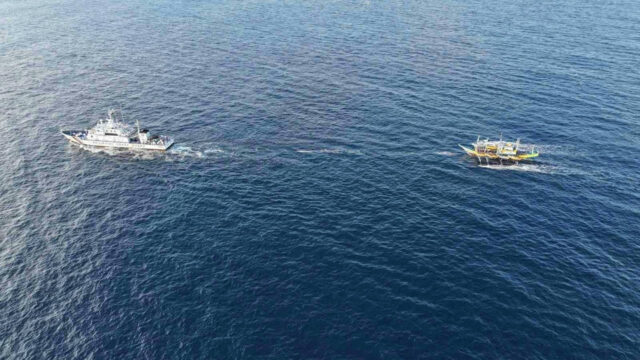
These gain even more significance when viewed in the context of China’s adventurism and gray-zone operations in the West Philippine Sea. In recent months and years, the Philippines has seen intensified and increasingly aggressive behavior by China. China has repeatedly and intentionally rammed Filipino vessels, used water cannons and military-grade lasers, and executed blockades that have prevented resupply missions to our ships. It has also intimidated our fisherfolk and kept them away from their livelihood right within our own territory.

These are not sporadic incidents or unfortunate maritime misunderstandings. They are calculated actions designed to instill fear, disrupt lawful operations, and undermine Philippine sovereign rights. They are sustained and deliberate, designed to assert China’s claims in an area that has already been determined as ours. International law, specifically the United Nations Convention on the Law of the Sea, and the 2016 decision of the Permanent Court of Arbitration saying that China’s nine-dash claim had no basis, supports us on this.

Filipinos want to be kept abreast of these acts of bullying. Further, these actions by China must be exposed and made known to the rest of the world. A recent survey by Pulse Asia revealed that 94% of Filipinos believe we should continue our transparency policy so that the global audience could know about the coercion faced by our people at sea.

After all, similar tactics have been observed in other countries in the South China Sea. China has been trying to turn what is shared maritime space into a lake belonging to a singular power. What is happening is a far-reaching campaign to reengineer the strategic landscape of the Indo-Pacific region.

How, then, should the Philippines and the rest of the world respond to the consistent undermining of our rights and of the rule of law in a supposedly common space?

At the recent “Manila Dialogue on the South China Sea,” representatives from various sectors in the Philippines and from other nations came together in acknowledgment of their shared responsibility. That responsibility is to ensure that the South China Sea remains open, stable, and governed by international law. The recurring theme of the discussions was partnership — working together on various fronts and levels toward this end.

In another Pulse Asia survey, Filipinos were asked which countries can best assist the Philippines in addressing aggression in the West Philippine Sea. The overwhelming responses were like-minded partners such as the United States (77%), Japan (45%), Australia (30%), Canada (29%), and the United Kingdom (25%). Yet another survey asked Filipinos which countries are our partners for economic security amid global risks. It was not surprising that the same five countries — the US at 77%, Japan at 44%, Australia at 26%, the UK at 24%, and Canada at 23% — topped the list, which also included ASEAN at 29%.

This only reveals that in the minds of Filipinos, our nation’s ability to deter aggression in our waters is very closely intertwined with our ability to ensure that the economic needs of our people are sustainably met.

Issues in the South China Sea should never be viewed from a single country’s perspective, or from a purely economic or defense point of view. It is a vast body of water that is as rich in economic and trading potential as it is in marine life. Ensuring that it is free, open, and stable is crucial to its role in the Indo-Pacific region and in the greater global community. Events occurring in the South China Sea should not be seen as distant or far removed from the people. These actions have tangible effects and serious consequences in our everyday lives.

The Philippines and the rest of the world must assert that the South China Sea, as a global commons, should be a zone of peace, stability, and inclusive prosperity. Only the rule of law must prevail, and no one country should assert dominance over others. It is imperative that we actively resist and expose these actions to prevent the South China Sea from becoming a theater of Chinese expansionism.


Victor Andres “Dindo” C. Manhit is the president of the Stratbase ADR Institute.

PHL insurance sector seen to sustain growth

JAKUB ZERDZICKI-UNSPLASH

THE PHILIPPINE insurance sector could post double-digit growth until next year as positive economic prospects could help drive spending and as the industry’s penetration rate remains low, the top official of East West Ageas Life Insurance Corp. (EastWest Ageas) said.

EastWest Ageas President and Chief Executive Officer Sjoerd Smeets said he expects the insurance market to grow around 11% this year despite declining interest rates and the weak performance of the stock market.

“But I still believe that next year will have a growth probably in the double digits. GDP (gross domestic product) growth in the Philippines still is expected to be around 6% next year, and you normally see the insurance market outpacing that a bit because the insurance sector in the Philippines is still under-benefited versus other Asian countries,” he said at an event on Tuesday.

“The total insurance spend [versus] GDP is something like 1.7%. And in mature markets, that’s close to 5%. So, that growth will still kick in. And with more Filipinos having higher earnings potential, we definitely expect the life insurance market to still grow.”

The sector recorded higher premiums in the first semester, according to data from the Insurance Commission (IC). Total premiums paid for life and nonlife insurance products grew by 12.98% to P242.842 billion at end-June from P214.941 billion in the same period last year.

As a result, insurance penetration, or the ratio of insurance premiums to the GDP, rose to 1.79% from 1.71% a year prior.

Insurance density, or the average spending of each individual on insurance, also increased by 12.07% to P2,137.32.

Life insurers saw a 12.01% increase in premiums collected to P195.05 billion in the period from P174.14 billion a year prior.

Philippine GDP growth averaged 5.4% in the first semester, slightly below the government’s 5.5 to 6.5% goal for the year.

Meanwhile, the Bangko Sentral ng Pilipinas has now cut benchmark interest rates by a total of 175 basis points since it kicked off its easing cycle in August 2024. It is expected to deliver further reductions until next year to help stimulate the economy as a widening corruption scandal involving state flood control and infrastructure projects is expected to affect both public and private investments.

These domestic governance concerns, along with worries over trade policies and the pace of monetary easing in developed countries, have caused Philippine stocks to decline in recent months. On Tuesday, the Philippine Stock Exchange index closed at 5,867.04, down by 10.14% or 661.75 points from its end-2024 finish of 6,528.79.

Mr. Smeets said financial literacy remains a challenge in the Philippines, contributing to low insurance penetration.

“I think the education system needs to be improved to make sure that young people start to learn to deal with money and also the unexpected things in life,” he said. “If you just see people on the streets, there’s not a lot of consciousness of savings.”

“We sometimes live too much in the day to day… In the insurance sector, we’re doing quite a lot of things to also improve that consciousness. We’re trying to make more people aware about insurance — get them to be aware of the things that will happen if something happens.”

The insurer’s PURPLE Report released at the event reflected Filipinos’ lack of consciousness about savings.

The study, which it commissioned to NielsenIQ, showed that only two out of 10 Filipinos have enough emergency funds lasting over three months, with most only having P50,000 in savings.

“This leaves the average middle-class Pinoy without the buffers needed to recover from unexpected challenges,” the company said.

It also showed that long-term financial planning is an afterthought for most Filipinos as 30% of their salaries go to their household expenses, such as for food, rent, transportation, and mortgage, making it difficult for them to set aside savings.

“Despite growing awareness to prepare for emergencies, getting started is far from easy, as Filipinos still need to plan around their current day-to-day needs,” EastWest Ageas said.

“However, Filipinos still recognize it is important to stay prepared, as it can ease their worries about unexpected situations. In fact, 52% are concerned about the health of their loved ones, and 24% worry about critical illnesses and the large medical expenses tied to them.”

The study showed that some Filipinos aged 40 and above said they have more than three months’ worth of emergency funds, reflecting an improved financial stability they age.

“However, the journey towards financial preparedness is often hampered by economic pressures like inflation and income instability. To get through emergencies, Filipinos would often rely on their personal savings, receive support from their families and communities, and take out loans from informal channels,” the insurer said.

“While these highlight Filipinos’ innate resilience, resourcefulness, and generosity, they also show their vulnerability when emergencies arise. Thus, Filipinos need the extra support to help them get through these struggles without compromising their goals.”

EastWest Ageas booked a premium income of P4.97 billion and a net income of P225.49 million in 2024, based on IC data.

East West Ageas Marketing Officer Greg Martin said at the same event that they continue to grow their presence nationwide following their expansion into Davao and Cebu.

“We’ll be expanding in the Bulacan area and in the Quezon City area as well. How we do that, though, is in a very careful and very commercially orientated fashion.” — Aubrey Rose A. Inosante

Peso rises to two-week high on divided Fed, inflation bets

BW FILE PHOTO

THE PESO continued to strengthen against the dollar on Tuesday, posting a two-week high, as several US Federal Reserve officials signaled that they are open to another rate cut next month despite the cautious tone adopted by its chief.

Bets of within-target Philippine headline inflation in October also supported the currency against the greenback.

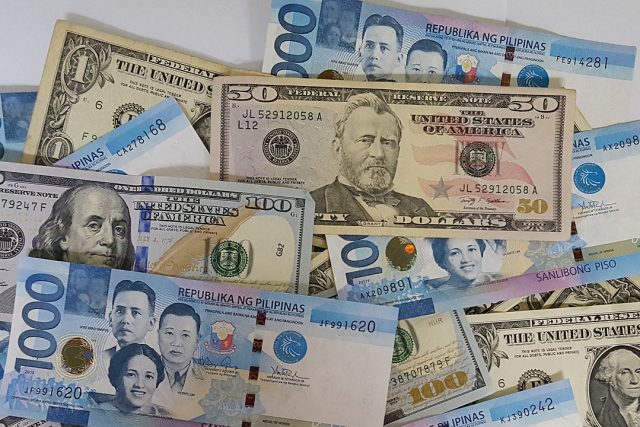
The local unit closed at P58.515 per dollar, rising by 27.5 centavos from its finish of P58.79 on Monday, Bankers Association of the Philippines data showed.

This was its best finish in nearly two weeks or since it ended at P58.41 a dollar on Oct. 22.

The peso opened Tuesday’s session stronger at P58.70 against the greenback. Its intraday best was at P58.51, while its weakest showing was at P58.75 versus the dollar.

Dollars exchanged inched up to $1.327 billion on Tuesday from $1.326 billion on Monday.

“The peso continued to appreciate after several Federal Reserve officials expressed openness towards delivering a rate cut in the December Fed meeting,” a trader said in an e-mail on Tuesday.

Fed officials continued offering competing views of where the economy stands and the risks facing it in the absence of economic data suspended due to the shutdown, Reuters reported.

The Fed cut rates last week, but Chair Jerome H. Powell suggested that might be the last cut of the year. Traders are now pricing in a 65% chance of a rate cut in December, compared with 94% a week earlier, CME FedWatch showed.

On Monday, Fed Governor Lisa Cook portrayed a tug-of-war view of the policy debate, saying elevated risks to both the central bank’s employment and inflation mandates leave the Dec. 9-10 meeting “live” for a possible rate cut, but not a lock.

Speaking earlier in the day, San Francisco Fed chief Mary Daly offered a similarly even-handed perspective, saying she viewed last week’s cut as further “insurance” against labor market weakening and has an “open mind” about the need for a similar move in December.

The peso continued to correct ahead of the release of Philippine October inflation data on Wednesday (Nov. 5), Rizal Commercial Banking Corp. Chief Economist Michael L. Ricafort said in a Viber message.

He said the October consumer price index (CPI) “is expected to be slightly higher versus 1.7% in September 2025 but still considered benign or still below the BSP’s (Bangko Sentral ng Pilipinas) inflation target range of 2%-4% and could still support future local policy rate cuts.”

A BusinessWorld poll of 17 analysts yielded a median estimate of 1.8% for the October CPI, which would be up slightly from the 1.7% clip in September but slower than the 2.3% seen in the same month last year.

This would be within the BSP’s 1.4-2.2% forecast for the month and mark the eighth straight month that inflation was below its 2%-4% annual goal.

The trader said the peso may rise further on Wednesday on expectations of within-target Philippine inflation.

The trader sees the peso moving between P58.35 and P58.60 versus the greenback, while Mr. Ricafort said the local unit could trade from P58.40 to P58.65. — Aubrey Rose A. Inosante with Reuters