Home Blog Page 7508

Garment, furniture industries flag delays in shipping goods

BW FILE PHOTO

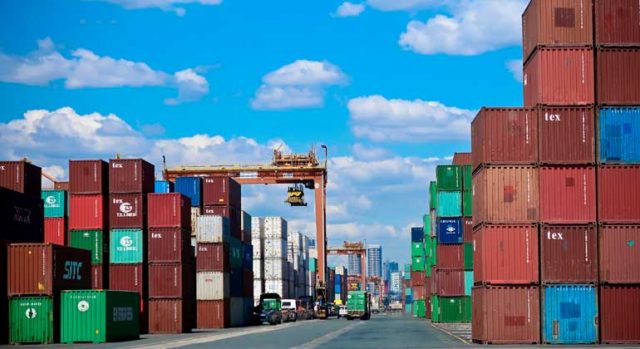
GARMENT and furniture exporters are asking the government to address shipping snags that are putting at risk their ability to deliver in time for the peak holiday season.

The garment industry is experiencing shipping delays due to unavailability of vessels, Philippine Exporters Confederation, Inc. (Philexport) trustee for the textile sector Robert M. Young said.

The delays were estimated at between two weeks and nearly two months, Philexport said in a statement Friday. Quoting exporters, the industry group said payments are withheld from vendors unable to transport finished goods, creating cash flow issues.

“We are seasonal holiday heavy and (it is) very critical that goods move on time as they have a short selling period.”

The exporters said that permit and import license releases have also been slow. Rising raw material costs and shortages are adding to manufacturing costs, with companies losing business to Vietnam and Indonesia.

Furniture exporters have also asked their association, the Chamber of Furniture Industries of the Philippines, to help them find slots on vessels as freight rates surge.

Philexport last week said that vessel space and container shortages and an ensuing surge in freight rates are causing shipment delays and losses for exporters. Shipment waiting times continue to be long even as market demand recovers.

Food and beverage firms have been paying cold storage fees in anticipation of delays, booking months in advance to secure space.

To address the delays, exporters are encouraging domestic shipping companies to help expand vessel capacity.

Global trade is experiencing a rebound after a slump during the height of the coronavirus disease 2019 (COVID-19) pandemic.

The UN Conference on Trade and Development (UNCTAD) global trade update last month said that global trade in goods have surpassed pre-pandemic levels, with a further rebound expected in the second quarter.

Philippine goods exports in March rose 31.6% from a year earlier to $6.68 billion, according to the Philippine Statistics Authority. Export growth that month was the fastest in over a decade, or since the 46.8% rise in September 2010.

Philexport said it is also supporting initiatives for small businesses.

Philexport President Sergio R. Ortiz-Luis, Jr. in May wrote to Senator Francis N. Pangilinan to ask that P100 million of the P100 billion provision for aiding the recovery of sectors impacted by the pandemic in the Bayanihan III bill be allocated as soft loans for small- and medium-sized enterprises.

He also asked for fiscal and tax support in the 2022 budget, including the postponement of value-added and income tax collection, support for technology-based projects, and higher transfer payments from the national to local governments to speed up disbursements. — Jenina P. Ibañez

GOCC subsidies decline more than 30% in April

REUTERS

BUDGETARY SUPPORT for government-owned companies fell 30.75% to P23.836 billion in April, largely due to the high year-earlier comparative base, the Bureau of the Treasury (BTr) said.

The BTr said subsidies to government-owned and -controlled corporations (GOCCs) were high in April 2020, when they came in at P34.42 billion after the government released P25 billion to the Social Security System to implement the wage subsidy program.

The April tally was much higher however than the March total of P3.838 billion.

Philippine Health Insurance Corp. received P8.95 billion or 37.5% of the total for the month. The National Food Authority received P7 billion, while the National Irrigation Administration (NIA) and National Housing Authority received P3.39 billion and P3.23 billion, respectively.

GOCCs that received more than P100 million worth of subsidies in April were the Philippine Children’s Medical Center (P204 million), Philippine Rice Research Institute (P185 million), Philippine Heart Center (P147 million), Philippine Postal Corp. (P140 million), National Kidney Transplant Institute (P107 million), and the Bases Conversion and Development Authority (P103 million).

Meanwhile, the Philippine National Railways, Small Business Corp. and Subic Bay Metropolitan Authority received no subsidies in April.

In the year to date, GOCC subsidies amounted to P35.255 billion, down 38% from a year earlier.

NIA was the top recipient in the four months with P10.885 billion.

The government subsidizes GOCCs firms to cover operational expenses not supported by their revenue.

It allotted P148.188 billion for GOCC subsidies this year, down 22% year on year. — Beatrice M. Laforga

Digital ecosystems: A frontier for digital competition

VECTORJUICE-FREEPIK

After more than a year of COVID-19 impacting the global economy, organizations around the world are still struggling to pivot to a more sustainable digital strategy. A central theme for this objective is the ecosystem play, which maps out how a platform can help acquire new customers more efficiently whilst enabling and incentivizing them to continue transacting within said platform.

THE ECOSYSTEM PLAY
Organizations are quickly realizing that it is not enough to onboard a new customer — they also need to consider how to organically encourage consistent transactional behavior from the customers to build ongoing dependency on the organization and its system. This can help protect organizations from losing their customer base to competitors. Hence, it is imperative to adopt an ecosystem strategy to increase the “stickiness” of customers to a platform.

There are three kinds of ecosystems for companies to consider.

Closed loop. A closed loop ecosystem only allows an organization and its affiliates to participate in the offering of products and services to its customer base. This kind of ecosystem is usually in response to a fierce competitive landscape.

Open loop. An open loop ecosystem enables a company to increasingly collaborate with not only its partners, but also other competitors in the space. The motivation behind a company’s interest in maintaining an open platform is so that it can still participate in transactions that it typically would not have engaged in through platform fees and other payments.

Hybrid. A hybrid ecosystem takes components of both previous types of ecosystems, allowing most players in the space to participate and the organization to have an “unfair advantage” over certain product and service offerings.

BUILD VS PARTNER: A CRUCIAL QUESTION
An increasing number of organizations are competing in the digital sphere. They face an inherent question — do they build features and products themselves or do they partner with other companies to maximize their online presence? Each option comes with its own set of advantages and disadvantages.

Building a new platform could prove to be capital intensive, yet this would enable an organization to capture end-to-end customer value. On the other hand, embedding the products and services of other companies into the ecosystem through a purely partnership model helps the organization be more flexible with its resources. This model means, though, that the organization will need to forego a certain amount of revenue in the form of commissions or fees. Certain organizations have also adopted a hybrid model where they build certain verticals (or customer niches) themselves and then partner up with others to fill the gaps.

For example, some local delivery service providers do this effectively by creating their own grocery marketplaces and onboarding other vendors, thereby creating a balance of competition and collaboration within their respective platforms.

CUSTOMER AT THE CENTER
Ecosystems are primarily established in order to efficiently cater to as many customer demands as possible. This incentivizes organizations to focus on the digital delivery of not only products and services, but also a robust customer experience journey. Consequently, this enables organizations to either consolidate their market leadership positions or help the chasing pack make inroads to narrow the gap to the prevailing incumbent. For example, startups such as Grab and Uber originally started operating only in the ride sharing space, but then established other verticals such as food delivery to capture a larger piece of the digital services pie. In the B2B segment, banks are expanding their digital presence by moving beyond simply lending to providing enablement services to small and medium enterprises. By helping these enterprises scale their businesses, banks create additional demand for the banks’ loan products.

THE IDEAL CUSTOMER JOURNEY: A BALANCING ACT
As more organizations look to create digital ecosystems, they face an important challenge: how to capture maximum value and how to go about providing a robust customer journey. Digital ecosystems are great tools to increase customer value, but they are at times done at the cost of customer experience. The challenge for any organization looking to establish or further its digital ecosystem play would be to strike a balance between sustainably providing an array of products and services on its platform while making it easy for its customer base to use. An additional layer of gamifying certain tasks to provide additional rewards can also increase the level of complexity of the ecosystem. Providing such features and maintaining a clean and precise user interface can prove to be critical, especially in hyper competitive sectors such as e-commerce and finance. To make customers “stick” to a platform, it is imperative that the platform be both simplistic and engaging — a challenging, but not impossible, task for any platform owner.

During the pandemic, the desire and need for a robust digital ecosystem has increased at an accelerated rate. As platform owners enter new verticals, the propensity of competition with incumbents increases. The ever-changing competitive landscape among various platforms will prove to be an interesting watch. Only time will tell who will come out on top.

This article is for general information only and is not a substitute for professional advice where the facts and circumstances warrant. The views and opinions expressed above are those of the author and do not necessarily represent the views of SGV & Co.


Akhil Hemrajani is a Consulting Senior Director of SGV & Co.

Funding education through better real property valuation

Have you ever scrutinized the receipt that your local government issues whenever you pay your annual real property tax (RPT)? On top of the basic tax on your real property, you will find another item called “Special Education Fund” (SEF). It is an additional one percent tax on the assessed value of your real property collected by the local government that goes to fund the needs of public schools within your city or municipality.

The list of how it will be spent has been expanding. Before, its spending was limited to the operation and maintenance of public schools like construction and repair, research, and sports activities. New things have been added that are charged to the fund like acquisition and titling of school lands, laboratory and information technology equipment (as a result of the K-12,) and salaries of teachers and day-care workers for early childhood care and development (ECCD).

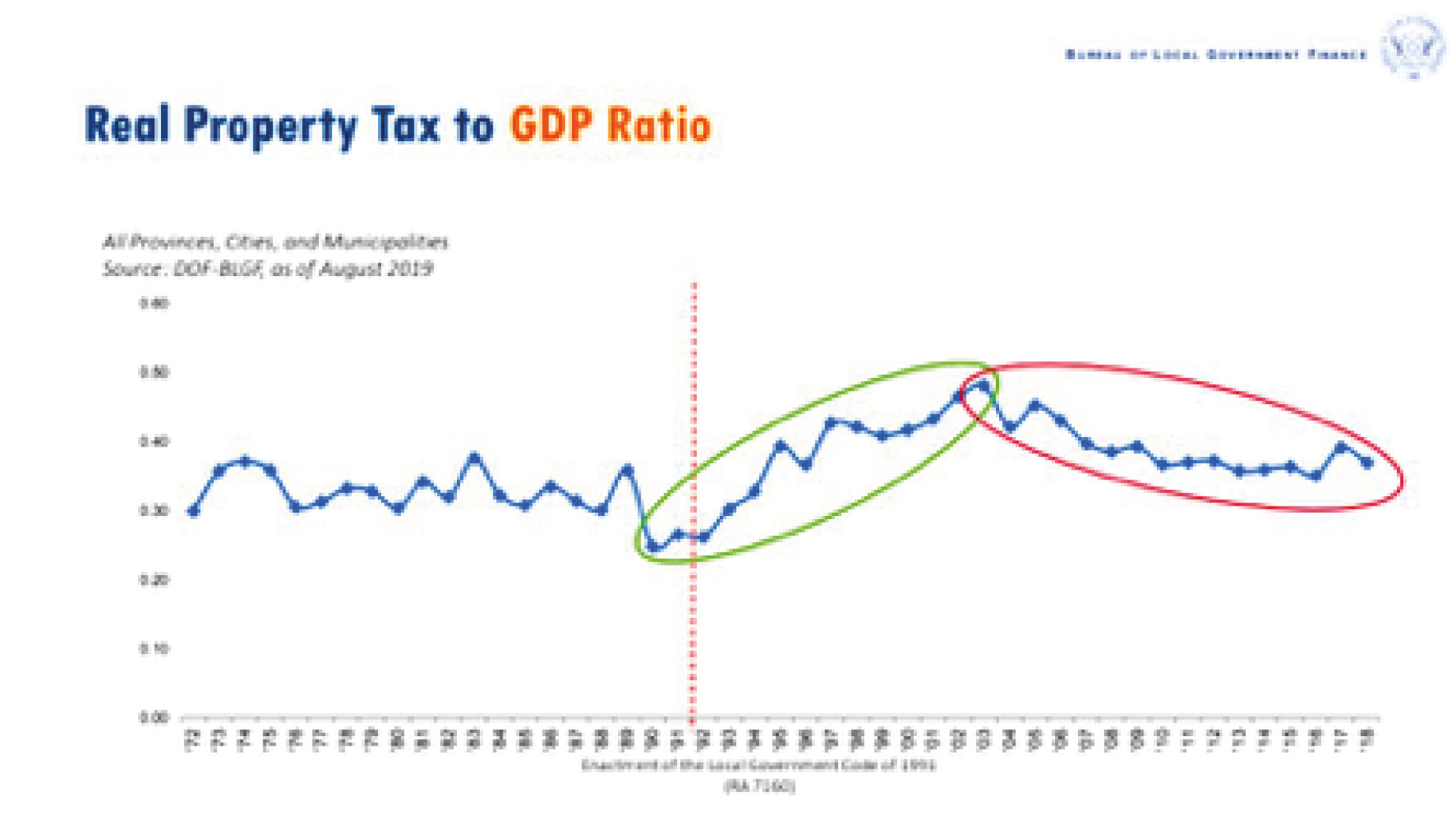
That additional one percent on your ameliar thus supports many claims. Yet, revenues derived from RPT as a percentage of the total economic output have declined since 2002.

Part of the reason for this decline is that property revaluation which should happen every three years hasn’t been diligently done. The Department of Finance-Bureau of Local Government Finance (DoF-BLGF) reports that as of March 2019, less than half (45%) of LGUs have updated Schedule of Market Values (SMV). Specifically, we are looking at 98 non-compliant cities and 46 provinces.

Another reason, as explained by former DoF Undersecretary Milwida Guevarra, is that the mean or average value of properties in a locality is used in preparing the schedule. But property owners have a strong incentive to undervalue the property so that attendant taxes that go with its sale — capital gains, documentary stamp tax, transfer tax, etc. — won’t be as high as it should be.

This becomes apparent when we see the divergence between the SMV and the private valuation on the same property. Looking at some 19 cities, the DoF discovered disparities ranging from 187% to 7,474%!

Finally, majority of provinces and municipalities, especially those outside the “NCR plus” area, lack technically qualified personnel to do tax mapping and computerize databases. Usually, the local government units (LGUs) that are able to build capacities are those that have received foreign grants for the purpose.

In this light, property revaluation creates a lot of room to increase local government revenue collections.

Pending before the Senate is House Bill 4664, otherwise known as the Real Property Valuation and Assessment Reform Act. It aims to address the decline in RPT collections despite economic growth by adopting internationally accepted standards on property valuation, rationalizing the process, establishing valuation benchmarks, and putting together a comprehensive database to support the valuation tasks and cross reference values between LGUs and the Bureau of Internal Revenue. But for me, the most important contribution of this proposed measure is the de-politicization of the valuation process. This will be done by recentralizing the technical aspect of valuing properties and determining the SMV using rationally determined benchmarks. Local legislative bodies still retain their power to set tax rates and assessment levels.

The proposed law has a “stick.” Local governments that fail to conduct a general revision of assessment and property classification and use the approved SMV will be ineligible for any performance-based grant or any form of credit financing.

One cannot overemphasize the importance of this measure especially as we try to beef up the education sector badly battered by the pandemic. Its passage will result in increased SEF per capita LGU allocation per student in public schools from the current P760 to P1,040, based on DoF estimates.

It will be unwise to rely on the supposed additional resources going to local governments resulting from the Mandanas-Garcia ruling. True, LGUs will receive a nominal addition of around 27% in 2022. But 2023 is a different matter altogether. The National Tax Allotment (NTA), formerly called Internal Revenue Allotment (IRA), is based on revenue collections three years back. That means the 2022 NTA share will be based on 2019 collections, a year prior to the pandemic. But since the pandemic in 2020, our economic output and national tax collections have plunged. Hence, the LGUs’ NTA in 2023 (and in the short term) will also decline in absolute amount.

Overall, poverty revaluation lessens LGUs’ dependence on  the National Government for resources to fund local development. And since property valuation is connected to the SEF, the passage of the bill on poverty revaluation enables a great investment for our children’s future.

The clock is rapidly ticking. Elections are just around the corner. When politicians, particularly incumbents, file their candidacies in October, Congress will have little appetite to do serious legislative work. The Senate must act quickly. Otherwise, the senators might be seen as the ones “dropping the ball” on this important measure.


Jessica Reyes-Cantos is President of Action for Economic Reforms (AER) and Co-convenor of Social Watch Philippines (SWP).

The politics of an open economy and national security: A zero-sum game?

A mathematical model present in both economic theory and information security is the situation of a zero-sum game, where one participant’s gain or loss is exactly balanced by the losses or gains of the other participant. Specifically, and in the context of economic security, it references a trade-off between investment and privacy. In the aftermath of the debates on opening the economy, we’ve seen a lot of commentaries and opinions that privacy wins the day; we do not want any large or foreign entity — government or corporation — to have too much power or control over our capital inflows and public utilities. Adam Smith himself, in a well-known passage in The Wealth of Nations, was concerned with the proper allocation of resources between “defense” and opulence,” in what led to the birth of literature on the economics of defense in the form of industrial mobilization, alliances, and, recently, economic foreign policy.

Much like free trade, can an open economy and national security evolve into a positive-sum game where increased capital inflow can be balanced with the strength of a nation’s infrastructure, government, and institutions?

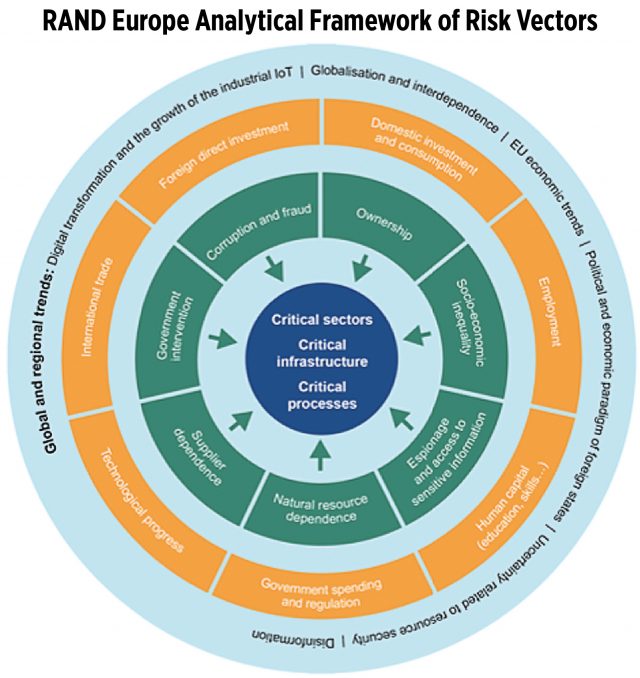
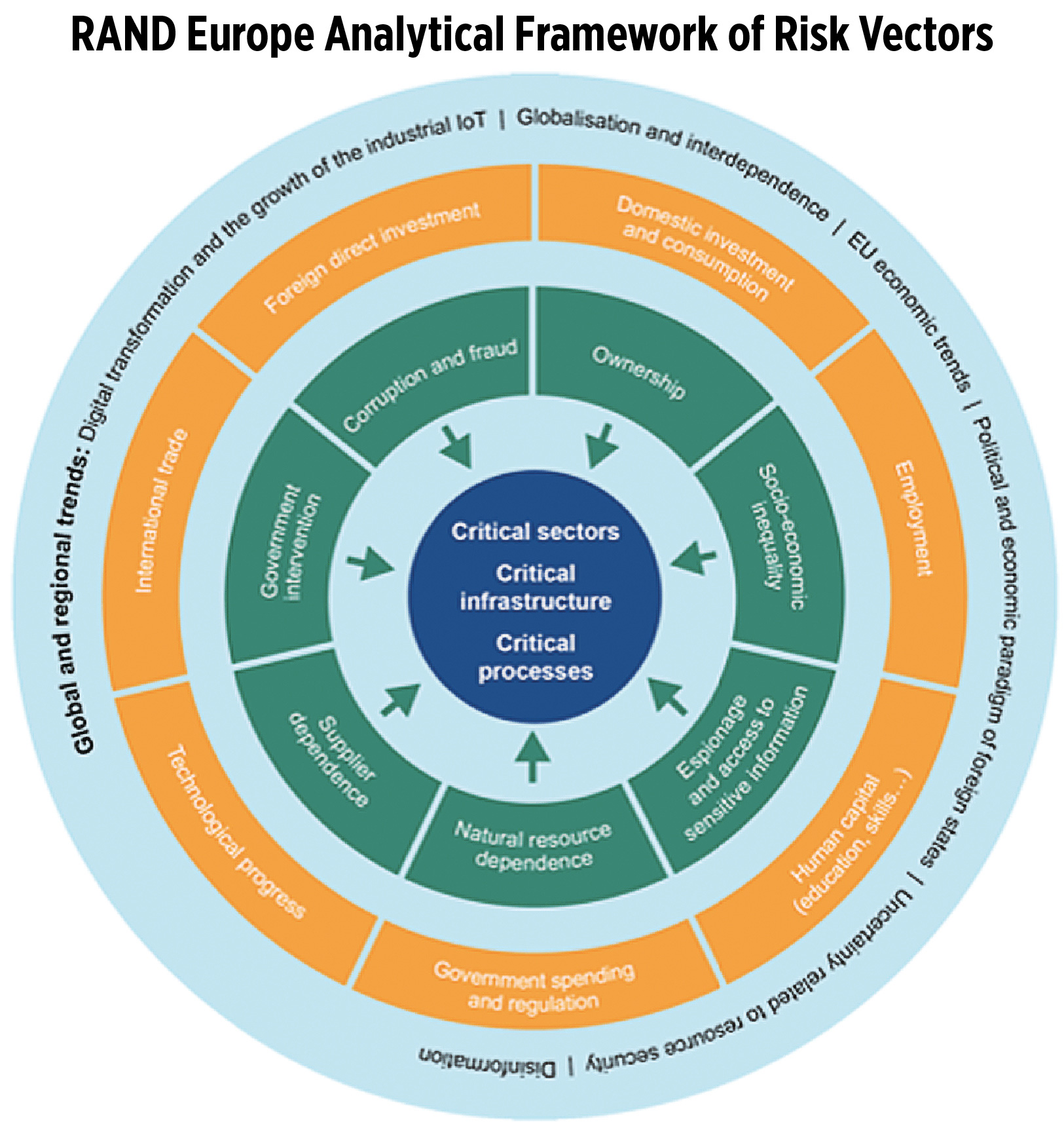
A study published by RAND Europe on Jan. 14, 2020, examines the relationship between the economy and national security and proposed a conceptual framework on how to develop a national security policy. The key findings of the study by Lucia Retter, Erik K. Frinking, Stijin Hoorens, Alice Lynch, Fook Nederveen, and William D. Philipps, are as follows:

• Foreign direct investment or FDIs and ownership of critical infrastructure and sectors can increase the risk that foreign entities gain influence and control over operations. Espionage and access to sensitive information could be enabled by the proximity or ownership of critical infrastructure and sectors by a foreign body.

• Natural resources and supplier dependence on imports from foreign countries could give foreign actors undue influence on the national economy.

• Corruption and fraud could undermine the resilience of critical infrastructure.

Moreover, security risks are not dependent on FDIs and imports alone. Digital transformation and the implementation of the industrial internet of things in relation to supply chains, cybersecurity, and data management by critical sectors pose concerns on the integrity of political institutions.

It is indeed time to update the Philippine National Security Policy (2017 to 2022) to better manage the gains of foreign investment. A dynamic and secure Philippine economy must be driven by economic interdependence and the capacity to develop transformational technologies.

The Philippines needs a national economic security agenda.

Firstly, and like the model proposed by David H. McCormick, Charles E. Luftig, and James M. Cunningham, the Philippines needs to develop and support a national innovation policy to be able to build a strong cybersecurity framework. Sectors which diversify supply chains, expand strategic reserves, or promote technology transfers should be promoted. Investment strategies should be implemented, from attracting foreign talent to foreign angel or capital venture funding or fanning private markets to invest in relevant technologies. Secondly, the economy should be opened first to allow for capital inflows and balanced with investment screening. Disclosures and financial transparency and the policing of rules is a more urgent and important concern than gatekeeping of investments. Finally, increased international cooperation should be developed and particularly on the promotion of open architecture networks.

It’s time to recognize that development is not sacrificed at the altar of information integrity. With known and managed risks, a strong 21st Century economy can be built on the foundation of interdependence and economic security statecraft.


Kristine C. Francisco-Alcantara is the Managing Partner of Abad Alcantara and Associates and is a Member of the Board of Trustees of the Foundation for Economic Freedom.

AAALaw@tradelawyers.ph

www.tradelawyers.ph

What 16th Century Venice teaches us about crypto

CARAVAGGIO’s The Cardsharps — GOOGLE ART PROJECT

ON FEB. 18, 1522, a secondhand clothing merchant named Geronimo Bambarara in the crowded Rialto district of Venice came up with a new way of clearing out stock.

Instead of selling his goods directly for money, he decided to enter customers in a draw. In exchange for a 1 lira ticket, they might win more than 1,000 times that amount in cash or take-home prizes of carpets, cloth of gold, fabric, amber, or animals. The promotion was a success. Within a week, the numbers chancing their odds resembled the crowds at the Ascension Day religious festival, according to one contemporary diarist: “At present, in this Rialto district, nothing is done except put money on the lottery.”

It didn’t last. Just 10 days after the game began, alarmed Venetian authorities banned private lotteries. Their next move was equally predictable. Having eliminated a lucrative private business, the city turned it into a public one, and started issuing tickets to raise state revenue.

That’s a lesson for how cryptocurrencies may develop over the years ahead, as more widespread usage magnifies the potential for negative public consequences.

Falling and rising by double-digit amounts in a matter of hours, Bitcoin has largely given up any pretense that it can offer a challenge to the greenback as a form of currency. Even the hyperinflating Venezuelan bolivar and Zimbabwean dollar exhibit less price volatility. As the $1.7 trillion invested in digital currencies attests, though, crypto remains immensely popular as a speculative investment, just as Bambarara’s lottery tickets were five centuries earlier.

If Bitcoin and its ilk are to survive an era when their downsides are becoming ever more apparent — from carbon emissions to ransomware attacks — they will need to find a way to betray their libertarian roots and cut their own deals with the state.

Gambling and the financial state are intimately bound up together. It’s little accident that the first modern lotteries originated in Venice, the city that issued the first sovereign bonds. Much of the Venetian economy turned on speculation about the fortunes of shipping ventures. A key plot point of Shakespeare’s play The Merchant of Venice occurs when one of the titular trader’s ships is “wrecked on the narrow seas,” causing him to default on a loan.

The gambling craze spread through Europe as incomes rose, often deprecated by religious authorities but tolerated or co-opted by governments. When the world’s first casino opened at the Ridotto in Venice in 1638, it was sanctioned by the governing Great Council as an attempt to regulate and oversee the numerous private card clubs that had sprung up. So many great fortunes were won and lost at the gaming tables that the inventor of basset, the poker-style game played at the Ridotto, is said to have been exiled to Corsica as punishment. 

None of that deterred players. The Italian artist Caravaggio, Flemish Theodoor Rombouts, and French Georges de la Tour all painted celebrated scenes of card playing, often emphasizing the amount of cheating that went on. There was clearly a ready market for such scenes, as both art and gambling were popular pastimes for the rich in 17th century Europe. That situation, too, has parallels in the current craze for NFT art.

The same pattern played out in northern Europe. Before it was funded by issuing sovereign bonds, Britain’s national debt was paid for in the late 17th century via the proceeds of lotteries and tontines. An early attempt to consolidate those borrowings and pay them off via proceeds from the slave trade resulted in the creation of the South Sea Company, leading to one of the first great speculative financial bubbles.

The lesson of all this is that the modern state can be remarkably tolerant of people winning and losing fortunes, so long as it gets some benefit. That can come in the form of a cut of the takings; a measure of control over otherwise chaotic risk-taking; or even the capital allocation functions provided by financial markets. Where those benefits are absent, however, governments grow impatient with the turmoil of unrestricted speculation, and crack down hard.

What’s unique about cryptocurrencies is the way their resistance to the nexus of traditional political and financial power is inscribed in their code. Bitcoin is “very attractive to the libertarian viewpoint,” its pseudonymous creator Satoshi Nakamoto wrote in a 2008 post. Anonymous and divorced from the state-sanctioned banking system, crypto got one of its early boosts as an untraceable way to buy illegal drugs on the internet. To this day its most useful function, outside of a simple gamble on its price, is as a currency for illicit activities.

That allergy to government control makes it fundamentally different than the many other speculative activities that have been tolerated over the centuries, as they showered riches on a lucky few and bankrupted others. For digital libertarians, that’s long seemed like a key feature of the technology. As the social and economic costs of tolerating crypto mount up, though, it may look more and more like a bug.

The moment governments decide the nuisance and destabilization caused by digital currencies is too great, they will ban financial institutions from exchanging them for fiat currencies as vigorously as the US enforces sanctions on its geopolitical enemies. That possibility, once remote, seems more and more likely in an era when America’s fuel supplies can be held hostage for $5 million in crypto.

By establishing a relatively efficient payments system for illicit activity, digital currencies have drastically reduced the cost of crime. That’s not the sort of challenge that the modern state can be expected to take lying down. If crypto doesn’t find a way to make its peace with the governments it was set up to circumvent, it will eventually find itself crushed.

BLOOMBERG OPINION

Why are imported goods more expensive in the Philippines?  

VECTORJUICE-FREEPIK

Malaysia-based information aggregator, iPrice, recently published a report that ranked Manila as the third most expensive city to live in in Southeast Asia. According to iPrice, the cost of living in Manila is only a fraction lower than in Bangkok but 28% more expensive, on average, than in Jakarta, Kuala Lumpur, and Ho Chi Minh. Singapore tops the list. The report says that it takes P50,800 to live decently in Manila (and key cities of the Philippines), about three times the salary of an average worker who earns P18,900.

There are two contributory reasons why the cost of living in the Philippines is inordinately expensive. The first is due to our import dependence. Unfortunately, the country’s manufacturing sector has eroded so severely in recent years that we now import the majority of our needs. These include basic food products (including rice), consumer goods, construction materials, machinery and equipment, etc. The second is due to expensive inbound freight cost.

See, international shipping lines have found a loophole to extract more revenues from local traders and manufacturers. They do this by charging what is called, “destination charges.” On top of being exorbitant, destination charges are unilaterally manipulated and controlled by the international shipping lines themselves. There are approximately 50 types of destination charges including bunker price adjustments, import release fees, container cleaning fees, and many more which the shipping lines levy upon the Filipino trader at its own discretion. None of these destination charges are transparent to the importer or the authorities.

Importers from the Philippines have no choice but to pay these destination charges, however unreasonable they may be. Not to do so will cause the shipping lines to withhold the release of their shipment. Don’t forget, the longer the cargo stays in the port with fees unpaid, the more demurrage charges accrue.

This practice is both immoral and illegal. It is immoral because it is extortive and designed to take advantage of the importer’s desperation. It is illegal because the terms, conditions, and fees that govern international shipping are standardized and enshrined in an international agreement called the International Commerce Terminology (Incoterms). Whatever costs are indicated in the Incoterms must be followed, no more, no less.

For instance, if the Incoterms indicate that the shipping arrangement is on a CIF (pre-paid cost of insurance and freight) or CFR (pre-paid cost and freight) basis, the consignee (the Filipino importer) should not be made to pay for any other charges since all costs relating to freight have been prepaid in the country of origin.

But this is not the case for cargo destined for the Philippines. When the shipment arrives at our ports, the local consignee (the Filipino importer) is made to a pay a bevy of destination charges which are arbitrarily levied upon him. So excessive are the destination charges that it is sometime exceeds the cost of freight itself. In effect, our importers pay the cost of freight twice. This is one of the reasons why landed cost of imported goods are more expensive in the Philippines than they are elsewhere in the region. This is also why locally manufactured goods that utilize imported raw materials often cost more than their imported counterparts.

Industry insiders say that it is not uncommon for international shipping lines to pay commissions or rebates to the shipper (the foreign exporter) using funds derived from the destination charges. The shipper, in effect, is able to recoup part or the whole of the cost of freight even if on a CIF or CFR basis. The scheme is manipulative in that it transfers the burden of payment to the Filipino importer whereas the shipper is contractually bound to pay for the freight cost and/or insurance.

Moreover, the freight contract, in a CIF or CFR arrangement, is between the shipper and the shipping line. To levy destination charges on the local importer is a violation of the Privity of Contract Principal.

Government is losing out on its rightful taxes too. Since destination charges are not indicated on the bill of lading, the landed cost of imported goods become undervalued. This leads to a misdeclaration in customs duties.

Exacerbating matters are the undue demurrage charges consignees must pay if they do not collect their containers within the grace period allowed. Consignees are also charged detention charges for failure to return the empty containers to the shipping line within 72 hours from time of pick up. Both charges are computed on a daily basis. They are “undue” because by law, demurrage and detention charges are forms of compensatory damage. But shipping lines charge these as a matter of course even without proving that they suffered loss or damage.

As usual, the beleaguered consignee has no power to question the demurrage and detention charges. Shipping companies impose liens or hold the release of the consignee’s other shipments unless all charges are settled. They also withhold the refund of container deposits for past transactions. These acts are illegal and akin to extortion.

It is government’s duty to curb these abuses inflicted by international shipping lines on the Filipino importer. But the problem is that no government agency has been given the mandate to oversee and regulate the charging schemes of foreign shipping lines. They basically do what they want, to the detriment of the Filipino trader.

Two bills have been filed in Congress to rectify this. House Bill 4316 sponsored by Rep. Bernadette Herrera-Dy and House Bill 4462 sponsored by Rep. Ronnie L. Ong. Although the Transport Committee in the House is already conducting hearings on the matter and a technical working group has been formed, the process is still painfully slow.

We urge congress (and eventually the Senate) to hasten the passage of these bills since it has an impact on the cost of goods for our citizens and diminishes the competitiveness of our manufacturing sector.


Andrew J. Masigan is an economist

andrew_rs6@yahoo.com

Facebook @AndrewJ. Masigan

Twitter @aj_masigan

First post-COVID cruise ship leaves Venice amid protest

REUTERS
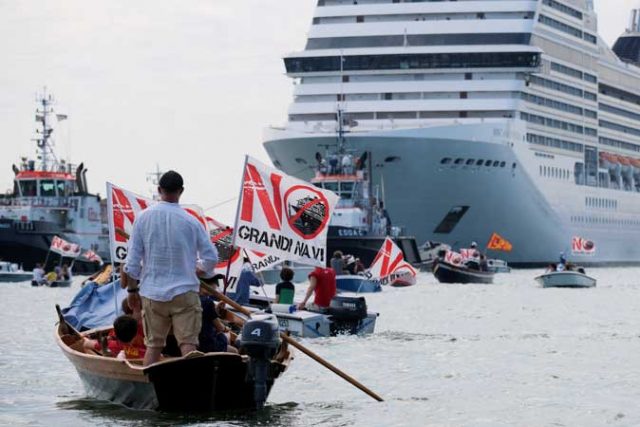
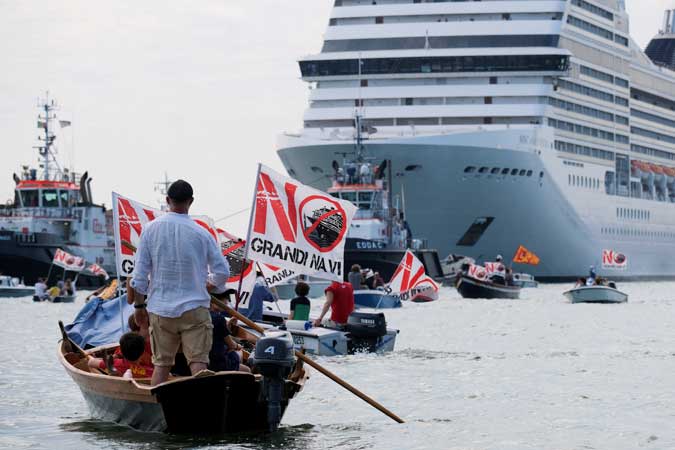
VENICE RESIDENTS hold a protest to demand an end to cruise ships passing through the lagoon city, as the first cruise ship of the summer season departs from the Port of Venice, Italy, June 5. — REUTERS

VENICE — The first cruise ship to leave Venice since coronavirus restrictions were eased set sail on Saturday, but some local residents protested over the return to normal, unhappy about the passage of giant liners through the historic lagoon city.

Hundreds of people rallied on land and small boats fluttering flags saying “No big ships” surrounded and followed the 92,000-ton MSC Orchestra as it departed Venice port en route for Croatia and Greece. “We are here because we are against this passage but also against a model of tourism that is destroying the city, pushing out residents, destroying the planet, the cities, and polluting,” said Marta Sottoriva, a 29-year old teacher and Venice resident.

But port authorities, workers and the city government welcomed the departure of the Orchestra, operated by MSC Cruises, seeing it as a symbol of business kicking off after the health crisis that hit hard at the cruise industry and the wider travel sector.

“We are happy to be back… to restart the engines. We care a lot about Venice and we’ve been asking for a stable and manageable solution for ships for many years,” said Francesco Galietti, national director for the trade group Cruise Lines International Association (CLIA).

Some residents have been urging governments for years to ban large cruise ships and other big vessels from passing through the lagoon and docking not far from the famed St. Mark’s Square.

Campaigners worry about safety and the environment, including pollution and underwater erosion in a city already in peril from rising sea waters.

“The struggle is very long, I think we are against very big financial interests,” Marco Baravalle, a 42-year old researcher, and member of the No Grandi Navi (No big ships) group.

He and other protesters were worried that “everything will go back to what we had before the pandemic,” he added.

Italy’s government ruled in April that cruise ships and container vessels must not enter Venice’s historic center but rather dock elsewhere.

But the ban will not take effect until terminals outside the lagoon have been completed, and a tender for their construction has not been launched yet. Part of the traffic might be diverted to the nearby port of Marghera starting from next year.

WHERE JOURNEYS BEGIN OR END
The Orchestra was escorted outside the port not just by small vessels protesting but by tugboats that saluted it with water sprays, a sea tradition reserved for special occasions.

The 16-deck ship can carry over 3,000 passengers and 1,000 crew but for this voyage will be sailing at only half capacity due to COVID-19 social distancing rules.

“It’s an important day for us, for 4,000 workers and many others who work in this sector. We are starting again after over 17 months, finally there is light at the end of the tunnel,” said Alessandro Santi, chairman of the Federlogistica business group.

He said the port community favored the bans but alternatives had to be found given the importance of tourism for the city.

The CLIA estimates that the cruise business represents more than 3% of Venice’s gross domestic product (GDP).

“Venice is where many itineraries begin or end, the economic impact on Venice is huge,” said Mr. Galietti. “If Venice is taken off the itineraries all the Adriatic (Sea) will suffer the consequences … it would be a huge impact.”  Reuters    

Gen Z now spending more than it did before pandemic

REUTERS

OK BOOMER, you may have money, but you’re not spending it.

Younger consumers, even though they have less saved than older Americans, are the ones opening their wallets as the US economy recovers. Millennials and members of Generation Z are spending even more than they did before the pandemic as vaccines proliferate around the world, American Express Co. (AmEx) Chief Executive Officer Steve Squeri said during a virtual investor conference Friday.

“We assumed there was such pent-up demand — not only for travel, but such a pent-up demand for consumer goods — that the US recovery would be like it is right now,” Mr. Squeri said. “When you look at your millennials and your Gen Zs right now,” they’re at “125% spending of what their pre-COVID levels were in 2019.”

That’s helped revive overall spending on AmEx’s cards, which nevertheless remains down this quarter compared with pre-pandemic levels. COVID-19 forced the company, long known for its cards that provide special perks for travel and dining, to reshape its business and focus its rewards on things like wireless and streaming services. As vaccines abound, AmEx is benefiting as consumers get back to vacationing and eating out.

While consumers have returned to the skies for domestic travel, businesses have yet to get their workers back on the road, Mr. Squeri said. AmEx now believes corporate travel won’t return to its pre-pandemic levels until 2023, he said.

The company is eyeing whether it can offer debit cards in markets outside China, Mr. Squeri said. Still, he cautioned, the firm is wary after a previous experiment offering prepaid debit cards to unbanked individuals ended with the division being dismantled less than a decade after its inception.

Mr. Squeri said that American Express is “very conscious about the brand” and needs to decide whether offering a debit card would fit in with the company’s largely high-end and aspirational products.

“It really didn’t work for us — the unbanked was really not our customer, and the prepaid market was not our customer, and we learned that,” Mr. Squeri said. “But is there something in between our everyday credit card and the prepaid card? And that potentially could be a debit card. That all needs to be worked out.” — Bloomberg

US boosts Taiwan’s COVID-19 fight with donation of 750,000 vaccine doses

TAIPEI — The United States will donate 750,000 COVID-19 vaccine doses to Taiwan as part of the country’s plan to share shots globally, US Senator Tammy Duckworth said on Sunday, offering a much-needed boost to the island’s fight against the pandemic.

Taiwan is dealing with a spike in domestic cases but has been affected like many places by global vaccines shortages. Only around 3% of its 23.5 million people have been vaccinated, with most getting only the first shot of two needed.

Speaking at Taipei’s downtown Songshan airport after arriving on a three-hour visit with fellow Senators Dan Sullivan and Christopher Coons, Ms. Duckworth said Taiwan would be getting 750,000 doses as part of the first tranche of US donations.

“It was critical to the United States that Taiwan be included in the first group to receive vaccines because we recognise your urgent need and we value this partnership,” she said at a news conference after the group arrived from South Korea.

She did not give details of which vaccines Taiwan would get or when.

Taiwan has complained about China, which claims the democratically-ruled island as its own, trying to block the island from accessing vaccines internationally, which Beijing has denied.

Standing by Duckworth’s side, Taiwan Foreign Minister Joseph Wu thanked the United States for the donation.

“While we are doing our best to import vaccines, we must overcome obstacles to ensure that these life-saving medicines are delivered free from trouble from Beijing,” he said.

China has offered Taiwan Chinese-made vaccines, but the government in Taipei has repeatedly expressed concern about their safety, and in any case cannot import them without changing Taiwanese law, which bans their import.

The senators also met with President Tsai Ing-wen at the airport, who said the vaccines, along with those Japan donated last week, would be a great help in their fight against the virus.

“The vaccines are timely rain for Taiwan, and your assistance will be etched on our hearts,” Ms. Tsai told the senators, in footage released by her office.

US senators and congressmen visit Taiwan routinely in normal times, but coming in the middle of an upswing in infections on the island when its borders remain largely closed to visitors is a strong show of support.

Unusually, they also arrived on a US Air Force C-17 Globemaster III freighter, rather than a private jet as is generally the case for senior US visitors.

Taiwan’s vaccine arrivals have been gathering pace.

Japan delivered to Taiwan 1.24 million doses of AstraZeneca Plc’s coronavirus vaccine on Friday for free, in a gesture that more than doubled the amount of shots the island has received to date. — Reuters

Saso slips to second in US Open

YUKA SASO plays her shot from the 12th tee during the third round of the US Women’s Open golf tournament at The Olympic Club. — REUTERS

Lexi Thompson shoots 66 to lead Saso by a stroke

SAN FRANCISCO — A relaxed Lexi Thompson fired a flawless 66 at the Olympic Club on Saturday to vault to a one-stroke lead heading into the final round of the US Women’s Open in San Francisco.

All facets of Thompson’s game were working as she carded her lowest round at the major in 15 appearances, sinking five birdies and gamely scrambling to avoid any bogeys to sit seven-under 206 for the tournament, one clear of Yuka Saso.

The popular American smiled and signed autographs as she walked the sloping Olympic Club’s Lake Course on a sunny day and said the work she has put in to improve her mental fitness was making a difference in her game.

“I haven’t played to my standards and I realized that I needed to change my mind-set,” she told reporters.

“It was only hurting me. Obviously, I needed to work on some technical things in my game and everything, but the mental side, I think, was really getting to me,” she said.

“I was just taking it way too seriously.”

Overnight leader Saso, 19, looked poised to run away with the tournament when she jumped out to a three-stroke lead but back-to-back bogeys on 13 and 14 opened the door for Thompson.

The Filipino player with an sharp short game pulled even with Thompson after completing a tough up-and-down on 17 but a bogey on the last left her in solo second place.

In the hunt at three-under were high school student Megha Ganne and 2019 champion Lee6 Jeong-eun, with the dangerous Shanshan Feng of China one shot further adrift.

Saso said she enjoyed the vocal support she received from the limited number of fans in attendance and said she was looking forward to her final round grouping with Thompson and friend Ganne.

“I’ll be rooting for her too,” Saso said with a laugh when she was told that Ganne had said that if she was not in the tournament, Ganne would be pulling for her fellow teenager.

“We have known each other for years, we played together in junior tournaments and she’s really nice.”

Ganne, the amateur turned talk of the tournament after she finished the first round as an unexpected co-leader, received rock star treatment from the fans in San Francisco and said she relished the spotlight.

“It was so fun,” she said.

“I’ve always imagined myself engaging with the fans like that because when I was younger and watching events, I loved it when I would see the pros just even look at the crowd or smile or do anything like that.

“So I really wanted to embody that today and I got a chance to on a few holes, which was nice.”

The 76th edition of the major marks the first time that it has been played at the iconic Olympic Club, a course that has hosted five men’s US Opens.

The men’s US Open will also be held in California this month at Southern California’s Torrey Pines. — Reuters

Kiefer Ravena’s Japan B.League stint on hold

PBA STAR Kiefer Ravena of the NLEX Road Warriors has to put his targeted stint in the Japan B.League on hold with the local league rendering it a no-go. — PBA IMAGES

BASKETBALL star Kiefer Ravena’s targeted stint with the Japan B.League is on hold as the parties concerned, including the local professional league, try to further sort out the matter.

In a virtual press conference on Saturday, the Philippine Basketball Association (PBA) Board of Governors reiterated its stand that Mr. Ravena is not allowed to play in the Japanese league as he has an existing contract with the NLEX Road Warriors and the league.

“The PBA has decided that Kiefer has to honor his contract,” said PBA chairman Ricky Vargas in the hurriedly organized press conference following the board’s meeting.

The league official shared that they looked at all possible scenarios and all the risks involved in the situation before making the decision.

The PBA was made to decide after news broke out last week that the Shiga Lakestars signed Mr. Ravena to play for the team in the B.League’s 2021-22 season.

No sooner after the Shiga Lakestars announced that they had signed versatile guard Ravena, the PBA came out and said it is not going to be possible.

The league said that Mr. Ravena is bound by the Uniform Players’ Contract (UPC) he signed with NLEX and the PBA which he must honor and adhere to.

“Kiefer has a UPC which he has to abide by. It’s the player’s contract. So he’s not allowed to play in other leagues,” PBA Commissioner Willie Marcial told BusinessWorld in a phone interview.

Mr. Ravena signed a three-year extension with the Road Warriors last year following a solid outing in the league’s “bubble” tournament where he averaged 19.4 points, 5.5 rebounds, 4.6 assists, and a steal throughout their run.

Earlier this year, however, news of Mr. Ravena getting a “good offer” to play in Japan broke out.

No less than NLEX coach Yeng Guiao confirmed the news. The coach said they support Mr. Ravena’s desire to pursue the opportunity presented to him, but admitted it was going to be easier said than done as a number of requirements had to be met for it to be a reality.

The PBA said after the press conference it was to communicate its decision to Mr. Ravena, the Lakestars and the B.League, and the Samahang Basketbol ng Pilipinas just as it asked local fans for understanding.

“I know the fans want him to play there. We also want that. But there’s a contract that should be followed. It’s basic. We really can’t let this pass,” Mr. Marcial said.

The league also deemed the Ravena situation as a “difficult precedent” not only for the PBA but also for world basketball governing body FIBA, whose approval is also needed for such kinds of transfer.

“FIBA is also very strict on contracts. FIBA deems the contracts of the players sacrosanct as well,” Mr. Vargas said.

So as not to complicate the situation further, Shiga said it was postponing the formal announcement of Mr. Ravena as a member of the Lakestars set for Monday.

“We have decided to postpone the press conference until a more appropriate time, as holding a press conference with Ravena and us at this time may add more confusion to the situation,” the team said in a statement.

“We will continue discussions to resolve this issue.”

Playing in Japan would make Mr. Ravena the second Filipino player to play in the league following his younger brother Thirdy, who plays for the San En NeoPhoenix team. — Michael Angelo S. Murillo