Home Blog Page 711

Jabra launches PanaCast 40 videoconferencing tool in PHL

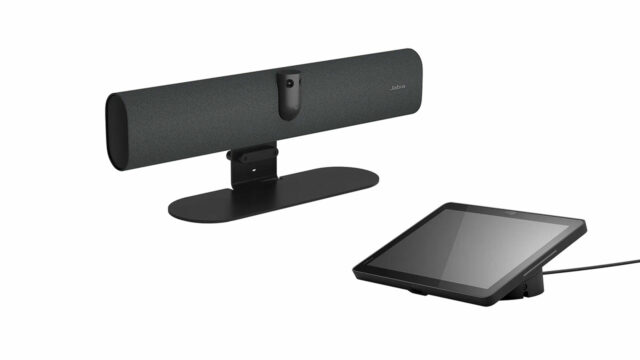
Jabra PanaCast 40 VBS — JABRA.COM

JABRA, a Danish audio and video technology brand, has launched its newest video bar system (VBS) in the Philippines, looking to capitalize on the transformation of workplaces and organizations’ need for modern collaborative tools.

Jabra on Tuesday launched the PanaCast 40 VBS, an Android-powered video bar that the brand said mainly caters to small meeting rooms.

“The Filipino workplace is undergoing a transformation, with many organizations reimagining how their spaces can drive productivity and collaboration,” Jabra Philippines Country Manager Larsen G. Sandoval said during the media preview.

“Most companies have previously prioritized large and medium office spaces, but with the return-to-office trend, there has to be more meeting rooms set on smaller scale. Equipping them with the right tools is what we’re going to do in Jabra,” Mr. Sandoval said.

Xuanling Lu, director for global project marketing at Jabra, said increased globalization among companies has highlighted the need for better collaborative tools for teams working from different geographic locations.

“Despite the size of the meeting rooms, the average number of participants at any given time is less than two people,” she said.

“There is a huge opportunity for organizations to understand how their employees are using the real estate space they have, and how they can optimize their space for more people in an office environment.”

The starting price for the Jabra PanaCast 40 VBS with a Jabra Control IP is at P165,000, while the Jabra PanaCast 40 VBS bar only costs P110,000.

The PanaCast 40 VBS is suitable for small rooms that are typically 4.5 meters (m) to 4.5m in size, accommodating four to eight people.

The device has a horizontal field-of-view (FoV) of 180 degrees and a 50-degree vertical FoV, captured by its two eight-megapixel cameras with up to 4x digital zoom.

Its video capabilities are complemented by GN Group’s sound processing abilities. Sounds will come from a single speaker and six microphones with adaptive beamforming and intelligent audio algorithms to ensure accurate voice pick-up.

The device also ensures easy connection to videoconferencing platforms like Zoom, Microsoft Teams, and build-your-own-device deployment options.

Jabra is a brand under GN Group, which provides hearing, audio, video, and gaming solutions across 100 countries. Its other brands include ReSound, SteelSeries, Beltone, Interton, BlueParrott, Danavox, and FalCom. — Beatriz Marie D. Cruz

PBB to expand consumer lending business as it eyes sustained profitability

PHILIPPINE Business Bank, Inc. (PBB) targets to double its income over the next four years as it looks to grow its consumer business to boost its margins while working towards its goal to upgrade to a universal bank.

“Looking to the future, we are seeing a bigger and more profitable bank… So, notwithstanding the continuous business improvements and initiatives towards growth, we see these [growth] accelerators contributing for us to be able to attain our target, which is to double our income levels within the next four years,” Joseph Jeeben R. Segui, PBB first vice-president and Corporate Planning and Investor Relations Group head, said in a presentation during the Philippine Stock Exchange’s Investor Day held virtually on Wednesday.

PBB booked a net profit of P475.42 million in the second quarter, down from P520.58 million a year ago. For the first semester, its net income increased to P1.07 billion from P1.03 billion.

Mr. Segui said the bank aims to boost its profits by growing its consumer lending business to make up about a third of its portfolio. At present, consumer loans make up just below 10% of its loan book, he said.

“This, we foresee, is a move that will bolster profitability through higher effective loan rates of consumer loan business compared to our core business, which is commercial lending,” he said. “As we’ve seen over the past few years, consumer loans… have really strong demand. And with this strong demand, it can propel both asset size growth as well as margins.”

PBB will select business lines that it believes it can be competitive in and are within its risk appetite, Mr. Segui said, including the teacher loans segment.

He noted that while the bank has taken a more “conservative” approach towards commercial loans due to the volatile operating environment, lending to small and medium enterprises will continue to be PBB’s core business even as it is now looking to diversify into high-margin market segments.

Mr. Segui added that PBB will also continue to explore potential acquisitions and partnerships but will remain “selective.”

“We’ll only pull the trigger if it is a compelling acquisition opportunity. In terms of strategic partnerships, we also continuously look into potential tie-ups or partnerships, and the major consideration being not just the additional funding that could be put into the bank, but, as important, we’d like a partner that can provide strategic value that will help the bank grow its business.”

Ideally, they want a partner that has the expertise, process, and technologies that can help PBB achieve its target to grow its consumer banking business, he said.

Lastly, the bank’s continuing work towards upgrading to a universal bank is also seen as a growth driver as it will allow PBB to tap new business lines, such as bancassurance, investment banking, and wealth management, to expand its customer base and boost its revenues and income, Mr. Segui said.

“We are working towards that, but we are being very deliberate. As our CEO always says, we don’t want to be a unibank just for the name. We want to be a unibank in essence, in terms of our service, in terms of the quality that we provide our clients, value, and in terms of our capabilities. So, we are continuously working on internal improvements to be able to be of that caliber and level to provide unibank-level services to our clients,” he said.

“We continue to be very intentional as we approach this milestone. So, we are headed in this direction, but we are not rushing it. But we are there, continuously working to be the unibank that we believe we have to be for our clients.”

PBB shares went down by 41 centavos or 4.72% to close at P8.28 each on Wednesday. — BVR

AboitizPower sees stronger second half on new capacities, contracts

ABOITIZPOWER.COM

ABOITIZ POWER CORP. (AboitizPower) expects stronger earnings in the second half (H2) of the year as new power capacities and contracts begin to contribute to revenues.

“We continue to keep the reliability of our plants, it’s a high priority, and are optimistic that we can bring up plant availability,” AboitizPower Chief Financial Officer Sandro Aboitiz said at a recent earnings results briefing.

New contracts with a total capacity of 800 megawatts (MW) are expected to be delivered within the third quarter, which will start contributing to higher margins, he said.

Mr. Aboitiz also cited ancillary service procurement agreements that recently secured final approval, which carry higher rates.

“We’re also hopeful that we will be able to retroactively recover the difference in the rates when the time we started delivering those contracts. And because the final approval just came in July, we’ll now start to see the impact of that in the second half financials,” he said.

Further, the company is expecting better results with the full operation of all three units of Excellent Energy Resources, Inc. (EERI), which is jointly owned by subsidiaries of AboitizPower, Manila Electric Co., and San Miguel Global Holdings Corp.

For the first six months of the year, AboitizPower’s attributable net income fell by 26% to P12.67 billion from P17.13 billion a year ago.

Operating revenues declined by 8% to P100.24 billion due to lower power generation and fuel costs.

This year, the company has earmarked a capital expenditure budget of P78.1 billion, with 66% allocated for its renewable energy portfolio.

AboitizPower serves as the Aboitiz Group’s investment arm for power generation, distribution, retail electricity, and related energy solutions.

The company aims to expand its total attributable net sellable capacity to 9.2 gigawatts by 2030, with a 50:50 balance between renewable and thermal energy sources. — Sheldeen Joy Talavera

Dining In/Out (08/21/25)


Krispy Kreme launches Hogwarts collection

KRISPY KREME, in partnership with Warner Bros. Discovery Global Consumer Products (WBDGCP), is launching a new doughnut collection inspired by Hogwarts School of Witchcraft and Wizardry. Now available for a limited time only, the collection brings the four Hogwarts houses to life through its different flavors. The Gryffindor Doughnut is a shell doughnut filled with cookie butter-flavored Kreme, dipped in red icing and Biscoff cookie crumble, topped with golden icing drizzles and the Gryffindor crest. The Slytherin Doughnut is an Original Glazed doughnut topped with chocolate and green buttercream-flavored swirls, a chocolate cookie sugar blend, and the Slytherin crest. The Hufflepuff Doughnut is a shell doughnut filled with brown butter toffee-flavored custard, dipped in golden yellow icing, and topped with black chocolate drizzle, cookie crunch, and the Hufflepuff crest. The Ravenclaw Doughnut is an Original Glazed doughnut dipped in blueberry-flavored icing, topped with the Ravenclaw sprinkles and crest. Also part of the collection is the new specialty Sorting Hat Doughnut, a doughnut filled with a mystery-colored Kreme representing one of the four Hogwarts Houses, then dipped in chocolate-flavored icing, sprinkled with gold stars and gold sugar, and topped with a Sorting Hat piece. The Sorting Hat doughnut is sold separately in a limited-edition specialty box, while supplies last. Accompanying the doughnuts is the new Golden Snitch Latte, a golden caramel toffee-inspired latte, topped with whipped cream, Biscoff cookie crumble, and a sprinkle of golden shimmer sugar. The collection is available until Sept. 15 in store, for take-out, drive-through, and delivery.


A taste of Singapore in Makati

THE Singapore Tourism Board (STB) is set to bring a flavorful slice of Singapore to Makati with SingaPob, a gastronomic takeover featuring award-winning bars and restaurants that spotlight Singapore’s status as a culinary haven. From Aug. 28 to 31, these hotspots will pop up in dining destinations in Poblacion and Rockwell. Building on the success of its 2023 run, SingaPob returns with a twist. This year, the celebration will bring a fresh mix of tastes and traditions to the table. From casual bites and hawker favorites to crafted cocktails and refined dining, diners will be spoilt for choice. Topping it all off, from Aug. 16 to Sept. 30, STB has partnered with Klook to offer exclusive discounts and promotions for travel to Singapore. The bars, restaurants, and special offerings are: Candlenut x Hapag will have an exclusive tasting menu that celebrates the best of Singapore and Filipino flavors; Keng Eng Kee, started as a family-run hawker stall serving Zi Char dishes and has been recognized by both the Michelin Guide and 50 Best Discovery guide, will be at Super Uncle Claypot; Jigger & Pony, which ranks 3rd on Asia’s 50 Best Bars 2025 and 5th on the World’s 50 Best Bars in 2024, will be hosted by OTO; Fura, which earned the Ketel One Sustainable Award at Asia’s 50 Best Bars in 2024 and landing 95th on the same list in 2025, will be at Aya; the speakeasy Night Hawk, ranked 77th on Asia’s Best Bars in 2025, will be at a secret location; Mama Diam’s, a speakeasy bar, will be at Polilya; Offtrack, ranked 23rd among Asia’s 50 Best Bars in 2025, will be hosted by Run Rabbit Run; Origin Bar, ranked 60th on Asia’s Best Bars in 2025, will be hosted by The Spirits Library; Onlypans Tacqueria, a homegrown taco sensation in Poblacion, will showcase an exclusive menu inspired by Singapore’s rich and diverse food culture. Lucky foodies who go around SingaPob will have a chance to win Klook travel discount vouchers, and an all-expenses-paid culinary trip for two to discover Singapore’s most celebrated dining destinations. Visit www.singapob.com for more information.


Long weekend at Solaire Resort North

MAKE THE MOST of the extended National Heroes’ weekend at Solaire Resort North, with a staycation for the whole family, indulging in some of the best dining options in the north. A staycation package starts at P12,086++ net, which includes a duo of complimentary drinks upon arrival at the Lobby Lounge, and breakfast for the family at Fresh. Enjoy the extended weekend for all bookings made for stay dates scheduled until Sept. 30. Then dine at Solaire North’s many restaurants including Trattoria e Dolci for Italian pizzas, pastas, and charcuterie, and 18 unique gelato flavors to choose from. On Sundays, savor steaks at Café Mangrove with their succulent slices of Slow-Roasted USDA Prime Rib served with classic sides. Enjoy authentic Chinese cuisine at Red Lantern with an exclusive seafood menu. This special seasonal menu is available for lunch daily until Aug. 31. The contemporary flavors of Japan are the focus at Yakumi where the season’s best for the month is the Kamasu or barracuda, available daily with dishes starting at P780++ net. Should weekend plans land on a Sunday, diners can partake in Yakumi’s Sunday Brunch from 11:30 a.m. to 2:30 p.m., with ribeye steaks, seafood teppanyaki, and fresh sashimi. One can sit back and relax at the Pool Café with their Pinoy Plates and Pints menu, offering Filipino meals, and beers to accompany each dish, including Dinakdakan, Sinuglaw, or Pinaputok na Bangus with a choice of local or imported beers. There is also the crowd-favorite buffet, Fresh for a hearty family meal. This August, the focus is on the cuisines of Thailand and Vietnam every weekday at lunch. Enjoy a 360 view of Quezon City while savoring the cuisine of Italy at Finestra. The Regional Cuisine Tour menu highlights the robust and traditional flavors of Calabria, Italy this August from 5:30 to 10:30 p.m. every day. Finally, take the rooftop journey to Skybar for two hours of free-flowing, unlimited classics ranging from sparkling, white, or red wines, cocktails, spirits, and beers ready to accompany each sunset. For guests who prefer non-alcoholic beverages, a selection of juices and sodas are also available. Enjoy the afternoon and sunset at Skybar every Sunday from 2:30 to 7:30 p.m. For reservations and inquiries, visit sn.solaireresort.com or sn.solaireresort.com/offers/quezon-city-86th-anniversary-special-room-offer, call +632 8888 8888, or e-mail snrestaurantevents@solaireresort.com to book a table.


40% off all ramen at Dohtonbori SM North EDSA

IN CELEBRATION of SM Supermalls’ 40th anniversary, Dohtonbori SM North EDSA is treating ramen lovers to a 40% discount on all ramen dishes for 40 days from Aug. 1 to Sept. 9. One of Dohtonbori’s best-sellers, the Tonkotsu Ramen is made from rich pork bone broth, resulting in a creamy and hearty base topped with tender pork slices, and cooked-to-perfection noodles. For those who prefer a lighter option, the Shoyu Ramen highlights the savory depth of soy sauce. Spice lovers can indulge in the Spicy Tonkotsu Ramen, a twist on the classic tonkotsu, topped with minced pork and infused with a special blend of spices that adds a fiery kick to its creamy broth. Dohtonbori Philippines is also the only restaurant in the country where guests can cook their own okonomiyaki, Japan’s savory pancake, right at their table. This special offer is exclusively available for dine-in customers at Dohtonbori SM North EDSA branch only.


Baguio’s Mile Hi to reopen

THE HISTORIC Mile Hi complex inside Baguio’s Camp John Hay makes a comeback after remaining nonoperational for six years. Luigi Nuñez, chief executive officer of the BBZ Group of Companies, has teamed up with the Bases Conversion and Development Authority (BCDA) and John Hay Management Corp. (JHMC) to revive the Mile Hi complex as a go-to destination in Baguio which will simultaneously contribute to the local community and tourism in the city. Already launched is the Mile Hi Grill, along with In-Bento Yakitori and Ramen, the homegrown Hay & Co. Coffee, and the return of the beloved Mile Hi Diner. Mile Hi is also envisioned as a weekend market where Baguio’s farmers and artisans can sell directly. While the contract is short-term in nature, the intent is long-lasting: to draw the community back to Camp John Hay, and set the tone for what could be a deeper, more permanent transformation. With this endeavor, the BBZ Group hopes to offer a renewed sense of pride, purpose, and possibility for the people of Baguio, and for generations who remember what Mile Hi once was.


Coca-Cola opens kiosks at LRT stations

COCA-COLA Europacific Aboitiz Philippines (CCEAP) has launched new Coca-Cola Refresh Stations in the Baclaran, EDSA, Blumentritt, Fernando Poe, Jr., and Balintawak stations along LRT Line 1. The new LRT-1 Coca-Cola Refresh Stations offer commuters a wide range of iconic beverages, including Coca-Cola, Royal, Sprite, Wilkins, Minute Maid, Fuze Tea, and Nutriboost.

In search of our own Goldilocks zone

GIANT “imperial star destroyers” chase and attempt to capture the tiny Millennium Falcon, nearly colliding with each other at one point in the 1980 Star Wars sequel, The Empire Strikes Back.

THE GOLDILOCKS ZONE: that distance from a sun that enables conditions in surrounding planets for liquid water to exist, hence, making them habitable, in theory — a rare sighting among astronomers.

Not an exact metaphor here, but it’s still kinda like the elusive condition under which our economy could thrive that we seek in our ties with China, the world’s second-biggest economy. Economists expect that giant to displace the United States as the biggest economy, current internal challenges notwithstanding. Hence, there is no way any country can decouple from it, though it would be wise to cut our reliance on China by diversifying trade and other aspects of the economy towards other opportunities.

Some folks, including China’s Foreign Minister Wang Yi, cite our Southeast Asian peers as examples of independent foreign policy for us to emulate (true of Vietnam, which has had its own tiff with China, but an unfair comparison with others that have not faced the aggression that we now do).

I recall fellow columnist, Stratbase CEO/Managing Director Victor Andres C. Manhit, saying in a briefing that he had told off with “I don’t care” a Southeast Asian academic who remarked that the Philippines was too identified with the US. Beijing has only itself to blame in this matter since it forced us to a corner. Sun Tzu would have given Beijing a failing mark, since it could otherwise have achieved its strategic objectives with us in more persuasive, non-confrontational ways.

It behooves each state to balance competing national interests at any given time.

Take Thailand, for example, which has been vying with Indonesia, Vietnam, and Malaysia for more trade, foreign direct investments, and tourists from China (which is the top source across these accounts for Thailand), and relies besides on that northern neighbor for weapons like tanks, air defense systems, warships, and submarines.

On the flip side, Thailand deported at least 40 Uighur refugees — who had been held for a decade in a Bangkok detention center — back to the human rights blackhole that is China’s predominantly Muslim Xinjiang region, saying that “China gave assurance that the Uighurs sent back to Xinjiang would be looked after.”1 Does anyone doubt that that was tantamount to a death sentence for those folks? Bangkok had also faced pressure from Beijing to drop a draft bill that would establish a casino-centered integrated entertainment complex.2

So, “independent foreign policy” is a moving target for each country in Southeast Asia that requires tradeoffs deemed acceptable amid circumstances at a given time.

EMBARRASSING
Let’s now turn our attention to the latest developments in our own backyard.

The Philippine Coast Guard (PCG) commander who deftly steered BRP Suluan out of the anvil towards which two much-larger Chinese ships were driving it on Aug. 11 showed us that we’ve got world-class skippers and crews in terms of seamanship and courage. One western analyst commented that long-running pressure from China has honed the consistently vastly outnumbered PCG into one of the best coast guards in the world (kind of in the same way that nearly a decade of conflict with Russia, punctuated by an invasion that is now on its third year, has steeled Ukraine’s troops into the most experienced army in Europe, and one of the best in the world — so I am glad that we are developing defense cooperation with Ukraine).3

Based on their comportment so far, I doubt if Chinese forces would have matched BRP Suluan’s offer of assistance on the spot to injured Chinese counterparts if the shoe were on the other foot. I know that that was universal coast guard SOP, but, given the circumstances, that was one class act.

It will be wise for us to exchange notes with other coast guards that have found themselves bearing the brunt of Beijing’s bully tactics, even though we are sure to have lots to teach them.

Now, of course, in the la la land that Beijing has been painting in its propaganda — foisted internationally but meant more for its truth-starved population who have long been denied access to the global internet and free speech — the smaller ship in the chase is the “troublemaker” and the Philippines is not capable of thinking on its own without the US4… talk about “Cold War mentality” which Beijing has been wont to blame on anyone questioning its hegemonistic designs without first taking a good look in the mirror.

Remember when China’s social media after the June 2024 confrontation — in which China Coast Guard (CCG) sailors, some wielding bladed weapons like stereotypical pirates, ganged up on a handful of Philippine counterparts, wounded a Filipino sailor, and stole their guns — had a field day deriding the latter’ capabilities and calling them names (ignoring the fact that the Filipinos were ordered not to do anything that could worsen the situation, and that they were, as usual, vastly outnumbered)?

Well, Beijing has been curiously silent to this day on the embarrassing Aug. 11 collision of their own ships that purportedly cost lives (reported in Taiwan — the best source of information on the mainland, bar none, not even the US).

Another western commentator likened BRP Suluan’s skipper to Hans Solo, the intrepid space smuggler-rebel commander who always eluded giant imperial “star destroyers” in Star Wars (in fact, one scene in The Empire Strikes Back shows two such “star destroyers” nearly colliding in their rush to corner Solo’s tiny ship, the Millennium Falcon.)

Of course, the BRP Suluan — one of 10 ships of the Parola class in the PCG’s inventory — was made by Yokohama-based Japan Marine United Corp. That (besides the superior seamanship by our Filipino Hans Solo) may partly account for the outcome of the Aug. 11 chase, if we were to believe accounts of shoddy workmanship found by foreign buyers of Chinese-made warships (Pakistan’s air victory using China-made jets in its recent skirmish with India is another matter since that was blamed partly on the latter’s overconfidence, miscalculation, and wrong tactics, as much as the quality of Chinese weaponry).

FOREWARNED
Now, here come Taiwan-based China hands warning us to brace for Beijing’s fury, as it reels from its Aug. 11 drubbing in the hands of what it regards as its vassal state and tries to “claw back” whatever it can from its massive loss of face (by the way: note how the Middle Kingdom’s delegates in international fora seem speechless whenever faced with counterarguments from other delegates, giving the impression that they are not used to Beijing being questioned in spontaneous public proceedings they do not control).5

So our coast guard and our navy — in the background in order to avoid taking Beijing’s bait for us to engage its minions in armed confrontation — have their work cut out for them. Strategic affairs analyst Prof. Renato C. de Castro of the De La Salle University and Stratbase noted on Tuesday that a badly hurting Beijing seems to have ordered the CCG to block our ships from leaving our 12 nautical mile territorial waters to the west, while National Maritime Council Spokesman Undersecretary Alexander S. Lopez (a retired vice-admiral) said in an Aug. 18 news conference that “contingency measures… are in place… for the worst scenario.”6

At this point, let me just say that I wish our President had not told Indian news site Firstpost on Aug. 8 that “[t]here is no way the Philippines can stay out of… a confrontation over Taiwan between China and the US,” even as he emphasized that “[w]e are not girding… for war… are just reacting to challenges we are facing…” and “want to… cool down the rhetoric…” in a quest to remain “an enemy to none and a friend to all.”7 That may be true, but it would be best to avoid any risk of misinterpretation — deliberate or otherwise — by Beijing, which has been painting the Philippines as a mindless US pawn in Asia that choreographed the Aug. 11 West Philippine Sea (WPS) incident with Washington.

Still, it’s wise to continue drawing all countries with a stake in unhindered South China Sea transit — the latest being India (which can also help us diversify trade and investments, though still not displacing China) — to collective efforts to keep it free. This partly enforces our July 2016 legal victory at The Hague (our contribution to international rule of law that is now being cited by various countries, not just the US and Vietnam).

There are quarters that argue that it would be better to limit our countermeasures to bilateral talks with Beijing, and to temper our armed forces modernization (which is just to catch up with our neighbors), even if the latter has shown that it does not respect diplomacy that is not backed by credible armed deterrence (just recall how it treated the past administration, whose bending over backwards to cater to Beijing’s sensitivities ended up short-changed and largely unrequited).

In the meantime, the envoys of both countries — Philippine Ambassador to China Jaime A. FlorCruz, a former CNN Beijing bureau chief who had studied and lived there since the onset of Martial Law in the early 1970s, and Chinese Ambassador Huang Xilian — have been working overtime to ensure that at least people-to-people and cultural exchanges, an anchor amid current difficulties, persevere.

Our embassy there and our business sector also soldier on in probing for economic opportunities, i.e., by participating in trade, investment, and tour fairs in China. Of late, our embassy there reported that a delegation led by our Tourism department participated in the Aug. 8 Diving Resort and Travel Show Expo at the China National Convention Center in Beijing.8

It’s just unfortunate that only one or two national dailies reported our participation in that expo, in a brief article buried deep in an inside page at that. Escalating WPS tensions have always hogged the headlines, compared to efforts — heroic at times — to push mutually beneficial exchanges in other arenas of bilateral relations.

We clearly need to bring to the fore all efforts to maximize other areas of our ties with China. Business leaders have already cautioned against the way WPS tensions seem to taint all aspects of our ties with China, and every now and then, one gets to hear some of them let loose their frustrations in private conversations.

Picking professionals in the persons of Foreign Affairs Secretary Maria Theresa P. Lazaro, who has faced senior Chinese counterparts in regular bilateral consultations (a mechanism set up in May 2017), and China hand Mr. FlorCruz, to deal with our northern neighbor was a good move. Secretary Frederick D. Go, former Gokongwei Group top exec-turned-Special Assistant to the President for Investment and Economic Affairs, also has his job here cut out for him.

It’s time for the government to regularly consult with the business sector on the next steps in our dealings with China, since businessmen have useful intelligence and unique insights to offer foreign and trade policymakers. Among others, there is a clear need to present a more holistic view of our bilateral ties with China to the public, and to give our businessmen a clearer picture of opportunities despite current challenges (the name of the game being maximizing whatever openings are available). If the government were to drag its feet here, then business groups can take the lead.

I also think that the government should help those heavily exposed to China to spread their risks to other markets. The pandemic impressed such diversification imperative on us, and I hope we have not forgotten that lesson.

Going further, there is a need to help businesses plan for massive disruptions should China invade Taiwan before this decade ends, as many analysts expect (even as US President Donald Trump said that Chinese President Xi Jinping assured him that China won’t attack Taiwan, which it regards as a renegade province, within Mr. Trump’s term9 — whoa, what’s that… till January 20, 2029? Note that the People’s Liberation Army marks its centennial in 2027, while October 2029 will mark the 80th anniversary of the People’s Republic of China.)

Hoping for the best but planning for the worst is a useful dictum here, requiring better-concerted planning across sectors led by the government, or by business chambers.

Before that northern empire strikes back, big time.

Notes:

1 https://tinyurl.com/23738dj7

2 https://tinyurl.com/24k4njhg

3 https://tinyurl.com/25bb4fts

4 https://tinyurl.com/274z68yr

5 https://tinyurl.com/224rsnpq

6 https://tinyurl.com/2by6rhmj

7 https://tinyurl.com/25jlxdtg

8 https://tinyurl.com/2xnqmef3

9 https://tinyurl.com/29lxypkr


Wilfredo G. Reyes was editor-in-chief of BusinessWorld from 2020 through 2023.

Americans fear the possibility of AI permanently displacing workers — Reuters/Ipsos poll

STOCK PHOTO | Image by DC Studio from Freepik/THIS RESOURCE WAS GENERATED WITH AI

WASHINGTON — Americans are deeply concerned over the prospect that advances in artificial intelligence (AI) could put swaths of the country out of work permanently, according to a new Reuters/Ipsos poll.

The six-day poll, which concluded on Monday, showed 71% of respondents said they were concerned that AI will be “putting too many people out of work permanently.”

The new technology burst into the national conversation in late 2022 when OpenAI’s ChatGPT chatbot launched and became the fastest-growing application of all time, with tech heavyweights like Facebook owner Meta Platforms, Google owner Alphabet and Microsoft offering their own AI products.

While at present there are few signs of mass unemployment — the US jobless rate was just 4.2% in July — AI is stirring concerns as it reshapes jobs, industries and day-to-day life.

Some 77% of respondents to the Reuters/Ipsos poll said they worried the technology could be used to stir up political chaos, a sign of unease over the now-common use of AI technology to create realistic videos of imaginary events.

President Donald J. Trump last month posted on social media an AI-generated video of former Democratic President Barack Obama being arrested, an event that never happened.

Americans are also leery about military applications for AI, the Reuters/Ipsos poll showed. Some 48% of respondents said the government should never use AI to determine the target of a military strike, compared with 24% who said the government should allow that sort of use of the technology. Another 28% said they were not sure.

The general enthusiasm for AI shown by many people and companies has fueled further investments, such as Foxconn and SoftBank’s planned data center equipment factory in Ohio. It has also upended national security policies as the United States and China vie for AI dominance.

More than half of Americans — some 61% — said they were concerned about the amount of electricity needed to power the fast-growing technology.

Google said earlier this month it had signed agreements with two US electric utilities to reduce its AI data center power consumption during times of surging demand on the grid, as energy-intensive AI use outpaces power supplies.

The new technology has also come under criticism for applications that have let AI bots hold romantic conversations with children, generate false medical information and help people make racist arguments.

Two-thirds of respondents in the Reuters/Ipsos poll said they worried that people would ditch relationships with other people in favor of AI companions.

People were split on whether AI technology will improve education. Some 36% of respondents thought it would help, while 40% disagreed and the rest were not sure.

The Reuters/Ipsos survey gathered responses online from 4,446 US adults nationwide and had a margin of error of about 2 percentage points. — Reuters

SMFL to buy 30% stake in RCBC leasing arm

BW FILE PHOTO

SUMITOMO Mitsui Finance and Leasing Co., Ltd. (SMFL) is set to buy a 30% stake in the leasing arm of Rizal Commercial Banking Corp. (RCBC).

SMFL has entered into an agreement to acquire an equity stake in RCBC Leasing and Finance Corp. (RLFC) via a third-party share issuance, RCBC said in a disclosure to the stock exchange on Wednesday.

“This new partnership brings together SMFL’s knowledge and expertise from its global presence with RLFC’s operations and RCBC’s local network to more effectively capitalize on the various opportunities arising form the Philippines’ strong economy,” the bank said.

SMFL and RLFC are working towards finalizing definitive transaction agreements, it added, which would depend on the deal’s terms and conditions and regulatory approval.

“This transaction also aligns with the multi-franchise strategy of Sumitomo Mitsui Financial Group, Inc. (SMFG), which seeks to solidify SMFG’s presence in high-growth areas such as India, Indonesia, Vietnam, and the Philippines by establishing new business bases in these areas,” RCBC said.

SMFG’s subsidiary Sumitomo Mitsui Banking Corp. purchased an additional 15% stake in RCBC in 2023, which brought its total shareholdings to 20% of the listed lender.

RCBC shares rose by 10 centavos or 0.4% to end at P25.25 each on Wednesday. — BVR

PR firm sets up studio with AI-generated anchors

LOCAL public relations (PR) firm PAGEONE Group has launched PAGEONE Studios, a production unit that will use artificial intelligence (AI) to produce newscasts and other digital content.

PAGEONE Studios will provide live event broadcasting, corporate video production, documentaries, and digital content, PAGEONE Group said in a statement on Wednesday.

Its first program, PAGEONE Prime, will use an AI format that converts press statements into news segments.

Each segment will include AI-generated anchors, graphics, and voiceovers, and will be distributed on PAGEONE’s digital platforms, it said.

Vonj C. Tingson, president and chief operating officer of PAGEONE Group, said the service will allow press releases to be turned into news videos within the same day. — Beatriz Marie D. Cruz

How a Ukrainian designer helped Zelensky dress for Trump diplomacy

KYIV — When Ukrainian designer Viktor Anisimov showed Volodymyr Zelensky a new black suit last Friday, it included a small detail. A back vent on the back inched it closer to a civilian suit, compared to the military outfits the president has favored throughout the war in Ukraine.

“These are our hopes for peace,” Mr. Anisimov told Reuters about the tweak. “We think that if we add something subtle to this image, something from civilian clothing to his uniform, then it will be like a lucky charm.”

On Monday, the lucky charm worked to set a warm tone for a White House meeting with US President Donald J. Trump. Moments after Mr. Zelensky arrived, Mr. Trump complimented him on the suit.

Mr. Zelensky’s dark military-style outfit was one of the things Mr. Trump objected to during a disastrous Oval Office meeting in February, when the Ukrainian leader was given a public scolding.

Mr. Anisimov, 61, from the northern region of Chernihiv, said he was watching videos of that interaction and felt the jabs. He perceived them as aimed at the Ukrainian citizens, not just at Mr. Zelensky.

“There was a slight sense of despair because they do not understand how we breathe, how we live,” he said.

A reporter at the White House who asked Mr. Zelensky in February why he was not wearing a suit also praised the Ukrainian on his attire on Monday, saying “You look fabulous in that suit.”

Mr. Anisimov said he was not watching for criticism or compliments this time but wanted to ensure the Ukrainian president looked dignified.

“They praise, they scold. If we win, and we will win, then whose suit it was doesn’t matter,” he said.

Mr. Zelensky has worn military-type outfits, often with collar-less shirts and heavy boots, to show solidarity with Ukraine’s troops since Russia’s full-scale invasion in February 2022.

“In this moment, internally, we all changed, everything changed, life changed. It was a point of no-return,” Mr. Zelensky said in an interview with a Ukrainian media outlet a year later.

URGENT REQUEST
The black suit worn on Monday was originally presented, along with an identical navy option, as an outfit idea for Ukrainian Independence Day on Aug. 24.

While the team was going back and forth on the back vent, Mr. Anisimov took it back for alterations on Friday. Before he even got to making the adjustments on sleeves, the phone rang with an urgent request from the administration on Saturday — the president needed the suit for his US trip.

It was not the first time that Mr. Anisimov had been charged with changing the president’s style.

In the early 2000s, then-comedian Mr. Zelensky and his team “Kvartal 95” sought to establish their identities on the Ukrainian screens after getting their initial break in comedy competitions.

The process was gradual: black T-shirts gave way to white shirts with ties and then morphed into suits worn by the team during the shows.

Mr. Anisimov said he had not heard from Mr. Zelensky for over five years when a mutual acquaintance from the previous make-over contacted him in January. They floated the idea of creating a capsule collection for the president.

Mr. Anisimov said he used the military uniform as an inspiration point to ensure versatility for all items in the capsule.

“I can’t say that we sewed (a suit) specifically for the NATO summit or for an important conversation with Trump and European leaders. The suit is just a suit,” Mr. Anisimov said, adding that Mr. Zelensky has about five similar-looking jackets with small tweaks.

Since then, the Ukrainian president wore Mr. Anisimov’s designs to the funeral of Pope Francis in April and a NATO Summit in June, both occasions that helped to bring the US and Ukraine closer together after the public rift in February. — Reuters

The future of money

STOCK PHOTO | Image from Freepik

You know you’re old — like me — if you have more years behind you than ahead of you; if at some point in your life you flew in or out of the old Manila International Airport (since NAIA Terminal 1 opened only in 1982); or if you knew what Traveler’s Checks (TCs) were, and maybe even used them.

Yes, I belong to that generation. And looking back now, I’m amazed at how much we’ve transitioned over the years: from using cash, mainly US dollars, and good-as-cash TCs, to credit and debit cards when traveling. Gone are the days when cash was king abroad.

Next year, that transition could become even more dramatic. Filipinos traveling across Southeast Asia may soon be able to pay for goods and services electronically, using mobile phones, QR codes, and Philippine e-wallets such as GCash and Maya, or mobile banking apps. These tools will allow payments in local currency, drawn from peso accounts, and settled in real time.

This shift could further reduce our reliance on cash abroad, and perhaps even dampen the use of credit and debit cards for overseas spending. With the implementation of Project Nexus, cross-border electronic payments within the Association of Southeast Asian Nations (ASEAN) may soon become seamless and widespread.

The planned regional payment system will rely on country-specific QR codes, or Quick Response codes. These are two-dimensional matrix barcodes that appear as square patterns and can store a wide range of encoded data. QR codes are machine-readable, or scannable by smartphones, and are already in widespread use domestically for payments.

As of today, eight ASEAN member states already have national QR payment systems: the Philippines, Indonesia, Malaysia, Thailand, Singapore, Cambodia, Laos, and Vietnam.

These systems are being integrated through the ASEAN Integrated QR Code Payment System initiative, aiming for full interoperability by 2026.

The goal is simple but ambitious: by next year, ASEAN travelers should be able to use their local e-wallets or bank apps to scan QR codes in any participating country, and pay in the local currency, debited from their local accounts or wallets, with real-time automatic currency conversion. No cash or card required.

This infrastructure will be powered by Project Nexus, which links ASEAN domestic fast payment systems into a multilateral hub-and-spoke platform based in Singapore. Developed by the BIS Innovation Hub Singapore Centre, Nexus is designed to connect each country’s Instant Payment System (IPS) — in our case, InstaPay — to a central hub, eliminating the need for individual bilateral links.

The Philippines is well-prepared for this integration. Our domestic QR system, QR Ph, is already widely used. The key remaining hurdles to full regional participation are regulatory: alignment on data privacy, anti-money laundering (AML) protocols, consumer protection, and cross-border merchant onboarding.

Instead of building custom bilateral pipelines, the Nexus model requires each national IPS operator to connect once to the hub. In the Philippines, that operator is BancNet, which runs InstaPay, the real-time clearing and settlement platform for domestic interbank and e-wallet transactions.

BancNet was nominated to connect the Philippines to Nexus as the national clearing switch operator. It already provides the backbone for banks and e-wallets to interoperate within the country. Through InstaPay, more than 120 financial institutions, including both traditional banks and e-money issuers, are technically enabled to participate in Nexus once it’s live.

Among these are GCash and Maya, both of which are InstaPay participants. This means they are automatically part of Nexus, via BancNet. Once cross-border QR interoperability is active, GCash and Maya users will be able to route international payments through the Nexus hub.

In practical terms, a Filipino traveler in Bangkok or Singapore could scan a local merchant’s QR code, pay using their Philippine wallet (GCash or Maya), and the merchant would receive the correct amount in their own currency, automatically converted, instantly settled.

The connection between InstaPay and Nexus will be enabled via secure, internet-based Application Programming Interfaces (APIs). All Nexus transactions will follow a very specific messaging standard to ensure uniformity and compatibility across systems. Data will be encrypted and transmitted through high-availability internet channels with strict security protocols.

Real-time foreign exchange (FX) conversion will be handled by pre-approved liquidity providers, which will maintain pre-funded pools or collateral accounts to minimize risk. Payments will settle instantly or near-instantly using each country’s domestic clearing systems.

Each transaction is expected to complete in under 10 seconds, with account holders identified by mobile numbers or wallet identifiers. Nexus itself will not hold funds. It will simply route instructions and facilitate confirmations.

Initially, to reduce risk, Nexus will support only low-value, retail-sized transactions. This mirrors existing practices in domestic QR and e-wallet ecosystems, and ensures safe scaling as the network matures.

By 2026, ASEAN-wide interoperability is expected. Japan and South Korea have already expressed interest in joining Project Nexus, which could allow the use of QR Ph in both countries in the future.

The only ASEAN country currently not part of the QR integration is Brunei, which has yet to launch its own national QR standard. However, Brunei is developing a national instant payment system called tarus, with tarusQR in the works. A regulatory mandate requires QR compliance by 2027, making Brunei a likely latecomer to Nexus.

The Bangko Sentral ng Pilipinas (BSP) has full authority, under its charter and without the need for enabling legislation, to subscribe the Philippines to Project Nexus. The BSP has constitutional and statutory power to regulate payment systems, manage currency, and oversee financial system interoperability.

Private banks and e-money issuers like GCash and Maya do not need to sign separate agreements with Nexus. Their inclusion happens through their existing participation in InstaPay. BancNet will serve as the technical integration point for Philippine financial players.

This is more than just a payment convenience. The implementation of Nexus and QR interoperability signals a regional financial realignment. By allowing direct local-currency transactions (e.g., Philippine peso – Thai baht, Philippine peso – Singapore dollar), the system reduces dependency on the US dollar for intra-ASEAN trade and travel.

Fewer people will need to buy US dollars for travel. That means less pressure on local foreign exchange reserves and reduced transaction costs for consumers. Over time, this could contribute to greater regional monetary cooperation, and more resilient cross-border flows.

Additionally, as cash usage declines and digital payments rise, younger generations may hold less physical currency and rely increasingly on wallets and bank apps. Money becomes more borderless, more instant, and more adaptive.

As QR Ph and Project Nexus take shape, the way Filipinos use money abroad is about to change radically. The future of travel money is fast, digital, and integrated. And maybe, you won’t need US dollars to do it.

We’ve truly come a long way since the era of Traveler’s Checks.


Marvin Tort is a former managing editor of BusinessWorld, and a former chairman of the Philippine Press Council

matort@yahoo.com

AI won’t make us obsolete — it’ll make us superhuman

By David Irecki

ARTIFICIAL INTELLIGENCE (AI) is fast becoming one of the biggest growth engines in the Philippines. According to Access Partnership, it could unlock P2.8 trillion ($50.7 billion) in economic value by 2030. That’s a game-changing opportunity, but it also raises an age-old question: what does this mean for human jobs?

It’s a valid concern, but one that needs reframing. AI isn’t here to sideline people. It’s here to amplify what we can do. As Boomi Chief Executive Officer Steve Lucas puts it, “AI is meaningless without humans. AI won’t take away our jobs. It will make us superhuman.”

Instead of asking whether AI will replace us, the better question is, how do we harness it in ways that empower people while building a workforce ready to thrive alongside it?

AI IS CREATING NEW ROLES
The world of work is evolving faster than ever. In 2024, one in ten hires on LinkedIn held job titles that didn’t even exist at the turn of the millennium. Roles like AI Engineer, Data Scientist, and Customer Success Manager, once considered niche, have become mainstream. It’s a clear sign of a deeper shift sweeping across industries everywhere.

In the Philippines, this transformation is already well underway. According to the Information Technology and Business Process Association of the Philippines (IBPAP), 67% of IT and business process management (ITBPM) firms are currently using AI. Despite the automation narrative, however, only 8% of those companies have reported any reduction in headcount.

As AI takes over repetitive and time-consuming tasks, it frees people to focus on higher-value work such as creative problem-solving, strategic thinking, and collaboration. But to fully realize this potential, we must ensure the workforce is equipped with skills that AI cannot replicate.

UPSKILLING AS A NATIONAL IMPERATIVE
The good news is that the Philippines is already taking steps to future-proof its workforce. The government’s National AI Upskilling Plan for 2026 is setting aside P1.5 billion ($26.18 million) to prioritize AI education, starting as early as high school.

But preparing for an AI-driven future requires more than technical training alone. Effective upskilling must also prioritize soft skills such as adaptability, critical thinking, and emotional intelligence — uniquely human strengths that remain irreplaceable, even as automation accelerates.

According to the Philippine Institute for Development Studies, many Filipinos struggle in this area — highlighting the need for a renewed focus on digital literacy, resilience, and problem-solving in both academic and professional development programs.

If successful, the rewards will be significant. Access Partnership estimates that narrowing the digital skills gap could add P809 billion ($14.5 billion) to the Philippine economy annually by 2030.

A NEW MODEL FOR TALENT DEVELOPMENT
In the past, early-career employees often spent years on routine, manual tasks. Today, AI is handling much of that work. New talent must be prepared to contribute at a strategic level from day one.

While AI can make decisions, draft reports, or analyze data at scale, it still can’t fully emulate the nuance of human judgment. It lacks context, compassion, and creativity, all of which are vital in business.

To support this, we need a new approach to career development — one that embeds mentorship, continuous learning, and hands-on experience with AI technologies. It also requires deeper alignment between academic institutions and industry to ensure education stays relevant to evolving business needs.

At the heart of this approach is a simple truth: there will always be humans in the loop. The future of work isn’t about choosing between humans or AI — it’s about equipping people to work smarter, together with AI.

BUILDING A FUTURE WHERE HUMANS THRIVE WITH AI
Technology should empower people. One of the most powerful manifestations of AI today is the rise of AI agents. These digital assistants automate tasks, provide intelligent recommendations, and even communicate with other systems in real time.

When designed and deployed thoughtfully, these agents can free people to focus on higher-value work that requires critical thinking, empathy, and creativity. But to harness their full potential, businesses need to build them responsibly. That means putting transparency, oversight, accountability, and clear guardrails from the start.

As AI continues to advance, it’s easy to be dazzled by what it can do. But even as it transforms how we work, qualities unique to humans will remain the cornerstone of truly future-ready organizations.


David Irecki is the Chief Technology Officer for APJ, Boomi

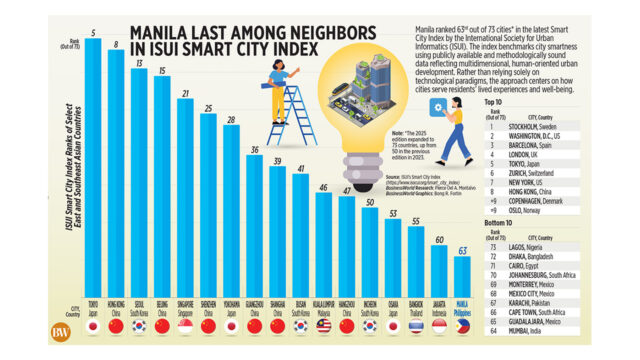
Manila last among neighbors in ISUI Smart City Index

MANILA continued its downward slide in the latest global index of “smart cities” by International Society for Urban Informatics (ISUI), even ranking last among select Asia-Pacific cities. Read the full story.

Manila last among neighbors in ISUI Smart City Index