Home Blog Page 696

The impact of recent developments in AI and their implications for educational policy

STOCK PHOTO | Image by Vectorjuice from Freepik

In today’s “Knowledge Age,” human capital, of which knowledge is the major component, has become the most important economic resource, supplanting the traditional factors of production, land, labor, and (physical) capital.

Knowledge has certain unique properties that distinguish it from physical and financial resources and must therefore be managed differently.

IMPLICATIONS OF AI DEVELOPMENTS
There are fears, both among organizational decision makers and thought leaders, that current developments in Artificial Intelligence (AI), notably the emergence of Generative AI, such as ChatGPT and DeepSeek, will soon achieve human cognitive capabilities and will eventually replace humans in many facets of social and organizational life.

Debates on this issue continue to rage on and will probably remain unsettled for an indefinite period of time.

It is generally agreed that AI — Generative AI, in particular — provides a useful set of tools for professional practitioners and top-level decision makers of organizations and social institutions. However, those who occupy lower levels in the organizational and social hierarchies and who typically do routine and repetitive tasks are bound to lose their jobs to AI and will have to develop new skills that are more employable, such as entrepreneurial and specialized technical skills.

Due to inherent limitations of AI, strategic and other high-level choices will continue to be the responsibility of highly trained and experienced human decision makers.

DIGRESSION: LIMITATIONS OF AI
In a revealing admission of its shortcomings, the widely used AI platform ChatGPT, when asked the question, “Will generative AI eventually exceed human cognition?” answered that AI can “…augment human decision making, but not replace human judgement, empathy, or moral reasoning.”

Specifically, ChatGPT stated that:

• AI lacks true understanding: AI models, including advanced ones, process data statistically — they recognize patterns but do not understand meaning. They cannot reason, feel, or possess common sense like humans.

• AI is highly data-dependent: AI systems rely heavily on large, high-quality datasets. If data is biased, incomplete, or wrong, the AI’s output will reflect those flaws (“garbage in, garbage out”).

• AI lacks creativity and judgment: While AI can generate art or text, it doesn’t create with intent or purpose; it recombines patterns from existing data rather than inventing from experience.

For these reasons, AI cannot be truly creative as human artists, nor be as competent as seasoned professional managers, practicing lawyers, and medical specialists. While AI can be factually correct and can solve complex problems based on raw data more accurately than humans, it is unable to provide useful insights based on experience.

IMPLICATIONS FOR EDUCATIONAL POLICY
Recent developments in AI have important implications on society’s educational policy. It has significantly reshaped the nature of work, and must be adapted to the changing needs of workers.

We focus on a specific issue: the design of educational programs and curricula.

In order to meet the country’s economic growth and developmental goals, and in line with our desire to reduce extreme poverty and economic inequality, our educational policy must be geared towards developing our stock of human capital, along with the values and attitudes that insure that this economic resource is put to good use. Not only is human capital today’s most productive resource, but it is also readily transferable to the economically disadvantaged, making them more potentially active in creating value — for themselves and for society.

One specific development is particularly bothersome.

There have recently been moves in the Philippine Senate to revise tertiary education to make it more relevant in the application of theoretical concepts and principles on mundane issues, rather than being purely abstract and academic. In particular, it has been proposed that the long-standing General Education (GE) program should be relegated to senior high school (Grades 11-12) to make way for courses that are relevant in dealing with practical matters, or, alternatively, assign it to the Technical Education and Skills Development Authority (TESDA).

We feel that this proposal is inappropriate largely because neither high school teachers nor TESDA trainers have the necessary academic background and required competence to handle GE courses.

Perhaps a more appropriate strategy is to rethink our academic programs at all levels to focus on developing the learners’ ability to think critically and to analyze issues holistically, and to assign the development of vocational skills to TESDA and the many other technical schools located in various parts of the country.

Finally, both academic and vocational programs should prepare students for lifelong learning to enable them to adapt to continuously changing technologies and environments.

The article reflects the personal opinion of the author and does not reflect the official stand of the Management Association of the Philippines or MAP.


Dr. Niceto S. Poblador is a member of the MAP Shared Prosperity Committee and a retired professor of Economics and Management at UP Diliman.

map@map.org.ph

nspoblador@gmail.com

PHL high-end retail hit by economic, reputational pressures

STOCK PHOTO | Image by DC Studio from Freepik

By Alexandria Grace C. Magno

THE PHILIPPINE high-end retail sector faces headwinds as economic pressures and reputational concerns temper luxury spending, while tourism and holiday bonuses provide some support, analysts said.

“Holiday spending and bonuses may have a positive impact on luxury demand, but the primary target market for these products may reduce purchases due to reputational concerns, especially after the recent public spending controversy,” said Reinielle Matt M. Erece, economist at Oikonomia Advisory and Research, Inc., in a Viber message.

Michael L. Ricafort, chief economist at Rizal Commercial Banking Corp., said economic fundamentals such as rising incomes, improving employment, and foreign tourism support luxury demand, but anti-corruption reforms could dampen discretionary spending.

“Although I’m not familiar with company-specific factors, sales may have been negatively impacted by weather disruptions that reduced the number of business and working days, increased competition from local, foreign, and online retailers,” he also said.

“Next year, if economic growth improves and wages rise faster, we may see improvement in the discretionary goods sector. For now, optimism is limited unless policy and political reforms are implemented,” Mr. Erece said.

Luis A. Limlingan, head of sales at Regina Capital Development Corp., noted that recent consumer surveys show generally cautious spending intentions across income groups, with the high-income segment least concerned.

“Tourism provides some support to high-end retail, but it does not fully offset the generally cautious domestic spending environment,” he said in a Viber message.

Specialty retailers, including SSI Group, Inc., are navigating mixed conditions, analysts added.

The listed retailer, which manages international brands, reported a 64.99% drop in third-quarter attributable net income to P188.08 million from P537.18 million a year earlier, due to weaker sales in its luxury, bridge, and casual wear segments. Revenue for the three months ending September fell 0.93% to P6.9 billion, while net sales declined 0.9% to P6.88 billion.

Online brokerage COL Financial Group, Inc. said the revenue drop partly reflected a recent SAP migration, and weaker consumer spending caused by typhoons and political uncertainty.

“Management expects fourth-quarter performance to benefit from seasonal tailwinds, with November trends showing improvement after a soft October,” COL Financial said.

According to SSI, third-quarter weakness stemmed mainly from lower sales in luxury and bridge segments, down 3.8%, and casual wear, down 2.9%, reflecting softer discretionary spending.

Following the third-quarter performance, Mr. Erece expressed cautious optimism: “We may see good growth for [SSI] and similar brands as higher holiday bonuses and Christmas spending drive demand for discretionary goods.”

Other Philippine Stock Exchange-listed chains primarily focus on supermarkets, drugstores, and mass-market formats, catering to everyday consumer goods, unlike SSI Group, which targets luxury and specialty retail. The closest high-end competitors on the exchange are Robinsons Retail Holdings, Inc., and conglomerates such as SM Investments Corp. through their retail subsidiaries.

Entertainment News (11/25/25)


Ayala Cinemas offers snacks for Wicked: For Good

THE musical sequel Wicked: For Good is now showing in Philippine cinemas. A sequel to Wicked and based on the Broadway musical, it follows the witches of Oz: Elphaba, the Wicked Witch of the West, and Glinda the Good, played by Cynthia Erivo and Ariana Grande, respectively. In line with the film’s release, Ayala Malls Cinemas’ Movie Snackbar is carrying limited-edition popcorn flavors inspired by the film: Pink Sweet Bubble Pop and Green Emerald Nori Crunch, available in Wicked: For Good popcorn tumblers.


Benilde holds free animation festival

ANIMATED FILMS by a roster of international animators and stop-motion designers will be screened for free as part of the MCADxMoving Image: Animation Festival of the De La Salle-College of Saint Benilde (DLS-CSB). Films include family comedy Ernest & Celestine (2012) and fantasy flick Le Roman de Renard (1937), set to screen on Nov. 26, 3 p.m. The 2003 edition of the 1953 work Le Roi et l’Oiseau and Filipino animated film Saving Sally (2016) are slated for Nov. 27, 3 p.m. Finally, indie animations Usahay (2022), Ewa (2023), and Anito (2016) will be presented on Nov. 28, 1 p.m. The MCADxMoving Image: Animation Festival is free and open to the public, and will be held at the Theater of the Benilde Design + Arts Campus, 950 Pablo Ocampo St., Malate, Manila.


Pinoy Playlist Music Fest celebrates diverse music

THE Pinoy Playlist Music Festival returns from Nov. 28 to 30 at the BGC Arts Center, Taguig. With the theme “Halo-halo, Sapin-sapin, Sabay-sabay,” it aims to celebrate the creativity and diversity of Filipino music. The festival will feature over 100 artists and groups, including KIKX and Day One, The Bloomfields, Tres Marias, Bugoy, and Gab Cabangon. The one-day pass costs P1,900, with a student rate of P750. The three-day festival pass is priced at P3,900. Tickets are available via www.bgcartscenter.org/ppmf2025 or at TicketWorld outlets.


Ayala Malls Manila Bay to light Christmas tree

THE Christmas Tree Lighting celebration of Ayala Malls Manila Bay in Parañaque City is set to kick off with immersive gift zones and holiday surprises on Nov. 29. With registration opening at 4 p.m. at the Garden Fountain area, the tree lighting celebration will include a special concert featuring Dionela and Ely Buendia.


Indonesian girl group unveils new single

GLOBAL girl group from Indonesia, no na, has released their new single, “the one,” out now via 88rising. The dreamy pop song contains hazy 1980’s-inspired retro synths and string motifs, with each of the group’s four members — Christy, Esther, Baila, and Shaz — contributing harmonies to the track. The accompanying music video is set in a retro universe with 1980s TV aesthetics. The song is out now on all digital music streaming platforms.


P-pop group ALAMAT leads Cheers Kitchenpalooza

CHEERS Kitchenpalooza, a holiday celebration by kitchen brand Cheers, is hosting a live performance by their brand ambassador, ALAMAT. The P-pop boy group known for multilingual hits will go onstage on Nov. 29, 1 p.m. onwards, at the SM Mall of Asia Music Hall in Pasay City. The event also features interactive Kitchenpalooza activity zones and content prompts.


The Roses to stream on Disney+

STARRING Benedict Cumberbatch and Olivia Colman, The Roses is a reimagining of the 1989 classic film The War of the Roses. Disney+ has announced that it will stream exclusively on the platform starting Dec. 3. Directed by Jay Roach, The Roses takes the concept of marital bliss and turns it upside down, with ambition, ego, and resentment sparking a domestic meltdown. The supporting cast includes Andy Samberg, Allison Janney, Belinda Bromilow, Sunita Mani, Ncuti Gatwa, Jamie Demetriou, Zoë Chao, and Kate McKinnon.


Ely Buendia among singers in Abu Dhabi show

ABU DHABI is set to witness a historic night for Original Pilipino Music (OPM) as Ely Buendia, Chito Miranda, and Arnel Pineda unite on one stage for the very first time. The OPM Legends concert is set to take place at the Etihad Arena on Jan. 10, 2026, presented by Live Nation, DVent Productions, and Tiana Entertainment. Tickets to the show are now available through Live Nation Middle East or Ticketmaster.


HBO renews two Game of Thrones franchise series

HBO has announced the renewal of two Game of Thrones franchise series, extending each of their runs until 2028. Both will air on HBO and stream on HBO Max. The half-hour drama series A Knight of the Seven Kingdoms has been renewed for a second season, ahead of the first season debut on Jan. 19, 2026, so that the second season will debut in 2027. Meanwhile, the third season of the drama series House of the Dragon will debut in Summer 2026, with a fourth season set for 2028.

BDO looking to issue five-year dollar bonds

BW FILE PHOTO

BDO UNIBANK, INC. is planning to issue five-year dollar-denominated bonds, it said on Monday.

The bank has tapped Standard Chartered Bank as sole global coordinator and alongside MUFG and Wells Fargo Securities as joint lead managers and joint bookrunners to arrange a series of fixed income investor calls that were set to start on Monday.

“A USD-denominated Regulation S only five-year fixed rate senior unsecured benchmark offering may follow, subject to market conditions,” it said in a disclosure to the stock exchange.

Details on the timing, pricing, and issue size were not immediately available.

Demand for the issuance is expected to be supported by the low interest rate environment, April Lynn Lee-Tan, chief equity strategist at COL Financial Group, Inc., said in a Viber message.

The timing of the bond offer is “strategically defensible,” considering elevated US Treasury yields and the dollar’s strength, Toby Allan C. Arce, head of sales trading at Globalinks Securities and Stocks, Inc., said in a Viber message.

“That means borrowing in dollars is not ‘cheap’ in absolute terms. At the same time, pressuring US government fiscal dynamics and volatility in yields make the funding window more interesting for some emerging-market issuers: locking in debt now for medium-term use could avoid even higher rates later, or at least hedge against rising funding costs.”

He said the issuance could attract strong interest, mainly from global debt fund managers, regional Asian investors, and US dollar fixed-income funds that follow Asia-Pacific issuers.

“BDO’s credit ratings (Baa2 from Moody’s, BBB- from Fitch) give it investment-grade status, which helps access a wider investor base. However, the strong dollar could deter some cross-border buyers that are sensitive to currency risk, unless BDO offers a premium to compensate,” he said.

The notes could be priced at the 4.5% to 5% range, assuming a “modest” risk premium and considering current Treasury yields, he added.

“Overall, I view this as a well-calibrated move by BDO: not overly aggressive, but opportunistic. It shows confidence in its lending franchise and capital structure, and it reflects a proactive approach to managing funding diversity. If executed well, it could strengthen BDO’s liability profile and support its medium-term growth — but BDO must remain disciplined on how it deploys the proceeds and manage the foreign exchange risks that come with dollar borrowing.”

BDO last tapped the offshore debt market in May 2022, raising $100 million from the issuance of seven-year blue bonds through an investment from the International Finance Corp. This marked the first private sector blue bond issuance in Southeast Asia.

The bank’s attributable net income rose 6.1% year on year to P22.47 billion in the three months through September on the sustained expansion of its core businesses.

This brought its nine-month earnings to P63.09 billion, 4.07% higher than a year earlier.

BDO shares declined by P2.50 or 1.9% to close at P129 each on Monday. — Aaron Michael C. Sy

2 pastoral letters 36 years apart show nothing much has changed

STOCK PHOTO | Image from Freepik

In July of the 4th year of President Corazon “Cory” Aquino’s term, the Catholic Bishops Conference of the Philippines (CBCP), ordered the reading of the pastoral letter “Thou Shall Not Steal” during Sunday Masses in all churches throughout the country. The letter was in reaction to the persistent and high-level corruption in government, even after the EDSA People Power Revolution, which was inspired by the promise of massive reforms in governance by the leaders of that change in government, foremost of whom was Cory Aquino.

Here are excerpts from the pastoral letter of the CBCP, signed by Leonardo Z. Legaspi, OP, Archbishop of Caceres, President of the CBCP, on July 11, 1989.

“Graft and corruption — in the plainest of language, stealing from the public through the misuse of influence or position — has become, to our shame as a people, an ordinary fixture of our nation’s public life. President Aquino herself has admitted that it has returned, if not to the same extent, at least with equal shamelessness during her administration.

“Acts of graft and corruption are no longer considered as sin or offenses against the Lord who has commanded us not to steal. This sin is today especially hateful before God because it steals money from the already poor.

“Under present circumstances, it becomes a sin of the blackest hue, a sin that cries to heaven for vengeance.

“We are conscious that we your bishops also have our share in this sin, and hence we express our repentance. But while acknowledging our own sinfulness, we want to exhort you to likewise condemn this sin which tarnishes our name as a Christian nation.”

The bishops exhorted the faithful to form anti-graft-and-corruption councils at all levels of our society to monitor the appropriation of public funds at the level on which they operate, and to act as the civilian arm of the ombudsman in the reporting and prosecution of graft and corruption cases.

But the bishops betrayed their misgivings about the people’s capability for such action when they asked, “Are we capable of the kind of action we are proposing here? We have no illusions about the difficulty and of the dangers of the undertaking too attendant to the pursuance.”

Indeed, the people proved incapable of the action proposed by the bishops. The task was too formidable for them. It would require much time and effort on their part. They have their own lives to live and their own business to mind. They were content with enjoying freedom of speech again, like denouncing the crooks in government, and freedom from fear of the abusive agents of martial law.

The councils were never formed. Graft and corruption at all levels of our society not only persisted, it became larger in scale.

In September of the 4th year of President Ferdinand “Bongbong” Marcos, Jr.’s term, the CBCP issued a pastoral letter titled “Beyond Survival: Rising Above the Floods of Corruption.” It was the bishops’ reaction to the multi-layered system of commissions consuming project funds, and a culture of “survival politics” that normalizes corruption. It condemned the widespread corruption in government flood control projects and urged accountability and restitution.

Here are excerpts from the pastoral letter of the CBCP signed by Pablo Virgilio S. Cardinal David, Bishop of Kalookan, President of the CBCP, on Sept. 8, 2025.

“Both the Senate and the House of Representatives are now investigating corruption in flood control projects. Yet we must ask: how credible are these inquiries when the very institutions conducting them are themselves implicated? Who inserted these projects into the national budget as pork, often at the expense of education, health, and social programs?

“For years, the anatomy of corruption in public works has been public knowledge. Senator Panfilo Lacson laid it bare. Mayors like Benjamin Magalong and Vico Sotto confirmed that a multi-layered system of ‘commissions’ often consumes 60% of project funds leaving less than half for construction.

“True justice, however, demands more than punishment. It also calls for restitution: that stolen wealth be returned to the public coffers from which it was taken. Retribution in this sense is not personal vengeance but the rightful act of giving back what was stolen, so that the people may finally benefit from resources meant for their welfare.

“Survival cannot be the standard of our politics. We must demand visible accountability: quick audits, real penalties, and transparency that people can see. And renewal must also begin with us.

“We too have often failed, whether by silence, by tolerating corruption in our own ranks, or by not setting a consistent example of integrity.

“Let us rise above the floods of corruption together. Let justice roll down like waters across our land. Let us rebuild our nation on truth, justice, and the common good.”

The bishops called on the faithful to commit themselves to rejecting patronage politics, and joining civic and parish initiatives in movements for good governance and ecological justice. They also urged their flock to demand justice, insisting on legal action, including criminal charges against those guilty of systematically plundering public funds.

Demanding justice, insisting on legal action, the faithful have done intensely. But that will not bring about justice. Senators and House of Representatives members accused of involvement in the flood control scandal are expected to hire as their legal counsels lawyers near the caliber of the late Estelito Mendoza, who was dubbed the “defense lawyer of last resort.” Do the prosecutors of the Department of Justice and of the Office of the Ombudsman match up to those pricey defense lawyers the accused senators and House members are expected to hire?

It has also been said that the Philippine justice system is the best that money can buy. The saying implies that judges and even justices can be bought. People have surmised that corrupt public officials charged with plunder or amassing millions illegally were acquitted because the officials shared their ill-gotten millions with Sandiganbayan justices. In fact, the Supreme Court had dismissed a Sandiganbayan associate justice found guilty of gross misconduct, dishonesty, and impropriety for acquitting a person charged with malversation.

And if some justices of the Sandiganbayan can be bought — so can prosecutors. I have wondered if any of the high-profile cases dismissed by the Sandiganbayan for lack of evidence were deliberately weakened by the prosecutors?

That is why the CBCP should do more than just call on the faithful to reject patronage politics, join movements for good governance, and demand accountability, retribution, and justice.

The Office of the Ombudsman filed graft charges against former congressman Elizaldy Co last Tuesday. Ombudsman Crispin Remulla said last week that graft charges against senators will be filed today. Not only are they expected to hire the best defense lawyers, they are also expected to use their influence and (ill-gotten?) millions to obtain an acquittal.

The CBCP should ask eminent lawyers, retired and practicing, who are close to the bishops to volunteer as amici curiae, Latin for “friends of the court.” Amici curiae are people who are not party to a legal case but who have a strong interest in the case’s subject matter and may file a legal brief, or an “amicus brief,” to the court to assist in its decision-making.

The participation of eminent lawyers in the prosecution of those accused of malversation in connection with the anomalous flood control projects would deter prosecutors from deliberately losing their case, and justices from handing down “influenced” decisions.


Oscar P. Lagman, Jr. has been a keen observer of Philippine politics since the 1950s.

SM Residences to launch luxury village in Susana Heights

SM PRIME HOLDINGS, INC.

SY-LED developer SM Prime Holdings, Inc. is set to unveil a luxury residential village within Susana Heights in Muntinlupa City, as it expands into the high-end residential market.

In a statement, the company said the low-density development will be constructed under its premium residential brand, Signature Series by SM Residences.

The village will feature lots ranging from 700 to 1,100 square meters (sq.m.) at a density of 6.5 lots per hectare. Planned amenities include a five-kilometer greenway loop and country club-inspired facilities.

The project will be located within the 284-hectare Susana Heights estate, acquired last year by SM Prime’s parent company, SM Investments Corp.

The conglomerate previously earmarked P25 billion to develop residential clusters, neighborhood retail, civic spaces, pocket parks, and an ultra-luxury village within Susana Heights.

Signature Series will also launch a “Life Space” in Susana Heights next year to showcase upcoming developments, said Jessica Bianca T. Sy, vice-president and head of Design, Innovation, and Strategy at SM Prime.

“We call it a ‘Life Space’ because it’s designed to show people what thoughtful living looks like,” Ms. Sy said.

The company recently opened its first Life Space gallery at The Podium Mall in Mandaluyong City. The 300-sq.m. gallery was designed by Lor Calma & Partners, the same firm behind The Mind Museum in Taguig City and the redeveloped National Museum of the Philippines in Manila.

The gallery features mixed seating areas, nooks, private conference rooms, and a bar, with wood, marble, and metal elements under ambient lighting, alongside commissioned artworks by Reg Yuson and Lui Gonzales.

Residential offerings under the Signature Series brand range from entry-level premium units (starting at P15 million) and upscale units (from P25 million) to luxury and ultra-luxury properties priced at P65 million and above.

SM Prime has also expressed interest in launching projects in Manila, Pasay, Pasig, Parañaque, Taguig, Cebu, Cavite, Tagaytay, and Batangas.

On Monday, SM Prime slipped by 15 centavos or 0.67% to close at P22.30 per share. — Beatriz Marie D. Cruz

Globe, ACMobility to roll out hybrid EVs for field fleet

STOCK PHOTO | Image from Freepik

GLOBE TELECOM, INC. has partnered with AC Mobility Holdings, Inc. (ACMobility), the Ayala group’s mobility arm, to deploy hybrid electric vehicles (EVs) for its field sales service fleet by yearend, advancing the company’s target to shift its fleet to hybrid and fully electric vehicles by 2028.

“Hybrid EVs are not just more efficient to operate and maintain, they also allow us to significantly reduce our carbon footprint… This roadmap is a powerful example of how a strong business strategy can go hand in hand with environmental responsibility,” Globe President and Chief Executive Officer Carl Raymond R. Cruz said in a media release on Monday.

Globe will roll out 20 hybrid EVs by the end of 2025, the company said, noting that this move will help it achieve its goal of electrifying nearly 500 vehicles over the next three years.

“We are committed to enabling this transition with BYD vehicles, charging networks, and digital platforms that make sustainability practical, scalable, and accessible,” said AC Mobility Chief Executive Officer Jaime Alfonso Antonio Zobel de Ayala.

Globe said the initiative is expected to cut roughly five million kilograms of carbon emissions while generating at least P100 million in fuel savings. The program also aligns with the Electric Vehicle Industry Development Act (EVIDA).

Financing plays a key role in accelerating EV adoption, according to BPI Tokyo Century Rental Corp., a subsidiary of Ayala-led Bank of the Philippine Islands (BPI).

“By making sustainable fleet options accessible and practical, we can help companies like Globe achieve their environmental goals while strengthening operational efficiency,” BPI Tokyo Century Rental President Satoshi Matsuo said.

Globe previously outlined its EV roadmap, targeting at least 20 hybrid EVs by 2025, 200 units by 2026, and 300 additional vehicles by 2028. The company plans to deploy the EVs nationwide alongside the rollout of charging infrastructure.

The initiative is part of Globe’s broader sustainability push as it works toward achieving its net-zero goal. The company has begun shifting over 3,000 cell sites and other low-energy facilities to renewable energy.

Globe said the gradual transition to renewables is expected to reduce greenhouse gas emissions by 5.5 million kilograms annually and supply 80 million kilowatt-hours of electricity each year from renewable sources.

On the local bourse on Monday, Globe shares rose P7, or 0.44%, to close at P1,608 apiece. — Ashley Erika O. Jose

Meghan Trainor turns cyberbullying into new single ‘Still Don’t Care’

LOS ANGELES — Singer-songwriter Meghan Trainor traversed new terrain with her song “Still Don’t Care,” which explores her experiences being cyberbullied on social media.

“Still Don’t Care,” part of her upcoming Toy with Me album, directly addresses the online backlash the “All About That Bass” singer has received about her weight loss.

“The verses are all the things I’ve read about myself and all the things people have said to my face,” Ms. Trainor told Reuters.

“I get to that chorus and I scream, ‘No, I still don’t care!’ And I love it,” she said.

Ms. Trainor said that “Still Don’t Care” was inspired by a lot of “crazy” comments on her social media that she felt were out of nowhere.

“I’ve been working on my health and my fitness journey for two years now,” she said, noting that she felt the comments were an attempt to regress her to another stage in her life. “They made me cry,” the 31-year-old said. “I thought, ‘Well, this is silly.’”

After over a decade in the entertainment industry, Ms. Trainor says she still hasn’t developed a thick skin.

“When I read people’s comments, I have to remind myself that it’s just like a bot online. It’s like a robot, or it’s just someone who is going through probably way harder things,” Ms. Trainor said.

“Still Don’t Care” is out now and Ms. Trainor’s full album will be released on April 24, 2026, when she will be traveling the US with her children for the Get It Girl tour.

The album centers on self-love and introduces songs about Ms. Trainor’s children and going to marriage counseling with her husband. — Reuters

Peso slips vs the dollar on possible yen intervention

BW FILE PHOTO

THE PESO slipped against the dollar on Monday to track the sideways movement among regional currencies led by the yen amid signals of more proactive intervention from Japanese Prime Minister Sanae Takaichi’s administration.

The local unit closed at P58.87 per dollar, inching down by 1.5 centavos from its P58.855 finish on Friday, Bankers Association of the Philippines data showed.

The peso opened the session slightly stronger at P58.83 against the greenback, which was also its intraday best. Its worst showing was at P59.02 versus the dollar.

Dollars traded fell to $1.17 billion on Monday from $1.68 billion on Friday.

The peso followed the yen’s range-bound movement amid signals of foreign exchange intervention from the Japanese government, Rizal Commercial Banking Corp. Chief Economist Michael L. Ricafort said in a Viber message.

“The dollar-peso traded sideways but closed a bit higher on lack of fresh catalysts,” a trader said in a phone interview.

For Tuesday, the trader sees the peso moving between P58.80 and P59.10 per dollar, while Mr. Ricafort expects it to range from P58.75 to P59.

The dollar was steady and traders wary on Monday as intervention risks swirled around the yen, Reuters reported.

A holiday in Tokyo lightened trade in the Asia day and left the yen on hold at ¥156.53 per dollar.

Japan’s currency has been sliding on a combination of its low interest rates and looser fiscal policies, but it bounced from 10-month lows late last week when Finance Minister Satsuki Katayama ramped up verbal warnings of official yen buying.

Traders see intervention looming somewhere between ¥158 and ¥162 per dollar, with Thanksgiving-thinned trade later in the week a possible window for authorities to step in.

“We do not rule out a move as early as Friday, London/New York hours, ahead of ¥160 and if it happens the move lower can be sharp especially if liquidity is thin,” said OCBC strategists Frances Cheung and Christopher Wong in a note.

Japan can actively intervene in the currency market to mitigate the negative economic impact of a weak yen, Takuji Aida, a private sector member of a key government panel, said in a television program on NHK on Sunday. — A.M.C. Sy with Reuters

Vietnam’s industrialization and the Philippines’ rule of law challenge

STOCK PHOTO | Image by Florian Wehde from Unsplash

HO CHI MINH, Vietnam — This is my third visit to our neighbor. Vietnam. I am on vacation with some of my former dormmates in UP Narra dormitory four decades ago. We brought our spouses. I even brought my eldest daughter. Special thanks to Pidro Sing for organizing this.

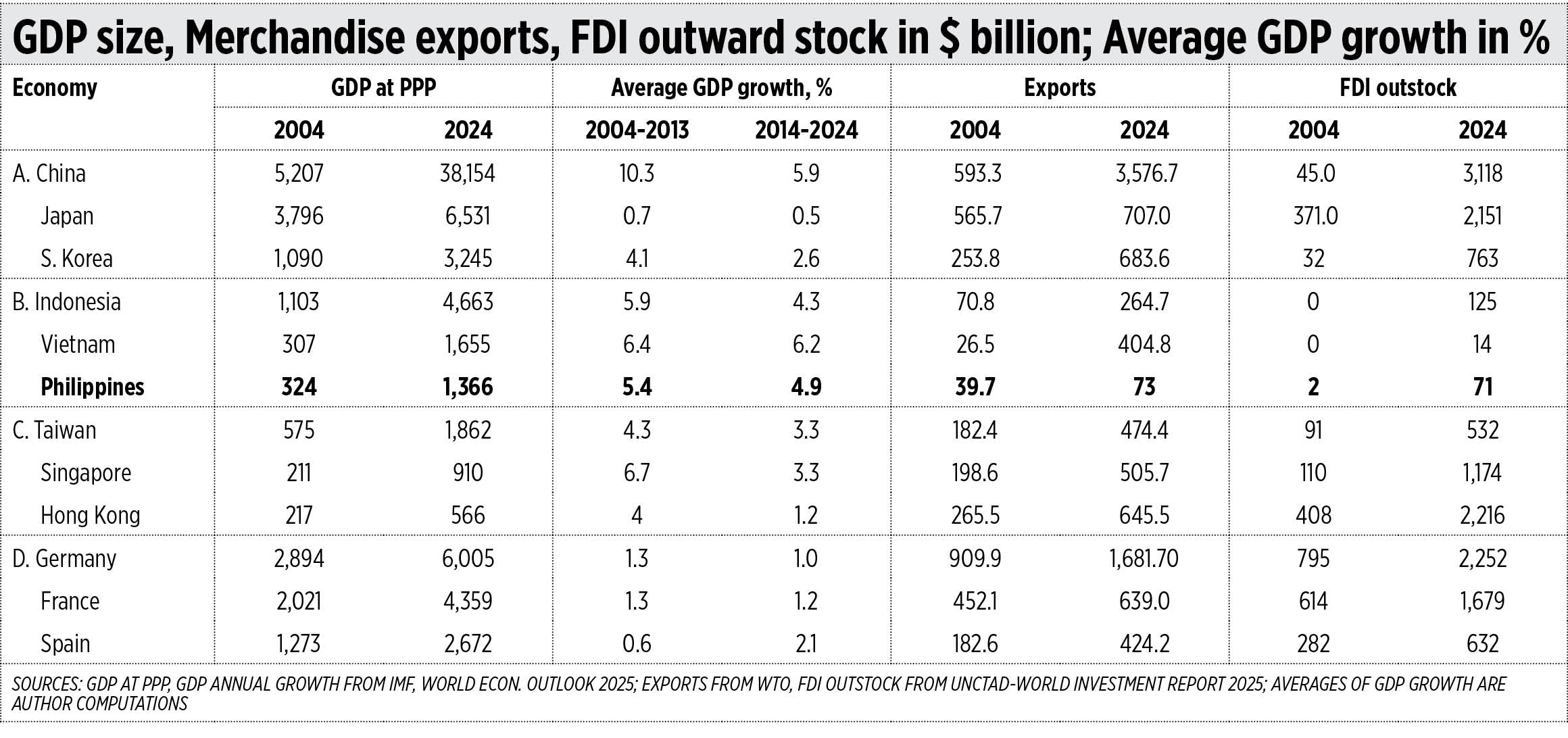
In GDP size at Purchasing Power Parity (PPP) values, in 2008 Vietnam overtook the Philippines and Colombia, and tied with Switzerland. That year, Vietnam and Switzerland had $445 billion while Philippines had $442 billion and Colombia had $444 billion.

Then Vietnam overtook Belgium in 2009. It overtook Malaysia and South Africa in 2016, Argentina in 2019, the Netherlands in 2020, Nigeria in 2022, and Pakistan in 2024. In 2024, Vietnam had a GDP (PPP) of $1.66 trillion and was 25th largest economy in the world while Philippines had $1.37 trillion and took the 31st spot.  Vietnam’s economic expansion came fast and was fantastic, especially for a dirt poor and war-ravaged economy until 1975 when the US left and ended its brutal and barbarous invasion of about 13 years.

So far, I have made four foreign trips this year — Hong Kong and China last April, Spain last September, and will be going on my fifth and last trip to Japan today. All were work-related except the Vietnam trip. I have been to all the countries I mention in the table accompanying this piece, which compares the economies mentioned, and neighboring countries.

From 2004 to 2024 or over two decades, looking at GDP size at PPP values, China expanded 7.3 times, Vietnam expanded 5.4 times, and the Philippines and Indonesia 4.2 times. In merchandise exports, Vietnam expanded 15.3 times, China expanded six times, and Indonesia expanded 3.7 times. In FDI outstock, China expanded 69.3 times, South Korea 23.8 times, Singapore 10.7 times, and Japan and Taiwan 5.8 times.

In average GDP growth, China was the fastest growing with 10.3% from 2004 to 2013, and 5.9% in the next 10 years. Vietnam grew by a consistent 6% plus over a similar period. European nations have had the slowest growth pattern over the past three decades or so.

For foreign direct investment (FDI), I used the outward stock to see the level of capital-exports an economy has evolved (see the table).

I made a number of observations of Ho Chi Minh City (formerly Saigon), both the city itself and its rural villages, when we went to the Cu Chi tunnel which is more than two hours away from the city center.

One, the roads are smooth, I did not see a single pothole. Two, there were no tricycles, no jeepneys, no three- or four-wheeled e-bikes on the road. Three, there were many motorcycles and yet the drivers were well-behaved; every household possibly has a motorcycle or car. The locals hardly walk, the ones walking on city’s wide sidewalks are very likely foreign visitors.

Four, there were no barung-barong (shanties), at worst there were modest looking houses. Five, almost everyone seems to have a job, there were no people gathered like unemployed tambay making small talk near the roads. Six, almost all rural houses have fences and gates except those with shops, restaurants, or coffee shops; there are almost no stray dogs on the road. Seven, the aircon buses are locally manufactured (Thaco, Samco, Kim Long). Cars were mostly from Japan and Korea but there were many Vinfast cars too, made in Vietnam.

It seems that socialist Vietnam has a stronger private property system, has better rule of law than supposedly capitalist Philippines, and this allowed them to industrialize faster.

Among the tourist attractions we visited were the Cu Chi tunnel outside the city, and the War Remnants Museum in the city. The huge spent shells, tanks, and fighter jets left by the US forces during the Vietnam war, the photos and narratives of war and destruction gave the impression that the US invasion was barbarous, uncivilized, even demonic.

The murders and destruction caused in that war should be enough of a reminder to humanity that war and invasion should not happen again, that diplomacy should prevail in settling political and territory disputes between and among countries.

Meanwhile the planned “civil-military reset” of the Philippine government as reported by Senator Ping Lacson and other officials is a dangerous and evil project, where unelected, self-styled “reformers” from the military allegedly intend to grab political power from the current elected leadership and constitutional set-up.

Corruption occurs not only in government’s executive and legislative branches but also among the people and voters who think that education, healthcare, and cash for their children are not parental and personal responsibilities but are government responsibilities.

Electoral democracy is not a perfect system, but it is a far superior system than rule by self-styled reformers whose faces and real backgrounds are anonymous.


Bienvenido S. Oplas, Jr. is the president of Bienvenido S. Oplas, Jr. Research Consultancy Services, and Minimal Government Thinkers. He is an international fellow of the Tholos Foundation.

minimalgovernment@gmail.com

Ayala Land targets BPOs, multinational companies for new Nuvali business hub

METRO NUVALI — AYALA LAND, INC.

AYALA LAND, INC. (ALI) aims to attract multinational and business process outsourcing (BPO) companies to Metro Nuvali, which it is developing as its next central business district (CBD) outside Metro Manila.

“We’re seeing entrepreneurs, we’re seeing professionals coming in, and BPOs who continue to be interested. International schools are also interested. They’re looking at opportunities to grow,” Christopher B. Maglanoc, senior vice-president and group head at Ayala Land Estates, told reporters during the project’s groundbreaking ceremony on Nov. 21.

The 200-hectare (ha) development will rise within the 2,500-ha Nuvali estate spanning Sta. Rosa, Cabuyao, and Calamba.

ALI launched Nuvali in 2009 in partnership with the Yulo family, the landowner.

“When we look at the plans from 16 years ago, this is the area identified as a CBD, so it’s [part of] a vision,” Mr. Maglanoc said.

ALI President and Chief Executive Officer Anna Ma. Margarita B. Dy said Metro Nuvali is positioned to become the next major business hub in the south.

“It is built for this moment in the region’s growth, ready for a rising economy, a dynamic talent pool, and the demand for a new urban center outside Metro Manila,” she said at the launch.

Calabarzon’s (Cavite, Laguna, Batangas, Rizal, and Quezon) economy expanded by 5.56% in 2024, slightly below the national growth rate of 5.7%.

THREE DISTRICTS
Metro Nuvali will feature three districts: the Lakeside District, Central District, and Civic District.

The 100-ha Lakeside District includes the rebranded Ayala Malls Nuvali (formerly Solenad).

The mall will add 50,000 square meters of retail space by the second half of the year, including a multi-level wing and wellness areas.

It will also bring in brands such as APEX Performance, Beyond the Box, Converse, Skechers, and Chili’s.

The 40-ha Central District will house modern office towers, flexible workspaces, and a three-ha Central Park connected to the East Bloc Garden.

The 60-ha Civic District will feature the Santa Rosa Civic Complex, a convention center, church, hotel, command center, and a two-ha satellite city hall. Located along the Casile–Tagaytay Road, it will offer access to Cavite, Tagaytay, and Laguna.

All districts will be connected to the wider Nuvali estate through major roads, public transport links, and green pedestrian networks, ALI said. The area is also close to Solenad, South Nuvali neighborhoods, Nuvali Commons, and 32 residential subdivisions, as well as schools such as Everest Academy, Xavier School, and Miriam College.

Connectivity is expected to improve further once the Carmona–Biñan Link Road opens, linking the South Luzon Expressway, Cavite–Laguna Expressway, and Cavite–Batangas Expressway.

ALI’s estate portfolio includes the Makati Central Business District, Bonifacio Global City, Cebu Business Park, Alviera in Pampanga, and the upcoming Ascenda in Davao City.

On Monday, Ayala Land shares gained P0.55, or 2.62%, ending the day at P21.55. — Beatriz Marie D. Cruz

Asian Terminals Q3 income dips on higher expenses

ASIANTERMINALS.COM.PH

LISTED port operator Asian Terminals, Inc. (ATI) reported a 4.26% decline in third-quarter (Q3) attributable net income to P1.35 billion, citing higher expenses during the period.

For the three months ending September, ATI’s revenues jumped 17.01% to P5.09 billion from P4.35 billion in the same quarter last year, while gross expenses rose 13.58% to P3.01 billion from P2.65 billion.

For the January-September period, the company logged an attributable net income of P4.26 billion, up 34.38% from P3.17 billion a year earlier. Gross revenues for the first nine months expanded 24.37% to P14.70 billion from P11.82 billion, driven by higher container volumes at South Harbor international containerized cargo terminals and Batangas Container Terminal, which rose 26.6% and 16%, respectively.

Revenues from ATI Batangas also increased 16.4% on higher volumes of international roll-on/roll-off cargo and increased passenger traffic. The government’s share in ATI’s revenues for the nine-month period grew 30.52% to P2.78 billion from P2.13 billion, as higher revenues were subject to port authorities’ share.

Combined expenses for the period rose 19.89% to P8.74 billion from P7.29 billion in the same period last year.

In March, ATI expanded capacity at Manila South Harbor with the commissioning of two additional ship-to-shore (STS) cranes to improve handling capacity and operational efficiency. These complement the terminal’s existing fleet of 11 STS cranes, rubber-tired gantries, and other cargo-handling equipment, supporting the company’s ongoing modernization program.

For full-year 2024, ATI handled nearly 1.6 million twenty-foot equivalent units (TEUs), a 4% increase from 2023. With recent infrastructure upgrades and new equipment deployment, the terminal is now capable of handling nearly 2 million TEUs annually.

On the local bourse on Monday, ATI shares rose 35 centavos, or 1.09%, to close at P32.45 apiece. — Ashley Erika O. Jose

ADVERTISEMENT
ADVERTISEMENT