Home Blog Page 6835

Early Facebook investor Peter Thiel to step down from Meta board

Meta

Facebook-parent Meta Platforms Inc said on Monday that billionaire investor Peter Thiel, an early investor who has been on the company’s board since 2005, has decided to retire.

Thiel aims to spend time helping elect candidates who he believes will advance former President Donald Trump’s agenda in the U.S. midterms, the Congressional elections this year, a person familiar with the situation said.

Thiel, a co-founder of online payments system PayPal and a rare voice of conservative politics in Silicon Valley, became a Facebook investor in 2004, when he provided $500,000 in capital at a $5 million valuation for a 10% stake in the company and a seat on its board of directors.

Thiel will serve as a director until Meta‘s annual shareholder meeting but will not to stand for re-election, the social media giant said.

Peter is truly an original thinker who you can bring your hardest problems and get unique suggestions,” Chief Executive Officer Mark Zuckerberg said, thanking Thiel for his service.

The announcement comes as Meta‘s shares have fallen sharply over concerns that privacy changes to Apple products was making it harder for advertisers to see how their ads work on Facebook. The stock fell 5.1% on Monday, and has lost a third of its value this year, but is still worth more than $600 billion.

Thiel left with kind words for Zuckerberg. “His talents will serve Meta well as he leads the company into a new era,” Thiel said in the statement announcing his departure from the board.

He did not respond to a request seeking further comment.

Thiel was one of Silicon Valley’s most prominent Trump supporters, speaking at the Republican National Convention in July 2016, where he hailed Trump as “a builder.” He later served as an advisor on Trump’s White House transition team.

Thiel plans in particular to help Blake Masters, a Republican candidate hoping to unseat Democratic U.S. Sen. Mark Kelly of Arizona, the person familiar with the situation said. He was also backing J.D. Vance, author of the best-selling memoir “Hillbilly Elegy” and a Republican Senate candidate in Ohio, the person said.

The billionaire has contributed $10 million each to political action committees supporting their individual candidacies, according to OpenSecrets.org, which tracks political donations.

Thiel‘s backing of Trump was unusual in Silicon Valley and led to dispute with fellow Facebook director, Netflix CEO Reed Hastings. In a 2016 email to Thiel, Hastings called his support of the presidential candidate “catastrophically bad judgment” and questioned his fitness to remain on the board, according the Wall Street Journal, which reviewed the message. – Reuters

U.S. approves $100 million sale for Taiwan missile upgrades

STOCK PHOTO | Patriot Missile Launch | Source: https://bit.ly/3oxNUQS

WASHINGTON – The United States has approved a possible $100 million sale of equipment and services to Taiwan to “sustain, maintain, and improve” the Patriot missile defense system used by the self-ruled island claimed by China, the Pentagon said on Monday.

A statement from the U.S. Defense Security Cooperation Agency said it had delivered the required certification notifying Congress following State Department approval for the sale, which was requested by Taiwan‘s de facto embassy in Washington.

Upgrades to the Patriot Air Defense System would “help improve the security of the recipient and assist in maintaining political stability, military balance, economic and progress in the region,” DSCA said in a statement.

“This proposed sale serves U.S. national, economic, and security interests by supporting the recipient’s continuing efforts to modernize its armed forces and to maintain a credible defensive capability,” the agency said.

The main contractors would be Raytheon Technologies and Lockheed Martin, it said.

Taiwan‘s Defense Ministry has said the decision to obtain newer Patriot missiles was made during a 2019 meeting with U.S. officials in the administration of President Donald Trump.

The democratically governed island has complained of repeated missions by China’s air force in its air defense zone, part of what Washington sees as Beijing’s effort to pressure Taipei into accepting its sovereignty.

The United States, like most countries, does not have official relations with Taiwan, but Washington is its biggest backer and is bound by law to provide it with means to defend itself.

U.S. officials have been pushing Taiwan to modernize its military so it can become a “porcupine”, hard for China to attack, and such arms sales always anger China.

China’s ambassador to the United States said last month that the two super powers could end up in a military conflict if Washington encourages Taiwan‘s independence. – Reuters

Manufacturing slows in December

Manufacturing eased in December but remained in the positive territory for the ninth straight month, the Philippine Statistics Authority (PSA) reported this morning.

Preliminary results of the PSA’s latest Monthly Integrated Survey of Selected Industries showed the volume of production index (VoPI) went up by 17.9% year on year in December, a turnaround from 14.8% contraction in December 2020.

However, this was slower than the revised 25.8% growth in November.

December’s growth was the ninth consecutive month that the VoPI remained in the positive territory or since April’s 152.1% growth.

This brought the average factory output growth last year to 50.3%, reversing the 40.5% decline in 2020.

The statistics agency said half of the 22 industry divisions contributed to the growth in December led by manufacture of wood, bamboo, cane, rattan articles, and related products (122.6%).

In comparison, IHS Markit’s Philippines Manufacturing Purchasing Managers’ Index (PMI) slightly increased to a nine-month high of 51.8 in December to 51.8 from 51.7 in November. A reading above 50 marks improvement for the manufacturing sector while anything below indicates deterioration.

The capacity utilization of these factories averaged 67.3% in December, slightly down from 67.8% in November. Of the 22 sectors, 20 averaged a capacity utilization rate of at least 50%. — Bernadette Therese M. Gadon

Philippines shifts election battle to social media as COVID-19 curbs campaigning

PHILIPPINE STAR/ MICHAEL VARCAS

MANILA – Campaigning for the Philippines’ general election gets underway officially on Tuesday, with COVID-19 curtailing the traditional fanfare and big rallies and turning the focus to social media as the key battleground for the May 9 contest.As with the 2016 polls that catapulted Rodrigo Duterte to the presidency, social media will be crucial in the three-month election buildup, while platforms will be under pressure to combat the rampant misinformation that has intensified in the Philippines in recent years, driving hate campaigns and deepening social divisions.The pandemic has upended campaigning for thousands of positions, from the president down to city council posts, with candidates shifting activities online to reach a population that ranks as one of the world’s biggest social media consumers.Marie Fatima Gaw, communications research professor at the University of the Philippines, said social media was crucial democratic space but had become “hyper partisan”, with hidden political content everywhere and insufficient blocking of inauthentic material.“The significance of social media now has been exponential,” she added.It has been a vital tool in particular for Ferdinand Marcos Jr, the son and namesake of the former dictator of the 1970s and 1980s, whose harsh rule defined the Philippines’ recent history.Marcos is clear favorite for the presidency and is drawing support from a massive social media campaign, one that critics say is attempting to rewrite the family’s controversial history.LIMITS ON MASS RALLIESThe limits on big rallies comes with the Philippines lagging behind with its COVID-19 vaccinations outside of urban centres, with half of the 110 million population inoculated so far, and campaigning underway just weeks after a run of record daily infections.Roughly 67.5 million Filipinos are eligible to vote, including 1.7 million overseas, in an election for a president, vice president, about 300 lawmakers and roughly 18,000 local government positions.Apart from Marcos, others vying for the presidency include boxing superstar Manny Pacquiao, Vice President Leni Robredo, Manila mayor Francisco Domagoso and senator Panfilo Lacson.Duterte is not allowed to seek a second term but his popular daughter, Davao mayor Sara Duterte-Carpio, could see some of his support shifted to Marcos, with whom she will run alongside in her bid for the vice presidency.The election to choose who runs the country for the next six years will be closely watched by investors too, with a huge task ahead in rebuilding an economy that went from being one of Asia’s fastest growing to recording one of its steepest contractions at 9.6% in 2020.“What investors really want is we have a clean and honest election where people will actually accept the outcome, that there is no cheating, it is the will of the people,” said April Lee Tan, head of research of stockbroker COL Financial. – Reuters

Pandemic clouds BSP exit strategy

PHILIPPINE STAR/ MICHAEL VARCAS

THE TIMING of the Bangko Sentral ng Pilipinas’ (BSP) exit strategy remains clouded by the uncertainty over the coronavirus pandemic, BSP Governor Benjamin E. Diokno said. 

“Under current circumstances, the timing and pace of the BSP’s exit plans remain uncertain. While recent indicators point to a recovery in economic activity, the recent new coronavirus disease 2019 (COVID-19) cases while receding are still high and could represent a downside risk to the outlook for growth and inflation,” Mr. Diokno told Global Source Partners in a report released on Feb. 4.

The economy grew by an annual 7.7% in the last three months of 2021, which brought full-year growth to 5.6%, as restrictions eased.

An Omicron-driven surge hit the country in January, but a recent decline in COVID-19 infections has prompted a more relaxed Alert Level 2 to be implemented in Metro Manila. The Health department reported 6,835 new cases on Monday, bringing active cases to 116,720.

“Even as we have begun looking toward the eventual withdrawal of policy support, the timing of the exit could still be contingent on how prevailing conditions evolve,” Mr. Diokno said. He previously signaled the central bank may consider adjusting policy rates when it sees four to six quarters of economic growth.

Mr. Diokno said there will be a more gradual process for the normalization of the central bank’s balance sheet which reflects its support to the National Government.

He earlier said the BSP’s purchase of government securities in the secondary market averaged P282 million daily from Dec. 1 to 23, a significant decline from the peak of P14.7 billion daily average in June 2020.

“Data as of Jan. 20 show that most of our government securities holdings will be retired by 2025. Meanwhile, the recent round of provisional advances to the National Government will mature by mid-2022,” he said.

The BSP in December approved another P300-billion zero-interest advance for the National Government, payable in three months. This is smaller than the previous P540-billion direct advance extended by the BSP in July.

Mr. Diokno said the central bank is aware of reputational risks coming from this budgetary financing, but stressed it was within the bounds of law. 

Under Republic Act 11494 or the Bayanihan to Recover as One Act, the central bank is authorized to lend the National Government an equivalent of 30% of its average revenue or P850 billion. This is higher than the cap set at 20% of its average annual revenue provided by Republic Act 7653 or The New Central Bank Act.

The International Monetary Fund has recommended that the gradual phasing out of direct advances to the National Government should be the first step taken by the BSP in its policy normalization once recovery becomes more entrenched.

“To dispel the notion of fiscal dominance, the BSP has been deliberate in communicating to the public that its direct provisional advances to the National Government is allowed under extraordinary times, is temporary, and is a last-resort intervention for only as long as weak economic activity continues to impede the government’s revenue streams,” Mr. Diokno said. — L.W.T.Noble

PHL drops in global opportunity index

PHILIPPINE STAR/ MICHAEL VARCAS

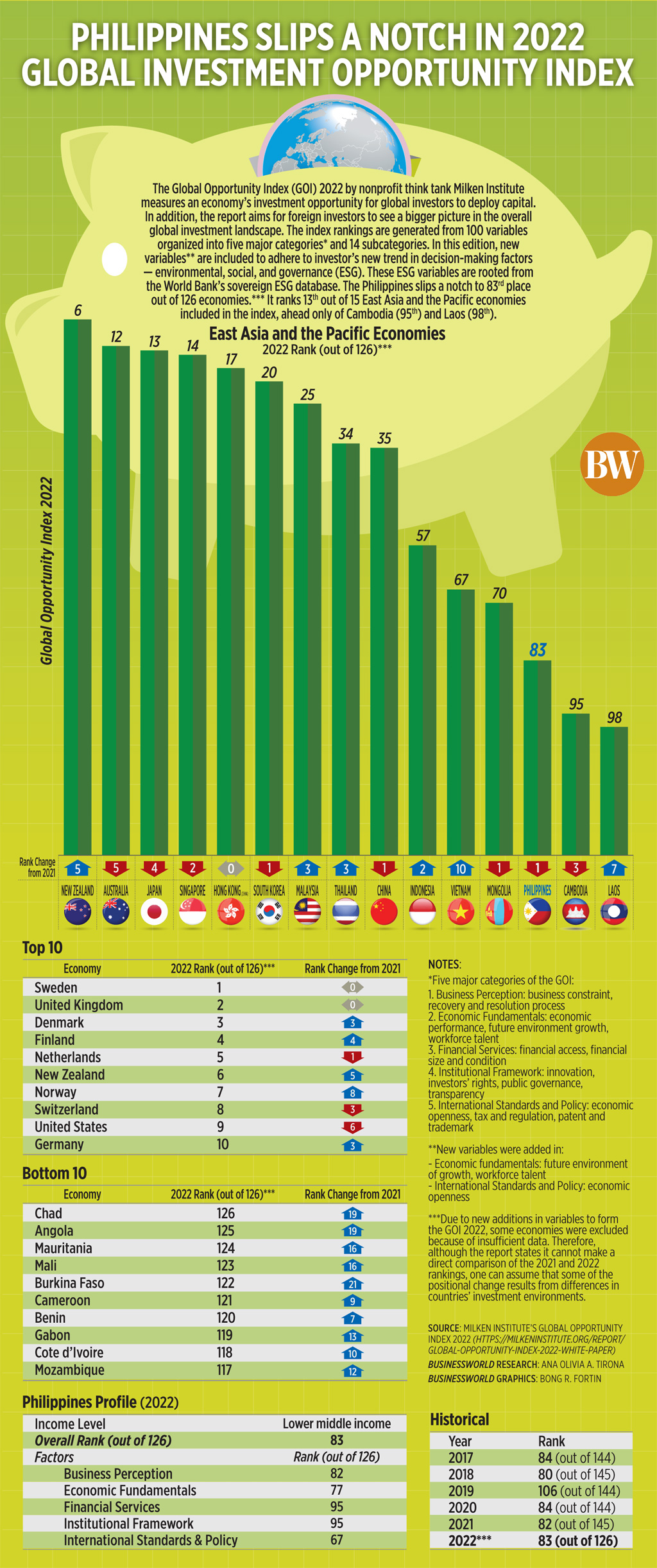
THE PHILIPPINES continues to lag behind other Asian countries in terms of potential in attracting foreign investors, the Milken Institute Global Opportunity Index showed.

Based on the Global Opportunity Index 2022, the Philippines ranked 83rd out of 126 countries, slipping one spot from the 82nd spot out of 145 countries in 2021. Some countries were excluded in the 2022 index due to insufficient data.

Malaysia ranked 25th, taking the top spot in “emerging Southeast Asia.” Thailand followed at 34th spot, while Indonesia and Vietnam ranked 57th and 67th place, respectively.

The Philippines was only ahead of Cambodia and Laos, which ranked 95th and 98th, respectively.

The Milken Institute noted that emerging Southeast Asia’s scores compared favorably with other emerging and developing economies in terms of its strong economic performance, highly qualified workforce, and strong integration with the global economy.

The annual index ranks countries based on business perception, economic fundamentals, financial services, institutional framework, and international standards and policy. For 2022, the Milken Institute included new variables related to environmental, social, and governance (ESG).

In the 2022 index, the Philippines was in 82nd place in terms of business perception, which measures the issues faced by businesses and ease in resolving disputes.

It ranked 77th in economic fundamentals, which refers to a country’s macroeconomic outlook, workforce talent, and potential for future innovation and development; and 95th in financial services.

The Philippines also placed 95th in institutional framework or the extent on which a country’s institutions assist or hamper business activity; and 67th in international standards and policy which gauges the integration of a country within the international community.

“Governments in the region must strengthen their institutional frameworks, deepen regional integration to take advantage of each country’s unique resources and opportunities, and maximize social impact by leveraging global capital flows to advance development,” Claude Lopez, head of the Research Department at the Milken Institute, said in a statement.

Rizal Commercial Banking Corp. Chief Economist Michael L. Ricafort said in an e-mail interview that the Philippines can improve its ranking by allowing the economy to further reopen amid the pandemic.

“(The country’s rankings) can improve with the further reopening of the local economy towards greater normalcy amid accelerated vaccination towards herd immunity by early 2022 as also aided by increased government spending especially on infrastructure that would help improve economic growth and development,” he said.

Mr. Ricafort said improving foreign policy, continuation of legislative and fiscal reforms, anti-corruption measures and ESG standards would help attract more investments in the Philippines.

Calixto V. Chikiamco, Foundation for Economic Freedom president, said in a mobile phone message that the country has made progress in approving economic reforms that would boost foreign investments.

These include the amendments to the Retail Trade Liberalization Act, which was already signed into law and amendments to the Public Service Act (PSA), which would open more sectors to 100% foreign ownership. The PSA measure is now awaiting President Rodrigo R. Duterte’s signature.

“Hopefully, the next administration will build on these investment-friendly laws by continuing the ‘Build, Build, Build’ program, addressing inflation by tackling our food production problems, and building up energy capacity and security,” Mr. Chikiamco said.

Chris Nelson, British Chamber of Commerce Philippines executive director, said in a mobile phone interview that the Philippines’ ranking will improve this year with the recent economic reform measures and participation in the Regional Comprehensive Economic Partnership (RCEP).

“Whenever the next (index) is done, I would anticipate seeing an improvement in the ranking. We remain optimistic that the Senate will ratify RCEP when it returns in May. That is going to increase the Philippines’ opportunity and attractiveness,” Mr. Nelson said.

The Senate recently went on a break for the national elections without giving its concurrence to RCEP’s ratification, delaying the country’s participation in the trade agreement.

RCEP, which took effect on Jan. 1 this year, is touted as the world’s largest trade deal, and involves the 10 members of the Association of Southeast Asian Nations (ASEAN), Australia, China, Japan, South Korea, and New Zealand. — Revin Mikhael D. Ochave

Philippines slips a notch in 2022 global investment opportunity index

BIR, Customs ordered to strengthen cybersecurity

REUTERS/KACPER PEMPEL/FILE PHOTO

FINANCE SECRETARY Carlos G. Dominguez III ordered the government’s main revenue collecting agencies to beef up their cybersecurity measures amid a rise in cyberthreats and attacks.

“Please make sure that your cybersecurity measures are up to date and effective against all sorts of threats,” he told the Bureau of Customs (BoC) and the Bureau of Internal Revenue (BIR) during a recent meeting of the Department of Finance (DoF) Executive Committee.

Mr. Dominguez in a statement also expressed concern over the increase in online financial scams as more Filipinos turned to online transactions during the coronavirus pandemic.

Finance Undersecretary Antonette C. Tionko, who oversees both bureaus, was quoted as saying cybersecurity measures are included in the BIR and BoC’s digitalization programs.

“Please make sure that that’s up to date because apparently, (cyberattacks are) getting more and more prevalent,” Mr. Dominguez said.

Even before the pandemic, Mr. Dominguez instructed the DoF and attached agencies to ramp up digitalization programs. Local government units were also told to digitize tax processes as their share of national taxes increase this year.

The BIR is working on nearly 50 digitalization projects, most of them involving making tax payments easier.

About 94% of tax returns were filed electronically in 2020, from 43% in 2015.

Electronic payments made to the bureau exceeded four million transactions in 2020, more than doubling the 1.91 million in 2015.

Mr. Dominguez’ call for stronger cybersecurity is a response to recent cyberattacks.

The National Bureau of Investigation last month said they caught five people involved in the hacking of more than 700 BDO Unibank, Inc. accounts in December.

The bureau is also investigating the alleged phishing scam that stole funds from the Land Bank of the Philippines accounts of several teachers.

Last week, the Bankers Association of the Philippines and the Department of Justice launched an anti-cybercrime partnership on information sharing and training, as losses from bank fraud during the pandemic hit P1 billion. 

In 2020, Mr. Dominguez also asked DoF bureaus and government financial institutions such as state-run pension fund and insurance agencies to come up with a cost-effective cybersecurity strategy to protect against data breaches. — J.P.Ibañez

NEDA prepares long-term innovation plan

PHILIPPINE STAR/EDD GUMBAN

THE COUNTRY’S long-term innovation plan will be launched within 2022 as the government aims for upper middle-income status, the National Economic and Development Authority (NEDA) said.

“(The) National Innovation Council (NIC) is now developing the National Innovation Agenda and Strategy Document (NIASD) to be launched within the year,” NEDA said in a press release on Monday. “This document will establish the country’s 10-year vision, long-term goals, agenda, and strategies related to innovation.”

The NIC, which held its first meeting on Feb. 4, was set up under a 2019 law designed to support research and enterprises geared towards developing “innovative solutions.”

Socioeconomic Planning Secretary Karl Kendrick T. Chua told the NIC in its first meeting that it should help raise the country’s economic productivity.

“Higher productivity will allow us to graduate from our current low middle-income country status to upper middle-income country status by the end of 2022, and high-income country status in one generation. For the Filipino people, it means living without poverty and having equal opportunities to succeed,” he said.

According to the World Bank, upper middle-income economies are those that have gross national income per capita of $4,096-$12,695.

“A strong economic foundation built on inclusive innovation will be crucial in raising overall productivity and bringing prosperity to the people,” Mr. Chua said. “The Philippine Innovation Act provides us with a window of opportunity to achieve this objective by creating a culture of futures planning and funding innovative solutions.”

Under the implementing rules of the law known as the Philippine Innovation Act or Republic Act No. 11293, the strategy document will align innovation policies and projects across government agencies and local government units. 

The document will also roll out strategies for innovation programs that target the poor, use public-private partnerships, support higher education, and commercialize intellectual property. It will also include innovation priority areas, strategies and sources of funding.

NEDA said the document will be developed through workshops among the council’s member agencies and other stakeholders.

The council, which has 25 members from the public and private sectors, is chaired by the president of the Philippines, while the NEDA head serves as vice-chairperson.

Last year, the Philippines slipped one spot to 51st place out of 132 economies on an annual list that measures innovation performance, after the country’s information technology infrastructure scores fell. The country’s performance in the Global Innovation Index hit its highest rank so far in 2020 after it made the top 50.

Despite the drop, the report said the Philippines is one of several middle-income economies that are “changing the innovation landscape.” The country improved under human capital and research and knowledge and technology output indicators, while business sophistication and creative output rankings slipped.

All government agencies and local government units are required by the Philippine Innovation Act to comply with the strategy document developed by the council. — Jenina P. Ibañez

AyalaLand Logistics buys Batangas industrial asset

AYALALAND Logistics Holdings Corp. (ALLHC), through its subsidiary, bought a ready-built facility and land in Batangas for a total of P1.24 billion, inclusive of value added tax.

ALLHC’s unit Ecozone Power Management, Inc. (EPMI) inked a deed of absolute sale to acquire a 64,000-square meter (sq.m.) ready-built facility from Sheng Long Property Management, Inc. along with the 96,980 sq.m. plot of land the facility was built on from Aibis Land Management, Inc.

“EPMI will assume ownership of the existing ready-built facility and will continue its operation under the ALLHC Group’s warehouse leasing brand, ALogis,” the company told the exchange on Monday.

The facility will be renamed “ALogis Sto. Tomas” as it is located within the Light Industry & Science Park (LISP) III in Sto. Tomas, Batangas. The park may be accessed through the South Luzon Expressway (SLEx) from Manila and the Southern Tagalog Arterial Road (STAR Tollway) from Batangas City.

ALogis Sto. Tomas is the ALLHC group’s first industrial property in Batangas. The company said it has accreditation from the Philippine Economic Zone Authority and currently houses companies in the manufacturing and logistics industries.

“This transaction strengthens ALLHC’s vision to be the leading real estate logistics and industrial parks developer and operator in the Philippines,” ALLHC said.

The company previously said it is targeting to be present in 10 “key areas” across the country. Aside from Batangas, it is present in Manila, Laguna, Cavite, Pampanga, and Laguindingan in Northern Mindanao.

ALogis Sto. Tomas expanded ALLHC’s warehouse gross leasable area (GLA) to 288,000 sq.m. from 224,000 sq.m. The company wants to have a GLA of 500,000 sq.m. by 2025.

ALLHC shares on Monday declined 4.04% or 22 centavos, closing at P5.23 apiece. — Keren Concepcion G. Valmonte

Figaro unit posts record profit as delivery sales rise

FIGARO COFFEE FACEBOOK PAGE

FIGARO Coffee Group, Inc.’s (FCG) wholly owned subsidiary Figaro Coffee Systems, Inc. (FCSI) logged record profit and revenues due to the uptick in pizza delivery sales and the group’s store expansion.

FCG is a food holding company that owns Figaro Coffee, Angel’s Pizza, Tien Ma’s Taiwanese cuisine, The Figaro Group (TFG) Express, and Café Portofino. FCSI operates and/or franchises the brands’ retail restaurants.

In a disclosure to the exchange on Monday, Figaro said FCSI’s unaudited net income before tax surged nearly three times or 274% to P424.6 million in 2021 from P155.1 million the previous year.

Meanwhile, FCSI’s unaudited revenues in 2021 totaled P2.01 billion, climbing 253% from 2020’s P749 million. Its gross margins also improved to 65% in 2021 from 59% previously.

“This was brought about by the surge in the delivery sales of Angel’s Pizza and the net opening of 18 stores for the year 2021,” Figaro said.

The launch of 18 more stores in 2021 brought FCG’s store count to 108 stores, 20% more than the 90 stores it had in 2020. The company said it was “an all-time record of the number of store openings in a single year.”

As of Jan. 21, the group’s store network stood at 109 stores, including 56 Figaro Coffee shops, 39 Angel’s Pizza outlets, seven TFG Express outlets, six Tien Ma’s Taiwanese cuisine restaurants, and one Café Portofino outlet.

Figaro announced on Friday that it was planning to open five more Angel’s Pizza outlets in the first quarter this year. The new stores will be located in Lipa in Batangas, Ortigas Center’s Hanston Building, Cebu City, Calamba in Laguna, and in Bonifacio Global City’s Avida Towers Cityflex.

The company listed on the Philippine Stock Exchange in late January, raising P767 million. It plans to use a portion of its proceeds to open 29 Angel’s Pizza stores, six TFG Express outlets, five Figaro Coffee shops, and one Tien Ma’s Taiwanese cuisine restaurant.

Figaro aims to have 150 system-wide stores by the end of this year and over 300 system-wide stores by the end of 2029.

On Monday, Figaro shares at the stock exchange went up 5.88% or five centavos to close at 90 centavos per share. — Keren Concepcion G. Valmonte

PNOC-EC seeks partners to explore offshore Palawan area

STATE-LED PNOC Exploration Corp. (PNOC-EC) is looking for partners to explore thousands of offshore square kilometers in Northwest Palawan, it said in an invitation posted on its website on Monday.

In the “farm-in” invitation, the company identified the exploration site as covered by Service Contract (SC) 57. The Energy department previously defined a farm-in contract as a “transfer of rights and obligations agreement.”

PNOC-EC said it had been awarded by the department a 100% interest in the service contract, or an agreement in which the government grants exclusive right to explore, develop or utilize the resources in a particular area.

SC 57 covers 7,120 square kilometers in offshore Northwest Palawan, about 50 kilometers northwest of Busuanga.

The company named Executive Order No. 80 series of 2019 and under Department of Energy (DoE) Circular DC2020-02-0006 as the legal basis on the offer. The circular states that all minerals, petroleum, and other mineral oils owned by the state should be under full control and supervision of the state.

BusinessWorld has reached out to the DoE regarding the notice, but has not immediately received a response.

The invitation to farm-in is being offered in two options: as an operator for the 40% participating interest and as a partner for the 30% participating interest both in SC 57. This will leave the government’s exploration company with a 30% stake in the service contract.

Interested parties can submit their Letter of Intent to PNOC-EC until Feb. 17, while the deadline for submission of proposals is on April 12 at 12 noon. PNOC-EC has the right to reject proposals. — Marielle C. Lucenio

AF Payments’ beep partners with four bus lines for QR ticketing

AF PAYMENTS, Inc., the firm behind tap-and-go payment system beep card, announced on Monday that its QR (quick response) code technology is going live in four bus lines covering several areas in the cities of Taguig, Makati, and Las Piñas, as well as the provinces of Cavite, Laguna, and Bulacan.

The bus lines are BGC Bus, TAS Trans, Precious Grace Transport Services, and San Agustin Transport, AF Payments said in an e-mailed statement.

The beep QR is AF Payments’ QR code-based ticket that passengers scan before boarding a bus instead of using a beep card or a regular ticket.

The company has partnered with GCash to allow commuters to generate their own prepaid beep QR ticket “anytime anywhere, thereby eliminating the need to line up to buy tickets in select routes.”

“To do this, simply open your GCash app, tap GLife, and select ‘beep™’ from the list of partners. Select among the four bus operators, then choose your route, as well as starting and destination terminals. Your fare will automatically be computed,” it said.

“After reviewing the details, tap ‘Buy Ticket’ and complete your payment. Click on the Ticket History to view your QR ticket or take a screenshot, which you can scan on the reader at the bus terminal or upon entering the bus,” it added.

According to the company, it aims to enable growth and digital transformation in the transport sector to make progress “more inclusive and beneficial to more people” in the long run.

“We constantly evolve the beep payment solution not only to keep up with technology but, more importantly, to help improve the quality of life of Filipinos. With QR, we are empowering commuters to take back a fraction of their time usually spent lining up,” said Sharon Fong, chief commercial officer of AF Payments.

The company introduced its QR ticketing in 2019. It was initially designed to replace the manual validation of paper tickets. “But now, in this evolving pandemic situation, QR technology offers a safer alternative to help the commuting public observe health protocols,” Ms. Fong said.

“AF Payments, Inc. will continue to actively roll out QR payment in other transportation networks like EDSA buses and modern jeepneys all over the country. We wish to replicate the system across the country through collaborations with businesses,” she added.

AF Payments is a joint venture of Metro Pacific Investments Corp. (MPIC) and Ayala Corp. that develops contactless payment solutions.

Hastings Holdings, Inc., a unit of PLDT Beneficial Trust Fund subsidiary MediaQuest Holdings, Inc., has a majority stake in BusinessWorld through the Philippine Star Group, which it controls. — Arjay L. Balinbin

ADVERTISEMENT
ADVERTISEMENT