Home Blog Page 6783

More women take top UK Plc roles, but there’s room for improvement – report

STOCK PHOTO | Image by DanaTentis from Pixabay

Women now make up nearly 40% of the boards of Britain’s biggest 100 companies, compared with just 12.5% a decade ago, with recommendations in place to enable more female representation in top management, a government-backed report said on Tuesday.

Researchers reviewed women‘s representation in about 24,000 positions in firms on Britain’s blue-chip FTSE 100 .FTSE, mid-cap FTSE 250 .FTMC and FTSE 350 .FTLC indices.

This puts Britain in second place globally, up from fifth in 2020 and just behind France which has a nearly 44% representation, according to the report.

Homebuilder Taylor Wimpey TW.L this month named Jennie Daly as CEO and Britain’s largest pet supplies retailer, Pets At Home PETSP.L, appointed Sky UK executive Lyssa McGowan as its CEO. Read full story

The review also set out four new recommendations, including increasing the minimum board and leadership representation of women in FTSE 350 companies to 40% by the end of 2025.

In July, Britain’s financial regulator also said at least 40% of board members in blue-chip companies should be women. Read full story

The latest report also found that female board representation in 2021 in the FTSE 250 and FTSE 350 grew by roughly 37% and 38% respectively.

British business secretary Kwasi Kwarteng lauded the progress, but said there was still more work to be done, with many companies yet to hit a 33% target set by previous reviews.

“Only one in three leadership roles and around 25% of all Executive Committee roles are held by women and there are very few women in the CEO role,” Kwarteng in a statement.

The report also said that number of women in chair roles across the FTSE 350 rose to 48 in 2021 from 39 a year earlier.

Water utilities Severn Trent SVT.L and Pennon PNN.L, and Holiday Inn owner IHG IHG.L are three of the companies with women in chair roles. – Reuters

Sharon Cuneta to star in The Mango Bride film adaptation

Singer, actress, and television host Sharon Cuneta joins the cast and is also set to produce the film adaptation of Marivi Soliven’s award-winning novel, The Mango Bride, according to a report published in Variety on Feb. 21.

Before being published by Penguin Random House in 2013, the novel’s manuscript won the Grand Prize at the Carlos Palanca Memorial Awards in 2011. The book revolves around two Filipino women — Amparo and Beverly — who migrate to California and see their lives intertwine.

“I wanted to do The Mango Bride because it’s the best way to connect to a global audience by putting some of the best Filipino talents and stories together to tell an emotional and uplifting story like this,” Ms. Cuneta said in a statement.  “I have long been a fan of Marivi Soliven’s writing, from Suddenly Stateside, her collection of light essays about living in the US, to The Mango Bride. She captures the Filipino migrant and Filipino American experience skillfully.”

Filipino-Canadian filmmaker Martin Edralin is directing the film, while Rae Red is adapting the novel into a screenplay.

Justin Deimen and Micah Tadena will produce the film for 108 Media, while executive producers include Anna Liza Recto and Michael Kaleda of Bold MP, Kevin Balhetchet; and Ryo Ebe and Abhi Rastogi of 108 Media.

Following the announcement, Ms. Cuneta wrote on her social media accounts: “Please pray for this project to succeed. My prayer is that it is able to open doors for all of us in the industry — finally!”

Ms. Cuneta’s role in the film has yet to be confirmed.

Production is set to begin in late 2022, a release date has yet to be announced. — MAPS

Filinvest REIT declares dividends

Filinvest REIT Corp. (FILRT) declared its third-quarter cash dividend, bringing its total dividends to 0.336 per share equivalent to an annualized dividend yield of 6.4%. This is higher than the 6.3% dividend yield it projected for 2021 in its REIT Plan and based on its initial public offering (IPO) price of ₱7.00 per share. 

On Feb. 15, 2022, the Board of Directors of FILRT approved the dividend declaration to all stockholders in the amount of 0.112 per outstanding common share. The cash dividends will be payable on March 20, 2022, to stockholders on record as of March 1, 2022. The amount is equivalent to a quarterly yield of 1.6%. FILRT distributed its previous two quarterly cash dividends of 0.112 per outstanding common share per declaration in September and November last year. 

“The declaration of quarterly cash dividends is our continuing commitment to our valued shareholders. It is compliant with the minimum dividend payout as required by the REIT Act and fulfills what we set forth in our REIT Plan,” said FILRT President and Chief Executive Officer Maricel Brion-Lirio.

FILRT’s property portfolio at present consists of 17 Grade A office buildings totaling over 300,000 square meters of gross leasable area (GLA) valued by an independent appraisal company at 48.5 billion. Of these, 16 of the 17 buildings are in Northgate Cyberzone in Filinvest City in Alabang, a PEZA Special Economic Zone, and IT park while another building is located in the gateway of Cebu IT Park in Lahug, Cebu City.

FILRT’s Sponsor, Filinvest Land, Inc. (FLI), is fully committed to growing the REIT portfolio with regular asset infusions. In its three-year investment plan submitted to the PSE and the Securities and Exchange Commission in December 2021, FILRT’s fund management company signified that it will constantly endeavor to expand the portfolio and provide a stable and competitive return to investors, with a focus on dividend yield protection.

To date, a pipeline of possible commercial projects has been identified for potential asset infusion as announced by FLI. There are two office buildings totaling almost 70,000 square meters in gross leasable area (GLA) that may potentially be added within the year. 

Part of FILRT’s investment policy is to invest in properties that have sustainability features to align with FILRT’s differentiation as a “green” or sustainability-themed REIT. Its current portfolio includes two LEED Gold-certified office buildings and 16 buildings are in Northgate Cyberzone in Filinvest City in Alabang, the first central business district in the country and the largest in Southeast Asia to receive Gold Certification from LEED® v4 for Neighborhood Development Plan. The buildings are cooled by the country’s largest district cooling system that reduces carbon emissions and energy consumption, the result of Filinvest’s partnership with Engie, a world leader in developing sustainable technology solutions.

 This press release may contain “forward-looking statements” which are subject to a number of risks and uncertainties that could affect FILRT’s business and results of operations. Any forward-looking statements are made based on current assessments. Although FILRT believes that expectations reflected in any forward-looking statements are reasonable, it can give no guarantee of future performance, action, or events.


Spotlight is BusinessWorld’s sponsored section that allows advertisers to amplify their brand and connect with BusinessWorld’s audience by enabling them to publish their stories directly on the BusinessWorld Web site. For more information, send an email to online@bworldonline.com.

Join us on Viber to get more updates from BusinessWorld: https://bit.ly/3hv6bLA.

Putin orders Russian troops to Ukraine after recognizing breakaway regions

RUSSIAN President Vladimir Putin. — REUTERS

MOSCOW – Russian President Vladimir Putin ordered the deployment of troops to two breakaway regions in eastern Ukraine after recognising them as independent on Monday, accelerating a crisis the West fears could unleash a major war.

A Reuters witness saw unusually large columns of military hardware moving through the breakaway city of Donetsk after Putin told Russia’s defence ministry to send forces into the two regions to “keep the peace” in a decree issued shortly after announcing recognition for Russian-backed separatists there.

The moves drew U.S. and European condemnation and vows of new sanctions although it was not immediately clear whether the Russian military action would be regarded by the West as the start of a fullscale invasion. The area was already controlled by Russian-backed separatists and Moscow in practice.

There was no word on the size of the force Putin was dispatching, but the decree said Russia now had the right to build military bases in the breakaway regions and that the troops’ mission would a peacekeeping operation.

In a lengthy televised address packed with grievances against the West, Putin, looking visibly angry, described Ukraine as an integral part of Russia’s history and said eastern Ukraine was ancient Russian lands and that he was confident the Russian people would support his decision.

Russian state television showed Putin, joined by Russia-backed separatist leaders, signing a decree recognising the independence of the two Ukrainian breakaway regions — the self-proclaimed Donetsk People’s Republic and the Lugansk People’s Republic – along with agreements on cooperation and friendship.

Defying Western warnings against such a move, Putin had announced his decision in phone calls to the leaders of Germany and France earlier, both of whom voiced disappointment, the Kremlin said.

Moscow’s action may well torpedo a last-minute bid for a summit with U.S. President Joe Biden to prevent Russia from invading Ukraine. The rouble extended its losses as Putin spoke, at one point sliding beyond 80 per dollar.

Biden responded by signing an executive order for a halt to all U.S. economic activity in the breakaway regions and a ban on import of all goods from those areas as well as investment there.

White House spokesperson Jen Psaki said the measures being rolled out in response to Putin’s decree were separate from sanctions the United States and its allies have been readying if Russia invades Ukraine.

U.S. Secretary of State Antony Blinken said the executive order “is designed to prevent Russia from profiting off of this blatant violation of international law.”

The U.N. Security Council will meet publicly on Ukraine at 9 p.m. EST Monday (0200 GMT on Tuesday), a Russian diplomat said, following a request by the United States, Britain and France.

Dutch Prime Minister Mark Rutte said European Union countries have agreed to impose a limited set of sanctions “targeting those who are responsible” for Russia’s recognition of the rebel regions, and British Foreign Minister Liz Truss said the government would announce new sanctions on Tuesday.

NATO Secretary-General Jens Stoltenberg accused Russia of “trying to stage a pretext” for a further invasion. Russia annexed Crimea from Ukraine in 2014.

In his address, Putin delved into history as far back as the Ottoman empire and as recent as the tensions over NATO’s eastward expansion. His demands that Ukraine drop its long-term goal of joining the Atlantic military alliance have been repeatedly rebuffed by Kyiv and NATO states.

With his decision to recognise the breakaway regions, Putin brushed off Western warnings.

“I deem it necessary to make a decision that should have been made a long time ago – to immediately recognise the independence and sovereignty of the Donetsk People’s Republic and the Lugansk People’s Republic,” Putin said.

He said earlier that “if Ukraine was to join NATO it would serve as a direct threat to the security of Russia.”

SANCTIONS THREAT

Putin has for years worked to restore Russia’s influence over nations that emerged after the collapse of the Soviet Union, with Ukraine holding an important place in his ambitions.

Russia denies any plan to attack its neighbour, but it has threatened unspecified “military-technical” action unless it receives sweeping security guarantees, including a promise that Ukraine will never join NATO.

But recognition of the separatist-held areas paved the way for Putin to send military forces there, arguing that he was intervening as an ally to protect the separtists against Ukrainian forces.

Putin’s move will narrow the diplomatic options to avoid war, since it is an explicit rejection of a seven-year-old ceasefire mediated by France and Germany, touted as the framework for future negotiations on the wider crisis.

Separately, Moscow said Ukrainian military saboteurs had tried to enter Russian territory in armed vehicles leading to five deaths, an accusation dismissed as “fake news” by Kyiv.

Both developments fit a pattern repeatedly predicted by Western governments, who accuse Russia of preparing to fabricate a pretext to invade by blaming Kyiv for attacks and relying on pleas for help from separatist proxies.

Moscow has said repeatedly it has no such plans.

Biden reaffirmed support for Ukraine’s sovereignty in a call with President Volodymyr Zelenskiy and also spoke to French President Emmanuel Macron and Germany Chancellor Olaf Scholz.

Hours earlier, Macron gave hope of a diplomatic solution, saying Putin and Biden had agreed in principle to meet.

But the Kremlin said there were no specific plans for a summit. The White House said Biden had accepted the meeting “in principle” but only “if an invasion hasn’t happened”.

Washington says Russia has massed a force numbering 169,000-190,000 troops in the region, including the separatists in the breakaway regions, and could invade within days.

European financial markets tumbled at the signs of increased confrontation, after having briefly edged higher on the glimmer of hope that a summit might offer a path out of Europe’s biggest military crisis in decades. The price of oil – Russia’s main export – rose, while Russian shares and the rouble plunged. — Reuters

BSP has room to keep policy rates low

BANGKO SENTRAL NG PILIPINAS GOVERNOR BENJAMIN E. DIOKNO — PHILIPPINE STAR/ GEREMY PINTOLO

BANGKO SENTRAL ng Pilipinas (BSP) Governor Benjamin E. Diokno said there is “room to maneuver” on monetary policy amid manageable inflation and the improving economy.

“We have decided to wait a little bit… I think we still have room to maneuver because the inflation outlook looks good and of course, growth also is picking up and unemployment is going down,” he told Bloomberg Television. 

“We’ll wait until [we see] what happens in the US and the extent to which they will tighten [rates],” he added, referring to the anticipated rate hike by the Federal Reserve starting March.

The Monetary Board kept the key policy rate at a record low of 2% on Thursday, as widely expected, to support economic growth amid uncertainty over the pandemic.

The BSP also raised its inflation forecast for 2022 to 3.7% from 3.2%, though still within its 2-4% target and slower than 4.5% in 2021.

Mr. Diokno said there are signs of improvement in the economy as seen in three consecutive quarters of growth and the lower unemployment rate.

The economy grew by 7.7% in the fourth quarter. This brought annual growth to 5.6%, a reversal from the record 9.6% contraction in 2020.

“Our GDP (gross domestic product) grew in the last three quarters, so we have two more quarters to look at. So, we’re just right where we want to be,” he said.

The BSP chief has said he wanted to see four to six quarters of economic growth before looking into a possible rate hike.

The central bank will hold its next policy review on March 24, a week after the Federal Open Market Committee’s meeting on March 15 to 16.

Mr. Diokno said the BSP would evaluate how the impending rate hike by the US Federal Reserve could affect the Philippine economy. Fed officials have signaled they might start increasing interest rates next month.

“If you look at the inflation rate in the US — [it’s] 7.5%. Our inflation right now is 3%. So, you have to consider that the real interest rate is what matters. And we evaluate how the Fed’s rate will affect our output and, of course, our inflation rate,” Mr. Diokno said.

Although the BSP has not touched rates, Mr. Diokno said they have started unwinding support for the National Government, noting a decline in direct advances and participation in the purchase of government securities.

In December, the BSP approved a P300-billion zero-interest loan to the National Government meant to fund pandemic response, the fifth time it extended direct advances. It was smaller than the P540-billion loan in July.

“Our participation in the government securities market… in 2020, we were holding something like 22% of the total volume. It’s down to 4% last year. And now, in the first two months of the year, [it’s at] 0.25%. So, we’re having our own version of slowing down our assistance to the National Government,” Mr. Diokno said.

Meanwhile, in a report on Friday, Nomura Global Market Research Chief ASEAN (Association of Southeast Asian Nations) Economist Euben Paracuelles and analyst Rangga Cipta said new signals from the BSP point out to eventual policy normalization. 

“While BSP’s forward guidance was changed, we think this was not intended to signal that policy normalization in the form of lift-off in the policy rate is likely soon,” they said.

Nomura expects the BSP to start raising rates by 25 basis points in the fourth quarter, noting how the central bank projected that economic output was likely to return to pre-pandemic levels only by the third quarter.

“We still think the economic recovery is facing some headwinds from a combination of domestic factors (in addition to external risks enumerated by BSP), such as relatively low vaccination rates, weak fiscal support despite the elections, and elevated political uncertainty,” it added.

WEAKER PESO
Meanwhile, Mr. Diokno said the depreciation trend of the peso versus the dollar should not be a concern, citing the country’s “strong macroeconomic fundamentals” reflected by gross international reserves, steady remittance inflows, business process outsourcing receipts, as well as foreign direct investments.

Amid market concern on impending policy tightening by major central banks, the safe-haven dollar has strengthened versus the peso.

The local unit closed 6.2% weaker year on year to P50.999 a dollar on Dec. 31. It closed stronger at P50.95 on Jan. 31, but has been trading weaker within the P51-to-a-dollar level in previous weeks.

“The macroeconomic assumption is P48-53 [until 2024] so we are comfortable. So, should we be concerned with the slight depreciation of the currency? I think not, we should not be concerned because that’s what the market supply and demand dictates,” he said.

Mr. Diokno said they do not target a peso-dollar rate and have been intervening less in the foreign exchange market in recent months compared with the earlier stage of the pandemic when the peso strengthened due to low import demand.

“We were intervening, I must admit, at the time when the peso was moving towards P48 because that’s really not good for our exporters, it’s not good for overseas Filipino workers. But right now, there’s very little intervention, if at all,” he said.

The recent depreciation trend of the peso shows similarities in 2018, when inflation accelerated quickly and the peso weakened amid a policy divergence between the BSP and the Fed, ING Bank N.V. Manila Senior Economist Nicholas Antonio T. Mapa said.

“A quick step breach by inflation induced by elevated energy prices, supply side bottlenecks, a weaker currency and rising domestic demand may force BSP to eventually tighten policy,” he said.

He said the BSP would be faced with either having to go for an emergency rate hike like what happened in 2018 or gradually reverse its accommodative policy to safeguard economic recovery. — Luz Wendy T. Noble


Philippines faces risks from mounting debt — analysts

BW FILE PHOTO

THE PHILIPPINE ECONOMY may face risks from mounting debt amid impending global monetary policy tightening, analysts said.

“If your debt is growing, then you’re vulnerable to rising interest rates, which might happen in the near future, because the US might reverse its current, easy monetary policy stance,” University of the Philippines School of Economics professor Renato E. Reside, Jr. said at an online webinar on Monday.

The US Federal Reserve has signaled it might start raising rates from near zero as early as March.

Outstanding debt last year swelled by P2 trillion or by 20% year on year to P11.73 trillion, based on data from the Bureau of the Treasury.

The country’s debt-to-gross domestic product (GDP) ratio soared to a 16-year high of 60.5% last year as the government borrowed more to finance its pandemic response. This was already beyond the 60% threshold considered manageable by multilateral lenders for developing economies.

Mr. Reside said the depreciation of the peso could also be a fiscal risk considering the country’s external debt. Outstanding foreign borrowings increased by 14.8% year on year to P3.56 trillion last year.

Rene E. Ofreneo, professor emeritus at the UP School of Labor and Industrial Relations, also expressed concern over the rising debt, noting government debt service could reach about P2 trillion a year on a debt-to-GDP ratio of 60%.

“Our debt is so big but it seems like we lack transparency,” he told the same forum in Filipino.

Mr. Ofreneo said the government should adopt a just debt policy that will involve a more thorough audit of borrowings.

The country’s budget deficit had risen by 24.63% to P1.33 trillion in the 11 months to November from a year earlier.

Amid the rising debt, Mr. Reside is hoping policy makers would focus on measures that could help drive growth. He said the next administration should prioritize public investments in the most productive sectors like infrastructure, health and education.

“The more rapid the growth, the more the increase in debt can be contained,” he said.

This year, the government expects the economy to grow by 7-9% following the 5.6% expansion in 2020 and the record 9.6% contraction in 2020.

Meanwhile, Trade Undersecretary Rafaelita Aldaba said the country needs more investments in digital transformation and human resource development to help drive post-pandemic economic growth.

“We want more investments on digital transformation, more research and development along with human resource development to help us in terms of building new and future skills of our workforce. These policies will be important for us to increase our productivity,” she said. — L.W.T. Noble

Business leaders back NCR’s shift to most relaxed alert level

PHILIPPINE STAR/ MICHAEL VARCAS

LOCAL BUSINESS LEADERS said the Philippine capital region should be placed under the most relaxed alert level soon to allow businesses to fully reopen and help in the economy’s recovery from the coronavirus disease 2019 (COVID-19) pandemic. 

Alert Level 1 should be enforced in the National Capital Region (NCR), Philippine Chamber of Commerce and Industry (PCCI) President George T. Barcelon told an online news briefing on Monday, adding that easing restrictions must be supported by increased public transport capacity.

“We are in favor of lowering down the alert level, but cognizant of the fact that the virus is still around. So, what’s important is the mobility side of it — for the commuter,” he said. 

“Once we go down to Alert Level 1, there will be more people working. The retail establishments will be patronized by more people going to the malls. It entails people commuting and that is one factor that the government has to look into to make sure that there is enough public transportation,” he added. 

Malacañang has kept NCR under Alert Level 2 until Feb. 28. More business establishments may increase operating capacities from 50% to 70% depending on whether activities are indoors or outdoors. 

Once the government approves the shift to Alert Level 1, businesses may operate at 100% capacity as long as minimum public health standards are followed.

Henry Lim Bon Liong, Federation of Filipino-Chinese Chambers of Commerce and Industry, Inc. (FFCCCII) president, said the country still needs to be cautious amid efforts to reopen the economy, 

“There is no businessman that will not support Alert Level 1. In fact, I think that without even doing anything, the government would really lift the Alert Level 2 already as early as the end of February. By March, we should see Alert Level 1 already,” he said. 

“We still have to be cautious, but at least not overcautious that it will really affect our economy,” he added. 

The Health department reported 1,427 COVID-19 infections on Monday, bringing the active caseload to 58,657.

Meanwhile, Presidential Adviser for Entrepreneurship Jose Ma. “Joey” A. Concepcion III said the country needs to open all businesses to boost economic recovery. 

“Open up everything. Open up the casinos. Open up every business out there that remains closed. That is very important. We have a lot of catching up to do,” he said. 

“This March, we move down to Alert Level 1. All businesses, hopefully open. Capacities for restaurants move up to 100%. And even for call centers and business process outsourcing, we have to allow more capacity in these because they become more viable and more competitive as we compete in that market,” he added. 

The Philippine economy grew by 5.6% in 2021, a reversal from the 9.6% contraction in 2020. The government is targeting 7-9% gross domestic product growth this year. — Revin Mikhael D. Ochave

SEC plans ‘umbrella fund’ rules

THE Securities and Exchange Commission (SEC) has drafted guidelines that will allow investment companies to be formed as “umbrella funds” which can create sub-funds with segregated assets and liabilities.

In a statement on Monday, the regulator said the move would offer fund managers “greater operational flexibility and cost savings.”

An umbrella fund is a registered, open-end investment firm with two or more sub-funds that have different investment objectives, policies, and strategies. The SEC wants all sub-funds to include the phrase “Umbrella Fund” in their names.

Meanwhile, sub-funds of an umbrella fund should include their classification under their names. Sub-funds should identify if it is an equity fund, bond or fixed-income fund, a balanced fund, money market fund, index fund, feeder fund, fund-of-funds, co-managed fund, or multi-asset/asset allocation fund.

Both new and existing open-end investment companies interested in adopting an umbrella fund structure will be covered by the drafted rules.

To convert into an umbrella fund, existing companies would need to revise their Articles of Incorporation (AOI) and Registration Statement (RS) to conform with the requirements under the proposed guidelines.

An umbrella fund must maintain at least two sub-funds at all times. Firms will be given a six-month period to comply from the approval of the first or from the approval of the termination of a sub-fund that led to its noncompliance.

The draft memorandum also covers rules on the termination of a sub-fund.

“Failure to meet the continuing requirement on the minimum number of sub-funds will constitute a ground for suspension of the secondary license of the umbrella fund,” the SEC said.

“The suspension order may be lifted upon approval of the second sub-fund registration, or upon filing of an application to amend the AOI and RS to convert to a regular investment company,” it added.

The umbrella funds need to be licensed to act as an investment firm to offer securities to the public. The funds may also register the securities of its first sub-fund and have additional securities registered afterward or have them registered all at once.

“In addition, an umbrella fund will not be allowed to establish and offer the securities of a new sub-fund unless the Commission has approved the securities and the relevant Sub-Fund Supplement,” the SEC said.

Umbrella funds will be the issuer or registrant of all the securities issued by their sub-funds. However, it will not be issued under the umbrella funds’ name unless it is in connection with any of its sub-funds.

“A sub-fund will only be allowed to issue a single type of security. The offering of both shares and units in a single sub-fund will be prohibited,” the SEC said.

The SEC’s draft regulations also cover requirements on the offering documents, such as the main prospectus and the sub-fund supplement.

Meanwhile, the draft memorandum also details the segregation of assets and liabilities of sub-funds. The fund manager and an independent entity tapped by the umbrella fund are tasked to ensure that the net asset value of each sub-fund is computed separately.

The fund manager will be required to submit reports on behalf of the umbrella fund as required under the Securities Regulation Code.

Umbrella funds will need to file separate quarterly and annual financial statements for each of their sub-funds to show the clear segregation of assets and liabilities.

“The umbrella fund may also choose to prepare a consolidated report, as long as the assets and liabilities of each sub-fund are clearly segregated and disclosed in the Notes to Financial Statements,” the SEC said. — Keren Concepcion G. Valmonte

SM Prime earns P21.8B, up 21%

SM PRIME Holdings, Inc. posted a 21% increase in consolidated net income last year to P21.8 billion, the property developer reported on Monday, saying it sees “recovery in the horizon” after the challenges in the past two years.

In its disclosure to the exchange, the company also said it generated a P6.2-billion consolidated net income in the fourth quarter, without giving a comparative figure, as revenues grew 20%.

“As we begin to see the result of joint effort by the government and private organizations to manage the pandemic, SM Prime is set to pursue business expansions with broader funding options available locally and internationally,” SM Prime President Jeffrey C. Lim said.

“We will continue to work with the government in helping the nation rebound from the challenges in the past two years,” he added.

Consolidated revenues for the October-to-December period amounted to P25.5 billion from P21.2 billion year on year. The company also recorded a 67% operating income growth to P10.8 billion from P6.5 billion previously.

For 2021, SM Prime’s consolidated operating income grew 11% to P32.4 billion in from P29.1 billion a year earlier.

Its residential business led by SM Development Corp. (SMDC) logged P45.9-billion revenues, while its sales take-up reached P98.9 billion in 2021.

SMDC was able to launch eight projects in 2021. These include high-rise and mid-rise condominium developments and house and lot residential projects.

In Metro Manila, SMDC launched Sands Residences in Manila, Ice Tower in Pasay, Gold Residences in Parañaque, and Twin Residences in Las Piñas. Meanwhile, the company launched Joy Residences in Bulacan, Cheerful Homes 2 in Pampanga, Calm Residences in Laguna, and Glade Residences in Iloilo.

SM Prime’s Philippine mall business benefited from the easing of mobility restrictions beginning November. The company generated P24.1 billion in revenues from its local malls in 2021, inching up 2% from P23.6 billion in 2020.

Rent income from its Philippine malls also grew to P23 billion, 6% more than the P21.8 billion logged in 2020.

SM Prime opened two new malls last year, SM City Daet in Camarines Norte and SM City Grand Central in Caloocan City. The company also launched MOA Square, which currently houses IKEA Philippines.

Overseas, SM Prime China malls logged a net income of 200 million renminbi (RMB), up 154% from last year’s RMB100 million. Its international mall business recorded RMB800 million in 2021, 20% more than the RMB700 million the previous year.

SM Prime’s offices, hotels, and convention centers “remained resilient” in 2021, posting a 4% growth in consolidated revenues to P6.6 billion. Meanwhile, revenues from its commercial properties grew 5% to P5 billion and the hotels and convention centers business segment booked P1.6 billion in revenues.

The company launched Park Inn by Radisson-Bacolod in the fourth quarter.

SM Prime shares on the stock market climbed 4.45% or P1.70 to close at P39.90 each on Monday. — Keren Concepcion G. Valmonte

ACEN switches on 40-MW solar power storage units

AYALA-LED AC Energy Corp. (ACEN) on Monday said it had energized two units of 20-megawatt (MW) battery energy storage system (BESS) in Alaminos, Laguna.

“The pilot 40-MW energy storage will allow the company to evaluate opportunities to store energy more effectively across [its] portfolio, with the aim to provide a sustainable and reliable energy source for the country,” ACEN said in a media release.

The energy storage project was built adjacent to ACEN’s 120-MW Alaminos solar farm to help store unused electricity from the solar project and to provide fast power charging when electricity demand is high.

The facility houses 24 battery containers with 2.5 megawatt-hour (MWh) Saft lithium-ion batteries, enough to power about 20,000 homes and avoid 35.87 metric tons of carbon dioxide emissions per year, the company said.

It also has a sustainability hub, which is surrounded by Ayala Land’s carbon forest that traps carbon and a plastic recycling amenity that turns plastic waste into eco-bricks.

“With the Alaminos Energy Storage project, we can harness renewable energy more effectively amidst its variability while improving the operating capabilities of the grid and ensuring high reliability,” ACEN Chief Development Officer Jose Maria P. Zabaleta said.

ACEN President and CEO Eric T. Francia said the company would invest more in storage as the technology increases the viability and competitiveness of the BESS.

The newly powered BESS, which is said to be the country’s first hybrid solar and energy storage project, will also provide ancillary services to the national grid.

The company said the Alaminos energy storage is vital for the company to achieve two goals by 2050: reaching net-zero greenhouse gas emission and becoming the biggest listed energy platform in Southeast Asia by installing 5,000 MW of renewable energy capacity.

On Monday, ACEN shares slipped 26 centavos or 2.94% to close at P8.59 apiece. — Marielle C. Lucenio

DLI promotes ‘boating lifestyle’ with Bridgeport

DAMOSA LAND, Inc. (DLI) finally launched its master-planned mixed-use project in Davao del Norte, after delays due to the coronavirus disease 2019 (COVID-19) pandemic.

“We were supposed to launch the (Bridgeport) project in 2020, we were all ready with our plans… but obviously COVID happened. Even if we could have launched it perhaps last year and I believe we could have sold it, we wanted to wait for a time where the situation was better,” DLI President Ricardo F. Lagdameo said during its online launch last week.

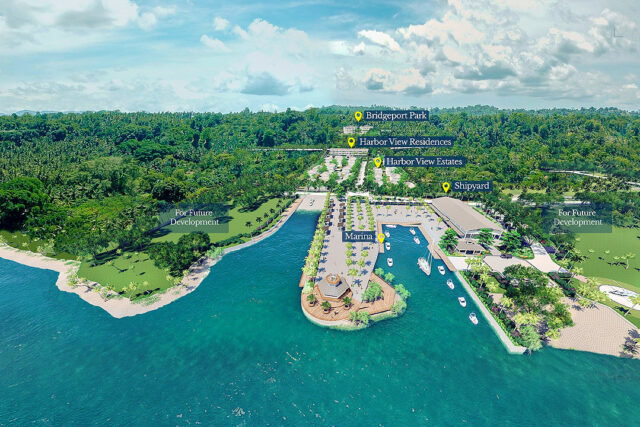
Bridgeport is a 13-hectare marina development located in Caliclic in Samal island, which can be accessed via a powerboat from Davao City. The company said the project was inspired by the US East Coast.

The development will feature four low-density condominium towers called Bridgeport Park, which will only have 274 units.

DLI said land development will start this year up to 2024, while construction of the first building is scheduled from 2024 to 2025. Turnover of the units is slated for the second quarter of 2025.

Bridgeport will also have a gated subdivision, Harbor View Estates, near the beach. DLI only plans to sell 22 lots, with lot sizes ranging from 400 to 600 square meters (sq.m.).

The company said the two residential components may bring in as much as P3 billion in sales.

“We’re positioning it as a second home, a leisure home, and we feel that the demand for these types of products will still be very strong,” Mr. Lagdameo said.

Damosa Land said the highlight of its Bridgeport project is the marina, as it wants to promote the “boating lifestyle.”

“The boating lifestyle is something that has really grown over the last couple of years here in Davao. We wanted to give our homeowners and buyers a place where they can enjoy the marina, they can even park their boats here, they can even go home to their own homes that they will be building,” Mr. Lagdameo said.

Bridgeport will also have a commercial area along the marina as well as a 1,200-sq.m. events hall that can accommodate 500 seats, a lighthouse with a cocktail bar, swimming pools, play areas, clubhouses, a pavilion, and a forest park.

Damosa Land said other projects on track to be completed this year include the Agriya agritourism component Naturetainment, the 63-hectare Anflo Industrial Estate, and its 17-level Damosa Diamond Tower.

Construction will begin this year on the University of the Philippines Professional School of Agriculture and the Environment in Panabo City.

“Our portfolio has extended into several real estate sectors that include township developments, residential, commercial, industrial, and even tourism projects,” Janine P. Salanga, an Anflo-industrial estate team sales and marketing assistant manager at DLI, said.

Damosa Land said it saw a 10% annual increase in residential sales in 2021.

Commercial spaces had an occupancy rate of 94.3% in 2021 from 87.6% the previous year.

Damosa Land’s industrial lot sales grew 221.05% in 2021.

“There was an additional industrial space take-up of 47,440 sq.m. in 2021, compared to the 75,234 sq.m. already sold or leased in 2020, which left 70,675 sq.m. availability for industrial lots and warehouses,” Ms. Salanga said.

By 2022, Damosa Land plans to earmark around P1 billion for capital expenditures (capex).

“A bulk of the capex will be for the township projects that were already started about two years ago,” Mr. Lagdameo said, adding that Damosa Land will also spend its budget on the Bridgeport project and industrial projects.

Mr. Lagdameo said the company still has a landbank “close to about 100 hectares” across the Davao region.

“We believe that for the next couple of years, we’re quite optimal with the landbank that we have that’s roughly about 100 hectares. Nevertheless, when we’re presented with interesting opportunities, we do look into those,” Mr. Lagdameo said. — Keren Concepcion G. Valmonte

RL Commercial REIT books P1.68-billion net income

RL Commercial REIT, Inc. (RCR) said it booked a P1.68-billion net income in 2021, surpassing expectations thanks to the company’s stable “revenue stream and operational efficiency.”

In a disclosure to the exchange on Monday, the company said the 14 buildings in its portfolio achieved high occupancy, allowing it to log P2.09 billion in revenues.

The company said it also made health and safety investments for its buildings, which include adding hybrid metal detectors with thermal scanners and infrared activated alcohol and soap dispensers.

RCR said its board of directors also approved a better-than-expected dividend yield for the year at P0.092 per outstanding common share, bringing its total declared dividends to P0.154 apiece.

The company said this brings the company’s annualized yield to 5.73%, higher than the projected 5.57% stated in its real estate investment trust (REIT) plan.

“The higher than projected dividend yield is a testament to the strength and quality of the assets of RCR,” RCR President and Chief Executive Officer Jericho P. Go said.

“The company shall continuously look into infusing assets that will support its investment criteria and contribute to the growth of RCR. RCR’s potential expansions are geared towards boosting its dividend yield,” he added.

According to RCR’s three-year investment plan filed in December, the company has an expansion pipeline that can be accessed through its sponsor firm Robinsons Land Corp. (RLC). RLC allows RCR to have “access to about 422,000 square meters (sq.m.) of gross leasable area (GLA) for acquisition.”

The company may also acquire properties from unrelated third parties.

RCR and RLC have inked a memorandum of understanding as of July 13 last year for the potential future acquisition of RLC’s Cyberscape Gamma and/or Robinsons Cybergate Center 1, which are subject to “final terms as may be agreed between the parties” and market conditions, among others. The two assets are said to have a 72,100-sq.m. GLA altogether.

With its current portfolio, RCR has an aggregate gross leasable area of 425,315 sq.m. The company said it holds the record of having a wide geographical reach across nine cities and the longest land lease tenure of up to 99 years.

RCR shares on Monday closed 4.75% or 36 centavos higher to finish at P7.94 apiece. — Keren Concepcion G. Valmonte